Public Health Update
  • Home
  • Public Health Update
  • Nepal Health Jobs
    • Public Health Job Board
    • Organization List
  • Opportunities
    • Fellowships, Studentship & Scholarships
    • Grants and Funding Opportunities
    • Fully funded
    • Conference
  • Downloads
    • International Plan, Policy & Guidelines
    • National Plan, Policy & Guidelines
    • Reports
    • Public Health Notes
    • Syllabus
    • Form Formats
  • School of Public Health
    • PhD
    • Master’s Degree
    • Online Courses
  • Notice
  • Home
  • Public Health Update
  • Nepal Health Jobs
    • Public Health Job Board
    • Organization List
  • Opportunities
    • Fellowships, Studentship & Scholarships
    • Grants and Funding Opportunities
    • Fully funded
    • Conference
  • Downloads
    • International Plan, Policy & Guidelines
    • National Plan, Policy & Guidelines
    • Reports
    • Public Health Notes
    • Syllabus
    • Form Formats
  • School of Public Health
    • PhD
    • Master’s Degree
    • Online Courses
  • Notice
LOGIN / REGISTER
Public Health Update
SUBSCRIBE
Public Health Update
  • Home
  • Public Health Update
  • Nepal Health Jobs
    • Public Health Job Board
    • Organization List
  • Opportunities
    • Fellowships, Studentship & Scholarships
    • Grants and Funding Opportunities
    • Fully funded
    • Conference
  • Downloads
    • International Plan, Policy & Guidelines
    • National Plan, Policy & Guidelines
    • Reports
    • Public Health Notes
    • Syllabus
    • Form Formats
  • School of Public Health
    • PhD
    • Master’s Degree
    • Online Courses
  • Notice

All Right Reserved. Designed and Developed by PenciDesign

DoHS Annual Health Report 2079/80
ReportsResearch & Publication

DoHS Annual Health Report 2079/80

by Public Health Update February 27, 2024
written by Public Health Update

Overview

This Annual Health Report (AHR) is for fiscal year (FY) 2079/80. It serves as a comprehensive document within the health sector, fulfilling the dual purpose of monitoring progress of annual programs and providing a detailed documentation of various facets including the health scenario, guiding documents/milestones, major activities of the fiscal year (FY), program/service status and strategic analysis of the strength, weakness, opportunity, and threat for the programs and service delivery.

The annually compiled comprehensive health sector report stands as a pivotal document, serving as a thorough monitoring and evaluation tool for the progress of planned programs, analysing shifts in coverage and utilization statistics. This indispensable record not only offers a snapshot of the sector’s advancements but also traces its evolution over time. This marks the 29th consecutive publication of its kind and the 7th Annual Report since the reorganization of MoHP.

Rationale

The report serves a dual purpose, functioning as  both an annual program monitoring report and a  comprehensive document covering various aspects,  including:

  • Health Scenario: An overview of the prevailing  health issues at the federal and provincial level.
  • The local level details are included in the respective provincial level annual reports,  needful information at programmatic level  for local levels have also been included as  per need felt by the respective programs
  • Guiding documents and milestones: Salient features  of the key guiding documents and milestones  relevant to health programs.
  • Major activities in FY 2079/80: A comprehensive  account of the significant activities carried out in health sector and related programs/services during  the fiscal year
  • Status of program/service indicators: Monitoring  of the status of the pertinent program/services  providing insights into achievements and areas  that require attention
  • SWOT Analysis: A strategic analysis covering the  strength, weakness, opportunity, and threat (SWOT)  pertaining to the programs and services.
  • The timely release of the annual report assumes crucial importance, as it establishes a vital link between service delivery and evidence-informed decision-making  and planning for future programs. This dynamic and  insightful report not only reflects the health sector’s  current standing but also guides future initiatives  towards more effective and impactful healthcare  strategies and action.

DOWNLOAD PDF FILE

DOWNLOAD PDF FILE

Related documents

  • Department Health Services (DoHS) Annual Report 2078/79 (2021/22)
  • Nepal Health Sector Strategic Plan 2023-2030
  • Annual Report of the Department of Health Services (DoHS) 2077/78
  • Glimpse of Annual Report Department of Health Services 2073/74 (2016/17)
  • Annual report of the Department of Health Services (DoHS) 2073/74 (2016/2017)
  • Annual Report Department of Health Services 2072/73 (2015/2016)
  • Annual Report of the Department of Health Services (DoHS) – 2071/72 (2014/2015)
  • Annual Report of DOHS 2070/71 (2013/2014)
  • Annual Report of DoHS 2069/2070 (2012-2013)
  • National Annual Review, MoHP – 2017/18 (Presentation Slides)
  • Health Sector Progress Report 2018, Ministry of Health & Population
  • Glimpse of Annual Report Department of Health Services 2073/74 (2016/17)
  • Key Findings (Nepali & English) – The 2016 Nepal Demographic and Health Survey (2016 NDHS)
  • Nepal Health Sector Strategy(NHSS) Implementation Plan 2016-21
February 27, 2024 0 comments
0 FacebookTwitterPinterestLinkedinTumblrVKOdnoklassnikiRedditStumbleuponWhatsappTelegramLINEPocketSkypeViberEmail
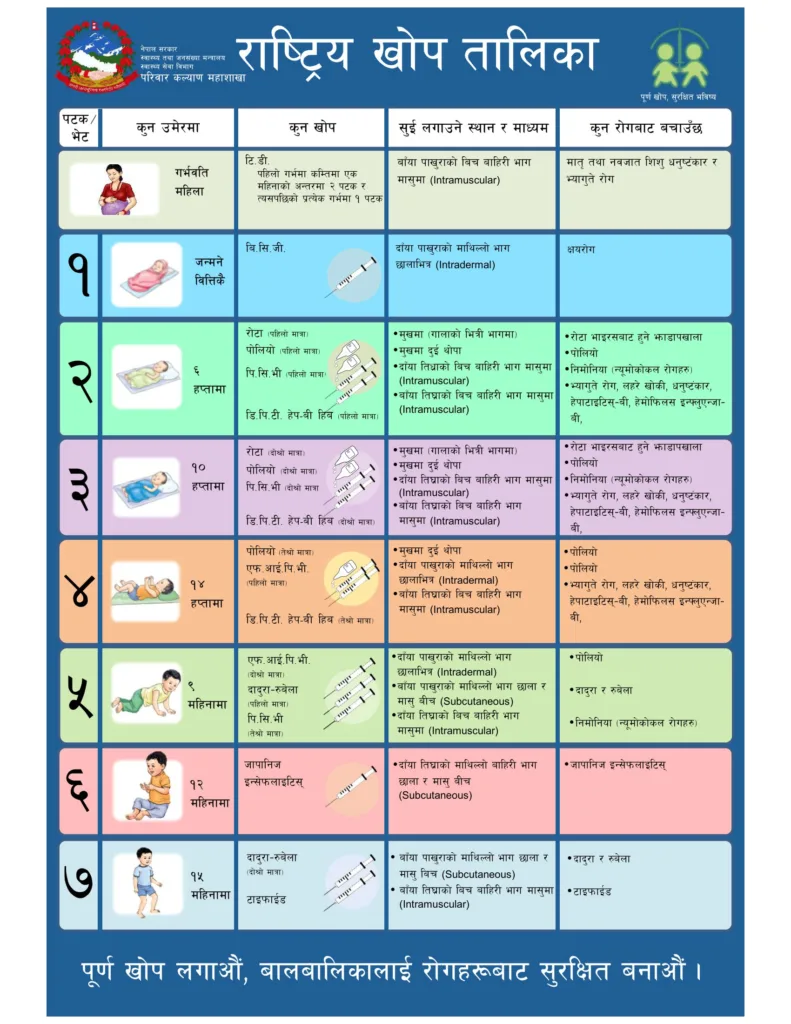
National Immunization Schedule Nepal
National Plan, Policy & GuidelinesPublic HealthPublic Health Programs

National Immunization Schedule, Nepal (Updated)

by Public Health Update February 3, 2024
written by Public Health Update

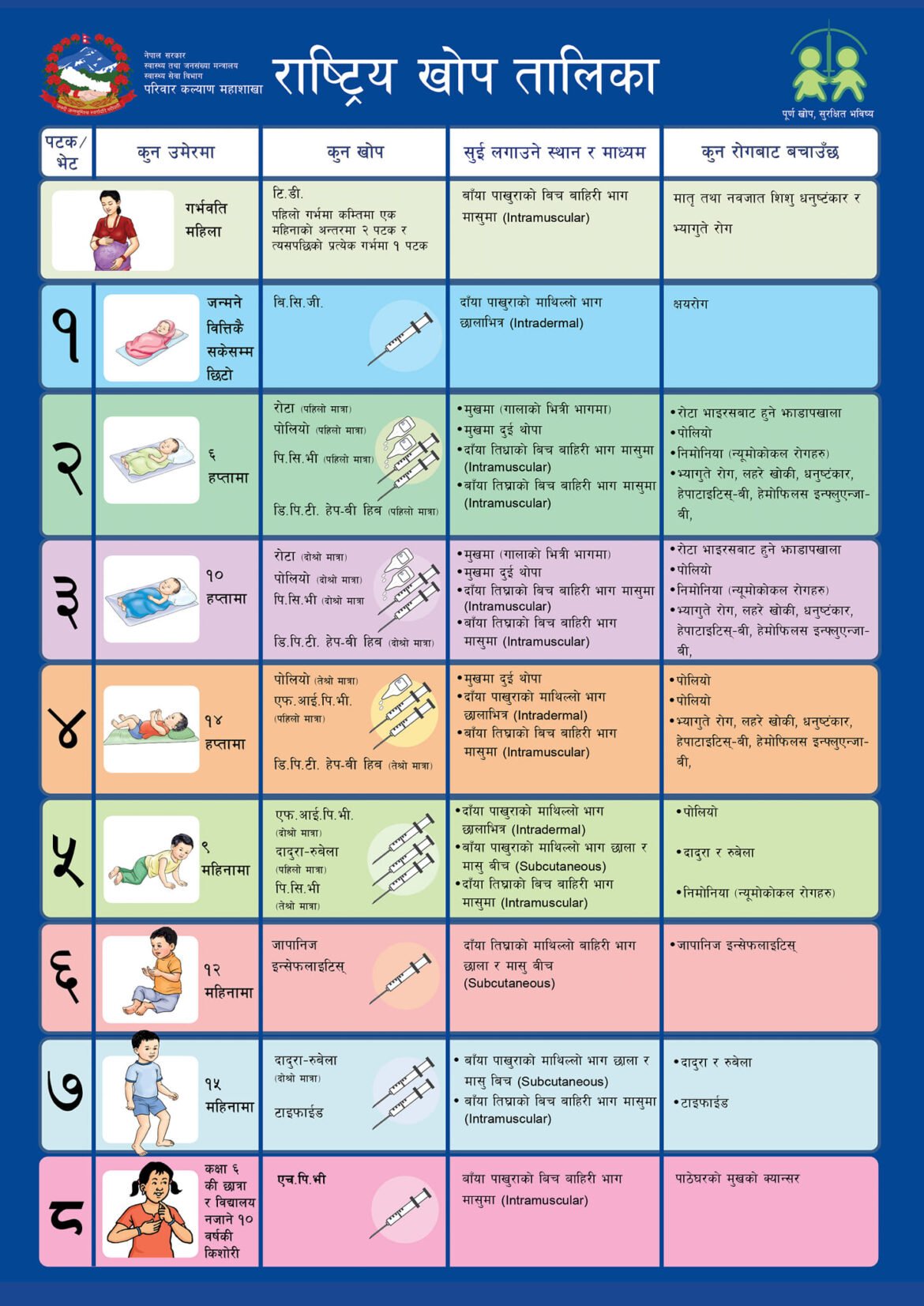
The National Immunization Programme (NIP) is a Priority 1 (P1) public health program of the Government of Nepal, which was launched as the Expanded Programme on Immunization in 2034 BS (1977/78). Here is the latest updated National Immunization Schedule of Nepal.


National Immunization Schedule Nepal


S. No.

Vaccine

Age

Route

Diseases

0Tetanus diphtheria (Td)Pregnant Mother:
For the first pregnancy: 2 doses (1-month gap)
For the second pregnancy and onwards: 1 dose
IntramuscularMaternal and Neonatal Tetanus & Diphtheria

1.

BCG (Bacillus Calmette Guerin)

At birth (1 dose)

Intradermal

Tuberculosis

2.

Pentavalent Vaccine (Diphtheria, Pertussis, Tetanus, Hepatitis B and Hemophilus influenza B)

6, 10 and 14 weeks (3 doses)

Intramuscular

Diphtheria, pertussis, Tetanus, Hepatitis B and Haemophilus Influenza B

3.

OPV (Oral Polio Vaccine)

6 and 10 and 14 weeks (3 doses)

Oral

Polio

4.

PCV (Pneumococcal Conjugate Vaccine)6, 10 weeks and 9 months (3 doses)

Intramuscular

Pneumococcal diseases (Meninges, ear and chest infections)

5.

Rotavirus vaccine

6 & 10 weeks (2 doses)

Oral

Rotavirus diarrhea

5.

fIPV (Fractional Injectable polio vaccine)14 weeks and 9 months (2 doses)Intradermal

Polio

6.

MR (Measles – Rubella)

9 and 15 months (2 doses)

Subcutaneous

Measles and Rubella

7.

JE (Japanese Encephalitis)

12 months (1 dose)

Subcutaneous

Japanese Encephalitis

8Typhoid Vaccine15 months (1 dose)IntramuscularTyphoid fever
9HPVAdolescent girls in grades 6-10 and out-of-school girls aged 10IntramuscularCervical cancer

Immunization Schedule
Latest updated National Immunization schedule of Nepal (2024)

Rotavirus Vaccine (Information for Parents and Public)

Rotavirus Vaccine Guideline 2075, CHD, Department of Health Services


Important Links


  • 27th March 2014 : Historical Day in field of Public Health to end Polio in Nepal
  • National Immunization Schedule 
  • Key Strategies for polio eradication 
  • Nepal Demographic and Health Survey 2016 Key Indicators Report (Short Notes)
  • Nepal Demographic and Health Survey 2016 Key Indicators Report
  • World Immunization Week 2017 #VaccinesWork
  • Sub-National Immunization Day- 2015
  • Nepal Multiple Indicator Cluster Survey (NMICS) 2014 Key Findings Report
  • World Polio Day 24 October 2017- Promoting health through the life-course


Do you have a website? Looking for the best hosting provider? Here’s a discount code.

Latest Public Health Jobs

Latest Posts

  • World Water Day 2026 | Water & Gender Equality
  • Nepal Antimicrobial Resistance (AMR) Bulletin FY 2081/82
  • Call for applications! Short Course on Qualitative Research Methods in Public Health, 2026
  • World Obesity Day 2026 | 8 Billion Reasons to Act on Obesity
  • Salim Yusuf Emerging Leaders Programme 2026

Thanks for visiting us.
Disclaimer: The resources, documents, guidelines, and information on this blog have been collected from various sources and are intended for informational purposes only. Information published on or through this website and affiliated social media channels does not represent the intention, plan, or strategies of an organization that the initiator is associated with in a professional or personal capacity, unless explicitly indicated.
If you have any complaints, information, or suggestions about the content published on Public Health Update, please feel free to contact us at blog.publichealthupdate@gmail.com.
#StayUpdated


  • WordPress
  • Link
  • Facebook
  • Mail
  • Facebook
  • Twitter
  • Twitter
  • LinkedIn
  • Instagram
  • Facebook


Do you have a website? Looking for the best hosting provider? Here’s a discount code.

Latest Public Health Jobs

Latest Posts

  • World Water Day 2026 | Water & Gender Equality
  • Nepal Antimicrobial Resistance (AMR) Bulletin FY 2081/82
  • Call for applications! Short Course on Qualitative Research Methods in Public Health, 2026
  • World Obesity Day 2026 | 8 Billion Reasons to Act on Obesity
  • Salim Yusuf Emerging Leaders Programme 2026

Thanks for visiting us.
Disclaimer: The resources, documents, guidelines, and information on this blog have been collected from various sources and are intended for informational purposes only. Information published on or through this website and affiliated social media channels does not represent the intention, plan, or strategies of an organization that the initiator is associated with in a professional or personal capacity, unless explicitly indicated.
If you have any complaints, information, or suggestions about the content published on Public Health Update, please feel free to contact us at blog.publichealthupdate@gmail.com.
#StayUpdated


  • WordPress
  • Link
  • Facebook
  • Mail
  • Facebook
  • Twitter
  • Twitter
  • LinkedIn
  • Instagram
  • Facebook
February 3, 2024 3 comments
0 FacebookTwitterPinterestLinkedinTumblrVKOdnoklassnikiRedditStumbleuponWhatsappTelegramLINEPocketSkypeViberEmail
MR Vaccination Campaign Guideline 2080-81
National Plan, Policy & GuidelinesPublic HealthPublic Health UpdateResearch & PublicationVaccine Preventable Diseases

MR Vaccination Campaign Guideline 2080-81

by Public Health Update February 3, 2024
written by Public Health Update

Overview

The Government of Nepal, Ministry of Health and Population, has decided to conduct a nationwide Measles-Rubella (MR) Vaccination Campaign from 25 February to 20 March 2024. The guideline on ‘MR Vaccination Campaign 2080-81’ is formulated to provide comprehensive guidance for vaccination efforts, with a particular focus on health workers stationed at vaccination centers, ensuring the efficient execution of vaccination sessions.

This guide offers technical guidance to managers, supervisors, and health workers at different levels, including cold chain officers and assistants, to plan, manage, and conduct the Measles-Rubella Vaccination Campaign for the fiscal year 2080-81.

Guideline and presentation slides

  • Presentation Slides for Palika level and Ward Level Orientation of MR Campaign 2080.81
  • Microplanning (PPT)
  • MR Vaccine and RI Strengthening, vaccine integration (PPT)
  • NIP, MR Elimination (PPT)
  • MR campaign overview and strategy (PPT)
  • MR Vaccination Campaign Guideline 2080-81

Download guideline

Download guideline (MR Vaccination Campaign Guideline 2080-81)

FWD, DoHS

Schedule for Missed Opportunity Vaccination in Nepal

Related readings

  • National Immunization Schedule, Nepal (Updated)
  • Microplanning for immunization service delivery using the Reaching Every District (RED) strategy
  • Guideline for Typhoid Vaccination Campaign 2022
  • World Immunization Week 2023: The Big Catch-Up
  • Revised Schedule of Fractional doses of the IPV
  • 2023 COVID-19 Recovery for Routine Immunization Programs
  • The National Immunization Programme
  • Schedule for Missed Opportunity Vaccination in Nepal
  • World Immunization Week 2021 – Vaccines bring us closer
  • World Immunization Week 2020 #VaccinesWork for All
  • World Immunization Week 2016: Close the immunization gap
  • World Immunization Week 24-30 April 2015
  • World Immunization Week 2017 #VaccinesWork
  • World Immunization Week- Protected Together: #VaccinesWork!
  • World Immunization Week 2022: Long Life for All
  • World Immunization Week 2018 “Protected Together, #VaccinesWork”
  • ”World Immunization Week, 22–27 April 2013”
  • Immunization Agenda 2030: A global strategy to leave no one behind
  • Sub-National Immunization Day- 2015
  • National Immunization Schedule Archives | Public Health Update
  • Immunization Archives | Public Health Update
  • World Immunization Week Archives | Public Health Update
  • National Immunization Programme Measles Rubella Campaign

  • World Water Day 2026 | Water & Gender Equality
  • Nepal Antimicrobial Resistance (AMR) Bulletin FY 2081/82
  • Call for applications! Short Course on Qualitative Research Methods in Public Health, 2026
  • World Obesity Day 2026 | 8 Billion Reasons to Act on Obesity
  • Salim Yusuf Emerging Leaders Programme 2026

February 3, 2024 0 comments
0 FacebookTwitterPinterestLinkedinTumblrVKOdnoklassnikiRedditStumbleuponWhatsappTelegramLINEPocketSkypeViberEmail
Call for Proposals: Website Redesign and Tools Integration
Call for Proposal, EOI & RFPPublic Health Update

Call for Proposals: Website Redesign and Tool Integration

by Public Health Update January 1, 2024
written by Public Health Update

Public Health Update (commonly known as Sagun’s Blog) is a popular public health portal in Nepal. Established in 2011, this blog is a pioneering platform dedicated to knowledge management; sharing national plans, policies, guidelines, and public health jobs in Nepal.

Because of our continuous dedication, thousands of health professionals are connected with us to get up-to-date public health updates, search for jobs, and explore opportunities. We have completed 12 years of service with single-handed management, and now we decided to develop an advanced version of the current website, making it more comprehensive and user-friendly by adding additional services and dashboards as per the demand of the public health market. We envision creating a comprehensive, user-friendly website to compile facts, disseminate information, and share evidence, updates, and job opportunities in Nepal.

For this, we are inviting qualified and experienced web development firms or consultants to submit proposals for the redesign of our existing website and the creation of a user-friendly portal. The objective is to enhance the website, streamline the user experience, and provide a robust platform for public health updates, job seekers, and employers.

Scope of Work

  1. Website Redesign:
    • Conducting a comprehensive audit of our current website to identify strengths, weaknesses, and areas for improvement.
    • Developing a modern and visually appealing design, dashboard for health facts and data, health indicator monitoring dashboard.
    • Improving website navigation and ensuring a responsive design for seamless access across various devices.
    • Integrating relevant multimedia elements to enhance user engagement.
    • Implementing best practices for SEO to improve visibility.
  2. Job Site Development:
    • Creating a dedicated job portal within main site (publichealthupdate.com) with user-friendly features for both job seekers and employers.
    • Implementing a robust search and filter functionality for job listings.
    • Incorporating user profiles, registration, resume builder, and job application tracking for job seekers.
    • Providing employers with easy-to-use tools for posting jobs, invoice generation, payment gatway integration, managing applications, and reviewing candidate profiles.
    • Organization profile and factsheet generator
    • Ensuring security measures to protect user data and maintain confidentiality.
  3. Other: Hosting plans, backups plan, safeguard, SSL certificate, server services, security measures, newsletter and subscription management.

Proposal Submission:

Interested individuals and firms are invited to submit the following to blog.publichealthupdate@gmail.com

  1. A detailed proposal outlining the approach to website redesign and job site development.
  2. Current website assessment and recommended CMS, hosting plan and user data security plan.
  3. Relevant experience and reference websites from previous clients.
  4. A comprehensive cost estimate, including all associated expenses.

For more info; feel free to write: blog.publichealthupdate@gmail.com +977 9856036932

January 1, 2024 0 comments
0 FacebookTwitterPinterestLinkedinTumblrVKOdnoklassnikiRedditStumbleuponWhatsappTelegramLINEPocketSkypeViberEmail
WHO Model Lists of Essential Medicines(EML) 2023
Drug and MedicinePublic Health NewsPublic Health Update

WHO Model Lists of Essential Medicines(EML) 2023

by Public Health Update July 26, 2023
written by Public Health Update

WHO Model Lists of Essential Medicines

The WHO Model Lists of Essential Medicines are updated every two years by the Expert Committee on Selection and Use of Essential Medicines. The first Essential Medicines List was published in 1977, and the first Essential Medicines List for Children was published in 2007. The current versions, updated in July 2023, are the 23rd Essential Medicines List (EML) and the 9th Essential Medicines List for Children (EMLc).

List of Essential Medicines for Basic Health Services in Nepal

Essential medicines are those that satisfy the priority health care needs of a population. They are selected with due regard to disease prevalence and public health relevance, evidence of efficacy and safety and comparative cost-effectiveness. They are intended to be available in functioning health systems at all times, in appropriate dosage forms, of assured quality and at prices individuals and health systems can afford.

Selection of a limited number of essential medicines as essential, taking into consideration national disease burden and clinical need can lead to improved access through streamlined procurement and distribution of quality-assured medicines, support more rational or appropriate prescribing and use and lower costs for both health care systems and for patients (WHO).

DOWNLOAD UPDATED (WHO Model List of Essential Medicines – 23rd list, 2023)

Model List of Essential Medicines (WHO Electronic EML)
The eEML is a comprehensive, freely accessible, online database containing information on essential medicines.

Lists of Essential Medicines

  • BCG vaccine
  • Japanese encephalitis vaccine
  • Abacavir
  • Abacavir + lamivudine
  • Abacavir + lamivudine + lopinavir + ritonavir
  • Abiraterone
  • Acetazolamide
  • Acetic acid
  • Acetylcysteine
  • Acetylsalicylic acid
  • Aciclovir
  • Aclidinium
  • Activated charcoal
  • Adalimumab
  • Afatinib
  • Albendazole
  • Alcohol based hand rub
  • Alcuronium
  • All-trans retinoic acid
  • Allopurinol
  • Alteplase
  • Amidotrizoate
  • Amikacin
  • Amiloride
  • Amiodarone
  • Amitriptyline
  • Amlodipine
  • Amodiaquine
  • Amodiaquine + sulfadoxine + pyrimethamine
  • Amoxicillin
  • Amoxicillin + clavulanic acid
  • Amphotericin B
  • Ampicillin
  • Anakinra
  • Anastrozole
  • Anidulafungin
  • Anti-d immunoglobulin
  • Anti-rabies immunoglobulin
  • Anti-rabies virus monoclonal antibodies
  • Anti-tetanus immunoglobulin
  • Antirabies hyperimmune serum
  • Antivenom immunoglobulin
  • Antivenom sera
  • Apixaban
  • Aprepitant
  • Arsenic trioxide
  • Artemether
  • Artemether + lumefantrine
  • Artesunate
  • Artesunate + amodiaquine
  • Artesunate + mefloquine
  • Artesunate + pyronaridine tetraphosphate
  • Ascorbic acid
  • Asparaginase
  • Atazanavir
  • Atazanavir + ritonavir
  • Atenolol
  • Atezolizumab
  • Atorvastatin
  • Atracurium
  • Atropine
  • Azacitidine
  • Azathioprine
  • Azithromycin
  • Aztreonam
  • Barium sulfate
  • Beclometasone
  • Beclometasone + formoterol
  • Bedaquiline
  • Bendamustine
  • Benzathine benzylpenicillin
  • Benznidazole
  • Benzoic acid + salicylic acid
  • Benzoyl peroxide
  • Benzyl benzoate
  • Benzylpenicillin
  • Betamethasone
  • Bevacizumab
  • Bicalutamide
  • Binimetinib
  • Biperiden
  • Bisacodyl
  • Bisoprolol
  • Bleomycin
  • Bortezomib
  • Bromocriptine
  • Budesonide
  • Budesonide + formoterol
  • Budesonide + salmeterol
  • Bupivacaine
  • Buprenorphine
  • Bupropion
  • C1 esterase inhibitor
  • Cabergoline
  • Caffeine citrate
  • Calamine
  • Calcipotriol
  • Calcitriol
  • Calcium
  • Calcium folinate (leucovorin calcium)
  • Calcium gluconate
  • Canagliflozin
  • Capecitabine
  • Capreomycin
  • Captopril
  • Carbachol
  • Carbamazepine
  • Carbetocin
  • Carbimazole
  • Carboplatin
  • Carvedilol
  • Caspofungin
  • Cefalexin
  • Cefazolin
  • Cefepime
  • Cefiderocol
  • Cefixime
  • Cefotaxime
  • Ceftaroline
  • Ceftazidime
  • Ceftazidime + avibactam
  • Ceftolozane + tazobactam
  • Ceftriaxone
  • Cefuroxime
  • Cetirizine
  • Chlorambucil
  • Chloramphenicol
  • Chlorhexidine
  • Chlorine base compound
  • Chloroquine
  • Chlorothiazide
  • Chloroxylenol
  • Chlorpromazine
  • Chlortalidone
  • Chlortetracycline
  • Cholera vaccine
  • Ciclesonide
  • Ciclosporin
  • Cimetidine
  • Ciprofloxacin
  • Cisplatin
  • Clarithromycin
  • Clindamycin
  • Clofazimine
  • Clomifene
  • Clomipramine
  • Clonazepam
  • Clopidogrel
  • Clotrimazole
  • Cloxacillin
  • Clozapine
  • Coagulation factor IX
  • Coagulation factor VIII
  • Coal tar
  • Cobicistat + elvitegravir + emtricitabine + tenofovir disoproxil fumarate
  • Cobicistat + elvitegravir + emtricitabine+ tenofovir alafenamide
  • Cobimetinib
  • Codeine
  • Colchicine
  • Colecalciferol
  • Colistin (injection)
  • Compound sodium lactate solution
  • Condoms
  • Copper-containing intrauterine device
  • Crizotinib
  • Cyanocobalamin
  • Cyclizine
  • Cyclopentolate
  • Cyclophosphamide
  • Cycloserine
  • Cytarabine
  • Dabigatran
  • Dabrafenib
  • Dacarbazine
  • Daclatasvir
  • Daclatasvir + sofosbuvir
  • Dactinomycin
  • Dalteparin
  • Dapagliflozin
  • Dapsone
  • Daptomycin
  • Daratumumab
  • Darbepoetin alfa
  • Darunavir
  • Dasabuvir
  • Dasatinib
  • Daunorubicin
  • Deferoxamine
  • Delafloxacin
  • Delamanid
  • Dengue vaccine
  • Desmopressin
  • Dexamethasone
  • Dextran 40
  • Dextran 70
  • Diaphragms
  • Diazepam
  • Diazoxide
  • Didanosine
  • Diethylcarbamazine
  • Digitoxin
  • Digoxin
  • Dihydroartemisinin + piperaquine phosphate
  • Dihydroergocryptine mesylate
  • Diloxanide
  • Dimercaprol
  • Diphtheria antitoxin
  • Diphtheria vaccine
  • Diphtheria-pertussis-tetanus vaccine
  • Diphtheria-tetanus vaccine
  • Docetaxel
  • Docusate sodium
  • Dolasetron
  • Dolutegravir
  • Dolutegravir + lamivudine + tenofovir
  • Dopamine
  • Doxorubicin
  • Doxycycline
  • Durvalumab
  • Edoxaban
  • Efavirenz
  • Efavirenz + emtricitabine + tenofovir
  • Efavirenz + lamivudine + tenofovir
  • Eflornithine
  • Elbasvir + grazoprevir
  • Empagliflozin
  • Emtricitabine
  • Emtricitabine + rilpivirine + tenofovir alafenamide
  • Emtricitabine + rilpivirine + tenofovir disoproxil fumarate
  • Emtricitabine + tenofovir
  • Emtricitabine + tenofovir alafenamide
  • Enalapril
  • Encorafenib
  • Enoxaparin
  • Entecavir
  • Enzalutamide
  • Ephedrine
  • Epinephrine
  • Epoetin alfa
  • Epoetin beta
  • Epoetin theta
  • Equine rabies immunoglobulin
  • Eravacycline
  • Ergocalciferol
  • Ergometrine
  • Erlotinib
  • Erythromycin
  • Erythropoiesis-stimulating agents
  • Estradiol cypionate + medroxyprogesterone acetate
  • Ethambutol
  • Ethambutol + isoniazid
  • Ethambutol + isoniazid + pyrazinamide + rifampicin
  • Ethambutol + isoniazid + rifampicin
  • Ethanol
  • Ether
  • Ethinylestradiol + etonogestrel
  • Ethinylestradiol + levonorgestrel
  • Ethinylestradiol + norethisterone
  • Ethionamide
  • Ethosuximide
  • Etonogestrel-releasing implant
  • Etoposide
  • Everolimus
  • Fentanyl
  • Ferrous salt
  • Ferrous salt + folic acid
  • Fexinidazole
  • Fexofenadine
  • Fifth generation cephalosporins
  • Filgrastim
  • Fingolimod
  • Fluconazole
  • Flucytosine
  • Fludarabine
  • Fludrocortisone
  • Flunisolide
  • Fluorescein
  • Fluoride
  • Fluorouracil
  • Fluoxetine
  • Fluphenazine
  • Flutamide
  • Fluticasone
  • Fluticasone + formoterol
  • Fluticasone furoate + vilanterol
  • Fluvastatin
  • Folic acid
  • Fomepizole
  • Fosfomycin (injection)
  • Fourth generation cephalosporins
  • Fresh-frozen plasma
  • Fulvestrant
  • Furosemide
  • Gabapentin
  • Gallamine
  • Gatifloxacin
  • Gefitinib
  • Gemcitabine
  • Gentamicin
  • Glass ionomer cement
  • Glatiramer acetate
  • Glecaprevir + pibrentasvir
  • Glibenclamide
  • Gliclazide
  • Glucagon
  • Glucose
  • Glucose + sodium chloride
  • Glutaral
  • Glyceryl trinitrate
  • Glycopyrronium
  • Goserelin
  • Granisetron
  • Griseofulvin
  • Haemophilus influenzae type b vaccine
  • Haloperidol
  • Halothane
  • Heparin sodium
  • Hepatitis a vaccine
  • Hepatitis b vaccine
  • Homatropine
  • Human papilloma virus (HPV) vaccine
  • Hydralazine
  • Hydrochlorothiazide
  • Hydrocortisone
  • Hydromorphone
  • Hydroxocobalamin
  • Hydroxycarbamide (hydroxyurea)
  • Hydroxychloroquine
  • Hyoscine butylbromide
  • Hyoscine hydrobromide
  • Hypochlorous acid
  • Ibrutinib
  • Ibuprofen
  • Idoxuridine
  • Ifosfamide
  • Imatinib
  • Imipenem + cilastatin
  • Indapamide
  • Indinavir
  • Indometacin
  • Influenza vaccine (seasonal)
  • Insulin
  • Insulin analogues
  • Insulin degludec
  • Insulin detemir
  • Insulin glargine
  • Intermediate-acting insulin
  • Intraperitoneal dialysis solution
  • Iodine
  • Iohexol
  • Ipecacuanha
  • Ipratropium bromide
  • Irinotecan
  • Isoflurane
  • Isoniazid
  • Isoniazid + pyrazinamide + rifampicin
  • Isoniazid + pyridoxine + sulfamethoxazole + trimethoprim
  • Isoniazid + rifampicin
  • Isoniazid + rifapentine
  • Isoprenaline
  • Isosorbide dinitrate
  • Itraconazole
  • Ivermectin
  • Kanamycin
  • Kanamycin (injection)
  • Ketamine
  • Lactulose
  • Lamivudine
  • Lamivudine + nevirapine + zidovudine
  • Lamivudine + tenofovir
  • Lamivudine + zidovudine
  • Lamotrigine
  • Latanoprost
  • Ledipasvir + sofosbuvir
  • Lenalidomide
  • Leuprorelin
  • Levamisole
  • Levodopa
  • Levodopa + benserazide
  • Levodopa + carbidopa
  • Levofloxacin
  • Levonorgestrel
  • Levonorgestrel-releasing implant
  • Levothyroxine
  • Lidocaine
  • Lidocaine + epinephrine
  • Lindane
  • Linezolid
  • Lisinopril + amlodipine
  • Lisinopril + hydrochlorothiazide
  • Lithium carbonate
  • Long-acting insulin analogues
  • Loperamide
  • Lopinavir + ritonavir
  • Loratadine
  • Lorazepam
  • Losartan
  • Lovastatin
  • Lugol’s solution
  • Magnesium sulfate
  • Mannitol
  • Measles vaccine
  • Mebendazole
  • Medroxyprogesterone acetate
  • Mefloquine
  • Meglumine antimoniate
  • Meglumine iotroxate
  • Melarsoprol
  • Melphalan
  • Meningococcal meningitis vaccine
  • Mercaptopurine
  • Meropenem
  • Meropenem + vaborbactam
  • Mesalazine
  • Mesna
  • Metformin
  • Methadone
  • Methimazole
  • Methionine
  • Methotrexate
  • Methoxy polyethylene glycol-epoetin beta
  • Methyldopa
  • Methylergometrine
  • Methylphenidate
  • Methylprednisolone
  • Methylthioninium chloride
  • Metoclopramide
  • Metoprolol
  • Metronidazole
  • Micafungin
  • Miconazole
  • Midazolam
  • Mifepristone – misoprostol
  • Miltefosine
  • Misoprostol
  • Mometasone
  • Mometasone + formoterol
  • Morphine
  • Moxifloxacin
  • Multiple micronutrient powder
  • Multiple micronutrient supplement
  • Mumps vaccine
  • Mupirocin
  • Nadroparin
  • Nalidixic acid
  • Naloxone
  • Natamycin
  • Nelfinavir
  • Neostigmine
  • Netilmicin
  • Nevirapine
  • Niclosamide
  • Nicotinamide
  • Nicotine replacement therapy
  • Nifedipine
  • Nifurtimox
  • Nilotinib
  • Nilutamide
  • Nitrofurantoin
  • Nitrous oxide
  • Nivolumab
  • Norethisterone
  • Norethisterone enantate
  • Normal immunoglobulin
  • Nystatin
  • Ocrelizumab
  • Ofloxacin
  • Omadacycline
  • Ombitasvir + paritaprevir + ritonavir
  • Omeprazole
  • Ondansetron
  • Oral rehydration salts
  • Oral rehydration salts – zinc sulfate
  • Oseltamivir
  • Osimertinib
  • Oxaliplatin
  • Oxamniquine
  • Oxazolindinones
  • Oxycodone
  • Oxygen
  • Oxytetracycline
  • Oxytocin
  • P-aminosalicylic acid
  • Paclitaxel
  • Palbociclib
  • Paliperidone
  • Palonosetron
  • Pancreatic enzymes
  • Paracetamol (acetaminophen)
  • Paromomycin
  • Pegaspargase
  • Pegylated interferon alfa (2a)
  • Pegylated interferon alfa (2b)
  • Pembrolizumab
  • Penicillamine
  • Pentamidine
  • Permethrin
  • Pertussis vaccine
  • Pertuzumab
  • Phenobarbital
  • Phenoxymethylpenicillin
  • Phenytoin
  • Phytomenadione
  • Pilocarpine
  • Piperacillin + tazobactam
  • Platelets
  • Plazomicin
  • Pneumococcal vaccine
  • Podophyllotoxin
  • Podophyllum resin
  • Poliomyelitis vaccine
  • Polygeline
  • Polymyxin B (injection)
  • Polymyxins
  • Potassium chloride
  • Potassium ferric hexacyanoferrate
  • Potassium iodide
  • Potassium permanganate
  • Povidone iodine
  • Pralidoxime
  • Pramipexole
  • Pravastatin
  • Praziquantel
  • Precipitated sulfur
  • Prednisolone
  • Prednisone
  • Primaquine
  • Probenecid
  • Procainamide
  • Procaine benzylpenicillin
  • Procarbazine
  • Progesterone vaginal ring
  • Proguanil
  • Promethazine
  • Propanol
  • Propofol
  • Propranolol
  • Propylthiouracil
  • Prostaglandin E1
  • Prostaglandin E2
  • Protamine sulfate
  • Pyrantel
  • Pyrazinamide
  • Pyridostigmine
  • Pyridoxine
  • Pyrimethamine
  • Quinidine
  • Quinine
  • Rabies vaccine
  • Raltegravir
  • Ranibizumab
  • Ranitidine
  • Rasburicase
  • Ready to use therapeutic food
  • Realgar-indigo naturalis formulation
  • Red blood cells
  • Retinol
  • Ribavirin
  • Riboflavin
  • Rifabutin
  • Rifampicin
  • Rifapentine
  • Risperidone
  • Ritonavir
  • Rituximab
  • Rivaroxaban
  • Ropinirole
  • Rotavirus vaccine
  • Rubella vaccine
  • Salbutamol
  • Salicylic acid
  • Saquinavir
  • Selenium sulfide
  • Senna
  • Silver diamine fluoride
  • Silver nitrate
  • Silver sulfadiazine
  • Simeprevir
  • Simvastatin
  • Smallpox vaccine
  • Snake antivenom
  • Sodium calcium edetate
  • Sodium chloride
  • Sodium hydrogen carbonate
  • Sodium nitrite
  • Sodium nitroprusside
  • Sodium stibogluconate
  • Sodium thiosulfate
  • Sofosbuvir
  • Sofosbuvir + velpatasvir
  • Spectinomycin
  • Spironolactone
  • Stavudine
  • Streptokinase
  • Streptomycin (injection)
  • Succimer
  • Sulfacetamide
  • Sulfadiazine
  • Sulfadoxine + pyrimethamine
  • Sulfamethoxazole + trimethoprim
  • Sulfasalazine
  • Sumatriptan
  • Suramin sodium
  • Surfactant
  • Suxamethonium
  • Tacalcitol
  • Tacrolimus
  • Tamoxifen
  • Telmisartan + amlodipine
  • Telmisartan + hydrochlorothiazide
  • Tenofovir alafenamide
  • Tenofovir disoproxil fumarate
  • Terbinafine
  • Terbutaline
  • Terizidone
  • Testosterone
  • Tetanus antitoxin
  • Tetanus vaccine
  • Tetracaine
  • Tetracycline
  • Thalidomide
  • Thiamine
  • Thiopental
  • Tick-borne encephalitis vaccine
  • Tigecycline
  • Timolol
  • Tioguanine
  • Tiotropium bromide
  • Tislelizumab
  • Tobramycin
  • Tocilizumab
  • Tolbutamide
  • Tramadol
  • Trametinib
  • Tranexamic acid
  • Trastuzumab
  • Trastuzumab emtansine
  • Triamcinolone hexacetonide
  • Triclabendazole
  • Trihexyphenidyl
  • Trimethoprim
  • Triptorelin
  • Tropicamide
  • Tropisetron
  • Tuberculin, purified protein derivative
  • Tubocurarine
  • Typhoid vaccine
  • Ulipristal
  • Umeclidinium
  • Urea
  • Valaciclovir
  • Valganciclovir
  • Valproic acid (sodium valproate)
  • Vancomycin
  • Varenicline
  • Varicella vaccine
  • Vecuronium
  • Vemurafenib
  • Verapamil
  • Vinblastine
  • Vincristine
  • Vinorelbine
  • Voriconazole
  • Warfarin
  • Water for injection
  • Whole blood
  • Xylometazoline
  • Yellow fever vaccine
  • Zanubrutinib
  • Zidovudine
  • Zinc sulfate
  • Zoledronic acid


Do you have a website? Looking for the best hosting provider? Here’s a discount code.

Latest Public Health Jobs

Latest Posts

  • World Water Day 2026 | Water & Gender Equality
  • Nepal Antimicrobial Resistance (AMR) Bulletin FY 2081/82
  • Call for applications! Short Course on Qualitative Research Methods in Public Health, 2026
  • World Obesity Day 2026 | 8 Billion Reasons to Act on Obesity
  • Salim Yusuf Emerging Leaders Programme 2026

Thanks for visiting us.
Disclaimer: The resources, documents, guidelines, and information on this blog have been collected from various sources and are intended for informational purposes only. Information published on or through this website and affiliated social media channels does not represent the intention, plan, or strategies of an organization that the initiator is associated with in a professional or personal capacity, unless explicitly indicated.
If you have any complaints, information, or suggestions about the content published on Public Health Update, please feel free to contact us at blog.publichealthupdate@gmail.com.
#StayUpdated


  • WordPress
  • Link
  • Facebook
  • Mail
  • Facebook
  • Twitter
  • Twitter
  • LinkedIn
  • Instagram
  • Facebook
July 26, 2023 0 comments
0 FacebookTwitterPinterestLinkedinTumblrVKOdnoklassnikiRedditStumbleuponWhatsappTelegramLINEPocketSkypeViberEmail
DoHS Annual report
Fact SheetHealth in DataPublic HealthPublic Health UpdateReportsResearch & Publication

Department Health Services (DoHS) Annual Report 2078/79 (2021/22)

by Public Health Update July 24, 2023
written by Public Health Update

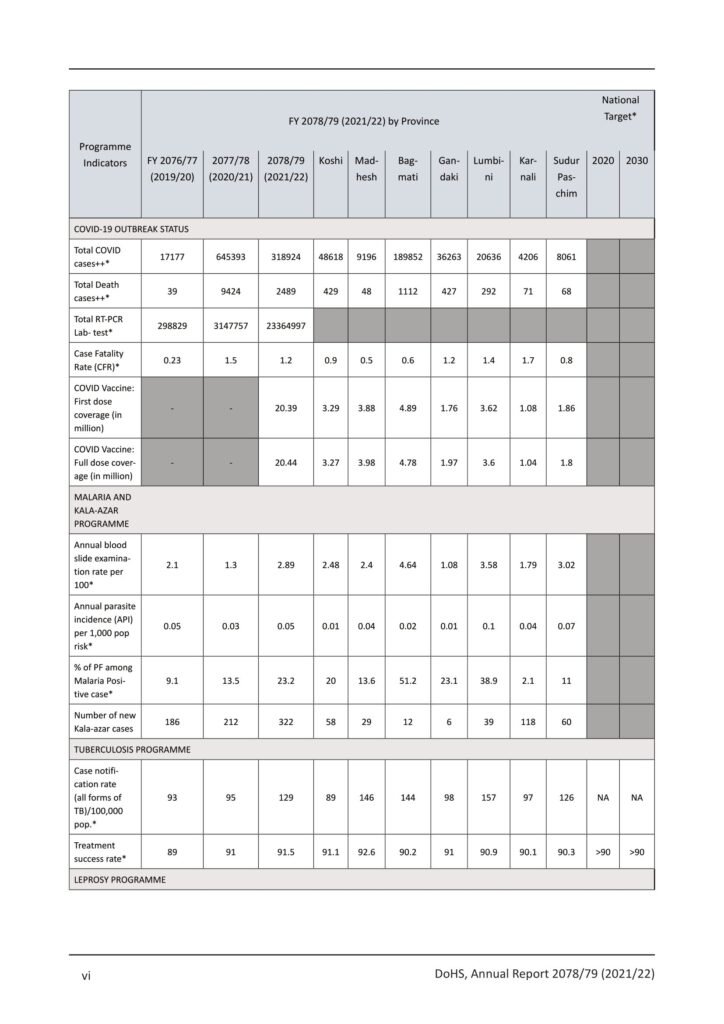
The Department Health Services (DoHS) Annual Report 2078/79 has released it’s annual report for the fiscal year 2078/79 (2021/22. The annual report of the Department of Health Services (DoHS) for fiscal year 2078/79 (2021/2022) is the twenty-eight consecutive report of its kind. This report focuses on the objectives, targets and strategies adopted by Nepal’s health programs and analyses their major achievements and highlights trends in service coverage over three fiscal years. This report also identifies issues, problems and constraints and suggests actions to be taken by health institutions for further improvements.

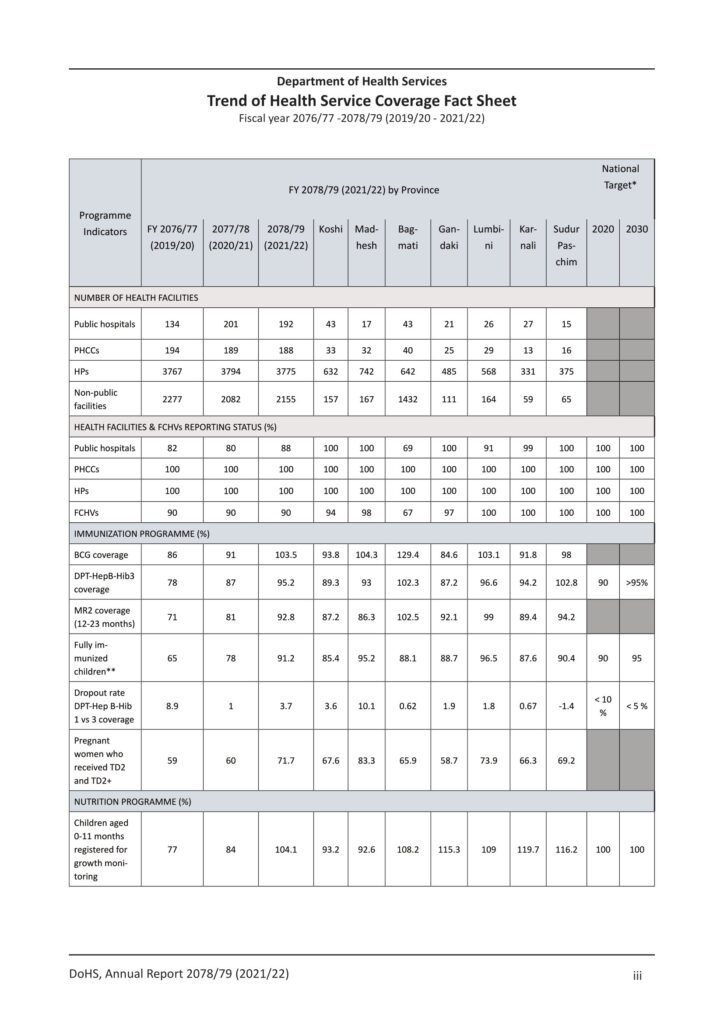
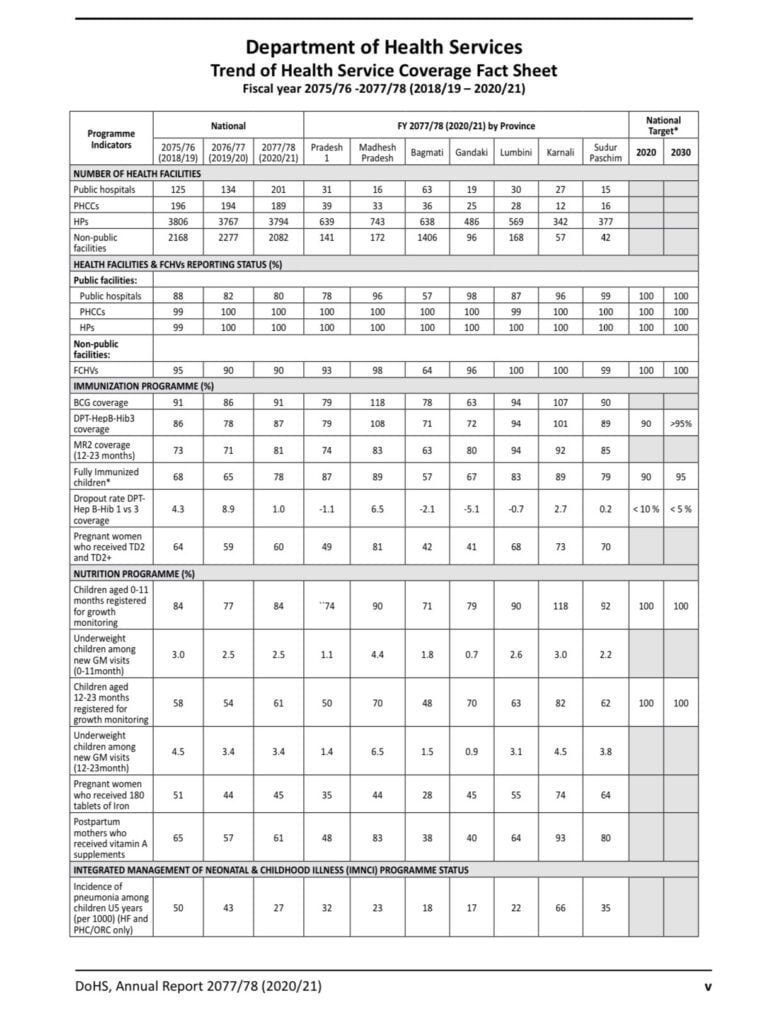
The main institutions that delivered basic health services in 2078/79 were the 192 public hospitals including other ministries, the 2,155 non-public health facilities, the 188 Primary Health Care Centers (PHCCs) and the 3,775 Health Posts (HPs) primary health care services were also provided by Primary Health Care Outreach Clinic (PHC-ORC) sites. A total of 16,950 Expanded Program of Immunization (EPI) clinics provided immunization services. These services were supported by 50,229 Female Community Health Volunteers (FCHV). The information on the achievements of the public health system, NGOs, INGOs and private health facilities were collected by DoHS’s Health Management Information System (HMIS).

Executive summary

National Immunization Program (NIP)

  • In FY 2078/79 compared to FY 2077/78, BCG coverage improved by 13%, whereas DTP-HepB-Hib3 and OPV3 coverage increased by 10% and 13% respectively. The fIPV2 coverage rate has increased to 93% for FY 2078/79. PCV3 coverage has increased to 94%, and PCV1 coverage has reached 98%. Coverage for MR1 and MR2 is now 95% and 93%, respectively.
  • High coverages of both MR1 and MR2 are necessary (> 95%) at all levels to achieve measles eradication. As a result, MR1 and MR2 coverage still has to be increased. The JE vaccination coverage is 96% at national level.

Integrated Management of Neonatal and Childhood Illnesses

  • Among all reported live births, chlorhexidine (CHX) was administered to 82.9% of newborns’ umbilical cord (HF+ FCHV).
  • Use of CHX varied by province, with Sudurpaschim having the highest use (96.9%) and Bagmati Province having the lowest use (64.7%). At the national level, injectable Gentamycin was given to all PSBI cases involving infants under two months old in the fiscal year (FY 2078/79).
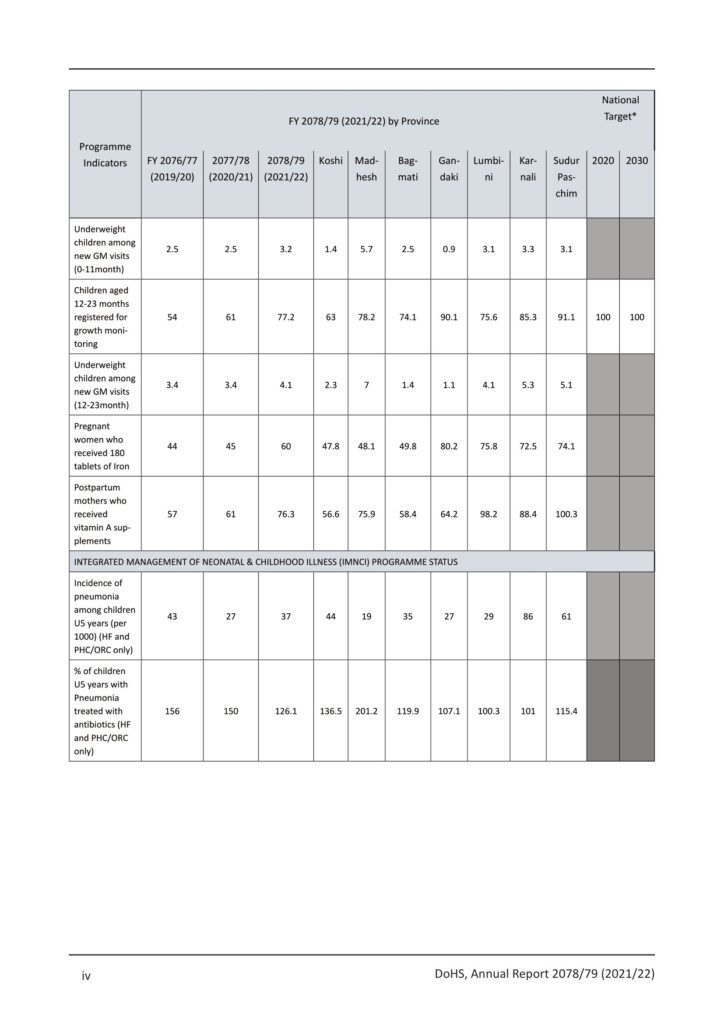
  • A total of 702,504 ARI cases were reported at HF and PHC/ORC in FY 2078/79, of which 13.3% were classified as pneumonia and 0.18% as severe pneumonia. At the national level, there were 55.1 cases of pneumonia (both mild and severe) per 1000 children under the age of five.

Nutrition

  • The growth monitoring visit has increased by 25.5 percentage points at the national level from FY 2076/77 (65.2%) to FY 2078/79 (90.7%). A significant reach of Growth Monitoring and Promotion (GMP) among the targeted age group is also demonstrated by the coverage of GMP registration across the seven (7) Provinces, with Provincial values ranging from a low of 78.1% in Province No. 1 to a high of 103.7% in Sudurpaschim Province. In FY 2078/79, the Mother Baby Friendly Hospital Initiative (MBFHI) program was assessed in 10 hospitals, and orientation was done in additional five hospitals.
  • Until FY 2078/79, 15 MBFHI hospitals have been certified. By the end of FY 2078/79, the CNSI training package has been rolled out in 72 districts and five districts of Bagmati province are planned for FY 2079/80.

Safe Motherhood and Newborn Health

  • Maternal and Newborn Health (MNH) is a high-priority program in Nepal. The National Safe Motherhood Programme implemented by Family Welfare Division (FWD) aims to reduce maternal and neonatal morbidity and mortality, improve maternal and neonatal health through preventive and promotive activities, and address avoidable factors that cause death during pregnancy and childbirth and the postpartum period.
  • In FY 2078/79, there was a significant increase in key Maternal and Newborn Health (MNH) indicators.
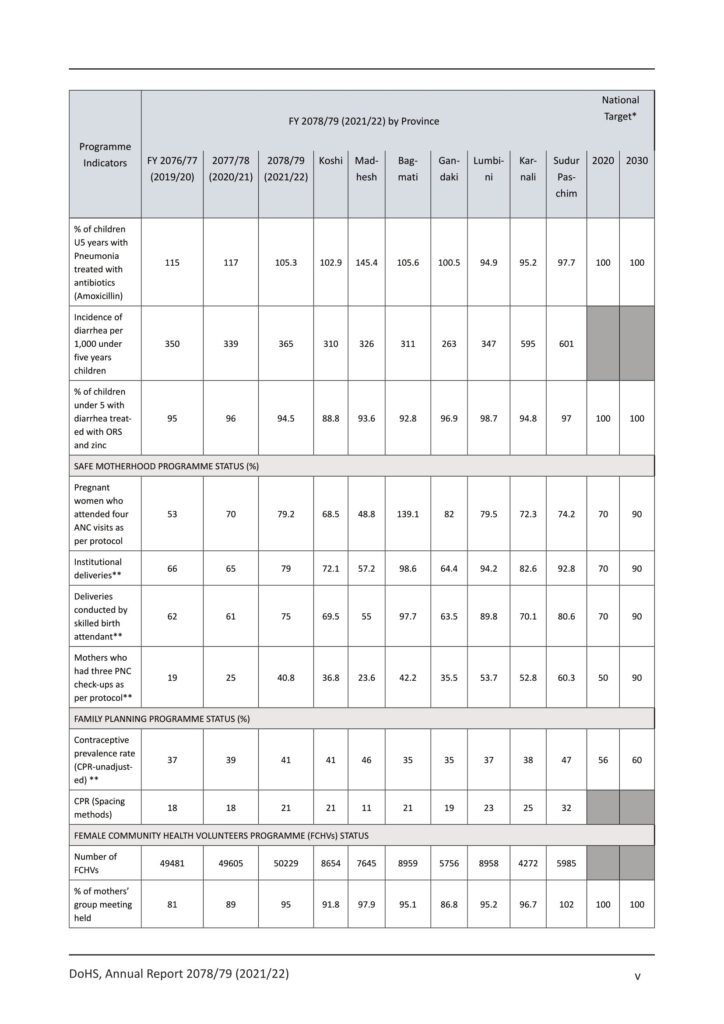
  • The percentage of pregnant women attending 4 ANC visits as per the protocol increased to 79.4 in FY 2078/79 from 70 in 2077/78. Similarly, institutional deliveries as a percentage of expected live births increased by 14%.
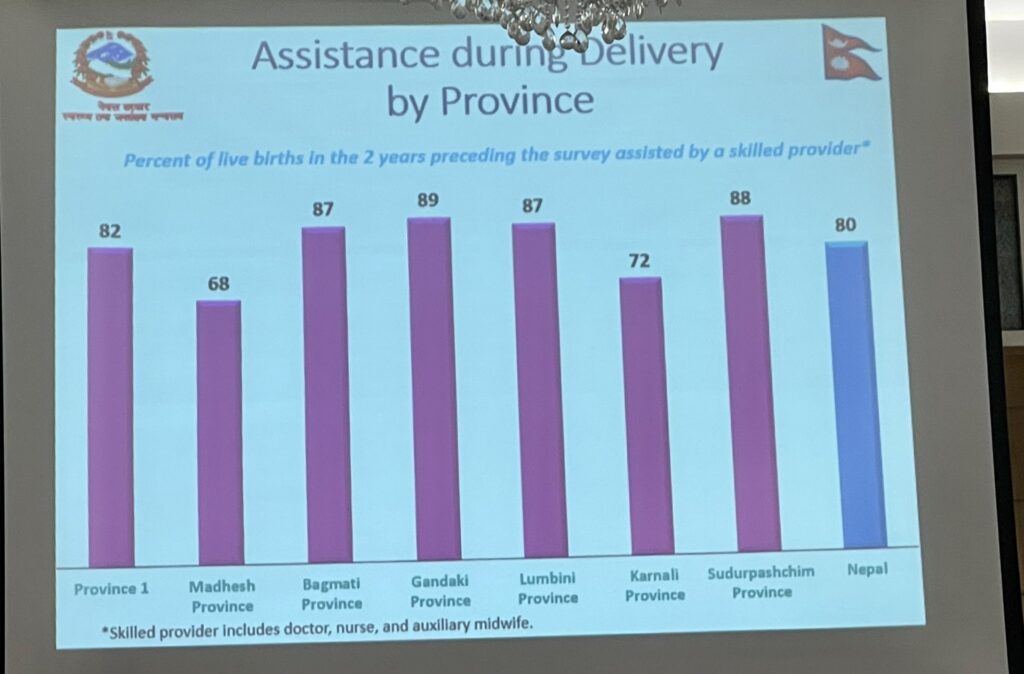
  • Furthermore, the delivery assisted by SBA increased to 75% in FY 2078/79 from 61% in FY 2077/78.
  • The national average for Emergency Obstetric Care (EOC) met needs was 11% in this reporting period, improving from 8.2% in FY 2077/78. The proportion of mothers attending three PNC visits as per the protocol increased from 25% in FY 2077/78 to 40.8% in FY
  • 2078/79.
  • Although there is improvement in key MNH indicators, major gaps in quality of care exist along the continuum of care such as 4 ANC visits and 3 PNC as per the protocol. Similarly, considerable interprovincial gaps were noticed in the quality of care, with around 32% difference in the proportion of women receiving 180 days’
  • supply of Iron Folic Acid (IFA) during pregnancy, with 80.2% of women receiving it in Gandaki Province while only 47.8%
  • in Koshi Province in the year 2078/79.
  • The number of safe abortion service users increased to 90,733 in FY 2078/79 from 79,952 in FY 2077/7 and 87,869 women in FY 2076/77.
  • Among these, 69% were medical abortions, and 31% were surgical abortions in FY 2078/79. 14.2% of the total pregnancies were terminated by induced procedures at health facilities, and 4.4% were induced using the surgical method. Although the safe abortion service users increased in FY 2078/79, the post-abortion contraception has slightly decreased to 74.7% in FY 2078/79 from 76.7% in FY 2077/78.
  • Among the safe abortion users, approx. 7% of the women were aged below 20 years.
  • In FY 2078/79, FWD implemented the MPDSR program in 32 districts and 94 hospitals.
  • In FY 2078/79, a high percentage of maternal deaths were reported in the antepartum period (34%) followed by the postpartum period after 48 hours of delivery (31%).
  • FWD also implemented various activities in FY 2078/79 to improve maternal and child health, such as expansion and quality improvement of BEONC and CEONC sites, onsite clinical coaching and mentoring, MNH readiness assessment and emergency referral funds. In this reporting period, 753 municipalities of 77 districts implemented onsite clinical coaching and mentoring programs, and a quality improvement process programme expanded in 65 hospitals.

Family Planning and Reproductive Health

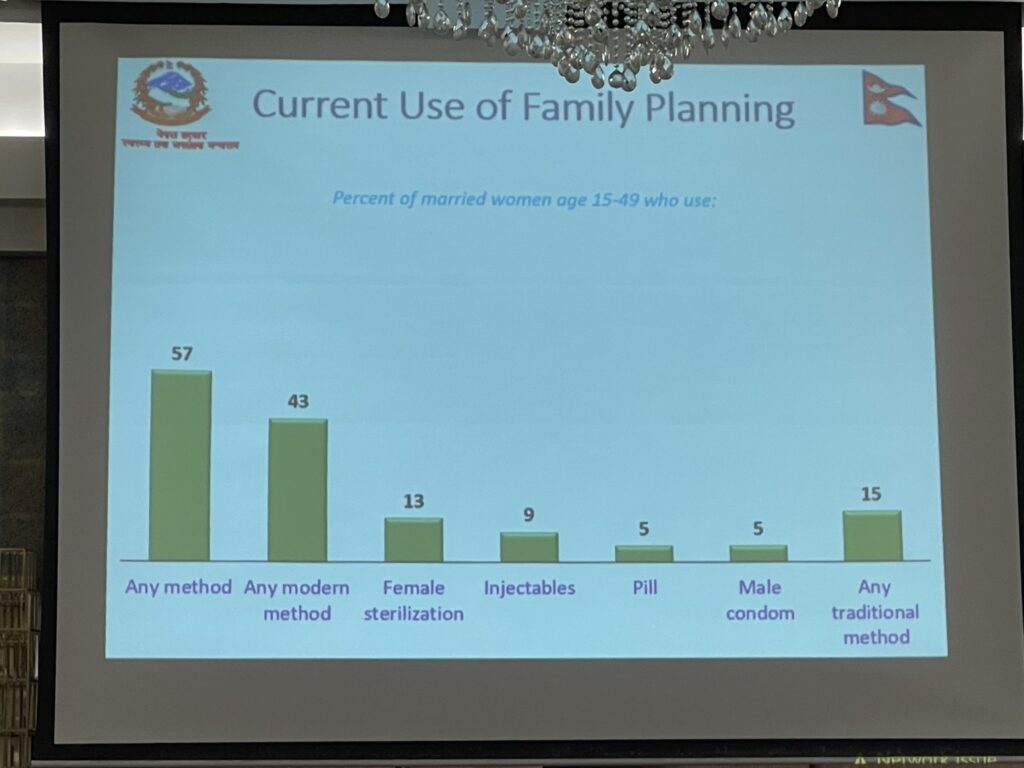
  • National family planning programme (FP) in 2078/79 has been successful to improve the service access and utilization.
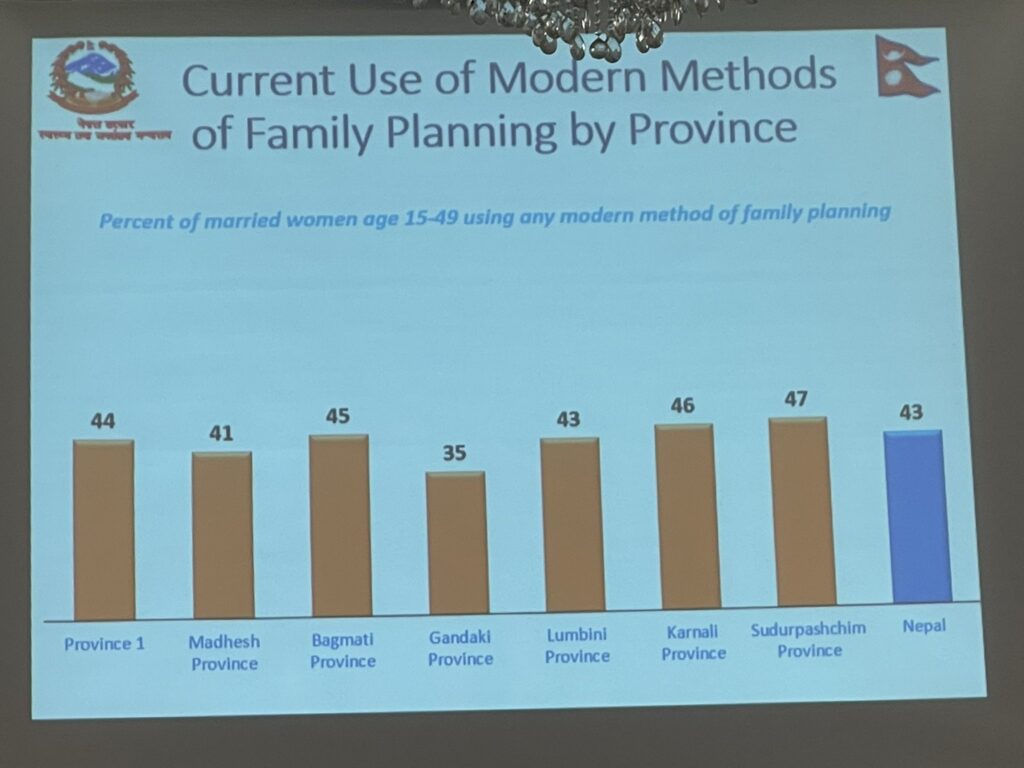
  • The modern contraceptive prevalence rate (unadjusted mCPR) for modern FP at national level is 41% compared to 39% in FY 2077/78.
  • Sudurpaschim Province has the highest mCPR of 48% while Bagmati Province has the lowest (35%). The number of districts with mCPR below 30% is in a decreasing trend.
  • In FY 2078/79, there are 5 districts with CPR less than 30 compared to 9 in FY 2077/78.
  • This indicates performance improvement among the low mCPR districts. Depo (38%) occupies the greatest part of the contraceptive method mix for all method new acceptors, followed by condom (23%), pills (19%), implant (14%), IUCD (2%), female sterilization (FS- 3 %) and lastly male sterilization (MS-1%) in FY 2078/79.
  • Immediate postpartum family planning uptake as proportion of total facility delivery is in increasing trend.
  • Postpartum IUCD uptake as proportion of total facility delivery is also in decreasing trend, while that of contraceptive
  • uptake among total reported abortion services is 71%, but only 15% have used LARCs indicating women after abortion are relying on less effective methods.

Adolescent sexual and reproductive health

  • Adolescent Sexual and Reproductive Health (ASRH) is one of the priority programs of FWD guided by The National Adolescent Health and Development Strategy, 2018. The National ASRH program has been scaled up to all 77 districts by Fiscal Year 2078/79. So far, about 1,355 health facilities have been listed and 116 health facilities have been certified as adolescent friendly service sites.
  • The number of adolescents receiving temporary contraceptive methods (excluding condom) is in decreasing trend.
  • Among four temporary contraceptive methods, Depo is the most preferred contraceptive method accounting for 58% of the contraceptive method mix. Compared to FY 2077/78, the share of implants in method mix has decreased.
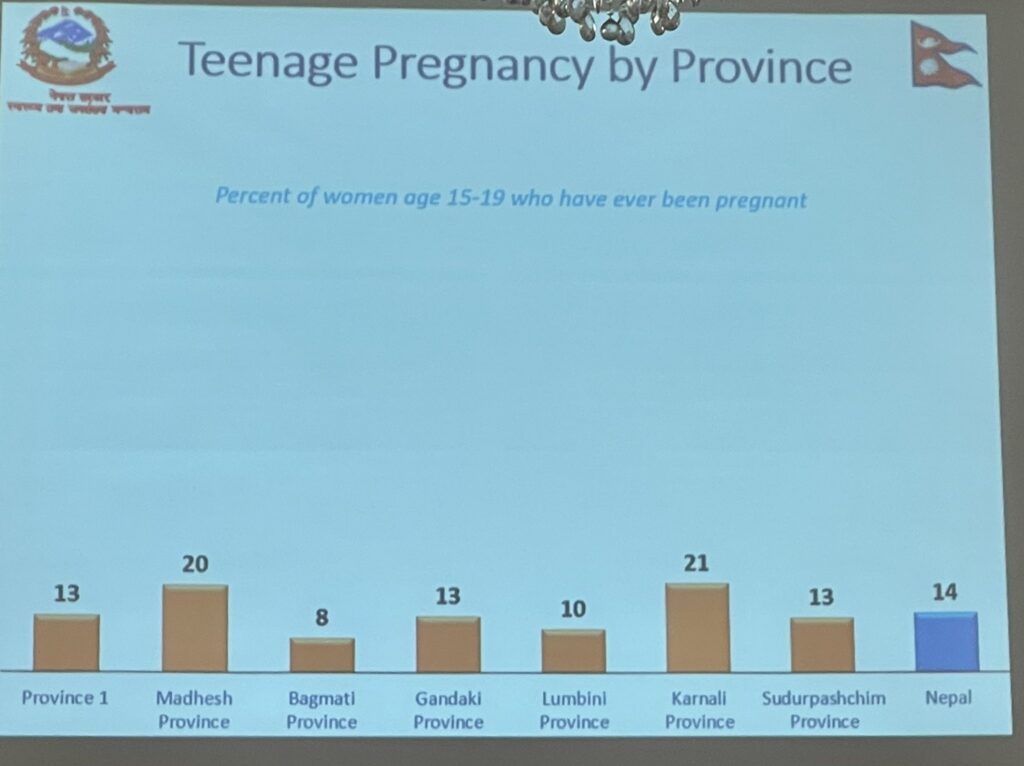
  • Similarly, utilization of abortion services is also in decreasing trend. This data needs to be cautiously interpreted as adolescents prefer to utilize the sexual and reproductive health (SRH) services from the private sector due to several reasons. It is interesting to note that the share of medical abortion services is decreasing. Almost two-thirds of adolescents (61%) who terminated the pregnancy opted for medical abortion.
  • In FY 2078/79, Madhesh Province had the highest number of adolescents who received first ANC services and first ANC visit as per protocol. Whereas Gandaki Province has the lowest number of adolescents receiving ANC services.
  • At the national level, the dropout rate between ANC 1st and ANC 4th visits is around 33% in FY 2078/79 which is lower than the previous year.
  • Primary Health Care Outreach Clinics
  • Primary health care outreach clinics (PHC/ORC) extend basic health care services to the community level. In FY 2078/79, 2,289,178 people were served from outreach clinics. Out of planned clinics, 86% were conducted.
  • There has been a slight increase in the conduction of PHC-ORC Clinics and clients served compared to previous year.
  • Malaria
  • Nepal has surpassed the Millennium Development Goal 6 by reducing malaria morbidity and mortality rates by more than 50% in 2010 as compared to 2000. Therefore, the Government of Nepal has set a vision of Malaria free Nepal by Current National Malaria Strategic Plan (NMSP) 2014-2025 was developed based on the epidemiology of malaria derived from 2012 micro-stratification. The aim of NMSP is to attain “Malaria Free Nepal by 2025”.
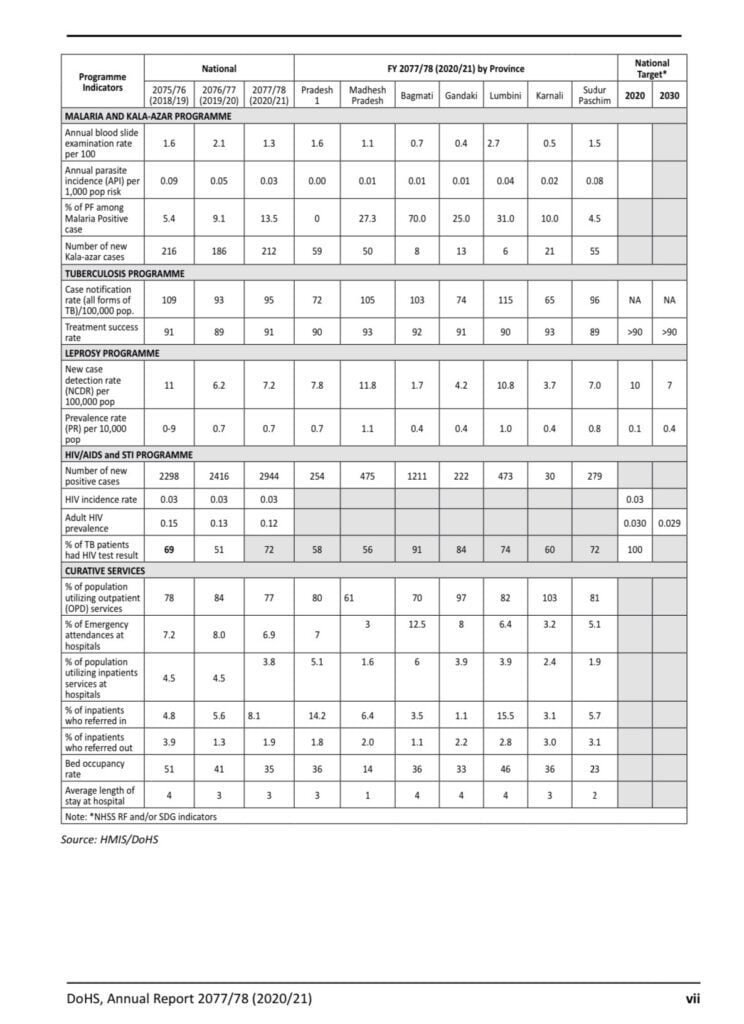
  • For assessing the risk areas, the program has been conducting micro-stratification on an annual basis. Total positive cases of malaria increased from 377 in FY 2077/78 to 491 in FY 2078/79 to, where 38 cases are indigenous cases and 453 are imported.
  • The trend of indigenous is decreasing, however, the number of imported cases is increasing.
  • As compared to the previous year, the proportion of P. falciparum infections has increased from 13.53% in FY 2077/78 to 23.2% in 2078/79. This proportion is high which is due to the high number of imported P. falciparum cases mostly from India and the Central Africa Region (CAR).
  • The trend of indigenous Pf malaria cases is decreasing. In FY 2078/79, all PF cases were imported. The trend of clinically malaria cases is slightly increasing and major indicators for malaria program; Test positivity rate (TPR), and Annual Blood Examination Rate (ABER) are in positive trend, however, Annual Parasite Incidence Rate (API) has slightly increased.

Kala-azar

  • Kala-azar is one of the high priority public health problems of Nepal. Most of the districts have been continuously reported new cases of Kala-azar in recent years. Therefore, to eliminate Kala-azar from Nepal, strategies to improve health status of vulnerable and at-risk populations have been made focusing on endemic areas of Nepal, which leads to elimination of Kala-azar, and it no longer becomes a public health problem. The incidence of kala-azar at national level has
  • been less than 1/10,000 population since FY 2073/74. However, the trend of Kala-azar cases has been increasing in a few
  • years. In FY 2078/79, two districts, Okhaldhunga and Kalikot, crossed the elimination threshold with 1.62 per 10,000 in Okhaldhunga and 4.14 per 10,000 in Kalikot.

Lymphatic filariasis (LF)

  • Lymphatic Filariasis (LF) is one of the mosquitoes borne parasitic diseases with a public health problem in Nepal.
  • Nepal is among the countries who have started LF MDA in all endemic districts and is on track to achieve elimination status by The goal of the Lymphatic Filariasis Elimination Program is to eliminate LF as a public health problem by reducing the level of the disease in the population to a point where transmission no longer occurs.
  • As of Poush 2079, MDA has been stopped and post MDA surveillance is ongoing in 48 of 64 endemic districts.
  • All endemic districts completed 6 rounds of MDA in 2075 other than Rasuwa which has recently been considered endemic from a confirmatory mapping survey.
  • Triple Drug Regimen (IDA: Ivermectin, Diethylcarbamazine and Albendazole) has been introduced in 5 districts from 2078 and EDCD has planned to expand it in all 15 districts that will implement MDA in 2079.
  • Since 2060 more than 115 million doses of lymphatic filariasis drugs have been administered to at-risk populations.
  • A total number of 10,477 hydrocele surgeries have been performed since FY 2073/74 to FY 2078/79.
  • The morbidity results by community mapping from 44 districts revealed that 30,925 cases of LF have been confirmed of which 21,105 cases of hydrocele, 9,574 cases of lymphoedema and 246 cases of both conditions.

Dengue

  • Dengue, a mosquito-borne disease, emerged in Nepal in 2062. The goal of the national Dengue control program is to DoHS, Annual Report 2078/79 (2021/22) reduce the morbidity and mortality due to dengue fever, dengue hemorrhagic fever (DHF) and dengue shock syndrome (DSS).
  • The number of reported dengue cases has decreased significantly since 2066 but cases of dengue have increased in recent years. During FY 2078/79, a total of 733 dengue cases were reported from 62 districts.
  • The majority of cases have been reported from Sankhuwasabha (79), Kathmandu (65), Dhading (55), and Rupandehi (44).

Scrub Typhus

  • After the devastating earthquake in 2072, outbreak of scrub typhus has been reported from across the country causing several morbidities and mortalities. Although the surveillance system for scrub typhus is not very well established, the scrub typhus cases were reported through the early warning and reporting system (EWARS) from 2073.
  • During FY 2078/79, a total of 2,474 dengue cases were reported from 71 districts. The majority of the cases have been reported from Doti (288), Darchula (222), Palpa (205), Kailali (160), Gulmi (133), Baitadi (124) and Sankhuwasabha (101).

Leprosy

  • During FY 2078/79 (2021/22), 2285 new leprosy cases were detected and put under Multi Drug Therapy (MDT) from 64 districts. Among total new cases, 3.19 % were child cases under 15 years, 7.44 % diagnosed with Grade 2 Disabilities and 43.3% were female cases, 2373 cases were under treatment and receiving MDT at the end of the fiscal year, marking a registered prevalence rate of 0.81 cases per 10,000 populations at the national level.
  • There is a slight increase in prevalence rate of leprosy might be due to loosening of restrictions due to COVID 19 and continuation of field level activities such as active case detection, IEC/BCC campaigns etc.
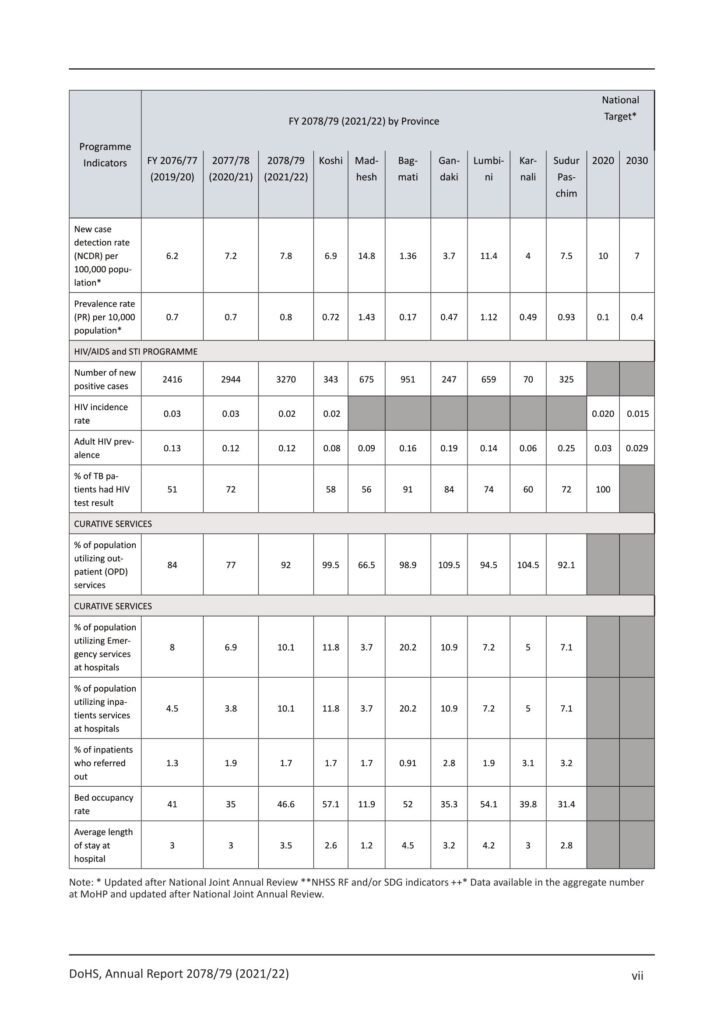
  • Madhesh province reported the highest PR of 1.43/10,000 population followed by Lumbini province (1.12). 16 districts have reported PR>1 per 10,000 population. 561 foreign cases from India were provided treatment in Nepal during FY 2078/79.

Disability inclusive health, rehabilitation, assistive technology and injury prevention

  • EDCD/ LCDMS has aimed for a disability inclusive health system and population access to rehabilitation services and assistive technology. During FY 2078/79 (2021/22), we developed a Disability management and rehabilitation training
  • package for primary health care providers and was piloted in Banke and Kaski. Post-COVID rehabilitation protocol, National standard on assistive technology and Operational guideline on priority assistive product list has been developed.
  • Furthermore, the Systematic Assessment of Rehabilitation Situation (STARS) report was finalized and the Rapid Assistive
  • Technology Assessment (rATA) was conducted in coordination with the National Health Research Center. Likewise, preliminary data was collected to evaluate the rehabilitation workforce using WHO standardized tools.
  • Altogether 54,670 new cli- ents were reported in DHIS-2 have received rehabilitation service from 42 different hospitals and rehabilitation centers which shows an increment in data reporting compared to last fiscal year which was 29,814 clients.
  • This is due to the fact that EDCD has initiated training to private rehabilitation service centers.
  • Situation assessment and prioritization of strategic intersectoral actions in road safety and the National Policy Dialogue on road safety was organized highlighting the components of the safer system approach.

Zoonoses

  • Nepal has a dual burden of disease and zoonotic diseases of epidemics; endemic and pandemic potentials are the major public health concerns. Globally more than 300 zoonotic diseases are identified among which about 60 have been identified in Nepal as emerging and re-emerging diseases.
  • No people die of rabies or poisonous snake bites due to unavailability of anti-rabies vaccine (ARV) or anti-snake venom serum or timely health care services and to prevent, control and manage epidemic and outbreak of zoonosis is the goal of the zoonosis program.
  • Around 75,000 cases in pets and more than human rabies cases occur each year with highest risk are in the terai.
  • During FY 2078/79, a total of 85,483 dog and other animal bites cases have been reported throughout Nepal and a total of 9,346 snake-bites cases have been reported. Among cases 8,420 were non-poisonous and 926 were poisonous.

Tuberculosis

  • Tuberculosis (TB) remains a major public problem in Nepal.
  • During this FY 2077/78, a total of 37,861 cases of TB were notified and registered at NTP.
  • Among these, 98.5% (37,287) were incident TB cases (New and Relapse). Among all forms of TB cases 72.1 %were pulmonary TB, and out of them, 57.1% were pulmonary bacteriologically confirmed.
  • Madhesh Province holds the highest proportion of TB cases (23.7%) followed by Bagmati province (23.3%). Kathmandu district alone holds around 42% (3,672 TB cases) of the TB cases notified from the Bagmati Province while its contribution is around 9.7% in the national total.
  • In terms of eco-terrain distribution, Terai belt reported more than half of cases (22,904; 60.5%). Most cases were reported in the middle age group with the highest of 45.1% in 15 44 years of age.
  • The childhood TB is around 8.7%. Out of total registered TB cases, there were 14,539 (38.4%) females and 23,322 (61.6%) males.
  • The burden of TB can be measured in terms of incidence (defined as the number of new and relapse cases), prevalence and mortality. WHO estimates the current prevalence of all types of TB cases for Nepal at 117,000 (416/100,000) while the number of all forms of incidence cases (newly notified cases) is estimated at 69,000 (235/100,000).
  • Case notification rate (CNR) of all forms of TB is 129/100,000 population whereas CNR for incident TB cases (new and relapse) is 72/100,000 population.
  • Among drugs sensitive TB cases registered in FY 2077/78, 91.5% were treated successfully.
  • There are estimated to be around 2,200 cases of DR-TB annually. However, 942 MDR TB cases are notified annually.
  • In FY 2077/78, 659 RR/MDR-TB cases were registered for treatment. Among them, Lumbini Province is found to have higher burden followed by Madesh Province, Koshi Province, Bagmati Province, Sudurpaschim province, Gandaki Province, and Karnali Province respectively. Similarly, the burden of Pre-XDR and XDR TB patients was found more at Lumbini Province
  • followed by Bagmati, Koshi, Madhesh, Sudurpaschim, Gandaki and Karnali provinces respectively.
  • TB services were provided through 5,971 treatment centers. Regarding diagnostic services, there are 896 Microscopic
  • centers and 93 GeneXpert centers throughout the country.
  • DR-TB services were provided through 22 treatment centers and 81 Treatment Sub-centers.
  • Though the DR-TB services are ambulatory, facility-based services were also provided through 2 TB treatment and referral management center 6 hostels and 1 DR home.

HIV/AIDS AND STI

  • HIV/AIDS is a priority public health program of the Ministry of Health & Population (MoHP). Nepal remained as concentrated epidemic with prevalence rate 0.12% among adult population (15-49 years) and >5 % among key population i.e. MSM/ TG and PWID.
  • The total estimated people living with HIV (PLHIV) is 30,300 in Nepal by 2021/22 (FY 2077/78), out of total estimated 4% are children (1,140) aged up to 14 years who are living with HIV in Nepal, while the adults aged 15 years and above account for 96%.
  • Almost 65% of total estimated infections (19,460) among the population aged 15-49 years. By sex, males account for 55% of the total infections and the remaining infections are in females. Total 22,125 PLHIV are on ART treatment by the end of FY 2078/79.

Non-Communicable Diseases

  • Non-communicable Diseases (NCDs) are emerging as the leading cause of deaths in Nepal due to changes in social determinants like unhealthy lifestyles, urbanization, demographic and economic transitions.
  • The deaths due to NCDs (cardiovascular, diabetes, cancer and respiratory disease) have increased from 60% of all deaths in 2014 to 66% in 2018 (WHO Nepal Country Profile 2018).
  • They are already killing more people than communicable diseases. Thus, Nepal has adapted and contextualized the PEN intervention for primary care in a low resource setting developed by WHO.
  • The epidemic of non-communicable disease is recognized by UN and addressed in Sustainable Development Goal 3 i.e. “ensure healthy life and promote well-being for all at all ages” of this goal 3.4 targeted to “reduce by one third premature mortality from NCDs through prevention and treatment and promote mental health and well-being”. PEN Implementation Plan (2016-2020) has been developed in line with the Multi-sectoral Action Plan for prevention and control of NCDs (2014-2020).

Mental Health

  • Mental health and substance abuse are recognized as one of the health priorities and also addressed in Sustainable Development Goals (SDG). Within the health goal, two targets are directly related to mental health and substance abuse.
  • Target 3.4 requests that countries: “By 2030, reduce by one third premature mortality from non-communicable diseases through prevention and treatment and promote mental health and well-being”. Target 3.5 requests that countries: “Strengthen the prevention and treatment of substance abuse and harmful use of alcohol”. Nepal has a high burden of mental illness but there are limited interventions to address the epidemic of mental diseases.

Epidemiology and Outbreak Management

  • Epidemiology and Outbreak Management involves working in the area of preparedness and response to outbreaks, epidemics and other health emergencies occurring in different parts of the country. It aligns with the organizational objective to reduce the burden of communicable diseases and unwanted health events through preparedness and responses during outbreak and epidemic situations by using the existing health care system and provides support to the Ministry of Health and Population (MoHP) for drafting national laws, policies, and strategies related to epidemiology and outbreak management. It provides subnational support for outbreak management and capacity building.
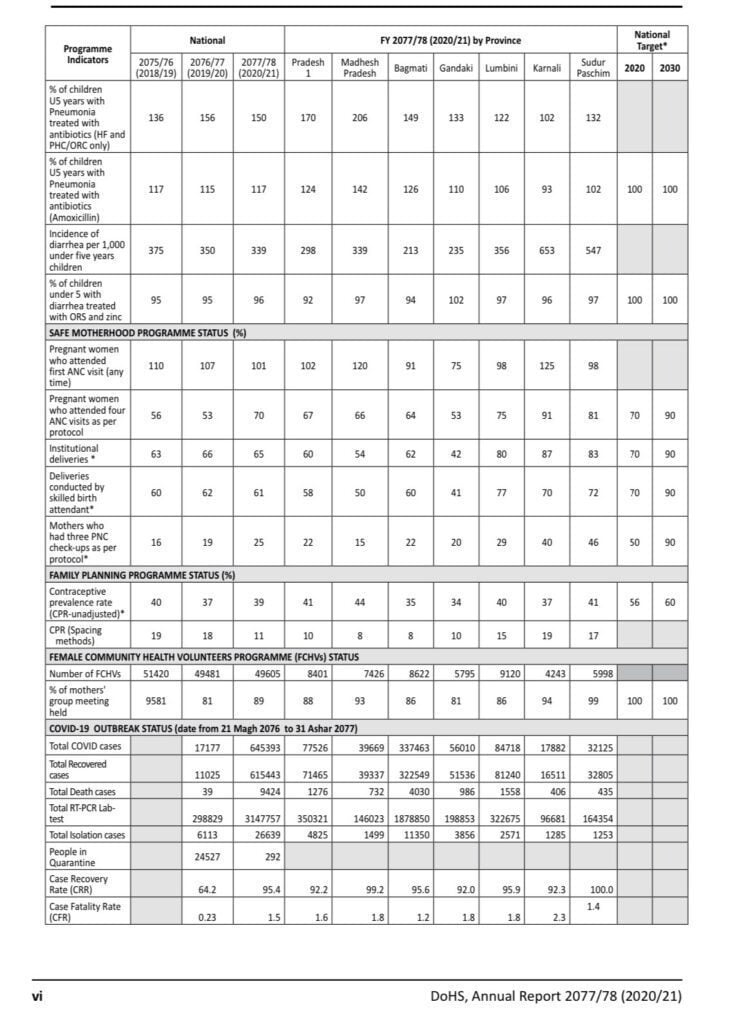
  • Continuation of COVID-19 pandemic was seen in FY 2078/79. In the FY, a total of 318,724 PCR and 94,040 Antigen positive cases were registered.
  • FY 2078/79 witnessed two cholera outbreaks, in Kapilvastu and Kathmandu Valley. A total of 1,914 Acute Diarrheal Disease (ADD) cases occurred in the outbreak in Kapilvastu district. Out of 21 stool samples tested for stool culture four stool samples tested positive for Vibrio Cholerae O1 Ogawa. Reactive Oral Cholera Vaccination (OCV) campaign was conduct- ed by Kapilvastu district in 10 municipalities.
  • In Kathmandu valley, until Asar 32,2079, a total of 30 cases of cholera were reported of which 24, 4 and 2 cases were reported from Kathmandu, Lalitpur and Bhaktapur districts respectively.

Surveillance and Research

  • Early Warning and Reporting System (EWARS) is a hospital-based sentinel surveillance system, established in 1997 – for early detection of six priority outbreak potential vector borne, water and food borne diseases/syndromes.
  • Currently, 18 hospitals from all provinces and districts in the country have been selected as sentinel sites. Among 118, 13 sentinel
  • sites reported consistently throughout the 52 epidemiological weeks in 2021 (FY 2077/78).
  • Being the secretariat of National Drinking Water Quality Surveillance, EDCD conducts drinking water quality surveillance
  • activities on a regular basis at national and sub-national level. In FY 2078/79 formation of provincial drinking water quality surveillance committee has been completed in the three provinces in this fiscal year and the rest four are planned in the next year.
  • Monitoring of drinking water quality surveillance and water sample testing for microbiological parameters at sub-national and local level was performed with co-ordination through provincial health ministers/ directorates and associated offices.
  • A single batch MTOT on water safety plan, drinking water quality surveillance and N-WASH (digita; tool for water supply and quality management) was conducted in this FY to strengthen and capacitate water quality surveillance at provincial and local level.
  • In FY 2078/79, the call center received 132,687 calls, out of which 122,016 calls were answered and 17,939 times the Interactive Voice Response (IVR) were recorded.
  • Alert and response System, pandemic response, general response and SMS service on epidemic and outbreak are the major scope of work of call center.

Health sector response to COVID-19 Pandemic

  • The Government of Nepal intends to gradually immunize its citizens when vaccines become available, starting with the groups most at risk, in order to lower morbidity and mortality associated with COVID-19.
  • A total of 47,838,854 doses of COVID-19 vaccinations, including 6,873,016 additional doses, have been safely administered.
  • There are now 108 RTPCR laboratories operating throughout all provinces (45.4% are private and 54.6% are public). Nepal recorded a total of 1,122,201 COVID-19 positive (including RT-PCR and Antigen test).
  • The total case fatality rate is 1.2%, and the rate for people 60 and older is 6.3%. A total of 695,144 individuals have completed the QR certification.

Curative Services

  • Minimum Service Standard (MSS) of health facilities is the service readiness tool designed to identify existing gaps towards the quality improvement of hospital services through self and joint assessment and developing an action plan scientifically.
  • MSS has been implemented in 118 different levels of hospitals all over the country.
  • There has been significant improvement in the service readiness status of the government hospitals since the implementation of MSS program and in the last two fiscal years the program has been expanded to health posts throughout the country.

Nursing and Social Security

Nursing Capacity Development

  • The main responsibility of the nursing capacity development section is to facilitate in the process of development of plans, policies, strategies and programs for strengthening various specialties of nursing and midwives’ services.
  • The major activities and achievements in FY 2078/079 were the school health and nursing program, development of five CPD modules and three clinical protocols, implementation of training on infection prevention and control based on a blended learning approach. In the FY 2078/079 community health nursing program was started in Bhaktapur and Bardibas Municipality.
  • Similarly, in the FY 2078/079 onsite coaching and mentoring program was started.

Geriatric and Gender Based Violence Management

  • The constitution of Nepal has ensured the right of the public to free basic health care service and emergency services.
  • It has also ensured that the elderly people will be entitled to special protection from the nation and are entitled to the right to social security. So, to ensure the accessibility and utilization of health services by older people, the Ministry of Health and Population is extending the geriatric health care services to hospitals with more than 50 beds in this fiscal year.
  • The geriatric services along with establishment of separate geriatric ward and outdoor services has been extended to 49 hospitals across the country in this fiscal year. Geriatric care center implementation guidelines and standards have been developed in which senior citizens with the many chronic health problems who need nursing care are the major service consumers.
  • National policy dialogue program related to geriatric health was conducted. This section trained 80 Primary Health Care Professionals (Health assistants and staff nurses) related to Integrated care for elderly people and 14 medical officers for geriatric health care.
  • Geriatric Review has been conducted among 24 geriatric service available hospitals.
  • Gender-based Violence (GBV) is a grave human rights issue and public health concern which impacts the physical and mental health of the individual survivor and his/her children, and carries a social and economic cost to society.
  • The Office of the Prime Minister and Council of Ministers developed a multi sectoral action plan to address the GBV issues in 2010 with celebration of international GBV years.
  • In line with the action plan and to address needs of GBV survivors in an effective and efficient way MoHP established a hospital based One Stop Crisis Management Center(OCMC).
  • In FY 2078/79, 88 OCMCs had been established in 77 districts. Orientation of the GBV program was conducted at three local levels. OCMC review was conducted in all provinces in FY 2078/79.

Deprived Citizen Treatment Support Program (Bipanna Nagarik Aushadhi Upchar Program)

  • The Impoverished Citizens Service Scheme of Social Health Security Section provides the funding for impoverished Nepalese citizens to treat serious health conditions.
  • Free treatment up to NPR 100,000 per patient via listed hospitals for severe diseases including cancer, heart disease, traumatic head injuries, traumatic spinal injuries, Alzheimer disease, Parkinson’s and sickle cell anemia diseases once in lifetime. Pre-transplant (HLA & cross match) test support up to NPR 50,000; renal transplantation costs up to NPR 400,000 per patient; medication costs up to NPR 100,000 for post-renal transplant cases; Free haemodialysis and peritoneal dialysis services; and free medical treatment for acute kidney infections up to NPR 100,000.
  • Till FY 2078/79 125,825 patients have received free treatment under impoverished citizens’ services scheme.

Female Community Health Volunteer (FCHV)

  • The Government of Nepal initiated the Female Community Health Volunteer (FCHV) Program in 2045/46 (1988/1989) in 27 districts and expanded it to all 77 districts thereafter. 51,423 FCHVs recruited a total of 49,605 (as reported in HMIS) FCHVs are actively working in Nepal. In the fiscal year 2077/078 biannual FCHV review meeting was held at local and FCHV day was celebrated.
  • The major role of FCHVs is to advocate healthy behavior among mothers and community people to promote safe motherhood, child health, for family planning and other community-based health issues and service delivery.
  • FCHVs distribute condoms and pills, ORS packets and vitamin A capsules, treat pneumonia cases (only in the selected remote area where referral is not possible), refer serious cases to health facilities and motivate and educate local people on healthy behavior related activities. They also distribute iron tablets to pregnant women.

Reimbursement program for free treatment of Janayudhha, Jana-andolan ghaite, Madhesh terai ghaite, Bhukampa pidit.

  • The program provides reimbursement to the government and community hospitals that claim an amount equal to the free services they have provided to the casualties of various peoples movement and earthquake affected peoples based recommendation by the government authorities stating their casualty status.
  • In FY 2078/79 a total of 2,500,000 rupees budget was allocated for the program and reimbursement were given to three hospitals that claimed the amount.

Reimbursement to the hospitals for free treatment of Acid Attack Victims

  • The program provides reimbursement to the four dedicated hospitals that provide free treatment to the acid attack victims. The program covers ambulance expenses, food expenses of the victim and care-taker, in-patient charges, medical and procedure expenses as well as long term medications that must be used by the patients. In FY 2078/79 total budget of 700,000 was provided to the hospitals for treatment of three victims.

Trainings conducted regarding hemodialysis

  • In FY 2078/79 two categories of training were conducted under hemodialysis specialty. Hemodialysis training for nurses was conducted in two batches with 20 participants in each batch yielding 40 hemodialysis specialist nurses.
  • Same-way users training for hemodialysis equipment maintenance was conducted in one batch with 10 participants.

Inpatients/OPD services

  • For the fiscal year, 2078/79 inpatient and outpatient services were provided by all types and levels of hospitals. A total of 1,548,336 patients were admitted to the hospitals. The highest admissions were due to pregnancy, childbirth and
  • puerperium which accounted for more than 20% of discharged cases. The inpatient hospital death rate was 1.08%. In
  • addition, the number of emergency visits was also increasing as 2,938,849 patients received emergency care. Outpatient morbidity has been reported in 19 different sections that cover 232 diseases including communicable diseases,
  • non-communicable diseases, injuries, organ-specific diseases, and mental health problems. Although the majority of tertiary hospitals and private hospitals had not reported outpatient morbidity throughout the year, the maximum OPD cases were related to headaches followed by upper respiratory tract infection (URTI).

Human Organ Transplant Services

  • Shahid Dharma Bhakta National Transplant Center (SDBNTC) was established in 2012 by the Ministry of Health and Population to strengthen and expand organ transplantation services in the country. This center started its services merely with the OPD services, but within a few years of its establishment it has extended its services beyond organ transplantation.
  • The number of patients in all these aspects has increased remarkably in FY 2078/79. There were 47,047 patients served in the outpatient department, while the number of admission and discharge were almost similar with 2,106 and 2,099 respectively.
  • There were 972 minor surgeries and 827 major surgeries in FY 2078/79. The number of kidney transplantations escalated from 49 to 160 in FY 2078/79. The number of sessions of paid dialysis decreased from 2,940 in FY 7078/79 to 2,526 in fiscal year 2077/78.
  • There has been a slight increase in free dialysis sessions in FY 2078/79. The number of lab tests done in FY 2078/79 was 160,537.

Pashupati Homoeopathic services

  • Pashupati Homoeopathic Hospital is the only hospital providing homeopathic services to the people of Nepal in the public sector. The homeopathic system is economical, easy and has no adverse effects. The hospital provides OPD service only.
  • The number of patients receiving homoepptathic services is increasing. Many referred cases are also treated here like allergic rhinitis, urticaria, laryngeal papilloma, PCOD and other skin diseases. People of Kathmandu valley and nearby districts can take free and convenient service at the hospital.
  • However, People far from Kathmandu valley are not able to take benefits provided by this hospital. It is essential to provide service in all seven provinces of Nepal with utmost priority.

National Health Training

  • The training network includes seven provincial health training centers and 60 clinical training sites.
  • It is also responsible for accrediting clinical training sites and Clinical and public health related training courses to maintain the standard of the health training so as to strengthen the capacity of health service providers across the country.

Vector Borne Disease Research & Training

  • In the FY 2078/79 Vector Borne Diseases Trainings (VBDs) for VBDs focal persons/health workers, malaria microscopic basic and refresher trainings for lab technicians and lab assistants were conducted to enhance their level of knowledge and skills related with prevalent vector borne diseases. Studies conducted during this fiscal year include monitoring of insecticide resistance in malaria vectors and transmission assessment survey of Lymphatic Filariasis.
  • During the FY 2078/79 VBDRTC conducted Re Pre TAS in Morang, Kailali, Banke, Kapilvastu and Dang districts, TAS-I in Bardiya and Dhankuta districts, and TAS-II in Darchula, Baitadi, Bajhang, Doti, Dadeldhura, Achham, Bajura, Dailekh, Surkhet, Jajarkot, Sunsari, Terhathum, Bhojpur and Udayapur districts.

Health, Education, Information and Communication

  • NHEICC has been taking a leading role in the SAFER initiative.
  • In the fiscal year 2078/79 major programme conducted by NHEICC was Tobacco control programme under which advocacy for Tobacco control and regulation with local leaders, journalist interaction and health tax fund programme activities were conducted. NHEICC launched the SAFER initiative for alcohol control and intensive RCCE activities were conducted.
  • It conducted national level campaigns like mask campaign, mental health wellbeing campaign, and COVID-19 vaccination campaign.
  • Likewise, advocacy and awareness programmes of health promotion for Samriddha Nepal, FP, RH morbidity, Safe motherhood and newborn care, nutrition child health, immunization, communicable disease, eye health, oral health, environmental health, RTI, mental health andNCDs through mass media and community engagement was carried out.
  • Similarly, NHEICC used a digital platform to disseminate health related messages and information.

Health Laboratory Services

  • In FY 2078/79, major public health related activities carried out through NPHL were laboratory-based surveillance of Japanese encephalitis, measles/rubella, polio, antimicrobial resistance (AMR) of selected bacteria, influenza etc.
  • Apart from public health related activities, it has provided results of thousands of routine and specialized tests from various
  • departments. NPHL is highly dedicated to quality service. For this it has implemented a two-way LIS system integrating collection, testing machine and reporting, which has dramatically minimized the human errors and effectiveness can be Felt in reports provided by NPHL.
  • National External Quality Assessment Scheme (NEQAS), one of the oldest programs related to quality service, has been running through NPHL since 1987.
  • In this program, NPHL prepares various proficiency test panels and dispatches to participating laboratories throughout the country and analyzes their quality based on the received results from them.
  • Currently more than 600 labs have enrolled in this program. Among them around 400 are private labs and the remaining are government labs. On the other hand, to monitor the service quality of its own, NPHL has participated in various
  • international External Quality Assessment Scheme (IEQAS) run by renowned institution of the glove like: CMC Vellore,
  • Birmingham IEQAS, Mahidol university hospital, Sriraaj hospital etc. The blood bank bureau of NPHL supports and regulates the blood banks throughout the country as well as organizes various workshops on planning and managing blood
  • transfusion service. It also supports blood banks for their capacity building.
  • In order to provide super specialized service, a flow cytometry lab has been established in NPHL. It provides the diagnosis of various cancers with its modern equipment and cutting-edge technologies.
  • HLA typing lab is also in full operation which has helped many patients by providing diagnostic requirements for organ transplant at a very reasonable price.
  • Similarly, an immunohistochemistry lab has been installed and is about to provide service soon. Triple marker and quadruple marker tests are also performed on a regular basis which has helped for screening of genetic abnormalities in fetuses.

Health Service Management:

  • Procuring, and distributing health commodities for the health facilities and the monitoring and evaluation of health programs. The division is also responsible for monitoring the quality of air, environmental health, health care waste management, water and sanitation.

Logistics Management

  • The major activities conducted by the IHIMS section in FY 2078/79 are approval of IHIMS’s Roadmap (2022-2030), comprehensive revision of HMIS tools (73 tools), orientation on the revised HMIS tools (M-ToT:89 participants, D-ToT: 168, local level Training: 1,522), DHIS2 dashboard program expanded to 33 LLGs, implementation and training on ICD 11, estimation of target population up to ward level, assessment of routine data quality (RDQA) in five districts (Morang, Dhanusha, Dhading, Tanahu, Pyuthan), preparation and publication of DoHS annual report, initiation of national data warehouse, initiation of DHIS 2 Upgrade from version 2.30 to 2.38, Health Infrastructure Information System (HIIS) integration process. Online self-reporting has been increased from 2,517 to 3,779 from previous FY 2077/78 to this FY 2078/79.
  • The major activities conducted for the FY 2078/79 were the revision of the LMIS form and Basic Logistics Training Manual, data quality assessment, review and optimization of information flow for the LMIS report, conduction of eLMIS training, implementation/ expansion of eLMIS sites, support through help desk, development and implementation of standard operating procedures (SOPs) for the functionality of the eLMIS along with eLMIS monitoring and data utility for decision making.

Personnel Administration

  • The Personnel Administration Section (PAS) is responsible for routine and program administrative function. Its major functions include upgrading health institutions (O&M), the transfer of health workers, level upgrading of health workers up to 7th level, capacity building as well as internal management of human resources of personnel.

Financial Management

  • The preparation of annual budgets, the timely disbursement of funds, accounting, reporting, and auditing are the main.
  • Out of the total National Budget of Rs. 1,647,576,700,000.00 a sum of Rs. 90,754,500,000 (5.50%) was allocated for the health sector during the fiscal year 2078/79. Of the total health sector budget, Rs. 43,276,927,000.00 (47.68%) was allocated for the execution of programs under the Department of Health Services with COVID-19 control and management.

Medico-legal Services

  • it is high time for the Nepal Government to facilitate the environment to utilize those experts in the medico-legal field for providing their specialist service to Nepali people.
  • During the last FY, a number of activities related to medico-legal services were conducted by DoHS and the Ministry of Social Development (Karnali Province).
  • Around 200 doctors working at the periphery were benefited by these orientation and skill enhancing training.

Monitoring and Evaluation

  • The Nepal Health Sector Strategy (NHSS) 2015-2022 focuses on better access to and use of information with ICT. It also emphasizes improved and interoperable routine information systems and prioritizes surveys and research for informed decision-making and better policy and planning processes. The strategy promotes upgraded and integrated health sector reviews at various levels that feed into the planning and budgeting process.

Health Councils

  • The six professional health councils (Nepal Medical Council, Nepal Nursing Council, NepalAyurvedic Medical Council, Nepal Health Professional Council, Nepal Pharmacy Council and Nepal Health Research Council) accredited more effectively the health services, training, research and regulated care providers managed in a scientific manner.

Health Insurance

  • Health Insurance is a social health security program from the Government of Nepal which aims at enabling its citizens with the access of quality health care services without placing a financial burden on them. In the beginning of FY 2072/73, it was run under the Social Health Development Committee, however since FY 2074/75, it has been running under the Health Insurance Board (HIB) guided by Health Insurance Act and Regulation. The Health Insurance program.
  • in FY 2073/74. At the end of FY 2076/77, the program was implemented in 58 districts of the country. Till the end of
  • FY 2078/79, the program was implemented in all 77 districts and 746 Local levels of the country.
  • The total cumulative numbers of enrolled people are 6,045,192 and total renewed insures are 3,451,951 at the end of FY 2078/79. During this
  • FY, the total population coverage of the health insurance program is 22.52%. Among the total insured, about 4,248,606
  • people were active in the health insurance program in FY 2078/79. The leading top five districts based on the number of new enrollments are Jhapa, Sunsari, Morang, Chitwan and Kailali.

Development Partners Support in Health Programs

  • The outcomes discussed in the previous chapters are the results of combined efforts of the Ministry of Health and Population (MoHP), various development partners (multilateral, bilateral) and other supporting organizations including international organizations and national NGOs and private sectors. The Department of Health Services acknowledges its partnership with these organizations and their large contributions to Nepal’s health sector. This chapter lists the focus of these organizations’ various programs. Partners have also provided technical assistance in their areas of expertise.
  • In the current sector programme, the World Bank has allocated all its commitment through a Program-for-Results, a tool which disburses funds against a verifiable set of results, called Disbursement Linked Results (DLRs). UKAid and GAVI are also disbursing part of their commitments against some DLRs identified and agreed with the MoHP. In addition, in the Fiscal Year 2021/2022, Development Partners continued to provide additional funding, in-kind and technical support to the MoHP for the preparedness and response to COVID-19 pandemic.
Annual Report 1 019
DoHS Annual report
DoHS Annual report
DoHS Annual report
DoHS Annual report
DoHS Annual report
DoHS Annual report
DoHS Annual report
DoHS Annual report
DoHS Annual Report

Download PDF FILE

Related documents

  • Nepal Health Sector Strategic Plan 2023-2030
  • Annual Report of the Department of Health Services (DoHS) 2077/78
  • Glimpse of Annual Report Department of Health Services 2073/74 (2016/17)
  • Annual report of the Department of Health Services (DoHS) 2073/74 (2016/2017)
  • Annual Report Department of Health Services 2072/73 (2015/2016)
  • Annual Report of the Department of Health Services (DoHS) – 2071/72 (2014/2015)
  • Annual Report of DOHS 2070/71 (2013/2014)
  • Annual Report of DoHS 2069/2070 (2012-2013)
  • National Annual Review, MoHP – 2017/18 (Presentation Slides)
  • Health Sector Progress Report 2018, Ministry of Health & Population
  • Glimpse of Annual Report Department of Health Services 2073/74 (2016/17)
  • Key Findings (Nepali & English) – The 2016 Nepal Demographic and Health Survey (2016 NDHS)
  • Nepal Health Sector Strategy(NHSS) Implementation Plan 2016-21
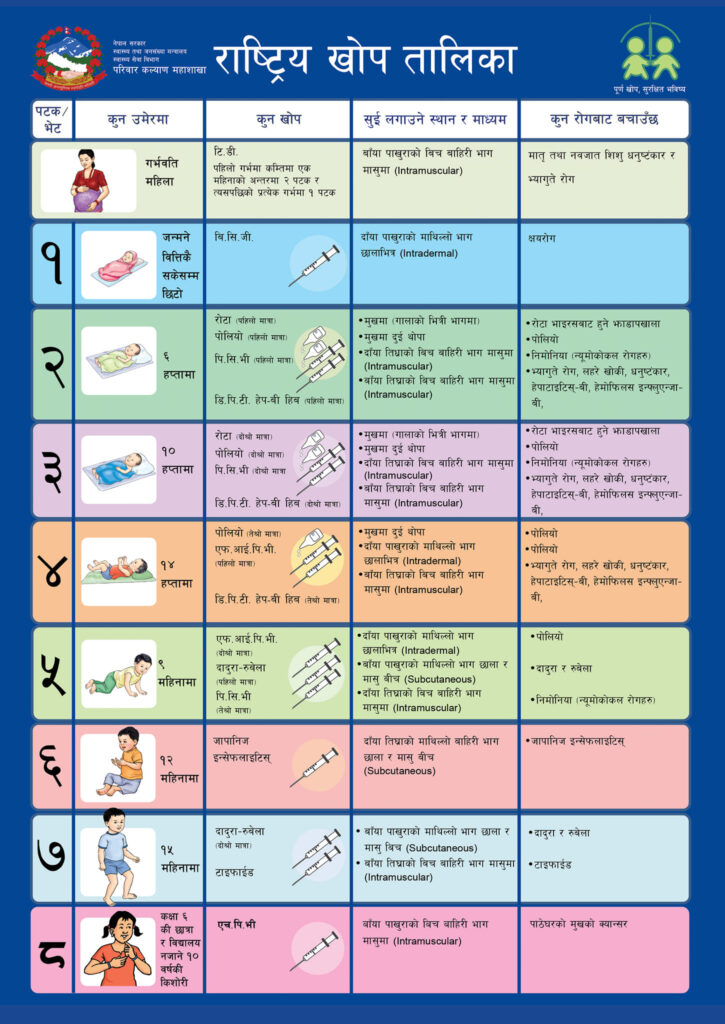
July 24, 2023 0 comments
0 FacebookTwitterPinterestLinkedinTumblrVKOdnoklassnikiRedditStumbleuponWhatsappTelegramLINEPocketSkypeViberEmail
Digital Mapping of Health INGOs in Nepal
DashboardFact SheetHealth in DataHealth Organization ProfilePublic Health Update

Digital Mapping of Health INGOs in Nepal

by Public Health Update July 21, 2023
written by Public Health Update

powered by Advanced iFrame


AIN Official Digital Mapping

Health INGOs in Nepal

  1. Action Against Hunger | Action Contre la Faim (ACF)      
  2. ADARA Group  
  3. ADRA Nepal                 
  4. AIDS Healthcare Foundation Nepal
  5. AMDA-MINDS   Japan  
  6. Safe Motherhood and Newborn Health (SMNH)
  7. Asia Foundation
  8. CARE Nepal      
  9. CBM Global
  10. CECI
  11. Childaid Network
  12. Community Action Nepal UK
  13. CRS
  14. Damien Foundation
  15. FAIRMED Foundation Nepal
  16. FHI 360 Nepal
  17. German Nepalese Help Association
  18. GNI
  19. Helen Keller International
  20. HI
  21. International Nepal Fellowship
  22. IPAS
  23. Lutheran World Relief (LWR)
  24. LWF Nepal
  25. Marie Stopes International
  26. MDM
  27. Mercy Corps Nepal
  28. Nick Simons Foundation International
  29. One Heart Worldwide
  30. Plan International
  31. PSI
  32. Save the Children
  33. Terre des hommes (Tdh) Foundation
  34. The Leprosy Mission Nepal
  35. UMN               
  36. VSO
  37. WaterAid                     
  38. Welthungerhilfe
  39. World Vision International
AIN Official Digital Mapping
July 21, 2023 0 comments
0 FacebookTwitterPinterestLinkedinTumblrVKOdnoklassnikiRedditStumbleuponWhatsappTelegramLINEPocketSkypeViberEmail
Call for Proposal, EOI & RFPNational Health NewsPublic Health NewsPublic Health OpportunitiesPublic Health Opportunity

Vacancy Announcement for Nurses [Nepal-UK G2G Agreement]

by Public Health Update July 20, 2023
written by Public Health Update

Nurse Recruitment Pilot: Application process goes live

1
Press release

The Department of Foreign Employment (DoFE) welcomes interested applicants to its online platform for the receipt of applications from eligible participants. The governments of the UK and Nepal have signed a Government-to-Government (G2G) agreement to begin a fair and ethical recruitment process of Nepali healthcare professionals to work in the UK’s health sector. The recruitment process will be undertaken only through DoFE’s online platform. DoFE is working closely with the UK’s Department of Health and Social Care’s (DHSC’s) designated entity on this recruitment.

F1hXEQhaEAAkKf3
Call for application

This platform serves as the only avenue for participating in the application and selection process. Through this platform interested applicants can see details on eligibility requirements, complete the application, as well as participate in the shortlisting and selection process. Successful candidates can then work through this platform to participate in the orientation and seek the final clearances for their move to the United Kingdom. This entire process will be handled through this platform. Participants are directed not to visit DoFE or approach any other third party. Any physical interaction, if required, will be communicated to the applicant through this platform (as well as email and SMS) once they are registered. Applicants are encouraged to send all their queries to uknursing@dofe.gov.np

Applications for the pilot phase of recruitment will open on July 20th and will close on October 19, 2023. Participants that meet the eligibility criteria can apply immediately, and those that need to complete some of the eligibility requirements can still begin the application process and upload their outstanding eligibility information before the application deadline of October 19th.

To start your registration and application process, please click here.

Applicant Requirements

The applicants to be recruited for the UK Nursing Initiative shall fulfil the following minimum set of requirements:

  • Be a Nepali citizen holding a valid Nepali passport. The passport must be valid for atleast one year during time of application for consideration for recruitment.
  • Have completed either of the following academic qualifications: Staff Nurse, Bachelor’s Degree in Nursing (BSc or BN), or Master’s degree in nursing from a recognised institution of the Government of Nepal or abroad.
  • Hold a valid professional license from the Nepal Nursing Council.
  • At least two years of recent professional experience in a registered hospital of Nepal at the time of application. Any work experience completed before 2019 shall not be considered.
  • Either of one following English language proficiency* :
    • For IELTS candidates require at least a score of 7 in the reading, listening and speaking sections, and a score of 6.5 in the writing section.
    • For OET, candidates require at least Grade B in reading, writing and listening sections, and Grade C+ in the writing section.

* Applicants can submit scores of up to two tests taken with in a year. They will have the benefit of combining the best score in each band among the two tests increasing their chances of meeting the English language requirement.

Other desirable requirements will include:

  • Experience in a variety of clinical settings
  • Evidence of Continuing Professional Development (CPD) during the past 24 months
  • Experience of a range of other clinical competencies (for example, venepuncture, male catheterisation, current tissue viability, IV administration, blood transfusion)

Note: While completing the application, please provide as much information in your application about your role as you can. While responding to these desirable requirements, include the types of patients you have looked after, clinical areas you have worked in, nurse to patient ratio, responsibilities, etc. This is your chance to tell us about your experience as a nurse.

Applicants are strongly encouraged to read the Implementation Protocol and DoFE Operating Procedures to fully understand the recruitment process.

NOTE OF CAUTION

No other UK or Nepali employer or recruitment agency is permitted to carry out active health worker recruitment activities in Nepal under this G2G agreement. Please refrain from engaging with any third parties. Please direct all your questions through the platform above. Selected nurses will not incur any fees for the recruitment. For successful candidates, the main costs associated with the recruitment purpose will be reimbursed or paid for.

appflowchart
Application process

More information

  • Nepal-UK G2G Agreement and Implementation Protocol
  • Participating UK NHS Trusts/Hospitals
  • Applicant Requirements
  •  Application Process Flowchart
  • Online Application
  • English Language Testing Information
  • IELTS
  • OET
  • CBT Testing Information and Centre
  • Interviews and Orientation Centre
  • Frequently Asked Questions
  • Key Guidance for Health Workers Moving to the UK
  • Nepalese Nursing Association UK
  • Nursing Role Information Sheet
To start your registration and application process, please click here.

Please visit official website for more information: https://ferms.dofe.gov.np/home


Do you have a website? Looking for the best hosting provider? Here’s a discount code.

Latest Public Health Jobs

Latest Posts

  • World Water Day 2026 | Water & Gender Equality
  • Nepal Antimicrobial Resistance (AMR) Bulletin FY 2081/82
  • Call for applications! Short Course on Qualitative Research Methods in Public Health, 2026
  • World Obesity Day 2026 | 8 Billion Reasons to Act on Obesity
  • Salim Yusuf Emerging Leaders Programme 2026

Thanks for visiting us.
Disclaimer: The resources, documents, guidelines, and information on this blog have been collected from various sources and are intended for informational purposes only. Information published on or through this website and affiliated social media channels does not represent the intention, plan, or strategies of an organization that the initiator is associated with in a professional or personal capacity, unless explicitly indicated.
If you have any complaints, information, or suggestions about the content published on Public Health Update, please feel free to contact us at blog.publichealthupdate@gmail.com.
#StayUpdated


  • WordPress
  • Link
  • Facebook
  • Mail
  • Facebook
  • Twitter
  • Twitter
  • LinkedIn
  • Instagram
  • Facebook
July 20, 2023 0 comments
0 FacebookTwitterPinterestLinkedinTumblrVKOdnoklassnikiRedditStumbleuponWhatsappTelegramLINEPocketSkypeViberEmail
Situation updates of Dengue in Nepal
Fact SheetGlobal Health NewsHealth in DataOutbreak NewsPublic Health NewsPublic Health UpdateVector-Borne Diseases(VBDs)World News

Situation update of Dengue in Nepal (As of 15 July, 2023)

by Public Health Update July 19, 2023
written by Public Health Update

Overview

Dengue is a viral infection transmitted to humans through the bite of infected Aedes mosquitoes. Dengue is widespread throughout the tropics, with local variations in risk influenced by climate parameters as well as social and environmental factors. Dengue is caused by a virus of the Flaviviridae family and there are four distinct, but closely related, serotypes of the virus that cause dengue (DENV-1, DENV-2, DENV-3 and DENV-4).

Step wise approach for Dengue Case Management

Dengue has become a rapidly growing concern in Nepal. The country has actively conducted vector surveillance in various districts, revealing the presence of Aedes aegypti and Aedes albopictus mosquitoes, which are known vectors for dengue transmission. Nepal has a historical record of all four dengue serotypes circulating, but in 2022, DENV-1 and DENV-3 were the most prevalent, with no evidence of DENV-4. In that same year, Nepal reported 54,784 dengue cases and 88 deaths, marking the highest number ever recorded in the country. This figure was more than three times the number of cases reported in 2019.

Screen Shot 2023 07 19 at 20.34.20
Trend of dengue cases in Nepal (2004-2023), EWARS and Line-Listing from Districts (as of 15 July 2023), Situation updates of Dengue as of Jan _ 15 July, 2023 (EDCD)

2023 Update

As of 15 July, 2023 a total of 2930 dengue cases have been identified from 68 districts, with Koshi province reporting highest number (1746), followed by Bagmati province (468) and Sudurpaschim Province (279).

Screen Shot 2023 07 19 at 20.34.43
Number of Dengue cases by Province, EWARS and Line-Listing from Districts (as of 15 July 2023), Situation updates of Dengue as of Jan _ 15 July, 2023 (EDCD)
Screen Shot 2023 07 19 at 20.34.58
EWARS and Line-Listing from Districts (as of 15 July 2023), Situation updates of Dengue as of Jan _ 15 July, 2023 (EDCD)
National Guideline on Prevention,  Management and Control of Dengue in Nepal

Interventions and Activities conducted for Dengue Prevention and Control

  • The comprehensive Action Plan on Dengue Prevention and Control has been developed by EDCD, which has been disseminated to all provinces, districts and local levels.
  • EDCD has been conducting routine surveillance of dengue cases through the Early Warning and Reporting System (EWARS). The line-lists of Dengue cases have been shared with 92 local levels in 66 districts to initiate timely response.
  • A Clinical Seminar on Dengue with a focus on clinical case management was recently organized by EDCD . The seminar brought together international experts in Dengue, and it saw the participation of over 110 doctors and nurses.
  • The EDCD is actively conducting a series of sensitization meetings with stakeholders from different workplaces to raise awareness about Dengue Prevention and Control. The EDCD has successfully completed sensitization meetings with the Auto-mechanic Proprietors’ Association of Nepal and the Nepal Recollection and Recyclers’ Association (Kawadi)
  • The Ministry of Health and Population (MOHP) has initiated a campaign encouraging all public offices to conduct a cleanliness campaign in their office premises for at least 10 minute on every Friday at 10:30 am.
  • In collaboration with NHEICC, EDCD has created a flyer for dengue prevention and control, which is regularly distributed through online and social media channels
  • Dengue test diagnostic kits are being supplied to provinces and districts on a need basis.
  • A joint program review of vector-borne diseases, including dengue, was undertaken by a team of national and international experts. This review assessed the issues and challenges related to dengue prevention and control, and identified the key priorities for action.
  • EDCD is maintaining a regular communication and collaboration with relevant levels, partners, and stakeholders to enhance the recording, reporting, and response to dengue.

Download PDF File


Recommended readings

  • Step wise approach for Dengue Case Management
  • National Guideline on Prevention,  Management and Control of Dengue in Nepal
  • Prevention & Control of Dengue Fever

Do you have a website? Looking for the best hosting provider? Here’s a discount code.

Latest Public Health Jobs

Latest Posts

  • World Water Day 2026 | Water & Gender Equality
  • Nepal Antimicrobial Resistance (AMR) Bulletin FY 2081/82
  • Call for applications! Short Course on Qualitative Research Methods in Public Health, 2026
  • World Obesity Day 2026 | 8 Billion Reasons to Act on Obesity
  • Salim Yusuf Emerging Leaders Programme 2026

Thanks for visiting us.
Disclaimer: The resources, documents, guidelines, and information on this blog have been collected from various sources and are intended for informational purposes only. Information published on or through this website and affiliated social media channels does not represent the intention, plan, or strategies of an organization that the initiator is associated with in a professional or personal capacity, unless explicitly indicated.
If you have any complaints, information, or suggestions about the content published on Public Health Update, please feel free to contact us at blog.publichealthupdate@gmail.com.
#StayUpdated


  • WordPress
  • Link
  • Facebook
  • Mail
  • Facebook
  • Twitter
  • Twitter
  • LinkedIn
  • Instagram
  • Facebook
July 19, 2023 0 comments
0 FacebookTwitterPinterestLinkedinTumblrVKOdnoklassnikiRedditStumbleuponWhatsappTelegramLINEPocketSkypeViberEmail
National Health care Quality Assurance Framework
Health SystemsNational Plan, Policy & GuidelinesQuality Improvement & Infection PreventionResearch & Publication

National Health care Quality Assurance Framework

by Public Health Update June 23, 2023
written by Public Health Update

The Ministry of Health and Population (MoHP) Nepal has released the National Health Care Quality Assurance Framework to provide guidance for policymakers, program managers, and health planners at the national, district, and facility levels. It is also intended for maternal and newborn health professionals, non-governmental organizations (NGOs), including private-sector health organizations involved or interested in the provision of maternal and newborn health services, as well as community organizations interested in improving the quality of health services. This Framework serves as a toolkit or an umbrella, which brings together and organizes the full range of evidence-based quality policies, standards, guidelines, protocols, tools, and practices in a single framework and provides necessary guidance and direction.

Purpose

  • To improve performance, reduce risk and achieve sustainable growth
  • To ensure high quality, effective, accountable, and evidence-based services
  • To measure the impact of service provision on both client, family, and community
  • To meet national and local performance standards
  • To contribute to the development of an organization-wide culture of ongoing quality assurance and quality improvement
  • To support high-quality governance standards
  • To link to strategic plans and initiatives (local, province, and federal government.

Commonly used QI tools/approaches in the Health Sector

  • Minimum Service Standards
  • Quality Improvement Tools
  • POCQI – Point of Care Quality Improvement Hospitals
  • Standard Treatment Guidelines and Protocols
  • Coaching and Mentoring Tool for MNH Service Providers
  • Client Feedback Tools/Mechanisms
  • Review Meetings (including focused review e.g., MPDSR)
  • MNH Readiness QI tool for Hospital
  • MNH Readiness QI tool for Birthing Center
  • Robson Implementation guideline
  • QI tool for Skilled Birth Attendant (SBA) and Mid-Level Practicum (MLP) Training Sites

Quality of care (six domains)

Screen Shot 2023 06 23 at 22.38.01
Quality of care (six domains)

Key roles for quality assurance and monitoring mechanisms

Federal Level

MoHP (Quality Assurance and Regulation Division)

  • Preparing, reviewing, and facilitating implication of national quality assurance policies and guidelines
  • Establishing service standards and monitoring for all services and types of facilities
  • Guidance and monitoring of the quality of services being delivered by all types of health facilities
  • Review and monitoring of service provision and quality of services delivered
  • Establishing quality standards for drugs, commodities, equipment, and medical supplies
  • Ensuring requirements as per the International Health Regulation (IHR)
  • Facilitating registration, renewal, and monitoring of health facilities based on their established criteria and norms.

DoHS

  • Facilitating implementation, monitoring, and review of the delivery of health services and quality of those services
  • Supporting MoHP in preparation of quality-of-care related policies, protocols, and guidelines of MoHP
  • Ensuring delivery of essential services by all basic health care facilities and other services as per the protocol and health policies.

Divisions/ Centers

  • Developing program-specific technical guidance and protocols to ensure preparedness and delivery of health services.

Province Level

MoSD/MoHP

  • Prepare and implement provincial policies, acts, quality standards, and implementation guidelines
  • Ensure delivery of essential services by all facilities and other services as per the policy and protocols
  • Facilitate registration, operation, listing, and regulation of private and cooperative health facilities as per the policy and protocols
  • Facilitate production, and use of health-related commodities, medicines and ensuring the quality of imported medicines and commodities.

Directorate/ Centers

  • Management of logistics and supply chain system of medicines, health commodities, and supplies
  • Facilitate implementation, monitoring, and review of the delivery of health services and quality of those services by provincial-level health facilities
  • Facilitate dissemination and implementation of program[1]specific technical guidance and protocols.

Health Offices (district level)

  • Coordinate with the municipal, district, and provincial level authorities to ensure delivery of health services as per the policy and protocol.

Local Level

Municipality

  • Ensure delivery of basic health and sanitation services as per the federal, provincial, and local health policies, standards, and protocols
  • Facilitate dissemination of information for public awareness and demand creation
  • Coordinate with other sections/sectors to create clean, healthy, and resilient societies

Hospital/Health Facility

  • Deliver basic health services as outlined in federal, provincial, and local health policies and by ensuring national standards and protocols.

Download: Nepali, English


Do you have a website? Looking for the best hosting provider? Here’s a discount code.

Latest Public Health Jobs

Latest Posts

  • World Water Day 2026 | Water & Gender Equality
  • Nepal Antimicrobial Resistance (AMR) Bulletin FY 2081/82
  • Call for applications! Short Course on Qualitative Research Methods in Public Health, 2026
  • World Obesity Day 2026 | 8 Billion Reasons to Act on Obesity
  • Salim Yusuf Emerging Leaders Programme 2026

Thanks for visiting us.
Disclaimer: The resources, documents, guidelines, and information on this blog have been collected from various sources and are intended for informational purposes only. Information published on or through this website and affiliated social media channels does not represent the intention, plan, or strategies of an organization that the initiator is associated with in a professional or personal capacity, unless explicitly indicated.
If you have any complaints, information, or suggestions about the content published on Public Health Update, please feel free to contact us at blog.publichealthupdate@gmail.com.
#StayUpdated


  • WordPress
  • Link
  • Facebook
  • Mail
  • Facebook
  • Twitter
  • Twitter
  • LinkedIn
  • Instagram
  • Facebook
June 23, 2023 0 comments
0 FacebookTwitterPinterestLinkedinTumblrVKOdnoklassnikiRedditStumbleuponWhatsappTelegramLINEPocketSkypeViberEmail
Nepal Demographic and Health Survey 2022 [Key Findings]
Fact SheetGlobal Health NewsHealth in DataPublic HealthReportsResearch & Publication

Nepal Demographic and Health Survey 2022 [Key Findings]

by Public Health Update June 23, 2023
written by Public Health Update

The 2022 Nepal Demographic and Health Survey (NDHS) provides data for monitoring the population and health situation in Nepal to inform strategic planning and program evaluation. The 2022 DHS is the 6th Demographic and Health Survey conducted in Nepal since 1996.

655d7ee1 0a3a 470a 8d55 8b790f2d14f7
Nepal Demographic and Health Survey 2022 @DHSprogram

Household and Respondent Characteristics & Household Water and Sanitation

  • Forty-four (44%) of women & 53% of men age 15-49 have some secondary education or higher. Still, 26% of women and 8% of men have no education.
  • More girls than boys attend school in Nepal. For every 100 boys who attend lower basic school, 105 girls are attending lower basic school.
  • Nighty eight (98%) of the population in Nepal has at least basic drinking water service.
  • Seventy-three (73%) of the population has access to at least basic sanitation service, nearly double from 40% in 2011.
  • Sixty-one (61%) of women with a menstrual period in the last year used appropriate materials & were able to wash & change in privacy.
GF56 1
Nepal Demographic and Health Survey 2022 @DHSprogram

Fertility and Family Planning

  • Women in Nepal have an average of 2.1 children (total fertility rate). Fertility has declined slightly from 2.3 children in 2016.
  • The contraceptive prevalence rate is 57% for married women age 15-49 – 43% use a modern method & 15% use a traditional method. The use of any Family Planning has increased from 53% in 2016.
  • The total demand for family planning among married women age 15-49 is 78%. 21% of married women have an unmet need for Family Planning. 55% of the demand for family planning is satisfied by modern methods.

Childhood Mortality

  • Infant & under-5 mortality rates for the 5-year period before the survey are 28 & 33 deaths per 1,000 live births, respectively. Neonatal deaths account for 3/4 of infant deaths, at 21 per 1,000 live births.
  • Under-5 mortality has declined in Nepal from 118 deaths per 1,000 live births in 1996 to 33 deaths per 1,000 live births in 2022.
GF56 2
Nepal Demographic and Health Survey 2022 @DHSprogram

Maternal and Newborn Health Care

  • Eighty-one (81%) of women age 15-49 attended 4+ antenatal care (ANC) visits, and 73% had their first ANC visit in the first trimester.
  • Seventy-Nine (79%) of live births are delivered in a health facility. Health facility deliveries have markedly improved from 57% in 2016 to 79% in 2022. Still, 19% of births are delivered at home.

Child Health

  • Eighty (80%) of children age 12-23 months are fully vaccinated against all basic antigens. Basic vaccination coverage has increased slightly from 78% in 2014.
  • Ten (10%) of children under 5 in Nepal had diarrhea in the 2 weeks before the survey. 48% of children under 5 with recent diarrhea received oral rehydration therapy, but 28% received no treatment.

Nutrition of Children and Women

  • Twenty-five (25%) of children under 5 are stunted, 8% are wasted, and 19% are underweight. The nutritional status of children has improved in the last 22 years.
  • Thirty-Five (35%) of Nepali women age 20-49 are overweight or obese and 10% are thin. Among adolescent women age 15-19, 6% are overweight or obese and 26% are thin.

Knowledge, Attitudes, and Behavior Related to HIV/AIDS

  • Three (3%) of women & 2% of men age 15-49 have been tested for HIV & received their results in the past 12 months.
  • Ten (10%) of women & 13% of men age 15-49 have ever been tested for HIV & received their results. Compared to 2016, the same number of women but fewer men were tested for HIV in 2022.

Domestic Violence

  • Twenty-three (23%) of women age 15-49 in Nepal have experienced physical violence since age 15. The most common perpetrator of physical violence against married women are current and former husbands/intimate partners.
  • Twenty-eight (28%) of women who have ever had a husband/intimate partner in Nepal have experienced intimate partner violence whether physical, sexual, or emotional by any current or previous husband/intimate partner.

Disability

  • Among adults age 15-49 in Nepal, 8% of women and 7% of men have a lot of difficulty or cannot function in more than one domain of disability.
  • Six (6%) of household members age 5 or older have a lot of difficulty or cannot do at all in at least one domain of disability. Difficulty seeing was the most commonly reported disability.

Accidents and Injuries

  • There are 14 deaths due to road traffic injuries per 100,000 population in Nepal. More men than women die due to road traffic injuries with 11 deaths per 100,000 men and 3 deaths per 100,000 women.
  • The most common type of road traffic accidents or crashes that occur in Nepal involve motorcycle accidents that account for 68% of those killed or injured in the 12 months preceding the survey.

Blood pressure

  • Eighteen (18%) of women and 23% of men age 15 and older have high blood pressure or hypertension. Among individuals age 60 and older, 46% of women and 42% of men have high blood pressure or hypertension.
  • Forty-eight (48%) of women and 52% of men age 15 and older with hypertension are unaware about their high blood pressure. 17% of women and 20% of men are aware about their condition but have not been treated.

Ministry of Health and Population [Nepal], New ERA, and ICF. 2023. Nepal Demographic and Health Survey 2022. Kathmandu, Nepal: Ministry of Health and Population [Nepal].

Download full report: Nepali and English


  • Nepal Demographic and Health Survey 2022
  • NEPAL DEMOGRAPHIC AND HEALTH SURVEY 2022 KEY INDICATORS REPORT
  • NEPAL DEMOGRAPHIC AND HEALTH SURVEY (NDHS) 2022 | KEY INDICATORS
  • KEY INDICATORS: THE NEPAL DEMOGRAPHIC AND HEALTH SURVEY (1996 NDHS- 2016 NDHS)
  • KEY FINDINGS (NEPALI & ENGLISH) – THE 2016 NEPAL DEMOGRAPHIC AND HEALTH SURVEY (2016 NDHS)
  • NEPAL DEMOGRAPHIC AND HEALTH SURVEY 2016 KEY INDICATORS REPORT
  • NEPAL DEMOGRAPHIC AND HEALTH SURVEY 2016 KEY INDICATORS REPORT (SHORT NOTES)
  • THE 2016 NEPAL DEMOGRAPHIC AND HEALTH SURVEY (2016 NDHS)
  • 2011 NEPAL DEMOGRAPHIC AND HEALTH SURVEY (NDHS)
June 23, 2023 0 comments
0 FacebookTwitterPinterestLinkedinTumblrVKOdnoklassnikiRedditStumbleuponWhatsappTelegramLINEPocketSkypeViberEmail
Nepal Demographic and Health Survey 2022
Public HealthReportsResearch & Publication

Nepal Demographic and Health Survey 2022

by Public Health Update June 23, 2023
written by Public Health Update

Introduction

The 2022 Nepal Demographic and Health Survey (NDHS) provides data for monitoring the population and health situation in Nepal to inform strategic planning and program evaluation. The 2022 DHS is the 6th Demographic and Health Survey conducted in Nepal since 1996. The 2022 Nepal Demographic and Health Survey (2022 NDHS) was implemented by New ERA under the aegis of the Ministry of Health and Population of Nepal. The funding for the NDHS was provided by the United States Agency for International Development (USAID). ICF provided technical assistance through The DHS Program, a USAID-funded project providing support and technical assistance in the implementation of population and health surveys in countries worldwide.

Objective

The primary objective of the 2022 NDHS is to provide up-to-date estimates of basic demographic and health indicators. Specifically, the 2022 NDHS collected information on fertility, marriage, family planning, breastfeeding practices, nutrition, food insecurity, maternal and child health, childhood mortality, awareness and behavior regarding HIV/AIDS and other sexually transmitted infections (STIs), women’s empowerment, domestic violence, fistula, mental health, accident and injury, disability, and other health- related issues such as smoking, knowledge of tuberculosis, and prevalence of hypertension.

The information collected through the 2022 NDHS is intended to assist policymakers and program managers in evaluating and designing programs and strategies for improving the health of Nepal’s population. The survey also provides indicators relevant to the Sustainable Development Goals (SDGs) for Nepal.

Key findings

Household and Respondent Characteristics & Household Water and Sanitation

  • Forty-four (44%) of women & 53% of men age 15-49 have some secondary education or higher. Still, 26% of women and 8% of men have no education.
  • More girls than boys attend school in Nepal. For every 100 boys who attend lower basic school, 105 girls are attending lower basic school.
  • Nighty eight (98%) of the population in Nepal has at least basic drinking water service.
  • Seventy-three (73%) of the population has access to at least basic sanitation service, nearly double from 40% in 2011.
  • Sixty-one (61%) of women with a menstrual period in the last year used appropriate materials & were able to wash & change in privacy.

Fertility and Family Planning

  • Women in Nepal have an average of 2.1 children (total fertility rate). Fertility has declined slightly from 2.3 children in 2016.
  • The contraceptive prevalence rate is 57% for married women age 15-49 – 43% use a modern method & 15% use a traditional method. The use of any Family Planning has increased from 53% in 2016.
  • The total demand for family planning among married women age 15-49 is 78%. 21% of married women have an unmet need for Family Planning. 55% of the demand for family planning is satisfied by modern methods.

Childhood Mortality

  • Infant & under-5 mortality rates for the 5-year period before the survey are 28 & 33 deaths per 1,000 live births, respectively. Neonatal deaths account for 3/4 of infant deaths, at 21 per 1,000 live births.
  • Under-5 mortality has declined in Nepal from 118 deaths per 1,000 live births in 1996 to 33 deaths per 1,000 live births in 2022.

Maternal and Newborn Health Care

  • Eighty-one (81%) of women age 15-49 attended 4+ antenatal care (ANC) visits, and 73% had their first ANC visit in the first trimester.
  • Seventy-Nine (79%) of live births are delivered in a health facility. Health facility deliveries have markedly improved from 57% in 2016 to 79% in 2022. Still, 19% of births are delivered at home.

Child Health

  • Eighty (80%) of children age 12-23 months are fully vaccinated against all basic antigens. Basic vaccination coverage has increased slightly from 78% in 2014.
  • Ten (10%) of children under 5 in Nepal had diarrhea in the 2 weeks before the survey. 48% of children under 5 with recent diarrhea received oral rehydration therapy, but 28% received no treatment.

Nutrition of Children and Women

  • Twenty-five (25%) of children under 5 are stunted, 8% are wasted, and 19% are underweight. The nutritional status of children has improved in the last 22 years.
  • Thirty-Five (35%) of Nepali women age 20-49 are overweight or obese and 10% are thin. Among adolescent women age 15-19, 6% are overweight or obese and 26% are thin.

Knowledge, Attitudes, and Behavior Related to HIV/AIDS

  • Three (3%) of women & 2% of men age 15-49 have been tested for HIV & received their results in the past 12 months.
  • Ten (10%) of women & 13% of men age 15-49 have ever been tested for HIV & received their results. Compared to 2016, the same number of women but fewer men were tested for HIV in 2022.

Domestic Violence

  • Twenty-three (23%) of women age 15-49 in Nepal have experienced physical violence since age 15. The most common perpetrator of physical violence against married women are current and former husbands/intimate partners.
  • Twenty-eight (28%) of women who have ever had a husband/intimate partner in Nepal have experienced intimate partner violence whether physical, sexual, or emotional by any current or previous husband/intimate partner.

Disability

  • Among adults age 15-49 in Nepal, 8% of women and 7% of men have a lot of difficulty or cannot function in more than one domain of disability.
  • Six (6%) of household members age 5 or older have a lot of difficulty or cannot do at all in at least one domain of disability. Difficulty seeing was the most commonly reported disability.

Accidents and Injuries

  • There are 14 deaths due to road traffic injuries per 100,000 population in Nepal. More men than women die due to road traffic injuries with 11 deaths per 100,000 men and 3 deaths per 100,000 women.
  • The most common type of road traffic accidents or crashes that occur in Nepal involve motorcycle accidents that account for 68% of those killed or injured in the 12 months preceding the survey.

Blood pressure

  • Eighteen (18%) of women and 23% of men age 15 and older have high blood pressure or hypertension. Among individuals age 60 and older, 46% of women and 42% of men have high blood pressure or hypertension.
  • Forty-eight (48%) of women and 52% of men age 15 and older with hypertension are unaware about their high blood pressure. 17% of women and 20% of men are aware about their condition but have not been treated.

Download dataset

Download Full report (English)

Download Summary report (Nepali)


  • NEPAL DEMOGRAPHIC AND HEALTH SURVEY 2022 KEY INDICATORS REPORT
  • NEPAL DEMOGRAPHIC AND HEALTH SURVEY (NDHS) 2022 | KEY INDICATORS
  • KEY INDICATORS: THE NEPAL DEMOGRAPHIC AND HEALTH SURVEY (1996 NDHS- 2016 NDHS)
  • KEY FINDINGS (NEPALI & ENGLISH) – THE 2016 NEPAL DEMOGRAPHIC AND HEALTH SURVEY (2016 NDHS)
  • NEPAL DEMOGRAPHIC AND HEALTH SURVEY 2016 KEY INDICATORS REPORT
  • NEPAL DEMOGRAPHIC AND HEALTH SURVEY 2016 KEY INDICATORS REPORT (SHORT NOTES)
  • THE 2016 NEPAL DEMOGRAPHIC AND HEALTH SURVEY (2016 NDHS)
  • 2011 NEPAL DEMOGRAPHIC AND HEALTH SURVEY (NDHS)
June 23, 2023 0 comments
0 FacebookTwitterPinterestLinkedinTumblrVKOdnoklassnikiRedditStumbleuponWhatsappTelegramLINEPocketSkypeViberEmail
Nepal Health Sector Strategic Plan 2023-2030
Health SystemsNational Plan, Policy & GuidelinesPublic HealthPublic Health UpdateResearch & Publication

Nepal Health Sector Strategic Plan 2023-2030

by Public Health Update June 5, 2023
written by Public Health Update

The Government of Nepal has endorsed the Nepal Health Sector Strategic Plan 2023-2030 (2079/80–2087/88). Here is the official version of the approved document.

Vision, Mission and Goal of Nepal Health Sector Strategic Plan 2023-2030

Vision: Healthy, productive, responsible and happy citizens

Mission: Ensure fundamental health rights of the citizens

Goal: Improved health status of every citizen

Guiding principles

This strategic plan adopts following guiding principles aligning with the National Health Policy 2019:

  • Universal access and social protection in health
  • Aligned and coordinated health systems
  • Multi-sectoral collaboration and health in all policies
  • Targeted approach to reach marginalised and vulnerable population
  • Public investments and governance
  • Professionalism and ethical practice
Strategic objectives, outcomes, outputs and interventions

This strategic plan has adopted five strategic objectives, fourteen outcomes, and 29 outputs to be achieved during the period of 2022-2030.

  1. Strategic objective 1. Enhance efficiency and responsiveness of health system
  2. Strategic objective 2. Address wider determinants of health
  3. Strategic objective 3. Promote sustainable financing and social protection in health
  4. Strategic objective 4. Promote equitable access to quality health services
  5. Strategic objective 5. Manage population and migration
Outcomes
  1. OC 1.1. Skill-mixed human resources for health produced and mobilized
  2. OC 1.2. Evidence- and equity-based planning
  3. OC 1.3. Safe and people friendly health infrastructures
  4. OC1.4. Ensured uninterrupted availability of quality medicine and supplies
  5. OC1.5. Improved governance, leadership, and accountability
  6. OC1.6. Public health emergencies managed effectively
  7. OC2.1. Reduced adverse effects of wider determinants on health
  8. OC2.2. Citizens responsible for their own, family and community health
  9. OC3.1. Improved public investment in health sector
  10. OC3.2. Improved social protection in health
  11. OC4.1. Improved quality of health services
  12. OC4.2. Reduced inequity in health services
  13. OC5.1. Maximized demographic dividend and managed demographic transitions
  14. OC5.2. Systematic migration and planned settlement practiced

DOWNLOAD PDF FILE

DOWNLOAD PDF FILE


  • Gender Equality and Social Inclusion (GESI) Strategy of Health Sector 2080
    Date
    January 1, 2024
  • DoHS Annual Health Report 2079/80
    Date
    February 27, 2024
  • Strategic Framework for improving newborn and child health in the South-East Asia Region (‎2024–2030)‎
    Date
    October 15, 2024
June 5, 2023 0 comments
0 FacebookTwitterPinterestLinkedinTumblrVKOdnoklassnikiRedditStumbleuponWhatsappTelegramLINEPocketSkypeViberEmail
World Health Day 2023: 75 years of improving public health
Global Health NewsNational Health NewsPH Important DayPublic Health EventsPublic Health NewsWorld News

World Health Day 2023: 75 years of improving public health

by Public Health Update April 1, 2023
written by Public Health Update

Overview

The World Health Organization will complete 75 years on April 7, 2023 – World Health Day. Countries joined efforts in 1948, to establish WHO to promote health, keep the world safe and serve the vulnerable – so everyone, everywhere can attain the highest level of health and well-being. On 7 April 2023, World Health Day, the World Health Organization will observe its 75th anniversary.

WHO has been working with Member States in the Region for addressing challenges, promoting Health for All, and building robust and resilient health systems. Today, the Region has eight flagship priority programmes, which are aligned to WHO’s global goals and the UN Sustainable Development Goals. 

World Health Day 2023 theme: Health For All

For the public: Demand your right to access the health services you need without falling into financial hardship!

  • Health For All envisions that all people have good health for a fulfilling life in a peaceful, prosperous, and sustainable world.
  • The right to health is a basic human right. Everyone must have access to the health services they need when and where they need them without financial hardship.
  • 30% of the global population is not able to access essential health services.
  • Almost two billion people face catastrophic or impoverishing health spending, with significant inequalities affecting those in the most vulnerable settings.
  • Universal health coverage (UHC) offers financial protection and access to quality essential services, lifts people out of poverty, promotes the well-being of families and communities, protects against public health crises, and moves us toward #HealthForAll.
  • To make health for all a reality, we need: individuals and communities who have access to high quality health services so that they can take care of their own health and that of their families; skilled health workers providing quality, people-centred care; and policy-makers committed to investing in universal health coverage.
  • Evidence shows that health systems powered by a primary health care (PHC) approach is the most effective and cost-effective way to bring services for health and well-being closer to people.
  • COVID-19 set back every country’s journey to #HealthForAll.
  • COVID-19 and other health emergencies, overlapping humanitarian and climate crises, economic constraints, and war, have made every country’s journey to #HealthForAll more urgent. Now is the time for leaders to take action to meet their universal health coverage commitments and for civil society to hold leaders accountable.
  • Progress needs to be accelerated if health-related SDGs are to be met.

For Member States

  • A blue circle with a blue plus sign in the center of it.
  • Investing in strong health systems is critical for a prosperous society. Increasing public financing for health and lowering out-of-pocket health costs saves lives while advancing the Sustainable Development Goals beyond health.
  • A blue circle with a blue plus sign in the center of it.
  • Strong health systems are needed to deliver both universal health coverage and emergency preparedness.
  • A blue circle with a blue plus sign in the center of it.
  • Universal health coverage is a political and social choice. We need strong political leadership and public demand.
  • A blue circle with a blue plus sign in the center of it.
  • Healthy living environments can transform people’s lives.
  • A blue circle with a blue plus sign in the center of it.
  • WHO recommends increases in “health taxes” on tobacco, alcohol, added sugar, and fossil fuels. These taxes bring in much needed public revenues.
  • A blue circle with a blue plus sign in the center of it.
  • Between 2023-2030 there is a projected shortfall of 10 million health workers worldwide. Investment in education and job creation for the health sector is needed.

ACTION POINTS

  • A square with a green check mark in it.
  • Shift from economies driven by profit and pollution to economies driven by fairness and well-being.
  • A square with a green check mark in it.
  • Success must be measured by the well-being of people and healthy environments.
  • A square with a green check mark in it.
  • Engage and empower individuals, families and communities for increased social participation and enhanced self-care in health. Ensure informed and active participation, with people at the center of health decisions and outcomes.
  • A square with a green check mark in it.
  • Strengthen integrated national health systems using a PHC approach to deliver essential quality services with financial protection, with equity-oriented, gender-sensitive and rights-based programming to reach and engage those in greatest need and improve the health and well-being of all people at all ages.
  • A square with a green check mark in it.
  • Enable non-State actors to participate in government-led planning, progress reviews or implementation towards UHC.
READ MORE
WHO OFFICIAL WEBSITE

  • WORLD HEALTH DAY 2022: OUR PLANET, OUR HEALTH
  • WORLD HEALTH DAY
  • WORLD HEALTH DAY 2021: BUILDING A FAIRER, HEALTHIER WORLD FOR EVERYONE
  • WORLD HEALTH DAY 2020: #SUPPORTNURSESANDMIDWIVES #COVID19
  • WORLD HEALTH DAY 2019 MARKED IN NEPAL
  • WORLD HEALTH DAY : HEALTH FOR ALL – EVERYONE, EVERYWHERE
  • WORLD HEALTH DAY 2018 (#WORLDHEALTHDAY) MARKED
  • WORLD HEALTH DAY 2018: 70TH ANNIVERSARY YEAR OF WHO
  • KEY MESSAGES FOR WORLD HEALTH DAY 2018
  • DEPRESSION: LET’S TALK – 7 APRIL 2017 | WORLD HEALTH DAY
  • WORLD HEALTH DAY 2016: BEAT DIABETES : ACTIVITIES @ POKHARA
  • WORLD HEALTH DAY 2016 : BEAT DIABETES: SCALE UP PREVENTION, STRENGTHEN CARE, AND ENHANCE SURVEILLANCE
  • WORLD HEALTH DAY-2014 (SMALL BITE : BIG THREAT)
  • WORLD HEALTH DAY 2015: FOOD SAFETY
  • WORLD HEALTH DAY 2012 – ”AGEING AND HEALTH: GOOD HEALTH ADDS LIFE TO YEARS”
April 1, 2023 0 comments
0 FacebookTwitterPinterestLinkedinTumblrVKOdnoklassnikiRedditStumbleuponWhatsappTelegramLINEPocketSkypeViberEmail
National Population and Housing Census 2021: A Report on Maternal Mortality
Fact SheetHealth in DataMaternal, Newborn and Child HealthPublic HealthPublic Health UpdateReportsResearch & Publication

National Population and Housing Census 2021: A Report on Maternal Mortality

by Public Health Update March 27, 2023
written by Public Health Update

Overview

The Sustainable Development Goals include the target of reducing the global maternal mortality ratio (MMR) to less than 70 per 100,000 live births, with no country having an MMR that exceeds twice the global average. Nepal has committed to reduce
the MMR from 281 per 100,000 live births in 2006 to 116 by 2022, 99 by 2025, and 70 by 2030. This Nepal Maternal Mortality Study 2021 is the first ever joint undertaking of the Ministry of Health and Population (MoHP), the National Statistics Office (NSO), the Nepal Health Research Council, and health development partners for estimating the MMR and identifying the causes of maternal deaths – during pregnancy, delivery, and postpartum periods – in Nepal. By doing so, it intends to inform evidence-based policies and programs at the federal, provincial, and local levels.

Brief Methodology

The MoHP, in collaboration with the NSO, made an arrangement through a Memorandum of Understanding, where the census enumerators, as a part of their regular work, collected data on live births and deaths of women of reproductive age (WRA) in the enumerated households for the last 12 months preceding the National Population and Housing Census 2021. In the first phase, those Census enumerators then completed the death notification forms to identify pregnancy-related deaths, and submitted them to the census supervisor and notified the deaths to the pre-identified and trained local level health workers. In the second phase of the study, the local level health workers visited the household of each of the deceased women, verified the information and identified the pregnancy related deaths. For each pregnancy-related death identified, a verbal autopsy was conducted by trained health workers using the verbal autopsy form.

Major Findings

The MMR was found to be 151 per 100,000 live births in Nepal.

The MMR was found to be 151 per 100,000 live births in Nepal, with higher ratios in the Lumbini and Karnali provinces (207 and 172 per 100,000 live births respectively) and a lowest ratio in the Bagmati province (98 per 100,000 live births). Of the 12,976 deaths among women of reproductive age (15-49 years), 653 were pregnancy-related, comprising five percent of the total deaths in this age group.

  • Of the 653 pregnancy-related deaths, 622 (95 percent) were classified as maternal deaths. The overall proportion of maternal deaths among the deaths of women of reproductive age was 4.8 percent. Only 611 maternal deaths were analysed further for causes and other attributes due to lack of sufficient information for 11 maternal deaths.
  • The majority of the maternal deaths occurred in the postpartum period (61 percent), while thirty-three percent occurred during pregnancy and six percent during delivery. Nearly half of the deaths (47 percent) were reported in the Lumbini and Madhesh provinces. One in ten maternal deaths was among adolescent mothers. The majority of the deaths (57 percent) occurred in health facilities, whereas 26 percent occurred at home.
  • Out of 412 women who died during delivery and postpartum period, fifty-three percent had attended all four antenatal care visits; while of the 173 women who died between 7-42 days of delivery 45 percent had attended all three postnatal care visits as per the protocol.
  • Among the women who had died during delivery and in the postpartum period, over three-fourth (76 percent) had delivered at health facilities. Among those, 62 percent had delivered at government facilities while 38 percent at non- government health facility.
  • Twenty-seven percent of women who died during the postpartum period had excessive bleeding, 23 percent had experienced dizziness and fainting, and 12 percent had been afflicted by fits and seizures. Eighty- three percent of the deceased had sought treatment for illness at a health facility or other place before death. Among those who did not seek treatment, nearly half did not consider it necessary (48%).
  • The largest cause of maternal death was found to be non-obstetric complications (indirect maternal deaths) (32 percent). This was followed by obstetric haemorrhage (26 percent) and hypertensive disorders (12 percent). Five percent of the deaths were attributable to pregnancies with abortive outcomes. The leading causes of death during pregnancy were observed to be non-obstetric complications (40 percent), followed by direct deaths without obstetric codes (17 percent), and hypertensive disorders (14 percent). On the other hand, more than three quarters (78 percent) of deaths during delivery were attributable to obstetric haemorrhage. For deaths during the postpartum period, nearly a third were due to obstetric haemorrhage and non- obstetric complications (31 percent each).
  • In connection to the “Three Delays” that lead to pregnancy-related mortality, a majority (74 percent) of the deceased women had experienced at least one type of delay, while 17 percent had experienced all three delays.
  • The most common was the delay in seeking appropriate care (57 percent), followed by delay in receiving appropriate care (40 percent), and delay in reaching the healthcare facility for care (33 percent).
20
21
Conclusion
  • In conclusion, the study showed that many maternal deaths in Nepal are due to preventable causes such as haemorrhage and high blood pressure during pregnancy, but a significant number are also caused by non- obstetric complications such as intentional self-harm. It highlighted the importance of improving the quality of maternal health services in health facilities and strengthening referral mechanisms, emergency transportation, and early screening for danger signs.
  • In addition of its potential to strengthen community-based maternal death surveillance and response in the country, the NMMS 2021 also sets a precedent for conducting nationwide censuses of maternal deaths in future censuses to estimate the MMR and identify causes of death.

[Excerpt from Executive summary]

Download Report: National Population and Housing Census 2021: A Report on Maternal Mortality


Recommended readings

  • Key Indicators: The Nepal Demographic and Health Survey (1996 NDHS- 2016 NDHS)
  • The 2016 Nepal Demographic and Health Survey (2016 NDHS)
  • Nepal Multiple Indicator Cluster Survey 2019 (NMICS 2019): Key findings
  • Organogram and Reporting Mechanism of Nepalese Health System in Federal Context
  • The 2015 Nepal Health Facility Survey: Further Analysis Reports
  • Key findings – The 2015 Nepal Health Facility Survey (2015 NHFS)
  • Nepal Health Facility Survey (2015 NHFS) Preliminary Report
  • Health Facility Operation and Management Committee- A reference guideline for local level
  • Nepal Health Facility Registry, MoHP
  • Health Facility Operation Standards, 2077
  • Health Facility Quality Improvement Module (QI Tool) for Health Services Strengthening
March 27, 2023 0 comments
0 FacebookTwitterPinterestLinkedinTumblrVKOdnoklassnikiRedditStumbleuponWhatsappTelegramLINEPocketSkypeViberEmail
Body Mass Index (BMI) Calculator | Calculate Your Body Mass Index
DashboardLife Style & Public Health NutritionPublic HealthPublic Health Tools

Body Mass Index (BMI) Calculator | Calculate Your Body Mass Index

by Public Health Update March 6, 2023
written by Public Health Update

Body Mass Index (BMI)

Body mass index (BMI) is a measure of body fat based on height and weight that applies to adult men and women. BMI is a simple index of weight-for-height that is commonly used to classify overweight and obesity in adults. It is defined as a person’s weight in kilograms divided by the square of his height in meters (kg/m2).

BMI is derived from a person’s weight in kilograms, divided by height (squared) in centimetres. The recommended levels are adapted from the global WHO recommendation of 18.5–24.9 as a normal BMI.

For adults over 20 years old, BMI falls into one of the following categories.

Nutritional status

BMINutritional status
Below 18.5Underweight
18.5–24.9Normal weight
25.0–29.9Pre-obesity
30.0–34.9Obesity class I
35.0–39.9Obesity class II
Above 40Obesity class III
BMI: Nutritional status

BMI Calculator

BMI Calculator
Inch Calculator LogoInch Calculator

World Health Organization (WHO) recommendations for a healthy lifestyle

To ensure a healthy lifestyle, WHO recommends eating lots of fruits and vegetables, reducing fat, sugar and salt intake and exercising. Based on height and weight, people can check their body mass index (BMI) to see if they are overweight. WHO provides a series of publications to promote and support healthy lifestyles.

12 steps to healthy eating
  1. Eat a nutritious diet based on a variety of foods originating mainly from plants, rather than animals.
  2. Eat bread, whole grains, pasta, rice or potatoes several times per day.
  3. Eat a variety of vegetables and fruits, preferably fresh and local, several times per day (at least 400g per day).
  4. Maintain body weight between the recommended limits (a BMI of 18.5–25) by taking moderate to vigorous levels of physical activity, preferably daily.
  5. Control fat intake (not more than 30% of daily energy) and replace most saturated fats with unsaturated fats.
  6. Replace fatty meat and meat products with beans, legumes, lentils, fish, poultry or lean meat.
  7. Use milk and dairy products (kefir, sour milk, yoghurt and cheese) that are low in both fat and salt.
  8. Select foods that are low in sugar, and eat free sugars sparingly, limiting the frequency of sugary drinks and sweets.
  9. Choose a low-salt diet. Total salt intake should not be more than one teaspoon (5g) per day, including the salt in bread and processed, cured and preserved foods. (Salt iodization should be universal where iodine deficiency is a problem)
  10. WHO does not set particular limits for alcohol consumption because the evidence shows that the ideal solution for health is not to drink at all, therefore less is better.
  11. Prepare food in a safe and hygienic way. Steam, bake, boil or microwave to help reduce the amount of added fat.
  12. Promote exclusive breastfeeding up to 6 months, and the introduction of safe and adequate complementary foods from the age of about 6 months. Promote the continuation of breastfeeding during the first 2 years of life.

Source of info: WHO


March 6, 2023 0 comments
0 FacebookTwitterPinterestLinkedinTumblrVKOdnoklassnikiRedditStumbleuponWhatsappTelegramLINEPocketSkypeViberEmail
Drug and MedicinePublic Health Update

Updated List of WHO GMP Certified Pharmaceutical Companies in Nepal

by Public Health Update February 28, 2023
written by Public Health Update

The Department of Drug Administration (DDA) has updated the list of WHO GMP Certified Pharmaceutical Companies in Nepal. Here is the updated list of registered pharmaceutical companies that are certified for World Health Organization Good Manufacturing Practices (WHO GMP). (Updated Feb 17, 2023).

Here is the list of updated WHO GMP certified companies in Nepal.

S.NoPharmaceutical Company
1Apex Pharmaceuticals Pvt. Ltd
2Apple Pharmaceuticals Pvt. Ltd
3Asian Pharmaceuticals Pvt. Ltd
4Bhaskar Herbaceuticals Pvt. Ltd
5Biogain Remedies Pvt. Ltd
6Curex Pharmaceuticals Pvt. Ltd
7Chemidrug Industries Pvt. Ltd
8Florid Laboratories Pvt. Ltd
9Genetica Laboratories Pvt. Ltd
10Grace Pharmaceuticals Pvt. Ltd
11Grace Pharmaceuticals Pvt. Ltd, Unit 2
12Kasturi Pharmaceuticl Pvt. Ltd
13Keva Pharmaceuticals Pvt. Ltd
14Magnus Pharmaceuticals Pvt. Ltd
15National Healthcare Pvt. Ltd
16Nepal Pharmaceuticals Lab. Pvt. Ltd
17Nova Genetica Pvt. Ltd
18Ohm Pharmaceuticals Laboratories Pvt. Ltd
19Omnica Laboratories Pvt. Ltd
20Panas Pharmaceuticals Pvt. Ltd
21QbD Pharmaceuticals Pvt. Ltd
22Qmed Formulation Pvt. Ltd.
23Quest Pharmaceuticals Pvt. Ltd
24Royal Pharmaceuticals Pvt. Ltd
25Samar Pharma Company Pvt. Ltd
26Siddhartha Pharmaceuticals Pvt. Ltd
27Simca Laboratories Pvt. Ltd
28Sumy Pharmaceutical Pvt. Ltd
29Supreme Healthcare Pvt. Ltd
30Time Pharmaceuticals Pvt. Ltd
31Unique Pharmaceuticals Pvt. Ltd
32Universal Formulation Pvt. Ltd
33Vega Pharmaceuticals Pvt. Ltd
34Vijayadeep Laboratories Pvt. Ltd
Updated List of WHO GMP Certified Pharmaceutical Companies in Nepal (Alphabetic order)
Updated WHO GMP list of domestic Industries

Related readings

  • Department of Drug Administration (DDA)
  • List of Domestic Industries listed in DDA DAMS
  • WHO GMP Certified Pharmaceutical Companies in Nepal
  • List of Narcotics and Psychotropic Substances identified for Import and Use in Nepal
  • Pharmacovigilance Network in Nepal
  • Drug and Medicine Related Act, Rules, Regulations, Policies, Guidelines & Directives in Nepal
  • New Drug Registration Process & Format of Documents for Import in Nepal
February 28, 2023 0 comments
0 FacebookTwitterPinterestLinkedinTumblrVKOdnoklassnikiRedditStumbleuponWhatsappTelegramLINEPocketSkypeViberEmail
Health Service Day
PH Important DayPublic HealthPublic Health EventsPublic Health Update

Health Service Day

by Public Health Update February 21, 2023
written by Public Health Update

Nepal Health Service Day

Health Service Day is celebrated every year on 15th Falgun to honour the Nepal Health Service Act which came into effect 26 years ago in 2053 (1997). Nepal Health Service Act was formulated to provide a legal guidance for management of human resources for health and operation of the health services in Nepal.

Health Service Day aims to raise awareness on role of health workers to achieve universal health coverage and SDGs. Health Service Day provides an opportunity to come together, discuss together and act together to strengthen the capacity of health workers, ensure equitable distribution and availability of quality health workforce as per the country health service systems.

Health service award

127A.Health service award :
(1) On the recommendation of the committee referred to in Sub-rule (2), the Government of Nepal shall provide the following health service award to the employees in the Nepal Health Service every year:
(a) Excellent health service award – Rs. 100,000.00 (For One person)
(b) Health service award Amount Number Rs. 50,000.00 (For Four persons)

(2) There shall be a committee as follows to recommend for the award as referred to in Sub-rule (1):
(a) Chief Secretary of the Government of Nepal – Chairperson
(b) Secretary of the Ministry of General Administration -Member
(c) Secretary of the Ministry -Member
(d) Director General of the Department of Health Services -Member
(e) Twelfth level officer designated by the Secretary of the Ministry -Member Secretary

(3) The committee as referred to in Sub-rule (2) shall make recommendation by selecting the employees in the health service on the following grounds:
(a) Recommendation of the concerned Department or Regional Directorate
(b) Work performance evaluation
(c) Work efficiency and work competency,
(d) Seniority, dedication, duty-bound and service done in the remote area.


Read more about Health Service Day
February 21, 2023 0 comments
0 FacebookTwitterPinterestLinkedinTumblrVKOdnoklassnikiRedditStumbleuponWhatsappTelegramLINEPocketSkypeViberEmail
Australia Awards Scholarships 2023 Field of Studies (Health Sector)
CoursesGrants and Funding OpportunitiesInternational Jobs & OpportunitiesMaster's DegreeOpportunities by RegionPublic Health OpportunitiesPublic Health Opportunity

Australia Awards Scholarships 2024

by Public Health Update January 28, 2023
written by Public Health Update

Australia Awards are prestigious international Scholarships and Short Courses funded by the Australian Government. Australia Awards equip recipients with the skills and knowledge to drive change and contribute to the economic and social development of their own countries.

All recipients of Australia Awards become part of the Australia Global Alumni network, connecting them to Australia and to each other — building an engaged and influential global network of leaders and advocates, and establishing a network of ambassadors for Australia and its first-class education system.

Application for 2024

Scholarships applications for Master’s programs commencing in 2024 will open 1 February to 1 May 2023.

Scholarships support programs within these priority development sectors:

  • Climate Change
  • Disaster Risk Reduction
  • Economic Development
  • Gender Equality, Disability and Social Inclusion
  • Governance
  • Inclusive Education
  • Natural Resource Management
  • Sustainable Infrastructure Development.

Check eligibility criteria including English language test requirements, and prepare to apply.

Eligibility Criteria

Please visit https://www.dfat.gov.au/sites/default/files/aus-awards-scholarships-policy-handbook.pdf for a comprehensive list of general eligibility requirements.

Personal criteria:

  • Over 18 years old
  • Citizen of Nepal and currently residing in and applying from Nepal
  • Not married, engaged to, or a de facto of a person who holds, or is eligible to hold, Australian or New Zealand citizenship or permanent residency
  • Not applying for a visa to live in Australia permanently
  • Not a current serving military personnel

Study program criteria:

  • Proposed study program is within one of the priority sectors offered
  • Applying for a Master’s program with proposed course of study not more than two years
  • Have not completed a qualification that is deemed to be equivalent to the Australian qualification you are applying for – Scholarships will not be available for courses of study in Australia where the applicant already has achieved that qualification and the qualification is deemed to be equivalent to the Australian qualification at the same level.

Academic and work experience criteria:

  • Possess one of the following:
    • a minimum four-year bachelor’s degree and minimum three years’ relevant full-time work experience earned after the bachelor’s degree; or
    • a three-year bachelor’s degree with at least a one-year master’s degree with a minimum of three years’ relevant full-time work experience earned after the bachelor’s degree; or
    • a two-year bachelor’s degree with at least a two-year master’s degree with a minimum of three years’ relevant full-time work experience earned after the bachelor’s degree.

English language test score criteria:

  • Possess one the following English language test scores valid on 1 January 2024:
    • IELTS (Academic) 6.5 or higher (with all band scores 6.0 or higher)
    • TOEFL (Internet-based) 84 or higher (with all subtest scores 21 or higher)
    • PTE (Academic) 58 or higher (with all communicative skill scores 50 or higher).

Women, people with disability, members of traditionally marginalised groups and public servants will be considered for eligibility with IELTS (Academic) score of 6.0 or higher (with all band scores 5.5 or higher) or an equivalent TOEFL (Internet-based) or PTE (Academic) test score. However, if offered an Australia Awards Scholarship, these applicants must meet the English language requirements of their preferred university and degree before commencing study.

Applicants with disability who require testing accommodations are encouraged to register early for English language tests.

For any clarification, please contact the Australia Awards – Nepal office.

Information sessions and events

To learn more about Australia Awards Scholarships, applicants may attend the following information sessions and events. Please register here to attend.

READY TO APPLY? READ MORE


January 28, 2023 0 comments
0 FacebookTwitterPinterestLinkedinTumblrVKOdnoklassnikiRedditStumbleuponWhatsappTelegramLINEPocketSkypeViberEmail
World Neglected Tropical Diseases Day
Neglected Tropical Diseases (NTDs)PH Important DayPublic HealthPublic Health Events

World NTD Day 2023: Act Now. Act together. Invest in NTDs Day

by Public Health Update January 28, 2023
written by Public Health Update

Overview

The World Neglected Tropical Diseases Day is observed on 30 January each year. The first-ever World NTD Day was celebrated on 30 January 2020. This international day is an opportunity to re-energize the momentum to end the suffering from these 20 diseases that are caused by a variety of pathogens including viruses, bacteria, parasites, fungi and toxins [Public Health Update]

Neglected tropical diseases (NTDs) are widespread in the world’s poorest regions, where water safety, sanitation and access to health care are substandard. NTDs affect over 1 billion people globally and are caused mostly by a variety of pathogens including viruses, bacteria, parasites, fungi, and toxins.

The Road map for Neglected Tropical Diseases (NTDs) 2021–2030

Theme for World NTD Day 2023: Act now. Act together. Invest in neglected tropical diseases

1. Act now, Act together to end NTDs

2023: the year to shine a spotlight on NTDs and the suffering they cause, and to call for comprehensive and universal care for those affected by them. It is our collective responsibility to confront inequalities and put an end to these diseases that are entirely preventable.


2. Keep NTD services accessible through innovation

Access to medicines, diagnostics, and essential technologies for NTDs should be sustained and expanded, including through donations and research & development. Countries and NTD programmes must use innovations that emerged before and during the COVID-19 pandemic to address disruptions and delays caused to the delivery of services.

3. Strengthen NTD integration, cross-sector collaborations and mainstreaming, for stronger country ownership and accountability

The WHO NTD road map 2021-2030 focuses on the value of integrating NTD programmes, establishing links with other sectors (education, nutrition, WASH, animal & environmental health), mainstreaming NTDs within health systems and primary health care services, and promoting country ownership and accountability.

4. Invest sustainably in NTDs for the best returns 

With increased investment, action and collaboration, countries can beat NTDs. NTD programmes are cost-effective interventions and, with the added benefit of drug donations by pharmaceutical companies, the value for money and returns on investment are highly favourable.

Investment in NTDs is also an investment in reducing poverty, and in allowing people and their families to lead healthier, more economically productive lives. Sustainable funding is key to relieving the burden of NTDs.

5. Stay committed to the deliver on the NTD road map 2021-2030

Despite the global COVID-19 pandemic, progress has been achieved during the two years since the publication of the 2021-2030 road map. Countries must continue their commitments to delivering quality NTD services to affected populations.

Source of info: WHO and NTD Day website

Recommended readings

  • Neglected tropical diseases (NTDs)
  • The first-ever World NTD Day
  • World Neglected Tropical Diseases (NTD) Day 2021
  • The Road map for Neglected Tropical Diseases (NTDs) 2021–2030
January 28, 2023 0 comments
0 FacebookTwitterPinterestLinkedinTumblrVKOdnoklassnikiRedditStumbleuponWhatsappTelegramLINEPocketSkypeViberEmail
Progress of Health and Population Sector 2021/22 (2078/79 BS) [National Joint Annual Review Report]
Health SystemsNational Plan, Policy & GuidelinesPublic HealthReports

Progress of Health and Population Sector 2021/22 (2078/79 BS)

by Public Health Update December 7, 2022
written by Public Health Update

Progress of Health and Population Sector 2021/22 (2078/79 BS) [National Joint Annual Review Report]

Overview

This report highlights the major progress of the health and population sector against its outcomes particularly over the last NHSS implementation year (Fiscal Year [FY] 2021/22), summarises lessons learned, and sets out the way forward for the next implementation period. Nepal has seen steady progress in health outcomes, particularly in life expectancy, child survival and maternal health during the NHSS implementation period. During FY 2021/22 priority was given to establishing new health facilities, strengthening existing facilities, enhancing quality related interventions such as minimum service standards (MSS) and roll out of standard treatment protocol for basic health services, and equitable distribution of health services.

National Joint Annual Review Meeting Presentation Slides

Progress in major health indicators

Capture 6
Progress in major health indicators- Nepal

Major achievements

The major achievements of the health and population sector in the FY 2021/22 were:
Strategies

  • Finalisation of the “Nepal Health Sector-Strategic Plan (NHS-SP) 2022-2030” which has been proceeded for the endorsement. This sets the priorities and implementation framework for the sector as an operational plan of the National Health Policy, 2019 and an instrument of the SWAp in alignment with the sustainable development goals (SDGs)
  • Final draft of National Health Financing Strategy was developed in November 2021 through a participatory approach adopting rapid results initiatives and was proceeded for the endorsement.
  • National Strategy on Human Resources for Health 2020/21- 2029/30 was endorsed by the FMoHP in 2021. This new strategy assesses the situation of the HRH in Nepal and sets roadmap for the management of the human resources for future.

Information Management and surveys

  • The Integrated Health Information Management System (IHMIS) roadmap (2022-2030) has been endorsed in 2021. The roadmap aims to initiate coordinated mechanism for health information management for various health information systems and increase the use of information and digital technology management.
  • As envisioned in the IHMIS Roadmap, all HMIS tools have been revised after 9 years to align with ongoing health sector programmes and services, and their implementation have also been initiated from current FY.
  • The FMoHP continued to expand the electronic reporting of service data from HFs. In FY 2021/22, altogether 2,970 public health facilities submitted HMIS monthly reports electronically.
  • The final report of the Nepal Health Facility Survey (NHFS) 2021 has been published. The NHFS 2021 collected information from all different types of public, private and non governmental facilities covering all 77 districts of the country.
  • The Nepal Demographic and Health Survey (NDHS) 2022 has been completed, and its major findings has been disseminated in November 2022.
  • MoHP has been conducting a maternal mortality study basing on the Nepal Population and Housing Census (NPHC). While the data collection was accomplished following the population census, data analysis is being done. This study is expected to provide the robust estimates of the maternal mortality in Nepal and can be supportive to design necessary interventions to reduce such mortalities.

Epidemic response (COVID-19 and Dengue)

  • The daily monitoring, reporting and dissemination of COVID-19 (and Dengue for the latest months) status is being continued by the national Health Emergency Operations Centres (HEOCs) in coordination with concerned entities. Provincial HEOCs are functional in each of seven provinces.
  • The number of reported cases of COVID-19 has reduced. Progress has been made in vaccine coverage after the vaccination campaign officially started on 27 January 2021. The booster dose of COVID-19 was initiated in January 2022. The guideline for vaccination against COVID-19 among the group 5 to 11 years was developed, and the vaccination was initiated to that age group.
  • As of September 2022, 99.5% of the target population above 12 years (23,208,483) have received the first dose of the COVID-19 vaccine, and 95.7% (22,324,933) have received the full dose.

Procurement and supply chain management

  • The Public Procurement Strategic Framework (PPSF) for Management of Medicines and Medical Goods (2022/23-2026/27) has been endorsed to address the challenges related to procurement and supply chain management.
  • The process of developing Consolidated Annual Procurement Plan (CAPP) has been institutionalised at the Department of Health Services (DoHS). The electronic CAPP for the FY 2021/22 was prepared on time.
  • After the transformation of the federal procurement implementation plan (PIP) into the PPSF, the three provinces (Madhesh, Lumbini and Sudurpaschim) prepared their respective PIPs coherent with the federal PPSF.
  • The capacity development of the officials working on procurement and supply chain management through facilitation, procurement clinics, on-site coaching, and distance support were continued throughout the year. The orientation sessions were organised on costestimate, specification preparation, and bid evaluation in health sector procurement to the officials of Departments, Centres and Hospitals.

Infrastructure, assets management and service standards

  • A total of 467 designs were received for the establishment of Basic hospitals (primary level) by the end of October 2022, of which 178 have been approved; the rest are being updated for resubmission of revised drawings.
  • The inventory audit of 54 hospitals was conducted using Planning and Management of Assets in Health Services (PLAMAHS) in the FY 2021/22 and audit of additional 80 hospitals has been planned for the FY 2022/23.
  • Over the period from July 2021 to April 2022, FMoHP conducted various capacity enhancement events on health infrastructure, involving a total of 146 participants despite the restrictions created by the COVID-19 pandemic
  • Public hospitals and health facilities were assessed using MSS to improve the quality of health services. A digital data system was established to monitor the MSS score in FY 2021/22. The MSS score of a total of 118 hospitals comprising of federal, provincial and local level hospitals has been systematically monitored.
  • The Department of Ayurveda and Alternative Medicine (DoAA) developed the MSS for different levels of Ayurveda institutions (Federal, Provincial, District and Aaushadhalaya) and their implementation has been initiated Standard treatment protocols (STP) for basic health services and emergency health services were finalised was endorsed in 2021 and orientation was conducted for their implementation
  • A guideline for the disposal of medicine and medicinal waste has been developed to address the emerging issue of environmental and health hazards, and has been endorsed and distributed to all health institutions, provincial and local governments.

One-stop Crisis Management Centres (OCMCs), Social Service Units (SSUs) and Geriatric Health

  • Eight additional One-stop Crisis Management Centres (OCMCs) were established in 2021/22 which makes a total of 88 OCMC sites in 77 districts. In FY 2020/21, 11,400 survivors received services from the OCMCs. Six more OCMCs are planned for 2022/23. SSUs are operationalised in 58 hospitals and FMoHP has planned for an additional 29 SSUs in FY 2022/23.
  • The OCMCs provide free hospital-based health services including identification of survivors, treatment, psychosocial counselling, and medico-legal services, and coordinate with multisectoral agencies that provide survivors access to safe homes, legal protection, personal security and rehabilitation. They also refer clients for specialist health services as required.
  • Fifty OCMC staff nurses have been certified as psychosocial counsellors after successful completion of six-month long psychosocial counselling training from the National Health Training Centre (NHTC) and 40 OCMC focal persons are in-process to complete the counselling course to become certified counsellors.
  • Fifteen new Social Service Units (SSUs) were established in referral and district-level hospitals; the total number of SSUs has gone up to 58. More than 200,000 beneficiaries (Female 50%; Poor 47%, Senior Citizens 39%, People with disabilities 4%, Destitute 3.8%; GBV survivors 0.6% and others) received free or partially free service in 2021/22 from 58 SSUs. The FMoHP plans to establish new SSUs in 29 hospitals in FY 2022/23.
  • An additional twenty-five geriatric wards were established in different-level hospitals in 2021/22 making a total of 49 hospitals with geriatric wards. The FMoHP has the plan to establish new geriatric health services in 12 hospitals in FY 2022/23.
  • Geriatric Health Service Strategy (2078), Leave No One Behind (LNOB) Budget Marker Guideline for the health sector (2078), SSU Operational Guideline (2078), Geriatric Health Service Operational Guideline (2077), Geriatric Health Service Protocol (2079) have been developed/revised and endorsed.

Training and mentoring

  • The National Nursing and Midwifery Strategic Action Plan 2020-2030 has been developed with a projection of the nursing and midwifery workforce required to provide quality services
  • The NHTC developed training materials for 13 different areas; essential critical care, paediatric essential critical care, integrated training for vector-borne diseases, screening for infertility, ambulance driver, basic emergency medical technician training, social accountability, disability-related training for medical officers, management training for health section chiefs at the local level, orientation for elected bodies at the local level, acute respiratory distress syndrome management, public health leadership.
  • The NHTC has revised five existing training materials: Rural obstetric ultrasound training, infection prevention (IP) training, Voluntary Surgical Contraception (VSC)/minilap training for MDGP/OBGYN/Surgeons, basic Intensive Care Unit (ICU) training for nurses, first-trimester safe abortion training for MDGP/OBGYN.
  • NHTC conducted 29 different types of training of trainers and basic training through which 10,882 human resources were trained.
  • The Family Welfare Division (FWD) and NHTC/ Provincial Health Training Centre (PHTC) trained 61 MNH clinical mentors from province one, Gandaki, Karnali, Madhesh, Sudurpashchim and Lumbini province, and established clinical mentors training sites at Surkhet provincial hospital Karnali province, Pokhara academy of Health Science, Gandaki Province and Janakpur Provincial hospital.
  • The Nursing and Social Security Division (NSSD) started clinical mentoring of nursing staff on routine nursing care at six federal hospitals. A learning resource package for nursing mentoring covering nine areas was developed, thirteen mentors were developed, and 165 nursing staff received in-house mentoring.
  • The training package on Gender Responsive Budgeting (GRB) and LNOB Budget Marker was finalised and approved by FMoHP. Based on this training package, training was provided to health staff from 5 provincial health ministries at NHTC.

Service expansion

  • The health insurance scheme is being implemented in all 77 districts with exception of some local levels in Kathmandu. Approximately 20.4% of the population have enrolled in the scheme by the end of 2021/22 while there was 28.9% drop out. Health Insurance Board (HIB) has initiated online systems for the renewal and has planned to initiate online enrolment.
  • The National Ambulance Guideline 2021 has been developed and endorsed to facilitate effective and timely referral of complicated cases. The guideline aims to strengthen prehospital care services and defines different categories of ambulance services.
  • The Department of Ayurveda and Alternative Medicine (DoAA) published the implementation plan and handbook for the effective implementation of Citizen Wellbeing Programme (Nagarik Aarogya Karyakram). Healthy lifestyle management programme under Nagarik Aarogya Karyakram (Citizen Wellbeing Programme) was conducted from 380 Ayurveda health institutions and 298 citizen wellbeing centres.
  • Around 7,700,000 children received vaccination against Typhoid through Typhoid vaccination campaign, and Typhoid vaccination has been integrated to routine immunisation programme
  • The TB Free Nepal Declaration Initiative was initiated in 25 local governments based on the TB Free Nepal Declaration Guideline 2020/21.
  • A non-Communicable Diseases (NCD) multisector action plan has been endorsed and a guideline has been prepared to facilitate the NCD screening.
  • The National Health Education, Information and Communication Centre (NHEICC) launched the SAFER initiative that include: Strengthening restrictions on alcohol availability; Advancing and enforcing drink driving counter measures; Facilitating access to screening, brief interventions and treatment; Enforcing bans or comprehensive restrictions on alcohol advertising, sponsorship, and promotion; and Raising prices on alcohol through excise taxes and pricing policies;
  • The Gender Equality and Social Inclusion (GESI) strategy of Madhesh province was developed and approved by the provincial government. A number of activities in the strategy were included in the Annual Workplan and Budget (AWPB) for implementation.
  • Lumbini province conducted an assessment on disability-inclusive health services at hospitals and health centres. The findings of the assessment were included in the current AWPB on a priority basis.

Download full report


Recommended readings

  • Progress of the Health and Population Sector, 2019/20
  • Progress of the Health and Population Sector, 2020/21 (NJAR Report)
  • Annual Report of the Department of Health Services (DoHS) 2077/78 (2020/2021)
  • Nepal Health Sector Strategy (NHSS) Mid Term Review Report
  • Preliminary Findings: Nepal Health Facility Survey 2021
December 7, 2022 0 comments
0 FacebookTwitterPinterestLinkedinTumblrVKOdnoklassnikiRedditStumbleuponWhatsappTelegramLINEPocketSkypeViberEmail
List of Federal Hospitals in Nepal
Public HealthPublic Health NotesPublic Health Update

List of Federal Hospitals in Nepal

by Public Health Update December 4, 2022
written by Public Health Update

Here is the list of federal hospitals in Nepal.

  1. Ayurved Hospital, Naradevi
  2. B.P Koirala Memorial Cancer Hospital
  3. Bhaktapur Cancer hospital
  4. Bharatpur Hospital
  5. Bheri Hospital
  6. Birendra Hospital, Chhauni
  7. Center Jail Hospital
  8. Civil Hospital
  9. Dadeldhura Hospital
  10. G.P. Koirala National Center for Respiratory Disease
  11. Gajendra Narayan Singh Hospital
  12. Human Organ Transplant Center
  13. Kanti Children’s Hospital
  14. Koshi Hospital
  15. Manmohan Cardiothoracic Vascular and Transplant Center
  16. Mental Hospital
  17. Shahid Gangalal National Heart Center
  18. Narayani Hospital
  19. National Trauma Center
  20. Nepal Armed Police Force Hospital
  21. Nepal Police Hospital
  22. Paropakar Maternity and Women’s Hospital
  23. Sukraraj Tropical and Infectious Disease Hospital
  24. Sushil Koirala Prakhar Cancer Hospital
  25. Tribhuvan University Teaching Hospital

Source of Information: NATIONAL JOINT ANNUAL REVIEW MEETING PRESENTATION SLIDES


Federal Government

Ministry of Health & Population

Divisions:

  1. Policy, Planning & Monitoring Division
  2. Health Coordination Division 
  3. Quality Assurance & Regulation Division
  4. Population Management Division
  5. Administration Division

Unit

  • Health Emergency and Disaster Management Unit (Health Emergency Operation Center -HEOC)

Councils

  1. Nepal Medical Council
  2. Nepal Nursing Council
  3. Nepal Ayurvedic Medical Council
  4. Nepal Health Professional Council
  5. Nepal Pharmacy Council and
  6. Nepal Health Research Council

Central Hospitals

Departments

  • Department of Health Services (DoHS)
  • Department of Drug Administration (DDA)
  • Department of Ayurveda and Alternative Medicine (DoAA)

Vector Borne Disease Research and Training Center (VBDRTC)

Department of Health Services (DoHS)
Centres

  • National Health Education, Information and Communication Centre (NHEICC)
  • National Health Training Centre (NHTC)
  • National Centre for AIDS and STD Control (NCASC)
  • National Tuberculosis Control Centre (NTC)
  • National Public Health Laboratory (NPHL)

Divisions

  • Management Division
  • Family Welfare Division
  • Curative Service Division
  • Nursing and Social Security Division
  • Epidemiology and Diseases Control Division (EDCD)

Sections

  • Administration Section
  • Finance Administration Section

Department of Drug Administration (DDA)

  1. Drug Evaluation and Registration Division
  2. Planning, Coordination and Management Division
  3. Inspection, Evaluation and Law Enforcement DivisionNational Medicines Laboratory (NML)
Department of Ayurveda and Alternative Medicine (DoAA)
  1. Herbs, Medicine and Research Division
  2. Ayurveda Medicine Division
  3. Alternative Medicine Division
  4. Administration Section
December 4, 2022 0 comments
0 FacebookTwitterPinterestLinkedinTumblrVKOdnoklassnikiRedditStumbleuponWhatsappTelegramLINEPocketSkypeViberEmail
National Joint Annual Review Meeting Presentation Slides
Presentation SlidesPublic HealthReports

National Joint Annual Review Meeting Presentation Slides

by Public Health Update December 2, 2022
written by Public Health Update

Progress of Health and Population Sector 2021/22 (2078/79 BS) [National Joint Annual Review Presentation Slides].

  • Academia
  • AIN
  • Bagmati
  • Consumer Association
  • Council
  • DDA
  • DoAA
  • DoHS
  • DUBEC
  • Federal Hospitals
  • Health Insurance Board
  • HSP_MoHP
  • HPDs
  • Karnali
  • Lumbini
  • Madhesh
  • Population sector_PMD_MoHP
  • Province 1
  • Sudurpashchim

December 2, 2022 0 comments
0 FacebookTwitterPinterestLinkedinTumblrVKOdnoklassnikiRedditStumbleuponWhatsappTelegramLINEPocketSkypeViberEmail
Nepal Demographic and Health Survey 2022 Key Indicators Report
Health in DataPublic HealthReportsResearch & Publication

Nepal Demographic and Health Survey 2022 Key Indicators Report

by Public Health Update November 24, 2022
written by Public Health Update

Overview

The 2022 Nepal Demographic and Health Survey (NDHS) was implemented by New ERA under the aegis of the Ministry of Health and Population (MOHP). Data collection took place from January 5 to June 22, 2022. ICF provided technical assistance through The DHS Program, which is funded by the United States Agency for International Development (USAID) and offers financial support and technical assistance for population and health surveys in countries worldwide. Suaahara II, USAID’s integrated nutrition activity, supported the ethical review process of the survey in Nepal.

This Key Indicators Report presents a first look at selected findings from the 2022 NDHS. A comprehensive analysis of the data will be presented in a final report in 2023.

Survey Objectives

The primary objective of the 2022 NDHS is to present up-to-date estimates of basic demographic and health indicators. The NDHS provides a comprehensive overview of population, maternal, and child health issues in Nepal. Specifically, the 2022 NDHS collected information on fertility levels, marriage, fertility preferences, awareness and use of family planning methods, breastfeeding practices, nutrition, maternal and child health, childhood mortality, awareness and behavior regarding HIV and other sexually transmitted infections (STIs), women’s empowerment and domestic violence, fistula, mental health, accident and injury, disability, food insecurity, and other health-related issues such as smoking, knowledge of tuberculosis, and prevalence of hypertension.

The information collected through the 2022 NDHS is intended to assist policymakers and program managers in designing and evaluating programs and strategies for improving the health of Nepal’s population. The 2022 NDHS also provides indicators relevant to the Nepal Health Sector Strategy 2016– 22, the next health sector strategic plan under development, and the Sustainable Development Goals (SDGs) for Nepal.

Sample Design

The sampling frame used for the 2022 NDHS is an updated version of the frame of the Nepal Population and Housing Census (NPHC) conducted in 2011, provided by the Central Bureau of Statistics. The smallest administrative unit in Nepal is the sub ward. The census frame includes a complete list of Nepal’s 36,020 sub-wards. Each sub-ward has a residence type (urban or rural) and a measure of size is the number of households.

Facts & trends

Nepal Demographic and Health Survey 2022 Key Indicators Report

Fertility

There has been a steady decline in the Total Fertility Rate from 4.8 births per woman in the 1996 NFHS to 2.1 births per woman in the 2022 NDHS.

Fertility is low among adolescents (71 births per 1,000 women age 15–19), peaks at 160 births per1,000 among women age 20–24, and then deceases thereafter.

Overall, 14% of women age 15–19 have ever been pregnant, including 10% who have had a live birth, 2% who have had a pregnancy loss, and 4% who are currently pregnant.

Teenage pregnancy is highest in Karnali Province (21%), followed by Madhesh Province (20%), and lowest in Bagmati Province (8%).

Ten percent (10%) of women want another child soon (within the next 2 years), 13% want to have another child later (in 2 or more years), and 1% want another child but have not decided when.

Fifty-three percent (53%) of women want no more children, 17% are sterilized, and 3% stated that they are infecund.

Family Planning

Use of any family planning method among currently married women rose from 29% in 1996 to 57% in 2022. Over the same period, use of modern methods of contraception increased from 26% in 1996 to 44% in 2006. It has held steady at 43% from 2011 through 2022.

Fifty-seven (57%) of currently married women are using a method of contraception; 43% are using a modern method, and 15% are using a traditional method.

The most popular modern methods used are female sterilization (13%), injectables (9%), and implants (6%).

Withdrawal is by far the most common traditional method used; 13% of currently married women use this method compared with 2% who use the rhythm method.

Twenty-one percent (21%) of currently married women in Nepal have an unmet need for family planning services.

Early Childhood Mortality

Between the 1996 NFHS and the 2022 NDHS surveys, under-5 mortality declined from 118 to 33 deaths per 1,000 live births, infant mortality declined from 78 to 28 deaths per 1,000 live births, and neonatal mortality declined from 50 to 21 deaths per 1,000 live births. Notably, however, between the 2016 and 2022 NDHS the neonatal mortality did not change.

  • During the 5 years immediately preceding the survey, the overall under-5 mortality rate was 33 deaths per 1,000 live births.
  • The infant mortality rate was 28 deaths per 1,000 live births.
  • The child mortality rate was 5 deaths per 1,000 children surviving to age 12 months.
  • The neonatal mortality rate was 21 deaths per 1,000 live births, during the 5 years immediately preceding the survey.
  • Eighty-five percent (85%) of all deaths among children under age 5 in Nepal take place before a child’s first birthday, with 64% occurring during the first month of life.

Maternal Care

The percentage of women who received antenatal care from skilled provider for their most recent live birth in the 2 years preceding the survey increased from 25% in 1996 to 94% in 2022. Similarly, those who made four or more ANC visits increased from 9% in 1996 to 81% in 2022. The percentage of live births that are assisted by a skilled provider has increased markedly, from 10% in 1996 to 80% in 2022).

  • Ninety-four percent (94%) of women reported receiving antenatal care from a skilled provider for their most recent live birth or stillbirth in the 2-year period preceding the survey.
  • Four in five women (81%) had at least four ANC visits for their most recent live birth.
  • Overall, 96% of women took iron-containing supplements during their most recent pregnancy.
  • Overall, 93% of women with a live birth in the 2 years preceding the survey received sufficient doses of tetanus toxoid injections to protect their baby against neonatal tetanus.
  • Overall, 79% of live births and still births in the 2 years preceding the survey were delivered in health facilities.
  • Four in five (80%) live births and stillbirths were delivered by skilled providers.
  • Overall, 70% of women with a live birth or stillbirth in the 2 years preceding the survey received a postnatal check within the 2 days after delivery.

Vaccination coverage

The percentage of children age 12–23 months who are fully vaccinated (received all the basic antigens) has fluctuated over time, rising from 43% in 1996 to a peak of 87% in 2011, then decreasing to 78% in 2016, and increasing slightly to 80% in 2022. The percentage of children age 12–23 months who did not receive any vaccinations has also fluctuated, notably increasing slightly from 1% in 2016 to 4% in 2022.

  • Overall, 80% of children age 12–23 months are fully vaccinated with basic antigens.
  • Ninety-five percent (95%) of children age 12–23 months received BCG vaccine, 89% received the third dose of DTP-HepB-Hib, 86% received the third dose of OPV, and 89% received a dose of MR.
  • Slightly more than half of the children age 12–23 months (52%) are fully vaccinated according to the national schedule.
  • Eighty-five percent (85%) of children received the second dose of fIPV, 81% received the third dose of PCV, 72% received the 2nd dose of RV, and 81% received a dose of JE vaccine.
  • Four percent (4%) of children age 12–23 months have received no vaccinations.

Child Nutrition Status

The prevalence of stunting has declined from 57% in 1996 to 25% in 2022. During this same period, the prevalence of wasting declined from 15% to 8%, and the prevalence of overweight was steady at 1%.

  • According to the three anthropometric indices: 25% of children under age 5 are stunted, 8% are wasted, and 19% are underweight. One percent of children under 5 are overweight.

Infant and Young Child feeding

Exclusive breastfeeding among children age 0–5 months has fluctuated widely—declining from 75% in 1996 to 53% in 2006, then rising to 70% in 2011, and declining to 56% in 2022.

  • Fifty-five percent (55%) of children age 0–23 months engaged in early initiation of breastfeeding.
  • Seventy-eight percent (78%) of children age 6–23 months met the minimum dietary diversity requirement.
  • Fifty-six percent (56%) of children under 6 months were exclusively breastfeed.
  • Forty-three percent (43%) of children age 6–23 months were fed a sweet beverage.
  • Sixty-nine percent (69%) of children age 6–23 months consumed unhealthy foods.

Anemia

The prevalence of anemia among children age 6–59 months has decreased from 48% in 2006 to 43% in 2022. However, the trend has not been consistently downward—in 2016, 53% of children were anemic. The prevalence of anemia among women age 15–49 increased from 36% in 2006 to 41% in 2016 and declined to 34% in 2022.

  • Fourty three (43)% of children age 6–59 months are anemic, including 25% who are mildly anemic, 18% who are moderately anemic, and less than 1% who are severely anemic.
  • Thirty four (34)% of women are anemic, including 18% who are mildly anemic, 15% who
  • are moderately anemic, and 1% who are severely anemic.
  • Women living in the terai ecological zone are more likely to be anemic (45%) than those living in hills (20%) and mountain (23%) regions. More than half of the women (52%) are anemic in Madhesh Province, which is in the terai ecological zone.

HIV

  • Sixty-five percent (65%) of young women and 88% of young men know that consistent use of condoms can reduce the risk of getting HIV.
  • Sixty-nine percent (69%) of young women and 85% of young men know that having just one uninfected partner can reduce the chance of getting HIV.
  • Only 16% of young women and 27% of young men have a thorough knowledge of HIV prevention methods.
  • Overall, 10% of women and 13% of men age 15–49 have ever been tested for HIV.
  • Three percent (3%) of women and 2% of men age 15–49 were tested for HIV in the 12-month period preceding the survey and received the results of the last test they took.

Disability

  • Overall, 71% of the de facto household population age 5 or older have no difficulty in any of the functional domains.
  • Among the de facto household population age 5 or older 23% have some difficulty in at least one functional domain, 5% have a lot of difficulty, and 1% cannot do at least one domain.
  • Six percent (6%) of the de facto household members age 5 or older have a lot of difficulty or cannot function at all in at least one of the functional domains.
  • Among the de facto household population age 5 and older, the most common disability reported is difficulty seeing (15% ) followed by difficulty walking or climbing steps (12%).

Ministry of Health and Population, Nepal; New ERA; and ICF. 2022. Nepal Demographic and Health Survey 2022: Key Indicators Report. Kathmandu, Nepal: Ministry of Health and Population, Nepal.

Download Report

Download Report

Recommended reading

  • NEPAL DEMOGRAPHIC AND HEALTH SURVEY (NDHS) 2022 | KEY INDICATORS
  • Nepal Health Facility Survey 2021 Preliminary Data Tables
  • Preliminary Findings: Nepal Health Facility Survey 2021
  • Second Round Seroprevalence Survey for SARS-COV-2
  • The 2nd National Sero-prevalence Survey of Nepal for COVID-19
  • Waste Management Baseline Survey of Nepal 2020
  • National Mental Health Survey, Nepal-2020 Fact Sheet
  • Nepal Multiple Indicator Cluster Survey 2019 (NMICS 2019): Key findings
  • National TB Prevalence Survey, 2018-19 Key findings
  • Nepal STEPS Survey 2019- Province wise Fact Sheets
  • NEPAL–NCDs risk factors STEPS Survey 2019 – Tobacco Factsheet
  • Nepal STEPS Survey 2019 Alcohol Consumption and Policy Fact Sheet
  • National NCD Risk Factor Survey (WHO-STEP Survey) 2019,Nepal
  • Nepal National Micronutrient Status Survey 2016
  • The 2015 Nepal Health Facility Survey: Further Analysis Reports
  • Key Indicators: The Nepal Demographic and Health Survey (1996 NDHS- 2016 NDHS)
  • Key Findings (Nepali & English) – The 2016 Nepal Demographic and Health Survey (2016 NDHS)
  • Nepal Demographic and Health Survey 2016 Key Indicators Report
  • Nepal Demographic and Health Survey 2016 Key Indicators Report (Short Notes)
  • The 2016 Nepal Demographic and Health Survey (2016 NDHS)
  • Key findings – The 2015 Nepal Health Facility Survey (2015 NHFS)
  • Nepal Health Facility Survey (2015 NHFS) Preliminary Report
  • Nepal Multiple Indicator Cluster Survey (MICS 2014) Final Report
November 24, 2022 0 comments
0 FacebookTwitterPinterestLinkedinTumblrVKOdnoklassnikiRedditStumbleuponWhatsappTelegramLINEPocketSkypeViberEmail
Nepal Demographic and Health Survey (NDHS) 2022 | Key Indicators
Health in DataMaternal, Newborn and Child HealthPublic HealthReports

Nepal Demographic and Health Survey (NDHS) 2022 | Key Indicators

by Public Health Update November 24, 2022
written by Public Health Update

The Ministry of Health and Population (MoHP) Nepal disseminated the key indicators of the Nepal Demographic and Health Survey (NDHS) 2022.

IMG 7747
Photo: Madhav Chaulagain @madhavjee
NDHS 2022
NDHS 2022: Photo: Madhav Chaulagain @madhavjee

Recommended: NEPAL HEALTH FACILITY SURVEY 2021(FINAL REPORT)

IMG 7759
Photo: Madhav Chaulagain @madhavjee
IMG 7760
Photo: Madhav Chaulagain @madhavjee
IMG 7756
Photo: Madhav Chaulagain @madhavjee
IMG 7755
Photo: Madhav Chaulagain @madhavjee
IMG 7757
Photo: Madhav Chaulagain @madhavjee
IMG 7758
Photo: Madhav Chaulagain @madhavjee
IMG 7753
Photo: Madhav Chaulagain @madhavjee
IMG 7752
Photo: Madhav Chaulagain @madhavjee
IMG 7750
Photo: Madhav Chaulagain @madhavjee
IMG 7751
Photo: Madhav Chaulagain @madhavjee
IMG 7749
Photo: Madhav Chaulagain @madhavjee
IMG 7754
Photo: Madhav Chaulagain @madhavjee
IMG 7744
Photo: Madhav Chaulagain @madhavjee

Nepal Demographic and Health Survey 2022 Key Indicators Report

Recommended reading

  • Nepal Health Facility Survey 2021 Preliminary Data Tables
  • Preliminary Findings: Nepal Health Facility Survey 2021
  • Second Round Seroprevalence Survey for SARS-COV-2
  • The 2nd National Sero-prevalence Survey of Nepal for COVID-19
  • Waste Management Baseline Survey of Nepal 2020
  • National Mental Health Survey, Nepal-2020 Fact Sheet
  • Nepal Multiple Indicator Cluster Survey 2019 (NMICS 2019): Key findings
  • National TB Prevalence Survey, 2018-19 Key findings
  • Nepal STEPS Survey 2019- Province wise Fact Sheets
  • NEPAL–NCDs risk factors STEPS Survey 2019 – Tobacco Factsheet
  • Nepal STEPS Survey 2019 Alcohol Consumption and Policy Fact Sheet
  • National NCD Risk Factor Survey (WHO-STEP Survey) 2019,Nepal
  • Nepal National Micronutrient Status Survey 2016
  • The 2015 Nepal Health Facility Survey: Further Analysis Reports
  • Key Indicators: The Nepal Demographic and Health Survey (1996 NDHS- 2016 NDHS)
  • Key Findings (Nepali & English) – The 2016 Nepal Demographic and Health Survey (2016 NDHS)
  • Nepal Demographic and Health Survey 2016 Key Indicators Report
  • Nepal Demographic and Health Survey 2016 Key Indicators Report (Short Notes)
  • The 2016 Nepal Demographic and Health Survey (2016 NDHS)
  • Key findings – The 2015 Nepal Health Facility Survey (2015 NHFS)
  • Nepal Health Facility Survey (2015 NHFS) Preliminary Report
  • Nepal Multiple Indicator Cluster Survey (MICS 2014) Final Report
November 24, 2022 0 comments
0 FacebookTwitterPinterestLinkedinTumblrVKOdnoklassnikiRedditStumbleuponWhatsappTelegramLINEPocketSkypeViberEmail
Public Service Commission (Lok Sewa Aayog) Syllabus for Health Services
Public HealthPublic Health NotesSyllabus

Public Service Commission (Lok Sewa Aayog) Syllabus for Health Services

by Public Health Update November 21, 2022
written by Public Health Update

Public Service Commission (Lok Sewa Aayog) Syllabus for Health Services

The Public Service Commission (PSC) was established in Nepal for selecting meritorious candidates required by Government of Nepal for various vacant posts of the civil service. Public Service Commission as an independent constitutional body of Government. The syllabus for various positions under health services are enlisted here.

Federal PSC Syllabus

S. NoLevelGroupSub-groupPosition1st Paper2nd PaperSeats
18thOthersBiomedical Engineeringbiomedical engineer1st PaperOpen
29thMedicineEndocrinologyConsultant Endocrinologist1st Paper2nd PaperOpen/Internal Competition
37thMedical Laboratory TechnologyMedical MicrobiologyMicrobiologist1st PaperOpen/Internal Competition
48thHomeopathy–Homeopathic Doctor1st PaperOpen
59thSurgeryKidney TransplantConsultant Kidney Transplant1st Paper2nd PaperOpen/Internal Competition
611thPathologyMicrobiologistChief Consultant Microbiologist1st Paper2nd PaperOpen/Internal Competition
79thMedical Laboratory TechnologyMedical MicrobiologyChief Microbiologist1st Paper2nd PaperOpen/Internal Competition
89thMedicineClinical GeneticsConsultant Clinical Genetics1st Paper2nd PaperOpen/Internal Competiiton
99thSurgerySports and Arthroscopic SurgeryConsultant Sports and Arthroscopic surgery1st Paper2nd PaperOpen/Internal Competition
109thSurgeryOrthoplasty and Reconstruction Surgeon SurgeryConsultant Orthoplasty and Reconstruction Surgeon1st Paper2nd PaperOpen/Internal Competition
119thMedicinePulmonologyConsultant Pulmonologist1st Paper2nd PaperOpen/Internal Competition
129thDentistryOral and maxillofacial SurgeryConsultant Oral and maxillofacial Surgeon1st Paper2nd PaperOpen/Internal Competition
139thSurgerySpinal SurgeryConsultant Spinal Surgeon1st Paper2nd PaperOpen/Internal Competition
149thDentistryGeneral Dental–1st Paper2nd PaperOpen  Internal Competition
154thMedical records–Junior Medical Recorders Assistant1st PaperOpen/Internal Competition
169thPhysiotherapy–उप-Chief Physiotherapist1st Paper2nd PaperOpenInternal Competition
1711thCommunity/Public HealthNursing––1st Paper2nd PaperOpen/Internal Competition
1811thSurgeryNeuro SurgeryChief Consultant Neuro Surgeon1st Paper2nd PaperOpenInternal
1911thMedicineTropical MedicineChief Consultant Tropical Medicine1st Paper2nd PaperOpenInternal
2011thMedicineMedical oncology11th1st Paper2nd PaperOpen & Internal
2111thMedicineForensic Medicine11th1st Paper2nd PaperOpen & Internal
225thHealth Education–Health Education Technician1st PaperOpen/Internal Competition
239thAyurvedaSalya and Sanghyaharan–1st Paper2nd PaperOpen & Internal
249thAyurvedaShalakya–1st Paper2nd PaperOpen & Internal
2511thPharmacy––1st Paper2nd PaperOpen & Internal
269thSurgeryGeneral Surgery–1st Paper2nd PaperOpen & Internal
279thPathologyHisto-Pathology–1st Paper2nd PaperOpen & Internal
289thPathologyHematology–1st Paper2nd PaperOpen & Internal
2911thSurgeryCardiothoracic–1st Paper2nd PaperOpen & Internal
3011thMedicineNeurology–1st Paper2nd PaperOpen & Internal

Pages: 1 2 3 4 5 6 7 8 9

Pages: 1 2 3 4 5 6 7 8 9

November 21, 2022 0 comments
0 FacebookTwitterPinterestLinkedinTumblrVKOdnoklassnikiRedditStumbleuponWhatsappTelegramLINEPocketSkypeViberEmail
List of Top Publications as per Google Scholar Metrics
JournalsPublic HealthPublic Health UpdateResearch & PublicationResearch Articles

List of Top Publications as per Google Scholar Metrics

by Public Health Update November 6, 2022
written by Public Health Update

Overview

Here is the list of top publications as per the analysis of Google Scholar data. Dates and citation counts are estimated and are determined automatically by a computer program. Google Scholar Metrics provide an easy way for authors to quickly gauge the visibility and influence of recent articles in scholarly publications. Scholar Metrics summarize recent citations to many publications, to help authors as they consider where to publish their new research. You can explore the top 100 publications (English), ordered by their five-year h-index and h-median metrics.

Available Metrics

The h-index of a publication is the largest number h such that at least h articles in that publication were cited at least h times each. For example, a publication with five articles cited by, respectively, 17, 9, 6, 3, and 2, has the h-index of 3.

The h-core of a publication is a set of top cited h articles from the publication. These are the articles that the h-index is based on. For example, the publication above has the h-core with three articles, those cited by 17, 9, and 6.

The h-median of a publication is the median of the citation counts in its h-core. For example, the h-median of the publication above is 9. The h-median is a measure of the distribution of citations to the articles in the h-core.

Finally, the h5-index, h5-core, and h5-median of a publication are, respectively, the h-index, h-core, and h-median of only those of its articles that were published in the last five complete calendar years.

S. NoPublicationh5-indexh5-median
1Nature444667
2The New England Journal of Medicine432780
3Science401614
4IEEE/CVF Conference on Computer Vision and Pattern Recognition389627
5The Lancet354635
6Advanced Materials312418
7Nature Communications307428
8Cell300505
9International Conference on Learning Representations286533
10Neural Information Processing Systems278436
11JAMA267425
12Chemical Reviews265444
13Proceedings of the National Academy of Sciences256364
14Angewandte Chemie245332
15Chemical Society Reviews244386
16Journal of the American Chemical Society242344
17IEEE/CVF International Conference on Computer Vision239415
18Nucleic Acids Research238550
19International Conference on Machine Learning237421
20Nature Medicine235389
21Renewable and Sustainable Energy Reviews227324
22Science of The Total Environment225311
23Advanced Energy Materials220300
24Journal of Clinical Oncology213315
25ACS Nano211277
26Journal of Cleaner Production211273
27Advanced Functional Materials210280
28Physical Review Letters207294
29Scientific Reports206274
30The Lancet Oncology202329
31Energy & Environmental Science202290
32IEEE Access200303
33PLoS ONE198278
34Science Advances197294
35Journal of the American College of Cardiology195276
36Applied Catalysis B: Environmental192246
37Nature Genetics191297
38BMJ190307
39Circulation189301
40European Conference on Computer Vision186321
41International Journal of Molecular Sciences183253
42Nature Materials181265
43Chemical engineering journal181224
44AAAI Conference on Artificial Intelligence180296
45Journal of Materials Chemistry A178220
46ACS Applied Materials & Interfaces177223
47Nature Biotechnology175315
48The Lancet Infectious Diseases173296
49Frontiers in Immunology173228
50Applied Energy173217
51Nano Energy172232
52Nature Energy170314
53Meeting of the Association for Computational Linguistics (ACL)169304
54The Astrophysical Journal167234
55Gastroenterology166254
56Nature Methods165296
57IEEE Transactions on Pattern Analysis and Machine Intelligence165293
58Cochrane Database of Systematic Reviews165243
59Blood165229
60Neuron164231
61Nano Letters164207
62Morbidity and Mortality Weekly Report163302
63European Heart Journal163265
64Nature Nanotechnology163264
65ACS Catalysis163220
66Nature Neuroscience162248
67American Economic Review160263
68Journal of High Energy Physics160220
69IEEE Communications Surveys & Tutorials159304
70Annals of Oncology159243
71Nutrients159214
72Accounts of Chemical Research159211
73Immunity158242
74Environmental Science & Technology158214
75Nature Reviews. Molecular Cell Biology155340
76Gut155235
77Physical Review D155217
78ACS Energy Letters155212
79Monthly Notices of the Royal Astronomical Society155194
80Conference on Empirical Methods in Natural Language Processing (EMNLP)154249
81Clinical Infectious Diseases153278
82Cell Metabolism153211
83Nature Reviews Immunology152292
84Joule152233
85Nature Photonics152228
86International Journal of Environmental Research and Public Health152225
87Environmental Pollution152222
88Computers in Human Behavior152214
89Frontiers in Microbiology151225
90Nature Physics151222
91Small150196
92Cell Reports149205
93Molecular Cell149202
94Clinical Cancer Research146201
95Bioresource Technology146190
96Journal of Business Research145233
97Molecular Cancer145209
98Sensors145201
99Nature Climate Change144228
100IEEE Internet of Things Journal144212
List of Top Publications as per Google Scholar Metrics

Nepal Journals OnLine (NepJOL)

LIST OF DIGITAL HEALTH JOURNALS

Recommended readings

  • Top Health and Medical Sciences (Public Health) Journals as per Google Scholar Metrics
  • List of Top Publications as per Google Scholar Metrics
  • List of Digital Health Journals
  • Top Health and Medical Sciences Journals (Pharmacology and Pharmacy)
  • Top Health and Medical Sciences Journals (HIV/ AIDS)
  • Top Health and Medical Sciences Journals [Health and Medical Sciences (General)]
  • Top Health and Medical Sciences Journals (Nursing)
  • Top Health and Medical Sciences Journals (Primary Health Care)
  • Top Health and Medical Sciences Journals (Communicable Diseases)
  • Top Health and Medical Sciences Journals (Nutrition Science)
November 6, 2022 0 comments
0 FacebookTwitterPinterestLinkedinTumblrVKOdnoklassnikiRedditStumbleuponWhatsappTelegramLINEPocketSkypeViberEmail
Public HealthDrug and MedicineNational Plan, Policy & Guidelines

Drug and Medicine Related Act, Rules, Regulations, Policies, Guidelines & Directives in Nepal

by Public Health Update November 2, 2022
written by Public Health Update

Overview

Government of Nepal has established Department of Drug Administration (DDA) in 1979 to implement and fulfill the aim of Drug Act 1978 and various regulations under it. The National Drug Policy 1995 focuses on establishing co-ordination among government, non-government and private organizations involved in the activities related to medicine production, import, export, storage, supply, sales, distribution, quality assessment, regulatory control, rational use and information flow. Here are the list of major Drug and Medicine Related Plan, Policies & Directives endirsed by Government of Nepal.

List of Drug and Medicine Related Plan, Policies & Directives in Nepal

S.NoDocuments
1Codes on Sales and Distribution of Drugs, 2071 (English)
2Codes on Sales and Distribution of Drugs, 2071 (Nepali)
3Drug Act 2035 (English)
4Drug Act 2035 (Nepali)
5Drug Consultative Council and Drug Advisory Committee Regulation 2037
6Drug Investigation and Inspection Rules 2040
7Drug Registration Guidance 2073 (Medicine registration guidance)
8Drug Registration Regulation 2038
9Drug Registration Regulation Revision
10Drug Standard Regulation 2043
11Drugs Registration Rules, 2038 (1981)
12Emergency Use of Medicines or Vaccines Code, 2078
13Essential Medicine List
14Emergency Use of Medicines or Vaccines Code, 2078 Revision
15Guidelines for Drug Donation to Nepal
16Health Technology Product a Medical Device Directive 2074
17Health Technology Product a Medical Device Regulation
18Hospital Pharmacy Guideline 2072 (English)
19Hospital Pharmacy Guideline 2072 (Nepali)
20Hospital Pharmacy Guideline 2078 (New)
21Narcotic Drugs Control Act 2033
22National Drug Policy 1995
23National GMP Code 2072
24National GMP Code 2072 (Updated National GMP Codes)
25Nepalese National Formulary (NNF)- 3rd edition
26Nepalese National Formulary NNF 2nd Edition
27Special Permission Guidance (1st revision) 2021
28Special Permission Guidance 2074
29Special Permission Guidance 2074 (2017)_Translated Final
30SOP for Product Recalls
Drug and Medicine Related Act, Rules, Regulations, Policies, Guidelines & Directives in Nepal


Related readings

  • Department of Drug Administration (DDA)
  • List of Domestic Industries listed in DDA DAMS
  • WHO GMP Certified Pharmaceutical Companies in Nepal
  • List of Narcotics and Psychotropic Substances identified for Import and Use in Nepal
  • Pharmacovigilance Network in Nepal
  • Drug and Medicine Related Act, Rules, Regulations, Policies, Guidelines & Directives in Nepal
  • New Drug Registration Process & Format of Documents for Import in Nepal
November 2, 2022 0 comments
0 FacebookTwitterPinterestLinkedinTumblrVKOdnoklassnikiRedditStumbleuponWhatsappTelegramLINEPocketSkypeViberEmail
Minimum Service Standards for Ayurveda Hospital, Health Centre & Aushadhalaya
Public HealthHealth SystemsNational Plan, Policy & GuidelinesQuality Improvement & Infection Prevention

Minimum Service Standards for Ayurveda Hospital, Health Centre & Aushadhalaya

by Public Health Update November 1, 2022
written by Public Health Update

Overview

The Minimum Service Standards (MSS) for Ayurveda health institutions is the readiness tool that sets in minimum set of standards to be fulfilled by the Ayurveda Hospital, Health Centre & Aushadhalayaand to be able to provide the services that it claims to provide. The Ayurveda Hospital, Health Centre & Aushadhalaya can thrive to provide more than what has been enlisted in the MSS but it is crucial that they have first fulfilled the MSS requirements.

The MSS is complementary to the existing quality improvement tools in the sense that it will ensure inputs in place before checking on the processes and outputs. It does not detail out how the services are to be provided which is basically the scope of Standard Treatment Protocols.

During the development of the MSS for Ayurveda Hospitals, the framework was prepared with three basic components- governance and management, clinical service management and support service management. The development of MSS for Ayurveda Hospitals is based the guidance of the Department of Ayurveda and Alternative Medicines.

Minimum Service Standards (MSS) for Ayurveda Aushadhalaya

Download: Minimum Service Standards (MSS) for Ayurveda Aushadhalaya


Minimum Service Standards (MSS) for Ayurveda Health Centre-District Level

Download: Minimum Service Standards (MSS) for Ayurveda Health Centre-District Level


Minimum Service Standards (MSS) for Ayurveda Hospital Provincial Level

Download: Minimum Service Standards (MSS) for Ayurveda Hospital Provincial Level


Minimum Service Standards (MSS) for Ayurveda Hospital Central Level

Download: Minimum Service Standards (MSS) for Ayurveda Hospital Central Level


Related reading

  • Implementation Guide for Minimum Service Standards (MSS)-2077
  • Minimum Service Standards (MSS) Tools (Health Post, Hospitals)
  • Guideline for Basic Health Services (BHS) Monitoring Framework
  • ORGANOGRAM AND REPORTING MECHANISM OF NEPALESE HEALTH SYSTEM IN FEDERAL CONTEXT
November 1, 2022 0 comments
0 FacebookTwitterPinterestLinkedinTumblrVKOdnoklassnikiRedditStumbleuponWhatsappTelegramLINEPocketSkypeViberEmail
WHO Internship Programme: For future leaders in public health
Public HealthInternational Jobs & OpportunitiesInternshipsOpportunities by RegionPublic Health OpportunitiesPublic Health Opportunity

WHO Internship Programme: For future leaders in public health

by Public Health Update October 27, 2022
written by Public Health Update

Overview

A competent and dynamic health workforce at the heart of each health system is essential to advance global health goals. Countries need a pool of health professionals trained and exposed to the systems and processes in the health sector and who understand how stakeholders interact within the international health arena.

WHO, as the leader in global public health issues, is committed to building a diverse pool of future leaders in public health. WHO’s Internship Programme offers a wide range of opportunities for students and recent graduates to gain insight into the technical and administrative programmes of WHO and enrich their knowledge and experience in various areas, thereby contributing to the advancement of public health.

Objectives

  • Provide a framework for assigning eligible students from diverse academic backgrounds to WHO programmes where their educational experience can be enhanced through capacity building opportunities.
  • Provide an opportunity for WHO programmes to benefit from engagement from students specializing in various fields related to technical and administrative programmes of WHO.
  • WHO offers internships in technical areas and administrative programmes such as communication, external relations or human resources.

 Eligibility

Age: You are at least twenty years of age on the date of application.

Education: You are enrolled in a course of study at a university or equivalent institution leading to a formal qualification (undergraduate, graduate, or postgraduate), in a public health, medical or social field related to the technical work of WHO, or in a management, administrative, communications, or external relations-related field. Applicants who have already completed a qualification may also qualify for consideration, if they apply to the internship within six months following the completion of the formal qualification. You have completed three years of full-time studies at a university or equivalent institution prior to starting (bachelor’s level or equivalent) the internship.

Languages: You are fluent at least in one of the working languages of the office of assignment.

Family relation: You are not related to a WHO staff member (e.g., son/daughter, brother/sister, or mother/father).

Nationality: You hold a valid passport of a WHO Member State.

Other: You have not previously participated in WHO’s Internship Programme.

Benefits

WHO provides all interns with medical and accident insurance coverage during the duration of the internship period. Insurance coverage before the start date of the internship and after the end date of the internship, including travel to and from the duty station location, is the sole personal and financial responsibility of the individual intern.  

As of January 2020, WHO provides living allowance to eligible selected interns who need financial support. All interns must complete a legal Declaration of Interests form. This form requires intern candidates to declare any relevant financial disclosures, including any financial support in the form of grants bursaries, scholarships, etc. Based on the information provided in this form, the  intern candidates’ eligibility to receive financial support from WHO will be assessed.  

Lunch vouchers may be provided at some duty stations.

How to apply?

We invite candidates from across the world to apply to the WHO Global Internship Programme.   

All applications must be made through the internship position vacancy notices posted on the WHO Careers site using the WHO online recruitment system (Stellis). There is no possibility to apply for an internship at WHO outside Stellis. More information on the recruitment process can be found in the FAQs section. 

Internship positions are available in various areas of work and in different organizational locations (regional offices, country offices or headquarters). As internship opportunities are posted on a continuous basis, with each containing different requirements and application deadlines, we encourage you to check the internship page regularly for new opportunities.

Official Information: WHO


Do you have a website? Looking for the best hosting provider? Here’s a discount code.

Latest Public Health Jobs

Latest Posts

  • World Water Day 2026 | Water & Gender Equality
  • Nepal Antimicrobial Resistance (AMR) Bulletin FY 2081/82
  • Call for applications! Short Course on Qualitative Research Methods in Public Health, 2026
  • World Obesity Day 2026 | 8 Billion Reasons to Act on Obesity
  • Salim Yusuf Emerging Leaders Programme 2026

Thanks for visiting us.
Disclaimer: The resources, documents, guidelines, and information on this blog have been collected from various sources and are intended for informational purposes only. Information published on or through this website and affiliated social media channels does not represent the intention, plan, or strategies of an organization that the initiator is associated with in a professional or personal capacity, unless explicitly indicated.
If you have any complaints, information, or suggestions about the content published on Public Health Update, please feel free to contact us at blog.publichealthupdate@gmail.com.
#StayUpdated


  • WordPress
  • Link
  • Facebook
  • Mail
  • Facebook
  • Twitter
  • Twitter
  • LinkedIn
  • Instagram
  • Facebook
October 27, 2022 0 comments
0 FacebookTwitterPinterestLinkedinTumblrVKOdnoklassnikiRedditStumbleuponWhatsappTelegramLINEPocketSkypeViberEmail
Core Competencies for Public Health Professionals
Public Health NotesPublic HealthPublic Health UpdateTrick, Technique & Skills

Core Competencies for Public Health Professionals

by Public Health Update July 30, 2022
written by Public Health Update

The Core Competencies for Public Health Professionals (Core Competencies) are a consensus set of knowledge and skills for the broad practice of public health, as defined by the 10 Essential Public Health Services. Developed by the Council on Linkages Between Academia and Public Health Practice (Council on Linkages), the Core Competencies reflect foundational or crosscutting knowledge and skills for professionals engaging in the practice, education, and research of public health. These competencies provide a framework for workforce development planning and action. Organizations are encouraged to interpret and adapt the Core Competencies in ways that meet their specific organizational needs.

THE 10 ESSENTIAL PUBLIC HEALTH SERVICES (REVISED, 2020)

The Core Competencies support workforce development within public health and can serve as a starting point for public health professionals and organizations working to better understand and meet workforce development needs, improve performance, prepare for accreditation, and enhance the health of the communities they serve. The Core Competencies can be used in assessing workforce knowledge and skills, identifying training needs, developing workforce development and training plans, crafting job descriptions, and conducting performance evaluations. The Core Competencies have been integrated into curricula for education and training, provide a reference for developing public health courses, and serve as a base for sets of discipline-specific competencies.

Organization of the Core Competencies

The Core Competencies contain 56 competency statements that apply across the public health workforce for those engaged in the practice, education, and research of public health. These competency statements are organized into eight domains representing skill areas within public health. In addition, the Core Competencies include three tiers, which describe different types of responsibilities within public health organizations. The tiers are used to organize subcompetencies, which articulate more detailed knowledge and skills for individuals with responsibilities related to each tier.
Domains

  • Data Analytics and Assessment Skills
  • Policy Development and Program Planning Skills
  • Communication Skills
  • Health Equity Skills
  • Community Partnership Skills
  • Public Health Sciences Skills
  • Management and Finance Skills
  • Leadership and Systems Thinking Skills

Competency Statements

Domain 1: Data Analytics and Assessment Skills
1.1. Describes factors that affect the health of a community
1.2. Accesses existing quantitative and qualitative data
1.3. Collects quantitative and qualitative data
1.4. Analyzes quantitative and qualitative data
1.5. Manages quantitative and qualitative data
1.6. Uses quantitative and qualitative data
1.7. Applies public health informatics in using data, information, and knowledge
1.8. Assesses community health status

Domain 2: Policy Development and Program Planning Skills
2.1. Develops policies, programs, and services
2.2. Implements policies, programs, and services
2.3. Evaluates policies, programs, services, and organizational performance
2.4. Improves policies, programs, services, and organizational performance
2.5. Influences policies, programs, and services external to the organization
2.6. Engages in organizational strategic planning
2.7. Engages in community health improvement planning

Domain 3: Communication Skills
3.1. Determines communication strategies
3.2. Communicates with internal and external audiences
3.3. Responds to information, misinformation, and disinformation
3.4. Facilitates communication among individuals, groups, and organizations

Domain 4: Health Equity Skills
4.1. Applies principles of ethics, diversity, equity, inclusion, and justice
4.2. Engages in continuous self-reflection about one’s biases
4.3. Recognizes the diversity of individuals and populations
4.4. Reduces systemic and structural barriers that perpetuate health inequities
4.5. Implements organizational policies, programs, and services to achieve health equity and social and environmental justice
4.6. Contributes to achieving and sustaining a diverse, inclusive, and competent public health workforce
4.7. Advocates for health equity and social and environmental justice

Domain 5: Community Partnership Skills
5.1. Describes conditions, systems, and policies affecting community health and resilience
5.2. Establishes relationships to improve community health and resilience
5.3. Maintains relationships that improve community health and resilience
5.4. Collaborates with community members and organizations
5.5. Shares power and ownership with community members and others

Domain 6: Public Health Sciences Skills

6.1. Describes systems, policies, and events impacting public health
6.2. Applies public health sciences in delivering the 10 Essential Public Health Services
6.3. Uses evidence in developing, implementing, evaluating, and improving policies, programs, and services
6.4. Contributes to the evidence base for improving health

Domain 7: Management and Finance Skills
7.1. Describes factors that affect the health of an organization
7.2. Secures human resources
7.3. Manages human resources
7.4. Engages in professional development
7.5. Secures financial resources
7.6. Manages financial resources
7.7. Implements organizational policies, programs, and services to achieve diversity, equity, inclusion, and justice
7.8. Manages programs and services
7.9. Engages in contingency planning
7.10. Applies critical thinking in decision making
7.11. Engages individuals and teams to achieve program and organizational goals
7.12. Facilitates collaboration among individuals, groups, and organizations
7.13. Engages in performance management

Domain 8: Leadership and Systems Thinking Skills
8.1. Creates opportunities to achieve cross-sector alignment
8.2. Implements a vision for a healthy community
8.3. Addresses facilitators and barriers impacting delivery of the 10 Essential Public Health Services
8.4. Creates opportunities for creativity and innovation
8.5. Responds to emerging needs
8.6. Manages organizational change
8.7. Engages politicians, policymakers, and the public to support public health infrastructure
8.8. Advocates for public health

Official Link: Core Competencies for Public Health Professionals, Revisions Adopted: October 2021 (Read more information)


NEPHA’s Definition of Public Health, Public Health Professional & Public Health Expert


Do you have a website? Looking for the best hosting provider? Here’s a discount code.

Latest Public Health Jobs

Latest Posts

  • World Water Day 2026 | Water & Gender Equality
  • Nepal Antimicrobial Resistance (AMR) Bulletin FY 2081/82
  • Call for applications! Short Course on Qualitative Research Methods in Public Health, 2026
  • World Obesity Day 2026 | 8 Billion Reasons to Act on Obesity
  • Salim Yusuf Emerging Leaders Programme 2026

Thanks for visiting us.
Disclaimer: The resources, documents, guidelines, and information on this blog have been collected from various sources and are intended for informational purposes only. Information published on or through this website and affiliated social media channels does not represent the intention, plan, or strategies of an organization that the initiator is associated with in a professional or personal capacity, unless explicitly indicated.
If you have any complaints, information, or suggestions about the content published on Public Health Update, please feel free to contact us at blog.publichealthupdate@gmail.com.
#StayUpdated


  • WordPress
  • Link
  • Facebook
  • Mail
  • Facebook
  • Twitter
  • Twitter
  • LinkedIn
  • Instagram
  • Facebook
July 30, 2022 0 comments
0 FacebookTwitterPinterestLinkedinTumblrVKOdnoklassnikiRedditStumbleuponWhatsappTelegramLINEPocketSkypeViberEmail
Program Implementation Guideline (Province Level) 2079/80
Public HealthNational Plan, Policy & GuidelinesResearch & Publication

Program Implementation Guideline (Province Level) 2079/80

by Public Health Update July 15, 2022
written by Public Health Update

The Department of Health Services (DoHS) has published a new program implmentation guideline for local level for  fiscal year 2079/80. This guideline aims to provide technical and financial norms for province levels. This guideline consists of program introduction, objectives, expected outputs, process of implementation, recording reporting, reference documents and budget information for each activities designed for 2079/80 at province level.

Download PDF File (Province level)

Download PDF File (Province level)


Related post: Program Implementation Guideline (Local Level) 2079/80

July 15, 2022 0 comments
0 FacebookTwitterPinterestLinkedinTumblrVKOdnoklassnikiRedditStumbleuponWhatsappTelegramLINEPocketSkypeViberEmail
Annual Report of the Department of Health Services (DoHS) 2077/78 (2020/2021)
Research & PublicationReports

Annual Report of the Department of Health Services (DoHS) 2077/78 (2020/2021)

by Public Health Update July 5, 2022
written by Public Health Update

Introduction

The annual report of the Department of Health Services (DoHS) for fiscal year 2077/78 (2020/2021) is the twenty-seven consecutive report of its kind. This report focuses on the objectives, targets and strategies adopted by Nepal’s health programs and analyses their major achievements and highlights trends in service coverage over three fiscal years. This report also identifies issues, problems and constraints and suggests actions to be taken by health institutions for further improvements.

The main institutions that delivered basic health services in 2077/78 were the 201 public hospitals including other ministries, the 2,082 non-public health facilities, the 189 Primary Health Care Centers (PHCCs) and the 3,794 Health Posts (HPs) primary health care services were also provided by 11,699 Primary Health Care Outreach Clinic (PHCORC) sites. A total of 16,950 Expanded Program of Immunization (EPI) clinics provided immunization services. These services were supported by 49,605 Female Community Health Volunteers (FCHV). The information on the achievements of the public health system, NGOs, INGOs and private health facilities were collected by DoHS’s Health Management Information System (HMIS).

This report mainly focuses on performance of DoHS in FY 2077/78 on following areas:
• Programme’s policy statements, including objectives, strategies, goals, major targets activities and
achievements.
• Health programme’s indicators.
• Problems, issues, constraints and recommendations on improving performance and achieving targets.

Fact sheet

Fact sheet 1
Factsheet
Fact sheet 2
Factsheet
Fact sheet 3
Factsheet

Download: Annual Report of the Department of Health Services (DoHS) 2077/78 (2020/2021)


  • National Annual Review, MoHP – 2017/18 (Presentation Slides)
  • Health Sector Progress Report 2018, Ministry of Health & Population
  • Glimpse of Annual Report Department of Health Services 2073/74 (2016/17)
  • Annual report of the Department of Health Services (DoHS) 2073/74 (2016/2017)
  • Annual Report Department of Health Services 2072/73 (2015/2016)
  • Annual Report of the Department of Health Services (DoHS) – 2071/72 (2014/2015)
  • Annual Report of DOHS 2070/71 (2013/2014)
  • Annual Report of DoHS 2069/2070 (2012-2013)
July 5, 2022 0 comments
0 FacebookTwitterPinterestLinkedinTumblrVKOdnoklassnikiRedditStumbleuponWhatsappTelegramLINEPocketSkypeViberEmail
National Plan, Policy & GuidelinesHealth SystemsResearch & Publication

Guideline for Planning & Budget Formulation in Health Sector

by Public Health Update January 13, 2021
written by Public Health Update

The Ministry of Health & Population developed a guideline for planning & budget formulation in health sector. This guideline is prepared with following objectives;

  • To provide information on the annual program and budget formulation process.
  • To create uniformity in program planning and budgeting process.
  • To facilitate evidence-based planning.
  • To make effective implementation, procurement process and reporting.
Download now
PDF FILE
Download now
PDF FILE

Related documents

  • Process & timeframe for health sector budget and programme formulation in Nepal
  • Budget and programme formulation at federal level
  • Budget and programme formulation in provinces
  • Budget and programme formulation at local level
  • Approval of budget and programme
  • Timeframe for Federal Budget and Programme Formulation
  • PROVINCIAL BUDGET AND PROGRAMME FORMULATION TIMEFRAME
  • BUDGET AND PROGRAMME FORMULATION TIMEFRAME AT LOCAL LEVEL
  • Public Financial Management (PFM) Strategic Framework


Do you have a website? Looking for the best hosting provider? Here’s a discount code.

Latest Public Health Jobs

Latest Posts

  • World Water Day 2026 | Water & Gender Equality
  • Nepal Antimicrobial Resistance (AMR) Bulletin FY 2081/82
  • Call for applications! Short Course on Qualitative Research Methods in Public Health, 2026
  • World Obesity Day 2026 | 8 Billion Reasons to Act on Obesity
  • Salim Yusuf Emerging Leaders Programme 2026

Thanks for visiting us.
Disclaimer: The resources, documents, guidelines, and information on this blog have been collected from various sources and are intended for informational purposes only. Information published on or through this website and affiliated social media channels does not represent the intention, plan, or strategies of an organization that the initiator is associated with in a professional or personal capacity, unless explicitly indicated.
If you have any complaints, information, or suggestions about the content published on Public Health Update, please feel free to contact us at blog.publichealthupdate@gmail.com.
#StayUpdated


  • WordPress
  • Link
  • Facebook
  • Mail
  • Facebook
  • Twitter
  • Twitter
  • LinkedIn
  • Instagram
  • Facebook
January 13, 2021 1 comment
0 FacebookTwitterPinterestLinkedinTumblrVKOdnoklassnikiRedditStumbleuponWhatsappTelegramLINEPocketSkypeViberEmail
Process & Timeframe for Health Sector Budget and Programme Formulation in Nepal
Public HealthHealth Financing and EconomicsNational Plan, Policy & GuidelinesPublic Health NotesResearch & Publication

Process & Timeframe for Health Sector Budget and Programme Formulation in Nepal

by Public Health Update December 29, 2020
written by Public Health Update

Formulation of Budget and Programme

Each level of government and its subordinate offices must formulate a budget and programme for the next year in order to obtain resources.

The budget should be divided under economic expenditure heads, based on the approved “Integrated code for revenue and expenditure for all three tiers of governments”, 2074. The budget and programme proposals shall be based on the objectives and targets of the periodic plan, Medium-term Expenditure Framework (MTEF) and the international commitments and annual plans and policies of the GoN.

Budget proposals shall be based on the long-term vision, mission, target and objectives and expected outputs. The budget proposal for the following year should track the progress of current year budget implementation. In formulating the health budget, intensity of disease, priority-based programmes, Basic Health Services, previous-year budget progress, demand from the field office, and local context must be included. Business Plans (BPs) are a helpful tool to ensure realistic budget formulation.

Budget and programme formulation at federal level

The MoHP receives the budget ceiling and budget formulation guidelines from the Ministry of Finance (MoF) and National Planning Commission; the Policy, Planning and Monitoring Division (PPMD) of MoHP sends budget ceilings and budget formulation guidelines to the subordinate departments, central-level offices, national and specialised hospitals and other health entities. The MoHP finalises the budget proposals from subordinate offices through discussion of the rationale of activities with departments. The PPMD enters the activities with their proposed budgets into the Electronic Annual Work Plan and Budget (e-AWPB) and Line Ministries Budget Information System (LMBIS).

The budget proposal of the MoHP is submitted to the MoF and NPC for discussion and finalisation of the ministerial budget. The budget formulation process begins from the third week of Magh each year and is completed in the fourth week of Baisakh.

By constitutional provision, the federal-level budget shall be presented in the joint session of federal parliament on the 15th of Jestha each year. Before presenting the budget estimation to parliament, the Minister of Finance submits next year’s budget policy to the Finance Committee and seeks suggestions. The Finance Minister presents progress on the current year’s budget and the status report of public enterprises along with the budget estimation.

Budget and programme formulation in provinces

At the provincial level, health budget proposals are formulated in accordance with the guidelines by the Health Division of the MoSD and the Budget Ceiling from Policy and Planning Commission and the Ministry of Economic Affairs and Planning (MoEAP).

The budget is drawn up taking into account the province periodic plan, project bank, MTEF and the rationale of the new programme. The MoSD shall provide finalised budget proposals for the next FY and forwards, with three-year expenditure projections, to the Province Policy and Planning Commission (PPC) and MoEA. The MoEA finalises the budget of the MoSD, including other ministries, and submits the budget estimation to the province assembly on Asar 1 each year.

Budget and programme formulation at local level:

At the local level, the programme and budget shall be formulated in compliance with the steps and limitations as laid out in the Local-level Programme Formulation Directives, 2075. The local executives shall deliver the budget proposal to the local assembly before Asar 10.

Role of the MoHP in conditional grants to local- and provincial-level budgeting:

At present, the MoHP identifies the activities and budget for the programmes implemented at provincial and local level and makes them available to the Federal MoF. The MoF allocates the budget as discussed with the MoHP as conditional grants to provinces and the local level.

Medium-term Expenditure Framework (MTEF): The MTEF for the health sector for all three tiers of government is prepared in accordance with Clause 17(2) (ka to chha) of the Inter-Governmental Financial Management Transfer Act, 2074, and Schedule 6 of the Local-level Budget Formulation Directives, 2076. The MTEF is prepared with the expected outputs/targets of the programme and the estimated budget for the same. The MTEF includes health sector programmes with detailed activity indicators, targets, and estimated budget for three years, including funding sources and short programme descriptions.

Approval of budget and programme

The federal parliament, provincial assembly and local assembly shall approve the budget. After approval of the budget, a budget authorisation letter shall be issued with detailed activities.


Timeframe for Federal Budget and Programme Formulation

S.NDetails of processResponsibilityTimeframe
1.Preparation of annual programme and budget formulationMinistryMagh 2nd–3rd week
2.Receipt of budget ceiling from NPC and distribution of guidelines on budget formulation along with budget ceilingMinistryMagh 3rd week
3.Review of budget formulation preparations and revision of budget ceiling as neededMinistryFalgun 1st week
4.Entry of proposed budget and programme details in e-AWPBDepartments and centresFalgun 2nd week
5.Discussion of proposed divisional budget in the ministryMinistryFalgun 2nd–3rd week
6.Entry of proposed programme and budget in e-AWPBDepartments and centresFalgun 4th week
7.Verification that the whole budget and programme under the ministry is in line with the budget formulation guidelines, budget ceiling and procurement planMinistryChaitra 1st week
8.Entry of finalised proposed budget and programmes of MoHP in e-AWPB and LMBISDepartments and centresChaitra 2nd–3rd week
9.Migration of proposed budget and programme of LMBIS to NPC and MoFMinistryChaitra 4th week
10.Policy-focused discussion on proposed annual programmes and federal- and local-level budgets in NPCNPCChaitra 4th week
11.Revision of LMBIS in line with the agreed discussion held in NPCDepartments and centresBaisakh 1st week
12.Policy-focused discussion on programmes and budget with MoFMoFBaisakh 2nd–4th week
13.Forwarding of statements of transfer through conditional grants with detailed programmes and activities to MoFMinistryBaisakh 3rd week
14.Entry of agreed proposed programmes and budget with MoF in LMBIS and e-AWPBMinistryBaisakh 4th week
15.Submission of budget estimates to the joint session of federal parliamentMoFJesth 15
16.Revision of LMBIS and e-AWPB in accordance with the approved budget from parliamentMinistryAshad 2nd week
17.Approval of the office-wise allocation in LMBIS from MoFMinistryShrawan 1st week
18.Issue of budget implanting authorisation with details of programmes for each officeMinistryShrawan 1st–2nd week
Timeframe for Federal Budget and Programme Formulation

PROVINCIAL BUDGET AND PROGRAMME FORMULATION TIMEFRAME

S.NSteps/phasesTimeframe
1.Submission of revenue and expenditure projection for next FY to GoNBy end of Paush
2.Delivery of budget ceilings and guidelines on fiscal transfer from GoN to ProvincesBy end of Falgun
3.Determination of the size of estimation on resources and budget ceilingBy Chaitra 15
4.Delivery of budget ceiling to line ministries/entity I provinceBy Chaitra 20
5.Submission of proposed programmes and budget to PPC and MoEABy Baisakh 10
6.Finalisation of proposed programmes and budgetBy Jestha 15
7.Obtaining approval from PPC on the proposed development programmes/activitiesBy Jestha 25
8.Submission of Province budget to Province assemblyBy Ashad 1
9.Obtaining approval from Province assembly on programmes and budgetBy end of Ashad
10.Publication of the budget and programmes of the following FYAshad 1
PROVINCIAL BUDGET AND PROGRAMME FORMULATION TIMEFRAME

BUDGET AND PROGRAMME FORMULATION TIMEFRAME AT LOCAL LEVEL

SNSteps/phasesTimeframe
1.Submission of revenue projection by Revenue Consultative Committee to local executivesPaush 15
 Submission of revenue and expenditure projection for following FY with data to GoNBy end of Paush
2.Obtaining  budget  ceilings  and  guidelines  on  fiscal  transfer  from GoN/ProvinceBy end of Falgun
3.Allocation to different thematic sectors by end of Chaitra
4.Determination/estimation of resources and budget ceiling by the Budget Ceiling Determining CommitteeBy Baisakh 10
5.Providing budget ceiling to committees and thematic divisionsBy Baisakh 15
6.Prioritising ward-level programme formulationBy Jestha 15
7.Formulation of the integrated proposed budget for the local level for the following FYBy end of Jestha
8.Approval of programmes and budget from the local executiveBy Ashad 5
9.Submission of budget estimation with mid-term expenditure frameworkBy Ashad 10
10.Obtaining  approval  from  local-level  assembly  on  the  budget  and programmes, including MTEFBy end of Ashad
11.Publication of the budget and programmes for the following FYBy Shrawan 15
BUDGET AND PROGRAMME FORMULATION TIMEFRAME AT LOCAL LEVEL

Source of information: Public Financial Management (PFM) Strategic Framework

Related readings

Ministry of Health & Population

Divisions:

  1. Policy, Planning & Monitoring Division
  2. Health Coordination Division 
  3. Quality Assurance & Regulation Division
  4. Population Management Division
  5. Administration Division

Unit

  • Health Emergency and Disaster Management Unit (Health Emergency Operation Center -HEOC)

Councils

  1. Nepal Medical Council
  2. Nepal Nursing Council
  3. Nepal Ayurvedic Medical Council
  4. Nepal Health Professional Council
  5. Nepal Pharmacy Council and
  6. Nepal Health Research Council

Central Hospitals

Departments

  • Department of Health Services (DoHS)
  • Department of Drug Administration (DDA)
  • Department of Ayurveda and Alternative Medicine (DoAA)

Vector Borne Disease Research and Training Center (VBDRTC)

Department of Health Services (DoHS)
Centres

  • National Health Education, Information and Communication Centre (NHEICC)
  • National Health Training Centre (NHTC)
  • National Centre for AIDS and STD Control (NCASC)
  • National Tuberculosis Control Centre (NTC)
  • National Public Health Laboratory (NPHL)

Divisions

  • Management Division
  • Family Welfare Division
  • Curative Service Division
  • Nursing and Social Security Division
  • Epidemiology and Diseases Control Division (EDCD)

Sections

  • Administration Section
  • Finance Administration Section

Department of Drug Administration (DDA)

  1. Drug Evaluation and Registration Division
  2. Planning, Coordination and Management Division
  3. Inspection, Evaluation and Law Enforcement DivisionNational Medicines Laboratory (NML)
Department of Ayurveda and Alternative Medicine (DoAA)
  1. Herbs, Medicine and Research Division
  2. Ayurveda Medicine Division
  3. Alternative Medicine Division
  4. Administration Section

Provincial Government

Provincial Health System

Ministry of Social Development (MoSD)

  • Hospital Development and Medical Service Division
  • Policy, Law, Standard, Planning and Public Health Division

Offices 

  • Health Directorate
  • PHEOC
  • Health Offices
  • Provincial Health Logistic Management Center
  • Health Training Center
  • Provincial Reference Laboratory
Local Government
Local Health System
  • Metropolitan Health System (Division/ Section)
  • Sub-Metropolitan Health Section
  • Rural Municipality Health Section
  • Municipality Health Section
  • Primary Hospitals
  • Primary Health Care Center
  • Health Post
  • Urban Health Promotion Center
  • Urban Health Center
  • Community Health Unit
  • Female Community Health Volunteers
  • Expanded Program on Immunization Clinics
  • Primary Health Care Outreach Clinics

Related readings: Health Insurance Board (HIB)


Do you have a website? Looking for the best hosting provider? Here’s a discount code.

Latest Public Health Jobs

Latest Posts

  • World Water Day 2026 | Water & Gender Equality
  • Nepal Antimicrobial Resistance (AMR) Bulletin FY 2081/82
  • Call for applications! Short Course on Qualitative Research Methods in Public Health, 2026
  • World Obesity Day 2026 | 8 Billion Reasons to Act on Obesity
  • Salim Yusuf Emerging Leaders Programme 2026

Thanks for visiting us.
Disclaimer: The resources, documents, guidelines, and information on this blog have been collected from various sources and are intended for informational purposes only. Information published on or through this website and affiliated social media channels does not represent the intention, plan, or strategies of an organization that the initiator is associated with in a professional or personal capacity, unless explicitly indicated.
If you have any complaints, information, or suggestions about the content published on Public Health Update, please feel free to contact us at blog.publichealthupdate@gmail.com.
#StayUpdated


  • WordPress
  • Link
  • Facebook
  • Mail
  • Facebook
  • Twitter
  • Twitter
  • LinkedIn
  • Instagram
  • Facebook
December 29, 2020 2 comments
0 FacebookTwitterPinterestLinkedinTumblrVKOdnoklassnikiRedditStumbleuponWhatsappTelegramLINEPocketSkypeViberEmail
Medical Education Commission (MEC) Eligibility Certificate
NoticeNational Plan, Policy & GuidelinesSchool of Public HealthTrick, Technique & Skills

Medical Education Commission (MEC) Eligibility Certificate

by Public Health Update December 26, 2020
written by Public Health Update

Application process

To regulate the medical education and maintain quality, Medical Education Commission (MEC) provide the eligibility certificate to the students for UG, PG, Fellowship and other High Level Training. Here is the application process for Eligibility Certificate for health science students in Nepal.

Related reading: Document Required & Application Process for No Objection Certification

MEC Eligibility Instruction
Eligibility Instruction 20220809 3

Government of Nepal, Medical Education Commission (MEC) listed the following things that should consider when applying for MEC Eligibility Certificate.

Application submission portal: MEC Eligibility

Eligibility Certificate

Basic Information required

  • Passport Size Photo
  • Full Name
  • Grandfather’s Name
  • Father’s Name
  • Mother’s Name
  • Date of Birth (DOB)
  • Secondary Phone Number
  • Secondary Email
  • Permanent Address
  • Temporary Address, Etc.

Guardian’s Information (Name, Address, Email, Phone Number)
Citizenship Details
Passport Details
Education
: SLC/SEE Detail (Institute Country, Institute Name, Registration Number, Percentage or GPA, Pass out Year, Institute Address, Marks Obtained, etc)
Apply for Eligibility: Apply for UG Eligibility / Apply for PG Eligibility / Apply for Fellowship / Apply for High Level Training, Degree/Course, Institution Detail, Bank Voucher, Etc. Details.

MEC Eligibility Portal
Apply Now

More information

Medical Education Commission
Sanothimi, Bhaktapur 44800, Nepal
016639414
info@mec.gov.np

How to register and apply for No Objection Certificate (NOC)?

Medical Education Commission (MEC) Eligibility Certificate (Process and documents required)

Document Required & Application Process for No Objection Certification (HOW to apply for NOC)

MEC Eligibility Guideline for Course in Foreign University/Institution 2077

Related organizations

  • Nepal Nursing Council (NNC)
  • Nepal Medical Council (NMC)
  • Nepal Health Professional Council (NHPC)
  • Nepal Pharmacy Council
  • Nepal Ayurvedic Medical Council (NAMC)

Related readings

  • Medical Education Commission (MEC)
  • Medical Education Commission (MEC) Eligibility Certificate
  • Syllabus for Undergraduate Common Entrance Examination 2020
  • List of Registered Postgraduate Medical (Health Professionals) Programs in Nepal
  • Medical Education Commission Syllabus for Postgraduate Entrance Examination (2020)
  • Syllabus for Postgraduate Integrated Entrance Examination
  • Syllabus for Bachelor in Public Health (BPH) Common Entrance Examination
  • Syllabus for MBBS/BDS/BSc Nursing/BASLP/B Perfusion Technology Common Entrance Examination
  • Syllabus for Bachelor in Nursing Science (BNS) Common Entrance Examination
  • Syllabus for BAMS/BSc MLT/BSc MIT/BPT/B Pharm/B Optometry Common Entrance Examination


Do you have a website? Looking for the best hosting provider? Here’s a discount code.

Latest Public Health Jobs

Latest Posts

  • World Water Day 2026 | Water & Gender Equality
  • Nepal Antimicrobial Resistance (AMR) Bulletin FY 2081/82
  • Call for applications! Short Course on Qualitative Research Methods in Public Health, 2026
  • World Obesity Day 2026 | 8 Billion Reasons to Act on Obesity
  • Salim Yusuf Emerging Leaders Programme 2026

Thanks for visiting us.
Disclaimer: The resources, documents, guidelines, and information on this blog have been collected from various sources and are intended for informational purposes only. Information published on or through this website and affiliated social media channels does not represent the intention, plan, or strategies of an organization that the initiator is associated with in a professional or personal capacity, unless explicitly indicated.
If you have any complaints, information, or suggestions about the content published on Public Health Update, please feel free to contact us at blog.publichealthupdate@gmail.com.
#StayUpdated


  • WordPress
  • Link
  • Facebook
  • Mail
  • Facebook
  • Twitter
  • Twitter
  • LinkedIn
  • Instagram
  • Facebook
December 26, 2020 3 comments
0 FacebookTwitterPinterestLinkedinTumblrVKOdnoklassnikiRedditStumbleuponWhatsappTelegramLINEPocketSkypeViberEmail
Eligibility Guideline for Course in Foreign University/Institution 2077
National Plan, Policy & GuidelinesNoticeResearch & Publication

MEC Eligibility Guideline for Course in Foreign University/Institution 2077

by Public Health Update October 21, 2020
written by Public Health Update

Government of Nepal, Medical Education Commission has published a guideline for Course in Foreign University/Institution 2077.

Medical Education Commission
Screen Shot 2021 01 09 at 11.58.44
MEC Eligibility Guideline

Medical Education Commission (MEC) Eligibility Certificate (Process and documents required)

Document Required & Application Process for No Objection Certification (HOW to apply for NOC)

MEC Eligibility Guideline for Course in Foreign University/Institution 2077

Download now
PDF FILE


Do you have a website? Looking for the best hosting provider? Here’s a discount code.

Latest Public Health Jobs

Latest Posts

  • World Water Day 2026 | Water & Gender Equality
  • Nepal Antimicrobial Resistance (AMR) Bulletin FY 2081/82
  • Call for applications! Short Course on Qualitative Research Methods in Public Health, 2026
  • World Obesity Day 2026 | 8 Billion Reasons to Act on Obesity
  • Salim Yusuf Emerging Leaders Programme 2026

Thanks for visiting us.
Disclaimer: The resources, documents, guidelines, and information on this blog have been collected from various sources and are intended for informational purposes only. Information published on or through this website and affiliated social media channels does not represent the intention, plan, or strategies of an organization that the initiator is associated with in a professional or personal capacity, unless explicitly indicated.
If you have any complaints, information, or suggestions about the content published on Public Health Update, please feel free to contact us at blog.publichealthupdate@gmail.com.
#StayUpdated


  • WordPress
  • Link
  • Facebook
  • Mail
  • Facebook
  • Twitter
  • Twitter
  • LinkedIn
  • Instagram
  • Facebook
October 21, 2020 1 comment
0 FacebookTwitterPinterestLinkedinTumblrVKOdnoklassnikiRedditStumbleuponWhatsappTelegramLINEPocketSkypeViberEmail
World Water Day 2026 | Water & Gender Equality
PH Important DayPublic HealthPublic Health EventsPublic Health Update

World Water Day 2026 | Water & Gender Equality

by Public Health Update March 22, 2026
written by Public Health Update

Every year on 22 March, the world marks World Water Day — a reminder that water is a human right and a foundation for health, dignity, and development. Yet, the global water crisis remains urgent — and deeply unequal:

  • 2.1 billion people still lack safely managed drinking water
  • 1 billion+ women and girls do not have reliable access to safe water
  • In 2 out of 3 households, women are responsible for collecting water
  • Women and girls spend 250 million hours every day fetching water.
  • That’s time lost from education, livelihoods, and leadership opportunities.

The consequences are severe:

  • Unsafe water, sanitation, and hygiene contribute to around 1,000 child deaths daily
  • Nearly half of global newborn deaths occur in settings where health facilities lack basic water services.
  • Women are not just water users — they must be decision-makers, leaders, and change agents.
  • This year’s theme — Water & Gender Equality — is a call for transformation.
  • Women are not just water users — they must be decision-makers, leaders, and change agents.
  • This year’s theme — Water & Gender Equality — is a call for transformation.

Yet gaps persist:

  • In 14% of countries, women have no formal role in water decision-making
  • Globally, women make up just over one-fifth of the water workforce
  • Where water flows, equality grows.
  • When women and girls have equal voice and leadership, water systems become more inclusive, sustainable, and effective.

There is progress to build on:

  • 2.2 billion people gained access to safely managed drinking water between 2000 and 2024
  • 961 million people gained access since 2015 alone
  • But achieving SDG 6 (Water and Sanitation for All) by 2030 requires faster, fairer, and more inclusive action.
  • Today, let’s commit to advancing water solutions that center equity, rights, and leadership — especially for women and girls.
  • Because water is life — and equality starts with access.

#WorldWaterDay #WaterForAll #SDG6 #GenderEquality #WASH #GlobalHealth #HealthEquity #ClimateAction #WHOFides

  • World Water Day 2026 | Water & Gender Equality
  • Nepal Antimicrobial Resistance (AMR) Bulletin FY 2081/82
  • Call for applications! Short Course on Qualitative Research Methods in Public Health, 2026
  • World Obesity Day 2026 | 8 Billion Reasons to Act on Obesity
  • Salim Yusuf Emerging Leaders Programme 2026

Do you have a website? Looking for the best hosting provider? Here’s a discount code.

Latest Public Health Jobs

Latest Posts

  • World Water Day 2026 | Water & Gender Equality
  • Nepal Antimicrobial Resistance (AMR) Bulletin FY 2081/82
  • Call for applications! Short Course on Qualitative Research Methods in Public Health, 2026
  • World Obesity Day 2026 | 8 Billion Reasons to Act on Obesity
  • Salim Yusuf Emerging Leaders Programme 2026

Thanks for visiting us.
Disclaimer: The resources, documents, guidelines, and information on this blog have been collected from various sources and are intended for informational purposes only. Information published on or through this website and affiliated social media channels does not represent the intention, plan, or strategies of an organization that the initiator is associated with in a professional or personal capacity, unless explicitly indicated.
If you have any complaints, information, or suggestions about the content published on Public Health Update, please feel free to contact us at blog.publichealthupdate@gmail.com.
#StayUpdated


  • WordPress
  • Link
  • Facebook
  • Mail
  • Facebook
  • Twitter
  • Twitter
  • LinkedIn
  • Instagram
  • Facebook
March 22, 2026 0 comments
0 FacebookTwitterPinterestLinkedinTumblrVKOdnoklassnikiRedditStumbleuponWhatsappTelegramLINEPocketSkypeViberEmail
Antimicrobial Resistance (AMR)Fact SheetHealth in DataPublic HealthReports

Nepal Antimicrobial Resistance (AMR) Bulletin FY 2081/82

by Public Health Update March 15, 2026
written by Public Health Update

Antimicrobial Resistance (AMR) is an increasing public health threat in Nepal. The AMR Bulletin FY 2081/82 highlights Nepal’s multisectoral efforts to tackle this challenge through a One Health approach, integrating human health, animal health, food systems, and environmental sectors.

With an estimated 4,710 deaths directly attributed to AMR in 2021 and nearly 19,600 associated deaths, coordinated action is critical.

Nepal’s National Action Plan on AMR (2080/81–2084/85) focuses on five strategic priorities:

  • Improving awareness through communication and education
  • Strengthening surveillance and research
  • Reducing infections through effective prevention and control (IPC)
  • Optimizing antimicrobial use across sectors
  • Ensuring sustainable resources, innovation, and research

Key progress

Key progress includes expanding laboratory surveillance, restricting misuse of critical antibiotics, banning antibiotics as growth promoters in animal feed, strengthening infection prevention systems, and increasing awareness through national campaigns and professional training.

These integrated actions reflect Nepal’s strong commitment to protecting the effectiveness of antimicrobials and safeguarding public health through collaboration across sectors.

Read more:

Download pdf file

AMR Bulletin 2081_2082Download
March 15, 2026 0 comments
0 FacebookTwitterPinterestLinkedinTumblrVKOdnoklassnikiRedditStumbleuponWhatsappTelegramLINEPocketSkypeViberEmail
Call for applications! Short Course on Qualitative Research Methods in Public Health, 2026
CoursesPublic Health OpportunitiesPublic Health OpportunitySummer and Winter CoursesSummer Courses

Call for applications! Short Course on Qualitative Research Methods in Public Health, 2026

by Public Health Update March 12, 2026
written by Public Health Update

Overview

Kathmandu Medical College Public Limited, in collaboration with the NIHR Global Health Research Centre for Multiple Long-Term Conditions, announces a Short Course on Qualitative Research Methods, to be held from 19–23 April 2026 in Kathmandu, Nepal. This short course is delivered as part of activities supported by the National Institute for Health and Care Research (NIHR).

This 5-day in-person course provides a practical introduction to qualitative research methods in public health. The course will equip participants with the knowledge and skills to design high-quality studies, collect rich data, conduct rigorous analysis and publish results in peer-reviewed journals. The course will include lectures, discussions, and exercises. At the end of the course, participants will be able to develop a qualitative study protocol, conduct in-depth interviews and focus group discussions, analyze data, disseminate findings and critically appraise qualitative studies. 

Learning Outcomes

By the end of the course, the participants should be able to:

  • Develop a robust qualitative research question.
  • Choose appropriate study design and data collection method/s.
  • Collect high-quality data through interviews, focus groups and other commonly used techniques.
  • Manage, code, and analyse qualitative data.
  • Publish findings in a peer-reviewed journal.
  • Understand and apply ethical principles in the design and conduct of qualitative public health research.

Who can apply?

  • Public health researchers
  • Healthcare professionals
  • Academicians

Eligibility and prerequisites:

  • Applicant must be a Nepali Citizen
  • Master’s degree in a health-related, social science, or allied disciplines.
  • Familiarity with qualitative research methods.
  • Prior experience of applying qualitative research methods in public health research projects desirable.

Cost to attend the short course: Participation will be free. Limited bursaries are available for participants from outside of Kathmandu valley.

Applications deadline: 15th March 2026 (5:00 PM)

For any inquiries, please contact us via email at mltc_centre@kmc.edu.np and Cc to ashna.parajuli@kmc.edu.np

This course is funded by the NIHR Global Health Research Centre for Multiple Long-Term Conditions using UK aid from the UK Government to support Global Health Research (NIHR203257). Learn more- https://nihrcentreformltc.org/general-public/

Application form

  • Call for Application: Multiple Long Term conditions, Health Data Science and Economic Evaluation Workshop
    Date
    February 2, 2025
  • Postdoctoral Fellowship
    Date
    November 4, 2025
  • SSPH+ Lugano Summer School in Public Health Policy, Economics, and Management 2025
    Date
    March 3, 2025
March 12, 2026 0 comments
0 FacebookTwitterPinterestLinkedinTumblrVKOdnoklassnikiRedditStumbleuponWhatsappTelegramLINEPocketSkypeViberEmail
World Obesity Day 2026 | 8 Billion Reasons to Act on Obesity
Public Health

World Obesity Day 2026 | 8 Billion Reasons to Act on Obesity

by Public Health Update March 2, 2026
written by Public Health Update

World Obesity Day

World Obesity Day 2026 unites people across the globe to raise awareness and drive meaningful action on obesity.

Convened by the World Obesity Federation in collaboration with its global members, the campaign brings together individuals, organisations, and alliances to highlight the urgent need for improved understanding, prevention, and treatment of obesity.

Previous campaigns have encouraged recognition of the root causes of obesity, challenged weight stigma, increased knowledge of the disease, and shifted attention from individual blame to the broader systems that shape health.

Public Health Calendar 1
World Obesity Day 2026 | 8 Billion Reasons to Act on Obesity

The 2026 Focus: Eight Billion Reasons

This year’s campaign brings together everyone affected by overweight and obesity all 8 billion of us — with particular attention to vulnerable communities, especially children.

Projections suggest that four billion people — half the global population; may be living with overweight and obesity by 2035. At this scale, obesity impacts every community, contributing significantly to non-communicable diseases (NCDs) and widening health inequalities, particularly in low- and middle-income countries.

Obesity is not only a health condition — it is also an indicator of systems that are not working effectively.

The Scale of the Challenge

The global burden of overweight and obesity continues to rise at an alarming rate:

  • In 2022, 1 in 8 people worldwide were living with obesity.
  • Adult obesity has more than doubled since 1990, while adolescent obesity has quadrupled globally.
  • In 2022, 2.5 billion adults (18+) were overweight. Of these, 890 million were living with obesity.
  • 43% of adults were overweight and 16% were living with obesity in 2022.
  • In 2024, 35 million children under five were overweight.
  • More than 390 million children and adolescents aged 5–19 years were overweight in 2022, including 160 million living with obesity.
  • By 2035, four billion people — half of the global population — are projected to be living with overweight and obesity.

Action at Every Level

Personal and Community Level

Each of us can help create a world where obesity is understood rather than stigmatised. We can promote prevention from the earliest years, support people living with obesity with dignity, and foster inclusive, supportive environments for children and families.

Policy Level

Governments and decision-makers play a critical role in shaping food systems, urban design, education, and public health policies that enable healthier choices and equitable access to care.

Health Systems Level

Health systems must be equipped to prevent, diagnose, and manage obesity effectively and compassionately. This includes:

  • Integrating obesity prevention and treatment into primary health care and universal health coverage frameworks
  • Training healthcare providers to deliver person-centred, stigma-free care
  • Ensuring equitable access to evidence-based interventions, including nutrition counselling, behavioural support, pharmacotherapy, and when appropriate, surgical options
  • Strengthening early screening and intervention for children and adolescents
  • Embedding lived experience into service design, evaluation, and policy planning

By strengthening health systems, we move beyond short-term responses toward sustainable, long-term solutions that benefit individuals and societies alike.

Source of Info: WHO, World Obesity Day


  • Obesity
  • World Obesity Day
  • COVID-19 and Obesity
  • Multi-Sector Nutrition Plan
  • Nutrition Friendly Local Level
  • Multi-Sector Nutrition Plan- III
  • Nutrition Friendly Local Level: Implementation Guideline 2078
  • Multi-sector Nutrition Plan II (2018-2022), Nepal

  • #WorldObesityDay 2017 is focusing on tackling the causes of #obesity to avoid #NCDs
    Date
    October 11, 2017
  • World Obesity Day: The Roots of Obesity Run Deep
    Date
    March 4, 2020
  • COVID-19 and Obesity: The 2021 Atlas
    Date
    March 4, 2021

March 2, 2026 0 comments
0 FacebookTwitterPinterestLinkedinTumblrVKOdnoklassnikiRedditStumbleuponWhatsappTelegramLINEPocketSkypeViberEmail
Salim Yusuf Emerging Leaders Programme 2026
Fellowships, Studentship & ScholarshipsInternational Jobs & OpportunitiesOpportunities by RegionPublic Health OpportunitiesPublic Health Opportunity

Salim Yusuf Emerging Leaders Programme 2026

by Public Health Update February 28, 2026
written by Public Health Update

Cardiovascular disease (CVD) remains the leading cause of death globally, and an increasing number of patients are living with multiple long-term conditions (MLTCs). Multimorbidity presents complex challenges for healthcare systems, patients, and communities, highlighting the urgent need for integrated models of care that combine prevention, treatment, and policy innovation.

Launched in 2014 by WHF Past President Professor Salim Yusuf, the programme offers advanced training, mentorship, and networking for healthcare professionals, researchers, and global health advocates dedicated to improving cardiovascular care.

This year, the programme will focus on integrated care for CVD and MLTCs, providing early and mid-career professionals with the tools, mentorship, and global networks to address these challenges.

Dates: 29 November – 3 December 2026
Location: House of Sciences, Menarini Foundation, Fiesole (Florence), Italy

Selected participants will engage in intensive seminars, workshops, and collaborative project development, supported by international experts including Prof Denis Xavier, Prof Clara Chow, Dr Maria Fernandez, and Prof Pablo Perel.

Why apply?
“Fantastic peers, mentors, and networks. Reasons not to? None. Join a growing community of early-career professionals focused on global approaches to CVD prevention.”
— Prof Amitava Banerjee, WHF Board Member 2025-2026 & Emerging Leader 2014

Application Requirements

The selection committee will expect candidates to demonstrate their passion for improving CVD care and making a difference at the grassroots level and beyond.

Applicants are requested to submit the following (in English) by Monday 16 March 2026:

  • Completed online application form
  • Motivation letter
  • 1-minute video
  • A published writing example
  • Letter of support from institution and WHF member organization (if applicable)
  • Request for travel support (if applicable)

Deadline: 16 March 2026
Notifications: By end of June 2026

Read more and Apply (Official Info)


Do you have a website? Looking for the best hosting provider? Here’s a discount code.

Latest Public Health Jobs

Latest Posts

  • World Water Day 2026 | Water & Gender Equality
  • Nepal Antimicrobial Resistance (AMR) Bulletin FY 2081/82
  • Call for applications! Short Course on Qualitative Research Methods in Public Health, 2026
  • World Obesity Day 2026 | 8 Billion Reasons to Act on Obesity
  • Salim Yusuf Emerging Leaders Programme 2026

Thanks for visiting us.
Disclaimer: The resources, documents, guidelines, and information on this blog have been collected from various sources and are intended for informational purposes only. Information published on or through this website and affiliated social media channels does not represent the intention, plan, or strategies of an organization that the initiator is associated with in a professional or personal capacity, unless explicitly indicated.
If you have any complaints, information, or suggestions about the content published on Public Health Update, please feel free to contact us at blog.publichealthupdate@gmail.com.
#StayUpdated


  • WordPress
  • Link
  • Facebook
  • Mail
  • Facebook
  • Twitter
  • Twitter
  • LinkedIn
  • Instagram
  • Facebook

February 28, 2026 0 comments
0 FacebookTwitterPinterestLinkedinTumblrVKOdnoklassnikiRedditStumbleuponWhatsappTelegramLINEPocketSkypeViberEmail
Global curriculum guide for community health workers
Health SystemsHuman Resource for HealthInternational Plan, Policy & GuidelinesPublic Health Update

Global curriculum guide for community health workers

by Public Health Update February 28, 2026
written by Public Health Update

Community health workers (CHWs) are the backbone of primary health care in many countries. They provide essential health services, support disease prevention and health promotion, and help communities navigate health systems. Their contribution is critical to achieving universal health coverage, yet their effectiveness depends on having the right skills, support, and integration into the health system.

Despite their importance, CHW training varies widely across countries and contexts. Differences exist in the scope, duration, methods, and quality of pre-service and in-service education, making it difficult to ensure that all CHWs are fully equipped to meet community needs. To address this, the World Health Organization has developed a Global Competency-Based Curriculum Guide for Community Health Workers.

Why a Competency-Based Curriculum?

The curriculum guide operationalizes key recommendations from the WHO CHW guideline, helping governments and partners design, implement, and evaluate CHW programs effectively. It provides practical guidance on:

  • Determining the appropriate duration of training based on the role, existing knowledge, and expected practice conditions
  • Including comprehensive content, from health promotion and disease prevention to diagnostic and curative services, as well as interpersonal communication and community engagement
  • Balancing theory and practice through a mix of face-to-face and e-learning approaches, supported by qualified faculty and a positive training environment
  • Certifying CHWs through competency-based formal recognition

The WHO Competency Model

At the heart of the curriculum guide is the WHO competency model, which defines competence as the summative learning outcomes of education programs. It emphasizes two complementary dimensions:

  1. Practice Activities and Tasks: Core functions of CHWs, such as household mapping, patient referral, and health promotion. These activities are also essential for workforce planning and classification.
  2. Competencies and Behaviours: The ability to integrate knowledge, skills, and attitudes in performing tasks. This includes collaboration, culturally sensitive care, effective communication, and adaptability in complex contexts.

Competencies are underpinned by foundational knowledge, skills, and attitudes (KSAs). Learning objectives break down each practice activity into the component skills and milestones necessary to develop competence. Education programs aim not only to teach discrete tasks but also to enable CHWs to navigate real-world challenges, make informed decisions, and collaborate with individuals, households, communities, and health systems.

Structure of the Curriculum Guide

The curriculum guide is organized into three sections:

  1. Core Competencies: Skills that all health workers, including CHWs, should possess, with varying levels of proficiency depending on role and education.
  2. Universal Modules: Knowledge and practical skills that every CHW needs to perform essential services.
  3. Role-Specific Modules: Optional modules tailored to service- or population-specific responsibilities in a given context.
Who Can Benefit

The primary audience for this guide includes CHW educators and curriculum developers. Secondary audiences include regulators, accreditation agencies, CHW managers and supervisors, health service managers, and development partners supporting primary health care programs. The guide is adaptable to different countries, health systems, and program contexts, ensuring relevance and practicality.

Moving Towards Stronger Health Systems

A standardized, competency-based CHW curriculum equips workers with the tools, knowledge, and confidence to deliver high-quality care at the community level. By investing in CHWs’ education, countries can strengthen primary health care, improve equity, and accelerate progress toward universal health coverage.

Global curriculum guide for community health workers


  • World Water Day 2026 | Water & Gender Equality
  • Nepal Antimicrobial Resistance (AMR) Bulletin FY 2081/82
  • Call for applications! Short Course on Qualitative Research Methods in Public Health, 2026
  • World Obesity Day 2026 | 8 Billion Reasons to Act on Obesity
  • Salim Yusuf Emerging Leaders Programme 2026
February 28, 2026 0 comments
0 FacebookTwitterPinterestLinkedinTumblrVKOdnoklassnikiRedditStumbleuponWhatsappTelegramLINEPocketSkypeViberEmail
Australia Awards Scholarships 2027
Fellowships, Studentship & ScholarshipsInternational Jobs & OpportunitiesPublic Health OpportunitiesPublic Health OpportunityUniversities & School of Public Health

Australia Awards Scholarships 2027

by Public Health Update February 28, 2026
written by Public Health Update

Australia Awards are prestigious international scholarships funded by the Australian Government as part of its long-term commitment to partner countries. The program aims to promote prosperity, reduce poverty, and enhance political stability by supporting education and leadership development. For many years, Australia Awards have supported professionals from Nepal to pursue higher education in Australia and return home with advanced skills, global exposure, and strong professional networks. Alumni of the program are contributing across government, academia, civil society, and the private sector, playing key roles in national development.

What the Scholarship Covers

  • Full tuition fees
  • Return airfares
  • Living expenses
  • Medical insurance
  • Academic and preparatory support
  • Access to a strong global alumni network

Application Deadline

30 April 2026, 14:00 AEST (9:45 AM Nepal time)

Priority Sectors

  • Climate change
  • Disaster risk reduction
  • Economic development
  • Education
  • Gender equality, disability & social inclusion
  • Governance
  • Mental health & rehabilitation therapies
  • Natural resource management
  • Sustainable infrastructure development

Who Can Apply?

Applicants must:

  • Be over 18 years old
  • Be a citizen of Nepal and residing in Nepal
  • Meet academic, work experience, and English language requirements
  • Apply for a Master’s program (maximum two years) within priority sectors

Women, persons with disabilities, members of marginalised groups, and public servants are strongly encouraged to apply.

How to Apply

  1. Review eligibility and guidelines
  2. Research suitable university courses
  3. Prepare required documents
  4. Submit your application through OASIS before the deadline

Start preparing early and take this opportunity to gain global exposure and contribute to Nepal’s social and economic development.

Australia Awards Scholarships 2027

  • World Water Day 2026 | Water & Gender Equality
  • Nepal Antimicrobial Resistance (AMR) Bulletin FY 2081/82
  • Call for applications! Short Course on Qualitative Research Methods in Public Health, 2026
  • World Obesity Day 2026 | 8 Billion Reasons to Act on Obesity
  • Salim Yusuf Emerging Leaders Programme 2026
February 28, 2026 0 comments
0 FacebookTwitterPinterestLinkedinTumblrVKOdnoklassnikiRedditStumbleuponWhatsappTelegramLINEPocketSkypeViberEmail
Health systems reviews template for authors
Health SystemsInternational Plan, Policy & GuidelinesPublic Health Update

APO Health systems reviews template for authors

by Public Health Update February 28, 2026
written by Public Health Update

The Asia Pacific Observatory on Health Systems and Policies (APO) has released an updated template for Health Systems Reviews (HiTs), its flagship publication series supporting evidence-based health policymaking across countries.
The newly updated 2025 template builds upon the previous 2016 version, which was refined through extensive consultations with authors, editors, and health systems experts. The latest revision was led by the APO Secretariat, with contributions from a new team of experts, and was field-tested by current HiT authors to ensure practicality and relevance.

The updated template features more specific questions, definitions, examples and an updated list of data sources for developing the country profile. To ensure cross-country comparison as possible, the 2025 template resembles the same structure as previous one while accommodating emerging health issues such as climate change and gender while specific sections are consolidated to improve clarity for the readers. The template is also designed to be user-friendly for authors, enabling easy navigation of the writing process.
HiTs seek to provide relevant information to support policy-makers and analysts in the development of health systems. This can be used:

  • to learn in detail about different approaches to the organization, financing and delivery of health services, and the role of the main actors in health systems;
  • to describe the institutional framework, the process, content and implementation of health-care reform programmes;
  • to highlight challenges and areas that require more in-depth investigation and/or policy attention;
  • to provide a tool for the dissemination of information on health systems and the exchange of experiences between policy-makers and analysts in different countries implementing reform strategies; and
  • to assist other researchers in more in-depth comparative analysis of health policies.

To ensure cross-country comparison as possible, the 2025 template resembles the same structure as previous one while accommodating emerging health issues such as climate change and gender while specific sections are consolidated to improve clarity for the readers. The template is also designed to be user-friendly for authors, enabling easy navigation of the writing process.

Download: Health systems reviews template for authors


Do you have a website? Looking for the best hosting provider? Here’s a discount code.

Latest Public Health Jobs

Latest Posts

  • World Water Day 2026 | Water & Gender Equality
  • Nepal Antimicrobial Resistance (AMR) Bulletin FY 2081/82
  • Call for applications! Short Course on Qualitative Research Methods in Public Health, 2026
  • World Obesity Day 2026 | 8 Billion Reasons to Act on Obesity
  • Salim Yusuf Emerging Leaders Programme 2026

Thanks for visiting us.
Disclaimer: The resources, documents, guidelines, and information on this blog have been collected from various sources and are intended for informational purposes only. Information published on or through this website and affiliated social media channels does not represent the intention, plan, or strategies of an organization that the initiator is associated with in a professional or personal capacity, unless explicitly indicated.
If you have any complaints, information, or suggestions about the content published on Public Health Update, please feel free to contact us at blog.publichealthupdate@gmail.com.
#StayUpdated


  • WordPress
  • Link
  • Facebook
  • Mail
  • Facebook
  • Twitter
  • Twitter
  • LinkedIn
  • Instagram
  • Facebook
February 28, 2026 0 comments
0 FacebookTwitterPinterestLinkedinTumblrVKOdnoklassnikiRedditStumbleuponWhatsappTelegramLINEPocketSkypeViberEmail
Research Fellowship in Public Health Intelligence – Berlin 2026
Fellowships, Studentship & ScholarshipsInternational Jobs & OpportunitiesPublic Health OpportunitiesPublic Health Opportunity

Research Fellowship in Public Health Intelligence – Berlin 2026

by Public Health Update February 28, 2026
written by Public Health Update

The Charité Center for Global Health, in collaboration with the WHO Hub for Pandemic and Epidemic Intelligence, invites mid- to senior-career researchers to join a 5–6 month research fellowship in Berlin.
This fellowship offers a unique opportunity to contribute to applied global health research, focusing on priority areas such as:

  • AI and Technological Advances
  • Data Preparedness
  • Analytical Frameworks
  • Multisectoral Approaches
  • Other public health intelligence topics aligned with the Pandemic and Epidemic Intelligence Research priorities

Fellowship Highlights:

  • Duration: Mid-May, June, or July – November 2026 (5–6 months)
  • Location: Berlin, Germany (CCGH & WHO Hub)
  • Eligibility: Mid- to senior-career postdoctoral researchers (5+ years of experience); exceptional early-career researchers may also apply
  • Funding: Living allowance, accommodation, health insurance, and travel support

What Fellows Gain

  • Conduct independent research aligned with priority global health themes
  • Collaborate with interdisciplinary teams at the WHO Hub and CCGH
  • Access Berlin’s Global Health ecosystem for networking and mentorship
  • Foster innovation in pandemic and epidemic intelligence research
  • Application Deadline: 3 March 2026.

This is an excellent opportunity for researchers to contribute to global health intelligence, strengthen skills, and build international collaborations. Apply by 3 March 2026 or feel free to reshare with anyone who may be interested.

More info & application: Charité Research Fellowship: https://lnkd.in/gnZ6Af8N


  • World Water Day 2026 | Water & Gender Equality
  • Nepal Antimicrobial Resistance (AMR) Bulletin FY 2081/82
  • Call for applications! Short Course on Qualitative Research Methods in Public Health, 2026
  • World Obesity Day 2026 | 8 Billion Reasons to Act on Obesity
  • Salim Yusuf Emerging Leaders Programme 2026
February 28, 2026 0 comments
0 FacebookTwitterPinterestLinkedinTumblrVKOdnoklassnikiRedditStumbleuponWhatsappTelegramLINEPocketSkypeViberEmail
Call for Application for a PhD Fellowship (NHEA/ University of Bergen)
Grants and Funding OpportunitiesInternational Jobs & OpportunitiesPhDPublic Health OpportunitiesPublic Health OpportunityResearch & Project GrantsResearch & Project Grants

Call for Application for a PhD Fellowship (NHEA/ University of Bergen)

by Public Health Update February 14, 2026
written by Public Health Update

Nepal Health Economics Association (NHEA) in collaboration with the University of Bergen

The Nepal Health Economics Association (NHEA) is a leading non-governmental, non-profit professional organization established in 1998, committed to advancing the field of health economics and supporting evidence-based health policy in Nepal. Our work focuses on health economics, financing, policy, and health systems, often in collaboration with the Ministry of Health and Population (MoHP), academic institutions, and international technical partners. 

NHEA in collaboration with the Bergen Centre for Ethics and Priority Setting in Health (BCEPS), Department of Global Public Health and Primary Care (IGS), University of Bergen (UiB) has been implementing a number of health systems projects around priority setting in health and working towards supporting the Government of Nepal in expanding access to and coverage of constitutionally mandated basic health care services (BHS) in Nepal. In line with studying legal, constitutional, and policy aspects of BHS and its interrelated dynamics with service provision, availability and coverage, we are excited to invite applications from qualified and motivated professionals to join our team as a PhD research fellow.

PhD Position:

Legal Dimensions of Essential Health Care Services in LMICs (with a Case Focus on Nepal)

Overview:

The incumbent as a PhD fellow affiliated to the Faculty of Medicine at UiB will study the legal architecture governing essential health services in low- and middle-income countries (LMICs). The project will examine legal provisions, policy positions, and the dynamics of service provision, availability, and coverage, with Nepal as a primary case study for basic health services. The candidate will produce a paper-based thesis (three publishable papers) that advances the legal and ethical scholarship on the right to health, universal health coverage (UHC), and priority-setting in resource-constrained settings.

Project Focus: 

The PhD project will investigate how national constitutions, statutes, regulations, and policy instruments define and operationalize essential/basic health services, and how these frameworks interact with implementation realities (e.g., financing, service delivery, entitlements, accountability).

Key themes may include (non-exhaustive):

  • Legitimacy of legal definitions, entitlements and regulations of essential/basic health services in LMICs.
  • Constitutional and statutory guarantees of the right to health and their justiciability.
  • Coverage and availability, how legal frameworks translate into service access (benefit packages, coverage decisions, inclusion of underserved groups).
  • Accountability and remedies, administrative/judicial mechanisms, grievance redressal, and regulatory oversight.
  • Discretion in applying the legal framework, examine the possible tension between predictability and contextual justice, for instance tied to automatization of legal decisions.  
  • Comparative analysis across LMICs, with Nepal as a core case; around approaches and processes including healthcare prioritization for ensuring essential/basic health services.
  • Symbolic legislation and sanctions, a legal analysis of how symbolic legislation and weak enforcement affect both citizens’ ability to claim essential/basic health services and administrators’ duties to justify decisions, and what sanctioning frameworks best promote equitable prioritization.

Training & degree requirements (UiB):

  • The candidate must take part in the UiB approved PhD program leading to a completed doctorate within a time limit of 3 years. You must have admission to the organised research training (PhD program) at the faculty in order to qualify for the PhD position. Application for admission to the PhD program, including a project protocol, must be submitted no later than three months after the date of commencement. 
  • The PhD fellow should complete a coursework equivalent to 30 ECTS including research dissemination. The thesis will be a paper-based thesis including three peer-reviewed papers, which will form the basis for PhD defence. 
  • The PhD candidate will be affiliated to the Faculty of Medicine, at UiB and will fully complete his/her academic requirements as per the requirements of the University. 
  • The position will be based at NHEA, with the requirement of spending around 1-3 months each year at UiB during the PhD program.

Qualifications and personal qualities:

  • Required:
    • Master’s degree in law (LL.M. or equivalent) or Philosophy,  qualifying for PhD admission.
    • Strong grounding in public law, health law, human rights law, or related fields.
    • Excellent analytical and academic writing skills (in English).
    • A Nepalese citizen. 
  • Desirable: 
    • Training on economics, health economics, public health or public policy will be considered as and added advantage.
    • Familiarity with health policy, global health, or UHC/priority-setting debates.
    • Experience with comparative legal methods and/or empirical legal research.
    • Experience of the Nepalese health care delivery system. (Regional knowledge of South Asia/LMICs is a plus).
    • Ability to work independently and collaboratively in an interdisciplinary environment.

What we offer:

  • Exciting development opportunities as part of your role in a strong professional environment.
  • A PhD fellowship for the period of 3 years (36 months).
  • All expenses covered and an additional living allowance for the period at UiB. 
  • Support for relevant conference and other academic participations.

Your application must include:

  • A brief account of your research interests and motivation for applying for the position (maximum two pages).
  • A concept note (maximum four pages) in one of the above themes or any other related themes matching the PhD position.
  • An updated CV with at least two referees.
  • A complete list of publications and scientific work you want to be evaluated.
  • Applicants whose education is from a country other than Norway, it is compulsory for the applicant to enclose a review from NOKUT to document whether the required education in question (master’s degree) is of a scope and level that corresponds to the level of a Norwegian master’s degree. See details here Apply for recognition of your foreign higher education | HK-dir. The PhD admission will be dependent on receiving the recognition of your previous academic degree on which basis you are applying for the PhD position.

Application submission and deadline: Submit your application by including the specified documents to nhea.nepal@gmail.com. 

Deadline: 12 March 2026 

Please clearly mention in the subject line of your email “Application for PhD Position” Only short-listed candidates will be called for further screening process.


  • World Water Day 2026 | Water & Gender Equality
  • Nepal Antimicrobial Resistance (AMR) Bulletin FY 2081/82
  • Call for applications! Short Course on Qualitative Research Methods in Public Health, 2026
  • World Obesity Day 2026 | 8 Billion Reasons to Act on Obesity
  • Salim Yusuf Emerging Leaders Programme 2026
February 14, 2026 0 comments
0 FacebookTwitterPinterestLinkedinTumblrVKOdnoklassnikiRedditStumbleuponWhatsappTelegramLINEPocketSkypeViberEmail
Newer Posts
Older Posts

Search

Follow Us

Facebook Twitter Instagram Pinterest Linkedin Youtube

Categories

  • Abstracts (25)
  • Activities (91)
  • Adolescent Sexual and Reproductive Health (ASRH) (25)
  • Advice & Tips (3)
  • African Region (5)
  • AI and Health (1)
  • Annual Meeting (6)
  • Antimicrobial Resistance (AMR) (21)
  • Award (19)
  • Awards (16)
  • Books (9)
  • Call for Proposal, EOI & RFP (103)
  • Call for Research Participants (8)
  • Clinical Doctor Jobs (6)
  • Communicable Diseases (107)
  • Competition (20)
  • Conference (128)
  • Consultant (1)
  • Courses (205)
  • Dashboard (2)
  • Digital Health & Health Informatics (10)
  • Drug and Medicine (18)
  • Eastern Mediterranean Region (3)
  • Education (15)
  • Environment (3)
  • Environmental Health & Climate Change (47)
  • European Region (42)
  • Exchange Program (1)
  • Fact Sheet (117)
  • FCHVs (1)
  • Fellowships, Studentship & Scholarships (168)
  • Financial Aid (13)
  • Form Formats (2)
  • Fully funded (22)
  • Global Health News (433)
  • Grants and Funding Opportunities (193)
  • Guest Post (44)
  • Health Assistant Jobs (1)
  • Health Equity (7)
  • Health Financing and Economics (24)
  • Health in Data (115)
  • Health Insurance (5)
  • Health Jobs (52)
  • Health Literacy, Health Education & Promotion (49)
  • Health Organization Profile (42)
  • Health Systems (83)
  • Human Resource for Health (33)
  • Humanitarian Health & Emergency Response (44)
  • Hypertension (5)
  • Implementation Research (48)
  • International Health (3)
  • International Jobs & Opportunities (373)
  • International Plan, Policy & Guidelines (210)
  • Internships (4)
  • Jobs Vacancies (56)
  • Journals (8)
  • Life Style & Public Health Nutrition (39)
  • Live (10)
  • Master's Degree (48)
  • Maternal, Newborn and Child Health (88)
  • Mentorship Program (2)
  • Miscellaneous (16)
  • National Health News (157)
  • National Plan, Policy & Guidelines (468)
  • Neglected Tropical Diseases (NTDs) (51)
  • Non- Communicable Diseases (NCDs) (120)
  • Notice (103)
  • Nursing Jobs (6)
  • Nutritionist Jobs (1)
  • One Health (17)
  • Online & Distance Learning (22)
  • Online Courses (90)
  • Op-Ed Article (3)
  • Opportunities by Region (83)
  • Outbreak News (213)
  • Partially funded (6)
  • PCL Health Science Jobs (3)
  • PH Important Day (533)
  • Pharmacist Jobs (3)
  • PhD (54)
  • Photos (5)
  • Planetary Health (4)
  • PostDoc (14)
  • Presentation Slides (26)
  • Primary Health Care (25)
  • Provincial Plan, Policies and Guidelines (14)
  • Public Health (1,281)
  • Public Health Epidemiology & Biostatistics (13)
  • Public Health Events (306)
  • Public Health Information (20)
  • Public Health Innovation (9)
  • Public Health Jobs (52)
  • Public Health News (552)
  • Public Health Notes (120)
  • Public Health Opportunities (507)
  • Public Health Opportunity (491)
  • Public Health Programs (108)
  • Public Health Seminar (2)
  • Public Health Tools (1)
  • Public Health Update (561)
  • Quality Improvement & Infection Prevention (20)
  • Region of America (8)
  • Reports (184)
  • Research & Project Grants (39)
  • Research & Project Grants (32)
  • Research & Publication (647)
  • Research Articles (10)
  • Road Traffic Accidents (RTA) (9)
  • School of Public Health (60)
  • Self funded (2)
  • South-East Asia Region (26)
  • Success Stories (17)
  • Summer and Winter Courses (40)
  • Summer Courses (28)
  • Sustainable Development Goals (SDGs) (14)
  • Syllabus (61)
  • Symposium (9)
  • Tobacco Control (35)
  • Training (40)
  • Travel Grants (15)
  • Trick, Technique & Skills (8)
  • Uncategorized (3)
  • Undergraduate Degree (7)
  • Universal Health Coverage (36)
  • Universities (29)
  • Universities & School of Public Health (58)
  • Vacancy Announcement (26)
  • Vaccine Preventable Diseases (40)
  • Vector-Borne Diseases(VBDs) (30)
  • Videos (3)
  • View Points (1)
  • Webinar (4)
  • Western Pacific Region (13)
  • Workshop (18)
  • World News (116)
Post New Jobs: Vacancy Announcement Service

Public Health Update (Sagun’s Blog) is a popular public health portal in Nepal. Thousands of health professionals are connected with Public Health Update to get up-to-date public health updates, search for jobs, and explore opportunities.
#1 Public Health Blog for sharing Job opportunities and updates in Nepal

”Public Health Information For All”
– – Sagun Paudel, Founder

  • HOT JOBS
    • Public Health Jobs
    • Medical Doctor Jobs
    • Nursing Jobs
    • Health Assistant Jobs
    • Pharmacist Jobs
    • NGOs Jobs
    • Government Jobs
  • Top Categories
    • National Plan, Policy & Guidelines Top
    • Public Health Calendar
    • Fellowships & Scholarships
    • Health Systems
    • Health Organization Profiles
    • International Jobs & Opportunities
    • Public Health Opportunity

PUBLIC HEALTH INITIATIVE

    • Submit your Vacancies New
    • Partnership Opportunities

Contact: blog.publichealthupdate@gmail.com

https://wa.me/+9779856036932

Public Health Initiative, A Registered Non-profit organization – All Right Reserved. 2011-2024. Contact us. 

Facebook Twitter Instagram Youtube Envelope
Public Health Update
  • Home
  • Public Health
    • Home 1
      • Adolescent Sexual and Reproductive Health (ASRH)
      • Antimicrobial Resistance (AMR)
      • Communicable Diseases
      • Digital Health & Health Informatics
      • Environmental Health & Climate Change
      • Health Financing and Economics
      • Health Equity
    • Home 2
      • Health Literacy, Health Education & Promotion
      • Human Resource for Health
      • Humanitarian Health & Emergency Response
      • Implementation Research
      • International Health
      • Life Style & Public Health Nutrition
      • Maternal, Newborn and Child Health
    • Home 3
      • Neglected Tropical Diseases (NTDs)
      • Non- Communicable Diseases (NCDs)
      • One Health
      • Planetary Health
      • Public Health Epidemiology & Biostatistics
      • Primary Health Care
      • Quality Improvement & Infection Prevention
    • Home 4
      • Road Traffic Accidents (RTA)
      • Sustainable Development Goals (SDGs)
      • Tobacco Control
      • Universal Health Coverage
      • Vaccine Preventable Diseases
      • Vector-Borne Diseases(VBDs)
      • Notices
  • Public Health Update
    • Home 1
      • Public Health News
      • Global Health News
      • Outbreak News
      • National Health News
      • COVID-19
    • Home 2
      • Fact Sheet
      • Health in Data
      • PH Important Day
      • Public Health Events
      • Public Health Programs
    • Home 3
      • Health Systems
      • Health Insurance
      • Health Organization Profile
      • Success Stories
      • Public Health Innovation
  • Public Health Opportunities
    • Fully funded
    • Travel Grants
    • Grants and Funding Opportunities
    • Opportunities by Region
    • International Jobs & Opportunities
    • Research & Project Grants
    • Fellowships, Studentship & Scholarships
    • Conference
  • Jobs
    • Home 1
      • Health Jobs
      • Public Health Jobs
      • Clinical doctor Jobs
      • Health Assistant Jobs
      • Nursing Jobs
      • PCL Health Science Jobs
    • Home 2
      • Dental Jobs
      • Pharmacist Jobs
      • TSLC (Health Jobs)
      • Laboratory Jobs
      • Nutritionist Jobs
  • Downloads
    • International Plan, Policy & Guidelines
    • National Plan, Policy & Guidelines
    • Reports
    • Books
    • Research Articles
  • School of Public Health
    • Home 1
      • Courses
      • Master’s Degree
      • Undergraduate Degree
      • PhD
    • Home 2
      • Universities
      • Syllabus
      • Public Health Notes
      • Mentorship Program
      • Startup Project
    • Home
      • Summer and Winter Courses
      • Summer Courses
      • Online Courses
      • Workshop
      • Training
Public Health Update
  • Home
  • Public Health
    • Home 1
      • Adolescent Sexual and Reproductive Health (ASRH)
      • Antimicrobial Resistance (AMR)
      • Communicable Diseases
      • Digital Health & Health Informatics
      • Environmental Health & Climate Change
      • Health Financing and Economics
      • Health Equity
    • Home 2
      • Health Literacy, Health Education & Promotion
      • Human Resource for Health
      • Humanitarian Health & Emergency Response
      • Implementation Research
      • International Health
      • Life Style & Public Health Nutrition
      • Maternal, Newborn and Child Health
    • Home 3
      • Neglected Tropical Diseases (NTDs)
      • Non- Communicable Diseases (NCDs)
      • One Health
      • Planetary Health
      • Public Health Epidemiology & Biostatistics
      • Primary Health Care
      • Quality Improvement & Infection Prevention
    • Home 4
      • Road Traffic Accidents (RTA)
      • Sustainable Development Goals (SDGs)
      • Tobacco Control
      • Universal Health Coverage
      • Vaccine Preventable Diseases
      • Vector-Borne Diseases(VBDs)
      • Notices
  • Public Health Update
    • Home 1
      • Public Health News
      • Global Health News
      • Outbreak News
      • National Health News
      • COVID-19
    • Home 2
      • Fact Sheet
      • Health in Data
      • PH Important Day
      • Public Health Events
      • Public Health Programs
    • Home 3
      • Health Systems
      • Health Insurance
      • Health Organization Profile
      • Success Stories
      • Public Health Innovation
  • Public Health Opportunities
    • Fully funded
    • Travel Grants
    • Grants and Funding Opportunities
    • Opportunities by Region
    • International Jobs & Opportunities
    • Research & Project Grants
    • Fellowships, Studentship & Scholarships
    • Conference
  • Jobs
    • Home 1
      • Health Jobs
      • Public Health Jobs
      • Clinical doctor Jobs
      • Health Assistant Jobs
      • Nursing Jobs
      • PCL Health Science Jobs
    • Home 2
      • Dental Jobs
      • Pharmacist Jobs
      • TSLC (Health Jobs)
      • Laboratory Jobs
      • Nutritionist Jobs
  • Downloads
    • International Plan, Policy & Guidelines
    • National Plan, Policy & Guidelines
    • Reports
    • Books
    • Research Articles
  • School of Public Health
    • Home 1
      • Courses
      • Master’s Degree
      • Undergraduate Degree
      • PhD
    • Home 2
      • Universities
      • Syllabus
      • Public Health Notes
      • Mentorship Program
      • Startup Project
    • Home
      • Summer and Winter Courses
      • Summer Courses
      • Online Courses
      • Workshop
      • Training
Public Health Initiative, A Registered Non-profit organization – All Right Reserved. 2011-2023