29 August 2026 | Nepal
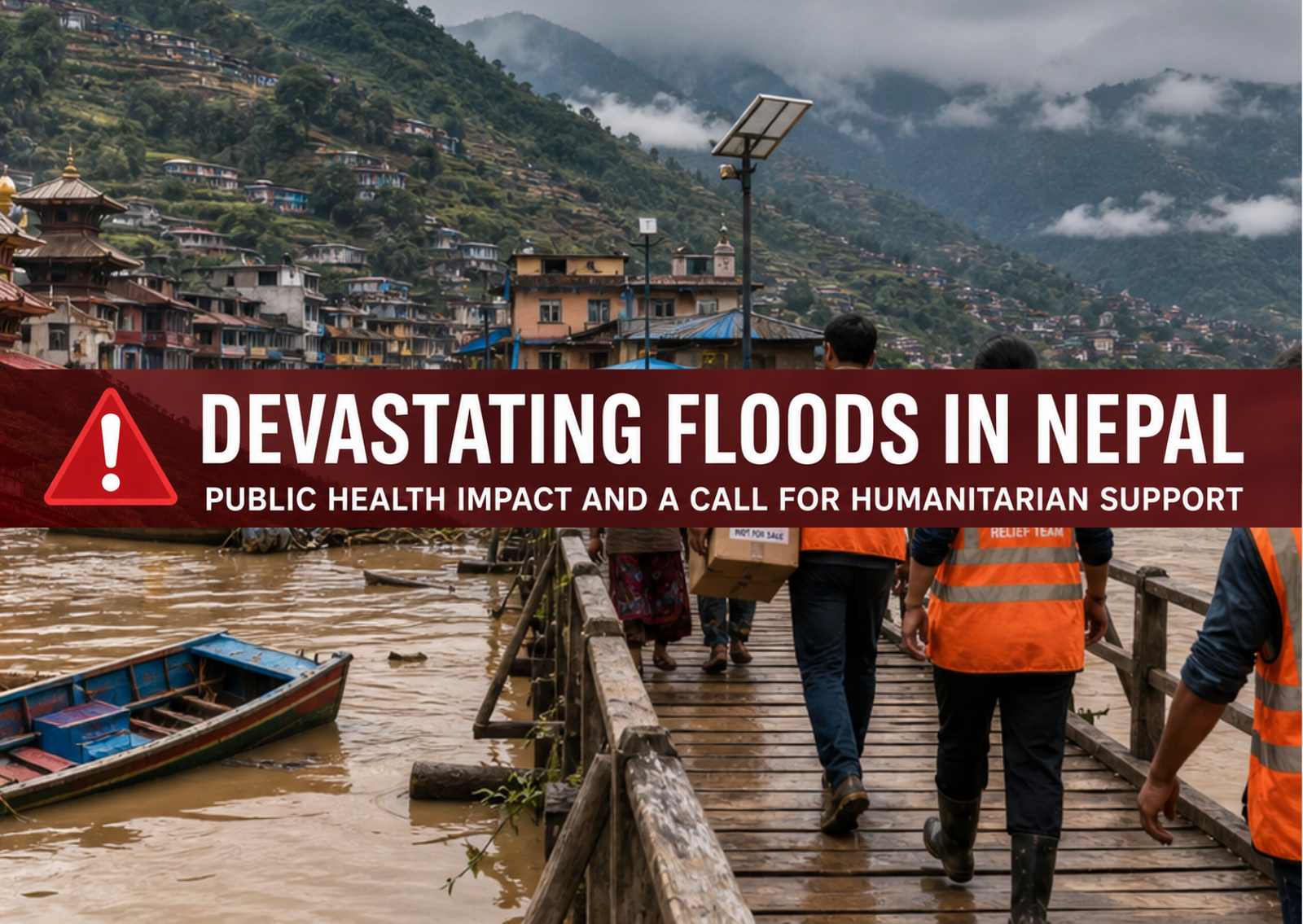
Nepal is facing a major humanitarian and public health challenge following a devastating flash flood in the Bhote Koshi River in Rasuwa District on 26 August 2026. The disaster has resulted in loss of life, injuries, displacement, disruption of livelihoods, and extensive damage to homes, roads, bridges, health facilities, and other critical infrastructure.
The impact has extended beyond Rasuwa to riverside communities across Nuwakot, Dhading, Gorkha, and other affected areas. Assessments of casualties, infrastructure damage, displacement, and humanitarian needs are continuing, and the full scale of the impact is still emerging.
Beyond the immediate humanitarian consequences, the disaster presents significant public health risks. Disruption of health services, damaged infrastructure, constrained transportation and referral pathways, displacement of communities, limited access to safe water and sanitation, and potential risks of communicable disease transmission require sustained and coordinated action.
Government-Led Response
The Government of Nepal is leading and coordinating search, rescue, relief, and health response operations in the affected areas. Government authorities, security agencies, local governments, health workers, humanitarian organizations, and development partners are contributing to the response.
The Social Welfare Council (SWC) has issued an urgent appeal to national and international NGOs to support rescue, relief, and rehabilitation efforts.
While immediate rescue and relief remain the priority, the response will need to evolve rapidly from life-saving assistance toward restoration of essential services, public health protection, recovery, rehabilitation, and resilient reconstruction.
🏥 Significant Impact on Health Infrastructure
The floods have caused serious damage to health infrastructure and disrupted access to essential healthcare services in several affected areas.
Rasuwa District and Border Area
In Rasuwa, severe structural damage has compromised primary healthcare services. Syafrubesi Health Post, Timure Health Post, Timure Health Desk at Rasuwagadhi, and Mailung Community Health Unit have reportedly been completely destroyed.
The loss of these facilities is particularly significant for remote and hard-to-reach communities that depend on local primary healthcare services and referral pathways.
Dhading and Neighboring Areas
In Dhading, Baireni Hospital in Galchi and Charaudhi Basic Health Service Center in Benighat have sustained partial damage and remain non-operational.
At the same time, significant access disruptions are affecting service continuity at important referral facilities, including Dhading Hospital and Trishuli Hospital.
The combination of damaged facilities and disrupted transportation creates additional barriers to timely access to emergency care, maternal and newborn services, child health services, medicines, chronic disease management, referrals, and other essential healthcare.
🌐 A Public Health Response Must Go Beyond Healthcare Delivery
The health response to the floods cannot be limited to restoring clinical services. A comprehensive public health response will be required to address the broader determinants and risks created by the disaster.
Key priorities include:
- Rapid health needs and facility assessments across affected areas
- Continuity of essential health services through temporary, mobile, or alternative service delivery arrangements
- Essential medicines, medical supplies, and equipment
- Maternal, newborn, child, and adolescent health services
- Disease surveillance, early warning, and outbreak preparedness
- Safe water, sanitation, and hygiene (WASH)
- Food and nutrition support, particularly for children and other vulnerable groups
- Mental health and psychosocial support
- Protection and inclusion of vulnerable and marginalized populations
- Referral and emergency transport systems
- Risk communication and community engagement
- Support and protection for health workers
- Restoration of damaged health infrastructure
- Resilient reconstruction and disaster preparedness
Particular attention will be required for pregnant women, newborns and children, older people, people with disabilities, people living with chronic conditions, and communities in remote and hard-to-reach locations.
🤝 Supporting a Coordinated Government-Led Response
The scale and geographic spread of the disaster require strong coordination between government, local authorities, humanitarian organizations, civil society, development partners, donors, technical agencies, and communities. External assistance should complement—not duplicate—the Government of Nepal’s response and should be aligned with nationally identified priorities and local needs.
Support can take several forms, including:
Emergency Relief and Essential Supplies
- Food and essential household supplies
- Emergency shelter and basic relief materials
- Safe water and sanitation supplies
- Hygiene and protection materials
Health and Public Health
- Medical supplies and essential medicines
- Mobile and temporary health services
- Health facility restoration
- Disease surveillance and outbreak preparedness
- Maternal, newborn, and child health support
- Mental health and psychosocial support
Technical and Financial Assistance
- Rapid assessments and response planning
- Public health expertise and technical assistance
- Financial support for emergency response and recovery
- In-kind contributions and essential equipment
- Support for rehabilitation and resilient reconstruction
🇳🇵 SUPPORT THE GOVERNMENT-LED RESPONSE
Individuals, organizations, donors, and partners wishing to contribute to immediate relief and longer-term recovery can support the Prime Minister’s Disaster Relief Fund / Prime Minister’s Relief Fund through designated government accounts.
Prime Minister’s Disaster Relief Fund
- Himalayan Bank Ltd. — USD Account: 01905631210046
- Standard Chartered Bank Nepal Ltd. — 01013243801 / 02013243801
- Rastriya Banijya Bank — 1130100003762001 / 1130100000006006
- Everest Bank Ltd. — 00100105200270 / 00101102200012
- Nepal Bank Ltd. — 00211600510039000003 / 00200100510039000001
- Global IME Bank Ltd. — 00401010000057 / 00411010000005
- Nabil Bank — 1710017505285
- Agricultural Development Bank Ltd. — 0100201002907014
- Rastriya Banijya Bank — 1430100000025006 / 1430100001164001
⚠️ Please verify the official government account details through authoritative Government of Nepal sources before making any contribution.
Every contribution, technical partnership, in-kind donation, and act of solidarity can help strengthen the response and recovery for affected communities.
🌍 A CALL TO THE PUBLIC HEALTH AND HUMANITARIAN COMMUNITY
Public Health Initiative (Nepal) calls on national and international partners, donors, humanitarian organizations, public health professionals, civil society organizations, researchers, and other stakeholders to consider providing or facilitating technical, financial, in-kind, and operational support for the ongoing response.
We particularly encourage organizations with expertise in public health, health systems, emergency response, WASH, nutrition, disease surveillance, mental health, health infrastructure, logistics, and disaster risk reduction to explore opportunities to support affected communities in coordination with the Government of Nepal.
Public Health Initiative (Nepal) remains committed to supporting the Government of Nepal and the Ministry of Health and Population in strengthening coordination, public health action, humanitarian response, and recovery efforts.
From Response to Recovery
The immediate focus must remain on saving lives, reaching affected communities, restoring essential services, and protecting public health. At the same time, recovery planning should begin early.
Rebuilding damaged health facilities should provide an opportunity to strengthen resilience, preparedness, continuity of services, climate and disaster risk management, and the capacity of local health systems to respond to future shocks.
The floods are a reminder that disaster response is not only about what happens during the emergency. It is also about how communities, health systems, and institutions recover, rebuild, and become better prepared for the next shock.
🫱🏽🫲🏾 Standing Together for Nepal
Nepal’s affected communities need solidarity, partnership, coordination, and sustained support.
We encourage partners and colleagues around the world to stand with the people of Nepal—not only during the immediate response, but throughout the recovery and rehabilitation process.
If you are interested in supporting or becoming part of the humanitarian and public health response, please connect with us:
We would greatly appreciate it if you could share and circulate this appeal within your networks and among relevant partners, donors, humanitarian organizations, public health institutions, and other organizations that may be able to contribute.
Together, we can support affected communities, restore essential health services, and help Nepal build back stronger and more resilient. 🙏
#RasuwaFlood #HumanitarianResponse #PublicHealth #FloodResponse #DisasterResponse #Nepal #EmergencyRelief #HealthSystems #Recovery #Resilience #Solidarity