
Public Health Update
  • Home
  • Public Health Update
  • Nepal Health Jobs
    • Public Health Job Board
    • Organization List
  • Opportunities
    • Fellowships, Studentship & Scholarships
    • Grants and Funding Opportunities
    • Fully funded
    • Conference
  • Downloads
    • International Plan, Policy & Guidelines
    • National Plan, Policy & Guidelines
    • Reports
    • Public Health Notes
    • Syllabus
    • Form Formats
  • School of Public Health
    • PhD
    • Master’s Degree
    • Online Courses
  • Notice
  • Home
  • Public Health Update
  • Nepal Health Jobs
    • Public Health Job Board
    • Organization List
  • Opportunities
    • Fellowships, Studentship & Scholarships
    • Grants and Funding Opportunities
    • Fully funded
    • Conference
  • Downloads
    • International Plan, Policy & Guidelines
    • National Plan, Policy & Guidelines
    • Reports
    • Public Health Notes
    • Syllabus
    • Form Formats
  • School of Public Health
    • PhD
    • Master’s Degree
    • Online Courses
  • Notice
LOGIN / REGISTER
Public Health Update
SUBSCRIBE
Public Health Update
  • Home
  • Public Health Update
  • Nepal Health Jobs
    • Public Health Job Board
    • Organization List
  • Opportunities
    • Fellowships, Studentship & Scholarships
    • Grants and Funding Opportunities
    • Fully funded
    • Conference
  • Downloads
    • International Plan, Policy & Guidelines
    • National Plan, Policy & Guidelines
    • Reports
    • Public Health Notes
    • Syllabus
    • Form Formats
  • School of Public Health
    • PhD
    • Master’s Degree
    • Online Courses
  • Notice

All Right Reserved. Designed and Developed by PenciDesign

International AIDS Candlelight Memorial Day 2021
Public HealthActivitiesPH Important DayPublic Health Events

International AIDS Candlelight Memorial Day 2021

by Public Health Update May 16, 2021
written by Public Health Update

The International AIDS Candlelight Memorial, held on the third Sunday of May every year.

The International AIDS Candlelight Memorial is a time for all of us to remember the many lives lost to AIDS. It is an opportunity to honour those who dedicated their lives to helping people living with and affected by HIV and continue to mobilise our communities in solidarity.

People living with HIV started the International AIDS Candlelight Memorial in 1983 and since then there have been thousands of events organized across the world by community-based organisations, from motorbike rallies by women living with HIV to uplifting ceremonies in places of worship and workplaces. Such events have helped raise awareness about HIV and more importantly have helped break down stigma within our communities.

The International AIDS Candlelight Memorial is also a campaign to mobilise communities and raise social consciousness about HIV and AIDS. With almost 38 million people living with HIV today, the International AIDS Candlelight Memorial serves as an important platform for global solidarity, breaking down barriers of stigma and discrimination, and giving hope to new generations.


Recommended readings

  • Ending AIDS Together !! International AIDS Candlelight Memorial 2017
  • Candlelight Memorial 2019: Intensifying the fight for Health and Rights!
  • Candlelight Memorial 2016: Engage, Educate, Empower! (Event of the Week)
  • National Centre for AIDS and STD Control (NCASC)
  • UNAIDS calls on countries to step up global action and proposes bold new HIV targets for 2025
  • UNAIDS calls on countries to step up global action and proposes bold new HIV targets for 2025
  • HIV Standard Service Package (SSP) For Key Populations
  • HIV Epidemic Update of Nepal (Fact sheet 2020)
  • UNAIDS calls on countries to step up global action and proposes bold new HIV targets for 2025
  • The Joint United Nations Programme on HIV/AIDS (UNAIDS) Data 2019
  • Interim Guidance for Continuing HIV Program Service Delivery During COVID-19 Pandemic
  • Interim Guideline for Malaria Program During COVID-19 in Nepal (Updated)


Do you have a website? Looking for the best hosting provider? Here’s a discount code.

Latest Public Health Jobs

Latest Posts

  • International Wellness Day: Promoting Global Wellness for All
  • Summit Declaration: The 12th National Summit of Health and Population Scientists in Nepal
  • Joint political declaration on the reform of the global health architecture
  • World Health Day 2026: Together for Health. Stand with Science.
  • World Water Day 2026 | Water & Gender Equality

Thanks for visiting us.
Disclaimer: The resources, documents, guidelines, and information on this blog have been collected from various sources and are intended for informational purposes only. Information published on or through this website and affiliated social media channels does not represent the intention, plan, or strategies of an organization that the initiator is associated with in a professional or personal capacity, unless explicitly indicated.
If you have any complaints, information, or suggestions about the content published on Public Health Update, please feel free to contact us at blog.publichealthupdate@gmail.com.
#StayUpdated

  • WordPress
  • Link
  • Facebook
  • Mail
  • Facebook
  • Twitter
  • Twitter
  • LinkedIn
  • Instagram
  • Facebook
May 16, 2021 0 comments
0 FacebookTwitterPinterestLinkedinTumblrVKOdnoklassnikiRedditStumbleuponWhatsappTelegramLINEPocketSkypeViberEmail
Interim Guidance for Continuing HIV Program Service Delivery During COVID-19 Pandemic
National Plan, Policy & GuidelinesCommunicable DiseasesResearch & Publication

Interim Guidance for Continuing HIV Program Service Delivery During COVID-19 Pandemic

by Public Health Update May 16, 2021
written by Public Health Update

Overview

The National Center for National Centre for AIDS and STD Control (NCASC) has updated it’s guideline on Interim Guidance for Continuing HIV Program Service Delivery During COVID-19 Pandemic.

The main objective of this document is to prevent community workers, healthcare workers and beneficiaries from COVID-19 infection while serving/ giving services and able to combat HIV transmission, retain on treatment and achieve the national goal during this pandemic. 

DOWNLOAD
GUIDELINE (NCASC)

Inside this;

  • Situation of HIV epidemic in Nepal
  • General information on COVID-19
  • How to prevent from COVID-19 infection?
  • COVID-19 and HIV service delivery continuity
  • Information for front line workers working in Prevention, Diagnosis, Treatment, Care and Support for HIV program
  • Hand hygiene and respiratory hygiene are key to COVID-19 prevention measures in addition to physical distancing
  • HIV Prevention Program Diagnosis of HIV
  • 8 Differentiated HIV testing services (HTS) in COVID-19 Context ART center
  • VL Sample Collection and Testing
  • Community providers services for PLHIV
  • Guidance for management of Harm reduction program for PWID
  • Opioid Substitution Therapy (OST)
  • Needle Syringe Program (NSP)
  • Communication during Covid-19 response

IMPACT OF COVID-19 ON HIV

During initial days of COVID pandemic, HIV infection was not considered as a risk factor for COVID-19 or more severe disease. However, recent studies conducted in larger samples suggest that PLHIV (particularly with low CD4 counts or not under ART) if infected with COVID are more likely to have severe clinical course in comparison to HIV negatives (Ambrosioni et al 2021).

Moreover, the COVID-19 pandemic has hugely disrupted HIV prevention and treatment services globally and created challenges to continue the essential service delivery. A recent modelling study suggests that in sub-Saharan Africa a 6-month interruption of ART would result in an excess of 500 000 adult deaths from HIV infection during a 4-year period and an up to twofold increase in mother-to-child transmission of HIV.

To maintain an effective HIV response during the COVID-19 pandemic, it is important to continue essential services such as providing early testing, implementing preventive measures among KPs, including harm reduction, and ensuring continuity of ART. WHO has enlisted HIV programs as an essential health service to be continued during COVID pandemic.

How to prevent from COVID-19 infection?

To prevent from acquiring COVID-19, everyone including PLHIV, Key Population, Community workers and health care workers providing services to these population should routinely follow practices mentioned below:

  1. Immunization against COVID-19, whenever possible (The currently available vaccines are safe for all including PLHIV)
  2. Avoid overcrowding and maintain social distancing (at least 2 metres)
  3. Do not touch eyes, nose and mouth with unclean hands
  4. Wash hands regularly with soap and water properly for at least 20 seconds. If the soap and water is not available, use sanitizers (alcohol based) instead. Hand washing and use of sanitizers should be done as frequently as possible.
  5. Clean the high touch surface area of the house and working area (such as table tops, door knobs etc.) with disinfectants
  6. When sneezing and coughing cover the mouth and nose with elbow and if tissue is used to cover the mouth and nose, immediately dispose the tissue paper in proper place such as closed bins
  7. Do not spit in the open place.
  8. Visit to health facilities should be minimized or avoided unless absolutely necessary
  9. In case of severe health conditions like shortness of breath, and other critical conditions, clients should be taken immediately to the health facility
  10. Everyone must follow the national public health standard for COVID-19 (SMS); Social distancing, use of mask (cloth mask or medical mask) and Sanitizer.

COVID-19 and HIV service delivery continuity

As Nepal, like many other countries in the world is tackling the COVID-19 pandemic, it is equally important to ensure that HIV essential services are not interrupted, and HIV prevention is maintained while battling with COVID-19 response and all PLHIV are retained on treatment. The NCASC has developed and updated this interim guidance to assist the National HIV programme, health personal and PLHIV for continuity of services during this Pandemic situation. All possible measures should be implemented to ensure that HIV key populations and PLHIV get continued services under safe conditions applying core human rights principles.

Read more: DOWNLOAD
GUIDELINE (NCASC)

Recommended readings

  • Ending AIDS Together !! International AIDS Candlelight Memorial 2017
  • Candlelight Memorial 2019: Intensifying the fight for Health and Rights!
  • Candlelight Memorial 2016: Engage, Educate, Empower! (Event of the Week)
  • National Centre for AIDS and STD Control (NCASC)
  • UNAIDS calls on countries to step up global action and proposes bold new HIV targets for 2025
  • UNAIDS calls on countries to step up global action and proposes bold new HIV targets for 2025
  • HIV Standard Service Package (SSP) For Key Populations
  • HIV Epidemic Update of Nepal (Fact sheet 2020)
  • UNAIDS calls on countries to step up global action and proposes bold new HIV targets for 2025
  • The Joint United Nations Programme on HIV/AIDS (UNAIDS) Data 2019
  • Interim Guidance for Continuing HIV Program Service Delivery During COVID-19 Pandemic
  • Interim Guideline for Malaria Program During COVID-19 in Nepal (Updated)


Do you have a website? Looking for the best hosting provider? Here’s a discount code.

Latest Public Health Jobs

Latest Posts

  • International Wellness Day: Promoting Global Wellness for All
  • Summit Declaration: The 12th National Summit of Health and Population Scientists in Nepal
  • Joint political declaration on the reform of the global health architecture
  • World Health Day 2026: Together for Health. Stand with Science.
  • World Water Day 2026 | Water & Gender Equality

Thanks for visiting us.
Disclaimer: The resources, documents, guidelines, and information on this blog have been collected from various sources and are intended for informational purposes only. Information published on or through this website and affiliated social media channels does not represent the intention, plan, or strategies of an organization that the initiator is associated with in a professional or personal capacity, unless explicitly indicated.
If you have any complaints, information, or suggestions about the content published on Public Health Update, please feel free to contact us at blog.publichealthupdate@gmail.com.
#StayUpdated


  • WordPress
  • Link
  • Facebook
  • Mail
  • Facebook
  • Twitter
  • Twitter
  • LinkedIn
  • Instagram
  • Facebook

May 16, 2021 0 comments
0 FacebookTwitterPinterestLinkedinTumblrVKOdnoklassnikiRedditStumbleuponWhatsappTelegramLINEPocketSkypeViberEmail
Public Health Opportunity! Explore world's trending global health opportunities! Visit us for latest public health opportunities.
Public Health OpportunityInternational Jobs & OpportunitiesOpportunities by RegionPublic Health OpportunitiesTrainingWorkshop

Call for Application: Conducting National Feminist Legal Theory and Practice Training in 2021

by Public Health Update May 14, 2021
written by Public Health Update

Call for Applications for National Partners to conduct the National Feminist Legal Theory and Practice (National FLTP) Trainings in 2021

APWLD is seeking expressions of interest from national or local organisations in Asia and the Pacific to partner with us to conduct the Feminist Legal Theory and Practice Training at the national level (National FLTPs). The collaborative work will include developing a national specific module, translation of materials and hosting the national FLTP training programme, conducting collaborative evaluation and becoming a member of the growing FLTP community of practice.

How To Apply?

Please fill out the on-line application form or download the form here.  Submit the completed application form, letter of interest (addressing the selection criteria and scope of work), and indicative budget for the training using the template provided. (Important note: costs related to institutional support, rent of office, payment for bills, purchasing of assets and equipment are not covered.) 

For applications sent via email please send to:

Sadia Afrin Khan

Programme Officer, Feminist Law & Practice, APWLD

sadia@apwld.org

Please indicate in the subject line: “Expression of Interest of National FLTP Partner 2021”

DEADLINE OF APPLICATIONS IS ON 31st MAY 2021

For more information on the National FLTPs 2021, please refer to the concept note. 

National FLTPs 2021

This year the Feminist Law and Practice Programme plans to pursue the potential of National FLTPs to help strengthen capacities in feminist practice and legal strategising that is responsive to the context, issues and needs of movements at the local and national level. 

APWLD will provide a small sub-grant support (US$8,000-10,000 per organisation) to 4-5 organisations to carry out the national FLTP training.  Each partner organisation is expected to organise a national FLTP training in the period of July – November 2021, and collectively share the learnings and new strategies in December 2021.  APWLD will provide a module for designing the national FLTP training and help national partners reach out to the FLTP trainers as well. 

The national-level FLTP Trainings have the following objectives:  

  • To build the capacity to identify, analyse and scrutinise the discriminatory national laws and policies from a feminist and human rights perspectives;
  • To develop feminist legal knowledge tools and strategies to support women’s human rights defenders at the national level;  
  • To conduct advocacy and national campaigns to challenge discriminatory laws and policies; and advance women’s human rights and Development Justice in the country; 
  • To build a strong supportive network and movement of feminist legal practitioners and activists within the country.

Who Can Apply

Selection Criteria 

APWLD is seeking to work with like-minded national partners from different countries within the Asia and the Pacific region with the following background: 

  • Work for the realisation of women’s human rights at community and national levels;  
  • Have a strong commitment to the promotion of women’s human rights, particularly young, rural, indigenous, migrant, urban poor women and/or women in other marginalised or minority groups;
  • Have strong networks and affiliations with feminist lawyers, activists, judiciary and the legal community in their countries;
  • Have experience in launching creative and participatory training and workshops in the areas of feminism, women’s human rights or women and the law; and 
  • Have necessary organisational resources to coordinate and conduct the National FLTPs with support from the APWLD Secretariat.

Expected Roles and Responsibilities of National Partners

National Partners lead in conducting the FLTPs in their countries with the support of the APWLD secretariat in the period of July – November 2021 and submit the final narrative report and financial report along with all necessary annexes by the end of November 2021. All national partners are expected to attend and contribute to collaborative monitoring, evaluation and learning meeting organised by APWLD in December 2021. 


Do you have a website? Looking for the best hosting provider? Here’s a discount code.

Latest Public Health Jobs

Latest Posts

  • International Wellness Day: Promoting Global Wellness for All
  • Summit Declaration: The 12th National Summit of Health and Population Scientists in Nepal
  • Joint political declaration on the reform of the global health architecture
  • World Health Day 2026: Together for Health. Stand with Science.
  • World Water Day 2026 | Water & Gender Equality

Thanks for visiting us.
Disclaimer: The resources, documents, guidelines, and information on this blog have been collected from various sources and are intended for informational purposes only. Information published on or through this website and affiliated social media channels does not represent the intention, plan, or strategies of an organization that the initiator is associated with in a professional or personal capacity, unless explicitly indicated.
If you have any complaints, information, or suggestions about the content published on Public Health Update, please feel free to contact us at blog.publichealthupdate@gmail.com.
#StayUpdated


  • WordPress
  • Link
  • Facebook
  • Mail
  • Facebook
  • Twitter
  • Twitter
  • LinkedIn
  • Instagram
  • Facebook
May 14, 2021 0 comments
0 FacebookTwitterPinterestLinkedinTumblrVKOdnoklassnikiRedditStumbleuponWhatsappTelegramLINEPocketSkypeViberEmail
Call For Application: Womanifesto 2021-2023
Public Health OpportunityInternational Jobs & OpportunitiesOpportunities by RegionPublic Health OpportunitiesTrainingWorkshop

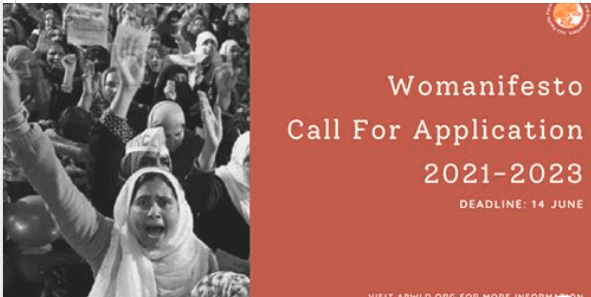
Call For Application: Womanifesto 2021-2023

by Public Health Update May 14, 2021
written by Public Health Update

Womanifesto: Combat Authoritarianism and Advance Participatory Democracy

Why Womanifesto?

Women’s participation and leadership in decision making at all levels, starting in the domestic sphere and extending to the highest levels of government, is a fundamental prerequisite for a just and equitable world and for participatory, accountable democracies. At present, not only are women under-represented in legislatures across the world, and particularly in Asia and the Pacific region, the socio-economic and cultural barriers make it difficult for women to fully exercise their democratic rights and political power. 

Since the early 2000, Asia Pacific Forum on Women, Law and Development (APWLD) has worked to build women’s capacity to increase women’s representation and transformative leadership in political and policy building processes. In 2018, based on the critical reflection of the state of women’s political participation and leadership, APWLD decided to adopt a new strategy called ‘Womanifesto’.  Womanifesto–women’s agenda for change–has long been used for by women’s movements to ensure elections are fought around policies demanding just, equitable and transformative changes that shift power relations and uphold women’s human rights. In APWLD, the Womanifesto is envisioned as a critical organising tool for women to influence the electoral process, hold elected leaders accountable to their promises in advancing women’s human rights, equality and Development Justice, and advance feminist participatory democracy. 

For details of the Womanifesto, please read the concept note.

Overall Objective

To advance women’s democratic rights and civic engagement in Asia and the Pacific by increasing women’s capacity to author and claim Womanifestos.

Specific Objectives

  • Develop the capacity of women, their organisations and communities to elaborate women’s political agenda (or womanifesto) and thereby, engage in broader political processes and policy debates at local and national levels;
  • Foster knowledge and resources on women’s human rights, particularly democracy methods and community organising tools;
  • Establish electoral advocacy plans to share and support women’s political manifestos;
  • Strengthen institutional development of partner organisations through leadership development and solidarity movement building.

Participants

Womanifesto will accommodate 8-10 partners of national and grassroot organisations led by women in all their diversities from marginalised communities, including women with disability, LBTIQ+, ethnic and religious minorities, indigenous communities. Each partner shall identify one grassroot woman organiser and one woman mentor. At least one of them should come from the community/constituent and be committed to community organising and feminist movement building. APWLD will provide the selected organisations with a small grant to employ a young woman community organiser and carry out the research including salary and on-costs with the approximate amount of US$ 13,000.

Deadline and Submission Information

To apply, download the application form, fill it in according to the instructions and send to Madhura at madhura@apwld.org by 14 June 2021. For any further queries please reach out to Madhura at the given email address.

Womanifesto Timeline

TimelineActivitiesDescription
May 2021Call for Application and Selection of ParticipantsOnly selected participants will be intimated by June
August 20211st Regional Training on Women’s Human Rights and Democracy MethodsThe first training will orient participants towards a better understanding of gender and politics through a human rights based approach. The training will also refine the participants’ skills in organising and bringing together women from their community using Feminist Participatory Action Research methodology
January 20222nd Regional Training on Drafting Womanifestos and Introducing Advocacy SkillsThe second training will prepare participants to go back and start drafting the Womanifestos through participatory approach with the community. It will also help them formulate advocacy plans of how to engage with the political leadership and elected representatives of the government with the Womanifestos
July 20223rd Regional Training on Advocating with the Womanifesto and the Way ForwardWe will take cognizance of the Womanifesto journey so far.Then we will move on to expand our advocacy skills further and plan for an advocacy phase
November 2022 – May 2023Advocacy PhaseThe partner organisations going ahead with further advocacy will enter into contracts and execute the advocacy phase for six months.
July 20234th Regional Monitoring, Evaluation and Learning MeetingAll the trainers and participants come together and reflect on the journey so far and the learnings from the successes and failures and evaluate the Womanifesto cycle
        SUBMISSION DEADLINE: 14 JUNE 2021


Do you have a website? Looking for the best hosting provider? Here’s a discount code.

Latest Public Health Jobs

Latest Posts

  • International Wellness Day: Promoting Global Wellness for All
  • Summit Declaration: The 12th National Summit of Health and Population Scientists in Nepal
  • Joint political declaration on the reform of the global health architecture
  • World Health Day 2026: Together for Health. Stand with Science.
  • World Water Day 2026 | Water & Gender Equality

Thanks for visiting us.
Disclaimer: The resources, documents, guidelines, and information on this blog have been collected from various sources and are intended for informational purposes only. Information published on or through this website and affiliated social media channels does not represent the intention, plan, or strategies of an organization that the initiator is associated with in a professional or personal capacity, unless explicitly indicated.
If you have any complaints, information, or suggestions about the content published on Public Health Update, please feel free to contact us at blog.publichealthupdate@gmail.com.
#StayUpdated


  • WordPress
  • Link
  • Facebook
  • Mail
  • Facebook
  • Twitter
  • Twitter
  • LinkedIn
  • Instagram
  • Facebook
May 14, 2021 0 comments
0 FacebookTwitterPinterestLinkedinTumblrVKOdnoklassnikiRedditStumbleuponWhatsappTelegramLINEPocketSkypeViberEmail
Coping with COVID-19 Pandemic
Outbreak NewsGuest Post

Coping with COVID-19 Pandemic

by Public Health Update May 14, 2021
written by Public Health Update

Prasharam BC, BPH 7th semester, National Academy for Medical Sciences (NAMS) Purbanchal University

The Covid-19 pandemic has impacted our lives in so many ways. People in the world are currently facing an unprecedented crisis due the spread of the coronavirus, and Nepal is no exception. The second wave of Covid-19 in Nepal is found to be more dangerous than the first. The Covid-19 crisis has upset the routine of many people. Staying healthy and safe is the first priority at this time. Government has imposed lockdown as public health action, for social distancing to limit the outdoor activities of people. The social distancing and strict hygiene practice are crucial for the control of the spread of Covid-19. Following the government advice, we have encouraged to stay home to help combat the spread of Covid-19.

Many of us are facing challenges that can be stressful, overwhelming. It is normal to feel overwhelmed, anxious and stressed. The social distancing and self-isolation may result in social loneliness because face to face interaction has be restricted. We are social beings, therefore loneliness and sadness can occur as a result of social distancing and self-isolation. It is very important now to improve our immune system and to take care of our mental health.

The following are the tips that will help to take good care of health (immune system) and coping with the Covid-19 pandemic:

1. Eat healthy

The food we eat plays a vital role in determining our overall health and immunity. Processed foods tend to be filled with sodium, added and saturated fats, which can cause unwanted weight gain and health problems therefore we should limit the intake of processed foods and consume fruits, vegetables, healthy fats, whole grains and healthy protein. Here are the nutrition advices for adults during Covid-19 pandemic:

  • Eat fresh and unprocessed foods every day:

Eat fruits, vegetables, legumes (e.g. beans), nuts and whole grains (e.g. unprocessed maize, millet, oats, wheat, tubers or roots such as potato, yam), foods from animal sources (e.g. meat, fish, eggs and milk).

  1. Choose raw vegetables and fresh fruit rather than foods that are high in sugar, fat or salt.
  2. Do not overcook vegetables because this can lead to the loss of important vitamins.
  3. Drink enough water every day:

Drink minimum 8-10 glasses of water every day.

  • Eat moderate amounts of fat and oil:

Consume unsaturated fats (e.g. found in fish, avocado, nuts, olive oil, soy, canola, sunflower and corn oils) rather than saturated fats (e.g. found in fatty meat, butter, coconut oil, cream, cheese, ghee and lard). Choose white meat (e.g. poultry) and fish, which are generally low in fat, rather than red meat. Avoid processed meats because they are high in fat and salt.

  •  Eat less salt and sugar:

Limit your daily salt intake to less than 5 g (approximately 1 teaspoon), and use iodized salt. Choose fresh fruits instead of sweet snacks such as cookies, cakes and chocolate.

2. Stay physically active

Being active can be as simple as taking short walk around your backyard, gardening, cleaning home environment, cooking food. Set aside some time to exercise or to practice a sport. This will support to improve physical and mental health. Keep your body flexible by stretching or doing yoga in the morning when you wake up. You can also stay active by practicing singing or joining a virtual groups.

3. Establish daily routine

Even you are staying at home all the day, having daily routine helps you to stay active and busy. Having daily routine is important to keep you stay active, strong and healthy during self-isolation.

4. Connect with others

Talk with other people you trust about your problems and how you are feeling. Take this time to re-connect with your friends, families during self-isolation. If you are active on Facebook, use messenger to chat or to play games with your friends. Take time to utilize multitudes of technologies and apps that can help you to stay in touch with distant loved ones.

4. Get plenty of sleep

Not getting enough sleep can make feel not just sleepy, but also tired and physically fatigued. During this time of crisis it is very important to establish routine and get plenty of sleep in order to maintain overall health.

5. Limit your screen time

It is very important to reduce the screen time but it may be difficult to limit the screen time during this period because everyone is working and learning from home. Scheduling breaks throughout day that are free from screens can help to reduce screen time.

6. Avoid information overload

Watching or reading too much negative news can increase anxiety. Limit the time you take in negative news and use the extra time to fill yourself with positive vibes.

7. Watch or read something uplifting

Sometimes distraction can be helpful. Watch something that make you feel uplifting and allow yourself to zone out from what’s going on in the world. Watching movies, TV shows, Reading novels can be helpful for distracting yourself from stress.

8. Practice self-care

Plug into tools to help you de-stress and take care of yourself. Practice yoga, meditation, breathing exercise that will reduce stress. Engaging your mind in your favorite activities during lockdown. Whatever your favorite thing is- reading a book, painting, playing an instrument or streaming your favorite music, dancing, writing, singing, etc. which will help you to feel better during this tough time.

9. Learn something new : Keeping yourself busy during Covid-19 is very important. It is great time to make a start to learn new things. You can get into drawing or learning a musical instrument or learning new languages.

SUSTAINABLY IMPROVING WATER SUPPLY, SANITATION AND HYGIENE BEHAVIOR IN RURAL AREAS OF NEPAL

–

Prasharam BC

Prasharam BC, BPH 7th semester, National Academy for Medical Sciences (NAMS), Purbanchal University

feedback and comments- prasharambc@gmail.com


Do you have a website? Looking for the best hosting provider? Here’s a discount code.

Latest Public Health Jobs

Latest Posts

  • International Wellness Day: Promoting Global Wellness for All
  • Summit Declaration: The 12th National Summit of Health and Population Scientists in Nepal
  • Joint political declaration on the reform of the global health architecture
  • World Health Day 2026: Together for Health. Stand with Science.
  • World Water Day 2026 | Water & Gender Equality

Thanks for visiting us.
Disclaimer: The resources, documents, guidelines, and information on this blog have been collected from various sources and are intended for informational purposes only. Information published on or through this website and affiliated social media channels does not represent the intention, plan, or strategies of an organization that the initiator is associated with in a professional or personal capacity, unless explicitly indicated.
If you have any complaints, information, or suggestions about the content published on Public Health Update, please feel free to contact us at blog.publichealthupdate@gmail.com.
#StayUpdated


  • WordPress
  • Link
  • Facebook
  • Mail
  • Facebook
  • Twitter
  • Twitter
  • LinkedIn
  • Instagram
  • Facebook

May 14, 2021 0 comments
0 FacebookTwitterPinterestLinkedinTumblrVKOdnoklassnikiRedditStumbleuponWhatsappTelegramLINEPocketSkypeViberEmail
National Plan, Policy & GuidelinesOutbreak NewsResearch & Publication

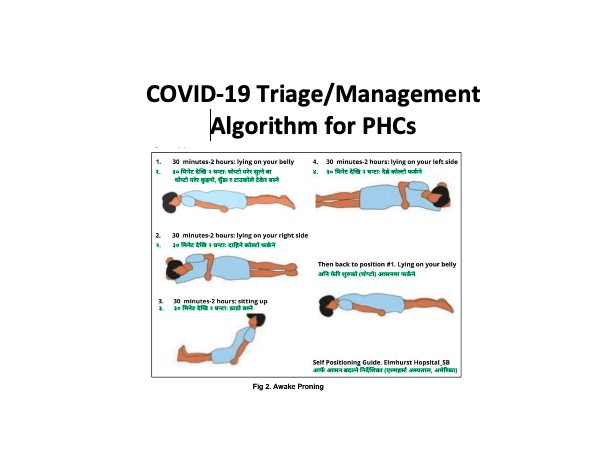
COVID-19 Triage/Management Algorithm for PHCs

by Public Health Update May 14, 2021
written by Public Health Update

COVID-19 Triage/Management Algorithm for PHCs

Objective

The purpose of this guideline is to help health care professionals in primary health care centers/setting, during the COVID-19 pandemic surge, to:

  1. Triage suspected or proven COVID cases,
  2. Manage moderate COVID cases in their centers
  3. Recognize severe cases and refer appropriately after initial stabilization
  4. Comply with appropriate infection control measures when managing COVID -19 cases

Target group: Physicians, nurses, other healthcare providers involved in management of COVID-19 infection in the Primary Health Care Centers of Nepal.

DOWNLOAD (ENGLISH)
DOWNLOAD (NEPALI)

Management of Patient During Shortage Created by COVID-19 Surge

DOWNLOAD
PDF FILE

Recommended readings

  • CLINICAL MANAGEMENT OF COVID-19 IN HEALTHCARE SETTING (SECOND EDITION)
  • POCKET BOOK FOR INFECTION PREVENTION AND CONTROL MEASURES FOR COVID-19 IN THE HEALTHCARE SETTING
  • LIST OF LABORATORIES FOR COVID-19 TESTING IN NEPAL
  • LIST OF LABORATORIES FOR SARS COV-2 RAPID ANTIGEN TEST
  • LIST OF LABORATORIES FOR COVID19 TESTING IN NEPAL
  • HEALTH SECTOR EMERGENCY RESPONSE PLAN, MOHP NEPAL
  • COVID-19 CONTINUES TO DISRUPT ESSENTIAL HEALTH SERVICES IN 90% OF COUNTRIES
  • ENHANCED SURVEILLANCE ON SERO-PREVALENCE OF SARS-COV-2 IN GENERAL POPULATION
  • COVID-19 VACCINE FAQS (NEPALI)
  • COVAX ADVANCE MARKET COMMITMENT (AMC)-ELIGIBLE ECONOMIES
  • GUIDELINE FOR COVID19 FACILITATION GROUP MOBILIZATION
  • GUIDELINE FOR ISOLATION KIT DISTRIBUTION
  • GUIDELINE FOR OPERATION OF COVID-19 TEMPORARY HOSPITALS 2077
  • INFECTIOUS DISEASE ACT NEPAL, 2020(1964)
  • COVID-19 CASES ISOLATION MANAGEMENT GUIDELINES
  • INTERIM GUIDANCE FOR RMNCH SERVICES IN COVID 19 PANDEMIC
May 14, 2021 0 comments
0 FacebookTwitterPinterestLinkedinTumblrVKOdnoklassnikiRedditStumbleuponWhatsappTelegramLINEPocketSkypeViberEmail
Clinical Management of COVID-19 in Healthcare Setting (Second Edition)
Research & PublicationNational Plan, Policy & GuidelinesOutbreak News

Clinical Management of COVID-19 in Healthcare Setting (Second Edition)

by Public Health Update May 13, 2021
written by Public Health Update

Overview

The Epidemiology and Diseases Control Division, DoHS published a revised edition of Clinical Management of COVID-19 in Healthcare Setting. This is the second edition of the Ministry of Health and Population‘s, Pocket book for Case Management of COVID-19 in the Healthcare Setting.

The first edition was adapted from the Interim Guidance for Caring of Patients with COVID-19 in Healthcare settings, Nepal Medical Council (NMC) and aligned with Clinical management of COVID-19, Interim Guidance, WHO (May
27, 2020).

The rationale for this updated edition has been to expand the scope of the earlier guidance, bringing together recently updated recommendations from NMCs October 2020 update and COVID-19 Clinical Management: Living Guidance (January 25, 2021) as well as the Clinical Care for Severe Acute Respiratory Infection: Toolkit-COVID-19 Adaptation: WHO 2020 and advice from subject matter experts.

Highlights

This edition provides updated technical guidance in several case management clinical areas as follows:

  • Revision of the release from the COVID-19 clinical pathway criteria
  • Addition of Treatment of acute co-infections
  • Addition of prevention of complications, immunomodulators and other adjunct therapies
  • Revision of recommendations on use of antivirals and corticosteroids in COVID-19
  • Assessment of severity by National early Warning Score 2 (NEWS 2).

Purpose

The purpose of this pocketbook is to help physicians, and healthcare workers, to properly manage persons with suspected or confirmed COVID-19 and to standardize case management of COVID-19 cases throughout the country.

It is not meant to replace clinical judgement or specialist consultation, but rather to strengthen frontline clinical management.

Target Group

The intended target audience are physicians, nurses, other healthcare personnel, involved in the clinical management of COVID-19 cases.

READ GUIDELINE
PDF FILE
READ GUIDELINE
PDF FILE

Essential readings

  • List of Laboratories for SARS CoV-2 Rapid Antigen Test in Nepal
  • List of Laboratories for COVID19 testing in Nepal (RT-PCR)
  • List of COVID-19 Hospitals (COVID-19 Care Units) in Nepal
  • National Testing-Guidelines for COVID-19 (Version 5), Nepal (Latest)
  • List of Certified COVID-19 Antigen kits in Nepal

Recommended readings

  • POCKET BOOK FOR INFECTION PREVENTION AND CONTROL MEASURES FOR COVID-19 IN THE HEALTHCARE SETTING
  • LIST OF LABORATORIES FOR COVID-19 TESTING IN NEPAL
  • LIST OF LABORATORIES FOR SARS COV-2 RAPID ANTIGEN TEST
  • LIST OF LABORATORIES FOR COVID19 TESTING IN NEPAL
  • HEALTH SECTOR EMERGENCY RESPONSE PLAN, MOHP NEPAL
  • COVID-19 CONTINUES TO DISRUPT ESSENTIAL HEALTH SERVICES IN 90% OF COUNTRIES
  • ENHANCED SURVEILLANCE ON SERO-PREVALENCE OF SARS-COV-2 IN GENERAL POPULATION
  • COVID-19 VACCINE FAQS (NEPALI)
  • COVAX ADVANCE MARKET COMMITMENT (AMC)-ELIGIBLE ECONOMIES
  • GUIDELINE FOR COVID19 FACILITATION GROUP MOBILIZATION
  • GUIDELINE FOR ISOLATION KIT DISTRIBUTION
  • GUIDELINE FOR OPERATION OF COVID-19 TEMPORARY HOSPITALS 2077
  • INFECTIOUS DISEASE ACT NEPAL, 2020(1964)
  • COVID-19 CASES ISOLATION MANAGEMENT GUIDELINES
  • INTERIM GUIDANCE FOR RMNCH SERVICES IN COVID 19 PANDEMIC


Do you have a website? Looking for the best hosting provider? Here’s a discount code.

Latest Public Health Jobs

Latest Posts

  • International Wellness Day: Promoting Global Wellness for All
  • Summit Declaration: The 12th National Summit of Health and Population Scientists in Nepal
  • Joint political declaration on the reform of the global health architecture
  • World Health Day 2026: Together for Health. Stand with Science.
  • World Water Day 2026 | Water & Gender Equality

Thanks for visiting us.
Disclaimer: The resources, documents, guidelines, and information on this blog have been collected from various sources and are intended for informational purposes only. Information published on or through this website and affiliated social media channels does not represent the intention, plan, or strategies of an organization that the initiator is associated with in a professional or personal capacity, unless explicitly indicated.
If you have any complaints, information, or suggestions about the content published on Public Health Update, please feel free to contact us at blog.publichealthupdate@gmail.com.
#StayUpdated


  • WordPress
  • Link
  • Facebook
  • Mail
  • Facebook
  • Twitter
  • Twitter
  • LinkedIn
  • Instagram
  • Facebook
May 13, 2021 0 comments
0 FacebookTwitterPinterestLinkedinTumblrVKOdnoklassnikiRedditStumbleuponWhatsappTelegramLINEPocketSkypeViberEmail
TDR
International Jobs & OpportunitiesAfrican RegionFellowships, Studentship & ScholarshipsGrants and Funding OpportunitiesImplementation ResearchPublic Health OpportunitiesPublic Health OpportunitySchool of Public HealthUniversities & School of Public Health

Call for applications for the TDR Postgraduate Training Scholarship- University of the Witwatersrand

by Public Health Update May 13, 2021
written by Public Health Update

Call for applications for the TDR Postgraduate Training Scholarship in Implementation Science for the 2022 Academic Year (starting January 2022)

Background

The University of the Witwatersrand’s School of Public Health invites suitably qualified candidates to apply for a full-time funded Master Degree Programme in the field of Implementation Science. The scholarship is provided by TDR, the UNICEF/UNDP/World Bank/WHO Special Programme for Research and Training in Tropical Diseases – hosted at the World Health Organization in Geneva, Switzerland.

The goal of the scheme is to enhance graduate training capacity in implementation research and boost the number of researchers in low- and middle-income countries. The focus is on implementation research on infectious diseases of poverty, including the neglected tropical diseases, malaria, tuberculosis, HIV/TB co-infection and COVID-19. The training is focused on courses relevant to a career in implementation science. Implementation science is a growing field that supports the identification of health system bottlenecks and approaches to address them, and is particularly useful in low- and middle-income countries where many health interventions do not reach those who need them the most.

Further information on implementation research is available at: https://tdr.who.int/home/ourwork/strengthening-research capacity/implementation-research-training-materials and on neglected tropical diseases at https://www.who.int/teams/control-of-neglected-tropical-diseases.

DEGREE PROGRAMME ON OFFER: MSc Epidemiology in the field of Implementation Science (18 months full-time)

ELIGIBILITY

Applicants should:

  • Be resident in and a national of a low- or middle-income country in the WHO African Region. (World Bank list of low- and middle-income countries: https://datahelpdesk.worldbank.org/knowledgebase/articles/906519- world-bank-country-and-lendinggroups) (WHO African Region countries: http://www.afro.who.int/countries)
  • Be under the age of 35.
  • Be interested in developing a career in implementation research on infectious diseases of poverty.
  • Be proficient in English.
  • Meet the Programme’s requirements: http://www.wits.ac.za/publichealth/academicprogrammes/postgraduate/master-of-science-in-epidemiology/.
  • TDR is committed to Equality, Diversity and Inclusivity in science. Applicants are encouraged to apply irrespective of gender identity, sexual orientation, ethnicity, religious, cultural and social backgrounds, or (dis)ability status.

SCHOLARSHIP PACKAGE

The scheme will provide full scholarships for Masters in the 2022 academic year and covers the following:

  • Return economy airfare between the candidate’s home country and Johannesburg, South Africa
  • Tuition fees
  • Basic medical and accident insurance
  • Monthly stipend to cover living expenses, including accommodation
  • Support for research project expenses
  • Further, recipients’ careers will be tracked with the new TDR Global alumni and stakeholder platform that will monitor the impact of the programme, as well as provide opportunities for networking and increased visibility opportunities for the Fellows.

HOW TO APPLY
The application process is two-fold and each MUST be completed separately

Application to the University of the Witwatersrand

  1. Apply by completing a University of the Witwatersrand postgraduate application form online at: http://www.wits.ac.za/postgraduate/applications/ Application fee is R200 for both international and local applications.
  2. Application deadline is 31 July 2021.
  3. Applicants should also note to:
    i) apply for accommodation at: https://www.wits.ac.za/accommodation/applications/ Accommodation application deadline is 30 October 2021.
    ii) Apply to the South African Qualification Authority (SAQA) at: http://www.saqa.org.za/index.php if with foreign certificates, to have certificates evaluated. The SAQA certificate or evidence of application MUST be uploaded as part of the required application documents.
    For more information on applications, please go to: www.wits.ac.za/askwits for general application queries or Mrs Lerato Podile (Lerato.Podile@wits.ac.za)

Application for the TDR scholarship

The application for the TDR scholarship should be made separately in writing and should include the following documents:
a. A letter of motivation for applying for the scholarship.
b. A certified copy of the bio-data page of the applicant’s passport.
c. Evidence of application to study Implementation Science as the field of study in the MSc Epidemiology Programme at University of the Witwatersrand’s School of Public Health commencing in January 2022.
d. A comprehensive curriculum vitae, including a description of relevant research and work
experience.
e. Two confidential referee reports should be sent directly by the referees to:
TDRenquiries.publichealth@wits.ac.za by 31 July 2021. The referee reports label MUST include the student’s name and application number.

The TDR Scholarship applications should be sent to: TDRenquiries.publichealth@wits.ac.za

CALENDAR FOR SCHOLARSHIP APPLICATION

  • Application deadline for TDR scholarship 31 July 2021
  • Communication of application outcome 30 October 2021
  • Applicants who are offered a scholarship will have 7 calendar days to confirm acceptance of the TDR Postgraduate Scholarship after notification of the offer. Any candidate who fails to confirm acceptance within the indicated period will be taken to have declined the scholarship and the offer will be awarded to another deserving candidate.
  • Following the selection process, scholarship recipients will commence their studies in January 2022.
  • Depending on the COVID-19 context at the time, the course may be delivered in a hybrid format (a combination of face-to-face and online teaching), or entirely online.
OFFICIAL INFO
DOWNLOAD

Similar Opportunities

  • JOINT EMRO/TDR CALL FOR APPLICATIONS ON: IHR(2005) AND HEALTH SECURITY PREPAREDNESS RESEARCH
  • IMPLEMENTATION RESEARCH WITH EMPHASIS ON INFECTIOUS DISEASES WORKSHOP
  • MOOC- LEARN IMPLEMENTATION RESEARCH (IR) ON INFECTIOUS DISEASES OF POVERTY ONLINE
  • MASSIVE OPEN ONLINE COURSE ON IMPLEMENTATION RESEARCH IN SPANISH
  • CALL FOR APPLICATIONS: 2020-2021 JOINT EMRO/TDR SMALL GRANTS SCHEME FOR IMPLEMENTATION RESEARCH ON INFECTIOUS DISEASES OF POVERTY

Recommended Readings

  • IR TOOLKIT TO INFORM THE IMPLEMENTATION AND SCALE-UP OF DIGITAL TECHNOLOGIES FOR TB
  • ETHICAL CONSIDERATIONS FOR HEALTH POLICY AND SYSTEMS RESEARCH
  • IMPLEMENTATION RESEARCH (IR) IN HEALTH: A PRACTICAL GUIDE
  • IMPLEMENTATION RESEARCH (IR) TOOLKIT(PARTICIPANTS MANUAL & FACILITATOR’S GUIDE)
  • TRAINING COURSE ON ETHICS IN IMPLEMENTATION RESEARCH
  • WHO TDR UPDATE: ENSURING ETHICAL CONDUCT OF IMPLEMENTATION RESEARCH
  • SEVEN APPROACHES TO INVESTING IN IMPLEMENTATION RESEARCH IN LOW- AND MIDDLE- INCOME COUNTRIES


Do you have a website? Looking for the best hosting provider? Here’s a discount code.

Latest Public Health Jobs

Latest Posts

  • International Wellness Day: Promoting Global Wellness for All
  • Summit Declaration: The 12th National Summit of Health and Population Scientists in Nepal
  • Joint political declaration on the reform of the global health architecture
  • World Health Day 2026: Together for Health. Stand with Science.
  • World Water Day 2026 | Water & Gender Equality

Thanks for visiting us.
Disclaimer: The resources, documents, guidelines, and information on this blog have been collected from various sources and are intended for informational purposes only. Information published on or through this website and affiliated social media channels does not represent the intention, plan, or strategies of an organization that the initiator is associated with in a professional or personal capacity, unless explicitly indicated.
If you have any complaints, information, or suggestions about the content published on Public Health Update, please feel free to contact us at blog.publichealthupdate@gmail.com.
#StayUpdated


  • WordPress
  • Link
  • Facebook
  • Mail
  • Facebook
  • Twitter
  • Twitter
  • LinkedIn
  • Instagram
  • Facebook

May 13, 2021 0 comments
0 FacebookTwitterPinterestLinkedinTumblrVKOdnoklassnikiRedditStumbleuponWhatsappTelegramLINEPocketSkypeViberEmail
Medical Education Commission
Courses

Fee for Bachelor Level and Postgraduate Programs in Nepal

by Public Health Update May 12, 2021
written by Public Health Update

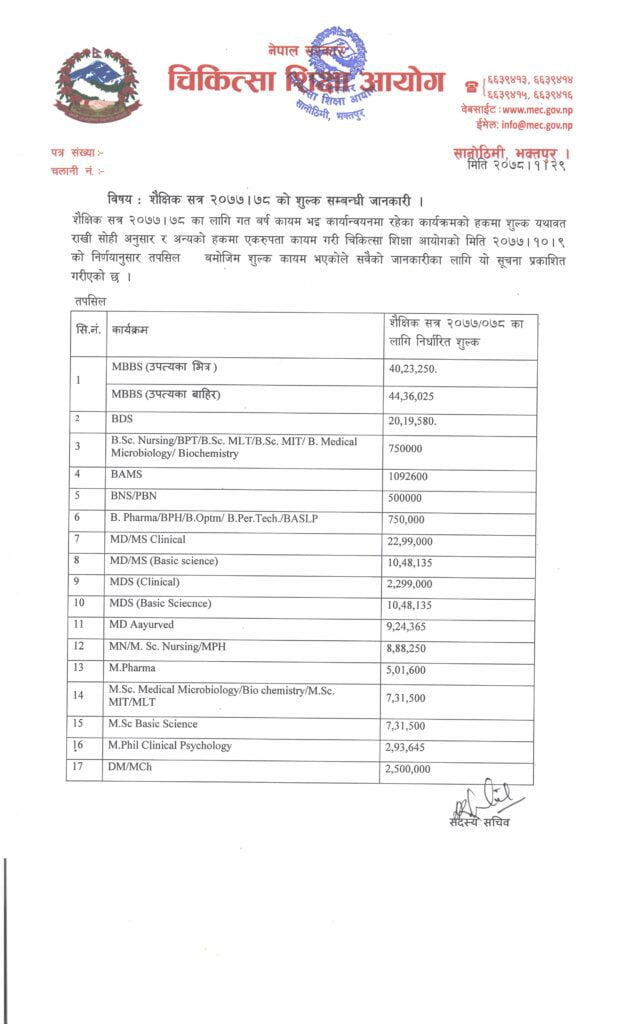
The Medical Education Commission (MEC) has determined the fee structure for Bachelor Level and Postgraduate Programs in Nepal.

S. NoProgramFee (NPR)
1MBBS (Valley)4023250
2MBBS (Out of Valley)4436025
3BDS2019580
4B.Sc. Nursing/ BPT/ BSc. MLT/BSc. MIT/ B. Medical (Microbiology/Biochemistry)750000
5BAMS1092600
6BNS/PBN500000
7MD/MS Clinical2299000
8MD/MS (Basic Science)1048135
9MDS (Clinical)2299000
10MD Ayurveda924365
11MN/ MSc. Nursing/ MPH888250
12M. Pharma501600
13M.Sc. Medical Microbiology/Biochemistry/M.Sc. MIT/ MLT731500
14MSc. Basic Science731500
15M. Phil Clinical Psychology293645
16DM/ MCh2500000
fee notice may12

Questions

How much does it cost to study MBBS in Nepal?

  • MBBS (Valley) – Rs. 4023250
  • MBBS (Out of Valley) – Rs. 4436025

How much does it cost to study Bachelor in Dental Science in Nepal?

  • BDS – Rs. 2019580

How much does it cost to study B.Sc. Nursing in Nepal?

  • B.Sc. Nursing – Rs. 750000
  • BPT – 750000- – Rs. 750000
  • BSc. MLT- Rs. 750000
  • B. Medical (Microbiology/Biochemistry)- Rs. 750000

How much does it cost to study B.A.M.S. (Bachelor of Ayurvedic Medicine and Surgery)in Nepal?

  • B.A.M.S. (Bachelor of Ayurvedic Medicine and Surgery) BAMS – Rs.1092600

How much does it cost to study Bachelor of Nursing Science (BNS) in Nepal?

  • Bachelor of Nursing Science (BNS)- Rs. 500000

How much does it cost to study Post Basic Bachelor in Nursing (PBN) in Nepal?

  • Post Basic Bachelor in Nursing (PBN)- Rs. 500000

How much does it cost to study MD/MS Clinical in Nepal?

  • MD/MS Clinical- Rs. 2299000
  • MD/MS (Basic Science)- Rs. 1048135
  • MDS (Clinical)- Rs.2299000
  • MD Ayurveda- Rs. 924365

How much does it cost to study Master in Nursing in Nepal?

  • Master in Nursing- Rs. 888250
  • Master of Science Nursing – Rs. 888250
  • Master of Midwifery- Rs. 888250
  • MN/ MSc. Nursing – Rs. 888250

How much does it cost to study Master of Public Health (MPH) in Nepal?

  • Master of Public Health (MPH) – Rs. 888250

How much does it cost to study M.Pharm (Master of Pharmacy) in Nepal?

  • M.Pharm (Master of Pharmacy)- Rs. 501600

How much does it cost to study Medical Microbiology in Nepal?

  • M.Sc. Medical Microbiology/Biochemistry/M.Sc. MIT/ MLT)- Rs.731500
  • MSc. Basic Science)- Rs. 731500
  • M. Phil Clinical Psychology)- Rs. 293645

How much does it cost to study Doctorate of. Medicine/Magister of Chirurgiae (DM/ MCh)in Nepal?

  • Doctorate of. Medicine/Magister of Chirurgiae (DM/ MCh)- Rs. 2500000

Further readings

  • Master of Science In Public Health (Msc.PH Program), Kathmandu University
  • Central Department of Public Health (CDPH)
  • Master of Public Health (Public Health Service Management & Health Promotion and Education) –Pokhara University
  • Masters in Public Health (MPH) in BPKIHS
  • Syllabus for Postgraduate Integrated Entrance Examination
  • Syllabus for Bachelor in Public Health (BPH) Common Entrance Examination
  • Sample Questions for MEC Common Entrance Examination
  • Syllabus for Bachelor in Public Health (BPH) Common Entrance Examination
  • Sample Questions for MEC Common Entrance Examination
  • 100 MCQs for Master of Public Health
  • Primary Health Care & Nutrition MCQs, Master of Public Health
  • Sociology MCQs, Master of Public Health
  • Health Management and Health Economics MCQs, Master of Public Health
  • Health Education MCQs, Master of Public Health
  • Epidemiology MCQs, Master of Public Health
  • Environmental & Occupational Health MCQs, Master of Public Health
  • Demography MCQs, Master of Public Health
  • Research Methodology & Bio-stat MCQs, Master of Public Health

Related courses

  • Bachelor of Public Health Program- Karnali Academy of Health Sciences
  • Bachelor in Public Health (BPH) Programme- IOM, Tribhuvan University
  • Bachelor of Public Health (BPH) colleges in Nepal
  • Bachelor of Public Health (BPH) – Faculty of Medical and Allied Science, Purbanchal University
  • Bachelor of Public Health (BPH) Program, Pokhara University
May 12, 2021 0 comments
0 FacebookTwitterPinterestLinkedinTumblrVKOdnoklassnikiRedditStumbleuponWhatsappTelegramLINEPocketSkypeViberEmail
Enrolment open: Research Writing in the Social Sciences online course (2021)
Online CoursesCoursesInternational Jobs & OpportunitiesPublic Health OpportunitiesPublic Health Opportunity

Enrolment open: Research Writing in the Social Sciences online course (2021)

by Public Health Update May 12, 2021
written by Public Health Update

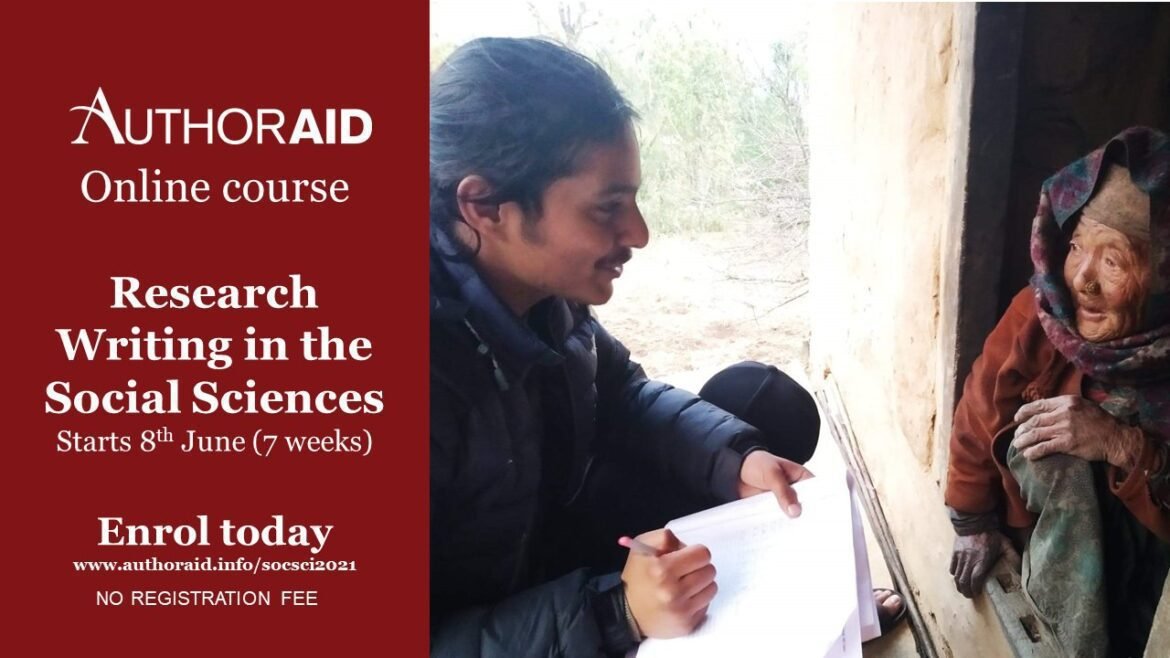
After successful offerings of this course in 2019 and 2020, AuthorAID is pleased to announce that the ‘Research Writing in the Social Sciences’ online course will be running again this year, from 8 June – 26 July 2021.

Who is this course for? 

The course is designed for researchers in developing countries working in the social sciences. It is particularly suitable for early career researchers, or those with limited experience in publishing papers in reputable peer-reviewed journals. 

Course Duration: 7 weeks (estimates 5 hours per week) 

Main topics covered in the course:  

  • Unit 1 / Week 1: Embarking on a research project 
  • Unit 2 / Week 2: Doing and reporting research ethically 
  • Unit 3 / Week 3: Developing an evidence base for your research 
  • Unit 4 / Week 4: Preparing to write your research paper 
  • Unit 5 / Week 5: Writing your research paper 
  • Unit 6 / Week 6: Publishing your paper in a peer-reviewed journal 

    (The seventh week will be for wrap-up activities) 

Course dates: 8 June – 26 July 2021 

Course leaders: INASP team – Andy Nobes, Josie Dryden, Ravi Murugesan – along with experienced guest facilitators from the AuthorAID network. 

How do I enrol?  

Complete information about the course along with enrolment instructions is available on the INASP Moodle website: https://moodle.inasp.info/enrol/index.php?id=258. You will need to create an INASP Moodle account if you do not already have one. Please follow the instructions carefully (you may need to click on the above link again after registering your account). 

Please note that although this is an open course, we may have to limit enrolment due to server capacity. We suggest that you enrol in the course as soon as possible if you are interested. 

INASP designs and runs capacity development activities that cater for both women and men’s interests and needs. We use methods that increase active participation and an inclusive learning environment, adopting attitudes and behaviours that value differential experiences and perspectives and ensuring listening and respect for each other’s experiences and views. 

AuthorAID runs regular MOOCs in research writing or grant proposal writing. Since 2015 over 20,000 participants have taken our courses, with an average completion rate of almost 50%

Upcoming dates

  • 6th April to 17th May 2021 – Scientific Writing (6 weeks)
  • 8th June to 20th July 2021 – Research Writing in the Social Sciences (6 weeks)
  • 7th September to 2nd November 2021 – Research Writing and Proposal Writing (8 weeks)
JOIN NOW
REGISTER HERE


Do you have a website? Looking for the best hosting provider? Here’s a discount code.

Latest Public Health Jobs

Latest Posts

  • International Wellness Day: Promoting Global Wellness for All
  • Summit Declaration: The 12th National Summit of Health and Population Scientists in Nepal
  • Joint political declaration on the reform of the global health architecture
  • World Health Day 2026: Together for Health. Stand with Science.
  • World Water Day 2026 | Water & Gender Equality

Thanks for visiting us.
Disclaimer: The resources, documents, guidelines, and information on this blog have been collected from various sources and are intended for informational purposes only. Information published on or through this website and affiliated social media channels does not represent the intention, plan, or strategies of an organization that the initiator is associated with in a professional or personal capacity, unless explicitly indicated.
If you have any complaints, information, or suggestions about the content published on Public Health Update, please feel free to contact us at blog.publichealthupdate@gmail.com.
#StayUpdated



  • WordPress
  • Link
  • Facebook
  • Mail
  • Facebook
  • Twitter
  • Twitter
  • LinkedIn
  • Instagram
  • Facebook

May 12, 2021 0 comments
0 FacebookTwitterPinterestLinkedinTumblrVKOdnoklassnikiRedditStumbleuponWhatsappTelegramLINEPocketSkypeViberEmail
Newer Posts
Older Posts

Search

Follow Us

Facebook Twitter Instagram Pinterest Linkedin Youtube

Categories

  • Abstracts (25)
  • Activities (91)
  • Adolescent Sexual and Reproductive Health (ASRH) (25)
  • Advice & Tips (4)
  • African Region (5)
  • AI and Health (1)
  • Annual Meeting (6)
  • Antimicrobial Resistance (AMR) (21)
  • Award (19)
  • Awards (16)
  • Books (9)
  • Call for Proposal, EOI & RFP (103)
  • Call for Research Participants (8)
  • Clinical Doctor Jobs (6)
  • Communicable Diseases (107)
  • Competition (20)
  • Conference (129)
  • Consultant (1)
  • Courses (205)
  • Dashboard (2)
  • Digital Health & Health Informatics (10)
  • Drug and Medicine (18)
  • Eastern Mediterranean Region (3)
  • Education (15)
  • Environment (3)
  • Environmental Health & Climate Change (47)
  • European Region (42)
  • Exchange Program (1)
  • Fact Sheet (117)
  • FCHVs (1)
  • Fellowships, Studentship & Scholarships (168)
  • Financial Aid (13)
  • Form Formats (2)
  • Fully funded (22)
  • Global Health News (434)
  • Grants and Funding Opportunities (193)
  • Guest Post (44)
  • Health Assistant Jobs (1)
  • Health Equity (7)
  • Health Financing and Economics (24)
  • Health in Data (115)
  • Health Insurance (5)
  • Health Jobs (52)
  • Health Literacy, Health Education & Promotion (50)
  • Health Organization Profile (42)
  • Health Systems (83)
  • Human Resource for Health (33)
  • Humanitarian Health & Emergency Response (44)
  • Hypertension (5)
  • Implementation Research (48)
  • International Health (3)
  • International Jobs & Opportunities (373)
  • International Plan, Policy & Guidelines (210)
  • Internships (4)
  • Jobs Vacancies (56)
  • Journals (8)
  • Life Style & Public Health Nutrition (39)
  • Live (10)
  • Master's Degree (48)
  • Maternal, Newborn and Child Health (88)
  • Mentorship Program (2)
  • Miscellaneous (16)
  • National Health News (158)
  • National Plan, Policy & Guidelines (468)
  • Neglected Tropical Diseases (NTDs) (51)
  • Non- Communicable Diseases (NCDs) (121)
  • Notice (103)
  • Nursing Jobs (6)
  • Nutritionist Jobs (1)
  • One Health (18)
  • Online & Distance Learning (22)
  • Online Courses (90)
  • Op-Ed Article (3)
  • Opportunities by Region (83)
  • Outbreak News (213)
  • Partially funded (6)
  • PCL Health Science Jobs (3)
  • PH Important Day (534)
  • Pharmacist Jobs (3)
  • PhD (54)
  • Photos (5)
  • Planetary Health (4)
  • PostDoc (14)
  • Presentation Slides (26)
  • Primary Health Care (25)
  • Provincial Plan, Policies and Guidelines (14)
  • Public Health (1,283)
  • Public Health Epidemiology & Biostatistics (13)
  • Public Health Events (306)
  • Public Health Information (20)
  • Public Health Innovation (9)
  • Public Health Jobs (52)
  • Public Health News (554)
  • Public Health Notes (120)
  • Public Health Opportunities (507)
  • Public Health Opportunity (491)
  • Public Health Programs (108)
  • Public Health Seminar (2)
  • Public Health Tools (1)
  • Public Health Update (564)
  • Quality Improvement & Infection Prevention (20)
  • Region of America (8)
  • Reports (184)
  • Research & Project Grants (39)
  • Research & Project Grants (32)
  • Research & Publication (647)
  • Research Articles (10)
  • Road Traffic Accidents (RTA) (9)
  • School of Public Health (60)
  • Self funded (2)
  • South-East Asia Region (26)
  • Success Stories (17)
  • Summer and Winter Courses (40)
  • Summer Courses (28)
  • Sustainable Development Goals (SDGs) (14)
  • Syllabus (61)
  • Symposium (9)
  • Tobacco Control (35)
  • Training (40)
  • Travel Grants (15)
  • Trick, Technique & Skills (8)
  • Uncategorized (3)
  • Undergraduate Degree (7)
  • Universal Health Coverage (36)
  • Universities (29)
  • Universities & School of Public Health (58)
  • Vacancy Announcement (26)
  • Vaccine Preventable Diseases (40)
  • Vector-Borne Diseases(VBDs) (30)
  • Videos (3)
  • View Points (1)
  • Webinar (4)
  • Western Pacific Region (13)
  • Workshop (18)
  • World News (117)
Post New Jobs: Vacancy Announcement Service

Public Health Update (Sagun’s Blog) is a popular public health portal in Nepal. Thousands of health professionals are connected with Public Health Update to get up-to-date public health updates, search for jobs, and explore opportunities.
#1 Public Health Blog for sharing Job opportunities and updates in Nepal

”Public Health Information For All”
– – Sagun Paudel, Founder

  • HOT JOBS
    • Public Health Jobs
    • Medical Doctor Jobs
    • Nursing Jobs
    • Health Assistant Jobs
    • Pharmacist Jobs
    • NGOs Jobs
    • Government Jobs
  • Top Categories
    • National Plan, Policy & Guidelines Top
    • Public Health Calendar
    • Fellowships & Scholarships
    • Health Systems
    • Health Organization Profiles
    • International Jobs & Opportunities
    • Public Health Opportunity

PUBLIC HEALTH INITIATIVE

    • Submit your Vacancies New
    • Partnership Opportunities

Contact: blog.publichealthupdate@gmail.com

https://wa.me/+9779856036932

Public Health Initiative, A Registered Non-profit organization – All Right Reserved. 2011-2024. Contact us. 

Facebook Twitter Instagram Youtube Envelope
Public Health Update
  • Home
  • Public Health
    • Home 1
      • Adolescent Sexual and Reproductive Health (ASRH)
      • Antimicrobial Resistance (AMR)
      • Communicable Diseases
      • Digital Health & Health Informatics
      • Environmental Health & Climate Change
      • Health Financing and Economics
      • Health Equity
    • Home 2
      • Health Literacy, Health Education & Promotion
      • Human Resource for Health
      • Humanitarian Health & Emergency Response
      • Implementation Research
      • International Health
      • Life Style & Public Health Nutrition
      • Maternal, Newborn and Child Health
    • Home 3
      • Neglected Tropical Diseases (NTDs)
      • Non- Communicable Diseases (NCDs)
      • One Health
      • Planetary Health
      • Public Health Epidemiology & Biostatistics
      • Primary Health Care
      • Quality Improvement & Infection Prevention
    • Home 4
      • Road Traffic Accidents (RTA)
      • Sustainable Development Goals (SDGs)
      • Tobacco Control
      • Universal Health Coverage
      • Vaccine Preventable Diseases
      • Vector-Borne Diseases(VBDs)
      • Notices
  • Public Health Update
    • Home 1
      • Public Health News
      • Global Health News
      • Outbreak News
      • National Health News
      • COVID-19
    • Home 2
      • Fact Sheet
      • Health in Data
      • PH Important Day
      • Public Health Events
      • Public Health Programs
    • Home 3
      • Health Systems
      • Health Insurance
      • Health Organization Profile
      • Success Stories
      • Public Health Innovation
  • Public Health Opportunities
    • Fully funded
    • Travel Grants
    • Grants and Funding Opportunities
    • Opportunities by Region
    • International Jobs & Opportunities
    • Research & Project Grants
    • Fellowships, Studentship & Scholarships
    • Conference
  • Jobs
    • Home 1
      • Health Jobs
      • Public Health Jobs
      • Clinical doctor Jobs
      • Health Assistant Jobs
      • Nursing Jobs
      • PCL Health Science Jobs
    • Home 2
      • Dental Jobs
      • Pharmacist Jobs
      • TSLC (Health Jobs)
      • Laboratory Jobs
      • Nutritionist Jobs
  • Downloads
    • International Plan, Policy & Guidelines
    • National Plan, Policy & Guidelines
    • Reports
    • Books
    • Research Articles
  • School of Public Health
    • Home 1
      • Courses
      • Master’s Degree
      • Undergraduate Degree
      • PhD
    • Home 2
      • Universities
      • Syllabus
      • Public Health Notes
      • Mentorship Program
      • Startup Project
    • Home
      • Summer and Winter Courses
      • Summer Courses
      • Online Courses
      • Workshop
      • Training
Public Health Update
  • Home
  • Public Health
    • Home 1
      • Adolescent Sexual and Reproductive Health (ASRH)
      • Antimicrobial Resistance (AMR)
      • Communicable Diseases
      • Digital Health & Health Informatics
      • Environmental Health & Climate Change
      • Health Financing and Economics
      • Health Equity
    • Home 2
      • Health Literacy, Health Education & Promotion
      • Human Resource for Health
      • Humanitarian Health & Emergency Response
      • Implementation Research
      • International Health
      • Life Style & Public Health Nutrition
      • Maternal, Newborn and Child Health
    • Home 3
      • Neglected Tropical Diseases (NTDs)
      • Non- Communicable Diseases (NCDs)
      • One Health
      • Planetary Health
      • Public Health Epidemiology & Biostatistics
      • Primary Health Care
      • Quality Improvement & Infection Prevention
    • Home 4
      • Road Traffic Accidents (RTA)
      • Sustainable Development Goals (SDGs)
      • Tobacco Control
      • Universal Health Coverage
      • Vaccine Preventable Diseases
      • Vector-Borne Diseases(VBDs)
      • Notices
  • Public Health Update
    • Home 1
      • Public Health News
      • Global Health News
      • Outbreak News
      • National Health News
      • COVID-19
    • Home 2
      • Fact Sheet
      • Health in Data
      • PH Important Day
      • Public Health Events
      • Public Health Programs
    • Home 3
      • Health Systems
      • Health Insurance
      • Health Organization Profile
      • Success Stories
      • Public Health Innovation
  • Public Health Opportunities
    • Fully funded
    • Travel Grants
    • Grants and Funding Opportunities
    • Opportunities by Region
    • International Jobs & Opportunities
    • Research & Project Grants
    • Fellowships, Studentship & Scholarships
    • Conference
  • Jobs
    • Home 1
      • Health Jobs
      • Public Health Jobs
      • Clinical doctor Jobs
      • Health Assistant Jobs
      • Nursing Jobs
      • PCL Health Science Jobs
    • Home 2
      • Dental Jobs
      • Pharmacist Jobs
      • TSLC (Health Jobs)
      • Laboratory Jobs
      • Nutritionist Jobs
  • Downloads
    • International Plan, Policy & Guidelines
    • National Plan, Policy & Guidelines
    • Reports
    • Books
    • Research Articles
  • School of Public Health
    • Home 1
      • Courses
      • Master’s Degree
      • Undergraduate Degree
      • PhD
    • Home 2
      • Universities
      • Syllabus
      • Public Health Notes
      • Mentorship Program
      • Startup Project
    • Home
      • Summer and Winter Courses
      • Summer Courses
      • Online Courses
      • Workshop
      • Training
Public Health Initiative, A Registered Non-profit organization – All Right Reserved. 2011-2023