
Public Health Update
  • Home
  • Public Health Update
  • Nepal Health Jobs
    • Public Health Job Board
    • Organization List
  • Opportunities
    • Fellowships, Studentship & Scholarships
    • Grants and Funding Opportunities
    • Fully funded
    • Conference
  • Downloads
    • International Plan, Policy & Guidelines
    • National Plan, Policy & Guidelines
    • Reports
    • Public Health Notes
    • Syllabus
    • Form Formats
  • School of Public Health
    • PhD
    • Master’s Degree
    • Online Courses
  • Notice
  • Home
  • Public Health Update
  • Nepal Health Jobs
    • Public Health Job Board
    • Organization List
  • Opportunities
    • Fellowships, Studentship & Scholarships
    • Grants and Funding Opportunities
    • Fully funded
    • Conference
  • Downloads
    • International Plan, Policy & Guidelines
    • National Plan, Policy & Guidelines
    • Reports
    • Public Health Notes
    • Syllabus
    • Form Formats
  • School of Public Health
    • PhD
    • Master’s Degree
    • Online Courses
  • Notice
LOGIN / REGISTER
Public Health Update
SUBSCRIBE
Public Health Update
  • Home
  • Public Health Update
  • Nepal Health Jobs
    • Public Health Job Board
    • Organization List
  • Opportunities
    • Fellowships, Studentship & Scholarships
    • Grants and Funding Opportunities
    • Fully funded
    • Conference
  • Downloads
    • International Plan, Policy & Guidelines
    • National Plan, Policy & Guidelines
    • Reports
    • Public Health Notes
    • Syllabus
    • Form Formats
  • School of Public Health
    • PhD
    • Master’s Degree
    • Online Courses
  • Notice

All Right Reserved. Designed and Developed by PenciDesign

National Family Planning Day
PH Important DayActivitiesAdolescent Sexual and Reproductive Health (ASRH)Public Health EventsPublic Health Update

National Family Planning Day 2078

by Public Health Update September 14, 2021
written by Public Health Update

The Family Welfare Division, DoHS invites the creative contents (blog, article, poem, tiktok, youtube videos and others) in the special occasion of National Family Planning Day 2078.

Interested content creators can submit their creations by 2078.06.29 too fprhsectionfwd@gmail.com to participant in this content competition.

For details notice, please find the attached announcement.

FP Day

Recommended reading

  • Determinants of Maternal Health and Family Planning Service Coverage in Nepal: Modelling of Routine Data
  • COVID-19 and Family Planning in Nepal
  • National Family Planning Day 2077
  • Family Planning Fact Sheet – 2019, Nepal
  • Kathmandu Declaration on: National Conference on Family Planning 2075
  • World Population Day 2018 – “Family Planning is a Human Right”
  • National Family Planning Costed Implementation Plan (2015-2020)
  • Barriers to Family Planning Use in Eastern Nepal: Results from a Mixed Methods Study
  • Family Planning ”Opportunities, challenges & Priorities in Nepal
  • National Family Planning Day (18- Sep 2016)
  • National Family Planning Program, Nepal
  • Family Planning 2020 (FP2020) Commitment, Nepal
  • #National Family Planning Day (18th Sep 2015)
  • National Family Planning Day sep 18th 2014
  • Family Welfare Division (FWD), Department of Health Services
  • Health Facility Quality Improvement Module (QI Tool) for Health Services Strengthening
  • Standard Treatment Protocol (STP) for BHS 2078 (Draft)


Do you have a website? Looking for the best hosting provider? Here’s a discount code.

Latest Public Health Jobs

Latest Posts

  • World Water Day 2026 | Water & Gender Equality
  • Nepal Antimicrobial Resistance (AMR) Bulletin FY 2081/82
  • Call for applications! Short Course on Qualitative Research Methods in Public Health, 2026
  • World Obesity Day 2026 | 8 Billion Reasons to Act on Obesity
  • Salim Yusuf Emerging Leaders Programme 2026

Thanks for visiting us.
Disclaimer: The resources, documents, guidelines, and information on this blog have been collected from various sources and are intended for informational purposes only. Information published on or through this website and affiliated social media channels does not represent the intention, plan, or strategies of an organization that the initiator is associated with in a professional or personal capacity, unless explicitly indicated.
If you have any complaints, information, or suggestions about the content published on Public Health Update, please feel free to contact us at blog.publichealthupdate@gmail.com.
#StayUpdated

  • WordPress
  • Link
  • Facebook
  • Mail
  • Facebook
  • Twitter
  • Twitter
  • LinkedIn
  • Instagram
  • Facebook
September 14, 2021 0 comments
0 FacebookTwitterPinterestLinkedinTumblrVKOdnoklassnikiRedditStumbleuponWhatsappTelegramLINEPocketSkypeViberEmail
Accelerate action to prevent and control non-communicable diseases: WHO
Global Health NewsPublic Health NewsPublic Health ProgramsPublic Health Update

Countries in WHO South-East Asia Region endorse health promoting schools, safe school operations during pandemic

by Public Health Update September 13, 2021
written by Public Health Update

Press release 1766
Countries in WHO South-East Asia Region endorse health promoting schools, safe school operations during pandemic Kathmandu, 13 September 2021 – The Member countries of WHO South-East Asia Region resolved to work towards making ‘every school a health promoting school’, while also committing to safe school operations during the pandemic.

“Schools have an important role in promoting healthy lifestyles, life-long healthy behaviors and to nurture human capital for sustainable development of any society. We need a whole-of-government approach to ensure children from all socio-economic background, including those with special needs, benefit from healthy schools,” said Dr Poonam Khetrapal Singh, Regional Director, WHO South-East Asia Region at the Regional Committee meeting.

Adopting a resolution at the Regional Committee meeting to revitalize school health and health promoting schools, Member countries expressed concern over school closure during the ongoing pandemic, its impact on learning, growth and health of young children and adolescents.  

Member countries also deliberated on the need to ensure safe reopening and operationalization of schools during the ongoing pandemic.  

At the five-day meeting 6 – 10 September, the Member countries agreed to develop an integrated Regional Action Plan on viral hepatitis, HIV and sexually transmitted diseases, aligned with WHO’s global and 2030 SDGs targets.

Other highlights of the Regional Committee meeting included a declaration signed by Member countries, at a ministerial round table, to take lessons from the pandemic and strengthen health system resilience to ensure health security and achieve universal health coverage and Sustainable Development Goals for health.

Nobel Laureate Abhijit Banerjee addressed the ministerial round table, emphasizing on the need to ensure quality of health care services.

WHO and Member countries of South-East Asia Region discussed further strengthening of health emergency security systems to be better prepared for future health emergencies.

The meeting also discussed enhancing routine immunization coverage along with continuing efforts to rapidly increase COVID-19 vaccination coverage.

Accelerating efforts to prevent and control the prevalence of non-communicable diseases, action being taken for measles and rubella elimination and progress on universal health coverage, were some of the other Regional flagship priorities deliberated upon at the meeting.

The annual governing body meeting, hosted by Nepal this year, was held virtually for the second consecutive year due to the pandemic.

For more information on issues and Regional Committee meeting –

https://www.who.int/southeastasia/about/governance/regional-committee/seventy-fourth-session


Press release 1766

Media contact:Shamila Sharma,  sharmasha@who.int, +91 98182 87256
Tsering Dolkar Gurung, gurungt@who.int, +977 9802300661 


Do you have a website? Looking for the best hosting provider? Here’s a discount code.

Latest Public Health Jobs

Latest Posts

  • World Water Day 2026 | Water & Gender Equality
  • Nepal Antimicrobial Resistance (AMR) Bulletin FY 2081/82
  • Call for applications! Short Course on Qualitative Research Methods in Public Health, 2026
  • World Obesity Day 2026 | 8 Billion Reasons to Act on Obesity
  • Salim Yusuf Emerging Leaders Programme 2026

Thanks for visiting us.
Disclaimer: The resources, documents, guidelines, and information on this blog have been collected from various sources and are intended for informational purposes only. Information published on or through this website and affiliated social media channels does not represent the intention, plan, or strategies of an organization that the initiator is associated with in a professional or personal capacity, unless explicitly indicated.
If you have any complaints, information, or suggestions about the content published on Public Health Update, please feel free to contact us at blog.publichealthupdate@gmail.com.
#StayUpdated


  • WordPress
  • Link
  • Facebook
  • Mail
  • Facebook
  • Twitter
  • Twitter
  • LinkedIn
  • Instagram
  • Facebook
September 13, 2021 0 comments
0 FacebookTwitterPinterestLinkedinTumblrVKOdnoklassnikiRedditStumbleuponWhatsappTelegramLINEPocketSkypeViberEmail
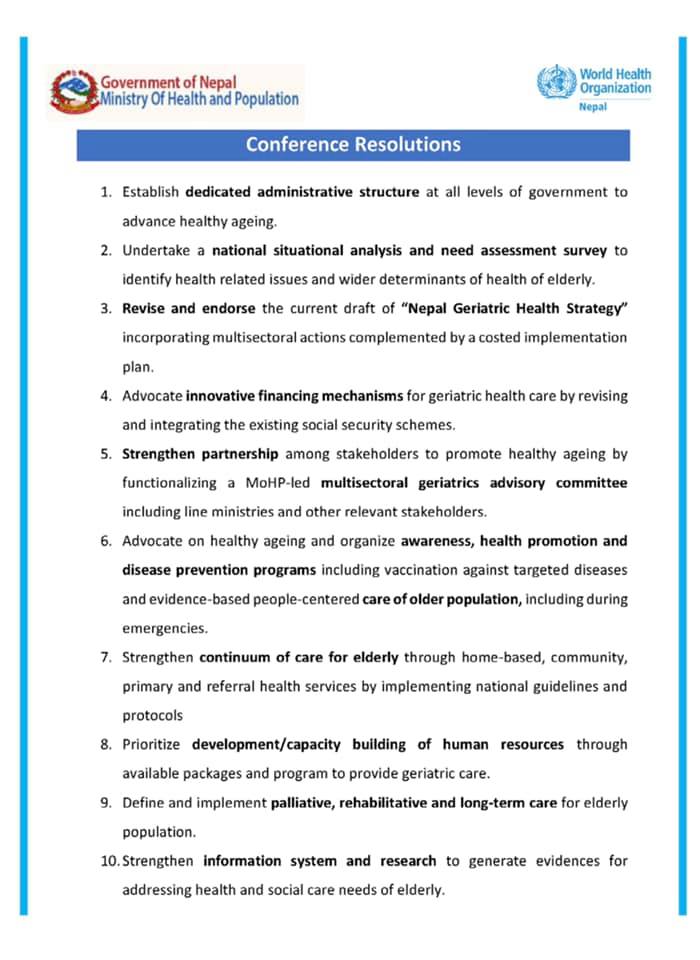
Nepal Conference on Geriatrics 2021
ConferenceActivitiesPublic Health Events

Nepal Conference on Geriatrics 2021

by Public Health Update September 13, 2021
written by Public Health Update

The Ministry of Health and Population (MoHP) in collaboration with World Health Organization (WHO) Country Office Nepal invites a call for participation on Geriatrics Conference Nepal 2021.

Details

  • Topic: Geriatric Conference
  • Date and Time: Sep 20, 2021 09:00 AM Sep 21, 2021 09:00 AM (Kathmandu time)

Registration

  • Scan QR code or link: https://who.zoom.us/meeting/register/tJwpc-Gsqz8vE9GQvZ0DiEwsOJrg6_7l_Gtp?
  • Required information for registration: (Personal information, contact details and statements on ”why are you interested to participate in this conference? What are your three key expectations from this conference?”

Nepal Conference on Geriatrics 2021


Do you have a website? Looking for the best hosting provider? Here’s a discount code.

Latest Public Health Jobs

Latest Posts

  • World Water Day 2026 | Water & Gender Equality
  • Nepal Antimicrobial Resistance (AMR) Bulletin FY 2081/82
  • Call for applications! Short Course on Qualitative Research Methods in Public Health, 2026
  • World Obesity Day 2026 | 8 Billion Reasons to Act on Obesity
  • Salim Yusuf Emerging Leaders Programme 2026

Thanks for visiting us.
Disclaimer: The resources, documents, guidelines, and information on this blog have been collected from various sources and are intended for informational purposes only. Information published on or through this website and affiliated social media channels does not represent the intention, plan, or strategies of an organization that the initiator is associated with in a professional or personal capacity, unless explicitly indicated.
If you have any complaints, information, or suggestions about the content published on Public Health Update, please feel free to contact us at blog.publichealthupdate@gmail.com.
#StayUpdated


  • WordPress
  • Link
  • Facebook
  • Mail
  • Facebook
  • Twitter
  • Twitter
  • LinkedIn
  • Instagram
  • Facebook
September 13, 2021 0 comments
0 FacebookTwitterPinterestLinkedinTumblrVKOdnoklassnikiRedditStumbleuponWhatsappTelegramLINEPocketSkypeViberEmail
Accelerate action to prevent and control non-communicable diseases: WHO
Non- Communicable Diseases (NCDs)Global Health NewsNational Health NewsPublic Health News

Accelerate action to prevent and control non-communicable diseases: WHO

by Public Health Update September 10, 2021
written by Public Health Update

Press release 1765

Kathmandu, 10 September 2021 – The World Health Organization has urged Member countries in South-East Asia Region to accelerate efforts to prevent and control non-communicable diseases which account for two-third of all deaths in the Region while also increasing the risk of severe COVID-19.

“The COVID-19 pandemic has further exposed the vulnerabilities of people living with non-communicable diseases. In addition to the increased risk of severe disease and death, disruption in essential services threatens to slow down progress and even reverse the gains in controlling NCDs,” said Dr Poonam Khetrapal Singh, Regional Director, WHO South-East Asia Region, at the Regional Committee meeting.

Prevention and control of non-communicable diseases (NCDs) such as cardiovascular diseases, cancers, chronic respiratory disease, diabetes, hypertension etc, is one of the flagship priorities of Dr Khetrapal Singh. Since 2014 member countries have been making concerted efforts, implementing multi-sectoral plans, providing, and scaling up NCD services at the primary health care level, promoting physical activity, taxing sugary drinks, taking multiple action to control tobacco use, promote mental health, among others.

“We need to address NCDs and include them as an integral part of pandemic preparedness and response. This will help establish mechanisms for uninterrupted access to NCD services during emergencies, and reduce risk of serious health complications,” the Regional Director said.

In view of the continuing challenges, Member countries discussed extending the Regional Action Plan for Prevention and Control of NCDs to meet SDG 2030 targets.

The Member countries also discussed integrated eye care and oral health and developing Regional Action Plans for them. Poor oral health is an important public health concern, with oral cancer being among top five cancers. The Region also has one of the highest prevalence of visual impairment and blindness globally.

There is some evidence of decline in the prevalence of blindness and moderate-to-severe visual impairment in the Region between 1990 and 2015; however, prevalence continues to be higher than the global average and coverage for effective cataract surgery remains below target. A situation analysis in 2020 of oral health policies showed some progress but also substantial gaps towards achieving the 2025 goals.

Nearly half of the deaths due to NCDs occur prematurely between 30 and 69 years of age. A quarter of the adult population in the Region suffers from hypertension and every twelfth adult has diabetes.

The Member countries discussed developing a regional NCD Implementation Roadmap 2022–2030 to provide operational guidance on “how to” sustain gains, accelerate action in areas that need greater emphasis and pilot innovative approaches in the Region to achieve SDG Target 3.4.

Media contact:

Shamila Sharma,  sharmasha@who.int, +91 98182 87256
Tsering Dolkar Gurung, gurungt@who.int, +977 9802300661

Press release 1765

Official Info: WHO SEARO website & social media links.


Do you have a website? Looking for the best hosting provider? Here’s a discount code.

Latest Public Health Jobs

Latest Posts

  • World Water Day 2026 | Water & Gender Equality
  • Nepal Antimicrobial Resistance (AMR) Bulletin FY 2081/82
  • Call for applications! Short Course on Qualitative Research Methods in Public Health, 2026
  • World Obesity Day 2026 | 8 Billion Reasons to Act on Obesity
  • Salim Yusuf Emerging Leaders Programme 2026

Thanks for visiting us.
Disclaimer: The resources, documents, guidelines, and information on this blog have been collected from various sources and are intended for informational purposes only. Information published on or through this website and affiliated social media channels does not represent the intention, plan, or strategies of an organization that the initiator is associated with in a professional or personal capacity, unless explicitly indicated.
If you have any complaints, information, or suggestions about the content published on Public Health Update, please feel free to contact us at blog.publichealthupdate@gmail.com.
#StayUpdated


  • WordPress
  • Link
  • Facebook
  • Mail
  • Facebook
  • Twitter
  • Twitter
  • LinkedIn
  • Instagram
  • Facebook
September 10, 2021 0 comments
0 FacebookTwitterPinterestLinkedinTumblrVKOdnoklassnikiRedditStumbleuponWhatsappTelegramLINEPocketSkypeViberEmail
Grants and Funding OpportunitiesPublic Health OpportunitiesPublic Health OpportunityResearch & Project GrantsResearch & Project Grants

Research and Business Development (R&BD) Application Call

by Public Health Update September 9, 2021
written by Public Health Update

Background

Research and Business Development (R&BD) is one of the major functional areas to plan, support, and develop the research projects and business strategy of the Nepal Technology Innovation Center (NTIC). Its strategy can lead to innovation and increased productivity and boost business competitive advantages. This includes increasing revenues, growth in terms of business expansion, and increasing profitability by building strategic partnerships and making strategic business decisions.

KU-IRDP/NTIC aims to serve as a research and business development platform of Nepal through relevant operational/support programs. The business development platform will incorporate all aspects for growing a business from a concept phase to a fully operational stage. The core of the project is to promote the integrated development of the community through the strengthening of R&BD capabilities. The support from R&BD may range from prototype/ process/ technique development and improvement, production and packaging support, and commercialization support.

In the first phase, R&BD will announce and select at least 5 projects within Kathmandu University in the following sectors:

  1. Health Related Livelihood and other areas

The selected projects will serve as flagship projects of KU-IRDP/NTIC.

In the next phase, R&BD will announce open calls for at least 5 projects within the above -mentioned three thematic areas. It will be open to business people, students, researchers, entrepreneurs, and other innovation centers. Those selected projects will be supported in terms of propagation of the existing technologies or innovative products/processes and commercialization for development of rural communities. Similarly, R&BD will support other functional areas as per their need during the project duration.

Objectives

  • To support R&BD in the three identified thematic areas (Agriculture, Renewable Energy and Health-related livelihood) and other possible areas through centrally run laboratories and rural research and development programs.
  • To serve as a research and development platform of Nepal through relevant operational/support programs.
  • To examine the feasibility of projects from the initial stage, conduct research in stages.
  • Establish and adjust the direction at each stage to enable commercialization. (As the main scope will be research and development activities that can directly contribute to commercial purposes and commercialization of the private sector to differentiate it from the various research institutes that carry out the basic research field.)

Total Supporting Fund and Period of Program within KU

CategoryDetails
Total Support FundNRs 30,000,000 inside KU
Support Period2021.11∼ 2023.03 (Within 16 months)
Support FundUp to NRs. 1,00,00,000 per project
Number of Supported ProjectUp to 5 projects

Eligibility for the Application 

The following eligibility criteria needed to be fulfilled for the application:

For Principal Investigator/s (PIs):

  1. Must be Kathmandu University (KU) faculty or,
  2. Individual researcher from KU with at least master degree from recognized institution.
  3. The project team is preferred to be organized into a consortium of KU and external organizations (e.g., industry).

Eligible Types of Projects

  • New Product/process Development Project: the project that creates new product/ process by developing creative and novel technology of commercial value/interest.
  • Technology Commercialization/Propagation Project: the project that commercializes or propagates existing technologies or innovative products/processes for developing rural communities.

Application Processes

  • The period of application and place of submission are as follows;
CategoryPeriod and Method
Call for applicationAnnouncement in the Kathmandu University website and KU-IRDP/NTIC website. September 8 to October 8, 2021 Visual press meet will also be organized for the announcement of the call
Application form and relevant templatesAvailable at the website of Kathmandu University and KU-IRDP/NTIC (for download) September 10 to October 8, 2021
Submission of project proposal and required documentsDrop off hard copy at KU-IRDP/NTIC office at KU or Send electronic copy via email at ntic@ku.edu.np September 10 to October 8, 2021

Please Click Here for all the relevant documents related to R&BD application call

  1. R&BD Application Call
  2. Operational Plan
  3. Guidelines for R&BD Accounting and Budgeting
  4. Management and Operational Guidelines

Official information: Visit Website


Do you have a website? Looking for the best hosting provider? Here’s a discount code.

Latest Public Health Jobs

Latest Posts

  • World Water Day 2026 | Water & Gender Equality
  • Nepal Antimicrobial Resistance (AMR) Bulletin FY 2081/82
  • Call for applications! Short Course on Qualitative Research Methods in Public Health, 2026
  • World Obesity Day 2026 | 8 Billion Reasons to Act on Obesity
  • Salim Yusuf Emerging Leaders Programme 2026

Thanks for visiting us.
Disclaimer: The resources, documents, guidelines, and information on this blog have been collected from various sources and are intended for informational purposes only. Information published on or through this website and affiliated social media channels does not represent the intention, plan, or strategies of an organization that the initiator is associated with in a professional or personal capacity, unless explicitly indicated.
If you have any complaints, information, or suggestions about the content published on Public Health Update, please feel free to contact us at blog.publichealthupdate@gmail.com.
#StayUpdated


  • WordPress
  • Link
  • Facebook
  • Mail
  • Facebook
  • Twitter
  • Twitter
  • LinkedIn
  • Instagram
  • Facebook
September 9, 2021 0 comments
0 FacebookTwitterPinterestLinkedinTumblrVKOdnoklassnikiRedditStumbleuponWhatsappTelegramLINEPocketSkypeViberEmail
Scale-up routine immunization along with COVID-19 vaccination: WHO
Global Health NewsPublic Health News

Strengthening health emergency security systems top priority: WHO

by Public Health Update September 9, 2021
written by Public Health Update

9 September 2021 

News release

SEARO SEAR/PR/1764

Kathmandu – The World Health Organization and Member countries of South-East Asia Region discussed further strengthening health emergency security systems to effectively respond to the ongoing COVID-19 pandemic and prepare for future health emergencies.

“The COVID-19 pandemic has posed unprecedented challenges. No country globally was prepared enough to deal with an emergency of this scale. It is critical that lessons from the ongoing pandemic are used to inform our efforts to strengthen health security systems,” said Dr Poonam Khetrapal Singh, Regional Director WHO South-East Asia, at the Seventy-Fourth Regional Committee meeting.

Strengthening emergency risk management has been a flagship priority programme of the WHO South-East Asia Region since 2014, which has consistently been scaling up response capacities since the 2004 Indian Ocean tsunami, a mega disaster that hit six countries of the Region.

Months before the COVID-19 outbreak, Member countries of the Region had adopted the ‘Delhi Declaration’ to strengthen emergency preparedness capacities by scaling up risk assessment, increasing investments, and enhancing implementation of multi-sectoral plans. Over the years, Member countries made considerable progress in implementing the International Health Regulations (IHR) (2005) for health emergency preparedness and response.

“Countries fully utilized the existing core capacities to control transmission and save lives while trying to match the unprecedented challenges of the pandemic,” the Regional Director said, adding that “critical gaps in our health security systems and arrangements need to be addressed.”

The Member countries discussed reviewing and reforming various aspects of preparedness, including but not limited to emergency governance structures and workforce, surveillance and alert mechanisms, laboratory, supply management systems, health-care system preparedness and risk communication and community engagement.

The ongoing response has demonstrated that the highest level of political leadership and involvement and functional multisectoral arrangements are crucial in preparing for and responding to severe health emergencies. Such arrangements enable timely, decisive and largescale actions, such as whole-of-government, whole-of-society responses and mobilization of financial resources. These arrangements should be continuously reviewed and strengthened.

Another important lesson from the pandemic is the extraordinary scale of surge capacities across the gamut of response from surveillance and contact tracing to clinical management, laboratory testing, vaccination, and community engagement, that the countries need to plan for.  

The pandemic has reiterated the importance of effective alert mechanism which ensures early notification and information sharing for global risk assessments and coordinated, timely and decisive responses.

Another lesson learnt from the ongoing pandemic is the effectiveness of non-pharmaceutical Public Health and Social Measures (PHSM). These measures can stop transmission but also have significant socioeconomic consequences. Hence, epidemiological analysis and response capacity assessment should guide timely adjustment of PHSMs with stringent measures being limited to where and when most needed.

Engaging with people for them to take informed decisions to adopt preventive behavior, support surveillance, contact-tracing, quarantine, and sharing correct information, is critical.

Dr Khetrapal Singh said Member countries must build, strengthen and maintain core capacities required under IHR (2005) through developing and implementing the national action plans for health security, linked with health systems strengthening efforts.

“We must continue to work together to identify priority actions to further strengthen health emergency preparedness and response capacities to respond to the ongoing pandemic and prepare better for future pandemics, emergencies and disasters,” the Regional Director said.

9 September 2021 News release SEARO


Do you have a website? Looking for the best hosting provider? Here’s a discount code.

Latest Public Health Jobs

Latest Posts

  • World Water Day 2026 | Water & Gender Equality
  • Nepal Antimicrobial Resistance (AMR) Bulletin FY 2081/82
  • Call for applications! Short Course on Qualitative Research Methods in Public Health, 2026
  • World Obesity Day 2026 | 8 Billion Reasons to Act on Obesity
  • Salim Yusuf Emerging Leaders Programme 2026

Thanks for visiting us.
Disclaimer: The resources, documents, guidelines, and information on this blog have been collected from various sources and are intended for informational purposes only. Information published on or through this website and affiliated social media channels does not represent the intention, plan, or strategies of an organization that the initiator is associated with in a professional or personal capacity, unless explicitly indicated.
If you have any complaints, information, or suggestions about the content published on Public Health Update, please feel free to contact us at blog.publichealthupdate@gmail.com.
#StayUpdated


  • WordPress
  • Link
  • Facebook
  • Mail
  • Facebook
  • Twitter
  • Twitter
  • LinkedIn
  • Instagram
  • Facebook
September 9, 2021 0 comments
0 FacebookTwitterPinterestLinkedinTumblrVKOdnoklassnikiRedditStumbleuponWhatsappTelegramLINEPocketSkypeViberEmail
Province Level Program Implementation Guideline
National Plan, Policy & GuidelinesPublic Health ProgramsResearch & Publication

Program Implementation Guideline (Province Level)2078/079

by Public Health Update September 9, 2021
written by Public Health Update

The Department of Health Services (DoHS) has published a new program implementation guideline for the province government for fiscal year 2078/079.

Related reading: Program Implementation Guideline (Local Level)2078/079

This guideline consists of program implementation guide following division and centers;

  • National Health Education, Information and Communication Centre (NHEICC)
  • National Health Training Centre (NHTC)
  • National Centre for AIDS and STD Control (NCASC)
  • National Tuberculosis Control Centre (NTC)
  • Management Division
  • Family Welfare Division
  • Curative Service Division
  • Nursing and Social Security Division
  • Epidemiology and Diseases Control Division (EDCD)

DOWNLOAD: PDF FILE

DOWNLOAD: PDF FILE


Do you have a website? Looking for the best hosting provider? Here’s a discount code.

Latest Public Health Jobs

Latest Posts

  • World Water Day 2026 | Water & Gender Equality
  • Nepal Antimicrobial Resistance (AMR) Bulletin FY 2081/82
  • Call for applications! Short Course on Qualitative Research Methods in Public Health, 2026
  • World Obesity Day 2026 | 8 Billion Reasons to Act on Obesity
  • Salim Yusuf Emerging Leaders Programme 2026

Thanks for visiting us.
Disclaimer: The resources, documents, guidelines, and information on this blog have been collected from various sources and are intended for informational purposes only. Information published on or through this website and affiliated social media channels does not represent the intention, plan, or strategies of an organization that the initiator is associated with in a professional or personal capacity, unless explicitly indicated.
If you have any complaints, information, or suggestions about the content published on Public Health Update, please feel free to contact us at blog.publichealthupdate@gmail.com.
#StayUpdated


  • WordPress
  • Link
  • Facebook
  • Mail
  • Facebook
  • Twitter
  • Twitter
  • LinkedIn
  • Instagram
  • Facebook
September 9, 2021 1 comment
0 FacebookTwitterPinterestLinkedinTumblrVKOdnoklassnikiRedditStumbleuponWhatsappTelegramLINEPocketSkypeViberEmail
Program Implementation Guideline Local Level
Research & PublicationNational Plan, Policy & Guidelines

Program Implementation Guideline (Local Level)2078/079

by Public Health Update September 9, 2021
written by Public Health Update

The Department of Health Services (DoHS) has published a new program implementation guideline for the local governments for fiscal year 2078/079.

Related reading: Program Implementation Guideline (Province Level)2078/079

This guideline consists of program implementation guide following division and centers;

  • National Health Education, Information and Communication Centre (NHEICC)
  • National Health Training Centre (NHTC)
  • National Centre for AIDS and STD Control (NCASC)
  • National Tuberculosis Control Centre (NTC)
  • Management Division
  • Family Welfare Division
  • Curative Service Division
  • Nursing and Social Security Division
  • Epidemiology and Diseases Control Division (EDCD)

DOWNLOAD: PDF FILE

DOWNLOAD: PDF FILE


Do you have a website? Looking for the best hosting provider? Here’s a discount code.

Latest Public Health Jobs

Latest Posts

  • World Water Day 2026 | Water & Gender Equality
  • Nepal Antimicrobial Resistance (AMR) Bulletin FY 2081/82
  • Call for applications! Short Course on Qualitative Research Methods in Public Health, 2026
  • World Obesity Day 2026 | 8 Billion Reasons to Act on Obesity
  • Salim Yusuf Emerging Leaders Programme 2026

Thanks for visiting us.
Disclaimer: The resources, documents, guidelines, and information on this blog have been collected from various sources and are intended for informational purposes only. Information published on or through this website and affiliated social media channels does not represent the intention, plan, or strategies of an organization that the initiator is associated with in a professional or personal capacity, unless explicitly indicated.
If you have any complaints, information, or suggestions about the content published on Public Health Update, please feel free to contact us at blog.publichealthupdate@gmail.com.
#StayUpdated



  • WordPress
  • Link
  • Facebook
  • Mail
  • Facebook
  • Twitter
  • Twitter
  • LinkedIn
  • Instagram
  • Facebook
September 9, 2021 1 comment
0 FacebookTwitterPinterestLinkedinTumblrVKOdnoklassnikiRedditStumbleuponWhatsappTelegramLINEPocketSkypeViberEmail
Scale-up routine immunization along with COVID-19 vaccination: WHO
Outbreak NewsGlobal Health NewsPublic Health NewsPublic Health Update

Scale-up routine immunization along with COVID-19 vaccination: WHO

by Public Health Update September 8, 2021
written by Public Health Update

Press release 1763

Kathmandu, 8 September 2021 – The World Health Organization today urged countries in South-East Asia Region to enhance routine immunization along with the ongoing efforts to rapidly increase COVID-19 vaccination coverage.

“The vulnerability to vaccine preventable diseases has increased with the pandemic disrupting essential immunization services and surveillance for vaccine preventable disease.  Though efforts are being made, much more needs to be done specially at the sub-national levels and to reach the unreached and underserved population,” said Dr Poonam Khetrapal Singh, Regional Director, WHO South-East Asia, at the Seventy-Fourth Regional Committee meeting.

Recalling the strong progress made until the onset of the pandemic, the Regional Director said, by 2019 the Region was in a historically best position related to vaccine preventable disease control with 91% coverage with three doses of DTP vaccine (DTP3). Ten of 11 countries had achieved more than 90% DTP3 coverage.

Though routine immunization services were among the first essential services that countries began to restore during the pandemic, the DTP3 coverage in the Region dipped to 85% in 2020. The number of unvaccinated or partially vaccinated children increased to 4.9 million as against 3 million in 2019. Surveillance of vaccine preventable diseases was also affected.

The COVID-19 pandemic has also impacted implementation of strategies for measles and rubella elimination, a flagship priority in the Region.  The estimated coverage with the first dose of measles-containing vaccine (MCV1) in the Region declined to 88% in 2020 compared with 94% in 2019. Similarly, coverage with the second dose of measles-containing vaccine declined to 78% in 2020 compared with 83% in 2019. The COVID-19 pandemic has also resulted in surveillance gaps in several countries and has delayed implementation of mass vaccination campaigns and other immunization-related activities.

“There is an urgent need to repair the damage caused by COVID-19, to regain the momentum achieved in the previous decade, and to protect infants, young people and adults with life-saving vaccines,” Dr Khetrapal Singh said.

The ongoing Regional Committee meeting discussed the Strategic Framework for the South-East Asia Regional Vaccine Action Plan 2022−2030 which focuses on the roll-out of COVID-19 vaccination and restoration of immunization systems and vaccine-preventable disease surveillance from the impact of the COVID-19 pandemic.

We need to ensure strategies are in place to maintain and enhance routine immunization without impacting the efforts to increase COVID-19 vaccination rates, the Regional Director said.  Adequate human resources for routine immunization and COVID-19 vaccination, efforts to build confidence among people to access immunization services and having Standard Operating Procedures in place for enhancing immunization activities immediately following cessation of lockdown periods, are some of the critical measures that need to be taken, she said.

“Implementation of the framework will need high-level political and programmatic commitment and partner collaboration to which WHO is committed,” the Regional Director said.

Countries in the Region are making unprecedented efforts to expand COVID-19 vaccination coverage with over 915 million doses administered across the Region. The availability of more vaccine doses in recent weeks has helped scale up coverage.

Despite the challenges posed by the pandemic, the Region has maintained its status of having eradicated polio and eliminated maternal and neonatal tetanus. Measles elimination has been achieved and maintained in five countries, while two of these countries have also achieved rubella elimination. Four countries have been verified as having achieved hepatitis B control through immunization.

The Regional Committee meeting is the annual governing body meeting of WHO South-East Asia Region. Being hosted by Nepal, the meeting is being held virtually for the second consecutive year in view of the pandemic.

Media contact:

Shamila Sharma,  sharmasha@who.int, +91 98182 8725

Tsering Dolkar Gurung, gurungt@who.int, +977 9802300661


Do you have a website? Looking for the best hosting provider? Here’s a discount code.

Latest Public Health Jobs

Latest Posts

  • World Water Day 2026 | Water & Gender Equality
  • Nepal Antimicrobial Resistance (AMR) Bulletin FY 2081/82
  • Call for applications! Short Course on Qualitative Research Methods in Public Health, 2026
  • World Obesity Day 2026 | 8 Billion Reasons to Act on Obesity
  • Salim Yusuf Emerging Leaders Programme 2026

Thanks for visiting us.
Disclaimer: The resources, documents, guidelines, and information on this blog have been collected from various sources and are intended for informational purposes only. Information published on or through this website and affiliated social media channels does not represent the intention, plan, or strategies of an organization that the initiator is associated with in a professional or personal capacity, unless explicitly indicated.
If you have any complaints, information, or suggestions about the content published on Public Health Update, please feel free to contact us at blog.publichealthupdate@gmail.com.
#StayUpdated


  • WordPress
  • Link
  • Facebook
  • Mail
  • Facebook
  • Twitter
  • Twitter
  • LinkedIn
  • Instagram
  • Facebook
September 8, 2021 0 comments
0 FacebookTwitterPinterestLinkedinTumblrVKOdnoklassnikiRedditStumbleuponWhatsappTelegramLINEPocketSkypeViberEmail
The 2nd International Day of Clean Air for blue skies
PH Important DayEnvironmental Health & Climate ChangePublic HealthPublic Health Events

The 2nd International Day of Clean Air for blue skies

by Public Health Update September 7, 2021
written by Public Health Update

Overview

The United Nations General Assembly has designated 7 September as the International Day of Clean Air for blue skies. The International Day of Clean Air for blue skies aims to build a global community of action that encourages countries to work together to tackle air pollution to ensure clean air for all. To this end, it gives people a platform that can enable cooperation to mitigate air pollution at the individual, national, regional, as well as international levels.

Theme 2021

The theme for this year’s International Day of Clean Air for blue skies is “Healthy Air, Healthy Planet” which emphasizes the health effects of air pollution, particularly during the COVID-19 pandemic. The Day aims to prioritize the need for healthy air for all while keeping conversations broad enough to encompass other critical issues such as climate change, human and planetary health as well as the Sustainable Development Goals. It serves as a rallying call to action to collectively align efforts and claim the right to clean air.

What can be done

Air pollution is preventable, but we need everyone on board–from individuals to private companies to governments.

The International Community can come together to develop a global approach to air pollution and integrate air pollution actions with climate change mitigation. Air pollution is a development issue with most of the poorest in the world disproportionately impacted. The international community can:

  • Help national governments improve their ability to plan and implement emissions reductions and monitor progress in reducing air pollution.
  • Steer investment to renewable and cleaner electricity generation, moving away from fossil-based electricity, to enable cleaner electric mobility, meet increased demand for cooling, electrical appliances, and clean cooking.
  • Support developing countries move away from using polluting fuels for energy and biomass for cooking.
  • Reduce methane emissions, thus reducing ozone pollution and its impacts on health, crop productivity, and forest growth.

Governments and policy makers have an important role to play in protecting their citizens by making structural changes that improves air quality. They can invest in processes that lead to better planning to reduce air pollution and build the capacity needed to deliver clean air. Policies can create an enabling environment that allows clean technology and businesses to flourish. Potential actions include:

  • Improving air quality monitoring and developing emission inventories and mitigation scenarios.
  • Rethink cities to reduce transport demand and provide sustainable and clean transport systems, shift to e-mobility, and encourage walking and cycling, all of which leads to a healthier population.
  • Ending fossil fuel subsidies and investment in new fossil fuel infrastructure, and instead using that money to reduce sources of air pollution and invest cleaner energy solutions.
  • Move away from cooking, heating, and lighting with biomass and other polluting fuels by investing in cleaner alternatives.

The private sector can drive rapid change and profit from providing solutions. In the last 10 years, for example, we’ve seen a global swing toward electrical vehicles, driven by innovation and government support. Consumers are demanding more environmentally friendly products and businesses can help by:

  • Tracking and reducing air pollutants and greenhouse gases from facilities and supply chains.
  • Investing in and promoting products, solutions, and technologies that cut emissions and reduce pollution.
  • Using recycled and recyclable materials in products and packaging, reducing and waste from production cycles, moving toward renewable energy sources, and by opting for energy-efficient transport.
  • Building networks with like-minded businesses to promote ecologically, economically, and socially sustainable business ideas that reduce air pollution.

There are also things we can do as individuals in our daily lives to make a difference. From cycling to work, to recycling non-organic trash and composting organic waste, to lobbying local authorities to improve green spaces in our cities. Here are some other ideas:

  • Encourage and support your government and businesses to take measures to improve air quality.
  • Conserve energy, turn-off lights and electronics when not in use, use appliances with high energy-efficiency ratings in your home. This will reduce emissions and save money.
  • Check efficiency ratings for home heating systems and cook-stoves, favouring fuels and technologies that reduce emissions and protect health.

The First International Day of Clean Air

Read more: https://www.unep.org https://www.cleanairblueskies.org


Do you have a website? Looking for the best hosting provider? Here’s a discount code.

Latest Public Health Jobs

Latest Posts

  • World Water Day 2026 | Water & Gender Equality
  • Nepal Antimicrobial Resistance (AMR) Bulletin FY 2081/82
  • Call for applications! Short Course on Qualitative Research Methods in Public Health, 2026
  • World Obesity Day 2026 | 8 Billion Reasons to Act on Obesity
  • Salim Yusuf Emerging Leaders Programme 2026

Thanks for visiting us.
Disclaimer: The resources, documents, guidelines, and information on this blog have been collected from various sources and are intended for informational purposes only. Information published on or through this website and affiliated social media channels does not represent the intention, plan, or strategies of an organization that the initiator is associated with in a professional or personal capacity, unless explicitly indicated.
If you have any complaints, information, or suggestions about the content published on Public Health Update, please feel free to contact us at blog.publichealthupdate@gmail.com.
#StayUpdated


  • WordPress
  • Link
  • Facebook
  • Mail
  • Facebook
  • Twitter
  • Twitter
  • LinkedIn
  • Instagram
  • Facebook
September 7, 2021 0 comments
0 FacebookTwitterPinterestLinkedinTumblrVKOdnoklassnikiRedditStumbleuponWhatsappTelegramLINEPocketSkypeViberEmail
Newer Posts
Older Posts

Search

Follow Us

Facebook Twitter Instagram Pinterest Linkedin Youtube

Categories

  • Abstracts (25)
  • Activities (91)
  • Adolescent Sexual and Reproductive Health (ASRH) (25)
  • Advice & Tips (3)
  • African Region (5)
  • AI and Health (1)
  • Annual Meeting (6)
  • Antimicrobial Resistance (AMR) (21)
  • Award (19)
  • Awards (16)
  • Books (9)
  • Call for Proposal, EOI & RFP (103)
  • Call for Research Participants (8)
  • Clinical Doctor Jobs (6)
  • Communicable Diseases (107)
  • Competition (20)
  • Conference (128)
  • Consultant (1)
  • Courses (205)
  • Dashboard (2)
  • Digital Health & Health Informatics (10)
  • Drug and Medicine (18)
  • Eastern Mediterranean Region (3)
  • Education (15)
  • Environment (3)
  • Environmental Health & Climate Change (47)
  • European Region (42)
  • Exchange Program (1)
  • Fact Sheet (117)
  • FCHVs (1)
  • Fellowships, Studentship & Scholarships (168)
  • Financial Aid (13)
  • Form Formats (2)
  • Fully funded (22)
  • Global Health News (433)
  • Grants and Funding Opportunities (193)
  • Guest Post (44)
  • Health Assistant Jobs (1)
  • Health Equity (7)
  • Health Financing and Economics (24)
  • Health in Data (115)
  • Health Insurance (5)
  • Health Jobs (52)
  • Health Literacy, Health Education & Promotion (49)
  • Health Organization Profile (42)
  • Health Systems (83)
  • Human Resource for Health (33)
  • Humanitarian Health & Emergency Response (44)
  • Hypertension (5)
  • Implementation Research (48)
  • International Health (3)
  • International Jobs & Opportunities (373)
  • International Plan, Policy & Guidelines (210)
  • Internships (4)
  • Jobs Vacancies (56)
  • Journals (8)
  • Life Style & Public Health Nutrition (39)
  • Live (10)
  • Master's Degree (48)
  • Maternal, Newborn and Child Health (88)
  • Mentorship Program (2)
  • Miscellaneous (16)
  • National Health News (157)
  • National Plan, Policy & Guidelines (468)
  • Neglected Tropical Diseases (NTDs) (51)
  • Non- Communicable Diseases (NCDs) (120)
  • Notice (103)
  • Nursing Jobs (6)
  • Nutritionist Jobs (1)
  • One Health (17)
  • Online & Distance Learning (22)
  • Online Courses (90)
  • Op-Ed Article (3)
  • Opportunities by Region (83)
  • Outbreak News (213)
  • Partially funded (6)
  • PCL Health Science Jobs (3)
  • PH Important Day (533)
  • Pharmacist Jobs (3)
  • PhD (54)
  • Photos (5)
  • Planetary Health (4)
  • PostDoc (14)
  • Presentation Slides (26)
  • Primary Health Care (25)
  • Provincial Plan, Policies and Guidelines (14)
  • Public Health (1,281)
  • Public Health Epidemiology & Biostatistics (13)
  • Public Health Events (306)
  • Public Health Information (20)
  • Public Health Innovation (9)
  • Public Health Jobs (52)
  • Public Health News (552)
  • Public Health Notes (120)
  • Public Health Opportunities (507)
  • Public Health Opportunity (491)
  • Public Health Programs (108)
  • Public Health Seminar (2)
  • Public Health Tools (1)
  • Public Health Update (561)
  • Quality Improvement & Infection Prevention (20)
  • Region of America (8)
  • Reports (184)
  • Research & Project Grants (39)
  • Research & Project Grants (32)
  • Research & Publication (647)
  • Research Articles (10)
  • Road Traffic Accidents (RTA) (9)
  • School of Public Health (60)
  • Self funded (2)
  • South-East Asia Region (26)
  • Success Stories (17)
  • Summer and Winter Courses (40)
  • Summer Courses (28)
  • Sustainable Development Goals (SDGs) (14)
  • Syllabus (61)
  • Symposium (9)
  • Tobacco Control (35)
  • Training (40)
  • Travel Grants (15)
  • Trick, Technique & Skills (8)
  • Uncategorized (3)
  • Undergraduate Degree (7)
  • Universal Health Coverage (36)
  • Universities (29)
  • Universities & School of Public Health (58)
  • Vacancy Announcement (26)
  • Vaccine Preventable Diseases (40)
  • Vector-Borne Diseases(VBDs) (30)
  • Videos (3)
  • View Points (1)
  • Webinar (4)
  • Western Pacific Region (13)
  • Workshop (18)
  • World News (116)
Post New Jobs: Vacancy Announcement Service

Public Health Update (Sagun’s Blog) is a popular public health portal in Nepal. Thousands of health professionals are connected with Public Health Update to get up-to-date public health updates, search for jobs, and explore opportunities.
#1 Public Health Blog for sharing Job opportunities and updates in Nepal

”Public Health Information For All”
– – Sagun Paudel, Founder

  • HOT JOBS
    • Public Health Jobs
    • Medical Doctor Jobs
    • Nursing Jobs
    • Health Assistant Jobs
    • Pharmacist Jobs
    • NGOs Jobs
    • Government Jobs
  • Top Categories
    • National Plan, Policy & Guidelines Top
    • Public Health Calendar
    • Fellowships & Scholarships
    • Health Systems
    • Health Organization Profiles
    • International Jobs & Opportunities
    • Public Health Opportunity

PUBLIC HEALTH INITIATIVE

    • Submit your Vacancies New
    • Partnership Opportunities

Contact: blog.publichealthupdate@gmail.com

https://wa.me/+9779856036932

Public Health Initiative, A Registered Non-profit organization – All Right Reserved. 2011-2024. Contact us. 

Facebook Twitter Instagram Youtube Envelope
Public Health Update
  • Home
  • Public Health
    • Home 1
      • Adolescent Sexual and Reproductive Health (ASRH)
      • Antimicrobial Resistance (AMR)
      • Communicable Diseases
      • Digital Health & Health Informatics
      • Environmental Health & Climate Change
      • Health Financing and Economics
      • Health Equity
    • Home 2
      • Health Literacy, Health Education & Promotion
      • Human Resource for Health
      • Humanitarian Health & Emergency Response
      • Implementation Research
      • International Health
      • Life Style & Public Health Nutrition
      • Maternal, Newborn and Child Health
    • Home 3
      • Neglected Tropical Diseases (NTDs)
      • Non- Communicable Diseases (NCDs)
      • One Health
      • Planetary Health
      • Public Health Epidemiology & Biostatistics
      • Primary Health Care
      • Quality Improvement & Infection Prevention
    • Home 4
      • Road Traffic Accidents (RTA)
      • Sustainable Development Goals (SDGs)
      • Tobacco Control
      • Universal Health Coverage
      • Vaccine Preventable Diseases
      • Vector-Borne Diseases(VBDs)
      • Notices
  • Public Health Update
    • Home 1
      • Public Health News
      • Global Health News
      • Outbreak News
      • National Health News
      • COVID-19
    • Home 2
      • Fact Sheet
      • Health in Data
      • PH Important Day
      • Public Health Events
      • Public Health Programs
    • Home 3
      • Health Systems
      • Health Insurance
      • Health Organization Profile
      • Success Stories
      • Public Health Innovation
  • Public Health Opportunities
    • Fully funded
    • Travel Grants
    • Grants and Funding Opportunities
    • Opportunities by Region
    • International Jobs & Opportunities
    • Research & Project Grants
    • Fellowships, Studentship & Scholarships
    • Conference
  • Jobs
    • Home 1
      • Health Jobs
      • Public Health Jobs
      • Clinical doctor Jobs
      • Health Assistant Jobs
      • Nursing Jobs
      • PCL Health Science Jobs
    • Home 2
      • Dental Jobs
      • Pharmacist Jobs
      • TSLC (Health Jobs)
      • Laboratory Jobs
      • Nutritionist Jobs
  • Downloads
    • International Plan, Policy & Guidelines
    • National Plan, Policy & Guidelines
    • Reports
    • Books
    • Research Articles
  • School of Public Health
    • Home 1
      • Courses
      • Master’s Degree
      • Undergraduate Degree
      • PhD
    • Home 2
      • Universities
      • Syllabus
      • Public Health Notes
      • Mentorship Program
      • Startup Project
    • Home
      • Summer and Winter Courses
      • Summer Courses
      • Online Courses
      • Workshop
      • Training
Public Health Update
  • Home
  • Public Health
    • Home 1
      • Adolescent Sexual and Reproductive Health (ASRH)
      • Antimicrobial Resistance (AMR)
      • Communicable Diseases
      • Digital Health & Health Informatics
      • Environmental Health & Climate Change
      • Health Financing and Economics
      • Health Equity
    • Home 2
      • Health Literacy, Health Education & Promotion
      • Human Resource for Health
      • Humanitarian Health & Emergency Response
      • Implementation Research
      • International Health
      • Life Style & Public Health Nutrition
      • Maternal, Newborn and Child Health
    • Home 3
      • Neglected Tropical Diseases (NTDs)
      • Non- Communicable Diseases (NCDs)
      • One Health
      • Planetary Health
      • Public Health Epidemiology & Biostatistics
      • Primary Health Care
      • Quality Improvement & Infection Prevention
    • Home 4
      • Road Traffic Accidents (RTA)
      • Sustainable Development Goals (SDGs)
      • Tobacco Control
      • Universal Health Coverage
      • Vaccine Preventable Diseases
      • Vector-Borne Diseases(VBDs)
      • Notices
  • Public Health Update
    • Home 1
      • Public Health News
      • Global Health News
      • Outbreak News
      • National Health News
      • COVID-19
    • Home 2
      • Fact Sheet
      • Health in Data
      • PH Important Day
      • Public Health Events
      • Public Health Programs
    • Home 3
      • Health Systems
      • Health Insurance
      • Health Organization Profile
      • Success Stories
      • Public Health Innovation
  • Public Health Opportunities
    • Fully funded
    • Travel Grants
    • Grants and Funding Opportunities
    • Opportunities by Region
    • International Jobs & Opportunities
    • Research & Project Grants
    • Fellowships, Studentship & Scholarships
    • Conference
  • Jobs
    • Home 1
      • Health Jobs
      • Public Health Jobs
      • Clinical doctor Jobs
      • Health Assistant Jobs
      • Nursing Jobs
      • PCL Health Science Jobs
    • Home 2
      • Dental Jobs
      • Pharmacist Jobs
      • TSLC (Health Jobs)
      • Laboratory Jobs
      • Nutritionist Jobs
  • Downloads
    • International Plan, Policy & Guidelines
    • National Plan, Policy & Guidelines
    • Reports
    • Books
    • Research Articles
  • School of Public Health
    • Home 1
      • Courses
      • Master’s Degree
      • Undergraduate Degree
      • PhD
    • Home 2
      • Universities
      • Syllabus
      • Public Health Notes
      • Mentorship Program
      • Startup Project
    • Home
      • Summer and Winter Courses
      • Summer Courses
      • Online Courses
      • Workshop
      • Training
Public Health Initiative, A Registered Non-profit organization – All Right Reserved. 2011-2023