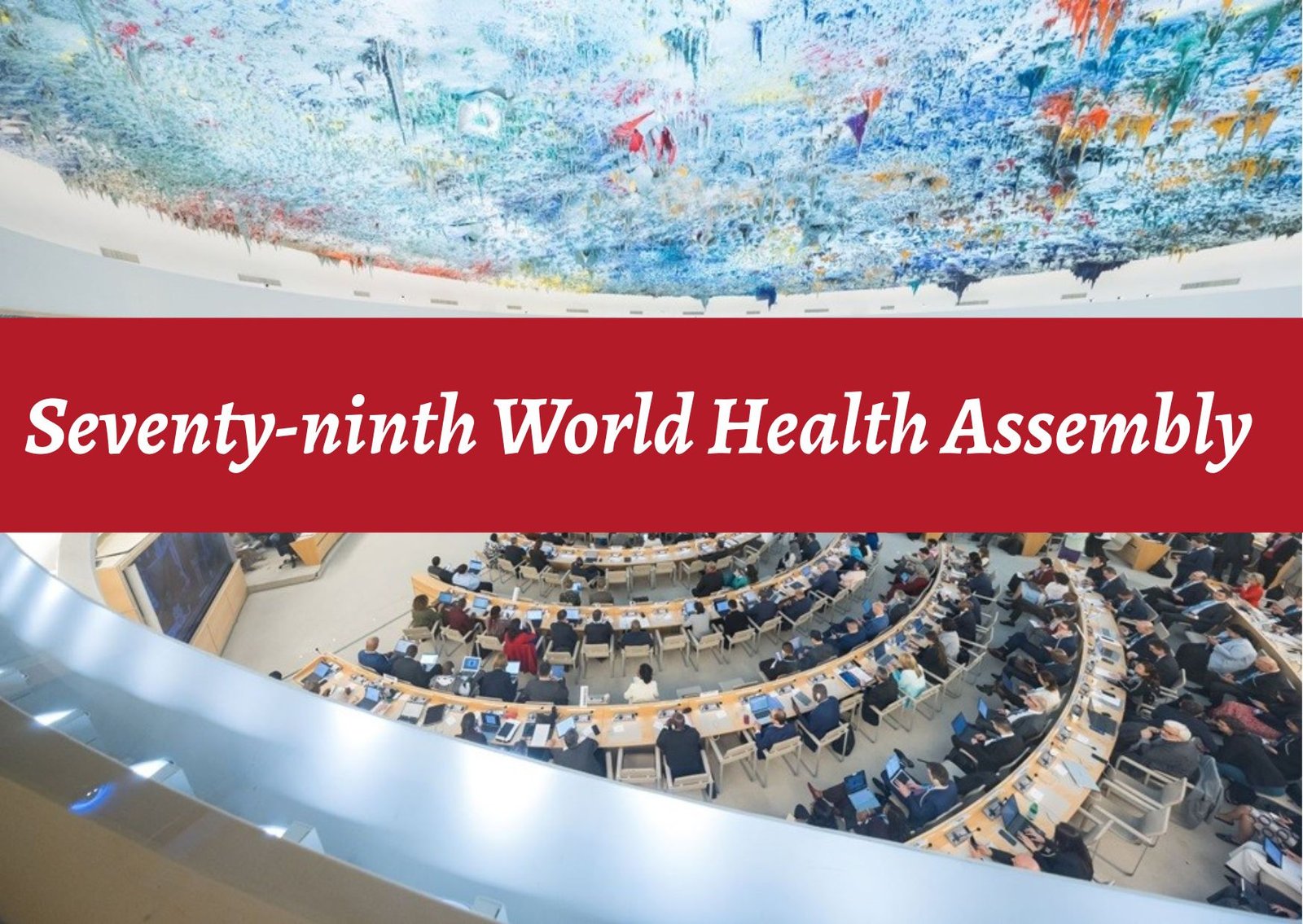
Seventy-ninth World Health Assembly
The Seventy-ninth World Health Assembly (WHA79), convened by the World Health Organization, is the highest decision-making forum in global health. Held in Geneva, it brings together delegations from all WHO Member States to set global health priorities, approve budgets, and adopt key health policies.
As the world continues to face interconnected health challenges—ranging from pandemics and climate change to health financing constraints and rising noncommunicable diseases—WHA79 represents a critical moment for shaping the direction of global health governance.
Role and Functions of the WHA
The World Health Assembly serves as the supreme governing body of WHO. Its core functions include:
- Setting global health policy direction for WHO and Member States
- Appointing the Director-General of WHO
- Approving the programme budget and overseeing financial frameworks
- Reviewing and endorsing global health strategies and resolutions
- Supervising implementation of international health agreements and frameworks
These functions ensure that WHA remains the central platform for multilateral decision-making on health.
WHA79 in Context
WHA79 takes place at a time of significant transition in global health governance. The meeting agenda reflects both urgent health crises and long-term system reforms.
Key agenda documents include consolidated reports, strategic frameworks, and technical updates covering:
- Health emergencies and pandemic preparedness
- Health financing and WHO programme budget (2026–2027)
- Antimicrobial resistance strategies (2026–2036)
- Malaria elimination progress
- Human resources and institutional reform
- Implementation of the International Health Regulations (2005)
These discussions are expected to shape global health priorities for the coming decade.
Major Thematic Priorities at WHA79
1. Health Emergencies and Pandemic Preparedness
A major focus is strengthening global preparedness and response systems through:
- Implementation of the International Health Regulations
- Ongoing negotiations on the WHO Pandemic Agreement
- Evaluation of WHO’s emergency operations and resilience systems
This reflects lessons learned from recent outbreaks and the need for stronger international coordination.
2. Health Financing and System Reform
WHA79 will review:
- Programme budget implementation (2024–2025)
- Financing framework for 2026–2027
- Operational efficiency and resource allocation reforms
These discussions are central to ensuring sustainable financing for WHO and strengthening health system resilience globally.
3. Antimicrobial Resistance (AMR)
A revised global action plan (2026–2036) on AMR is expected to be discussed, focusing on:
- Strengthening surveillance systems
- Improving antimicrobial stewardship
- Advancing the One Health approach across human, animal, and environmental health.
4. Noncommunicable Diseases and Tobacco Control
WHA79 continues to build on global commitments to address NCDs through:
- Strengthening prevention and control strategies
- Enhancing integration into primary health care systems
- Aligning efforts with the WHO Framework Convention on Tobacco Control.
5. Global Health Governance and Reform
A key discussion area is the reform of the global health architecture, including:
- Coordination within the United Nations system
- The UN80 initiative
- Strengthening multilateral cooperation in health governance.
Importance of WHA79 for Global Health
WHA79 is not only a technical meeting but also a diplomatic platform where global health priorities are negotiated and aligned. Its outcomes influence:
- National health policies
- International funding priorities
- Emergency preparedness systems
- Long-term global health strategies
In an increasingly interconnected world, decisions taken at WHA79 will have implications far beyond Geneva, shaping health outcomes at global, regional, and national levels.
WHA79 Side Events
Alongside the official plenary discussions, a parallel stream of side events offers a deeper, more flexible space for dialogue, innovation, and partnership-building across global health actors. Side events are thematic sessions organized during WHA week by Member States, WHO partners, civil society organizations, academic institutions, and global health initiatives. These side events are an increasingly important feature of the World Health Assembly, reflecting the complexity and urgency of today’s global health challenges.
The official WHA79 side events calendar is available through WHO:
https://apps.who.int/gb/Side-Events/WHA79/index.html
- World Atopic Eczema Day 2026: Breaking the Invisible Burden
- DEVASTATING FLOODS IN NEPAL: PUBLIC HEALTH IMPACT AND A CALL FOR HUMANITARIAN SUPPORT
- PEN-Plus Orientation Manual for Mid-Level Health Care Workers
- National Health Training Strategy 2082
- Simulation Accreditation Manual for Clinical Training Sites