
Public Health Update
  • Home
  • Public Health Update
  • Nepal Health Jobs
    • Public Health Job Board
    • Organization List
  • Opportunities
    • Fellowships, Studentship & Scholarships
    • Grants and Funding Opportunities
    • Fully funded
    • Conference
  • Downloads
    • International Plan, Policy & Guidelines
    • National Plan, Policy & Guidelines
    • Reports
    • Public Health Notes
    • Syllabus
    • Form Formats
  • School of Public Health
    • PhD
    • Master’s Degree
    • Online Courses
  • Notice
  • Home
  • Public Health Update
  • Nepal Health Jobs
    • Public Health Job Board
    • Organization List
  • Opportunities
    • Fellowships, Studentship & Scholarships
    • Grants and Funding Opportunities
    • Fully funded
    • Conference
  • Downloads
    • International Plan, Policy & Guidelines
    • National Plan, Policy & Guidelines
    • Reports
    • Public Health Notes
    • Syllabus
    • Form Formats
  • School of Public Health
    • PhD
    • Master’s Degree
    • Online Courses
  • Notice
LOGIN / REGISTER
Public Health Update
SUBSCRIBE
Public Health Update
  • Home
  • Public Health Update
  • Nepal Health Jobs
    • Public Health Job Board
    • Organization List
  • Opportunities
    • Fellowships, Studentship & Scholarships
    • Grants and Funding Opportunities
    • Fully funded
    • Conference
  • Downloads
    • International Plan, Policy & Guidelines
    • National Plan, Policy & Guidelines
    • Reports
    • Public Health Notes
    • Syllabus
    • Form Formats
  • School of Public Health
    • PhD
    • Master’s Degree
    • Online Courses
  • Notice

All Right Reserved. Designed and Developed by PenciDesign

HSG 2022 Board Election: Call for Candidate Nominations
Public Health OpportunitiesCall for Proposal, EOI & RFPPublic Health Opportunity

HSG 2022 Board Election: Call for Candidate Nominations

by Public Health Update July 30, 2022
written by Public Health Update

HSG is launching its 2022 Board election and is seeking nominations for six available seats on its Board of Directors.

Three general seats and three regional seats (Western Pacific region, European region and South East Asia region) are open for this year’s election. Both new candidates and current Board members seeking re-election are eligible for nomination.

Nominations

All HSG Society members are invited to participate in the nomination process. Please note that self-nominations will not be accepted.

Nominated individuals must be active members of Health Systems Global for at least 2 years prior to nomination; participate in HSG’s Thematic Working Groups, Symposium Scientific Committees, virtual communications, blog publishing or other. Active HSG members can be searched on the member directory page using a simple search WINDOW or by clicking on the ADVANCED search link.

More detailed instructions explaining the nomination and election process are available here, including details about how to nominate.

The deadline for nominations is August 1st, 2022. Please submit through the online nomination form.

Nominated individuals will be contacted by the HSG Secretariat to confirm their interest to participate in the election and will be required to submit a statement of interest and supporting documents. The deadline for nominees to submit the election application package is August 21, 2022.

Shortlisted nominees from the Western Pacific region, European region, South East Asia region, and those residing in LMIC settings are strongly encouraged to stand for election.

Official Info.


Do you have a website? Looking for the best hosting provider? Here’s a discount code.

Latest Public Health Jobs

Latest Posts

  • International Wellness Day: Promoting Global Wellness for All
  • Summit Declaration: The 12th National Summit of Health and Population Scientists in Nepal
  • Joint political declaration on the reform of the global health architecture
  • World Health Day 2026: Together for Health. Stand with Science.
  • World Water Day 2026 | Water & Gender Equality

Thanks for visiting us.
Disclaimer: The resources, documents, guidelines, and information on this blog have been collected from various sources and are intended for informational purposes only. Information published on or through this website and affiliated social media channels does not represent the intention, plan, or strategies of an organization that the initiator is associated with in a professional or personal capacity, unless explicitly indicated.
If you have any complaints, information, or suggestions about the content published on Public Health Update, please feel free to contact us at blog.publichealthupdate@gmail.com.
#StayUpdated

  • WordPress
  • Link
  • Facebook
  • Mail
  • Facebook
  • Twitter
  • Twitter
  • LinkedIn
  • Instagram
  • Facebook
July 30, 2022 0 comments
0 FacebookTwitterPinterestLinkedinTumblrVKOdnoklassnikiRedditStumbleuponWhatsappTelegramLINEPocketSkypeViberEmail
The 10 Essential Public Health Services (Revised, 2020)
Public HealthPublic Health NotesPublic Health Update

The 10 Essential Public Health Services (Revised, 2020)

by Public Health Update July 29, 2022
written by Public Health Update

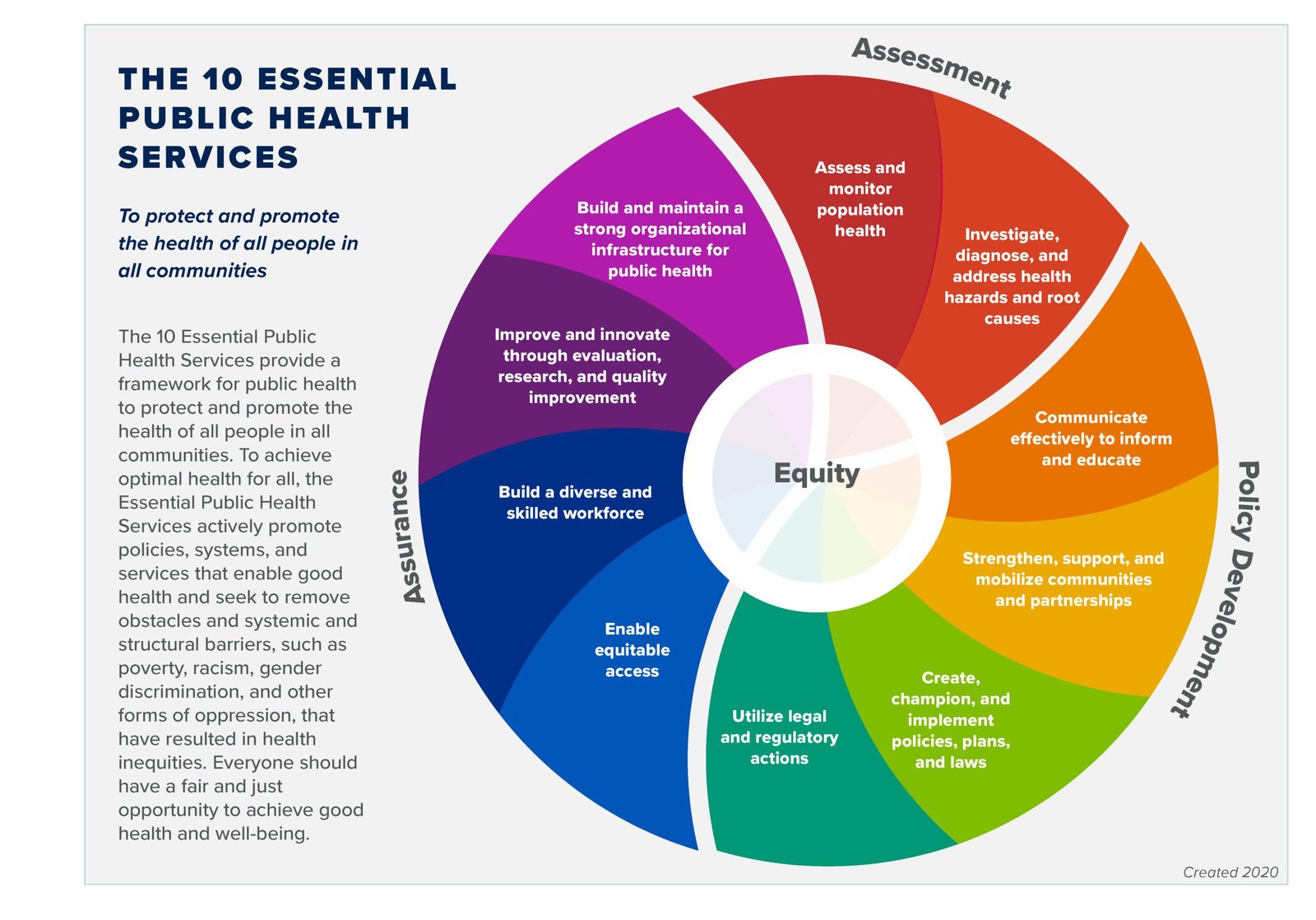
The 10 Essential Public Health Services provide a framework for public health to protect and promote the health of all people in all communities. To achieve equity, the Essential Public Health Services actively promote policies, systems, and overall community conditions that enable optimal health for all and seek to remove systemic and structural barriers that have resulted in health inequities. Such barriers include poverty, racism, gender discrimination, ableism, and other forms of oppression. Everyone should have a fair and just opportunity to achieve optimal health and well-being.

  1. Assess and monitor population health status, factors that influence health, and community needs and assets
  2. Investigate, diagnose, and address health problems and hazards affecting the population
  3. Communicate effectively to inform and educate people about health, factors that influence it, and how to improve it
  4. Strengthen, support, and mobilize communities and partnerships to improve health
  5. Create, champion, and implement policies, plans, and laws that impact health
  6. Utilize legal and regulatory actions designed to improve and protect the public’s health
  7. Assure an effective system that enables equitable access to the individual services and care needed to be healthy
  8. Build and support a diverse and skilled public health workforce
  9. Improve and innovate public health functions through ongoing evaluation, research, and continuous quality improvement
  10. Build and maintain a strong organizational infrastructure for public health.
10 essential public health services

Source of Info: CDC


  • What is Public Health?
  • Post-Secondary Educational Programs Related to Public Health in Canada
  • Universities for Doctor of Public Health (DrPH) IN USA
  • Doctor of Philosophy (PhD) Opportunities for Public Health Professionals in USA
  • Masters of Public Health (MPH) in USA (Universities & Specialization)
  • NEPHA’s Definition of Public Health, Public Health Professional & Public Health Expert
  • Master of Public Health (MPH) Colleges in Nepal
July 29, 2022 0 comments
0 FacebookTwitterPinterestLinkedinTumblrVKOdnoklassnikiRedditStumbleuponWhatsappTelegramLINEPocketSkypeViberEmail
New rabies vaccine candidate demonstrates promising immune response and safety
Global Health NewsNeglected Tropical Diseases (NTDs)Public Health NewsPublic Health Update

New rabies vaccine candidate demonstrates promising immune response and safety

by Public Health Update July 29, 2022
written by Public Health Update

PUBLISHED: 28 JULY 2022 (https://www.ox.ac.uk/news)

Researchers from the University of Oxford have today reported new findings from a Phase 1 clinical trial studying the immune response and safety of their newly-developed single shot rabies vaccine, ChAdOx2 RabG – with promising results identified.

The RAB001 trial was conducted at the University and is the first time the novel rabies vaccine has been used in human volunteers. The aim of the study was to look at safety and measure immune responses from the vaccine by analysing levels of rabies neutralising antibodies – a powerful marker of successful rabies vaccination.

In their findings (published in The Lancet Microbe), the researchers reported that 12 volunteers were recruited into the study in total, with three receiving a low dose, three receiving a medium dose and six receiving a high dose of ChAdOx2 RabG. Strong immune responses against rabies were generated by the vaccine, with all volunteers who received a medium or high dose developing levels of rabies neutralising antibodies above the World Health Organisation protective threshold (0.5 International Units / ml) within two months.

No serious adverse events or safety concerns were reported during the trial. Expected levels of common short-lived vaccine side effects such as soreness at the injection area or feverishness were observed in volunteers, mainly in the medium- and higher-dose groups.

Additionally, the researchers assessed longer term immune responses. Six of the seven middle- and high-dose recipients who returned for an additional follow-up one year after vaccination maintained neutralising antibody levels above the protective threshold, demonstrating that the immune response from the vaccine persists over time.

Associate Professor Sandy Douglas, Chief Investigator of the trial at the Jenner Institute, University of Oxford, said:

‘We’re absolutely delighted with these early results – the vaccine has performed even better than we had expected. The problems with existing rabies vaccines are that they are expensive and require multiple doses. We’re very hopeful that expanded trials in countries affected by rabies will prove that this new vaccine could enable routine, affordable, single-dose vaccination against this devastating disease for people living in such areas.’

Dr Daniel Jenkin, Lead Clinical Research Fellow of the trial at the Jenner Institute, University of Oxford, said:

‘New rabies vaccines based on modern vaccine technologies could become important tools in preventing the tens of thousands of rabies deaths that occur annually. Our strong early clinical trial data with ChAdOx2 RabG supports further development of this approach.’

The ChAdOx2 RabG vaccine is based on the ChAdOx2 vector – a weakened version of a common cold virus (adenovirus) that has been genetically modified so that it is impossible for it to replicate in humans, and is similar to the technology used successfully in the Oxford-AstraZeneca COVID-19 vaccine.

National Guideline on Rabies Prophylaxis in Nepal 2019

Researchers hope the promising results from the RAB001 trial will support further development of the vaccine and allow larger clinical trials to take place in the future. A Phase Ib/II clinical trial to assess safety and immunogenicity in Tanzania is also currently ongoing and results of that trial are expected later this year, with full results due in late 2023.

PUBLISHED: 28 JULY 2022, Official Link (https://www.ox.ac.uk/news)


  • World Rabies Day 2021! Rabies: Facts, Not Fear
  • National Guideline on Rabies Prophylaxis in Nepal 2019
  • World Rabies Day 2020! End Rabies: Collaborate, Vaccinate
  • World Rabies Day! Rabies: Vaccinate to Eliminate!
  • Rabies: Share the message. Save a life. #WorldRabiesDay
  • Fast-track efforts to eliminate rabies: WHO
  • Rabies: Zero by 30, World Rabies Day 2017
  • World Rabies Day : Educate. Vaccinate. Eliminate
  • ”End Rabies Together” : World Rabies Day
  • World Rabies Day
July 29, 2022 0 comments
0 FacebookTwitterPinterestLinkedinTumblrVKOdnoklassnikiRedditStumbleuponWhatsappTelegramLINEPocketSkypeViberEmail
World Hepatitis Day
Global Health NewsPH Important DayPublic HealthPublic Health News

Bring hepatitis care closer to people: WHO

by Public Health Update July 28, 2022
written by Public Health Update

28 July 2022 

News release (SEARO) New Delhi | 28 July 2022 

The World Health Organization today called for making quality hepatitis care affordable, accessible, and integrated into primary health care, to bring these lifesaving services closer to people and accelerate efforts to eliminate viral hepatitis in the WHO South-East Asia Region by 2030.

“Viral hepatitis is preventable and treatable. Yet, an estimated 60 million people live with chronic hepatitis B and about 10.5 million with chronic hepatitis C in our Region. Our efforts to eliminate viral hepatitis can only succeed if we ensure everyone everywhere has access to hepatitis services,” said Dr Poonam Khetrapal Singh, Regional Director, WHO South-East Asia Region, while addressing a virtual event to mark the World Hepatitis Day.

A strong advocate for elimination of viral hepatitis and a hepatitis survivor, Mr Amitabh Bachchan, said in a video message, “For a person living with hepatitis, every day is hepatitis day. I can feel the pain of a sufferer, the pain of my near and dear ones seeing me suffer. We need to ask. What will it take to prevent more people from losing their lives, their health to hepatitis? We need to bring care closer to communities.”

Hepatitis kills more people than HIV and malaria – nearly one person every 30 seconds, globally.
“We are calling on countries to integrate quality, accessible and affordable hepatitis care into primary health care services, in line with the Region’s new Strategy for Primary Health Care, as well as new WHO Global Health Sector Strategies on HIV, viral hepatitis and sexually transmitted infections (STIs),” the Regional Director said.

A new Regional Action Plan on viral hepatitis, HIV and STIs, is being launched in September with the aim to increase quality and efficiency, and leverage the full power of primary health care, universal health coverage and health systems. It will promote equity and innovation, and advance people-centred and community-driven approaches.

The Regional Director said, to bring hepatitis care closer to communities, and to eliminate hepatitis as a public health threat, several priorities must be addressed. Political commitment to eliminate hepatitis must be strengthened and investment into high-quality, people-centered hepatitis care must be increased.

“Access for all to safe and effective vaccines and drugs, and point-of-care diagnostics, must be improved, with a focus on increasing affordability,” she said.

Communication and community engagement strategies must be strengthened to reduce stigma and to increase awareness and testing, especially among populations at higher risk.

“Importantly, we must explore service delivery models that are close to where people live and work, and which are aligned with people’s needs, preferences and health-seeking behaviors. We need to shift from the specialist domain, and into communities,” the Regional Director emphasized. 

Viral hepatitis can be prevented. Vaccination, especially Hepatitis B birth dose followed by other doses in childhood vaccination schedule; safe injection; safe blood transfusion and safe dental procedures are among key preventive measures. Equally important is timely detection to ensure treatment, as only 10% people with hepatitis are aware of their status.

Mr Bachchan, in his video message on World Hepatitis Day, reiterated, “We must collectively resolve, communicate and act. Action to eliminate viral hepatitis cannot and must not wait.”

The virtual webinar organized by WHO South-East Asia Regional office was attended by national programme managers from Member countries, experts, partners and representatives of organizations working at the community level.

News release (SEARO) New Delhi | 28 July 2022 


  • World Hepatitis Day 2022: Bringing hepatitis care closer to you
  • World Hepatitis Day
  • World Hepatitis Day 2021: Hepatitis Can’t Wait
  • World Hepatitis Day 2020: “Hepatitis-free future”
  • World Hepatitis Day 2019! Invest in eliminating H̶e̶p̶a̶t̶i̶t̶i̶s̶
  • Bangladesh, Bhutan, Nepal and Thailand achieve Hepatitis B control: WHO
  • Find the Missing Millions, ”Eliminate H̶e̶p̶a̶t̶i̶t̶i̶s̶- #WorldHepatitisDay 2018
  • World Hepatitis Day: 28 July 2015: Prevent hepatitis. Act now
  • #WorldHepDay 2016 : “Know hepatitis – Act now”
July 28, 2022 0 comments
0 FacebookTwitterPinterestLinkedinTumblrVKOdnoklassnikiRedditStumbleuponWhatsappTelegramLINEPocketSkypeViberEmail
World Hepatitis Day
PH Important DayPublic HealthPublic Health EventsPublic Health NewsPublic Health Update

World Hepatitis Day 2022: Bringing hepatitis care closer to you

by Public Health Update July 28, 2022
written by Public Health Update

World Hepatitis Day takes places every year on 28 July to raise awareness and promote global action on viral hepatitis.

Hepatitis is an inflammation of the liver. There are five main types of the hepatitis virus – A, B, C, D and E. Hepatitis B and C lead to chronic disease in hundreds of millions of people globally, and together are the most common cause of liver cirrhosis, liver cancer and viral hepatitis-related deaths.

As of 2019, an estimated 116 million people in the Western Pacific are living with hepatitis B and 10 million with hepatitis C. While there are evidence-based, effective and safe interventions to diagnose, treat, and prevent chronic hepatitis B and C, most people remain undiagnosed and untreated. In the Western Pacific, only 18% of people living with hepatitis B have been diagnosed and 5% have received treatment. For hepatitis C, 25% of people have been diagnosed and 10% have received treatment.

Bringing hepatitis care closer to you

This year’s theme, “Bringing hepatitis care closer to you”, aims to raise awareness about the need to simplify and bring hepatitis care to primary health facilities, community-based venues and locations beyond hospital sites, so that care is closer to communities and people wherever they are.

The new Global Health Sector Strategies on, respectively, HIV, viral hepatitis and sexually transmitted infections for the period 2022-2030 emphasizes the importance of person-centered care and alignment of systems and integration of services to reach the goal of elimination by 2030. To achieve hepatitis elimination at least 60% of people living with hepatitis B and C must be diagnosed and at least 50% eligible for treatment must be cured (hepatitis C) or receiving treatment (hepatitis B) by 2025.

For this to happen, those in need must have access to hepatitis services that are accessible, and that are equitable, effective, efficient, timely and of an acceptable quality.

5 actions to protect yourself against hepatitis:

  1. Use sterile injections always
  2. Use your own razors and blades
  3. Practise safe sex
  4. Use safe tattooing and piercing equipment
  5. Vaccinate infants against Hepatitis B

Source of Info: World Health Organization


Do you have a website? Looking for the best hosting provider? Here’s a discount code.

Latest Public Health Jobs

Latest Posts

  • International Wellness Day: Promoting Global Wellness for All
  • Summit Declaration: The 12th National Summit of Health and Population Scientists in Nepal
  • Joint political declaration on the reform of the global health architecture
  • World Health Day 2026: Together for Health. Stand with Science.
  • World Water Day 2026 | Water & Gender Equality

Thanks for visiting us.
Disclaimer: The resources, documents, guidelines, and information on this blog have been collected from various sources and are intended for informational purposes only. Information published on or through this website and affiliated social media channels does not represent the intention, plan, or strategies of an organization that the initiator is associated with in a professional or personal capacity, unless explicitly indicated.
If you have any complaints, information, or suggestions about the content published on Public Health Update, please feel free to contact us at blog.publichealthupdate@gmail.com.
#StayUpdated


  • WordPress
  • Link
  • Facebook
  • Mail
  • Facebook
  • Twitter
  • Twitter
  • LinkedIn
  • Instagram
  • Facebook
July 28, 2022 0 comments
0 FacebookTwitterPinterestLinkedinTumblrVKOdnoklassnikiRedditStumbleuponWhatsappTelegramLINEPocketSkypeViberEmail
Council for Technical Education and Vocational Training (CTEVT) Scholarship 2079/80
Public HealthCoursesFellowships, Studentship & ScholarshipsNoticePublic Health OpportunitiesPublic Health Opportunity

Council for Technical Education and Vocational Training (CTEVT) Scholarship 2079/80

by Public Health Update July 28, 2022
written by Public Health Update

Council for Technical Education and Vocational Training (CTEVT)- Sanothimi, Bhaktapur invites application for the pre-diploma and diploma/ Proficiency Level courses for academic year 2079/80.

LIST OF CTEVT INSTITUTIONS FOR TSLC AND PCL LEVEL HEALTH SCIENCES

CTEVT MASTER
CTEVT MASTER PRE
CTEVT 2
Council for Technical Education and Vocational Training (CTEVT) Scholarship 2079/80
CTEVT 4
Council for Technical Education and Vocational Training (CTEVT) Scholarship 2079/80
PRE 1
Council for Technical Education and Vocational Training (CTEVT) Scholarship 2079/80
CTEVT 1
Council for Technical Education and Vocational Training (CTEVT) Scholarship 2079/80
CTEVT 3
Council for Technical Education and Vocational Training (CTEVT) Scholarship 2079/80

  • Diploma in Pharmacy (D.Pharm) – CTEVT
  • Proficiency Certificate Level in Nursing (PCL Nursing)-CTEVT
  • Certificate in Dental Science (Dental Hygiene)- CTEVT
  • Certificate in General Medicine (Health Assistant) – CTEVT
  • Certificate in Ophthalmic Science- CTEVT
July 28, 2022 0 comments
0 FacebookTwitterPinterestLinkedinTumblrVKOdnoklassnikiRedditStumbleuponWhatsappTelegramLINEPocketSkypeViberEmail
Are you looking for a fully-funded PhD position? Tips for getting a PhD position
Advice & TipsGrants and Funding OpportunitiesInternational Jobs & OpportunitiesPhDPublic Health OpportunitiesPublic Health Opportunity

Are you looking for a fully-funded PhD position? Tips for getting a PhD position

by Public Health Update July 23, 2022
written by Public Health Update

The following framework developed by Faheem Ullah, Assistant Professor will 10x your chances of getting a PhD position.

Do you have one or more research publications?

YES —> Read the following.
NO —> Go to step 1B.

??. ??? ??????????? ??????:  To get a PhD position, you first need to know that a position is available. For this, set alerts on various scholarship websites, university websites, and social media groups. Make an excel sheet of the available positions and their deadlines.

??. ??????? ? ????????-???????? ??: A generic CV is unlikely to sell you the best. Prepare a CV that shows what research value you will bring to the lab. If nothing else highlight research areas in your CV that are aligned with the target lab.

??. ?????? ?? ????? ???????? ???? ? ????: Someone will open your CV if there is a hook in your email. This hook should work in the first 3 seconds. This hook can be in the subject line or in the body. I can share a template if you need one.

??. ???? ???????????? ?? ?????: Professors receive tons of emails. It’s possible that your email is lost somewhere. Should you give up? No. Find alternative ways to bring yourself in front. These ways could be a contact via Twitter or LinkedIn or even face-to-face contact during an event.

??. ??????? ??? ??? ?????????: Once you hear from the professor or the school, it is likely that you will be asked for an interview. Here you need to shine bright. For this, the best way is to defend your CV well. Also, importantly, explore the target lab/professor’s research and demonstrate how it aligns with yours.

??. ?????, ?????, ??? ?????: There are multiple reasons why a candidate might not be selected. To increase your chances, you need to apply to as many positions as possible. The more you apply, the sooner you will get your PhD position. Contact professors who already have PhD positions available or advertised.

You don’t have any research publications?

YES —> Read the following.

??. ???? ???? ???, ???? ??????, ??? ??????????: While contacting a professor or applying directly, highlight your strong points such as GPA, grad school, your experiences, or a solid research proposal. Think about what I have that can be of use to the professor or target lab. Highlight those skills or records.

??. ????????? ??? ????????: If you are not getting a direct entry to your PhD position, volunteer for around 6 months to do research with a professor having a solid record of recent publications. You will get research experience and publish papers. Then, either the same professor can offer you a PhD position or you can follow steps 1A – 6A to get another position easily.

Framework developed by Faheem Ullah, Assistant Professor


Explore Public Health Opportunities Now!


Doctor of Philosophy (PhD) Opportunities for Public Health Professionals in USA

Masters of Public Health (MPH) in USA (Universities & Specialization)


Do you have a website? Looking for the best hosting provider? Here’s a discount code.

Latest Public Health Jobs

Latest Posts

  • International Wellness Day: Promoting Global Wellness for All
  • Summit Declaration: The 12th National Summit of Health and Population Scientists in Nepal
  • Joint political declaration on the reform of the global health architecture
  • World Health Day 2026: Together for Health. Stand with Science.
  • World Water Day 2026 | Water & Gender Equality

Thanks for visiting us.
Disclaimer: The resources, documents, guidelines, and information on this blog have been collected from various sources and are intended for informational purposes only. Information published on or through this website and affiliated social media channels does not represent the intention, plan, or strategies of an organization that the initiator is associated with in a professional or personal capacity, unless explicitly indicated.
If you have any complaints, information, or suggestions about the content published on Public Health Update, please feel free to contact us at blog.publichealthupdate@gmail.com.
#StayUpdated


  • WordPress
  • Link
  • Facebook
  • Mail
  • Facebook
  • Twitter
  • Twitter
  • LinkedIn
  • Instagram
  • Facebook
July 23, 2022 0 comments
0 FacebookTwitterPinterestLinkedinTumblrVKOdnoklassnikiRedditStumbleuponWhatsappTelegramLINEPocketSkypeViberEmail
World Health Organization (WHO) declares Monkeypox a public health emergency
Outbreak NewsGlobal Health NewsNational Health NewsPublic Health News

World Health Organization (WHO) declares Monkeypox a public health emergency

by Public Health Update July 23, 2022
written by Public Health Update

The World Health Organization (WHO) on Saturday declared the monkeypox outbreak as a public health emergency. The WHO Director-General recognizes the complexities and uncertainties associated with this public health event. Having considered the views of Committee Members and Advisors as well as other factors in line with the International Health Regulations, the Director-General has determined that the multi-country outbreak of monkeypox constitutes a Public Health Emergency of International Concern.

“For all of these reasons, I have decided that the global #monkeypox outbreak represents a public health emergency of international concern.”-@DrTedros

MONKEYPOX ENDEMIC NEWS: WHAT IS MONKEYPOX?, SYMPTOMS AND PREVENTIVE MEASURES


WHAT IS PUBLIC HEALTH EMERGENCY OF INTERNATIONAL CONCERN (PHEIC)?


RULES & REGULATIONS FOR PUBLIC HEALTH EMERGENCY IN NEPAL


July 23, 2022 0 comments
0 FacebookTwitterPinterestLinkedinTumblrVKOdnoklassnikiRedditStumbleuponWhatsappTelegramLINEPocketSkypeViberEmail
Orange Knowledge Programme Scholarships for Master programmes and Short courses 2021
Public Health OpportunitiesFellowships, Studentship & ScholarshipsGrants and Funding OpportunitiesInternational Jobs & OpportunitiesPublic Health OpportunitySchool of Public HealthUniversities & School of Public Health

Nuffic Global Development, Orange Knowledge Programme 2022

by Public Health Update July 22, 2022
written by Public Health Update

The Orange Knowledge Programme aims to contribute to a society’s sustainable and inclusive development. Its scholarships are open to mid-career professionals in specific countries.

About this scholarship

The Orange Knowledge Programme (OKP) offers scholarships funded by the Dutch Ministry of Foreign Affairs available for a selection of:

  • short courses (duration 2 weeks to 12 months);
  • master’s programmes (duration 12 to 24 months).

Countries

You may be eligible for an OKP scholarship if you are a national of and working in:

Bangladesh, Benin, Burkina Faso, Burundi, Colombia, Congo (DRC), Egypt, Ethiopia, Ghana, Guatemala, Guinea, Indonesia, Iraq, Jordan, Kenya, Lebanon, Liberia, Mali, Mozambique, Myanmar, Niger, Nigeria, Palestinian Territories, Rwanda, Senegal, Sierra Leone, Somalia, South Africa, South Sudan, Sudan, Suriname, Tanzania, Tunisia, Uganda, Vietnam, Yemen and Zambia.

Applicants for master’s programmes from Indonesia should apply through the OKP-LPDP joint programme.

Requirements

A limited number of scholarships is awarded to female and male professionals who are:

  • motivated;
  • living and working in an OKP country;
  • proficient in English or French;
  • working in one of the priority areas for their country;
  • can motivate using and transferring their knowledge and experience in their employing organisation after their studies;
  • agreeing to the OKP obligations and conditions (133.9 kB).

For more information on the general eligibility criteria please read:
OKP information for applicants (168.8 kB) (168.8 kB)

Language

You need English or French language skills to follow classes in the Netherlands. Demands for certificates showing language skills differ per education institution.

Priority themes per country

The main priority areas of the Orange Knowledge Programme are;

  • sexual and reproductive health and rights
  • security and rule of law
  • food and nutrition security
  • water management

There are focus areas for each country. Please note that these focus areas, as well as the list of countries is subject to change. Only applications that fall within the focus area of your country of employment are eligible.

Is your field of experience eligible for funding? Please check the Country focus document.

Employer statement

You need an employer statement that is signed by you and your employer. It shows us that your employer supports your application. And that you can share the knowledge and experience you gained in the Netherlands once you return to your country. This is required because the OKP is focused onstrengthening organisations by strengthening people.

Government statement

If you are a civil servant, it might be necessary to sign a government statement. This certifies the support of your government for your OKP application.

Please check whether your local government requires a government statement:
Government statement requirements

Other requirements

The education institution will inform you on the requirements needed for your application. As this scholarship is for working professionals, applications from students will not be taken into consideration. In order to apply for one of the courses you must motivate:

  • that you work within the priority themes for your country as mentioned above;
  • how the courses will strengthen both you and the organisation you work for;
  • how you will use your newly gained knowledge and experience in your organisation after your study.

How to apply

You cannot apply online on this website. Please follow the steps below and apply through the Dutch education institution of your choice.

  1. Check if your application falls within the OKP focus areas determined for your country.
  2. Check if you meet the OKP eligibility criteria.
  3. Find a course on the OKP course list. Please find a study, using the filter ‘Orange Knowledge Programme (OKP)’.
  4. Ask your employer whether they are willing to nominate you for an OKP scholarship.
  5. Contact the Dutch education institution of your choice to receive more information about the application procedure, the academic requirements and the link to apply online.
  6. Prepare your application: employer statement, motivation, passport, government statement (if required).
  7. During an application round, submit your application online using the link you receive from the Dutch education institution. Please be aware of the application deadline of the educational institution of your choice.

Deadlines of application rounds

You can only apply for a scholarship during an open application round.

The following rounds are expected for 2022:

Round 1 – for master’s and short courses
– Accepting applications between 2 February – 22 March 16.00 CET.
– Both master’s and short courses should start between 25 July and 21 November 2022.

Round 2 – for short courses
– Accepting applications between 11 May – 28 June 16.00 CET.
– Courses should start between 21 November 2022 and 20 February 2023.

Round 3 – for short courses
– Accepting applications between 31 August – 11 October 16.00 CET.
– Courses should start from 20 February 2023 onward and must be completed before 31 August 2023.

Deadlines per institution

Please note that educational institutions may set a shorter deadline for application. Please consult your educational institution for the exact deadlines.

Selection procedure

The procedure is as follows:

1. Candidates register with their Dutch education institution
2. Dutch institution nominates candidates and submits grant application
3. Embassies check eligibility and assess applications
4. Selection results available for Dutch education institutions
5. Grants awarded through Dutch education institutions

Results of applications are announced 3 to 4 months after application. The Dutch education institution through which you applied for the scholarship will contact you on the results of your application.

Application process

Please contact the Dutch education institution where you want to study on questions regarding your application for the OKP scholarship. A new application round for #OrangeKnowledge scholarships will open on 31 August!

Are you from a participating country and motivated to share your knowledge? Maybe you have a chance to be selected for a fully funded short course in the Netherlands! Discover which countries and fields of expertise are eliglible at www.studyinholland.nl/okp

July 22, 2022 0 comments
0 FacebookTwitterPinterestLinkedinTumblrVKOdnoklassnikiRedditStumbleuponWhatsappTelegramLINEPocketSkypeViberEmail
First World Report on the Health of Refugees and Migrants
Public HealthGlobal Health NewsPublic Health NewsReportsResearch & Publication

First World Report on the Health of Refugees and Migrants

by Public Health Update July 20, 2022
written by Public Health Update

Overview

Worldwide, more people are on the move now than ever before, yet many refugees and migrants face poorer health outcomes than the host populations. Addressing their health needs is, therefore, a global health priority and integral to the principle of the right to health for all. The key is to strengthen and maintain health systems by ensuring that they are refugee- and migrant-sensitive and inclusive.

Health outcomes are influenced by a whole host of determinants. However, refugees and migrants face additional determinants such as precarious legal status; discrimination; social, cultural, linguistic, administrative and financial barriers; lack of information about health entitlements; low health literacy; and fear of detention and deportation.

This groundbreaking publication outlines current and future opportunities and challenges and provides several strategies to improve the health and well-being of refugees and migrants. It is an advocacy tool for national and international policy-makers involved in health and migration.

Evidence on the health of refugees and migrants remains fragmented – comparable data across countries and over time are urgently needed to track progress towards the health-related United Nations Sustainable Development Goals. With only 8 years until the 2030 target date to transform our world, the time to act is now.

DOWNLOAD SUMMARY REPORT

WHO report shows poorer health outcomes for many vulnerable refugees and migrants

20 July 2022 News release (WHO)

Around the world, millions of refugees and migrants in vulnerable situations, such as low-skilled migrant workers, face poorer health outcomes than their host communities, especially where living and working conditions are sub-standard, according to the first WHO World report on the health of refugees and migrants. This has dire consequences for the probability that the world will not achieve the health-related Sustainable Development Goals for these populations.

“Today there are some one billion migrants globally, about one in eight people. The experience of migration is a key determinant of health and wellbeing, and refugees and migrants remain among the most vulnerable and neglected members of many societies,” said Dr Tedros. “This report is the first to offer a global review of refugee and migrant health; it calls for urgent and collective action to ensure they can access health care services that are sensitive to their needs. It also illustrates the pressing need to address the root causes of ill health and to radically reorient health systems to respond to a world increasingly in motion.”

Based on an extensive review of literature from around the world, the report demonstrates that refugees and migrants are not inherently less healthy than host populations. It is, rather, the impact of the various suboptimal health determinants, such as education, income, housing, access to services, compounded by linguistic, cultural, legal and other barriers and the interaction of these during the life course, that are behind poor health outcomes.

The report reiterates that the experience of migration and displacement is a key factor in a person’s health and wellbeing, especially when combined with other determinants. For example, a recent meta-analysis of more than 17 million participants from 16 countries across five WHO regions found that, compared with non-migrant workers, migrant workers were less likely to use health services and more likely to have an occupational injury. Evidence also showed that a significant number of the 169 million migrant workers globally are engaged in dirty, dangerous, and demanding jobs and are at greater risk of occupational accidents, injuries, and work-related health problems than their non-migrant counterparts, conditions exacerbated by their often limited or restricted access to and use of health services.

The Report demonstrated critical gaps in data and health information systems regarding the health of refugees and migrants – while data and evidence are plentiful, they are fragmented and not comparable across countries and over time. Although these mobile populations are sometimes identifiable in global datasets used for SDG monitoring, health data are often missing from migration statistics and migratory status variables are often missing from health statistics. This makes it difficult to determine and track progress for refugees and migrants towards the health-related SDGs.

“It is imperative that we do more on refugees and migrants’ health but if we want to change the status quo, we need urgent investments to improve the quality, relevance and completeness of health data on refugees and migrants. We need sound data collection and monitoring systems that truly represent the diversity of the world population and the experience that refugees and migrants face the world over and that can guide more effective policies and interventions,” said Dr Zsuzsanna Jakab, WHO’s Deputy Director-General.   

While lack of comparable data on the health of refugees and migrants across countries and over time often impedes good policy development towards health equity, policies and frameworks do exist that address and respond to the health needs of refugees and migrants. However, disparities in health outcomes remain and the report shows that they are mainly due to a lack of meaningful and effective implementation of policies.

“Health does not begin or end at a country’s border. Migratory status should therefore not be a discriminatory factor but a policy driver on which to build and strengthen healthcare and social and financial protection. We must reorient existing health systems into integrated and inclusive health services for refugees and migrants, in line with the principles of primary health care and universal health coverage,” said Dr Santino Severoni, Director of WHO’s Health and Migration Programme. 

Refugees and migrants can introduce innovative ideas that drive economic and social transformation. The Report highlights the extraordinary contributions of refugee and migrant healthcare workers to the COVID-19 frontline response. One of the most notable was the contributions of migrants in several countries of the Organisation for Economic Co-operation and Development (OECD), which were particularly significant when in some countries as many as half of doctors or nurses are foreign born.

Implementing inclusive health systems that conform to the principle of right to health for all and universal health coverage would permit individuals in need of health services to be identified and supported early, before many problems become acute. Health systems are only as strong as their weakest link. The inclusion of refugees and migrants is a worthwhile investment for the development and wellbeing of societies around the world. 

20 July 2022 News release (WHO)


July 20, 2022 0 comments
0 FacebookTwitterPinterestLinkedinTumblrVKOdnoklassnikiRedditStumbleuponWhatsappTelegramLINEPocketSkypeViberEmail
Newer Posts
Older Posts

Search

Follow Us

Facebook Twitter Instagram Pinterest Linkedin Youtube

Categories

  • Abstracts (25)
  • Activities (91)
  • Adolescent Sexual and Reproductive Health (ASRH) (25)
  • Advice & Tips (4)
  • African Region (5)
  • AI and Health (1)
  • Annual Meeting (6)
  • Antimicrobial Resistance (AMR) (21)
  • Award (19)
  • Awards (16)
  • Books (9)
  • Call for Proposal, EOI & RFP (103)
  • Call for Research Participants (8)
  • Clinical Doctor Jobs (6)
  • Communicable Diseases (107)
  • Competition (20)
  • Conference (129)
  • Consultant (1)
  • Courses (205)
  • Dashboard (2)
  • Digital Health & Health Informatics (10)
  • Drug and Medicine (18)
  • Eastern Mediterranean Region (3)
  • Education (15)
  • Environment (3)
  • Environmental Health & Climate Change (47)
  • European Region (42)
  • Exchange Program (1)
  • Fact Sheet (117)
  • FCHVs (1)
  • Fellowships, Studentship & Scholarships (168)
  • Financial Aid (13)
  • Form Formats (2)
  • Fully funded (22)
  • Global Health News (434)
  • Grants and Funding Opportunities (193)
  • Guest Post (44)
  • Health Assistant Jobs (1)
  • Health Equity (7)
  • Health Financing and Economics (24)
  • Health in Data (115)
  • Health Insurance (5)
  • Health Jobs (52)
  • Health Literacy, Health Education & Promotion (50)
  • Health Organization Profile (42)
  • Health Systems (83)
  • Human Resource for Health (33)
  • Humanitarian Health & Emergency Response (44)
  • Hypertension (5)
  • Implementation Research (48)
  • International Health (3)
  • International Jobs & Opportunities (373)
  • International Plan, Policy & Guidelines (210)
  • Internships (4)
  • Jobs Vacancies (56)
  • Journals (8)
  • Life Style & Public Health Nutrition (39)
  • Live (10)
  • Master's Degree (48)
  • Maternal, Newborn and Child Health (88)
  • Mentorship Program (2)
  • Miscellaneous (16)
  • National Health News (158)
  • National Plan, Policy & Guidelines (468)
  • Neglected Tropical Diseases (NTDs) (51)
  • Non- Communicable Diseases (NCDs) (121)
  • Notice (103)
  • Nursing Jobs (6)
  • Nutritionist Jobs (1)
  • One Health (18)
  • Online & Distance Learning (22)
  • Online Courses (90)
  • Op-Ed Article (3)
  • Opportunities by Region (83)
  • Outbreak News (213)
  • Partially funded (6)
  • PCL Health Science Jobs (3)
  • PH Important Day (534)
  • Pharmacist Jobs (3)
  • PhD (54)
  • Photos (5)
  • Planetary Health (4)
  • PostDoc (14)
  • Presentation Slides (26)
  • Primary Health Care (25)
  • Provincial Plan, Policies and Guidelines (14)
  • Public Health (1,283)
  • Public Health Epidemiology & Biostatistics (13)
  • Public Health Events (306)
  • Public Health Information (20)
  • Public Health Innovation (9)
  • Public Health Jobs (52)
  • Public Health News (554)
  • Public Health Notes (120)
  • Public Health Opportunities (507)
  • Public Health Opportunity (491)
  • Public Health Programs (108)
  • Public Health Seminar (2)
  • Public Health Tools (1)
  • Public Health Update (564)
  • Quality Improvement & Infection Prevention (20)
  • Region of America (8)
  • Reports (184)
  • Research & Project Grants (39)
  • Research & Project Grants (32)
  • Research & Publication (647)
  • Research Articles (10)
  • Road Traffic Accidents (RTA) (9)
  • School of Public Health (60)
  • Self funded (2)
  • South-East Asia Region (26)
  • Success Stories (17)
  • Summer and Winter Courses (40)
  • Summer Courses (28)
  • Sustainable Development Goals (SDGs) (14)
  • Syllabus (61)
  • Symposium (9)
  • Tobacco Control (35)
  • Training (40)
  • Travel Grants (15)
  • Trick, Technique & Skills (8)
  • Uncategorized (3)
  • Undergraduate Degree (7)
  • Universal Health Coverage (36)
  • Universities (29)
  • Universities & School of Public Health (58)
  • Vacancy Announcement (26)
  • Vaccine Preventable Diseases (40)
  • Vector-Borne Diseases(VBDs) (30)
  • Videos (3)
  • View Points (1)
  • Webinar (4)
  • Western Pacific Region (13)
  • Workshop (18)
  • World News (117)
Post New Jobs: Vacancy Announcement Service

Public Health Update (Sagun’s Blog) is a popular public health portal in Nepal. Thousands of health professionals are connected with Public Health Update to get up-to-date public health updates, search for jobs, and explore opportunities.
#1 Public Health Blog for sharing Job opportunities and updates in Nepal

”Public Health Information For All”
– – Sagun Paudel, Founder

  • HOT JOBS
    • Public Health Jobs
    • Medical Doctor Jobs
    • Nursing Jobs
    • Health Assistant Jobs
    • Pharmacist Jobs
    • NGOs Jobs
    • Government Jobs
  • Top Categories
    • National Plan, Policy & Guidelines Top
    • Public Health Calendar
    • Fellowships & Scholarships
    • Health Systems
    • Health Organization Profiles
    • International Jobs & Opportunities
    • Public Health Opportunity

PUBLIC HEALTH INITIATIVE

    • Submit your Vacancies New
    • Partnership Opportunities

Contact: blog.publichealthupdate@gmail.com

https://wa.me/+9779856036932

Public Health Initiative, A Registered Non-profit organization – All Right Reserved. 2011-2024. Contact us. 

Facebook Twitter Instagram Youtube Envelope
Public Health Update
  • Home
  • Public Health
    • Home 1
      • Adolescent Sexual and Reproductive Health (ASRH)
      • Antimicrobial Resistance (AMR)
      • Communicable Diseases
      • Digital Health & Health Informatics
      • Environmental Health & Climate Change
      • Health Financing and Economics
      • Health Equity
    • Home 2
      • Health Literacy, Health Education & Promotion
      • Human Resource for Health
      • Humanitarian Health & Emergency Response
      • Implementation Research
      • International Health
      • Life Style & Public Health Nutrition
      • Maternal, Newborn and Child Health
    • Home 3
      • Neglected Tropical Diseases (NTDs)
      • Non- Communicable Diseases (NCDs)
      • One Health
      • Planetary Health
      • Public Health Epidemiology & Biostatistics
      • Primary Health Care
      • Quality Improvement & Infection Prevention
    • Home 4
      • Road Traffic Accidents (RTA)
      • Sustainable Development Goals (SDGs)
      • Tobacco Control
      • Universal Health Coverage
      • Vaccine Preventable Diseases
      • Vector-Borne Diseases(VBDs)
      • Notices
  • Public Health Update
    • Home 1
      • Public Health News
      • Global Health News
      • Outbreak News
      • National Health News
      • COVID-19
    • Home 2
      • Fact Sheet
      • Health in Data
      • PH Important Day
      • Public Health Events
      • Public Health Programs
    • Home 3
      • Health Systems
      • Health Insurance
      • Health Organization Profile
      • Success Stories
      • Public Health Innovation
  • Public Health Opportunities
    • Fully funded
    • Travel Grants
    • Grants and Funding Opportunities
    • Opportunities by Region
    • International Jobs & Opportunities
    • Research & Project Grants
    • Fellowships, Studentship & Scholarships
    • Conference
  • Jobs
    • Home 1
      • Health Jobs
      • Public Health Jobs
      • Clinical doctor Jobs
      • Health Assistant Jobs
      • Nursing Jobs
      • PCL Health Science Jobs
    • Home 2
      • Dental Jobs
      • Pharmacist Jobs
      • TSLC (Health Jobs)
      • Laboratory Jobs
      • Nutritionist Jobs
  • Downloads
    • International Plan, Policy & Guidelines
    • National Plan, Policy & Guidelines
    • Reports
    • Books
    • Research Articles
  • School of Public Health
    • Home 1
      • Courses
      • Master’s Degree
      • Undergraduate Degree
      • PhD
    • Home 2
      • Universities
      • Syllabus
      • Public Health Notes
      • Mentorship Program
      • Startup Project
    • Home
      • Summer and Winter Courses
      • Summer Courses
      • Online Courses
      • Workshop
      • Training
Public Health Update
  • Home
  • Public Health
    • Home 1
      • Adolescent Sexual and Reproductive Health (ASRH)
      • Antimicrobial Resistance (AMR)
      • Communicable Diseases
      • Digital Health & Health Informatics
      • Environmental Health & Climate Change
      • Health Financing and Economics
      • Health Equity
    • Home 2
      • Health Literacy, Health Education & Promotion
      • Human Resource for Health
      • Humanitarian Health & Emergency Response
      • Implementation Research
      • International Health
      • Life Style & Public Health Nutrition
      • Maternal, Newborn and Child Health
    • Home 3
      • Neglected Tropical Diseases (NTDs)
      • Non- Communicable Diseases (NCDs)
      • One Health
      • Planetary Health
      • Public Health Epidemiology & Biostatistics
      • Primary Health Care
      • Quality Improvement & Infection Prevention
    • Home 4
      • Road Traffic Accidents (RTA)
      • Sustainable Development Goals (SDGs)
      • Tobacco Control
      • Universal Health Coverage
      • Vaccine Preventable Diseases
      • Vector-Borne Diseases(VBDs)
      • Notices
  • Public Health Update
    • Home 1
      • Public Health News
      • Global Health News
      • Outbreak News
      • National Health News
      • COVID-19
    • Home 2
      • Fact Sheet
      • Health in Data
      • PH Important Day
      • Public Health Events
      • Public Health Programs
    • Home 3
      • Health Systems
      • Health Insurance
      • Health Organization Profile
      • Success Stories
      • Public Health Innovation
  • Public Health Opportunities
    • Fully funded
    • Travel Grants
    • Grants and Funding Opportunities
    • Opportunities by Region
    • International Jobs & Opportunities
    • Research & Project Grants
    • Fellowships, Studentship & Scholarships
    • Conference
  • Jobs
    • Home 1
      • Health Jobs
      • Public Health Jobs
      • Clinical doctor Jobs
      • Health Assistant Jobs
      • Nursing Jobs
      • PCL Health Science Jobs
    • Home 2
      • Dental Jobs
      • Pharmacist Jobs
      • TSLC (Health Jobs)
      • Laboratory Jobs
      • Nutritionist Jobs
  • Downloads
    • International Plan, Policy & Guidelines
    • National Plan, Policy & Guidelines
    • Reports
    • Books
    • Research Articles
  • School of Public Health
    • Home 1
      • Courses
      • Master’s Degree
      • Undergraduate Degree
      • PhD
    • Home 2
      • Universities
      • Syllabus
      • Public Health Notes
      • Mentorship Program
      • Startup Project
    • Home
      • Summer and Winter Courses
      • Summer Courses
      • Online Courses
      • Workshop
      • Training
Public Health Initiative, A Registered Non-profit organization – All Right Reserved. 2011-2023