Public Health Update
  • Home
  • Public Health Update
  • Nepal Health Jobs
    • Public Health Job Board
    • Organization List
  • Opportunities
    • Fellowships, Studentship & Scholarships
    • Grants and Funding Opportunities
    • Fully funded
    • Conference
  • Downloads
    • International Plan, Policy & Guidelines
    • National Plan, Policy & Guidelines
    • Reports
    • Public Health Notes
    • Syllabus
    • Form Formats
  • School of Public Health
    • PhD
    • Master’s Degree
    • Online Courses
  • Notice
  • Home
  • Public Health Update
  • Nepal Health Jobs
    • Public Health Job Board
    • Organization List
  • Opportunities
    • Fellowships, Studentship & Scholarships
    • Grants and Funding Opportunities
    • Fully funded
    • Conference
  • Downloads
    • International Plan, Policy & Guidelines
    • National Plan, Policy & Guidelines
    • Reports
    • Public Health Notes
    • Syllabus
    • Form Formats
  • School of Public Health
    • PhD
    • Master’s Degree
    • Online Courses
  • Notice
LOGIN / REGISTER
Public Health Update
SUBSCRIBE
Public Health Update
  • Home
  • Public Health Update
  • Nepal Health Jobs
    • Public Health Job Board
    • Organization List
  • Opportunities
    • Fellowships, Studentship & Scholarships
    • Grants and Funding Opportunities
    • Fully funded
    • Conference
  • Downloads
    • International Plan, Policy & Guidelines
    • National Plan, Policy & Guidelines
    • Reports
    • Public Health Notes
    • Syllabus
    • Form Formats
  • School of Public Health
    • PhD
    • Master’s Degree
    • Online Courses
  • Notice

All Right Reserved. Designed and Developed by PenciDesign

Province Level Program Implementation Guideline
National Plan, Policy & GuidelinesPublic Health ProgramsResearch & Publication

Program Implementation Guideline (Province Level)2078/079

by Public Health Update September 9, 2021
written by Public Health Update

The Department of Health Services (DoHS) has published a new program implementation guideline for the province government for fiscal year 2078/079.

Related reading: Program Implementation Guideline (Local Level)2078/079

This guideline consists of program implementation guide following division and centers;

  • National Health Education, Information and Communication Centre (NHEICC)
  • National Health Training Centre (NHTC)
  • National Centre for AIDS and STD Control (NCASC)
  • National Tuberculosis Control Centre (NTC)
  • Management Division
  • Family Welfare Division
  • Curative Service Division
  • Nursing and Social Security Division
  • Epidemiology and Diseases Control Division (EDCD)

DOWNLOAD: PDF FILE

DOWNLOAD: PDF FILE


Do you have a website? Looking for the best hosting provider? Here’s a discount code.

Latest Public Health Jobs

Latest Posts

  • International Wellness Day: Promoting Global Wellness for All
  • Summit Declaration: The 12th National Summit of Health and Population Scientists in Nepal
  • Joint political declaration on the reform of the global health architecture
  • World Health Day 2026: Together for Health. Stand with Science.
  • World Water Day 2026 | Water & Gender Equality

Thanks for visiting us.
Disclaimer: The resources, documents, guidelines, and information on this blog have been collected from various sources and are intended for informational purposes only. Information published on or through this website and affiliated social media channels does not represent the intention, plan, or strategies of an organization that the initiator is associated with in a professional or personal capacity, unless explicitly indicated.
If you have any complaints, information, or suggestions about the content published on Public Health Update, please feel free to contact us at blog.publichealthupdate@gmail.com.
#StayUpdated


  • WordPress
  • Link
  • Facebook
  • Mail
  • Facebook
  • Twitter
  • Twitter
  • LinkedIn
  • Instagram
  • Facebook
September 9, 2021 1 comment
0 FacebookTwitterPinterestLinkedinTumblrVKOdnoklassnikiRedditStumbleuponWhatsappTelegramLINEPocketSkypeViberEmail
Program Implementation Guideline Local Level
Research & PublicationNational Plan, Policy & Guidelines

Program Implementation Guideline (Local Level)2078/079

by Public Health Update September 9, 2021
written by Public Health Update

The Department of Health Services (DoHS) has published a new program implementation guideline for the local governments for fiscal year 2078/079.

Related reading: Program Implementation Guideline (Province Level)2078/079

This guideline consists of program implementation guide following division and centers;

  • National Health Education, Information and Communication Centre (NHEICC)
  • National Health Training Centre (NHTC)
  • National Centre for AIDS and STD Control (NCASC)
  • National Tuberculosis Control Centre (NTC)
  • Management Division
  • Family Welfare Division
  • Curative Service Division
  • Nursing and Social Security Division
  • Epidemiology and Diseases Control Division (EDCD)

DOWNLOAD: PDF FILE

DOWNLOAD: PDF FILE


Do you have a website? Looking for the best hosting provider? Here’s a discount code.

Latest Public Health Jobs

Latest Posts

  • International Wellness Day: Promoting Global Wellness for All
  • Summit Declaration: The 12th National Summit of Health and Population Scientists in Nepal
  • Joint political declaration on the reform of the global health architecture
  • World Health Day 2026: Together for Health. Stand with Science.
  • World Water Day 2026 | Water & Gender Equality

Thanks for visiting us.
Disclaimer: The resources, documents, guidelines, and information on this blog have been collected from various sources and are intended for informational purposes only. Information published on or through this website and affiliated social media channels does not represent the intention, plan, or strategies of an organization that the initiator is associated with in a professional or personal capacity, unless explicitly indicated.
If you have any complaints, information, or suggestions about the content published on Public Health Update, please feel free to contact us at blog.publichealthupdate@gmail.com.
#StayUpdated


  • WordPress
  • Link
  • Facebook
  • Mail
  • Facebook
  • Twitter
  • Twitter
  • LinkedIn
  • Instagram
  • Facebook
September 9, 2021 1 comment
0 FacebookTwitterPinterestLinkedinTumblrVKOdnoklassnikiRedditStumbleuponWhatsappTelegramLINEPocketSkypeViberEmail
Scale-up routine immunization along with COVID-19 vaccination: WHO
Outbreak NewsGlobal Health NewsPublic Health NewsPublic Health Update

Scale-up routine immunization along with COVID-19 vaccination: WHO

by Public Health Update September 8, 2021
written by Public Health Update

Press release 1763

Kathmandu, 8 September 2021 – The World Health Organization today urged countries in South-East Asia Region to enhance routine immunization along with the ongoing efforts to rapidly increase COVID-19 vaccination coverage.

“The vulnerability to vaccine preventable diseases has increased with the pandemic disrupting essential immunization services and surveillance for vaccine preventable disease.  Though efforts are being made, much more needs to be done specially at the sub-national levels and to reach the unreached and underserved population,” said Dr Poonam Khetrapal Singh, Regional Director, WHO South-East Asia, at the Seventy-Fourth Regional Committee meeting.

Recalling the strong progress made until the onset of the pandemic, the Regional Director said, by 2019 the Region was in a historically best position related to vaccine preventable disease control with 91% coverage with three doses of DTP vaccine (DTP3). Ten of 11 countries had achieved more than 90% DTP3 coverage.

Though routine immunization services were among the first essential services that countries began to restore during the pandemic, the DTP3 coverage in the Region dipped to 85% in 2020. The number of unvaccinated or partially vaccinated children increased to 4.9 million as against 3 million in 2019. Surveillance of vaccine preventable diseases was also affected.

The COVID-19 pandemic has also impacted implementation of strategies for measles and rubella elimination, a flagship priority in the Region.  The estimated coverage with the first dose of measles-containing vaccine (MCV1) in the Region declined to 88% in 2020 compared with 94% in 2019. Similarly, coverage with the second dose of measles-containing vaccine declined to 78% in 2020 compared with 83% in 2019. The COVID-19 pandemic has also resulted in surveillance gaps in several countries and has delayed implementation of mass vaccination campaigns and other immunization-related activities.

“There is an urgent need to repair the damage caused by COVID-19, to regain the momentum achieved in the previous decade, and to protect infants, young people and adults with life-saving vaccines,” Dr Khetrapal Singh said.

The ongoing Regional Committee meeting discussed the Strategic Framework for the South-East Asia Regional Vaccine Action Plan 2022−2030 which focuses on the roll-out of COVID-19 vaccination and restoration of immunization systems and vaccine-preventable disease surveillance from the impact of the COVID-19 pandemic.

We need to ensure strategies are in place to maintain and enhance routine immunization without impacting the efforts to increase COVID-19 vaccination rates, the Regional Director said.  Adequate human resources for routine immunization and COVID-19 vaccination, efforts to build confidence among people to access immunization services and having Standard Operating Procedures in place for enhancing immunization activities immediately following cessation of lockdown periods, are some of the critical measures that need to be taken, she said.

“Implementation of the framework will need high-level political and programmatic commitment and partner collaboration to which WHO is committed,” the Regional Director said.

Countries in the Region are making unprecedented efforts to expand COVID-19 vaccination coverage with over 915 million doses administered across the Region. The availability of more vaccine doses in recent weeks has helped scale up coverage.

Despite the challenges posed by the pandemic, the Region has maintained its status of having eradicated polio and eliminated maternal and neonatal tetanus. Measles elimination has been achieved and maintained in five countries, while two of these countries have also achieved rubella elimination. Four countries have been verified as having achieved hepatitis B control through immunization.

The Regional Committee meeting is the annual governing body meeting of WHO South-East Asia Region. Being hosted by Nepal, the meeting is being held virtually for the second consecutive year in view of the pandemic.

Media contact:

Shamila Sharma,  sharmasha@who.int, +91 98182 8725

Tsering Dolkar Gurung, gurungt@who.int, +977 9802300661


Do you have a website? Looking for the best hosting provider? Here’s a discount code.

Latest Public Health Jobs

Latest Posts

  • International Wellness Day: Promoting Global Wellness for All
  • Summit Declaration: The 12th National Summit of Health and Population Scientists in Nepal
  • Joint political declaration on the reform of the global health architecture
  • World Health Day 2026: Together for Health. Stand with Science.
  • World Water Day 2026 | Water & Gender Equality

Thanks for visiting us.
Disclaimer: The resources, documents, guidelines, and information on this blog have been collected from various sources and are intended for informational purposes only. Information published on or through this website and affiliated social media channels does not represent the intention, plan, or strategies of an organization that the initiator is associated with in a professional or personal capacity, unless explicitly indicated.
If you have any complaints, information, or suggestions about the content published on Public Health Update, please feel free to contact us at blog.publichealthupdate@gmail.com.
#StayUpdated


  • WordPress
  • Link
  • Facebook
  • Mail
  • Facebook
  • Twitter
  • Twitter
  • LinkedIn
  • Instagram
  • Facebook
September 8, 2021 0 comments
0 FacebookTwitterPinterestLinkedinTumblrVKOdnoklassnikiRedditStumbleuponWhatsappTelegramLINEPocketSkypeViberEmail
The 2nd International Day of Clean Air for blue skies
PH Important DayEnvironmental Health & Climate ChangePublic HealthPublic Health Events

The 2nd International Day of Clean Air for blue skies

by Public Health Update September 7, 2021
written by Public Health Update

Overview

The United Nations General Assembly has designated 7 September as the International Day of Clean Air for blue skies. The International Day of Clean Air for blue skies aims to build a global community of action that encourages countries to work together to tackle air pollution to ensure clean air for all. To this end, it gives people a platform that can enable cooperation to mitigate air pollution at the individual, national, regional, as well as international levels.

Theme 2021

The theme for this year’s International Day of Clean Air for blue skies is “Healthy Air, Healthy Planet” which emphasizes the health effects of air pollution, particularly during the COVID-19 pandemic. The Day aims to prioritize the need for healthy air for all while keeping conversations broad enough to encompass other critical issues such as climate change, human and planetary health as well as the Sustainable Development Goals. It serves as a rallying call to action to collectively align efforts and claim the right to clean air.

What can be done

Air pollution is preventable, but we need everyone on board–from individuals to private companies to governments.

The International Community can come together to develop a global approach to air pollution and integrate air pollution actions with climate change mitigation. Air pollution is a development issue with most of the poorest in the world disproportionately impacted. The international community can:

  • Help national governments improve their ability to plan and implement emissions reductions and monitor progress in reducing air pollution.
  • Steer investment to renewable and cleaner electricity generation, moving away from fossil-based electricity, to enable cleaner electric mobility, meet increased demand for cooling, electrical appliances, and clean cooking.
  • Support developing countries move away from using polluting fuels for energy and biomass for cooking.
  • Reduce methane emissions, thus reducing ozone pollution and its impacts on health, crop productivity, and forest growth.

Governments and policy makers have an important role to play in protecting their citizens by making structural changes that improves air quality. They can invest in processes that lead to better planning to reduce air pollution and build the capacity needed to deliver clean air. Policies can create an enabling environment that allows clean technology and businesses to flourish. Potential actions include:

  • Improving air quality monitoring and developing emission inventories and mitigation scenarios.
  • Rethink cities to reduce transport demand and provide sustainable and clean transport systems, shift to e-mobility, and encourage walking and cycling, all of which leads to a healthier population.
  • Ending fossil fuel subsidies and investment in new fossil fuel infrastructure, and instead using that money to reduce sources of air pollution and invest cleaner energy solutions.
  • Move away from cooking, heating, and lighting with biomass and other polluting fuels by investing in cleaner alternatives.

The private sector can drive rapid change and profit from providing solutions. In the last 10 years, for example, we’ve seen a global swing toward electrical vehicles, driven by innovation and government support. Consumers are demanding more environmentally friendly products and businesses can help by:

  • Tracking and reducing air pollutants and greenhouse gases from facilities and supply chains.
  • Investing in and promoting products, solutions, and technologies that cut emissions and reduce pollution.
  • Using recycled and recyclable materials in products and packaging, reducing and waste from production cycles, moving toward renewable energy sources, and by opting for energy-efficient transport.
  • Building networks with like-minded businesses to promote ecologically, economically, and socially sustainable business ideas that reduce air pollution.

There are also things we can do as individuals in our daily lives to make a difference. From cycling to work, to recycling non-organic trash and composting organic waste, to lobbying local authorities to improve green spaces in our cities. Here are some other ideas:

  • Encourage and support your government and businesses to take measures to improve air quality.
  • Conserve energy, turn-off lights and electronics when not in use, use appliances with high energy-efficiency ratings in your home. This will reduce emissions and save money.
  • Check efficiency ratings for home heating systems and cook-stoves, favouring fuels and technologies that reduce emissions and protect health.

The First International Day of Clean Air

Read more: https://www.unep.org https://www.cleanairblueskies.org


Do you have a website? Looking for the best hosting provider? Here’s a discount code.

Latest Public Health Jobs

Latest Posts

  • International Wellness Day: Promoting Global Wellness for All
  • Summit Declaration: The 12th National Summit of Health and Population Scientists in Nepal
  • Joint political declaration on the reform of the global health architecture
  • World Health Day 2026: Together for Health. Stand with Science.
  • World Water Day 2026 | Water & Gender Equality

Thanks for visiting us.
Disclaimer: The resources, documents, guidelines, and information on this blog have been collected from various sources and are intended for informational purposes only. Information published on or through this website and affiliated social media channels does not represent the intention, plan, or strategies of an organization that the initiator is associated with in a professional or personal capacity, unless explicitly indicated.
If you have any complaints, information, or suggestions about the content published on Public Health Update, please feel free to contact us at blog.publichealthupdate@gmail.com.
#StayUpdated


  • WordPress
  • Link
  • Facebook
  • Mail
  • Facebook
  • Twitter
  • Twitter
  • LinkedIn
  • Instagram
  • Facebook
September 7, 2021 0 comments
0 FacebookTwitterPinterestLinkedinTumblrVKOdnoklassnikiRedditStumbleuponWhatsappTelegramLINEPocketSkypeViberEmail
The Global Week for Action on NCDs 2021
Non- Communicable Diseases (NCDs)ActivitiesPH Important DayPublic Health EventsPublic Health Update

The Global Week for Action on NCDs 2021 #ActOnNCDs

by Public Health Update September 7, 2021
written by Public Health Update

Overview

The Global Week for Action on NCDs aims to unite the NCD movement each year under a specific theme, concentrating our combined efforts with the aim of reducing the NCD burden globally and increasing health and equality. Join the movement!

Noncommunicable diseases (NCDs) such as cancers, diabetes, mental health conditions and many others, affect us all. They cause nearly 3 out of 4 deaths globally – and billions of people live with one or more NCDs, many of which are preventable.

Theme

Each year from 2020 to 2025, the Global Week for Action of NCDs will raise awareness about NCDs while focusing on a specific theme. In 2021, we are uniting under the theme of community engagement – leveraging the power and potential of communities to co-create healthier societies. Join the movement and make a difference in your community and the world!

The theme for the Global Week for Action on NCDs (6-12 September 2021) is Community Engagement – celebrating the power and potential of communities to act together on NCDs and drive change.

Everyone has the right to participate in decision making, helping authorities to deepen their understanding of the needs of communities including people living with NCDs; identify gaps, explore and develop options in response to challenges, understand the impact of decisions on different people and groups; and balance inputs, perspectives and interests.

READ MORE: Global Week for Action on NCDs


Recommended readings

  • #ActOnNCDs! Keep the Momentum. Go the Extra Mile!
  • NEPAL–NCDs risk factors STEPS Survey 2019 – Tobacco Factsheet
  • Bogor Declaration on Tobacco Control and NCDs Prevention #APCAT2019
  • WHO launched a new community-driven platform KAP for NCDs
  • NCDA civil society statement on 2018 Political Declaration on NCDs
  • Noncommunicable diseases (NCDs) Booklet
  • High burden, low budget: NCDs in low and middle income countries
  • Yoga is a valuable tool to increase physical activity and decrease NCDs
  • Montevideo Roadmap 2018-2030 on NCDs as a Sustainable Development Priority
  • Module For Ayurveda & Yoga Education At School
  • National Yoga Day: ‘Lets practice yoga, COVID-19 will go away’


Do you have a website? Looking for the best hosting provider? Here’s a discount code.

Latest Public Health Jobs

Latest Posts

  • International Wellness Day: Promoting Global Wellness for All
  • Summit Declaration: The 12th National Summit of Health and Population Scientists in Nepal
  • Joint political declaration on the reform of the global health architecture
  • World Health Day 2026: Together for Health. Stand with Science.
  • World Water Day 2026 | Water & Gender Equality

Thanks for visiting us.
Disclaimer: The resources, documents, guidelines, and information on this blog have been collected from various sources and are intended for informational purposes only. Information published on or through this website and affiliated social media channels does not represent the intention, plan, or strategies of an organization that the initiator is associated with in a professional or personal capacity, unless explicitly indicated.
If you have any complaints, information, or suggestions about the content published on Public Health Update, please feel free to contact us at blog.publichealthupdate@gmail.com.
#StayUpdated


  • WordPress
  • Link
  • Facebook
  • Mail
  • Facebook
  • Twitter
  • Twitter
  • LinkedIn
  • Instagram
  • Facebook
September 7, 2021 0 comments
0 FacebookTwitterPinterestLinkedinTumblrVKOdnoklassnikiRedditStumbleuponWhatsappTelegramLINEPocketSkypeViberEmail
WHO South-East Asia countries resolve to reorient and strengthen health systems
Global Health NewsInternational Plan, Policy & GuidelinesPublic HealthPublic Health News

WHO South-East Asia countries resolve to reorient and strengthen health systems

by Public Health Update September 7, 2021
written by Public Health Update

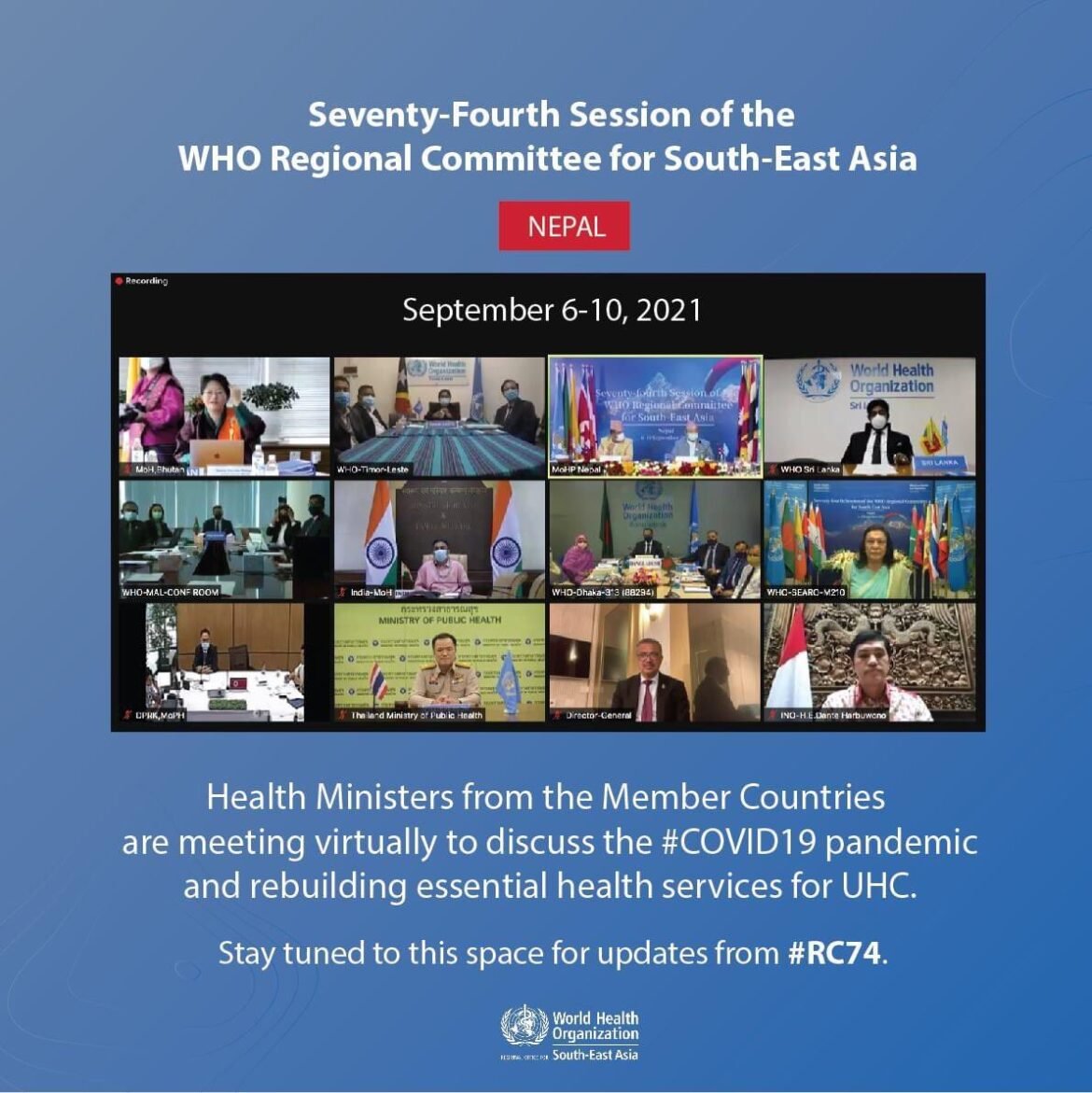
Kathmandu, 7 September 2021 – Taking lessons from the ongoing pandemic and emphasizing a once-in-a-century opportunity, countries of WHO South-East Asia Region today adopted a Ministerial Declaration resolving to strengthen health system resilience to ensure health security, and achieve universal health coverage and Sustainable Development Goals for health.

“Strong health systems that are primary health care-oriented, and which leave no one behind, create populations that are healthier, more productive and financially secure. Resilient health systems are the bedrock of emergency preparedness and response, and ensure that when acute events occur, essential health services can be maintained,” said Dr Poonam Khetrapal Singh, Regional Director, WHO South-East Asia, at a ministerial round table during the ongoing Seventy-Fourth Regional Committee meeting.

Through the Declaration adopted at the ministerial round table, Member countries committed to provide political leadership and accountability to advance health security and progress towards universal health coverage and the health-related SDGs.

The Member countries resolved to reorient health systems towards comprehensive primary health care through increased public investments, as the foundation for strengthening both public health emergency capabilities and achievement of universal health coverage.

“The pandemic has highlighted the urgency and importance of investment in human resource for health, especially at the primary health care level, and the need for adequate supply of affordable, effective, quality and safe medical products to ensure an effective response to public health emergencies and to build resilient health systems,” the Regional Director said.

The Declaration also commits to closer engagement with and the empowerment of communities to maintain the delivery of essential health services and public health programmes during and after the pandemic.

To roll-out effective response for at-risk and affected communities, Member countries agreed to ensure integration of public health emergencies and disaster risk management strategies, as well as strengthening surveillance and preparedness capacity at the primary health care level.

Member countries additionally resolved to accelerate integration of noncommunicable diseases including mental health, and other programmes, at the primary health care level, as well as establishing national quality standards for primary health care services and ensuring access to quality health services during the pandemic and recovery phase.

The Member countries further agreed to appropriately leverage the potential of traditional systems of medicine, while optimizing innovations in digital health technologies.

The declaration emphasized the importance of leveraging additional resources and partnerships, including the important role of WHO, to support the development of national capacities to address public health emergencies and ensure the delivery of high-quality health services for all.

“Together we are stronger. Together we can build back better essential health services, for a fairer, healthier and more health-secure future for all, leaving no one behind,” the Regional Director said.
Media contact: Shamila Sharma,  sharmasha@who.int, +91 98182 8725Tsering Dolkar Gurung, gurungt@who.int, +977 9802300661

Source of info: WHO SEARO


DOWNLOAD: Declaration by the Health Ministers of Member States at the Seventy-fourth Session of the WHO Regional Committee for South-East Asia


Do you have a website? Looking for the best hosting provider? Here’s a discount code.

Latest Public Health Jobs

Latest Posts

  • International Wellness Day: Promoting Global Wellness for All
  • Summit Declaration: The 12th National Summit of Health and Population Scientists in Nepal
  • Joint political declaration on the reform of the global health architecture
  • World Health Day 2026: Together for Health. Stand with Science.
  • World Water Day 2026 | Water & Gender Equality

Thanks for visiting us.
Disclaimer: The resources, documents, guidelines, and information on this blog have been collected from various sources and are intended for informational purposes only. Information published on or through this website and affiliated social media channels does not represent the intention, plan, or strategies of an organization that the initiator is associated with in a professional or personal capacity, unless explicitly indicated.
If you have any complaints, information, or suggestions about the content published on Public Health Update, please feel free to contact us at blog.publichealthupdate@gmail.com.
#StayUpdated


  • WordPress
  • Link
  • Facebook
  • Mail
  • Facebook
  • Twitter
  • Twitter
  • LinkedIn
  • Instagram
  • Facebook
September 7, 2021 0 comments
0 FacebookTwitterPinterestLinkedinTumblrVKOdnoklassnikiRedditStumbleuponWhatsappTelegramLINEPocketSkypeViberEmail
Nepal Ambulance Guideline 2078
National Plan, Policy & GuidelinesHumanitarian Health & Emergency ResponseResearch & Publication

National (Nepal) Ambulance Guideline 2078

by Public Health Update September 7, 2021
written by Public Health Update

The Ministry of Health and Population (MoHP) has endorsed a new guideline for Ambulance management in Nepal. The National Ambulance Guideline 2078 aims to strengthen the pre-hospital care services.

This guideline envisions to enroll all ambulances in an integrated system. The toll free no. 102 will be activated to provide ambulance service in Nepal.

DOWNLOAD: Nepal Ambulance Guideline 2078

DOWNLOAD: Nepal Ambulance Guideline 2078


Recommended (Previous version)

  • Guideline for Integrated Ambulance and Pre-hospital service operation 2077
  • Ambulance Service Operation Guidelines- MoHP


Do you have a website? Looking for the best hosting provider? Here’s a discount code.

Latest Public Health Jobs

Latest Posts

  • International Wellness Day: Promoting Global Wellness for All
  • Summit Declaration: The 12th National Summit of Health and Population Scientists in Nepal
  • Joint political declaration on the reform of the global health architecture
  • World Health Day 2026: Together for Health. Stand with Science.
  • World Water Day 2026 | Water & Gender Equality

Thanks for visiting us.
Disclaimer: The resources, documents, guidelines, and information on this blog have been collected from various sources and are intended for informational purposes only. Information published on or through this website and affiliated social media channels does not represent the intention, plan, or strategies of an organization that the initiator is associated with in a professional or personal capacity, unless explicitly indicated.
If you have any complaints, information, or suggestions about the content published on Public Health Update, please feel free to contact us at blog.publichealthupdate@gmail.com.
#StayUpdated


  • WordPress
  • Link
  • Facebook
  • Mail
  • Facebook
  • Twitter
  • Twitter
  • LinkedIn
  • Instagram
  • Facebook
September 7, 2021 0 comments
0 FacebookTwitterPinterestLinkedinTumblrVKOdnoklassnikiRedditStumbleuponWhatsappTelegramLINEPocketSkypeViberEmail
WHO South-East Asia Regional Committee meeting begins (Photo: WHO-SEARO)
Public Health EventsGlobal Health NewsPublic HealthPublic Health News

WHO South-East Asia Regional Committee meeting begins

by Public Health Update September 6, 2021
written by Public Health Update

Press release 1761

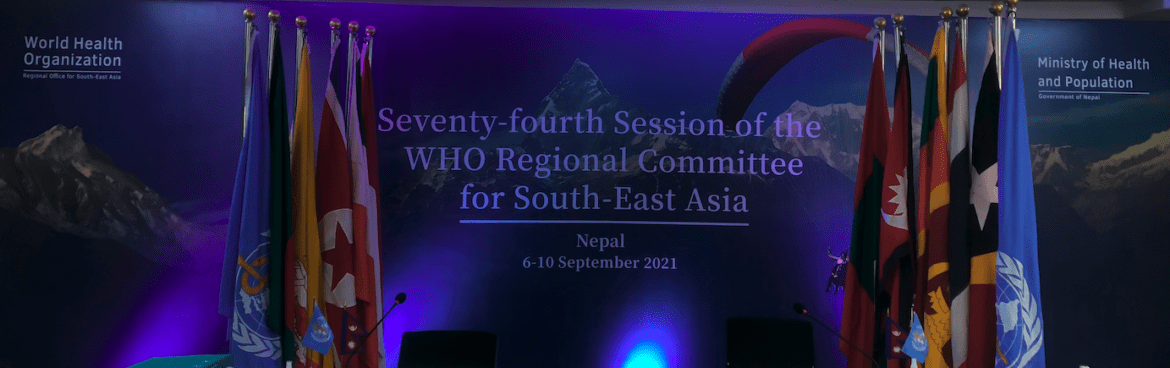
Kathmandu, 6 September 2021:  The Seventy Fourth Regional Committee meeting of WHO South-East Asia Region, began today with health leaders calling for greater commitment to build resilient health systems and to achieve universal health coverage.

“This Session is convened to take important decisions on improving the health status of the people in this Region at a time our health systems are overstretched to cater essential health services to the needy people. Let’s ensure equitable access to vaccines, medicines, tools and technologies for the sake of humanity. Reaching out to the unreached should be our priority,” said the Prime Minister of Nepal, Mr Sher Bahadur Deuba, while inaugurating the annual governing body meeting of WHO in the Region.

The WHO Director-General, Dr Tedros Adhanom Ghebreyesus, said, “the COVID-19 pandemic continues to take a heavy toll on lives, livelihoods, societies and economies. I am pleased to see a decline in cases and deaths in the South-East Asia region, following the devastating surge in May of this year.  However, the situation varies widely from country to country and place to place, with steep increases and overwhelmed hospitals in some areas…….We must never again allow a pandemic on this scale. And that we must never again allow an injustice on this scale.”

Regional Director Dr Poonam Khetrapal Singh said, “covid has taken a massive toll on our health systems. Services have been disrupted and health care workers exhausted. Our challenge is multi-faceted, we have to regain lost ground in terms of health outcomes, rebuild health systems that have lost capacity and we have to do this at a time when government revenues in all countries will be under intense pressure.”

The five-day virtual session, attended by Health Ministers and senior health officials of the Member countries of the Region, UN Agencies, partners, donors, and civil society representatives, will deliberate on strengthening public health emergency preparedness and response and accelerating progress for prevention and control of non-communicable diseases, among others health issues.

A ministerial roundtable is planned tomorrow on ‘building back better’ the essential health services, hit by the ongoing COVID-19 pandemic, with the aim to achieve universal health coverage.

Other key issues to be discussed are regional framework for vaccine action plan, revitalizing school-health, and ending viral hepatitis, HIV and STIs.

Progress made by the Region on previous Regional Committee resolutions on measles and rubella elimination by 2023, improving access to essential medical products, and strengthening health systems to accelerate delivery of services for non-communicable diseases at the primary health care level, will also be discussed at the session.

Home to one-fourth of the global population but with a disproportionate burden of diseases, the Region has been prioritizing elimination of measles and rubella by 2023, addressing noncommunicable diseases through multisectoral policies and plans, accelerating reduction of maternal, neonatal and under-five mortality, advancing universal health coverage, reversing antimicrobial resistance, scaling-up emergency risk management capacities, eliminating neglected tropical diseases and ending TB.

 Media contact:Shamila Sharma,  sharmasha@who.int, +91 98182 8725 Tsering Dolkar Gurung, gurungt@who.int, +977 9802300661 

Press release 1761

WHO SEARO


Do you have a website? Looking for the best hosting provider? Here’s a discount code.

Latest Public Health Jobs

Latest Posts

  • International Wellness Day: Promoting Global Wellness for All
  • Summit Declaration: The 12th National Summit of Health and Population Scientists in Nepal
  • Joint political declaration on the reform of the global health architecture
  • World Health Day 2026: Together for Health. Stand with Science.
  • World Water Day 2026 | Water & Gender Equality

Thanks for visiting us.
Disclaimer: The resources, documents, guidelines, and information on this blog have been collected from various sources and are intended for informational purposes only. Information published on or through this website and affiliated social media channels does not represent the intention, plan, or strategies of an organization that the initiator is associated with in a professional or personal capacity, unless explicitly indicated.
If you have any complaints, information, or suggestions about the content published on Public Health Update, please feel free to contact us at blog.publichealthupdate@gmail.com.
#StayUpdated


  • WordPress
  • Link
  • Facebook
  • Mail
  • Facebook
  • Twitter
  • Twitter
  • LinkedIn
  • Instagram
  • Facebook
September 6, 2021 0 comments
0 FacebookTwitterPinterestLinkedinTumblrVKOdnoklassnikiRedditStumbleuponWhatsappTelegramLINEPocketSkypeViberEmail
Fellowships, Studentship & ScholarshipsPublic Health OpportunitiesPublic Health Opportunity

AYUSH Scholarship Scheme for UG/PG/PhD courses for the Academic Year 2021-22

by Public Health Update September 5, 2021
written by Public Health Update

The Embassy of India, Kathmandu invites applications from Nepalese Nationals to study Undergraduate/ Postgraduate/PhD courses related to Ayurveda, Unani, Siddha, Yoga & Homoeopathy and B.Sc. in Yoga in Indian Universities/Institutions/Colleges under AYUSH Scholarship Scheme through Online ICCR A2A Portal www.a2ascholarships.iccr.gov.in for the academic year 2021-22. Preference will be accorded to candidates who have completed their school studies in Nepal.

Eligibility for Undergraduate courses:

a) Bachelor of Ayurvedic Medicine and Surgery (BAMS): 5 ½ year degree course including one year mandatory clinical training (internship)

Eligibility: 12 years of schooling with science subjects (Physics, Chemistry & Biology)
b) Bachelor of Siddha Medicine and Surgery (BSMS): 5 ½ year degree course including one year mandatory clinical training (internship)

Eligibility: 12 years of schooling with science subjects (Physics, Chemistry & Biology)

c) Bachelor of Unani Medicine and Surgery (BUMS): 5 ½ year degree course including one year mandatory clinical training (internship)

Eligibility: 12 years of schooling with science subjects (Physics, Chemistry & Biology)

d) Bachelor of Homeopathic Medicines and Surgery (BAMS): 5 ½ year degree course including one year mandatory clinical training (internship)

Eligibility: 12 years of schooling with science subjects (Physics, Chemistry & Biology)

e) B.Sc in Yoga : 3 year course Eligibility: 12 years of schooling

f) B. A. (Yoga Shastra) : 3 years course Eligibility: 12 years of schooling

Eligibility for Post Graduate and Ph. D. Courses:

a) M.D. Ayurveda : 3 year course

Eligibility: BAMS degree recognized by Central Council of Indian Medicine (CCIM)

b) MD Siddha: 3 year course
Eligibility: BSMS degree recognized by Central Council of Indian Medicine (CCIM)

c) MD Unani: 3 year course
Eligibility: BUMS degree recognized by Central Council of Indian Medicine (CCIM)

d) MD Homeopathy: 3 year course
Eligibility: BHMS degree recognized by Central Council of Homeopathy (CCH)

Ph.D. Courses:
a) Ph. D in Ayurveda:
3 years course
Eligibility: MD (Ayurveda) degree recognized by CCIM

b) Ph. D in Unani: 3 years course

Eligibility: MD (Unani) degree recognized by CCIM.

The Last Date for submission of application for these schemes is September 30, 2021 (Thursday).

How to Apply :

  1. The Online Applications may please be submitted through A2A Portal and the procedures and norms governing these scholarships are given on the www.a2ascholarships.iccr.gov.in
  2. Candidates are advised to go through the ICCR instructions and guidelines carefully for filling up of the online application form with respect to each scholarship scheme. Candidates are also advised to visit the website of the concerned institute/universities for the details of courses.
  3. For selection of University/Institute and course, applicants are advised to exercise due diligence and research in a dedicated manner on the specific admission criteria laid down by various Universities for each subject, and ensure that they submit all relevant documentation as required by the Universities/Institutes in addition to the basic certificates mentioned in the application form. For this, they may refer to the Universities Handbook/University Grants Commission’s website and the concerned institute’s website for eligibility criteria.
  4. Separate application forms should be submitted for each course.

How to submit application:

  1. The applicant should deposit application fee of NRs. 400/- in favor of Education Wing, Embassy of India, Kathmandu in Account No. 17725240200331 at any branch of Nepal SBI, located in Nepal. After depositing of application fee, the applicant should write online application registration number and his/her name on the top of the counterfoil/receipt for identification.
  2. Thereafter, the applicant should submit the original counterfoil along with the copy of the application (with enclosures) uploaded online directly to (i) the Embassy of India, Kathmandu (all other districts except the districts mentioned under the Consulate General of India, Birgunj); or (ii) Consulate General of India, Birgunj (for those hailing from districts – Bara, Chitwan, Dhanusha, Mahottari, Makwanpur, Parsa, Rautahat & Sarlahi), as the case may be. Application fee once deposited will not be refunded or adjusted.
  3. The candidates should submit their applications (complete in all respects) and duly supported by required documents on or before September 30, 2021 (last date of submission of application). No application will be accepted after last date of application.

Please Note :

  1. Applicants should attain 18 years at the time of admission in Indian Universities /institutions. There is no upper age limit.
  2. The medium of teaching will be English and / or Hindi. The short listed applicants may have to appear in English test/Interview for English reading, writing and comprehensive capability.
  3. The candidate has to fill his/her 05 choices of Universities in the application in order of preference. If no seats are available in the choice of University given by the candidate, the allocation of University will be done by the Ministry of AYUSH in other University as per the availability of seats.
  4. The application will be processed only for the course applied for. No request for the change of course will be entertained later.
  5. No request for transfer of University will be entertained once the admission is confirmed.
  6. Applicant should be medically sound.

Important Information
The Embassy of India only entertains applications directly from the applicant himself/herself. The Embassy does not recognize or receive applications through any so called Education Consultants/Middle-men/Agencies in Nepal. Students are advised to beware of such unscrupulous persons/agencies. Applications found to have been received through such agencies/persons are liable to be rejected.

Official Announcement


Do you have a website? Looking for the best hosting provider? Here’s a discount code.

Latest Public Health Jobs

Latest Posts

  • International Wellness Day: Promoting Global Wellness for All
  • Summit Declaration: The 12th National Summit of Health and Population Scientists in Nepal
  • Joint political declaration on the reform of the global health architecture
  • World Health Day 2026: Together for Health. Stand with Science.
  • World Water Day 2026 | Water & Gender Equality

Thanks for visiting us.
Disclaimer: The resources, documents, guidelines, and information on this blog have been collected from various sources and are intended for informational purposes only. Information published on or through this website and affiliated social media channels does not represent the intention, plan, or strategies of an organization that the initiator is associated with in a professional or personal capacity, unless explicitly indicated.
If you have any complaints, information, or suggestions about the content published on Public Health Update, please feel free to contact us at blog.publichealthupdate@gmail.com.
#StayUpdated



  • WordPress
  • Link
  • Facebook
  • Mail
  • Facebook
  • Twitter
  • Twitter
  • LinkedIn
  • Instagram
  • Facebook
September 5, 2021 0 comments
0 FacebookTwitterPinterestLinkedinTumblrVKOdnoklassnikiRedditStumbleuponWhatsappTelegramLINEPocketSkypeViberEmail
EDCD
Public HealthNoticeOutbreak News

Important Notice regarding COVID-19 Laboratory Reporting

by Public Health Update September 5, 2021
written by Public Health Update

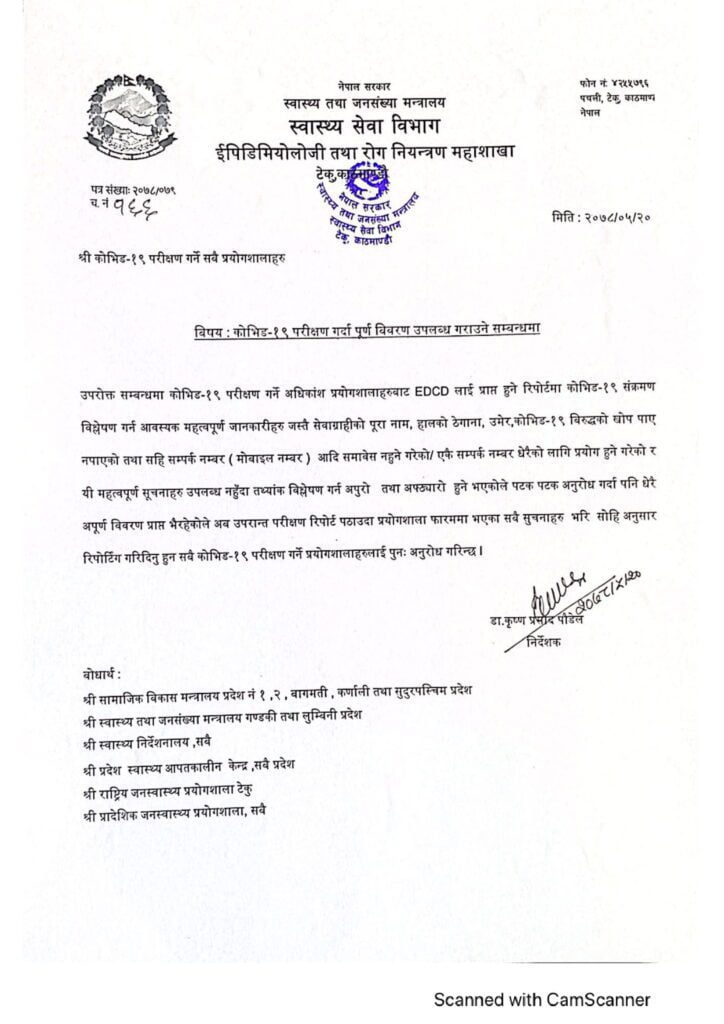
The Epidemiology and Diseases Control Division (EDCD), DoHS has requested all COVID-19 laboratories to collect and submit important socio-demographic information and contact details of the clients, including (full name, current address, age, vaccination status, mobile number) to keep an updated record of the clients for the analysis of the data. 

Here is the attached official letter for needful action.

COVID-19 lab reporting

Recommended readings

  • List of Laboratories for COVID-19 testing in Nepal
  • List of Laboratories for SARS CoV-2 Rapid Antigen Test in Nepal
  • List of Laboratories for COVID19 testing in Nepal
  • Provincial Health Laboratory Profile- Gandaki
  • List of Certified COVID-19 Antigen kits in Nepal
  • List of COVID-19 Hospitals (COVID-19 Care Units) in Nepal
  • COVID-19 Triage/Management Algorithm for PHCs
  • Clinical Management of COVID-19 in Healthcare Setting (Second Edition)
  • Responding to COVID-19: Health sector preparedness, response and lessons learnt
  • National Testing-Guidelines for COVID-19 (Version 5), Nepal
  • Guideline for Operation of COVID-19 Temporary Hospitals 2077
September 5, 2021 0 comments
0 FacebookTwitterPinterestLinkedinTumblrVKOdnoklassnikiRedditStumbleuponWhatsappTelegramLINEPocketSkypeViberEmail
Newer Posts
Older Posts

Search

Follow Us

Facebook Twitter Instagram Pinterest Linkedin Youtube

Categories

  • Abstracts (25)
  • Activities (91)
  • Adolescent Sexual and Reproductive Health (ASRH) (25)
  • Advice & Tips (4)
  • African Region (5)
  • AI and Health (1)
  • Annual Meeting (6)
  • Antimicrobial Resistance (AMR) (21)
  • Award (19)
  • Awards (16)
  • Books (9)
  • Call for Proposal, EOI & RFP (103)
  • Call for Research Participants (8)
  • Clinical Doctor Jobs (6)
  • Communicable Diseases (107)
  • Competition (20)
  • Conference (129)
  • Consultant (1)
  • Courses (205)
  • Dashboard (2)
  • Digital Health & Health Informatics (10)
  • Drug and Medicine (18)
  • Eastern Mediterranean Region (3)
  • Education (15)
  • Environment (3)
  • Environmental Health & Climate Change (47)
  • European Region (42)
  • Exchange Program (1)
  • Fact Sheet (117)
  • FCHVs (1)
  • Fellowships, Studentship & Scholarships (168)
  • Financial Aid (13)
  • Form Formats (2)
  • Fully funded (22)
  • Global Health News (434)
  • Grants and Funding Opportunities (193)
  • Guest Post (44)
  • Health Assistant Jobs (1)
  • Health Equity (7)
  • Health Financing and Economics (24)
  • Health in Data (115)
  • Health Insurance (5)
  • Health Jobs (52)
  • Health Literacy, Health Education & Promotion (50)
  • Health Organization Profile (42)
  • Health Systems (83)
  • Human Resource for Health (33)
  • Humanitarian Health & Emergency Response (44)
  • Hypertension (5)
  • Implementation Research (48)
  • International Health (3)
  • International Jobs & Opportunities (373)
  • International Plan, Policy & Guidelines (210)
  • Internships (4)
  • Jobs Vacancies (56)
  • Journals (8)
  • Life Style & Public Health Nutrition (39)
  • Live (10)
  • Master's Degree (48)
  • Maternal, Newborn and Child Health (88)
  • Mentorship Program (2)
  • Miscellaneous (16)
  • National Health News (158)
  • National Plan, Policy & Guidelines (468)
  • Neglected Tropical Diseases (NTDs) (51)
  • Non- Communicable Diseases (NCDs) (121)
  • Notice (103)
  • Nursing Jobs (6)
  • Nutritionist Jobs (1)
  • One Health (18)
  • Online & Distance Learning (22)
  • Online Courses (90)
  • Op-Ed Article (3)
  • Opportunities by Region (83)
  • Outbreak News (213)
  • Partially funded (6)
  • PCL Health Science Jobs (3)
  • PH Important Day (534)
  • Pharmacist Jobs (3)
  • PhD (54)
  • Photos (5)
  • Planetary Health (4)
  • PostDoc (14)
  • Presentation Slides (26)
  • Primary Health Care (25)
  • Provincial Plan, Policies and Guidelines (14)
  • Public Health (1,283)
  • Public Health Epidemiology & Biostatistics (13)
  • Public Health Events (306)
  • Public Health Information (20)
  • Public Health Innovation (9)
  • Public Health Jobs (52)
  • Public Health News (554)
  • Public Health Notes (120)
  • Public Health Opportunities (507)
  • Public Health Opportunity (491)
  • Public Health Programs (108)
  • Public Health Seminar (2)
  • Public Health Tools (1)
  • Public Health Update (564)
  • Quality Improvement & Infection Prevention (20)
  • Region of America (8)
  • Reports (184)
  • Research & Project Grants (39)
  • Research & Project Grants (32)
  • Research & Publication (647)
  • Research Articles (10)
  • Road Traffic Accidents (RTA) (9)
  • School of Public Health (60)
  • Self funded (2)
  • South-East Asia Region (26)
  • Success Stories (17)
  • Summer and Winter Courses (40)
  • Summer Courses (28)
  • Sustainable Development Goals (SDGs) (14)
  • Syllabus (61)
  • Symposium (9)
  • Tobacco Control (35)
  • Training (40)
  • Travel Grants (15)
  • Trick, Technique & Skills (8)
  • Uncategorized (3)
  • Undergraduate Degree (7)
  • Universal Health Coverage (36)
  • Universities (29)
  • Universities & School of Public Health (58)
  • Vacancy Announcement (26)
  • Vaccine Preventable Diseases (40)
  • Vector-Borne Diseases(VBDs) (30)
  • Videos (3)
  • View Points (1)
  • Webinar (4)
  • Western Pacific Region (13)
  • Workshop (18)
  • World News (117)
Post New Jobs: Vacancy Announcement Service

Public Health Update (Sagun’s Blog) is a popular public health portal in Nepal. Thousands of health professionals are connected with Public Health Update to get up-to-date public health updates, search for jobs, and explore opportunities.
#1 Public Health Blog for sharing Job opportunities and updates in Nepal

”Public Health Information For All”
– – Sagun Paudel, Founder

  • HOT JOBS
    • Public Health Jobs
    • Medical Doctor Jobs
    • Nursing Jobs
    • Health Assistant Jobs
    • Pharmacist Jobs
    • NGOs Jobs
    • Government Jobs
  • Top Categories
    • National Plan, Policy & Guidelines Top
    • Public Health Calendar
    • Fellowships & Scholarships
    • Health Systems
    • Health Organization Profiles
    • International Jobs & Opportunities
    • Public Health Opportunity

PUBLIC HEALTH INITIATIVE

    • Submit your Vacancies New
    • Partnership Opportunities

Contact: blog.publichealthupdate@gmail.com

https://wa.me/+9779856036932

Public Health Initiative, A Registered Non-profit organization – All Right Reserved. 2011-2024. Contact us. 

Facebook Twitter Instagram Youtube Envelope
Public Health Update
  • Home
  • Public Health
    • Home 1
      • Adolescent Sexual and Reproductive Health (ASRH)
      • Antimicrobial Resistance (AMR)
      • Communicable Diseases
      • Digital Health & Health Informatics
      • Environmental Health & Climate Change
      • Health Financing and Economics
      • Health Equity
    • Home 2
      • Health Literacy, Health Education & Promotion
      • Human Resource for Health
      • Humanitarian Health & Emergency Response
      • Implementation Research
      • International Health
      • Life Style & Public Health Nutrition
      • Maternal, Newborn and Child Health
    • Home 3
      • Neglected Tropical Diseases (NTDs)
      • Non- Communicable Diseases (NCDs)
      • One Health
      • Planetary Health
      • Public Health Epidemiology & Biostatistics
      • Primary Health Care
      • Quality Improvement & Infection Prevention
    • Home 4
      • Road Traffic Accidents (RTA)
      • Sustainable Development Goals (SDGs)
      • Tobacco Control
      • Universal Health Coverage
      • Vaccine Preventable Diseases
      • Vector-Borne Diseases(VBDs)
      • Notices
  • Public Health Update
    • Home 1
      • Public Health News
      • Global Health News
      • Outbreak News
      • National Health News
      • COVID-19
    • Home 2
      • Fact Sheet
      • Health in Data
      • PH Important Day
      • Public Health Events
      • Public Health Programs
    • Home 3
      • Health Systems
      • Health Insurance
      • Health Organization Profile
      • Success Stories
      • Public Health Innovation
  • Public Health Opportunities
    • Fully funded
    • Travel Grants
    • Grants and Funding Opportunities
    • Opportunities by Region
    • International Jobs & Opportunities
    • Research & Project Grants
    • Fellowships, Studentship & Scholarships
    • Conference
  • Jobs
    • Home 1
      • Health Jobs
      • Public Health Jobs
      • Clinical doctor Jobs
      • Health Assistant Jobs
      • Nursing Jobs
      • PCL Health Science Jobs
    • Home 2
      • Dental Jobs
      • Pharmacist Jobs
      • TSLC (Health Jobs)
      • Laboratory Jobs
      • Nutritionist Jobs
  • Downloads
    • International Plan, Policy & Guidelines
    • National Plan, Policy & Guidelines
    • Reports
    • Books
    • Research Articles
  • School of Public Health
    • Home 1
      • Courses
      • Master’s Degree
      • Undergraduate Degree
      • PhD
    • Home 2
      • Universities
      • Syllabus
      • Public Health Notes
      • Mentorship Program
      • Startup Project
    • Home
      • Summer and Winter Courses
      • Summer Courses
      • Online Courses
      • Workshop
      • Training
Public Health Update
  • Home
  • Public Health
    • Home 1
      • Adolescent Sexual and Reproductive Health (ASRH)
      • Antimicrobial Resistance (AMR)
      • Communicable Diseases
      • Digital Health & Health Informatics
      • Environmental Health & Climate Change
      • Health Financing and Economics
      • Health Equity
    • Home 2
      • Health Literacy, Health Education & Promotion
      • Human Resource for Health
      • Humanitarian Health & Emergency Response
      • Implementation Research
      • International Health
      • Life Style & Public Health Nutrition
      • Maternal, Newborn and Child Health
    • Home 3
      • Neglected Tropical Diseases (NTDs)
      • Non- Communicable Diseases (NCDs)
      • One Health
      • Planetary Health
      • Public Health Epidemiology & Biostatistics
      • Primary Health Care
      • Quality Improvement & Infection Prevention
    • Home 4
      • Road Traffic Accidents (RTA)
      • Sustainable Development Goals (SDGs)
      • Tobacco Control
      • Universal Health Coverage
      • Vaccine Preventable Diseases
      • Vector-Borne Diseases(VBDs)
      • Notices
  • Public Health Update
    • Home 1
      • Public Health News
      • Global Health News
      • Outbreak News
      • National Health News
      • COVID-19
    • Home 2
      • Fact Sheet
      • Health in Data
      • PH Important Day
      • Public Health Events
      • Public Health Programs
    • Home 3
      • Health Systems
      • Health Insurance
      • Health Organization Profile
      • Success Stories
      • Public Health Innovation
  • Public Health Opportunities
    • Fully funded
    • Travel Grants
    • Grants and Funding Opportunities
    • Opportunities by Region
    • International Jobs & Opportunities
    • Research & Project Grants
    • Fellowships, Studentship & Scholarships
    • Conference
  • Jobs
    • Home 1
      • Health Jobs
      • Public Health Jobs
      • Clinical doctor Jobs
      • Health Assistant Jobs
      • Nursing Jobs
      • PCL Health Science Jobs
    • Home 2
      • Dental Jobs
      • Pharmacist Jobs
      • TSLC (Health Jobs)
      • Laboratory Jobs
      • Nutritionist Jobs
  • Downloads
    • International Plan, Policy & Guidelines
    • National Plan, Policy & Guidelines
    • Reports
    • Books
    • Research Articles
  • School of Public Health
    • Home 1
      • Courses
      • Master’s Degree
      • Undergraduate Degree
      • PhD
    • Home 2
      • Universities
      • Syllabus
      • Public Health Notes
      • Mentorship Program
      • Startup Project
    • Home
      • Summer and Winter Courses
      • Summer Courses
      • Online Courses
      • Workshop
      • Training
Public Health Initiative, A Registered Non-profit organization – All Right Reserved. 2011-2023