Public Health Update
  • Home
  • Public Health Update
  • Nepal Health Jobs
    • Public Health Job Board
    • Organization List
  • Opportunities
    • Fellowships, Studentship & Scholarships
    • Grants and Funding Opportunities
    • Fully funded
    • Conference
  • Downloads
    • International Plan, Policy & Guidelines
    • National Plan, Policy & Guidelines
    • Reports
    • Public Health Notes
    • Syllabus
    • Form Formats
  • School of Public Health
    • PhD
    • Master’s Degree
    • Online Courses
  • Notice
  • Home
  • Public Health Update
  • Nepal Health Jobs
    • Public Health Job Board
    • Organization List
  • Opportunities
    • Fellowships, Studentship & Scholarships
    • Grants and Funding Opportunities
    • Fully funded
    • Conference
  • Downloads
    • International Plan, Policy & Guidelines
    • National Plan, Policy & Guidelines
    • Reports
    • Public Health Notes
    • Syllabus
    • Form Formats
  • School of Public Health
    • PhD
    • Master’s Degree
    • Online Courses
  • Notice
LOGIN / REGISTER
Public Health Update
SUBSCRIBE
Public Health Update
  • Home
  • Public Health Update
  • Nepal Health Jobs
    • Public Health Job Board
    • Organization List
  • Opportunities
    • Fellowships, Studentship & Scholarships
    • Grants and Funding Opportunities
    • Fully funded
    • Conference
  • Downloads
    • International Plan, Policy & Guidelines
    • National Plan, Policy & Guidelines
    • Reports
    • Public Health Notes
    • Syllabus
    • Form Formats
  • School of Public Health
    • PhD
    • Master’s Degree
    • Online Courses
  • Notice

All Right Reserved. Designed and Developed by PenciDesign

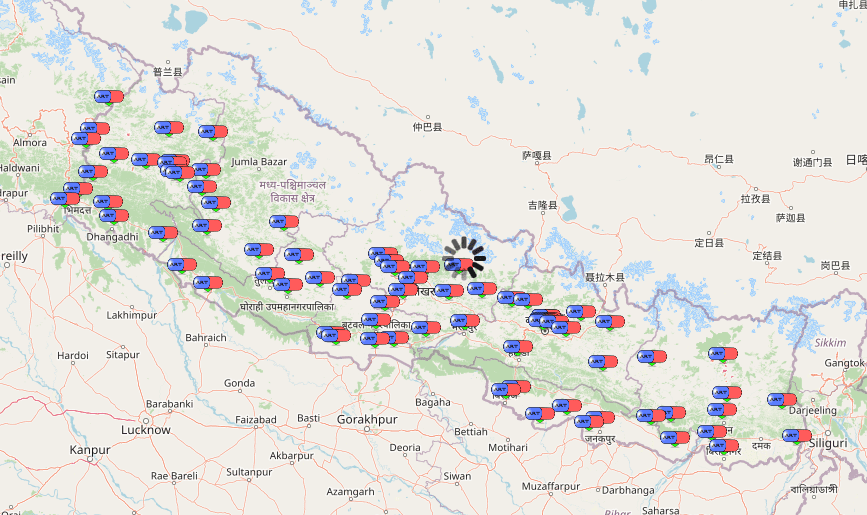
Antiretroviral Therapy (ART) sites in Nepal
Public HealthFact SheetHealth in DataNational Plan, Policy & GuidelinesPublic Health Programs

Antiretroviral Therapy (ART) sites in Nepal

by Public Health Update December 26, 2020
written by Public Health Update

The National HIV Strategic Plan 2016-2021 aims to achieve 90% of all people with diagnosed HIV infection will receive sustained antiretroviral therapy (ART) and 90% of all people receiving antiretroviral therapy will have viral suppression by 2020. The Anti-retroviral therapy is the major treatment for HIV.

Following ART sites are available in Nepal as per the latest update from National Centre for AIDS and STD Control.

S.N.DistrictName of ART SiteLocationProvinceEstablishment Year
1SunsariBP Koirala Institute of Health Science (BPKIHS)Dharan12006
2MorangKoshi HospitalMorang12007
3JhapaMechi Provincial HospitalJhapa12007
4UdaypurUdaypur District HospitalGaighat12015
5SunsariInaruwa HospitalInaruwa12017
6DhankutaDhankuta District HospitalDhankuta12015
7IlamIllam District HospitalIlam12015
8SankhuwasabhaSankhuwasava District HospitalSankhubasava12015
9OkhaldhungaOkhaldhunga District HospitalOkhaldhunga12015
10ParsaNarayani HospitalBirgunj22006
11DhanushaJanakpur Provincial HospitalJanakpur22008
12SaptariRam Raja Prasad Singh Academy of Health Sciences (Sagarmatha)Rajbiraj22008
13RautahatRautahat District HospitalGaur22014
14BaraBara District HospitalKalaiya22014
15SirahaRam Kumar Uma Shankar Charity HospitalLahan22014
16MahottariJaleshwor District HospitalJaleshwor22015
17SarlahiSarlahi District HospitalMalangwa22015
18KathmanduSukraraj Tropical & Infectious Disease Hospital (STIDH)TekuBagmati2004
19LalitpurSparsha NepalSanepaBagmati2005
20KathmanduKanti Bal HospitalKathmanduBagmati2006
21ChitawanBharatpur HospitalChitawanBagmati2007
22KathmanduMaiti NepalKathmanduBagmati2007
23KathmanduBir HospitalKathmanduBagmati2008
24KavreDhulikhel HospitalKavreBagmati2010
25KathmanduTribhuwan University Teaching Hospital (TUTH)MaharajgunjBagmati2011
26NuwakotTrishuli HospitalTrishuliBagmati2012
27MakwanpurHetauda HospitalMakwanpurBagmati2012
28BhaktapurBhaktapur HospitalBhaktapurBagmati2013
29DhadingDhading District HospitalDhadingbesiBagmati2014
30SindhupalchowkSindhupalchowk District HospitalChautaraBagmati2014
31DolakhaCharikot PHCCharikotBagmati2020
32SindhuliSindhuli HospitalSindhulimadiBagmati2015
33KathmanduParopakar Maternity Women Hospital (PMWH)KathmanduBagmati2017
34KaskiPokhara Academy of Health Sciences (Western Regional Hospital)PokharaGandaki2006
35BaglungDhaulagiri Provincial HospitalBaglungGandaki2007
36TanahunDamauli HospitalDamauliGandaki2010
37GorkhaGorkha District HospitalGorkhaGandaki2010
38SyangjaSyangja District HospitalPutlibazarGandaki2010
39LamjungLamjung District Community HospitalBeshisaharGandaki2010
40MyagdiMyagdi District HospitalBeniGandaki2014
41ParbatParbat District HospitalKushmaGandaki2016
42SyangjaGarhaun Ghyangling PHC (Waling) PHCSyangjaGandaki2016
43Nawalparasi EastChormara PHCNawalpurGandaki2018
44BankeBheri HospitalNepalgunjLumbini2004
45RupandehiLumbini Provincial HospitalButwalLumbini2007
46DangRapti Academy of Health ScienceDangLumbini2008
47PalpaUnited Mission HospitalPalpaLumbini2008
48BardiyaBardiya District HospitalGulariya MunicipalityLumbini2010
49KapilvastuKapilvastu HospitalTaulihawaLumbini2010
50GulmiGulmi District HospitalTamghasLumbini2010
51PyuthanPyuthan HospitalKhalangaLumbini2013
52RolpaRolpa District HospitalLiwangLumbini2013
53ArghakhachiArghakhanchi District HospitalSandhikharkaLumbini2014
54Nawalparasi WestPrithivi Chandra HospitalParasiLumbini2014
55RupandehiBhim HospitalBhairahawaLumbini2017
56KapilvastuMaharajgunj PHCKapilvastuLumbini2018
57DangRapti Provincial HospitalTulsipurLumbini2018
58SurkhetKarnali Provincial HospitalSurkhetKarnali2008
59DailekhDailekh District HospitalDailekhKarnali2010
60KalikotKalikot District HospitalKalikotKarnali2016
61Rukum WestRukum District HospitalMusikotKarnali2016
62SalyanSalyan District HospitalKhalangaKarnali2016
63DailekhRakamkarnali HPAathbishKarnali2019
64KanchanpurMahakali Provincial HospitalMahendranagarSudurpashchim2006
65KailaliSeti Provincial HospitalDhangadiSudurpashchim2006
66AchhamAchham District HospitalAchhamSudurpashchim2007
67DotiDoti District hospitalSilgudhiSudurpashchim2007
68BaitadiBaitadi District HospitalDashrathchand MunicipalitySudurpashchim2009
69KailaliTikapur HospitalKailaliSudurpashchim2009
70AchhamBayalpata HospitalBayalpataSudurpashchim2010
71DadeldhuraDadeldhura HospitalAmargadhi MunicipalitySudurpashchim2012
72BajhangBajhang District HospitalChainpurSudurpashchim2013
73BajuraBajura District HospitalMartadiSudurpashchim2013
74DarchulaDarchula District HospitalKhalangaSudurpashchim2014
75AchhamKamalbazar PHCKamalbazarSudurpashchim2017
76AchhamChaurmandu PHCAchhamSudurpashchim2018
77KailaliMalakheti PHCGodawariSudurpashchim2018
78KanchanpurDodhara PHCMahakali MunicipalitySudurpashchim2019
79BaitadiKesharpur PHCMelauliSudurpashchim2019
80DadeldhuraJogbudha HospitalJogbudhaSudurpashchim2020
ART Sites in Nepal [Nov 2020, NCASC]

More information
National Centre for AIDS and STD Control
Teku, Kathmandu
Telephone: +977-1- 536-1653,536-8219
Fax: +977-1- 536-1406
Email: ncasc@ncasc.gov.np
URL: www.ncasc.gov.np

Recommended readings

  • HIV Epidemic Update of Nepal (Fact sheet 2020)
  • Key facts on HIV: Country Snapshot 2019: Nepal
  • WHO recommends dolutegravir as preferred HIV treatment (Mexico Update, IAS 2019)
  • UNAIDS calls on countries to step up global action and proposes bold new HIV targets for 2025
  • World AIDS Day 2020: Global solidarity, shared responsibility!
  • World AIDS Day 2019: Communities make the difference!
  • The Joint United Nations Programme on HIV/AIDS (UNAIDS) Data 2019
  • More people suffering from HIV/AIDS in the country are receiving antiretroviral drugs
  • UNAIDS DATA 2017


Do you have a website? Looking for the best hosting provider? Here’s a discount code.

Latest Public Health Jobs

Latest Posts

  • Call for Application for a PhD Fellowship (NHEA/ University of Bergen)
  • Nepal Multiple Indicator Cluster Survey 2024-25
  • Multisectoral Action Plan for the Prevention and Control of NCDs, 2026-2030 (Draft)
  • National Standard Operating Procedure for Early Warning, Alert and Response System (EWARS), 2025
  • Priority Infectious Diseases for Community-Based Surveillance in Nepal

Thanks for visiting us.
Disclaimer: The resources, documents, guidelines, and information on this blog have been collected from various sources and are intended for informational purposes only. Information published on or through this website and affiliated social media channels does not represent the intention, plan, or strategies of an organization that the initiator is associated with in a professional or personal capacity, unless explicitly indicated.
If you have any complaints, information, or suggestions about the content published on Public Health Update, please feel free to contact us at blog.publichealthupdate@gmail.com.
#StayUpdated
  • WordPress
  • Link
  • Facebook
  • Mail
  • Facebook
  • Twitter
  • Twitter
  • LinkedIn
  • Instagram
  • Facebook
December 26, 2020 2 comments
0 FacebookTwitterPinterestLinkedinTumblrVKOdnoklassnikiRedditStumbleuponWhatsappTelegramLINEPocketSkypeViberEmail
National Health Education Information and Communication Centre (NHEICC)
Public HealthHealth Organization ProfileHealth SystemsNational Plan, Policy & GuidelinesResearch & Publication

National Health Education, Information and Communication Centre (NHEICC)

by Public Health Update December 26, 2020
written by Public Health Update

Background

The National Health Education, Information and Communication Centre (NHEICC) is the apex body under the Ministry of Health and Population for planning, implementing, monitoring and evaluating Nepal’s health promotion, education and communication programmes including periodic surveys and research.

National Health Education, Information and Communication Centre (NHEICC) was established under the Department of Health Services (DoHS) in 1993 during the restructuring process as a focal point of Ministry of Health and Population for planning, implementation, monitoring and evaluation of health promotion and communication programs of all health programs and services in an integrated manner.

[quads id=RndAds]

Key functions

NHEICC supports all 3 divisions to plan, implement, and monitor and evaluate all health promotion and education and health communication programs including developing, producing and disseminating IEC/BCC materials.

The Scope of the centre is guided by the National Health Communication Policy 2012 and the National Health Policy 2014, communication strategies and other health related plans and policies. The centre functions to support health programmes and services to achieve national health goals and SDGs through health promotion, education, information and communication approach. The centre is the lead for all health promotion, education and communication programmes including multi-sectoral health initiatives. The centre uses advocacy, social mobilization and marketing, behaviour change and community lead social change strategies to implement its programmes.

Goal

The goal of the National Health Education, information and Communication program is to contribute to attaining the national health programme goals and objectives by providing support for all health services and programmes.

Program Objectives

General Objective

The general objective of National Health Education, information and Communication program is to raise the health awareness of the people as a means to promote improved health status and to prevent disease through the efforts of the people themselves and through full utilization of available resources.

Specific Objectives

The specific objectives of the IEC/BCC programs are to:

  • Increase awareness and knowledge of the people on health issues.
  • Promote desired behavior change on EHCS and beyond.
  • Create demand for quality EHCS among all castes and ethnic groups, and disadvantaged and hard to reach populations.
  • Advocate for required resources (human and financial) and capacity development.
  • Increase access to new information and technology on health programmes.
  • Promote environment health, hygiene and sanitation.
  • Control Non Communicable Diseases (NCDs) and its risk factors.

Program Major Strategies

  • Health communication programs will be implemented through health structures at centre, region, district and community levels in decentralized manner.
  • Coordination and collaboration will be made with local bodies and other stakeholders for implementing health communication programs in decentralized manner.
  • The policy of planning and implementing health related communication programs of all health service and programs in one door system and integrated approach will be implemented through Ministry of Health and Population, National Health Education, Information and Communication Centre.
  • Advocacy, community mobilization and behavior change communication programs will be implemented at different levels by formulating subject wise health communication strategies of health services and programs in an integrated manner.
  • Health communication programs of different health service and programs will be integrated while formulating annual programs and budget of Ministry of Health and Population and will be implemented through National Health Education, Information and Communication Centre.
  • Budget will be allocated annually according to the policy for the implementation of health communication related programs while formulating annual program and budget.
  • The bodies under UN and external development partners will be encouraged and facilitated to invest in health communication programs.
  • Certain tax will be levied on any services or commodities used by general public and on behavior or commodities that adversely affect health. Some percent of the tax will be deposited in health messages or information dissemination management fund for utilizing to implement health promotion and communication programs.
  • The practice of free distribution and use will be discouraged and managed by developing standards of health related communication messages or information, materials, equipment and services.
  • Health Communication Coordination Committee will be formed comprising stakeholders to assist in the implementation of policy and decisions taken by high level health communication direction committee.
  • Adolescents, youths, journalists, professionals, institution and various organizations will be mobilized for the promotion of healthy behavior, basic health services and programs in coordination and collaboration with different relevant ministries and institutions.
  • Modern electronic communication media such as radio, television, FM radio, website, telephone, mobile etc will also be used timely to disseminate health messages. Arrangements will be made to include health message and its link in all governmental websites.
  • Booklet, pamphlet, poster, calendar, dairy, signage, sticker, flip-chart, wall chart, flyer, flash card, flex, bulletin hoarding board will be produced, published and displayed for effective dissemination of health message or information. Also health messages or information will be published and displayed through various means and materials like outer cover page of text and practical books, package and bags of various materials and food items, tickets, postal letters, T-shirts.
  • Traditional and local folk art, culture and rituals like Maruni, Rodi, Dhan Nach, Shakewa Nach, Nautanki, Dohori Geet, Deuda, Ghatu, Dhami Jhankri, Gaine, Fine Art, Street Drama, Puppet Dance, Miking etc of powerful folk communication media and its related arts will be used timely to disseminate health related messages or information.
  • Various carnivals, festivals, days, events, exhibitions will be organized to spread health message and information effectively up to the public community.
  • Innovative ideas of art especially articles, Radio and Television program, Interaction, Drama, Film, songs with message, dance, fine art, sculpture etc will be encouraged for raising health awareness. Other sectors will also be encouraged for conducting similar types of activities.
  • Interpersonal communication program will be promoted upto the doorsteps of the people through community groups, local organizations, schools, FCHVs, students, teachers, religious leaders, media, health workers and influential persons.
  • Health message or information will be provided to mass communication media in proportionate manner.
  • Health message or information dissemination management fund will be established to disseminate health message or information.
  • Health message or information will be produced following scientific communication process.
  • Health communication technical committee will be formed to recommend health messages and materials for dissemination.
  • Health communication media, media personnel and health personnel will be encouraged through honor, award for message dissemination.
  • Necessary mechanism will be developed for encouraging public private partnership for health message dissemination.
  • Unauthorized dissemination that are adverse or harmful to health will be banned, controlled and regulated.
  • Arrangement will be made to inform about public right to health information and services
  • NCD risk factors control strategic plan will be formulated and implemented.
    Human, physical and technical capacity will be developed on health communication.
  • Multi media and methods of health communication will be used for health message dissemination.
  • Health messages will be socially inclusive, linked to services and developed in locally understandable language.
  • Updated communication technology will be used for health message dissemination.
  • Academic institution will be mobilized for professional development in health communication.
  • High level policy directive committee will be formed for monitoring and evaluation of the health communication policies and programs.

Major Activities

National Health Education, Information and Communication Centre mainly conducts health promotion, education and health communication activities at all levels as following:

Central Level

  • Support development of policy and strategy health promotion, education and health communication program
  • Implement National Health Communication Policy 2012
  • Development of program and budget for central, region, district and community.
  • Development of Program guideline and directives
  • Development, production and airing of messages through Radio, Television & FM
  • Development and publication of health messages through Newspapers
  • Development, production, dissemination and distribution of IEC/BCC materials
  • Program orientation to regional & district level program manager & focal person
  • Advocacy -Global Hand Washing Day, World Health Day and World No Tobacco Day Celebration
  • Coordination – conduct Technical Committees meetings
  • Capacity building on health promotion, education and health communication
  • Conduct health promotion, education and health communication researches
    Supervision, Monitoring and evaluation of health promotion, education & health communication program
  • Conduct Non-communicable disease (NCD) & its risk factors control program
  • Conduction of environmental health, hygiene and sanitation program
  • Press meet and health news collection, distribution and dissemination
  • Knowledge management particularly Health Library and its management.


Regional Level

  • Regional mass media activities
  • Supervision and Monitoring of IEC/BCC activities
  • Sensitization program for prevention and control of epidemics
  • Distribution of IEC materials through Regional medical stores


District Level

  • Strengthen district IEC corner by supporting electronic equipment
  • Sensitization program for prevention and control of epidemics
  • Production of need based IEC materials
  • Distribution of IEC materials in health facilities
  • Production & airing of health radio programs & messages through local FM radio
  • Production and airing of family planning messages through local FM radio
  • Exhibition to promote health services & programs
  • Publication of health messages in print media
  • Community interaction program for health service promotion
  • Establishment and management of IEC corner in each health facilities
  • IEC program on anti-tobacco and non communicable diseases control
  • Supervision and Monitoring of IEC activities
  • Celebration of Health days
  • Report on the achievement on the IEC activities in time.

Information was collected from various documents, websites, reports and government publications. For more info please visit official website of NHEICC.

Contact
National Health Education Information and Communication Centre (NHEICC)
Pachali Bhairab, Teku, Kathmandu, Nepal
Email: nheicc.nepal@gmail.com
Phone:01-4254271

Recommended organizational profile
  • Organogram and Reporting Mechanism of Nepalese Health System in Federal Context
  • Province Health Directorate (HD)
  • The Nursing and Social Security Division (NSSD)
  • Clinical Trial Registration Process in Nepal
  • NepMed, Nepal MEDLINE (Medical Literature Analysis and Retrieval System Online)
  • Nepal Health Research Council (NHRC)
  • The Ministry of Health and Population (MoHP), Nepal
  • Epidemiology and Disease Control Division, Department of Health Services
  • Department of Drug Administration (DDA), Ministry of Health and Population
  • Department of Health Services (DoHS), Ministry of Health and Population
  • Department of Ayurveda and Alternative Medicine (DoAA)
  • Management Division, Department of Health Services
  • Epidemiology and Disease Control Division, Department of Health Services
  • Family Welfare Division (FWD), Department of Health Services
  • National Public Health Laboratory (NPHL)
  • Province Health Directorate, Ministry of Social Development (MoSD)
  • List of Approved Institutional Review Committee (IRC), NHRC
  • National Health Training Center (NHTC)
  • Nepal Ayurvedic Medical Council (NAMC)
  • The Nursing and Social Security Division (NSSD)


Do you have a website? Looking for the best hosting provider? Here’s a discount code.

Latest Public Health Jobs

Latest Posts

  • Call for Application for a PhD Fellowship (NHEA/ University of Bergen)
  • Nepal Multiple Indicator Cluster Survey 2024-25
  • Multisectoral Action Plan for the Prevention and Control of NCDs, 2026-2030 (Draft)
  • National Standard Operating Procedure for Early Warning, Alert and Response System (EWARS), 2025
  • Priority Infectious Diseases for Community-Based Surveillance in Nepal

Thanks for visiting us.
Disclaimer: The resources, documents, guidelines, and information on this blog have been collected from various sources and are intended for informational purposes only. Information published on or through this website and affiliated social media channels does not represent the intention, plan, or strategies of an organization that the initiator is associated with in a professional or personal capacity, unless explicitly indicated.
If you have any complaints, information, or suggestions about the content published on Public Health Update, please feel free to contact us at blog.publichealthupdate@gmail.com.
#StayUpdated


  • WordPress
  • Link
  • Facebook
  • Mail
  • Facebook
  • Twitter
  • Twitter
  • LinkedIn
  • Instagram
  • Facebook
December 26, 2020 2 comments
0 FacebookTwitterPinterestLinkedinTumblrVKOdnoklassnikiRedditStumbleuponWhatsappTelegramLINEPocketSkypeViberEmail
National Tuberculosis Control Centre (NTCC)
Public HealthHealth Organization ProfileHealth SystemsNational Plan, Policy & Guidelines

National Tuberculosis Control Centre (NTCC)

by Public Health Update December 26, 2020
written by Public Health Update

Background

National Tuberculosis Control Centre (NTCC) is the focal point of the National Tuberculosis Control Program. Tuberculosis Control Programme was launched by Government of Nepal almost six decades ago. In 1937 ‘Tokha Sanatorium’ situated on the north of Kathmandu city was established. The Central Chest Clinic (CCC) came into existence in 1951 with the facility of diagnosis and treatment services for the TB patients on domiciliary basis. Similarly, in 1965, TB Control Programme was systematically organized with tripartite agreement between Government of Nepal, WHO and UNICEF. Since then TB Control Programme started on a nationwide basis offering preventive measures such as BCG vaccination, case-findings and distribution of drugs.

Later Central Chest Clinic and TB Control Programme were amalgamated into one centre as National Tuberculosis Centre. As a result the National Tuberculosis Centre in Thimi, Bhaktapur at the central level and Regional Tuberculosis Centre (RTC) at the regional level in Pokhara were established in 1989 with the cooperation of Japan International Cooperation Agency.

Major role

National Tuberculosis Control Centre (NTCC) is the focal point of the NTP and responsible for formulating policies, strategy, planning, monitoring, and quality assurance.

Key functions

  • Develop the National policies, strategies, standards, and guidelines on TB management.
  • Support Provinces and sub-national levels for capacity building.
  • Support planning, coordination, monitoring and evaluation of ending TB activities with concerned stakeholders and partners.
  • Monitoring and supportive supervision of tuberculosis service delivery.
  • Manage and advise on the procurement and distribution of TB drugs and supplies.
  • Prepare standardized tools for recording and reporting, health education and training materials for TB.
  • Analyse all reported TB data, produce reports and feedback to lower levels
  • Plan and carry out capacity enhancement activities at all levels on TB management
  • Coordinate with partner agencies.
  • Serve as secretariat to the TB Technical working group; National Technical Working Group for Tuberculosis (TB TWG).
  • Ensure and advocate for budget allocation for implementation of the program.
  • Collaborate with other diseases control programs and centers like HIV, Diabetes, and RMNCAH for organizing effective cross-referral, monitoring and coordination.

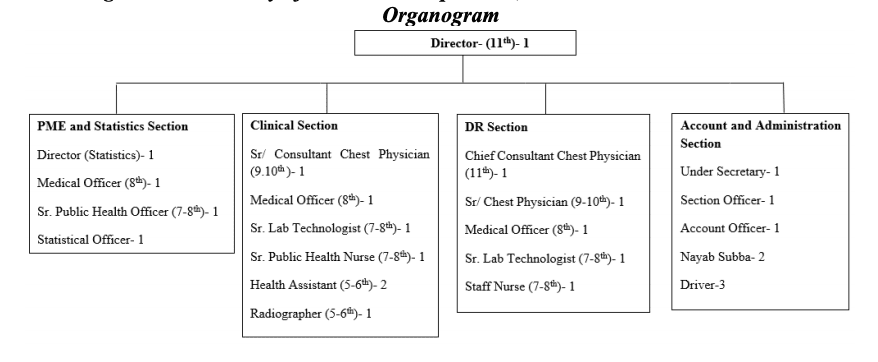
Organization structure of National Tuberculosis Control Centre (NTCC)
Screen Shot 2020 12 26 at 13.15.42
Organization structure of National Tuberculosis Control Centre (NTCC), NTP, ANNUAL REPORT 2075/76 72

Vision: To end the TB by 2030 and make Nepal free of TB by 2050.

Objectives Tuberculosis Control Programme

Objective 1: Increase case notification through improved health facility-based diagnosis; increase diagnosis among children (from 6% at baseline, to 10% of total cases by 2021); examination of household contacts and expanded diagnosis among vulnerable groups within the health service, such as PLHIV (from 179 cases at baseline to over 1,100 cases in 2020/21), and those with diabetes mellitus (DM).

Objective 2: Maintain the treatment success rate at 90% patients (all forms of TB) through to 2021

Objective 3: Provide DR diagnostic services for 50% of persons with presumptive DR TB by 2018 and 100% by 2021; successfully treat at least 75 % of the diagnosed DR patients

Objective 4: Further expand case finding by engaging providers for TB care from the public sector (beyond MoH), medical colleges, NGO sector, and private sector through results based financing (PPM) schemes, with formal engagements (signed MoUs) to notify TB cases.

Objective 5: Strengthen community systems for management, advocacy, support and rights for TB patients in order to create an enabling environment to detect & manage TB cases in 60% of all districts by 2018 and 100% by 2021

Objective 6: Contribute to health system strengthening through HR management and capacity development, financial management, infrastructures, procurement and supply management in TB

Objective 7: Develop a comprehensive TB Surveillance, Monitoring and Evaluation system

Objectives 8: To develop a plan for continuation of NTP services in the event of natural disaster or public health emergency.


Information was collected from various documents, reports and government publications. For more info please visit official website of NTCC.

[quads id=RndAds]

Contact
National Tuberculosis Control Centre (NTCC)
Phone: +977-1-6630033+977-1-6630073
FAX: +977-1-6635986
Location: Thimi, Bhaktapur, Nepal

Publications and related documents

  • Global Tuberculosis Report 2020
  • National Tuberculosis Program Update in Nepal #WorldTBDay #EndTB
  • National TB Prevalence Survey, 2018-19 Key findings
  • World Tuberculosis Day 2020! It’s time to End TB!
  • National Guideline on Drug Resistant TB Management 2019, Nepal
  • National Tuberculosis Management Guideline 2019, Nepal
  • Global Tuberculosis Report 2019: Latest status of the tuberculosis epidemic
  • National TB Prevalence Survey, 2018-19 Key findings
  • New WHO recommendations to prevent tuberculosis aim to save millions of lives
  • World Health Organization (WHO) Information Note Tuberculosis and COVID-19
  • World Tuberculosis Day 2020! It’s time to End TB!
  • People-centred framework for tuberculosis programme planning and prioritization, User guide

Recommended organizational profile
  • Organogram and Reporting Mechanism of Nepalese Health System in Federal Context
  • Province Health Directorate (HD)
  • The Nursing and Social Security Division (NSSD)
  • Clinical Trial Registration Process in Nepal
  • NepMed, Nepal MEDLINE (Medical Literature Analysis and Retrieval System Online)
  • Nepal Health Research Council (NHRC)
  • The Ministry of Health and Population (MoHP), Nepal
  • Epidemiology and Disease Control Division, Department of Health Services
  • Department of Drug Administration (DDA), Ministry of Health and Population
  • Department of Health Services (DoHS), Ministry of Health and Population
  • Department of Ayurveda and Alternative Medicine (DoAA)
  • Management Division, Department of Health Services
  • Epidemiology and Disease Control Division, Department of Health Services
  • Family Welfare Division (FWD), Department of Health Services
  • National Public Health Laboratory (NPHL)
  • Province Health Directorate, Ministry of Social Development (MoSD)
  • List of Approved Institutional Review Committee (IRC), NHRC
  • National Health Training Center (NHTC)
  • Nepal Ayurvedic Medical Council (NAMC)
  • The Nursing and Social Security Division (NSSD)


Do you have a website? Looking for the best hosting provider? Here’s a discount code.

Latest Public Health Jobs

Latest Posts

  • Call for Application for a PhD Fellowship (NHEA/ University of Bergen)
  • Nepal Multiple Indicator Cluster Survey 2024-25
  • Multisectoral Action Plan for the Prevention and Control of NCDs, 2026-2030 (Draft)
  • National Standard Operating Procedure for Early Warning, Alert and Response System (EWARS), 2025
  • Priority Infectious Diseases for Community-Based Surveillance in Nepal

Thanks for visiting us.
Disclaimer: The resources, documents, guidelines, and information on this blog have been collected from various sources and are intended for informational purposes only. Information published on or through this website and affiliated social media channels does not represent the intention, plan, or strategies of an organization that the initiator is associated with in a professional or personal capacity, unless explicitly indicated.
If you have any complaints, information, or suggestions about the content published on Public Health Update, please feel free to contact us at blog.publichealthupdate@gmail.com.
#StayUpdated


  • WordPress
  • Link
  • Facebook
  • Mail
  • Facebook
  • Twitter
  • Twitter
  • LinkedIn
  • Instagram
  • Facebook
December 26, 2020 5 comments
0 FacebookTwitterPinterestLinkedinTumblrVKOdnoklassnikiRedditStumbleuponWhatsappTelegramLINEPocketSkypeViberEmail
Medical Education Commission
Health Organization ProfileHealth SystemsNational Plan, Policy & GuidelinesResearch & Publication

Medical Education Commission (MEC)

by Public Health Update December 26, 2020
written by Public Health Update

Background

As per provision of the National Medical Education Act 2075, in the context of the essence and spirit of the reports of the commission, committee and task force formed to improve medical education at different times.

Key functions

Medical Education Commission has been established to:

  • increase the investment of the state in the field of medical education,
  • develop medical education in line with the national needs of Nepal,
  • regulate medical education in integrated and efficient way,
  • organize the work related to the establishment and operation of medical institutions,
  • maintain quality, professionalism, institutional accountability, geographical balance and social justice in medical education,
  • ensure equal access of all students including the deprived.

The Act defines medical education as education of all disciplines and levels related to the health profession (Health Professional Education).

Related organizations

  • Nepal Nursing Council (NNC)
  • Nepal Medical Council (NMC)
  • Nepal Health Professional Council (NHPC)
  • Nepal Pharmacy Council
  • Nepal Ayurvedic Medical Council (NAMC)

Formation

DesignationPosition
Prime Minister       Chairperson
Education Minister, Government of NepalCo-Chairperson
Health Minister, Government of Nepal       Co-Chairperson
Appointed by Government of Nepal from among the doctors who have made special contribution in the field of medicineVice Chairperson
Member, National Planning Commission (Education and Health)Member
Three vice chancellors from the University having medical education programMember
Secretary, Ministry of education, Government of NepalMember
Secretary, Ministry of health, Government of NepalMember
Chairperson, University Grant CommissionMember
Vice Chairperson, Council for Technical Education and Vocational Training Member
Chairperson, Nepal Ayurvedic Medical CouncilMember
Chairperson, Nepal Health Research CouncilMember
Chairperson, Nepal Nursing CouncilMember
Chairperson, Nepal Health Professionals CouncilMember
Chairperson, Nepal Pharmacy CouncilMember
Chairpersons including at least one female from National level medical and nursing professional – 2Member
Chairperson from a private educational institution association except medical and dental Organization – 1 Member
Distinguished members of civil society including at least one female – 2Member
Chairperson, Nepal Medical CouncilMember
Among medical education experts based on the principles of inclusion including at least two females – 3Member
Chairperson, Nepal Medical AssociationMember
Chairperson of private medical and dental college of national level official organizationMember
Senior staff of the commissionMember Secretary
Formation of MEC
Directorate
  1. Standards and Accreditation: Monitoring and evaluation is an integral part of providing quality health education. If we strengthen the system of continuous scientific monitoring and evaluation, it will increase the quality of any academic programs. The Directorate of standards and accreditation is determined towards assuring quality and uniformity in medical education throughout the country by implementing worldwide accepted accreditation standards. Including the role responsibility and authority stipulated in the National Medical Education Act 2075 the role, responsibility and authority of the Directorate of standards and Accreditation are as follows:
  • Set basic criteria for the necessary infrastructure in order to establish medical institutions and conduct educational program.
  • Set basic criteria for the teachers’ eligibility.
  • Work regarding teaching pedagogy and technology.
  • Set accreditation standards for quality evaluation of medical education
  • Work regarding the accreditation of universities and academias conducting medical education programs.
  • Set standards of Medical Education sector’s curriculum, including quality and standard.
  • Issue eligibility letter to those willing to go on abroad studies and fellowships including high level training on medical education.

2. Planning, Coordination and Academic Upgradation: Directorate of Planning, Coordination and Academic Upgradation has a role to formulate national health professional education policy and then, plan annual programs of medical education commission accordingly. In this connection, the directorate is responsible to estimate national human resource projection, production and consumption. The areas of coordination with the academia and government agencies includes the functions of letter of intent, fees structures and student seats of the colleges. Academic upgradation for quality improvement, expansion of new programs and research in medical education including teaching learning methodologies are other areas of roles and responsibilities of the directorate.

3. Examination Directorate: Examination is an integral part of education. If we strengthen the system of examination, it will exert enormous impact in the process and the product of any academic programs. The Directorate of examination is determined towards assuring quality and uniformity in medical education throughout the country by implementing robust system of examination.

In the present context, the major focus of the directorate is to conduct common postgraduate entrance examination at the earliest date, followed by that for undergraduate and super specialty (eg. DM/MCh) programs. The salient features of the entrance examination conducted by Medical Education Commission (MEC) would be:

  • National common entrance examination to encompass all the academic institutions conducting medical/health professional courses so that students get rid of troubles due to several entrance examinations for the same academic programs and levels.
  • Objective tests with technology-driven evaluation system with less human intervention.
  • Merit based selection of the candidates among their choices through computer matching system.
  • The merit is also applicable for pursuing National Board Specialty (NBS) degree to be conducted through MEC
  • The pass score in the entrance examination is also a mandatory requirement for issuing eligibility certificate by MEC for pursuing the postgraduate courses abroad.

 4. National Board of Medical Specialties: National Board of Medical Specialties is established by Medical Education Commission Act; and is among one of the directorates established in Medical Education Commission. As per the Act its objectives is to establish the competency based specialty and subspecialty programmes in the country utilizing the expertise available beyond the existing universities and academia to fulfill the dire need of the specialists in the country .
For this purpose, the National Board of Medical Specialties will identify the prospective institution and faculties for starting the academic programme.

The institution and faculties will be accredited as per the standard set by Medical Education Commission and the specialty and subspecialty albeit superspecialty programmes will be skill based, supervised and will have innovative teaching-learning methodologies. It also includes the courses in ethics, communication skills, basic life support skills, research methodology, leadership skills, social community services and many more so that the prospective specialists are well acquainted in these aspects along with academic excellence.

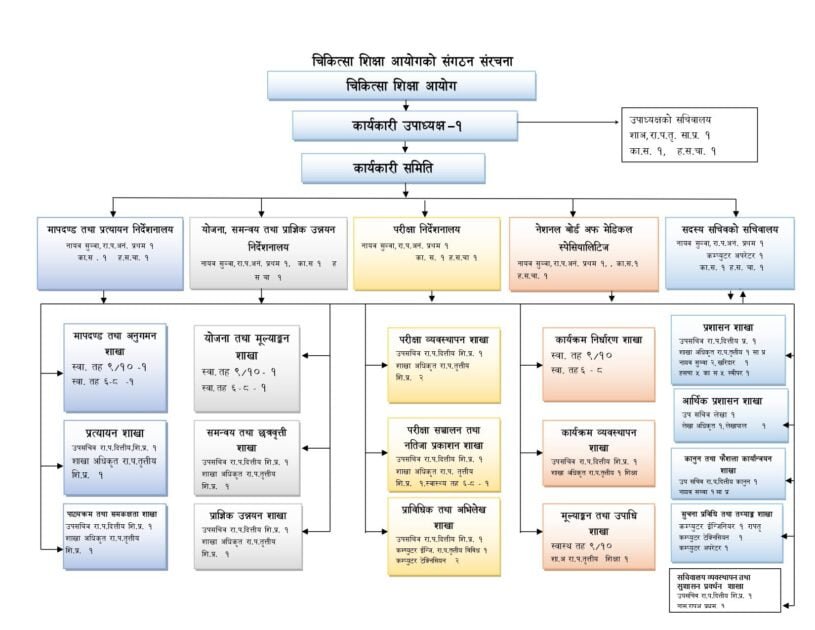
Organization Chart

onm
Organization Chart of Medical Education Commission (MEC)
More information

Medical Education Commission
Sanothimi, Bhaktapur 44800, Nepal
016639414
info@mec.gov.np

Publications & related readings

  • Medical Education Commission (MEC) Eligibility Certificate
  • Syllabus for Undergraduate Common Entrance Examination 2020
  • List of Registered Postgraduate Medical (Health Professionals) Programs in Nepal
  • Medical Education Commission Syllabus for Postgraduate Entrance Examination (2020)
  • Syllabus for Postgraduate Integrated Entrance Examination
  • Syllabus for Bachelor in Public Health (BPH) Common Entrance Examination
  • Syllabus for MBBS/BDS/BSc Nursing/BASLP/B Perfusion Technology Common Entrance Examination
  • Syllabus for Bachelor in Nursing Science (BNS) Common Entrance Examination
  • Syllabus for BAMS/BSc MLT/BSc MIT/BPT/B Pharm/B Optometry Common Entrance Examination


Do you have a website? Looking for the best hosting provider? Here’s a discount code.

Latest Public Health Jobs

Latest Posts

  • Call for Application for a PhD Fellowship (NHEA/ University of Bergen)
  • Nepal Multiple Indicator Cluster Survey 2024-25
  • Multisectoral Action Plan for the Prevention and Control of NCDs, 2026-2030 (Draft)
  • National Standard Operating Procedure for Early Warning, Alert and Response System (EWARS), 2025
  • Priority Infectious Diseases for Community-Based Surveillance in Nepal

Thanks for visiting us.
Disclaimer: The resources, documents, guidelines, and information on this blog have been collected from various sources and are intended for informational purposes only. Information published on or through this website and affiliated social media channels does not represent the intention, plan, or strategies of an organization that the initiator is associated with in a professional or personal capacity, unless explicitly indicated.
If you have any complaints, information, or suggestions about the content published on Public Health Update, please feel free to contact us at blog.publichealthupdate@gmail.com.
#StayUpdated


  • WordPress
  • Link
  • Facebook
  • Mail
  • Facebook
  • Twitter
  • Twitter
  • LinkedIn
  • Instagram
  • Facebook
December 26, 2020 4 comments
0 FacebookTwitterPinterestLinkedinTumblrVKOdnoklassnikiRedditStumbleuponWhatsappTelegramLINEPocketSkypeViberEmail
Medical Education Commission (MEC) Eligibility Certificate
NoticeNational Plan, Policy & GuidelinesSchool of Public HealthTrick, Technique & Skills

Medical Education Commission (MEC) Eligibility Certificate

by Public Health Update December 26, 2020
written by Public Health Update

Application process

To regulate the medical education and maintain quality, Medical Education Commission (MEC) provide the eligibility certificate to the students for UG, PG, Fellowship and other High Level Training. Here is the application process for Eligibility Certificate for health science students in Nepal.

Related reading: Document Required & Application Process for No Objection Certification

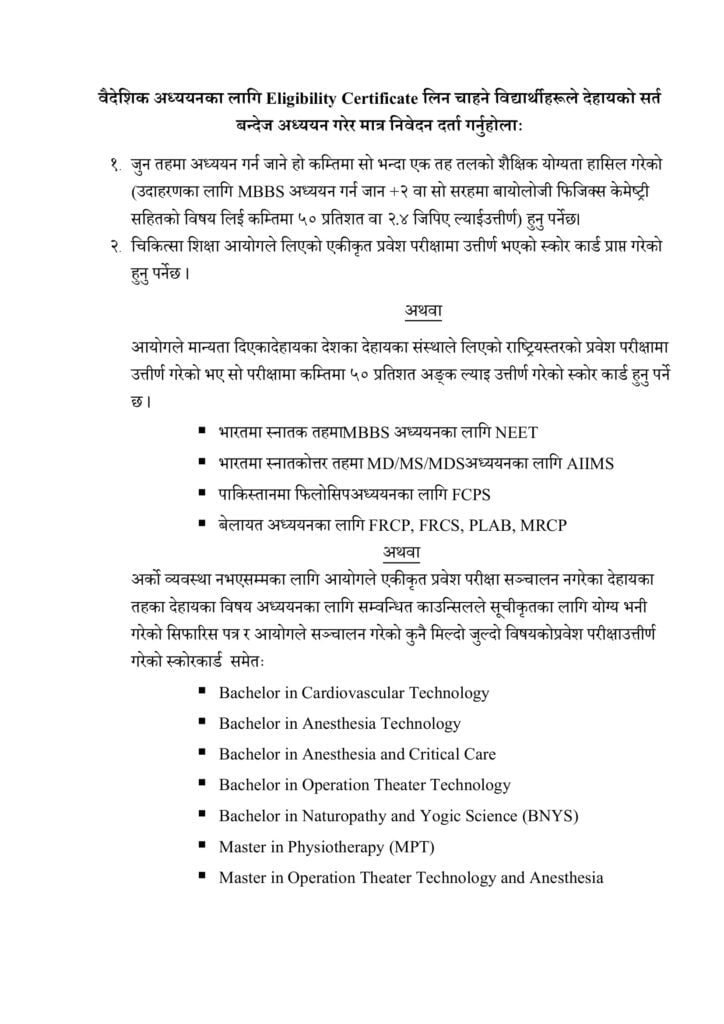
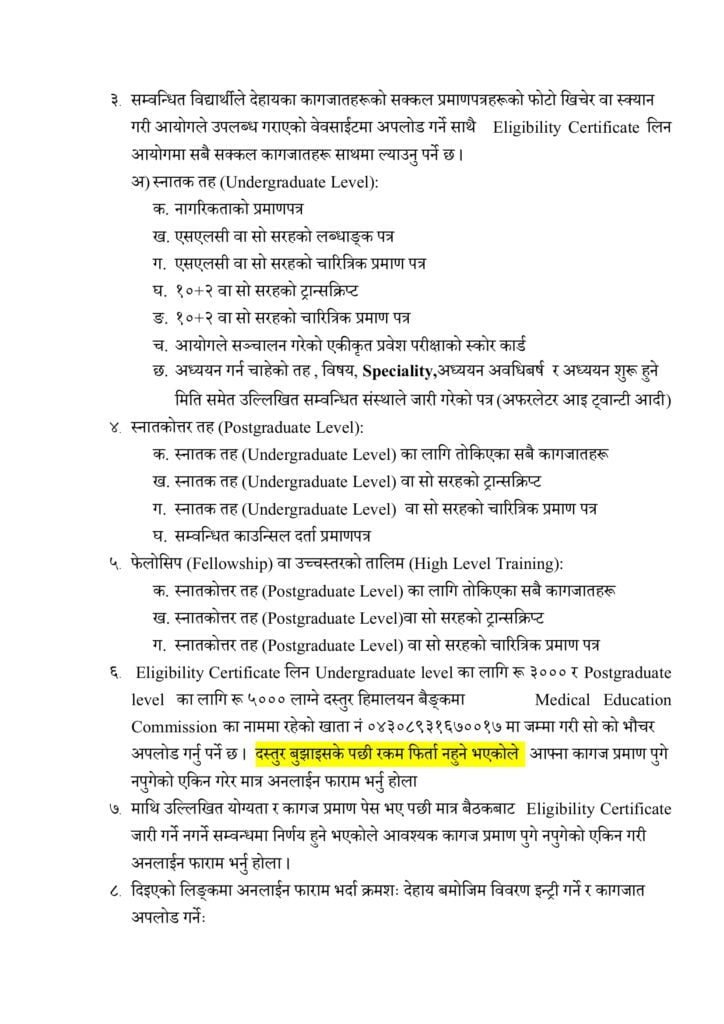
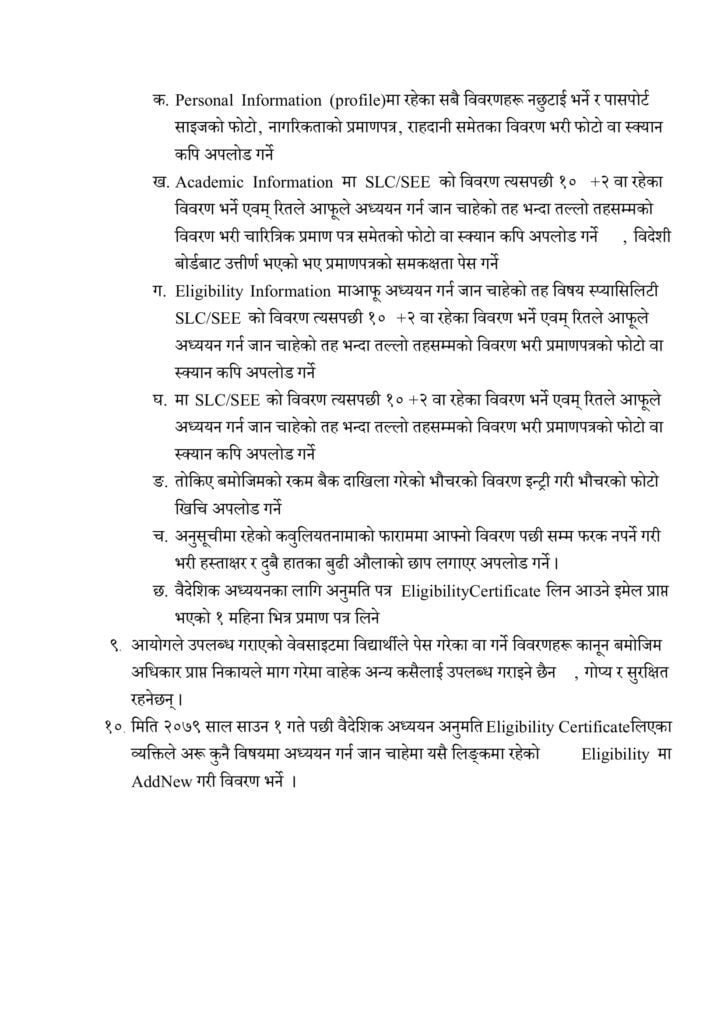
MEC Eligibility Instruction
Eligibility Instruction 20220809 3

Government of Nepal, Medical Education Commission (MEC) listed the following things that should consider when applying for MEC Eligibility Certificate.

Application submission portal: MEC Eligibility

Eligibility Certificate

Basic Information required

  • Passport Size Photo
  • Full Name
  • Grandfather’s Name
  • Father’s Name
  • Mother’s Name
  • Date of Birth (DOB)
  • Secondary Phone Number
  • Secondary Email
  • Permanent Address
  • Temporary Address, Etc.

Guardian’s Information (Name, Address, Email, Phone Number)
Citizenship Details
Passport Details
Education
: SLC/SEE Detail (Institute Country, Institute Name, Registration Number, Percentage or GPA, Pass out Year, Institute Address, Marks Obtained, etc)
Apply for Eligibility: Apply for UG Eligibility / Apply for PG Eligibility / Apply for Fellowship / Apply for High Level Training, Degree/Course, Institution Detail, Bank Voucher, Etc. Details.

MEC Eligibility Portal
Apply Now

More information

Medical Education Commission
Sanothimi, Bhaktapur 44800, Nepal
016639414
info@mec.gov.np

How to register and apply for No Objection Certificate (NOC)?

Medical Education Commission (MEC) Eligibility Certificate (Process and documents required)

Document Required & Application Process for No Objection Certification (HOW to apply for NOC)

MEC Eligibility Guideline for Course in Foreign University/Institution 2077

Related organizations

  • Nepal Nursing Council (NNC)
  • Nepal Medical Council (NMC)
  • Nepal Health Professional Council (NHPC)
  • Nepal Pharmacy Council
  • Nepal Ayurvedic Medical Council (NAMC)

Related readings

  • Medical Education Commission (MEC)
  • Medical Education Commission (MEC) Eligibility Certificate
  • Syllabus for Undergraduate Common Entrance Examination 2020
  • List of Registered Postgraduate Medical (Health Professionals) Programs in Nepal
  • Medical Education Commission Syllabus for Postgraduate Entrance Examination (2020)
  • Syllabus for Postgraduate Integrated Entrance Examination
  • Syllabus for Bachelor in Public Health (BPH) Common Entrance Examination
  • Syllabus for MBBS/BDS/BSc Nursing/BASLP/B Perfusion Technology Common Entrance Examination
  • Syllabus for Bachelor in Nursing Science (BNS) Common Entrance Examination
  • Syllabus for BAMS/BSc MLT/BSc MIT/BPT/B Pharm/B Optometry Common Entrance Examination


Do you have a website? Looking for the best hosting provider? Here’s a discount code.

Latest Public Health Jobs

Latest Posts

  • Call for Application for a PhD Fellowship (NHEA/ University of Bergen)
  • Nepal Multiple Indicator Cluster Survey 2024-25
  • Multisectoral Action Plan for the Prevention and Control of NCDs, 2026-2030 (Draft)
  • National Standard Operating Procedure for Early Warning, Alert and Response System (EWARS), 2025
  • Priority Infectious Diseases for Community-Based Surveillance in Nepal

Thanks for visiting us.
Disclaimer: The resources, documents, guidelines, and information on this blog have been collected from various sources and are intended for informational purposes only. Information published on or through this website and affiliated social media channels does not represent the intention, plan, or strategies of an organization that the initiator is associated with in a professional or personal capacity, unless explicitly indicated.
If you have any complaints, information, or suggestions about the content published on Public Health Update, please feel free to contact us at blog.publichealthupdate@gmail.com.
#StayUpdated


  • WordPress
  • Link
  • Facebook
  • Mail
  • Facebook
  • Twitter
  • Twitter
  • LinkedIn
  • Instagram
  • Facebook
December 26, 2020 3 comments
0 FacebookTwitterPinterestLinkedinTumblrVKOdnoklassnikiRedditStumbleuponWhatsappTelegramLINEPocketSkypeViberEmail
Public HealthHealth Organization ProfileHuman Resource for HealthNational Plan, Policy & Guidelines

Nepal Nursing Council (NNC)

by Public Health Update December 25, 2020
written by Public Health Update

Overview

Nepal Nursing Council (NNC) is established under Nepal Nursing Council Act 2052 (1996). It came into force on 2053-03-02 (16 June 1996). NNC is an autonomous body formed to maintain quality nursing and midwifery education for the provision of quality nursing and midwifery services to the public. Basically, the council examines the standard and infrastructure of the proposed nursing and midwifery educational institution on the basis of the requirements as set by this council.

  • The Nursing and Social Security Division (NSSD)
  • Syllabus for Bachelor in Nursing Science (BNS) Common Entrance Examination
  • Proficiency Certificate Level in Nursing (PCL Nursing)-CTEVT

Related

  • Nepal Nursing Council (NNC)
  • Nepal Medical Council (NMC)
  • Nepal Health Professional Council (NHPC)
  • Nepal Pharmacy Council
  • Nepal Ayurvedic Medical Council (NAMC)

Functions

The main functions of the council are:

  • Register the nurse through licensing examination and manage the registration of qualified nursing professionals
  • Formulate policy required to operate the nursing and midwifery profession smoothly and to provide better care to the public.
  • Inspect, monitor and recognition to nursing and midwifery academic institutions and monitor the quality of nursing and midwifery services for better nursing care.
  • Maintain the standardization in nursing and midwifery education through evaluating and reviewing the nursing and midwifery curriculum, the terms and conditions of admission and examination systems.
  • Formulate professional code of conduct of the nursing and midwifery professionals and to take action against those professionals who violate such code of conduct.
  • Develop the scope of practice for nursing and midwifery professionals to determine the work limit of nursing and midwifery professionals.
  • Publish the annual Journal of the Nepal Nursing Council.

Power & Duties

The power, function and duties of the council shall be as follows;

  • To formulate policy required to operate the nursing profession smoothly
  • To provide recognition to a teaching institution ,
  • To evaluate and review the curriculum, terms and conditions of admission, examination system and other necessary terms and conditions and infrastructure of a teaching institution which has been granted recognition pursuant to clause (b),
  • If a teaching institution is found form the evaluation and review made pursuant to clause (c) to have failed to met the standards determined by the council, to make a recommendation for revoking the approval for operation of such institution.
  • To determine the qualifications of the nursing professionals and to issue certification to the qualified nursing professional after registering his /her name in the registration book,
  • To determine the work limit of nursing professionals,
  • To formulate professional code of conduct of the nursing professionals and to take action against those nursing professionals who violate such code of conduct.

Registered professionals

Current Registration Status Up to 01 December, 2020

  • NURSES : 61421
  • MIDWIFE : 11
  • ANM: 34432
  • FOREIGN NURSES: 844

Approved programs

  • A.N.M.
  • P.C.L. Nursing
  • B.Sc. Nursing
  • Bachelor of Midwifery Science (BMS)
  • BN/ BNS
  • MN/ MSc. Nursing
Key documents
  • Code of conduct for registered nurses and midwives
  • Scope of Midwifery Practice in Nepal
  • Minimum requirements for the recognition of auxiliary nurse midwife (ANM) programme
  • Minimum requirements for the recognition of proficiency certificate level (PCL) programme in nursing
  • Minimum requirements for the recognition of post basic bachelor of nursing science (BNS) programme in nursing
  • Minimum requirements for the recognition of bachelor of science (B.Sc.) programme in nursing
  • Minimum requirements for the recognition of bachelor in midwifery programme in nursing
  • Minimum requirements for proficiency certificate level (PCL) programme in midwifery
  • Minimum requirements for the recognition of the master degree programme in nursing
  • Guidelines for the National Licensure Examination for Nurses (NLEN)
  • The Competency Guidelines for the National Licensure Examination for Midwives (NLEM)

Contact
Nepal Nursing Council,
Bansbari, Kathmandu, Nepal
P.O.Box. 12541
Tel.: 977-1-4372521
Fax: 977-1-4377214
E-mail: info@nnc.org.np

Recommended organizational profile
  • Organogram and Reporting Mechanism of Nepalese Health System in Federal Context
  • Province Health Directorate (HD)
  • The Nursing and Social Security Division (NSSD)
  • Clinical Trial Registration Process in Nepal
  • NepMed, Nepal MEDLINE (Medical Literature Analysis and Retrieval System Online)
  • Nepal Health Research Council (NHRC)
  • The Ministry of Health and Population (MoHP), Nepal
  • Epidemiology and Disease Control Division, Department of Health Services
  • Department of Drug Administration (DDA), Ministry of Health and Population
  • Department of Health Services (DoHS), Ministry of Health and Population
  • Department of Ayurveda and Alternative Medicine (DoAA)
  • Management Division, Department of Health Services
  • Epidemiology and Disease Control Division, Department of Health Services
  • Family Welfare Division (FWD), Department of Health Services
  • National Public Health Laboratory (NPHL)
  • Province Health Directorate, Ministry of Social Development (MoSD)
  • List of Approved Institutional Review Committee (IRC), NHRC


Do you have a website? Looking for the best hosting provider? Here’s a discount code.

Latest Public Health Jobs

Latest Posts

  • Call for Application for a PhD Fellowship (NHEA/ University of Bergen)
  • Nepal Multiple Indicator Cluster Survey 2024-25
  • Multisectoral Action Plan for the Prevention and Control of NCDs, 2026-2030 (Draft)
  • National Standard Operating Procedure for Early Warning, Alert and Response System (EWARS), 2025
  • Priority Infectious Diseases for Community-Based Surveillance in Nepal

Thanks for visiting us.
Disclaimer: The resources, documents, guidelines, and information on this blog have been collected from various sources and are intended for informational purposes only. Information published on or through this website and affiliated social media channels does not represent the intention, plan, or strategies of an organization that the initiator is associated with in a professional or personal capacity, unless explicitly indicated.
If you have any complaints, information, or suggestions about the content published on Public Health Update, please feel free to contact us at blog.publichealthupdate@gmail.com.
#StayUpdated


  • WordPress
  • Link
  • Facebook
  • Mail
  • Facebook
  • Twitter
  • Twitter
  • LinkedIn
  • Instagram
  • Facebook
December 25, 2020 3 comments
0 FacebookTwitterPinterestLinkedinTumblrVKOdnoklassnikiRedditStumbleuponWhatsappTelegramLINEPocketSkypeViberEmail
Nepal Medical Council (NMC)
Public HealthHealth Organization ProfileHealth SystemsHuman Resource for HealthNational Plan, Policy & Guidelines

Nepal Medical Council (NMC)

by Public Health Update December 25, 2020
written by Public Health Update

Overview

Nepal Medical Council (NMC) is a statutory organization established under the Act. The major functions of Nepal Medical Council is to provide registration to both National Doctors and Foreign National Doctors with Medical Degree/ Diploma, recognize Medical/ Dental Colleges, which meets standard criteria, and permit them to enroll students and run Academic (Medical/ Dental) programs.

Related

  • Nepal Nursing Council (NNC)
  • Nepal Medical Council (NMC)
  • Nepal Health Professional Council (NHPC)
  • Nepal Pharmacy Council
  • Nepal Ayurvedic Medical Council (NAMC)

Nepal Medical Council is also responsible for providing Eligibility Certificate to those who possess minimum qualification and wants to pursue Medical Degree/ Diploma from abroad. If any NMC registered doctors or/ and Medical/ Dental Colleges are found to be violating NMC rules and regulations or involving in any fraudulent acts related with medical practices, Nepal Medical Council have right to stop such misconducts and can recommend legal actions against such deceitful acts.

In addition to this, Nepal Medical Council has been conducting Licensing Examination for under graduates and Speciality Examination for post graduates, effectively studying and investigating the complaints registered against the subjects related with health practices as well as doctors’ profession, providing temporary license for foreign doctors to practice medicine in Nepal and preparing and implementing Accreditation Guidelines to operate academic programs for Medical/ Dental Colleges.

Roles and functions

The primary role of the Council has been to register qualified doctors to the Register of NMC and allow them to practice safe modern medicine. The role of NMC has evolved over the period of time: From mere registration of doctors that are eligible to practice modern medicine to conducting licensing examination before registration, to monitoring and regulation of medical education in the country. With enforcement of the new Health Professional Education Commission (HPEC) Bill the role of NMC in medical education is being shifted to HPEC. NMC now onwards will be focusing on the following major areas of work:

  1. Improve the standards of the Medical licensing examinations and specialist examinations. 
  2. Establish and enforce Continuous Professional Development of the medical practitioners.
  3. Monitor, encourage and enforce ethical medical practice in all spheres of healthcare.

Registered professionals

Total Registration Status

TypeMaleFemaleTotal
MBBS15485766123146
BDS111820823200
Total16603974326346
No. of Doctors in Nepal

Specialist Registration Status

TypeMaleFemaleTotal
MD/MS521319727185
MDS317256573
Total553022287758
No. of Specialist Doctors in Nepal

Update: 31st December, 2019

Contact

Nepal Medical Council 
Bansbari, Kathmandu, Nepal.
Post Box no.: 13890 
Tel: +977-1-4371954/4377164
FAX: +977-1-4372318 
E-mail: nmc@nmc.org.np
URL: www.nmc.org.np


Recommended organizational profile
  • Organogram and Reporting Mechanism of Nepalese Health System in Federal Context
  • Province Health Directorate (HD)
  • The Nursing and Social Security Division (NSSD)
  • Clinical Trial Registration Process in Nepal
  • NepMed, Nepal MEDLINE (Medical Literature Analysis and Retrieval System Online)
  • Nepal Health Research Council (NHRC)
  • The Ministry of Health and Population (MoHP), Nepal
  • Epidemiology and Disease Control Division, Department of Health Services
  • Department of Drug Administration (DDA), Ministry of Health and Population
  • Department of Health Services (DoHS), Ministry of Health and Population
  • Department of Ayurveda and Alternative Medicine (DoAA)
  • Management Division, Department of Health Services
  • Epidemiology and Disease Control Division, Department of Health Services
  • Family Welfare Division (FWD), Department of Health Services
  • National Public Health Laboratory (NPHL)
  • Province Health Directorate, Ministry of Social Development (MoSD)
  • List of Approved Institutional Review Committee (IRC), NHRC

  • Nepal Health Professional Council (NHPC)
  • Nepal Pharmacy Council
  • Nepal Ayurvedic Medical Council (NAMC)
  • National Health Training Center (NHTC)
  • The Nursing and Social Security Division (NSSD)
December 25, 2020 7 comments
0 FacebookTwitterPinterestLinkedinTumblrVKOdnoklassnikiRedditStumbleuponWhatsappTelegramLINEPocketSkypeViberEmail
Public HealthHealth Organization ProfileHealth SystemsHuman Resource for Health

Nepal Health Professional Council (NHPC)

by Public Health Update December 25, 2020
written by Public Health Update

Overview

Nepal Health Professional Council (NHPC) has been established to make more effective health services in Nepal, to mobilize the services of health professionals except the qualified doctors and nurses to be registered with the Medical Council in a managed and scientific manner and make provisions on the registration of their names according to their qualifications, according to “Nepal Health Professional Council Act 2053” by the Government of Nepal .

Related readings

  • Nepal Health Professional Council (NHPC)
  • Nepal Pharmacy Council
  • Nepal Ayurvedic Medical Council (NAMC)

Functions

Functions, duties and powers of Council According to the article 9 of the Act, the functions, duties and powers of the Council shall be as follows:

  • To make necessary policies for smoothly operating the health profession related activities.
  • To determine the curricula, terms of admission and policies on examination system of educational institutions imparting teaching and learning on health profession and evaluate and review the related matters.
  • To determine the qualifications of health professionals and to provide for the registration of the names of health professionals having required qualifications.

Recognized programme

Following educational programmes are recognized by NHPC;

  1. Public Health
  2. Health Education
  3. Medicine
  4. Medical Microbiology
  5. Diag. Health Lab
  6. Diag. Radiography
  7. Diag. Radiotherapy 
  8. Diag. Cytology
  9. Diag. Hematology
  10. Diag. Biochemistry
  11. Ayurved 
  12. Homeopathy
  13. Unani
  14. Pharmacy
  15. Acupuncture
  16. Physiotherapy
  17. Community based Rehabilitation
  18. Prosthetic & Arthritic
  19. Dental Assistant
  20. Naturopathy
  21. Yoga
  22. Ophthalmology 
  23. Operation Theatre and Allied Health Sciences
  24. Clinical psychology
  25. Speech and Hearing
Subject committees of the Council

For the registration of health professional, the council has 9 different subject committees:

  • Medical subject committee
  • Public Health subject committee
  • Radiology subject committee
  • Laboratory Medicine subject Committee
  • Physiotherapy and Rehabilitation subject committee,
  • Ayurveda subject committee,
  • Dental subject committee
  • Optometry Science Subject committee
  • Miscellaneous subject (Homiyo, Yunani, Naturopathy etc.) committee
Registered professionals
S.No.SubjectSpecializationFirstSecondThird
1Public Health12704331  
2Health Education357716 
    3Primary Health Care 1  
4Medicine  1736360242
5Medical Microbiology145145  
6Laboratory392837795118770
7Radiography376992052 
8Radiotherapy179 
9Cytrology23  
10Haematology208  
11Biochemistry20385  
12Virology10   
13Nuclear Medicine 1  
14Ayurved  1811161
15Homeopathy 16047 
16Unani 21  
17Acupuncture3119851
18Physiotherapy20715318475
19Community Base Rehabilitation 1  
20Prostheses & Orthoses 12 1
21Dental Assistant  1414787
22Naturopathy157  
23Yoga39 1
24Ophthalmology159201307 
25Operation Theater and Allied Health Sciences 1380 
26Clinical Psychology24   
27Speech and Hearing 12791 
28Forensic Medicine  3 
29Perfusion Technology38  
30Anaesthesia1631 
31 Cardiology 4  
32Renal Dialysis 4  
33Occupational Therapy 2  
34TCM AMT3   
35Embryology1   
Sub-total 2035110893060781088
Total124819
Nepal Health Professional Council (NHPC) registered professionals (Source: NHPC Website)
Contact Address

www.nhpc.org.np
977-1-4373118, 977-1-4375079
977-1-4650257
admin@nhpc.org.np
Nepal Health Professional Council (NHPC), Bansbari, Kathmandu, Nepal

Recommended organizational profile
  • Organogram and Reporting Mechanism of Nepalese Health System in Federal Context
  • Province Health Directorate (HD)
  • The Nursing and Social Security Division (NSSD)
  • Clinical Trial Registration Process in Nepal
  • NepMed, Nepal MEDLINE (Medical Literature Analysis and Retrieval System Online)
  • Nepal Health Research Council (NHRC)
  • The Ministry of Health and Population (MoHP), Nepal
  • Epidemiology and Disease Control Division, Department of Health Services
  • Department of Drug Administration (DDA), Ministry of Health and Population
  • Department of Health Services (DoHS), Ministry of Health and Population
  • Department of Ayurveda and Alternative Medicine (DoAA)
  • Management Division, Department of Health Services
  • Epidemiology and Disease Control Division, Department of Health Services
  • Family Welfare Division (FWD), Department of Health Services
  • National Public Health Laboratory (NPHL)
  • Province Health Directorate, Ministry of Social Development (MoSD)
  • List of Approved Institutional Review Committee (IRC), NHRC


Do you have a website? Looking for the best hosting provider? Here’s a discount code.

Latest Public Health Jobs

Latest Posts

  • Call for Application for a PhD Fellowship (NHEA/ University of Bergen)
  • Nepal Multiple Indicator Cluster Survey 2024-25
  • Multisectoral Action Plan for the Prevention and Control of NCDs, 2026-2030 (Draft)
  • National Standard Operating Procedure for Early Warning, Alert and Response System (EWARS), 2025
  • Priority Infectious Diseases for Community-Based Surveillance in Nepal

Thanks for visiting us.
Disclaimer: The resources, documents, guidelines, and information on this blog have been collected from various sources and are intended for informational purposes only. Information published on or through this website and affiliated social media channels does not represent the intention, plan, or strategies of an organization that the initiator is associated with in a professional or personal capacity, unless explicitly indicated.
If you have any complaints, information, or suggestions about the content published on Public Health Update, please feel free to contact us at blog.publichealthupdate@gmail.com.
#StayUpdated


  • WordPress
  • Link
  • Facebook
  • Mail
  • Facebook
  • Twitter
  • Twitter
  • LinkedIn
  • Instagram
  • Facebook
December 25, 2020 1 comment
0 FacebookTwitterPinterestLinkedinTumblrVKOdnoklassnikiRedditStumbleuponWhatsappTelegramLINEPocketSkypeViberEmail
Nepal Pharmacy Council
Public HealthHealth Organization ProfileHealth SystemsHuman Resource for HealthNational Plan, Policy & Guidelines

Nepal Pharmacy Council

by Public Health Update December 25, 2020
written by Public Health Update

The Nepal Pharmacy Council (NPC) established in order to make effective the pharmacy business by managing and operating it in a scientific manner and also provide for the registration of names according to the qualification of pharmacists and pharmacy assistants.

Related readings

  • Nepal Nursing Council (NNC)
  • Nepal Medical Council (NMC)
  • Nepal Health Professional Council (NHPC)
  • Nepal Pharmacy Council
  • Nepal Ayurvedic Medical Council (NAMC)

Nepal Pharmacy Council was established in 2058 BS (2001 AD) with the objective of making the pharmacy profession effective through systematic and scientific operation and also for the registration of the pharmacists and pharmacy assistants as per their qualification. NPC is the professional body to register the name of Pharmacy manpower (Pharmacist and  Pharmacy Assistant) in Nepal.

Functions and Duties

  • Established in accordance with Nepal Pharmacy Council.
  • Function is to work for quality assurance and accreditations of pharmacy institutions to produce quality pharmacy human resources as per the need of county.
  • Nine members committee and a registrar appointed by GoN.
  • Provision of registration of Pharmacist and Pharmacy Assistant.

Regular activities

  • Licensure examination (three times a year).
  • Registration of Pharmacist and Pharmacy Assistant after passing out the licensure examination.
  • Inspection of pharmacy teaching institutions.
  • Accreditation of pharmacy teaching institutions.
  • Permission for starting a new college after from universities and CTEVT.
  • Monitoring and supervision of pharmacy colleges

Specific activities

  • Revision on the existing guidelines for college.
  • Directives for improvement of infrastructure and facilities.
  • Code of Ethics for publishing pharmacy text book.
  • Issuing “No Objection Letter” for foreign study.
  • Routine visit of Pharmacy institutes.
  • Information update and use o fIT in documentation.
Pharmacists
  • Diploma: 8359
  • Bachelor: 4261
  • Master & above: Approximately 2100

Contact
Bijulibazar, New Baneshwor Kathmandu, Nepal
+977 (0)1 478 0747
npc@nepalpharmacycouncil.org.np
www.nepalpharmacycouncil.org.np

Recommended organizational profile
  • Organogram and Reporting Mechanism of Nepalese Health System in Federal Context
  • Province Health Directorate (HD)
  • The Nursing and Social Security Division (NSSD)
  • Clinical Trial Registration Process in Nepal
  • NepMed, Nepal MEDLINE (Medical Literature Analysis and Retrieval System Online)
  • Nepal Health Research Council (NHRC)
  • The Ministry of Health and Population (MoHP), Nepal
  • Epidemiology and Disease Control Division, Department of Health Services
  • Department of Drug Administration (DDA), Ministry of Health and Population
  • Department of Health Services (DoHS), Ministry of Health and Population
  • Department of Ayurveda and Alternative Medicine (DoAA)
  • Management Division, Department of Health Services
  • Epidemiology and Disease Control Division, Department of Health Services
  • Family Welfare Division (FWD), Department of Health Services
  • National Public Health Laboratory (NPHL)
  • Province Health Directorate, Ministry of Social Development (MoSD)
  • List of Approved Institutional Review Committee (IRC), NHRC
  • National Health Training Center (NHTC)
  • Nepal Ayurvedic Medical Council (NAMC)
  • The Nursing and Social Security Division (NSSD)


Do you have a website? Looking for the best hosting provider? Here’s a discount code.

Latest Public Health Jobs

Latest Posts

  • Call for Application for a PhD Fellowship (NHEA/ University of Bergen)
  • Nepal Multiple Indicator Cluster Survey 2024-25
  • Multisectoral Action Plan for the Prevention and Control of NCDs, 2026-2030 (Draft)
  • National Standard Operating Procedure for Early Warning, Alert and Response System (EWARS), 2025
  • Priority Infectious Diseases for Community-Based Surveillance in Nepal

Thanks for visiting us.
Disclaimer: The resources, documents, guidelines, and information on this blog have been collected from various sources and are intended for informational purposes only. Information published on or through this website and affiliated social media channels does not represent the intention, plan, or strategies of an organization that the initiator is associated with in a professional or personal capacity, unless explicitly indicated.
If you have any complaints, information, or suggestions about the content published on Public Health Update, please feel free to contact us at blog.publichealthupdate@gmail.com.
#StayUpdated


  • WordPress
  • Link
  • Facebook
  • Mail
  • Facebook
  • Twitter
  • Twitter
  • LinkedIn
  • Instagram
  • Facebook
December 25, 2020 4 comments
0 FacebookTwitterPinterestLinkedinTumblrVKOdnoklassnikiRedditStumbleuponWhatsappTelegramLINEPocketSkypeViberEmail
Nepal Ayurvedic Medical Council (NAMC)
Public HealthHealth Organization ProfileHealth SystemsHuman Resource for HealthNational Plan, Policy & Guidelines

Nepal Ayurvedic Medical Council (NAMC)

by Public Health Update December 25, 2020
written by Public Health Update

Overview

The Nepal Ayurvedic Medical Council (NAMC) is the autonomous body to regulate and control Ayurvedic medicine in Nepal. It was established under the Ayurveda Medical Council Act, 2045.

Related

  • Nepal Nursing Council (NNC)
  • Nepal Medical Council (NMC)
  • Nepal Health Professional Council (NHPC)
  • Nepal Pharmacy Council
  • Nepal Ayurvedic Medical Council (NAMC)

The council is the regulatory and legislative body for Ayurvedic courses, human resources, institutions, practitioners and traditional healers in Nepal. All Ayurveda practitioner and educational institutions have to be register with the council. The council has developed a code of ethics for Ayurvedic doctors and minimum requirements for Ayurvedic educational institutions.

The council’s main committee consists of an Ayurvedic doctor nominated by the government as chairperson, three doctors nominated by the government, the DoA director, three doctors elected by registered doctors one campus chief nominated by the government and one registrar nominated by the government.

Functions and objectives

  • Arrange for the smooth provision of Ayurveda treatment
  • Develop the system of use of Ayurvedic medicines
  • Determine the qualification of doctors and to register them
  • Advice the government on the production, sale and distribution of Ayurvedic medicines.
  • Suggest to the government for making arranging research on Ayurveda.
  • Recognise appropriate Ayurveda educational institutions in Nepal.
  • Determine the curriculum, terms admission and examination system policies and essential infrastructures of educational institutions.
  • Recognise the educational qualifications granted on Ayurveda, modern medicine and surgery and paramedics.
  • Prepare a code of conduct for Ayurvedic doctors and to monitor its implementation.

The number of registered manpower

  • Master: 103
  • Bachelor: 729
  • Ayurveda B. Pharma: 5
  • Certificate level: 1526
  • T.S.L.C. : 2365
  • Foreign doctors: 4
  • Traditional Healers: 19 (listed)
The number of registered members, institutions and courses

MD & Bachelor Level Programme:

  • Tribhuvan University, IOM, Ayurveda Campus, Kirtipur (With MD)
  • Mithila Ayurveda College & Research Center, Janakpur, Dhanusha (Affiliated by NSU)
  • Nepal Ayurveda Medical College, Birgunj, Parsha (Affiliated By T.U.)
  • Nepal Sanskrit University, Kendriya Ayurveda Vidhyapeeth, Bijauri, Dang.
  • Patanjali Ayurveda Medical College & Research Centre, Dhulikhel, Kabhre. (Affiliated By NSU)

Certificate Level Programme (AHA)

  • NSU, Janta Vidhayapeeth, Bijauri, Dang
  • Dhanwantari Ayurbigyan Adhyan Sansthan, Baphal, Kathmandu (Affiliated by CTEVT)
  • Himalayan Ayurveda College, Baneshwor, Kathmandu. (Affiliated by CTEVT)

Under CTEVT, Ayurveda Health Worker (AAHW)

  • Sailaja Acharya Politechnical Institute, Sishwani, Morang.
  • Jagadamba Medical Institute, Rajbiraj, Saptari
  • Modern Institute of Health Science, Gaighat, Udayapur.
  • Ayurvedic Medical Institute, Janakpurdham, Dhanusha.
  • Shankar Technical Training Centre, Janakpur, Dhanusha.
  • National Institute of Science & Technology, Bharatpur, Chitwan.
  • Bardiya Medical Institute, Gulariya, Bardiya.
  • Institute of Community Service Assistant, Dhangadhi, Kailali.
  • Dadeldhura Paramedical Campus, Dadeldhura.
  • White Park College, Dadeldhura.
  • Rastriya Prabidhik Sikhsalaya, Surkhet.
  • Triyuga National Institution, Gaighat.
  • Ilam Technical Institute, Ilam.
  • Bagalamukhi Technical Institute, Itahari.

(NAMC- Nepal Ayurvedic Medical Council , MD – Master of Medicine, BAMMS- Bachelor of Ayurveda & Modern Medicine & Surgery , BAMS- Bachelor of Ayurveda Medicine & Surgery, AHA- Ayurved Health Assistant; AAHW- Auxiliary Ayurveda Health Worker)

Contact

Nepal Ayurvedic Medical Council (NAMC)
Nardevi, Kathmandu, Nepal
Phone / Fax: –+977-01-4259678
Web: – www.namc.org.np
Email- nepal.namc@gmail.com


Recommended organizational profile
  • Organogram and Reporting Mechanism of Nepalese Health System in Federal Context
  • Province Health Directorate (HD)
  • The Nursing and Social Security Division (NSSD)
  • Clinical Trial Registration Process in Nepal
  • NepMed, Nepal MEDLINE (Medical Literature Analysis and Retrieval System Online)
  • Nepal Health Research Council (NHRC)
  • The Ministry of Health and Population (MoHP), Nepal
  • Epidemiology and Disease Control Division, Department of Health Services
  • Department of Drug Administration (DDA), Ministry of Health and Population
  • Department of Health Services (DoHS), Ministry of Health and Population
  • Department of Ayurveda and Alternative Medicine (DoAA)
  • Management Division, Department of Health Services
  • Epidemiology and Disease Control Division, Department of Health Services
  • Family Welfare Division (FWD), Department of Health Services
  • National Public Health Laboratory (NPHL)
  • Province Health Directorate, Ministry of Social Development (MoSD)
  • List of Approved Institutional Review Committee (IRC), NHRC


Do you have a website? Looking for the best hosting provider? Here’s a discount code.

Latest Public Health Jobs

Latest Posts

  • Call for Application for a PhD Fellowship (NHEA/ University of Bergen)
  • Nepal Multiple Indicator Cluster Survey 2024-25
  • Multisectoral Action Plan for the Prevention and Control of NCDs, 2026-2030 (Draft)
  • National Standard Operating Procedure for Early Warning, Alert and Response System (EWARS), 2025
  • Priority Infectious Diseases for Community-Based Surveillance in Nepal

Thanks for visiting us.
Disclaimer: The resources, documents, guidelines, and information on this blog have been collected from various sources and are intended for informational purposes only. Information published on or through this website and affiliated social media channels does not represent the intention, plan, or strategies of an organization that the initiator is associated with in a professional or personal capacity, unless explicitly indicated.
If you have any complaints, information, or suggestions about the content published on Public Health Update, please feel free to contact us at blog.publichealthupdate@gmail.com.
#StayUpdated


  • WordPress
  • Link
  • Facebook
  • Mail
  • Facebook
  • Twitter
  • Twitter
  • LinkedIn
  • Instagram
  • Facebook
December 25, 2020 7 comments
0 FacebookTwitterPinterestLinkedinTumblrVKOdnoklassnikiRedditStumbleuponWhatsappTelegramLINEPocketSkypeViberEmail
Newer Posts
Older Posts

Search

Follow Us

Facebook Twitter Instagram Pinterest Linkedin Youtube

Categories

  • Abstracts (25)
  • Activities (91)
  • Adolescent Sexual and Reproductive Health (ASRH) (25)
  • Advice & Tips (3)
  • African Region (5)
  • AI and Health (1)
  • Annual Meeting (6)
  • Antimicrobial Resistance (AMR) (20)
  • Award (19)
  • Awards (16)
  • Books (9)
  • Call for Proposal, EOI & RFP (103)
  • Call for Research Participants (8)
  • Clinical Doctor Jobs (6)
  • Communicable Diseases (107)
  • Competition (20)
  • Conference (128)
  • Consultant (1)
  • Courses (204)
  • Dashboard (2)
  • Digital Health & Health Informatics (10)
  • Drug and Medicine (18)
  • Eastern Mediterranean Region (3)
  • Education (15)
  • Environment (3)
  • Environmental Health & Climate Change (47)
  • European Region (42)
  • Exchange Program (1)
  • Fact Sheet (116)
  • FCHVs (1)
  • Fellowships, Studentship & Scholarships (165)
  • Financial Aid (13)
  • Form Formats (2)
  • Fully funded (22)
  • Global Health News (433)
  • Grants and Funding Opportunities (193)
  • Guest Post (44)
  • Health Assistant Jobs (1)
  • Health Equity (7)
  • Health Financing and Economics (24)
  • Health in Data (114)
  • Health Insurance (5)
  • Health Jobs (52)
  • Health Literacy, Health Education & Promotion (49)
  • Health Organization Profile (42)
  • Health Systems (81)
  • Human Resource for Health (32)
  • Humanitarian Health & Emergency Response (44)
  • Hypertension (5)
  • Implementation Research (48)
  • International Health (3)
  • International Jobs & Opportunities (370)
  • International Plan, Policy & Guidelines (208)
  • Internships (4)
  • Jobs Vacancies (56)
  • Journals (8)
  • Life Style & Public Health Nutrition (39)
  • Live (10)
  • Master's Degree (48)
  • Maternal, Newborn and Child Health (88)
  • Mentorship Program (2)
  • Miscellaneous (16)
  • National Health News (157)
  • National Plan, Policy & Guidelines (468)
  • Neglected Tropical Diseases (NTDs) (51)
  • Non- Communicable Diseases (NCDs) (120)
  • Notice (103)
  • Nursing Jobs (6)
  • Nutritionist Jobs (1)
  • One Health (17)
  • Online & Distance Learning (22)
  • Online Courses (90)
  • Op-Ed Article (3)
  • Opportunities by Region (82)
  • Outbreak News (213)
  • Partially funded (6)
  • PCL Health Science Jobs (3)
  • PH Important Day (532)
  • Pharmacist Jobs (3)
  • PhD (54)
  • Photos (5)
  • Planetary Health (4)
  • PostDoc (14)
  • Presentation Slides (26)
  • Primary Health Care (25)
  • Provincial Plan, Policies and Guidelines (14)
  • Public Health (1,278)
  • Public Health Epidemiology & Biostatistics (13)
  • Public Health Events (305)
  • Public Health Information (20)
  • Public Health Innovation (9)
  • Public Health Jobs (52)
  • Public Health News (552)
  • Public Health Notes (120)
  • Public Health Opportunities (503)
  • Public Health Opportunity (487)
  • Public Health Programs (108)
  • Public Health Seminar (2)
  • Public Health Tools (1)
  • Public Health Update (558)
  • Quality Improvement & Infection Prevention (20)
  • Region of America (8)
  • Reports (183)
  • Research & Project Grants (39)
  • Research & Project Grants (32)
  • Research & Publication (647)
  • Research Articles (10)
  • Road Traffic Accidents (RTA) (9)
  • School of Public Health (60)
  • Self funded (2)
  • South-East Asia Region (26)
  • Success Stories (17)
  • Summer and Winter Courses (39)
  • Summer Courses (27)
  • Sustainable Development Goals (SDGs) (14)
  • Syllabus (61)
  • Symposium (9)
  • Tobacco Control (35)
  • Training (40)
  • Travel Grants (15)
  • Trick, Technique & Skills (8)
  • Uncategorized (3)
  • Undergraduate Degree (7)
  • Universal Health Coverage (36)
  • Universities (29)
  • Universities & School of Public Health (57)
  • Vacancy Announcement (26)
  • Vaccine Preventable Diseases (40)
  • Vector-Borne Diseases(VBDs) (30)
  • Videos (3)
  • View Points (1)
  • Webinar (4)
  • Western Pacific Region (13)
  • Workshop (18)
  • World News (116)
Post New Jobs: Vacancy Announcement Service

Public Health Update (Sagun’s Blog) is a popular public health portal in Nepal. Thousands of health professionals are connected with Public Health Update to get up-to-date public health updates, search for jobs, and explore opportunities.
#1 Public Health Blog for sharing Job opportunities and updates in Nepal

”Public Health Information For All”
– – Sagun Paudel, Founder

  • HOT JOBS
    • Public Health Jobs
    • Medical Doctor Jobs
    • Nursing Jobs
    • Health Assistant Jobs
    • Pharmacist Jobs
    • NGOs Jobs
    • Government Jobs
  • Top Categories
    • National Plan, Policy & Guidelines Top
    • Public Health Calendar
    • Fellowships & Scholarships
    • Health Systems
    • Health Organization Profiles
    • International Jobs & Opportunities
    • Public Health Opportunity

PUBLIC HEALTH INITIATIVE

    • Submit your Vacancies New
    • Partnership Opportunities

Contact: blog.publichealthupdate@gmail.com

https://wa.me/+9779856036932

Public Health Initiative, A Registered Non-profit organization – All Right Reserved. 2011-2024. Contact us. 

Facebook Twitter Instagram Youtube Envelope
Public Health Update
  • Home
  • Public Health
    • Home 1
      • Adolescent Sexual and Reproductive Health (ASRH)
      • Antimicrobial Resistance (AMR)
      • Communicable Diseases
      • Digital Health & Health Informatics
      • Environmental Health & Climate Change
      • Health Financing and Economics
      • Health Equity
    • Home 2
      • Health Literacy, Health Education & Promotion
      • Human Resource for Health
      • Humanitarian Health & Emergency Response
      • Implementation Research
      • International Health
      • Life Style & Public Health Nutrition
      • Maternal, Newborn and Child Health
    • Home 3
      • Neglected Tropical Diseases (NTDs)
      • Non- Communicable Diseases (NCDs)
      • One Health
      • Planetary Health
      • Public Health Epidemiology & Biostatistics
      • Primary Health Care
      • Quality Improvement & Infection Prevention
    • Home 4
      • Road Traffic Accidents (RTA)
      • Sustainable Development Goals (SDGs)
      • Tobacco Control
      • Universal Health Coverage
      • Vaccine Preventable Diseases
      • Vector-Borne Diseases(VBDs)
      • Notices
  • Public Health Update
    • Home 1
      • Public Health News
      • Global Health News
      • Outbreak News
      • National Health News
      • COVID-19
    • Home 2
      • Fact Sheet
      • Health in Data
      • PH Important Day
      • Public Health Events
      • Public Health Programs
    • Home 3
      • Health Systems
      • Health Insurance
      • Health Organization Profile
      • Success Stories
      • Public Health Innovation
  • Public Health Opportunities
    • Fully funded
    • Travel Grants
    • Grants and Funding Opportunities
    • Opportunities by Region
    • International Jobs & Opportunities
    • Research & Project Grants
    • Fellowships, Studentship & Scholarships
    • Conference
  • Jobs
    • Home 1
      • Health Jobs
      • Public Health Jobs
      • Clinical doctor Jobs
      • Health Assistant Jobs
      • Nursing Jobs
      • PCL Health Science Jobs
    • Home 2
      • Dental Jobs
      • Pharmacist Jobs
      • TSLC (Health Jobs)
      • Laboratory Jobs
      • Nutritionist Jobs
  • Downloads
    • International Plan, Policy & Guidelines
    • National Plan, Policy & Guidelines
    • Reports
    • Books
    • Research Articles
  • School of Public Health
    • Home 1
      • Courses
      • Master’s Degree
      • Undergraduate Degree
      • PhD
    • Home 2
      • Universities
      • Syllabus
      • Public Health Notes
      • Mentorship Program
      • Startup Project
    • Home
      • Summer and Winter Courses
      • Summer Courses
      • Online Courses
      • Workshop
      • Training
Public Health Update
  • Home
  • Public Health
    • Home 1
      • Adolescent Sexual and Reproductive Health (ASRH)
      • Antimicrobial Resistance (AMR)
      • Communicable Diseases
      • Digital Health & Health Informatics
      • Environmental Health & Climate Change
      • Health Financing and Economics
      • Health Equity
    • Home 2
      • Health Literacy, Health Education & Promotion
      • Human Resource for Health
      • Humanitarian Health & Emergency Response
      • Implementation Research
      • International Health
      • Life Style & Public Health Nutrition
      • Maternal, Newborn and Child Health
    • Home 3
      • Neglected Tropical Diseases (NTDs)
      • Non- Communicable Diseases (NCDs)
      • One Health
      • Planetary Health
      • Public Health Epidemiology & Biostatistics
      • Primary Health Care
      • Quality Improvement & Infection Prevention
    • Home 4
      • Road Traffic Accidents (RTA)
      • Sustainable Development Goals (SDGs)
      • Tobacco Control
      • Universal Health Coverage
      • Vaccine Preventable Diseases
      • Vector-Borne Diseases(VBDs)
      • Notices
  • Public Health Update
    • Home 1
      • Public Health News
      • Global Health News
      • Outbreak News
      • National Health News
      • COVID-19
    • Home 2
      • Fact Sheet
      • Health in Data
      • PH Important Day
      • Public Health Events
      • Public Health Programs
    • Home 3
      • Health Systems
      • Health Insurance
      • Health Organization Profile
      • Success Stories
      • Public Health Innovation
  • Public Health Opportunities
    • Fully funded
    • Travel Grants
    • Grants and Funding Opportunities
    • Opportunities by Region
    • International Jobs & Opportunities
    • Research & Project Grants
    • Fellowships, Studentship & Scholarships
    • Conference
  • Jobs
    • Home 1
      • Health Jobs
      • Public Health Jobs
      • Clinical doctor Jobs
      • Health Assistant Jobs
      • Nursing Jobs
      • PCL Health Science Jobs
    • Home 2
      • Dental Jobs
      • Pharmacist Jobs
      • TSLC (Health Jobs)
      • Laboratory Jobs
      • Nutritionist Jobs
  • Downloads
    • International Plan, Policy & Guidelines
    • National Plan, Policy & Guidelines
    • Reports
    • Books
    • Research Articles
  • School of Public Health
    • Home 1
      • Courses
      • Master’s Degree
      • Undergraduate Degree
      • PhD
    • Home 2
      • Universities
      • Syllabus
      • Public Health Notes
      • Mentorship Program
      • Startup Project
    • Home
      • Summer and Winter Courses
      • Summer Courses
      • Online Courses
      • Workshop
      • Training
Public Health Initiative, A Registered Non-profit organization – All Right Reserved. 2011-2023