Public Health Update
  • Home
  • Public Health Update
  • Nepal Health Jobs
    • Public Health Job Board
    • Organization List
  • Opportunities
    • Fellowships, Studentship & Scholarships
    • Grants and Funding Opportunities
    • Fully funded
    • Conference
  • Downloads
    • International Plan, Policy & Guidelines
    • National Plan, Policy & Guidelines
    • Reports
    • Public Health Notes
    • Syllabus
    • Form Formats
  • School of Public Health
    • PhD
    • Master’s Degree
    • Online Courses
  • Notice
  • Home
  • Public Health Update
  • Nepal Health Jobs
    • Public Health Job Board
    • Organization List
  • Opportunities
    • Fellowships, Studentship & Scholarships
    • Grants and Funding Opportunities
    • Fully funded
    • Conference
  • Downloads
    • International Plan, Policy & Guidelines
    • National Plan, Policy & Guidelines
    • Reports
    • Public Health Notes
    • Syllabus
    • Form Formats
  • School of Public Health
    • PhD
    • Master’s Degree
    • Online Courses
  • Notice
LOGIN / REGISTER
Public Health Update
SUBSCRIBE
Public Health Update
  • Home
  • Public Health Update
  • Nepal Health Jobs
    • Public Health Job Board
    • Organization List
  • Opportunities
    • Fellowships, Studentship & Scholarships
    • Grants and Funding Opportunities
    • Fully funded
    • Conference
  • Downloads
    • International Plan, Policy & Guidelines
    • National Plan, Policy & Guidelines
    • Reports
    • Public Health Notes
    • Syllabus
    • Form Formats
  • School of Public Health
    • PhD
    • Master’s Degree
    • Online Courses
  • Notice

All Right Reserved. Designed and Developed by PenciDesign

Capturing the evidence on access to essential antibiotics in refugee and migrant populations
Public HealthGlobal Health NewsPublic Health NewsPublic Health Update

Capturing the evidence on access to essential antibiotics in refugee and migrant populations

by Public Health Update September 23, 2022
written by Public Health Update

Overview

The fourth report of the Global Evidence Review on Health and Migration (GEHM) series synthesizes available evidence on access to essential antibiotics in refugee and migrant populations. The report captures evidence across four themes related to antibiotic access and use: access, appropriate use, barriers to access and use, and interventions to improve access and use.

Findings of the report suggest that access to and use of antibiotics by refugee and migrant populations is heterogeneous and is significantly influenced by the health systems of the host countries, as well as by non-health policies and factors. Evidence on access to antibiotics, antibiotic use compared with the host population and quality of available antibiotics is almost non-existent for refugee camp settings and for migrants residing in low- and middle-income countries (LMICs). Given the variability in health systems across countries with different income levels, refugees and migrants face a wide range of barriers in obtaining health services and, by extension, in accessing and using antibiotics.

The report provides policy considerations for equitable access and appropriate use of antibiotics among refugee and migrant populations in five areas: global governance, research and surveillance, and barriers to seeking formal care, utilizing formal care and receiving adequate and quality care. 

Executive summary

Antimicrobial resistance (AMR) is a complex global health challenge, with significant implications for human health, social well-being and economic development. Bacterial AMR alone causes over 1.27 million deaths annually worldwide. Although the development of resistance in pathogens is natural and unavoidable, the emergence of AMR has been accelerated by decades of overuse of antimicrobials across sectors, prematurely rendering these drugs less effective in treating common infections.

Maintaining the ability to treat serious infections requires a balance between equitable access to and appropriate use of existing and new antimicrobial medicines for all. International refugee and migrant populations may be particularly vulnerable to rising AMR; the draft global action plan for the promotion of the health of refugees and migrants underscores the importance of appropriate antibiotic use and prevention of AMR. The number of international refugees and migrants has grown significantly since the early 2000s, reaching an estimated 281 million, or about 3.5% of the global population, in 2020.

The conditions under which refugees and migrants leave their countries of origin and transit to their destination countries may lead to increased infections, as well as to disruptions and barriers to health care access.

This Report, the fourth in the Global Evidence Review on Health and Migration (GEHM) series, synthesizes the available evidence across four themes related to antibiotic access and use:
(i) access,
(ii) appropriate use,
(iii) barriers to access and use, and
(iv) interventions to improve access and use.

It provides policy considerations for equitable access and appropriate use of antibiotics among refugee and migrant populations. A scoping review found scarce evidence on access and use of antibiotics by refugees and migrants and that existing research largely focuses on migrants residing in high-income contexts; therefore, generalizability of the findings is limited. However, the available evidence suggests that access to and use of antibiotics by refugee and migrant populations is heterogeneous and is significantly influenced by the health systems of the host countries, as well as by non-health policies and factors. Evidence on access to antibiotics, antibiotic use compared with the host population and quality of available antibiotics is almost non-existent for refugee camp settings and for migrants residing in low- and middle-income countries (LMICs). Differences in health systems, legal entitlements and drug reimbursement programmes have resulted in variable levels of access to antibiotics for refugees and migrants across high-income countries (HIC). Systemic factors in the countries of origin, transit and destination play a major role in determining patient behaviours and facilitating access to and appropriate use of antibiotics. The review identified no evidence on the direct or indirect impact of the COVID-19 pandemic on access to antibiotics in refugee and migrant populations.

Given the variability in health systems across countries with different income levels, refugees and migrants face a wide range of barriers in obtaining health services and, by extension, in accessing and using antibiotics. Previous unsatisfactory experiences with formal care can act as a barrier to refugees’ and migrants’ desire for formal care, as can norms and preferences that encourage self-medication and the ease of informal access to antibiotics. Those refugees and migrants who do desire care may face barriers related to stigmatization, fear of deportation or language, and may also be unable to reach formal care due to financial and time constraints. Moreover, lack of knowledge about antibiotics and their appropriate use may contribute to the unnecessary or incorrect use of antibiotics. Aspects of the health system that can create barriers to access to and appropriate use of antibiotics include long waiting times and limited capacity of health services, high health care costs, diagnostic uncertainty, and lack of translated materials or interpreter services.

Policy considerations

This GEHM synthesized the available evidence on barriers to antibiotic access and appropriate use refugees and migrants, and on interventions implemented to address these barriers. Based on its findings, policy considerations are given in five areas: global governance, global data collection, and overcoming national-level barriers to seeking formal care, utilizing formal care and receiving adequate and quality care.

Global governance

  • Strengthen engagement between key institutions for coordinated global governance.
  • Align and integrate action plans for a coherent framework and concerted action.
  • Establish financial arrangements in LMIC markets for equitable antimicrobial access and use.

Global data collection: research and surveillance

  • Strengthen surveillance systems for data-driven and evidence-informed policy solutions.
  • Support research to fill substantial knowledge gaps.
  • Overcoming national-level barriers to seeking formal care
  • Facilitate access to care by improving language accessibility.
  • Monitor and support the provision of migrant- and refugee-sensitive cultural training for health care personnel.
  • Improve migrants’ and refugees’ knowledge of antibiotics through communitybased initiatives.

Overcoming national-level barriers to utilizing formal care

  • Remove status-related barriers to care.
  • Ensure that essential antibiotics are affordable.
  • Improve knowledge of and registration for entitlements to care.
  • Avoid restrictions that limit access to antibiotics for vulnerable populations.
  • Overcoming national-level barriers to receiving adequate and quality care
  • Ensure access to the tools necessary for optimal case management in vulnerable populations.

Capturing the evidence on access to essential antibiotics in refugee and migrant populations


Do you have a website? Looking for the best hosting provider? Here’s a discount code.

Latest Public Health Jobs

Latest Posts

  • International Wellness Day: Promoting Global Wellness for All
  • Summit Declaration: The 12th National Summit of Health and Population Scientists in Nepal
  • Joint political declaration on the reform of the global health architecture
  • World Health Day 2026: Together for Health. Stand with Science.
  • World Water Day 2026 | Water & Gender Equality

Thanks for visiting us.
Disclaimer: The resources, documents, guidelines, and information on this blog have been collected from various sources and are intended for informational purposes only. Information published on or through this website and affiliated social media channels does not represent the intention, plan, or strategies of an organization that the initiator is associated with in a professional or personal capacity, unless explicitly indicated.
If you have any complaints, information, or suggestions about the content published on Public Health Update, please feel free to contact us at blog.publichealthupdate@gmail.com.
#StayUpdated


  • WordPress
  • Link
  • Facebook
  • Mail
  • Facebook
  • Twitter
  • Twitter
  • LinkedIn
  • Instagram
  • Facebook
September 23, 2022 0 comments
0 FacebookTwitterPinterestLinkedinTumblrVKOdnoklassnikiRedditStumbleuponWhatsappTelegramLINEPocketSkypeViberEmail
Massive open online course on Implementation research
Implementation ResearchCoursesInternational Jobs & OpportunitiesOnline CoursesPublic Health OpportunitiesPublic Health Opportunity

Call for Applications! Massive open online course on Implementation research

by Public Health Update September 20, 2022
written by Public Health Update

TDR and the University of Ghana’s School of Public Health, the TDR-supported Regional Training Centre for the WHO African Region, are organizing a new session in English of the TDR Massive Open Online Course (MOOC) on Implementation Research (IR).

Implementation Research (IR) Initiative in Nepal

This free course is a step-by-step online training for public health researchers and decision-makers, disease control programme managers, academics and others, that focuses on how to design and demonstrate robust IR projects to improve control of infectious diseases of poverty and generate better health outcomes.

Implementation research (IR) is important for designing strategies or solutions to overcome bottlenecks that prevent proven and innovative public health interventions from reaching the people who need them. This ensure that these interventions are used in a manner that results in the outcome for which they were intended. Such solutions include how to overcome barriers to adoption of drugs, diagnostics or preventive measures that improve health for people at risk of malaria, tuberculosis, NTDs or other infectious diseases. IR can help to ensure that health solutions reach the people who need them and are used in ways that generate intended results.

This course is open to all applicants. No technical or scientific background is required, though a health background would be an advantage.

Language: English with subtitles in English, Spanish and French

The course starts on 3 October 2022.

To register, please send a request to: artc@ug.edu.gh


Implementation Research (IR) Initiative in Nepal


Do you have a website? Looking for the best hosting provider? Here’s a discount code.

Latest Public Health Jobs

Latest Posts

  • International Wellness Day: Promoting Global Wellness for All
  • Summit Declaration: The 12th National Summit of Health and Population Scientists in Nepal
  • Joint political declaration on the reform of the global health architecture
  • World Health Day 2026: Together for Health. Stand with Science.
  • World Water Day 2026 | Water & Gender Equality

Thanks for visiting us.
Disclaimer: The resources, documents, guidelines, and information on this blog have been collected from various sources and are intended for informational purposes only. Information published on or through this website and affiliated social media channels does not represent the intention, plan, or strategies of an organization that the initiator is associated with in a professional or personal capacity, unless explicitly indicated.
If you have any complaints, information, or suggestions about the content published on Public Health Update, please feel free to contact us at blog.publichealthupdate@gmail.com.
#StayUpdated


  • WordPress
  • Link
  • Facebook
  • Mail
  • Facebook
  • Twitter
  • Twitter
  • LinkedIn
  • Instagram
  • Facebook
September 20, 2022 0 comments
0 FacebookTwitterPinterestLinkedinTumblrVKOdnoklassnikiRedditStumbleuponWhatsappTelegramLINEPocketSkypeViberEmail
NHRC Health Grant
Public HealthCall for Proposal, EOI & RFPGrants and Funding OpportunitiesPublic Health OpportunitiesPublic Health Opportunity

Call for NHRC Health Research Grant

by Public Health Update September 20, 2022
written by Public Health Update

Nepal Health Research Council (NHRC) announces Request for Proposals for Provincial Research Grant, Under Graduate and Post Graduate Research Grant for the fiscal year 207918 0 from Nepalese citizens. Provincial research grant is open for all 7 provinces and UG/PG research grant for any final year UG/PG students enrolled in Nepalese University across the country to support innovative research ideas on health and medical sciences from eligible Nepali citizens.

More Information

  • Request for Proposal (UG & PG)_001
  • Request for Proposal (Provincial Grant)_001

For details please visit: www.nhrc.gov.np.

Contact
Capacity Building Section
Nepal Health Research Council CNHRC)
Ramshah Path, P.O. Box:7626, Kathmandu,
Nepal Tel: +977 I 425422014227460
Email : grant.nhrc@gmail.com

September 20, 2022 0 comments
0 FacebookTwitterPinterestLinkedinTumblrVKOdnoklassnikiRedditStumbleuponWhatsappTelegramLINEPocketSkypeViberEmail
Call for Applications! NHRC's Virtual Training Workshops 
Public HealthNoticePublic Health OpportunitiesPublic Health OpportunityTraining

Call for Applications! NHRC’s Virtual Training Workshops 

by Public Health Update September 20, 2022
written by Public Health Update

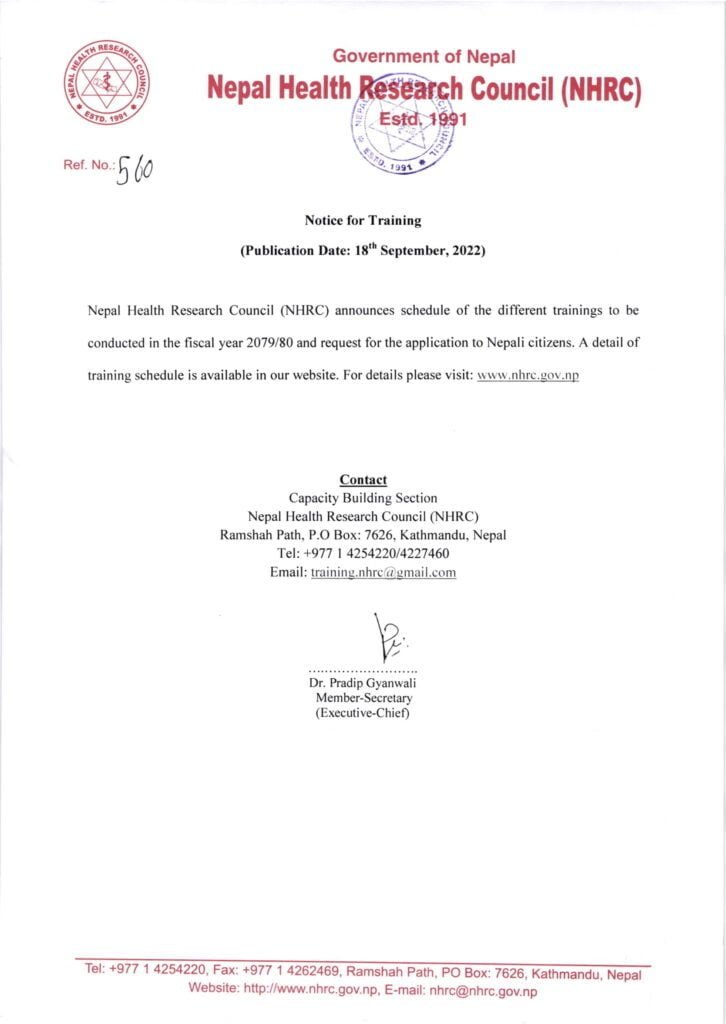
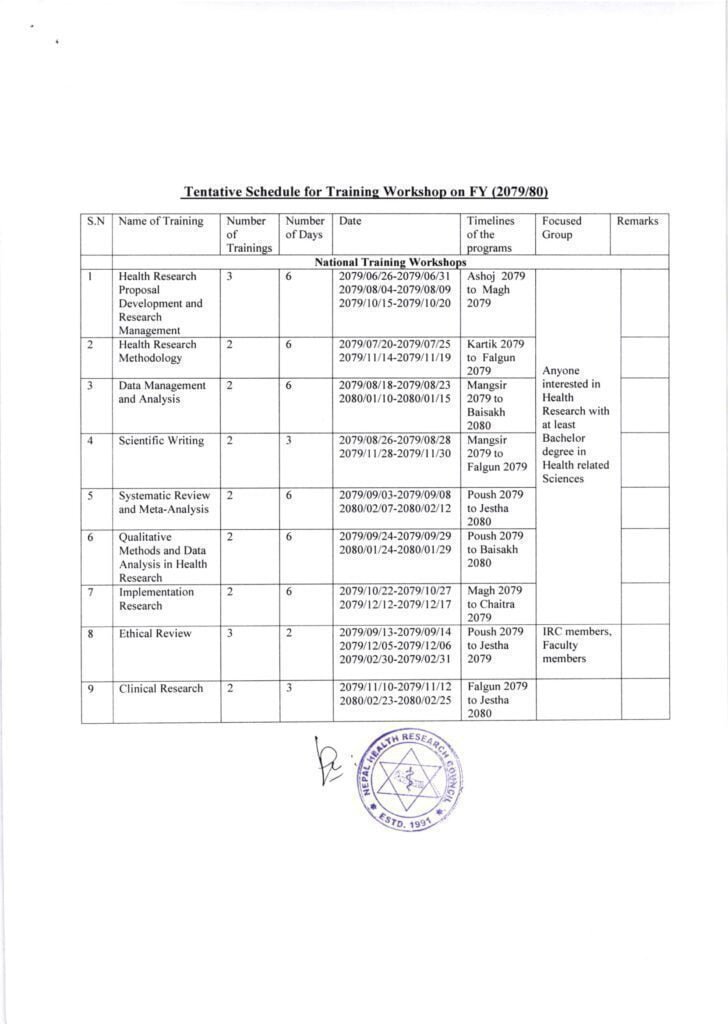
Nepal Health Research Council (NHRC) announces schedule of the different trainings to be conducted in the fiscal year 2079/80 and request for the application to Nepali citizens. A detail of training schedule is available in NHRC website.

For the fiscal year 2079/80, the Nepal Health Research Council is now taking applications for a verify of virtual training workshops related to health research. Please fill out the form if you are interested in attending any of these training workshops.

Eligible Criteria:

  • Candidates holding at least Bachelor’s Degree in health sciences will be considered for training workshops.
  • Undergraduate candidates from health sciences background are eligible to apply for Health Research Methodology training only.

NHRC will conduct virtual training workshops in different batches and applicants fulfilling the minimum criteria will be informed regarding their selection and training via email.

Application form

Call for Training 001 1
Tentative ScheduleFY079.80 001 1


Do you have a website? Looking for the best hosting provider? Here’s a discount code.

Latest Public Health Jobs

Latest Posts

  • International Wellness Day: Promoting Global Wellness for All
  • Summit Declaration: The 12th National Summit of Health and Population Scientists in Nepal
  • Joint political declaration on the reform of the global health architecture
  • World Health Day 2026: Together for Health. Stand with Science.
  • World Water Day 2026 | Water & Gender Equality

Thanks for visiting us.
Disclaimer: The resources, documents, guidelines, and information on this blog have been collected from various sources and are intended for informational purposes only. Information published on or through this website and affiliated social media channels does not represent the intention, plan, or strategies of an organization that the initiator is associated with in a professional or personal capacity, unless explicitly indicated.
If you have any complaints, information, or suggestions about the content published on Public Health Update, please feel free to contact us at blog.publichealthupdate@gmail.com.
#StayUpdated


  • WordPress
  • Link
  • Facebook
  • Mail
  • Facebook
  • Twitter
  • Twitter
  • LinkedIn
  • Instagram
  • Facebook
September 20, 2022 0 comments
0 FacebookTwitterPinterestLinkedinTumblrVKOdnoklassnikiRedditStumbleuponWhatsappTelegramLINEPocketSkypeViberEmail
NESCOM Webinar: Opportunities for Public Health Professionals in Global Health Career
Public HealthPublic Health EventsPublic Health OpportunitiesPublic Health OpportunityWebinar

Webinar: Opportunities for Public Health Professionals in Global Health Career

by Public Health Update September 18, 2022
written by Public Health Update

Nepalese Society of Community Medicine (NESCOM) invites public health profesisonals to join a Webinar on Opportunities for Public Health Professionals in Global Health Career.

Nepalese Society of Community Medicine (NESCOM) Webinar 21.

Topic: Opportunities for Public Health Professionals in Global Health Career

Date: Sept 30, 2022
Time: 6:30 PM

Mode of Delivery: Online
LINK to Register: https://nren.zoom.us/meeting/register/u5Uvdu6sqTkqGNyLsDtUbpbMX-KSOlyZmfdO?

Presenter: Dr Shambhu Acharya, Director, Strategic Division, WHO, Geneva, Switzerland

Moderator: Dr Suman Lohani

Any problem in registration contact: 9841794785 [Dr Surya] 


Do you have a website? Looking for the best hosting provider? Here’s a discount code.

Latest Public Health Jobs

Latest Posts

  • International Wellness Day: Promoting Global Wellness for All
  • Summit Declaration: The 12th National Summit of Health and Population Scientists in Nepal
  • Joint political declaration on the reform of the global health architecture
  • World Health Day 2026: Together for Health. Stand with Science.
  • World Water Day 2026 | Water & Gender Equality

Thanks for visiting us.
Disclaimer: The resources, documents, guidelines, and information on this blog have been collected from various sources and are intended for informational purposes only. Information published on or through this website and affiliated social media channels does not represent the intention, plan, or strategies of an organization that the initiator is associated with in a professional or personal capacity, unless explicitly indicated.
If you have any complaints, information, or suggestions about the content published on Public Health Update, please feel free to contact us at blog.publichealthupdate@gmail.com.
#StayUpdated


  • WordPress
  • Link
  • Facebook
  • Mail
  • Facebook
  • Twitter
  • Twitter
  • LinkedIn
  • Instagram
  • Facebook
September 18, 2022 0 comments
0 FacebookTwitterPinterestLinkedinTumblrVKOdnoklassnikiRedditStumbleuponWhatsappTelegramLINEPocketSkypeViberEmail
The 17th World Congress on Public Health
Public HealthConferenceGrants and Funding OpportunitiesPublic Health EventsPublic Health OpportunitiesPublic Health OpportunityTravel Grants

The 17th World Congress on Public Health

by Public Health Update September 18, 2022
written by Public Health Update

A World in Turmoil: Opportunities to Focus on the Public’s Health

In May 2023, over 3.000 public health professionals and researchers, policymakers, and students will convene in Rome, Italy, for the 17th World Congress on Public Health, a momentous event organised by the World Federation of Public Health Associations (WFPHA) in association with the Italian Society of Hygiene, Preventive Medicine and Public Health (SItI) and the Association of Schools of Public Health in the European Region (ASPHER).

The 17th World Congress on Public Health coincides with a critical juncture for our world. The COVID19 pandemic has indelibly altered our planet and our lives, exacerbating existing inequalities and alerting us to the threats of an unsustainable mode of production. Conflicts worldwide, from Ukraine to Afghanistan, from Syria to Ethiopia — to cite a few — have further destabilised the world, alongside the devastating consequences felt by all those directly affected. And together with the pandemic and the war, we have failed to mitigate the effects of climate change — the pandemic itself a potential consequence — with environmental disasters growing in frequency and impact. We are undoubtedly living in a world in turmoil.

Now more than ever, these crises serve as an opportunity to advocate for and create better social protection systems, promote health for all, prepare for the challenges posed by future pandemics or global crises, and work together to end exploitation and to create harmony between nature and humanity.

The theme of the Congress — A World in Turmoil: Opportunities to Focus on the Public’s Health — reflects our commitment, as the global health community, to work together in and outside of our respective fields to promote health equity and to build a more sustainable and just future.

This World Congress on Public Health will be an opportunity to foster collaboration and co-creation of a vision informed by our professional knowledge and that of the communities we serve. Empowering communities and becoming more responsive to them will lie at the heart of any attempt to move forward, to safeguard and nurture a world in need of healing and protection.

Congress Theme 

The theme of the Congress is “A World in Turmoil: Opportunities to Focus on the Public’s Health”. It underlines the commitment of working together across sectors to promote health equity and build a more sustainable and just future.

Congress Sessions

PLENARY THEMES

  • Planetary Health and Public Health
  • Social, economic and political determinants of health and health equity
  • Digital health, health information and Artificial Intelligence
  • COVID-19: The Ongoing Challenge, Lessons Learnt and How to Prevent the Next Pandemic
  • Mental health and social wellbeing
  • Vaccine preventable diseases and Vaccine confidence
  • Skills and capacity for health improvement: growing the global public health workforce
  • Conflicts and public health: prevention, responses, recovery, rehabilitation, reconciliation.

Abstract topics (Workshops, Oral Presentations & Posters):

  • Adults & Older Adults Health 
  • Antimicrobial Resistance 
  • Climate Change, Environmental and Urban Health 
  • Communicable Diseases – except COVID-19 
  • COVID-19: Lessons Learnt and How to Prevent the Next Pandemic 
  • Digital Health, Health Information and AI 
  • Education and Training 
  • Health Determinants, Sustainable Health Equity and SDGs 
  • Health Promotion and Universal Health Systems 
  • Hygiene & Sanitation – including Clean Water and Hospital Hygiene 
  • Intersectoral and Multilateral Collaborations and Health Systems Strengthening 
  • Maternal & Adolescent & Child Health 
  • Mental Health & Social Wellbeing 
  • Minorities, Diversity & Inclusion – including Indigenous Peoples, Migrants, Refugees, LGBTQ 
  • Non-Communicable Diseases including – Cancer, CVD, Obesity, Oral Health
  • Public Health Advocacy, Policy, and Diplomacy 
  • Public Health Communication 
  • Public Health Ethics & Law 
  • Public Health in Emergencies, Disasters, and Wars 
  • Public Health Leadership and Workforce 
  • Public Health, Governance, Politics and Economics 
  • Research, Theories, and Methods in Public Health 
  • Social Security & Social Protection – including Health Insurance, Occupational Health, Injuries and Accidents 
  • Surveillance, Monitoring, Evaluation and Reporting – including HIA, HTA and Registries 
  • Vaccine Preventable Diseases (VPDs) and Vaccine Confidence

Funding Opportunities

The 17th World Congress of Public Health Grant is designed to give motivated attendees who require financial assistance an opportunity to join the World Congress. The grant is fundamentally need-based, and eligibility criteria for consideration fall into the following categories:

  • Attendees with low earnings and from low to low-middle income countries (as determined by World Bank country classifications) or
  • Full-time students with no financial income (unemployed)

The 17th World Congress of Public Health Grant is strictly limited, and funding will be awarded based on both merit and need.

Depending on the applicant’s ranking in both need and merit of the financial support, the grant will cover either:

  • Full cost of both registration to the 17th World Health Congress on Public Health as well as accommodation costs for the duration of the Congress (a maximum of 4 nights, from May 2nd, 2023, to May 6th, 2023), or
  • Registration fee to the Congress only

Any additional fees (i.e for pre-conferences, Congress dinner) will not be covered.

Please note that no amount under any condition will be dedicated to travel costs. All applicants are responsible for their own travel cost to/from Rome and for all the related expenses.

Grants awarded to successful applicants will be administered by the Organizing Secretariat, who will take care of registration and accommodation directly. No funding for daily allowances or other costs will be funded.

Please note that no request for reimbursement will be accepted. Therefore, if applying for the grant, we strongly advise not to register or book accommodation before grant notification has been given.

Eligibility Requirements for Grant
  • Applicants should be either a delegate with low earnings from a lower or lower-middle income country (World Bank country classifications), or a full-time student of a maximum age of 26 years old with no financial income (unemployed);
  • Applicants must have submitted an abstract for oral/poster presentations; abstracts must be submitted online by December 9th 2022;
  • Attendance at the World Congress must not be supported by industry. (The committee reserves the right to rescind grants to awardees whose abstracts and/or attendance are supported by industry);
  • Good command of the English language is mandatory.

IMPORTANT DATES

  • REGISTRATION OPEN AND EARLY BIRD OFFER: 09 MAY 2022
  • CALL FOR ABSTRACTS OPEN: 01 SEPTEMBER 2022
  • ABSTRACT SUBMISSION CLOSE: 09 DECEMBER 2022
  • CLOSING EARLY BIRD REGISTRATIONS: 09 DECEMBER 2022
  • STANDARD REGISTRATION FEES ON OFFER: 10 DECEMBER 2022
  • NOTIFICATION OF ABSTRACT ACCEPTANCE: 30 JANUARY 2023
  • DEADLINE FOR ACCEPTED PRESENTER TO REGISTER: 15 MARCH 2023

Contact

  • General enquiries: infowcph2023@thetriumph.com
  • Sponsorship and exhibition opportunities: sponsorwcph2023@thetriumph.com
  • Registration: registrationwcph2023@thetriumph.com
  • Accommodation: bookingwcph2023@thetriumph.com

Official website (The 17th World Congress on Public Health)


Do you have a website? Looking for the best hosting provider? Here’s a discount code.

Latest Public Health Jobs

Latest Posts

  • International Wellness Day: Promoting Global Wellness for All
  • Summit Declaration: The 12th National Summit of Health and Population Scientists in Nepal
  • Joint political declaration on the reform of the global health architecture
  • World Health Day 2026: Together for Health. Stand with Science.
  • World Water Day 2026 | Water & Gender Equality

Thanks for visiting us.
Disclaimer: The resources, documents, guidelines, and information on this blog have been collected from various sources and are intended for informational purposes only. Information published on or through this website and affiliated social media channels does not represent the intention, plan, or strategies of an organization that the initiator is associated with in a professional or personal capacity, unless explicitly indicated.
If you have any complaints, information, or suggestions about the content published on Public Health Update, please feel free to contact us at blog.publichealthupdate@gmail.com.
#StayUpdated


  • WordPress
  • Link
  • Facebook
  • Mail
  • Facebook
  • Twitter
  • Twitter
  • LinkedIn
  • Instagram
  • Facebook
September 18, 2022 0 comments
0 FacebookTwitterPinterestLinkedinTumblrVKOdnoklassnikiRedditStumbleuponWhatsappTelegramLINEPocketSkypeViberEmail
The 5 Moments for Medication Safety
Public HealthHealth Literacy, Health Education & PromotionPublic Health UpdateQuality Improvement & Infection Prevention

The 5 Moments for Medication Safety

by Public Health Update September 17, 2022
written by Public Health Update

The 5 Moments for Medication Safety are the key moments where action by the patient or caregiver can greatly reduce the risk of harm associated with the use of their medication/s. Each moment includes 5 critical questions. Some are self-reflective for the patient and some require support from a health professional to be answered and reflected upon correctly.

For patients, families and caregivers

Pay attention to these 5 MOMENTS when using medication/s. ASK these QUESTIONS and FIND the ANSWERS with the help of a health care professional whenever you:

  • visit a doctor, nurse, pharmacist or dentist
  • visit a primary health care facility or pharmacy
  • are admitted to and discharged from a health care facility
  • are referred to another health care facility
  • are transferred to another health care facility
  • receive treatment and care at home.

Global Patient Safety Action Plan 2021-2030

For health professionals

Promote patient engagement by introducing this tool to your patients, their families and caregivers and supporting them in answering the questions.

5 MOMENTS

  1. Starting a medication
  2. Taking my medication
  3. Adding a medication
  4. Reviewing my medication
  5. Stopping my medication

Starting a medication

  • What is the name of this medication and what is it for?
  • What are the risks and possible side-effects?
  • Is there another way of treating my condition?
  • Have I told my health professional about my allergies and other health conditions?
  • How should I store this medication?

Taking my medication

  • When should I take this medication and how much should I take each time?
  • How should I take the medication?
  • Is there anything related to food and drink that I should know while taking this medication?
  • What should I do if I miss a dose of this medication?
  • What should I do if I have side-effects?

Adding a medication

  • Do I really need any other medication?
  • Have I told my health professional about the medications I am already taking?
  • Can this medication interact with my other medications?
  • What should I do if I suspect an interaction?
  • Will I be able to manage multiple medications correctly?

Reviewing my medication

  • Do I keep a list of all my medications?
  • How long should I take each medication?
  • Am I taking any medications I no longer need?
  • Does a health professional check my medications regularly?
  • How often should my medications be reviewed?

Stopping my medication

  • When should I stop each medication?
  • Should any of my medications not be stopped suddenly?
  • What should I do if I run out of medication?
  • If I have to stop my medication due to an unwanted effect, where should I report this?
  • What should I do with leftover or expired medications?

DOWNLOAD WHO Tool on the 5 Moments for Medication Safety

World Patient Safety Day 2022: Medication without harm


Do you have a website? Looking for the best hosting provider? Here’s a discount code.

Latest Public Health Jobs

Latest Posts

  • International Wellness Day: Promoting Global Wellness for All
  • Summit Declaration: The 12th National Summit of Health and Population Scientists in Nepal
  • Joint political declaration on the reform of the global health architecture
  • World Health Day 2026: Together for Health. Stand with Science.
  • World Water Day 2026 | Water & Gender Equality

Thanks for visiting us.
Disclaimer: The resources, documents, guidelines, and information on this blog have been collected from various sources and are intended for informational purposes only. Information published on or through this website and affiliated social media channels does not represent the intention, plan, or strategies of an organization that the initiator is associated with in a professional or personal capacity, unless explicitly indicated.
If you have any complaints, information, or suggestions about the content published on Public Health Update, please feel free to contact us at blog.publichealthupdate@gmail.com.
#StayUpdated


  • WordPress
  • Link
  • Facebook
  • Mail
  • Facebook
  • Twitter
  • Twitter
  • LinkedIn
  • Instagram
  • Facebook
September 17, 2022 0 comments
0 FacebookTwitterPinterestLinkedinTumblrVKOdnoklassnikiRedditStumbleuponWhatsappTelegramLINEPocketSkypeViberEmail
World Patient Safety Day
Public HealthPH Important DayPublic Health UpdateQuality Improvement & Infection Prevention

World Patient Safety Day 2022: Medication without harm

by Public Health Update September 17, 2022
written by Public Health Update

Overview

The World Patient Safety Day is a global campaign to improve patient safety, celebrated each year on 17th September. Recognizing patient safety as a global health priority, all 194 WHO Member States at The 72nd World Health Assembly in May 2019 endorsed the establishment of World Patient Safety Day (Resolution WHA72.6), to be marked annually on 17 September.

Global Patient Safety Action Plan 2021-2030

Objective

The campaign aims to mobilize patients, health workers, health leaders, policy-makers, academics, researchers, professional networks, the private sector and health care industry to speak up for health worker safety to improve the safety of health care, and reduce the risk of harm, both to health workers and patients.

The objectives of World Patient Safety Day are to increase public awareness and engagement, enhance global understanding, and spur global solidarity and action to promote patient safety.

World Patient Safety Day 2022: Medication without harm

This year the theme of world patient safety day is related to Medication Safety. As medications are the most widely utilized interventions in health care, and medication-related harm constitutes the greatest proportion of the total preventable harm due to unsafe care, let alone the economic and psychological burden imposed by such harm. Acknowledging this substantial burden and recognizing the complexity of medication-related harm prevention and reduction, “Medication Safety” has been selected as the theme for World Patient Safety Day 2022.

Facts
  • Medication harm accounts for 50% of the overall preventable harm in medical care.
  • US$ 42 billion of global total health expenditure worldwide can be avoided if medication errors are prevented.

Key Messages

Policy-makers and programme managers

  • Ensure medication safety is addressed at all levels and in all settings in the health care system
  • Assess the burden of medication-related harm in your country
  • Integrate medication safety into every stage of patient care
  • Co-design and implement medication safety programmes with stakeholders, including patients and public
  • Establish a patient safety incident reporting and learning system, including medication safety incidents (medication errors and related harm)
  • Monitor progress and evaluate the impact of medication safety programmes
  • Launch Know. Check. Ask. as the medication safety campaign across the country.

Health care leaders and facility managers

  • Designate a focal point and a multidisciplinary team to develop processes to ensure medication safety in your facility
  • Develop and implement standard operating procedures for safe medication use, taking into account the risk of human error
  • Make sure there are sufficient staff to cover patients’ medication needs
  • Provide opportunities to train health workers on safe medication use
  • Operationalize a patient safety incident reporting and learning system, including medication safety incidents (medication errors and related harm)
  • Create a safety culture where health workers are able to raise safety concerns related to medications
  • Prioritize action in areas where most medication-related harm occurs, such as high-risk situations, transitions of care and polypharmacy
  • Put in place strategies to reduce the risk of medication errors, such as double-checking, patient engagement and using information technology to improve processes.

Health workers

  • Keep your skills in safe medication practices up to date
  • Engage patients through shared decision-making using tools such as the 5 Moments for Medication Safety and implement actions related to the Know. Check. Ask. campaign
  • Provide clear and full medication-related information to all members of the clinical team throughout the process of care
  • Report medication safety incidents, and share and apply lessons learned with your team and patients when possible
  • Be mindful of situations where risk from medications is high and ensure safety measures are followed
  • Mentor new members of your team on safe medication systems and practices.

Patients, families and general public

  • When prescribed a medication, check with your health worker that you have all the information you need to take it safely. Follow the Know. Check. Ask. actions
  • Keep an up-to-date list of all the medications you take, including traditional medicines, and share it with your treating health workers
  • Take your medications as recommended by your health worker
  • Use the 5 Moments for Medication Safety tool to keep you safe while taking your medications
  • Be aware of the potential side-effects of your medications
  • Store your medications as indicated and check the expiration date regularly
  • Raise any concerns about your medication with your health worker.

Source of Info: World Health Organization


Related readings

  • World Patient Safety Day
  • World Patient Safety Day 2021 : Act now for safe and respectful childbirth!
  • Global Patient Safety Action Plan 2021-2030
  • World Patient Safety Day: Speak up for health worker safety!
  • World Patient Safety Day: Speak up for patient safety!
  • Global Patients Congress 2020 Call To Action
  • WHO calls for urgent action to reduce patient harm in healthcare
  • Six principles to ensure AI works for the public interest in all countries
September 17, 2022 0 comments
0 FacebookTwitterPinterestLinkedinTumblrVKOdnoklassnikiRedditStumbleuponWhatsappTelegramLINEPocketSkypeViberEmail
Country Climate and Development Report for Nepal`
Public Health

Country Climate and Development Report for Nepal

by Public Health Update September 16, 2022
written by Public Health Update

Objective and scope

The Country Climate and Development Report (CCDR) identifies ways that Nepal can achieve its overall development objectives while fostering its strategic ambition to transition to a greener, more resilient, and inclusive development pathway. It identifies the major risks and opportunities that climate change presents for Nepal’s economic growth and poverty reduction and shows how investments in climate actions are good for sustainable development and vice versa. This CCDR is a contribution to an evolving analytical agenda on climate and development in Nepal. While it does not address all dimensions of climate and development, it proposes an overall framework, recommends selected priority actions to enhance synergies and manage trade-offs between development and climate objectives, and identifies areas for further research.

This report is organized as follows:

  • Chapter 1 captures the current situation in the country with respect to climate impacts and risks, emission sources, and opportunities for integrated climate change adaptation and mitigation.
  • Chapter 2 describes the government’s response, through sectoral and economywide commitments, laws, and regulations.
  • Chapter 3 assesses the impacts of climate change on the macroeconomy and road transport systems, given their critical role to connectivity. It also analyzes the links between climate change and air pollution, poverty, health, social inclusion, and community resilience.
  • Chapter 4 presents pathways to transition to resilience, looking at integrated management of landscape systems comprising water, agriculture, and forests as well as strengthening climate and disaster risk management governance.
  • Chapter 5 analyzes pathways to transition to decarbonization, primarily the potential for hydropower expansion domestically and in the region. It also looks at transport and urban opportunities to reduce emissions while enhancing resilience and adaptation co-benefits.
  • Chapter 6 discusses how to scale up financing for resilience, hydropower, and other opportunities, given the limitations of the country’s fiscal space.
  • Chapter 7 presents a prioritization framework for the most transformational climate action with seven ‘policy packages’—one for each priority transition and each key enabler—that contain specific recommendations for how to move from analysis to action.

Key Messages

Nepal has achieved significant development progress in recent decades. Due in large part to steady inflows from remittances, the country has expanded access to electricity and drinking water, improved youth literacy, raised primary and secondary school enrollment, and reduced infant mortality.
Development gains may be at risk due to climate change. Nepal is highly vulnerable to climate and disaster risks. Rising temperatures, melting glaciers, and more intense rainfall are expected to increase climate-related hazards, particularly river flooding and landslides. Women, indigenous people, and other marginalized groups are often excluded from mainstream development and suffer from cumulative and cascading impacts of climate change and disasters.

Nepal is a negligible contributor to global greenhouse gas (GHG) emissions, but emissions are rising. Virtually all of Nepal’s population is reported to be exposed to unsafe levels of air pollution, with significant negative impacts on health, productivity, and economic output.

There are many low-carbon and climate-resilient opportunities in Nepal, including development of hydropower to fuel its own growth and for export to neighbors, clean cooking solutions, electric vehicles, and solar energy. Bringing in the private sector by improving the business environment and financing avenues will be critical to helping Nepal achieve its ambitious climate goals.

Read more: Download Report


Do you have a website? Looking for the best hosting provider? Here’s a discount code.

Latest Public Health Jobs

Latest Posts

  • International Wellness Day: Promoting Global Wellness for All
  • Summit Declaration: The 12th National Summit of Health and Population Scientists in Nepal
  • Joint political declaration on the reform of the global health architecture
  • World Health Day 2026: Together for Health. Stand with Science.
  • World Water Day 2026 | Water & Gender Equality

Thanks for visiting us.
Disclaimer: The resources, documents, guidelines, and information on this blog have been collected from various sources and are intended for informational purposes only. Information published on or through this website and affiliated social media channels does not represent the intention, plan, or strategies of an organization that the initiator is associated with in a professional or personal capacity, unless explicitly indicated.
If you have any complaints, information, or suggestions about the content published on Public Health Update, please feel free to contact us at blog.publichealthupdate@gmail.com.
#StayUpdated


  • WordPress
  • Link
  • Facebook
  • Mail
  • Facebook
  • Twitter
  • Twitter
  • LinkedIn
  • Instagram
  • Facebook
September 16, 2022 0 comments
0 FacebookTwitterPinterestLinkedinTumblrVKOdnoklassnikiRedditStumbleuponWhatsappTelegramLINEPocketSkypeViberEmail
Geriatric Health Service Strategy 2021-2030
National Plan, Policy & GuidelinesResearch & Publication

Geriatric Health Service Strategy 2021-2030

by Public Health Update September 16, 2022
written by Public Health Update

Background

In recognition of the vulnerability and rights of senior citizens, the Ministry of Health and Population decided to develop a Geriatric Health Service Strategy. The Ministry has enforced this strategy in accordance with the powers entrusted to the Ministry by the Government of Nepal (Allocation of Business) Rules, 2018 and the prevailing Governance (Management and Operations) Act, 2007.

Priorities of the Strategy

Nepal’s constitutional and policy commitments provide a firm basis for healthy ageing. Healthy ageing is the process of developing and maintaining the functional ability that enables well-being in older age. This strategy builds state capacity to support healthy ageing and provide quality health care to senior citizens. As part of Nepal’s pursuit of Universal Health Coverage, this strategy has the following priorities:

  1. Easy access to, and availability of quality health services for senior citizens;
  2. Competent execution and strengthening of health promotion and protection, quality health care service delivery and social health insurance for senior citizens;
  3. Multisectoral advocacy for sensitization and awareness of health ageing;
  4. Strengthening and expansion of family and community support systems for healthy ageing;
  5. Capacity enhancement of health facilities at all levels engaged in delivering basic curative services, long-term care, community-based and home-based curative services for senior citizens;
  6. Strengthening the development and utilisation of integrated information management system for the health of senior citizens;
  7. Planning, management and development of appropriate human resources for ensuring quality health service delivery for senior citizens;
  8. Guaranteeing gender equitable and inclusive health care services for senior citizens and ensuring accountability;
  9. Effective implementation, and the strengthening and expansion of financially sustainable social health insurance system for senior citizens;
  10. Institutional integration and development of geriatric health services at provincial and local levels.

Vision: A meaningful, quality and healthy life for all senior citizens.

Purpose: To protect the health rights of senior citizens by means of their health promotion and protection, effective delivery of health services and an improved system of social health insurance.

Goal: To enable senior citizens to lead active and quality lives on the basis of optimum health protection and effective health service delivery.

Objectives

The Geriatric Health Service Strategy has the following main objectives:

  1. To provide lifelong health promotion and protection services to senior citizens.
  2. To build an effective, inclusive and accountable health service delivery system for senior citizens.
  3. To promote multisectoral coordination, harmony, collaboration and partnerships to achieve effective geriatric health services.
  4. Motivate senior citizens for healthy living and enhance awareness at family and community levels to reinforce health promoting actions. (Objective 1)
  5. Strengthen and expand the health protection system for senior citizens. (Objective 1)
  6. Increase access to, and the affordability and utilization of quality health services and assistive devices by senior citizens. (Objective 1)
  7. Develop a senior citizen-inclusive health system to address the health needs of senior citizens in an appropriate manner. (Objective 2)
  8. Motivate and enhance the professional and technical competence of health personnel to provide quality geriatric health services effectively and efficiently. (Objective 2)
  9. Expand and strengthen innovative and implementable social health insurance reform measures to respond to the needs of senior citizens and their family members. (Objective 2)
  10. Mainstream and institutionalize the health concerns of senior citizens into the health system at all levels. (Objective 3)
  11. Strengthen coordination and harmonization across spheres of government and across sectors for the effective delivery of geriatric health services. (Objective 3).

DOWNLOAD PFD FILE


Recommended readings

  • Geriatrics (Senior Citizens) Health Service Program Implementation Guideline-2077
  • Medical Treatment of Deprived Citizens (Bipanna Nagarik Kosh), MoHP
  • Geriatric Care Center Operation Guideline and Standards
September 16, 2022 0 comments
0 FacebookTwitterPinterestLinkedinTumblrVKOdnoklassnikiRedditStumbleuponWhatsappTelegramLINEPocketSkypeViberEmail
Newer Posts
Older Posts

Search

Follow Us

Facebook Twitter Instagram Pinterest Linkedin Youtube

Categories

  • Abstracts (25)
  • Activities (91)
  • Adolescent Sexual and Reproductive Health (ASRH) (25)
  • Advice & Tips (4)
  • African Region (5)
  • AI and Health (1)
  • Annual Meeting (6)
  • Antimicrobial Resistance (AMR) (21)
  • Award (19)
  • Awards (16)
  • Books (9)
  • Call for Proposal, EOI & RFP (103)
  • Call for Research Participants (8)
  • Clinical Doctor Jobs (6)
  • Communicable Diseases (107)
  • Competition (20)
  • Conference (129)
  • Consultant (1)
  • Courses (205)
  • Dashboard (2)
  • Digital Health & Health Informatics (10)
  • Drug and Medicine (18)
  • Eastern Mediterranean Region (3)
  • Education (15)
  • Environment (3)
  • Environmental Health & Climate Change (47)
  • European Region (42)
  • Exchange Program (1)
  • Fact Sheet (117)
  • FCHVs (1)
  • Fellowships, Studentship & Scholarships (168)
  • Financial Aid (13)
  • Form Formats (2)
  • Fully funded (22)
  • Global Health News (434)
  • Grants and Funding Opportunities (193)
  • Guest Post (44)
  • Health Assistant Jobs (1)
  • Health Equity (7)
  • Health Financing and Economics (24)
  • Health in Data (115)
  • Health Insurance (5)
  • Health Jobs (52)
  • Health Literacy, Health Education & Promotion (50)
  • Health Organization Profile (42)
  • Health Systems (83)
  • Human Resource for Health (33)
  • Humanitarian Health & Emergency Response (44)
  • Hypertension (5)
  • Implementation Research (48)
  • International Health (3)
  • International Jobs & Opportunities (373)
  • International Plan, Policy & Guidelines (210)
  • Internships (4)
  • Jobs Vacancies (56)
  • Journals (8)
  • Life Style & Public Health Nutrition (39)
  • Live (10)
  • Master's Degree (48)
  • Maternal, Newborn and Child Health (88)
  • Mentorship Program (2)
  • Miscellaneous (16)
  • National Health News (158)
  • National Plan, Policy & Guidelines (468)
  • Neglected Tropical Diseases (NTDs) (51)
  • Non- Communicable Diseases (NCDs) (121)
  • Notice (103)
  • Nursing Jobs (6)
  • Nutritionist Jobs (1)
  • One Health (18)
  • Online & Distance Learning (22)
  • Online Courses (90)
  • Op-Ed Article (3)
  • Opportunities by Region (83)
  • Outbreak News (213)
  • Partially funded (6)
  • PCL Health Science Jobs (3)
  • PH Important Day (534)
  • Pharmacist Jobs (3)
  • PhD (54)
  • Photos (5)
  • Planetary Health (4)
  • PostDoc (14)
  • Presentation Slides (26)
  • Primary Health Care (25)
  • Provincial Plan, Policies and Guidelines (14)
  • Public Health (1,283)
  • Public Health Epidemiology & Biostatistics (13)
  • Public Health Events (306)
  • Public Health Information (20)
  • Public Health Innovation (9)
  • Public Health Jobs (52)
  • Public Health News (554)
  • Public Health Notes (120)
  • Public Health Opportunities (507)
  • Public Health Opportunity (491)
  • Public Health Programs (108)
  • Public Health Seminar (2)
  • Public Health Tools (1)
  • Public Health Update (564)
  • Quality Improvement & Infection Prevention (20)
  • Region of America (8)
  • Reports (184)
  • Research & Project Grants (39)
  • Research & Project Grants (32)
  • Research & Publication (647)
  • Research Articles (10)
  • Road Traffic Accidents (RTA) (9)
  • School of Public Health (60)
  • Self funded (2)
  • South-East Asia Region (26)
  • Success Stories (17)
  • Summer and Winter Courses (40)
  • Summer Courses (28)
  • Sustainable Development Goals (SDGs) (14)
  • Syllabus (61)
  • Symposium (9)
  • Tobacco Control (35)
  • Training (40)
  • Travel Grants (15)
  • Trick, Technique & Skills (8)
  • Uncategorized (3)
  • Undergraduate Degree (7)
  • Universal Health Coverage (36)
  • Universities (29)
  • Universities & School of Public Health (58)
  • Vacancy Announcement (26)
  • Vaccine Preventable Diseases (40)
  • Vector-Borne Diseases(VBDs) (30)
  • Videos (3)
  • View Points (1)
  • Webinar (4)
  • Western Pacific Region (13)
  • Workshop (18)
  • World News (117)
Post New Jobs: Vacancy Announcement Service

Public Health Update (Sagun’s Blog) is a popular public health portal in Nepal. Thousands of health professionals are connected with Public Health Update to get up-to-date public health updates, search for jobs, and explore opportunities.
#1 Public Health Blog for sharing Job opportunities and updates in Nepal

”Public Health Information For All”
– – Sagun Paudel, Founder

  • HOT JOBS
    • Public Health Jobs
    • Medical Doctor Jobs
    • Nursing Jobs
    • Health Assistant Jobs
    • Pharmacist Jobs
    • NGOs Jobs
    • Government Jobs
  • Top Categories
    • National Plan, Policy & Guidelines Top
    • Public Health Calendar
    • Fellowships & Scholarships
    • Health Systems
    • Health Organization Profiles
    • International Jobs & Opportunities
    • Public Health Opportunity

PUBLIC HEALTH INITIATIVE

    • Submit your Vacancies New
    • Partnership Opportunities

Contact: blog.publichealthupdate@gmail.com

https://wa.me/+9779856036932

Public Health Initiative, A Registered Non-profit organization – All Right Reserved. 2011-2024. Contact us. 

Facebook Twitter Instagram Youtube Envelope
Public Health Update
  • Home
  • Public Health
    • Home 1
      • Adolescent Sexual and Reproductive Health (ASRH)
      • Antimicrobial Resistance (AMR)
      • Communicable Diseases
      • Digital Health & Health Informatics
      • Environmental Health & Climate Change
      • Health Financing and Economics
      • Health Equity
    • Home 2
      • Health Literacy, Health Education & Promotion
      • Human Resource for Health
      • Humanitarian Health & Emergency Response
      • Implementation Research
      • International Health
      • Life Style & Public Health Nutrition
      • Maternal, Newborn and Child Health
    • Home 3
      • Neglected Tropical Diseases (NTDs)
      • Non- Communicable Diseases (NCDs)
      • One Health
      • Planetary Health
      • Public Health Epidemiology & Biostatistics
      • Primary Health Care
      • Quality Improvement & Infection Prevention
    • Home 4
      • Road Traffic Accidents (RTA)
      • Sustainable Development Goals (SDGs)
      • Tobacco Control
      • Universal Health Coverage
      • Vaccine Preventable Diseases
      • Vector-Borne Diseases(VBDs)
      • Notices
  • Public Health Update
    • Home 1
      • Public Health News
      • Global Health News
      • Outbreak News
      • National Health News
      • COVID-19
    • Home 2
      • Fact Sheet
      • Health in Data
      • PH Important Day
      • Public Health Events
      • Public Health Programs
    • Home 3
      • Health Systems
      • Health Insurance
      • Health Organization Profile
      • Success Stories
      • Public Health Innovation
  • Public Health Opportunities
    • Fully funded
    • Travel Grants
    • Grants and Funding Opportunities
    • Opportunities by Region
    • International Jobs & Opportunities
    • Research & Project Grants
    • Fellowships, Studentship & Scholarships
    • Conference
  • Jobs
    • Home 1
      • Health Jobs
      • Public Health Jobs
      • Clinical doctor Jobs
      • Health Assistant Jobs
      • Nursing Jobs
      • PCL Health Science Jobs
    • Home 2
      • Dental Jobs
      • Pharmacist Jobs
      • TSLC (Health Jobs)
      • Laboratory Jobs
      • Nutritionist Jobs
  • Downloads
    • International Plan, Policy & Guidelines
    • National Plan, Policy & Guidelines
    • Reports
    • Books
    • Research Articles
  • School of Public Health
    • Home 1
      • Courses
      • Master’s Degree
      • Undergraduate Degree
      • PhD
    • Home 2
      • Universities
      • Syllabus
      • Public Health Notes
      • Mentorship Program
      • Startup Project
    • Home
      • Summer and Winter Courses
      • Summer Courses
      • Online Courses
      • Workshop
      • Training
Public Health Update
  • Home
  • Public Health
    • Home 1
      • Adolescent Sexual and Reproductive Health (ASRH)
      • Antimicrobial Resistance (AMR)
      • Communicable Diseases
      • Digital Health & Health Informatics
      • Environmental Health & Climate Change
      • Health Financing and Economics
      • Health Equity
    • Home 2
      • Health Literacy, Health Education & Promotion
      • Human Resource for Health
      • Humanitarian Health & Emergency Response
      • Implementation Research
      • International Health
      • Life Style & Public Health Nutrition
      • Maternal, Newborn and Child Health
    • Home 3
      • Neglected Tropical Diseases (NTDs)
      • Non- Communicable Diseases (NCDs)
      • One Health
      • Planetary Health
      • Public Health Epidemiology & Biostatistics
      • Primary Health Care
      • Quality Improvement & Infection Prevention
    • Home 4
      • Road Traffic Accidents (RTA)
      • Sustainable Development Goals (SDGs)
      • Tobacco Control
      • Universal Health Coverage
      • Vaccine Preventable Diseases
      • Vector-Borne Diseases(VBDs)
      • Notices
  • Public Health Update
    • Home 1
      • Public Health News
      • Global Health News
      • Outbreak News
      • National Health News
      • COVID-19
    • Home 2
      • Fact Sheet
      • Health in Data
      • PH Important Day
      • Public Health Events
      • Public Health Programs
    • Home 3
      • Health Systems
      • Health Insurance
      • Health Organization Profile
      • Success Stories
      • Public Health Innovation
  • Public Health Opportunities
    • Fully funded
    • Travel Grants
    • Grants and Funding Opportunities
    • Opportunities by Region
    • International Jobs & Opportunities
    • Research & Project Grants
    • Fellowships, Studentship & Scholarships
    • Conference
  • Jobs
    • Home 1
      • Health Jobs
      • Public Health Jobs
      • Clinical doctor Jobs
      • Health Assistant Jobs
      • Nursing Jobs
      • PCL Health Science Jobs
    • Home 2
      • Dental Jobs
      • Pharmacist Jobs
      • TSLC (Health Jobs)
      • Laboratory Jobs
      • Nutritionist Jobs
  • Downloads
    • International Plan, Policy & Guidelines
    • National Plan, Policy & Guidelines
    • Reports
    • Books
    • Research Articles
  • School of Public Health
    • Home 1
      • Courses
      • Master’s Degree
      • Undergraduate Degree
      • PhD
    • Home 2
      • Universities
      • Syllabus
      • Public Health Notes
      • Mentorship Program
      • Startup Project
    • Home
      • Summer and Winter Courses
      • Summer Courses
      • Online Courses
      • Workshop
      • Training
Public Health Initiative, A Registered Non-profit organization – All Right Reserved. 2011-2023