Public Health Update
  • Home
  • Public Health Update
  • Nepal Health Jobs
    • Public Health Job Board
    • Organization List
  • Opportunities
    • Fellowships, Studentship & Scholarships
    • Grants and Funding Opportunities
    • Fully funded
    • Conference
  • Downloads
    • International Plan, Policy & Guidelines
    • National Plan, Policy & Guidelines
    • Reports
    • Public Health Notes
    • Syllabus
    • Form Formats
  • School of Public Health
    • PhD
    • Master’s Degree
    • Online Courses
  • Notice
  • Home
  • Public Health Update
  • Nepal Health Jobs
    • Public Health Job Board
    • Organization List
  • Opportunities
    • Fellowships, Studentship & Scholarships
    • Grants and Funding Opportunities
    • Fully funded
    • Conference
  • Downloads
    • International Plan, Policy & Guidelines
    • National Plan, Policy & Guidelines
    • Reports
    • Public Health Notes
    • Syllabus
    • Form Formats
  • School of Public Health
    • PhD
    • Master’s Degree
    • Online Courses
  • Notice
LOGIN / REGISTER
Public Health Update
SUBSCRIBE
Public Health Update
  • Home
  • Public Health Update
  • Nepal Health Jobs
    • Public Health Job Board
    • Organization List
  • Opportunities
    • Fellowships, Studentship & Scholarships
    • Grants and Funding Opportunities
    • Fully funded
    • Conference
  • Downloads
    • International Plan, Policy & Guidelines
    • National Plan, Policy & Guidelines
    • Reports
    • Public Health Notes
    • Syllabus
    • Form Formats
  • School of Public Health
    • PhD
    • Master’s Degree
    • Online Courses
  • Notice

All Right Reserved. Designed and Developed by PenciDesign

ERASMUS+: Erasmus Mundus excellence scholarships
Public HealthEuropean RegionFellowships, Studentship & ScholarshipsGrants and Funding OpportunitiesMaster's DegreeSchool of Public Health

ERASMUS+: Erasmus Mundus excellence scholarships

by Public Health Update October 2, 2022
written by Public Health Update

Overview

Europubhealth+ is a two year Master’s course equivalent to 120 ECTS Credits. The first academic year covers core competencies in public health and is delivered either in Sheffield or Dublin (in English), in Granada (in Spanish) or in Liège (in French). For the second academic year, students choose a specialisation course either in Poland, France, The Netherlands or Spain (except for students who spent their first year in Spain already). A 3-week integration module brings all Europubhealth+ students together in Rennes (France) at the end of each academic year.

Europubhealth+ students are allowed to work part-time during the programme as long as the mandatory minimum requirement of 90% attendance to the course is met, and provided that it is in line with the national legislation of the country(ies) concerned (e.g. visa or residence permit rules).

The Erasmus+ programme does not foresee any restrictions for remunerated work outside of the Master’s course provided that the student is able to dedicate the necessary efforts to the Master’s Course’s mandatory activities in order to complete it successfully within the agreed period.

With the Europubhealth+ programme you are choosing:

  • to live abroad: during 2 years, you will live and study in at least 2 European countries and benefit from the support of experienced teams in each Higher Education Institution,
  • global health and intercultural work through multicultural team work, problem-based learning and a mandatory internship or practicum,
  • a large network in public health composed of academics and professionals with high expertise in the field as well as international students and alumni.

Eligibility

Main criteria for eligibility are:

  • At least a university undergraduate degree, i.e. 180 ECTS, or recognized equivalent;
  • Proficiency in one, two or three languages depending on the chosen pathway: English, English + French, Spanish + French + English, Spanish + English.
  • Submission before the deadline of a full online application, together with all required supporting documents in English.

Admission requirements are fully listed here.

Who are the candidates? Is there an age limit?

Candidates come from all over the world and from various academic backgrounds. Some of them apply as soon as they finish their undergraduate studies, and some of them are professionals who want to develop their knowledge and skills in designing, planning, implementation, advising and assessment of health programmes or health and social service management. They can be graduate students in law, economics, management, public health, biology, medicine, engineering, etc…

There is no age limit. You can apply at any age provided that you meet the eligibility requirements in terms of study level and language proficiency.

Application Process

To apply for Europubhealth+, you have to fill in an online application form in English and upload all mandatory attachments.

Required attachments

Your application form has to be filled in, signed and sent before the deadline with:

  • A copy of your passport or ID card
  • Curriculum Vitae (European model)
  • Motivation letter (600 words max. – in English)
  • Certified true copies of previous degrees (a bachelor’s degree being the minimum requirement) with the Diploma Supplement if available and the official or sworn English translation
  • Official transcripts and mark sheets in English (or official/sworn English translations from the candidate’s native language) from all higher education institutions attended
  • Evidence of language proficiency, in accordance with the chosen pathway
  • Two letters of recommendation
  • Proof of residence (for scholarship applicants only)
  • Additional documents are to be provided by students who choose the University of Liège for their 1st year: a copy of high school certificate with an official/sworn translation in French or in English / Year by year official documents for the past 5 years, if they are not covered by the last diploma (studies, (un)employment certificate…). The activities having lasted at least 3 months only must be justified. You don’t need to justify sabbatical periods.

Scholarship amount

EMJMD scholarships cover travel expenses, participation costs and living costs for the entire duration of the Master course (max. 46,000€ for the two-year course). The total amount of the grant can vary according to the nationality and the place of residence of the scholarship holder. Therefore, a proof of the current place of residence at the time of application is mandatory to provide at application stage when applying for a scholarship.

Objective Scholarship holder from a Partner Country Scholarship holder from a Programme Country 
Contribution to the travel costsFrom 2.000€ to 3.000€ per year1.000€ per year
Contribution to the installation costs1.000€ at the begining of the courseN/A
Contribution to the subsistence costs*1.000€ per month1.000€ per month
Contribution to the participation costs8.000€ per year.N.B.: This amount is directly deducted from the grant and is not paid to the student.4.500€ per year. (Scholarship holders from Programme countries benefit from a participation waiver of 1.000€ per year).N.B.: This amount is directly deducted from the grant and is not paid to the student.

*Monthly allowances cannot be paid during a period of study/internship spent in the student’s country of residence.

To be eligible for an Erasmus+:Erasmus Mundus scholarship, applicants must meet both:

  • The Europubhealth+ admission requirements and be selected by the Europubhealth+ Selection Committee to join the course.
  • The Erasmus Mundus eligibility criteria that are specific to the scholarship:
    • Students who have already obtained an Erasmus Mundus scholarship at Master/Doctoral level are not eligible for an additional scholarship within the Europubhealth+ programme.
    • Students benefiting from an Erasmus Mundus scholarship cannot benefit from another EU grant while pursuing their Europubhealth+ studies.
    • Students must study their first and second academic year in two countries that are different from their country of residence.
    • The financial support shall be repaid by the scholarship holder in case of fraud or false declaration.

The application for the Erasmus+:Erasmus Mundus scholarships is done when applying online for the Europubhealth+ Master course before the indicated deadline. (Note: The Europubhealth+ Application Platform is currently CLOSED. Next application campaign for 2023-2025 academic session will start in October 2022.)

Application deadlines for 2022 intake: For all candidates applying for an Erasmus Mundus excellence scholarship 12. January 2022 (23:00pm CET) is )


Do you have a website? Looking for the best hosting provider? Here’s a discount code.

Latest Public Health Jobs

Latest Posts

  • International Wellness Day: Promoting Global Wellness for All
  • Summit Declaration: The 12th National Summit of Health and Population Scientists in Nepal
  • Joint political declaration on the reform of the global health architecture
  • World Health Day 2026: Together for Health. Stand with Science.
  • World Water Day 2026 | Water & Gender Equality

Thanks for visiting us.
Disclaimer: The resources, documents, guidelines, and information on this blog have been collected from various sources and are intended for informational purposes only. Information published on or through this website and affiliated social media channels does not represent the intention, plan, or strategies of an organization that the initiator is associated with in a professional or personal capacity, unless explicitly indicated.
If you have any complaints, information, or suggestions about the content published on Public Health Update, please feel free to contact us at blog.publichealthupdate@gmail.com.
#StayUpdated


  • WordPress
  • Link
  • Facebook
  • Mail
  • Facebook
  • Twitter
  • Twitter
  • LinkedIn
  • Instagram
  • Facebook
October 2, 2022 0 comments
0 FacebookTwitterPinterestLinkedinTumblrVKOdnoklassnikiRedditStumbleuponWhatsappTelegramLINEPocketSkypeViberEmail
WHO announces updates to its guidelines on tests for the diagnosis of TB infection
Global Health NewsCommunicable DiseasesPublic Health NewsPublic Health Update

WHO announces updates to its guidelines on tests for the diagnosis of TB infection

by Public Health Update September 30, 2022
written by Public Health Update

WHO has released updated consolidated guidelines and a new operational handbook on tests for the diagnosis of tuberculosis (TB) infection today. The updated policy includes, for the first-time recommendations on a new class of Mycobacterium tuberculosis antigen-based skin tests (TBSTs) and consolidates all currently existing recommendations for the diagnosis of TB infection, including the traditional tuberculin skin test (TST) and interferon-gamma release assays (IGRAs).

“The diagnostic options for people with TB infection are increasing thanks to manufacturer engagement and new research. Ensuring that everyone in need can obtain a rapid and accurate diagnosis of TB infection is of critical importance to prevent and finally eliminate TB” said Dr Tereza Kasaeva, Director of WHO’s Global TB Programme.

Testing for TB infection increases the probability that individuals who are considered for TB preventive treatment (TPT) will benefit from such treatment. IGRAs and TBSTs use Mycobacterium tuberculosis specific antigens and represent a significant advancement to TST which has been used for over half a century.

The WHO consolidated guidelines are accompanied by an operational handbook which provides laboratory personnel, clinicians as well as ministries of health and technical partners detailed guidance on how to implement the WHO evidence-based recommendations on TB infection tests. The document describes the WHO recommended tests, test procedures, a model algorithm, and the steps required to scale-up TB infection testing within a health programme.


Download PDF file


Do you have a website? Looking for the best hosting provider? Here’s a discount code.

Latest Public Health Jobs

Latest Posts

  • International Wellness Day: Promoting Global Wellness for All
  • Summit Declaration: The 12th National Summit of Health and Population Scientists in Nepal
  • Joint political declaration on the reform of the global health architecture
  • World Health Day 2026: Together for Health. Stand with Science.
  • World Water Day 2026 | Water & Gender Equality

Thanks for visiting us.
Disclaimer: The resources, documents, guidelines, and information on this blog have been collected from various sources and are intended for informational purposes only. Information published on or through this website and affiliated social media channels does not represent the intention, plan, or strategies of an organization that the initiator is associated with in a professional or personal capacity, unless explicitly indicated.
If you have any complaints, information, or suggestions about the content published on Public Health Update, please feel free to contact us at blog.publichealthupdate@gmail.com.
#StayUpdated


  • WordPress
  • Link
  • Facebook
  • Mail
  • Facebook
  • Twitter
  • Twitter
  • LinkedIn
  • Instagram
  • Facebook
September 30, 2022 0 comments
0 FacebookTwitterPinterestLinkedinTumblrVKOdnoklassnikiRedditStumbleuponWhatsappTelegramLINEPocketSkypeViberEmail
Civil Service Ordinance
Public HealthHuman Resource for HealthProvincial Plan, Policies and Guidelines

Gandaki Province Civil Service Ordinance 2079

by Public Health Update September 27, 2022
written by Public Health Update

The Government of Gandaki Province, Ministry of Law, Communication and Provincial Assembly Affairs has published a Gandaki Province Civil Service Ordinance 2079 (2022).

DOWNLOAD PDF FILE

DOWNLOAD PDF FILE


Do you have a website? Looking for the best hosting provider? Here’s a discount code.

Latest Public Health Jobs

Latest Posts

  • International Wellness Day: Promoting Global Wellness for All
  • Summit Declaration: The 12th National Summit of Health and Population Scientists in Nepal
  • Joint political declaration on the reform of the global health architecture
  • World Health Day 2026: Together for Health. Stand with Science.
  • World Water Day 2026 | Water & Gender Equality

Thanks for visiting us.
Disclaimer: The resources, documents, guidelines, and information on this blog have been collected from various sources and are intended for informational purposes only. Information published on or through this website and affiliated social media channels does not represent the intention, plan, or strategies of an organization that the initiator is associated with in a professional or personal capacity, unless explicitly indicated.
If you have any complaints, information, or suggestions about the content published on Public Health Update, please feel free to contact us at blog.publichealthupdate@gmail.com.
#StayUpdated


  • WordPress
  • Link
  • Facebook
  • Mail
  • Facebook
  • Twitter
  • Twitter
  • LinkedIn
  • Instagram
  • Facebook
September 27, 2022 0 comments
1 FacebookTwitterPinterestLinkedinTumblrVKOdnoklassnikiRedditStumbleuponWhatsappTelegramLINEPocketSkypeViberEmail
WHO Launches NCDs Data Portal to Strengthen Accountability
Public HealthHealth in DataNon- Communicable Diseases (NCDs)Public Health Update

WHO Launches NCDs Data Portal to Strengthen Accountability

by Public Health Update September 27, 2022
written by Public Health Update

Overview

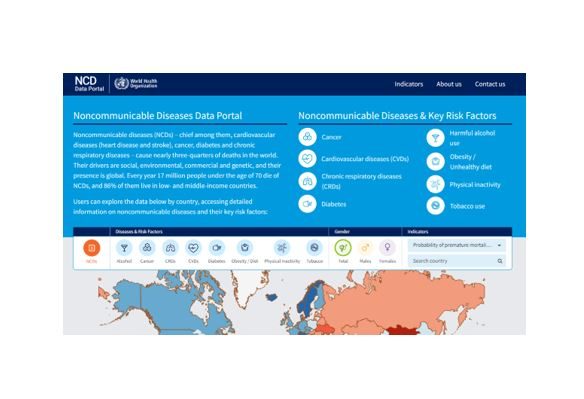
World Health Organization’s new NCD data portal contains the latest country-specific data, risk factors and policy implementation for 194 countries. It allows the exploration of the data for four NCDs and their main drivers and risk factors. The portal makes the patterns and trends in countries visible and allows comparison across countries or within geographical regions. Use it to track global and national progress against key targets, identify common challenges, and signpost useful resources.

Objective

The noncommunicable diseases data portal aims to raise awareness on progress in tackling NCDs and their risk factors and strengthen accountability for action by countries. It displays data to highlight current status of NCD mortality, morbidity and risk factor exposures, and track global and national progress against key targets, identify common challenges, and signpost useful resources.

NCD Data Portal


Recommended readings

  • WHO South-East Asia Region to accelerate progress for NCD prevention and control
  • Noncommunicable Diseases (NCDs) Progress Monitor 2022
  • Multi-sectoral Action Plan for Prevention and Control of NCDs 2021-2025
  • Multisectoral Action Plan on the Prevention and Control of NCD in Nepal 2014-2020
  • NEPAL–NCDs risk factors STEPS Survey 2019 – Tobacco Factsheet
  • National NCD Risk Factor Survey (WHO-STEP Survey) 2019,Nepal
  • WHO launched a new community-driven platform KAP for NCDs
  • NCDA civil society statement on 2018 Political Declaration on NCDs
  • Noncommunicable diseases (NCDs) Booklet
  • High burden, low budget: NCDs in low and middle income countries
  • The Nepal NCDI Poverty Commission Report
September 27, 2022 0 comments
0 FacebookTwitterPinterestLinkedinTumblrVKOdnoklassnikiRedditStumbleuponWhatsappTelegramLINEPocketSkypeViberEmail
World Rabies Day 2022: “One Health, Zero Death”
Public HealthActivitiesNeglected Tropical Diseases (NTDs)PH Important DayPublic Health Events

World Rabies Day 2022: “One Health, Zero Death”

by Public Health Update September 27, 2022
written by Public Health Update

Overview

World Rabies Day 2022: One Health, Zero Deaths

This year’s theme will focus on One Health, coupled with the reminder of the “Zero by 30” goal and the fact that dog-mediated human rabies elimination is possible. The COVID-19 pandemic has shown the stark vulnerabilities of health systems but it also demonstrated what collaboration across sectors can achieve.

National Guideline on Rabies Prophylaxis in Nepal 2019

Rabies control programmes offer a great example for One Health implementation and the structures and trust that underpin these are crucial for other zoonotic diseases, including those that are pandemic-prone.

The world has the vaccines, medicines, tools, and technologies to break the cycle of one of the oldest diseases.

Zero by 30: Global Strategic Plan for the elimination of dog-mediated human rabies deaths by 2030 is an ambitious document with achievable targets. It is aligned with the new NTD road map that prioritizes integrated interventions and mainstreaming of NTD programmes within national health systems.

NTD road map

The integrated approaches advocated in both the Global Strategic Plan for rabies and the road map are relevant, as they show the importance of working together optimally and collaboratively in face of numerous challenges, as experienced during the current COVID-19 pandemic.

It is therefore critical to work with stakeholders, champions, and people at community, local, national, and global levels to rebuild and strengthen health systems and rabies control programs.

By collaborating and joining forces, enaging communities and committing to sustain dog vaccination, rabies can be eliminated. 

Key Fact & message

  • Over 59,000 people die of rabies every year, worldwide, and millions have to seek life-saving treatment
  • Someone dies of rabies every 9 minutes – these deaths can be stopped
  • 29 million people seek life-saving treatment to prevent rabies every year Rabies deaths are a direct consequence of poverty and inequality in access to health services
  • Many rabies deaths are a result of poverty
  • People die of rabies because they cannot get medical help
  • Rabies is 100% preventable with current knowledge, technology, and vaccines – improving access to human and dog vaccines will save more lives
  • Together we can end human deaths from dog-transmitted rabies by 2030.
  • Rabies elimination is possible. Let’s make the possibility a reality by 2030.
  • Vaccinate your dog. Protecting dogs against rabies helps protect you and your family too.
  • Avoid dog bites: Learn to read a dog’s body language. Don’t tease or attack them.
  • Rabies-related deaths are preventable; simple and relatively low-cost tools and strategies for rabies control and prevention exist.
  • One Health or holistic rabies programs work and are within reach for even low and middle income countries.

Policy makers

  • Rabies-related deaths are preventable; simple and low-cost tools and strategies for rabies control and prevention exist.
    – 100% of human rabies deaths can be prevented.
    – The world has all the tools it needs to end rabies deaths.
  • One Health or holistic rabies programs work and are within reach for even low and middle-income countries – the crucial need lies in garnering the political will to take these programs forward.
    – Human and animal health stakeholders need to work together to eliminate rabies.
    – Governments need to make rabies programs a priority.
    – Rabies disproportionately affects the poor, but elimination is within reach of even low-income countries.
  • Sustained national integrated rabies programs result in cost savings to national health budgets.
    – Controlling dog rabies through vaccination will reduce human healthcare costs.
    – National rabies programs reduce costs as well as deaths.
    – Investment in dog vaccination is the single most effective way of reducing the disease burden.
  • Rabies is a solvable problem that can lead to immediate (within an election cycle) results for national governments and international donors.
    – Well-designed rabies programs have a significant impact within a few years.
  • Rabies programs can be integrated into existing health systems and mechanisms, strengthening them in the process.
    – Existing health systems will be strengthened by integrating rabies prevention programs.
    – Capacity building for rabies surveillance and control can strengthen health systems for the prevention of other diseases.
    – Capacity building for rabies control will strengthen (one) health systems / disease preparedness.
  • Ending rabies is integrally linked to UN Sustainable Development Goal (SDG) 3, to ensure healthy lives and well-being, particularly SDG 3.3, to end the epidemics of neglected tropical diseases by 2030.
    – Freedom from dog-mediated human rabies is a global public good.
    – Ending rabies supports progress towards other Sustainable Development Goals, primarily those related to poverty, food security, economic growth, infrastructure, inequality, and global partnerships.
    – A Global Strategic Plan has been developed to drive global rabies elimination towards the goal of Zero By 30.
  • Rabies is still present in over 150 countries.
  • We can eliminate human, dog and livestock deaths from dog-transmitted rabies by vaccinating 70% of dogs.
  • Vaccinating 70% of dogs in at-risk areas can eliminate dog rabies.
  • Rabies goes beyond country borders. National governments need to work together on the international stage.

More Information: https://rabiesalliance.org/ and https://www.who.int/


Rabies in Nepal

Rabies is primarily a disease of warm-blooded animals like Dogs, Jackals, Wolfs, Mongoose wild cats etc. Rabies cases are almost all fatal but it is 100% preventable by vaccination, awareness about human and animal interaction. Most of the affected are children. It has been assumed that almost half of Nepal’s population are at high risk and a quarter at moderate risk of rabies. It is estimated that around 30,000 cases in pets and more than 100 human rabies cases occur each year with the highest risk are in the Terai. Latent infections have been reported in dogs and cats. Very few patients take rabies immune globulin (postexposure prophylaxis). Almost all of human cases (99%) of rabies are result of dog bites. Vaccinating 70% of dogs break rabies transmission cycle in an area at risk. So, along with the EDCD, every dog owner and animal health authorities are more concerned to eliminate it as public health problem.

Activities and achievements in 2077/78 in Rabies control Programme
The following activities were carried out in 2077/78 for the control of rabies cases:

  • Awareness programs about Rabies for school students and general public.
  • Celebration of Work Rabies day on 28th September and co-ordination with province and local level health officials for its effective implementations.
  • Epidemiological study on the active dog bites cases.
  • Surveillance about Rabies on outbreak area.
  • Orientation program about the benefit of Intradermal (ID) delivery of Anti Rabies Vaccine (ARV) for health workers.
  • Orientation on application of immunoglobulin for provincial level health facilities.
  • Procurement of cell culture ARV vaccine and immunoglobulin.

Read More: DoHS Annual Report


Recommended readings

  • National Guideline on Rabies Prophylaxis in Nepal 2019
  • World Rabies Day 2020! End Rabies: Collaborate, Vaccinate
  • World Rabies Day! Rabies: Vaccinate to Eliminate!
  • Rabies: Share the message. Save a life. #WorldRabiesDay
  • Fast-track efforts to eliminate rabies: WHO
  • Rabies: Zero by 30, World Rabies Day 2017
  • World Rabies Day : Educate. Vaccinate. Eliminate
  • ”End Rabies Together” : World Rabies Day
  • Online Course! One Health: Connecting Humans, Animals and the Environment
  • International days, weeks and years of Public Health Concern
  • The Road map for Neglected Tropical Diseases (NTDs) 2021–2030

September 27, 2022 0 comments
0 FacebookTwitterPinterestLinkedinTumblrVKOdnoklassnikiRedditStumbleuponWhatsappTelegramLINEPocketSkypeViberEmail
Public HealthHealth SystemsInternational Plan, Policy & Guidelines

 Organizational Structure and Staffing Pattern for BHSC, 50 and 200 Bedded Hospitals

by Public Health Update September 25, 2022
written by Public Health Update

The Ministry of Health and Population (MoHP) Nepal has approved the Organizational Structure and Staffing Pattern for Basic Health Service Centers (BHSC), 50 and 200 bedded Hospitals. The Ministry of Health and Population circulated the organizational structure and staffing structure through the Ministry of Federal Affairs and General Administration (MOFAGA) to all provinces and local governments for implementation.

Download PDF File


Related

  • Organizational Structure and Staffing Pattern for Basic Hospitals of 5, 10 and 15 bedded Hospitals
  • National Joint Annual Review 2077/78 (2020/21)- Presentations
  • Organogram and Reporting Mechanism of Nepalese Health System in Federal Context

Organogram and Reporting Mechanism of Nepalese Health System in Federal Context

September 25, 2022 0 comments
0 FacebookTwitterPinterestLinkedinTumblrVKOdnoklassnikiRedditStumbleuponWhatsappTelegramLINEPocketSkypeViberEmail
The National Safe Abortion Service Day
Public HealthAdolescent Sexual and Reproductive Health (ASRH)Maternal, Newborn and Child HealthPH Important Day

The 8th National Safe Abortion Service Day, Nepal

by Public Health Update September 24, 2022
written by Public Health Update

The National Safe Abortion Service Day is marked each year on 26th September. It was initiated in 2015 to raise awareness on safe abortion. The 11th amendment to the Civil Code on 26 September 2002 opened the way for legal facility for abortion (up to 12 weeks of pregnancy) and up to 18 weeks in unusual cases like rape and incest. The theme of 8th National Safe Abortion Service Day 2022 is “Safe Abortion: Not a Crime, It’s a Right”  “सुरक्षित गर्भपतन : अपराध होइन, अधिकार हो”

Recommended readings: Safe abortion Services in Nepal


Download presentation slides

Related contents

  • International Safe Abortion Day- “Self-Managed Abortion”
  • Sixth National Safe Abortion Service Day 2077
  • International Safe Abortion Day 2017 #LeavingNoOneBehind
  • Free Safe Abortion Service Guideline – 2073
  • First safe abortion service day marked
  • Nepal Safe Motherhood and Newborn Health Road Map 2030
  • Safe Motherhood and Newborn Health in Nepal

Methods of Safe Abortion (Comprehensive Abortion Care (CAC)

According to ”National RH Protocol 2066″ following are the methods of safe abortion services;

  • Medical Abortion
  • Manual Vacuum Aspiration
  • D&E or Medical Induction

Safe Abortion (Comprehensive Abortion Care (CAC) services should be;

  • Accessible
  • Acceptable
  • Affordable
  • Equitable
  • Quality of Care

Right to Safe Motherhood and Reproductive Health Act 2075

The Right to Safe Motherhood and Reproductive Health Act, 2075 (2018)

  1. To perform safe abortion: A pregnant woman shall have the right to get safe abortion performed in any of the following circumstances:
    (a) Fetus (gestation) up to twelve weeks, with the consent of the pregnant woman,
    (b)  Fetus (gestation) up to twenty-eight weeks, as per the consent of such woman, after the opinion of the licensed doctor that there may be danger upon the life of the pregnant woman or her physical or mental health may deteriorate or disabled infant may be born in case the abortion is not performed,
    (c) Fetus (gestation) remained due to rape or incest, fetus (gestation) up to twenty-eight weeks with the consent of the pregnant woman,
    (d) Fetus (gestation) up to twenty-eight weeks with the consent of the woman who is suffering from H.I.V. or other incurable disease of such nature,
    (e) Fetus (gestation) up to twenty eight weeks with the consent of the woman, as per the opinion of the health worker involved in the treatment that damage may occur in the womb due to defects occurred in the fetus (gestation), or that there is such defect in the fetus of the womb that it cannot live even after the birth, that there is condition of disability in the fetus (gestation) due to genetic defect or any other cause.
  2. Not to get abortion conducted forcefully:
    (1) Except in the circumstance as referred to in Section 15, no one shall conduct or get abortion conducted with an intention to get the abortion conducted or knowingly or having reason to believe that the abortion can occur.
    (2) No one shall get the abortion conducted by coercing a pregnant woman, threatening, enticing or tempting her.
    (3) If any of the following acts is committed, it shall be deemed to have got abortion performed:
    (a) Getting abortion conducted pursuant to sub-section (2),
    (b) Miscarriage that occurs while something is done to the pregnant woman with some enmity,
    (c) Making assistance to commit acts referred to in clauses (a) and (b),
    (4) While conducting abortion, in case the abortion does not occur instantly but a living infant is born, and if the infant, which is born as a result of such an act dies immediately, it shall be deemed to have got the abortion conducted for the purposes of this Section.
  3. Not to commit abortion upon identifying sex:
    (1) No one shall commit or cause to be committed an act to identify the sex of the fetus in the womb.
    (2) A pregnant woman shall not be pressurized or compelled or intimidated or coerced or enticed or entrapped in undue influence to identify the sex of the fetus.
    (3) Conducting abortion or causing it to be conducted, by identifying the sex pursuant to sub-sections (1) and (2), is prohibited.
  4. Safe abortion service:
    (1) The licensed health worker who has fulfilled the prescribed standards and qualification shall have to provide the pregnant woman with safe abortion service pursuant to Section 15 in the licensed health institution.
    (2) Appropriate technology and process of the service to be provided as referred to in sub-section (1) shall be as prescribed.
    (3) The pregnant woman who wants to obtain the safe abortion service shall have to give consent in the prescribed format to the health institution which has obtained a license, or to the health worker who has obtained a license.
    (4) Notwithstanding anything contained in sub-section (3), in the case of a woman who is an insane, who is not in a condition to give consent instantly or who has not completed the age of eighteen years, her guardian or curator shall have to give consent.
    (5) Notwithstanding anything contained in sub-section (4), in the case of a woman who is below the age of eighteen years, safe abortion service shall have to be provided by considering her best interests.
  5. To maintain confidentiality:
    (1) The licensed health institution or licensed health worker shall have to keep confidential all records, information, documents related to reproductive health of the pregnant woman and counseling and service provided to her.
    (2) Notwithstanding anything contained in sub-section (1) the records relating to such information, document and counseling service may be made available on the following conditions:
    (a) If information is demanded by the investigation authority or court in course of investigation and hearing of any lawsuit,
    (b) If it is required to quote without revealing identity of the related woman for the purpose of study, research or monitoring relating to safe abortion,
    (c) If the woman concerned demands herself the records thereof.

  • Safe abortion Services in Nepal
  • Worldwide, an estimated 25 million unsafe abortions occur each year- WHO
  • Free Safe Abortion Service Guideline – 2073
  • International Safe Abortion Day 2017 #LeavingNoOneBehind
  • WHO calls for global action on sepsis – cause of 1 in 5 deaths worldwide
  • Interim Guidance for RMNCH services in COVID 19 Pandemic
  • Right to Safe Motherhood and Reproductive Health Act 2075
  • International Safe Abortion Day 2017 #LeavingNoOneBehind
  • Free Safe Abortion Service Guideline – 2073
  • First safe abortion service day marked

National Safe Abortion Service Day

[MEC id=”77411″]
September 24, 2022 0 comments
0 FacebookTwitterPinterestLinkedinTumblrVKOdnoklassnikiRedditStumbleuponWhatsappTelegramLINEPocketSkypeViberEmail
World Pharmacists Day
Public HealthPH Important DayPublic Health Events

World Pharmacists Day 2022: Pharmacy united in action for a healthier world

by Public Health Update September 24, 2022
written by Public Health Update

Overview

The World Pharmacists Day is observed each year on 25 September. The World Pharmacists Day is an opportunity to communicate how, together, pharmacists are transforming health through a variety of health services in their communities, including advising on healthy living, vaccinating to prevent disease, and ensuring that medicines are taken correctly.

Theme 2022

“Pharmacy united in action for a healthier world”

This World Pharmacists Day 2022 resource gives some examples of the invaluable actions of the pharmacy profession towards SdGs targets.

This year’s theme aims to showcase pharmacy’s positive impact on health around the world and to further strengthen solidarity among the profession.We invite colleagues from all sectors of the pharmacy profession to take part in the campaign and show the world how we are united for health, regardless of and overcoming conflict, different politics and cultures, and economic disparity.

Why we must stay united in action

  • There are many improvements to health and wellbeing of which the pharmacy profession can be proud. Nevertheless, we all now face the task of restoring essential health services that have been disrupted by the COVID-19 pandemic when more people have been unable to get health check-ups, vaccinations and even urgent care. Decades of improvements in health outcomes are under threat of reversal.
  • If universal health coverage is to become a reality by 2030, growth in the provision and use of essential health services must greatly accelerate. Pharmacy — through its many sectors and areas of expertise — is vital to this vision!

Source of information: https://www.fip.org/


[MEC id=”77145″]
September 24, 2022 0 comments
0 FacebookTwitterPinterestLinkedinTumblrVKOdnoklassnikiRedditStumbleuponWhatsappTelegramLINEPocketSkypeViberEmail
World Lung Day
Public HealthNon- Communicable Diseases (NCDs)PH Important DayPublic Health Events

World Lung Day 2022: Lung Health for All

by Public Health Update September 24, 2022
written by Public Health Update

Overview

World Lung Day (WLD) observed each year on 25 September. It is a day for lung health advocacy and action, an opportunity for us all to unite and promote better lung health globally. It was initiated by the Forum of the International Respiratory Society (FIRS) for lung health advocacy and action. The WLD is focused to improve and promote better lung health globally.

Respiratory diseases impose an immense worldwide health burden. Globally, 4 million people die prematurely from chronic respiratory diseases which include chronic obstructive pulmonary disease (COPD), asthma, acute lower respiratory tract infections, tuberculosis, and lung cancer.

World Lung Day 2022: Lung Health For All

The COVID pandemic has highlighted stark inequalities in lung health, so our theme this year is Lung Health for All. We will look at what can be done to close those gaps, focussing on: 

  • The global burden of the major respiratory diseases and the impact of COVID, with a focus on lower and middle income countries
  • The importance of early detection and screening
  • Reducing inequalities in screening, diagnosis and treatment of chronic lung conditions.

Respiratory illnesses affect people in all countries, but disproportionally in low- and middle-income countries (LMICs) where resources for research, prevention, and management are scarce. To address such inequity, we must look beyond medical care to the social and environmental determinants of health such as tobacco use, air pollution, climate change and poverty.

Five respiratory diseases are the commonest causes of illness and death worldwide – chronic obstructive pulmonary disease (COPD), asthma, acute respiratory tract infection or pneumonia, tuberculosis (TB) and lung cancer.

On World Lung Day, the Forum of International Respiratory Societies (FIRS) Calls for Action to Tackle Global Inequity in Respiratory Health.

The FIRS Global Impact of Respiratory Disease report shows the immense burden of these lung diseases:

  • An estimated 200 million people have COPD , of which about 3.2 million die each year, making it the third-leading cause of death worldwide.
  • Asthma is one of the commonest non-communicable diseases globally affecting 262 million people.1
  • With more than 2.2 million new cases of lung cancer in 2020 and 1.80 million deaths, globally, lung cancer is responsible for 1 in 4 cancer deaths.
  • Lower respiratory tract infection or pneumonia is a leading cause of mortality, accounting for more than 2.4 million deaths every year, particularly among those in LMICs. COVID-19 has dramatically increased deaths from pneumonia globally.
  • In children under 5 years of age, pneumonia is the leading single cause of death outside the neonatal period.
  • TB is a major burden with the World Health Organization’s annual global report finding that TB deaths have risen for the first time in more than a decade due to the COVID pandemic.2

1. thelancet.com/pb-assets/Lancet/gbd/summaries/diseases/asthma.pdf

2. who.int/publications/i/item/9789240037021

Source of info: WHO, Press release APSR


September 24, 2022 0 comments
0 FacebookTwitterPinterestLinkedinTumblrVKOdnoklassnikiRedditStumbleuponWhatsappTelegramLINEPocketSkypeViberEmail
Procurement Handbook
Public HealthNational Plan, Policy & Guidelines

Medicine Related Commodities Procurement and Supply Management Facilitation Booklet

by Public Health Update September 23, 2022
written by Public Health Update

The Management Division(MD), Department of Health Services (DoHS) has published a booklet to provide technical guidance for Medicine Related Commodities Procurement and Supply Management in Nepal.

Download PDF File (Procurement Handbook)


Related

  • Procurement Handbook 2074, Logistic Management Division, DoHS
  • Geriatric Health Service Strategy 2021-2030
  • Nepal Health Facility Survey 2021(Final Report)
  • Lactation Management Centre Guideline 2079
  • Standards for Minimum Qualification of Higher Education Level Teachers (Faculty), 2079
  • Integrated Health Information Management System (IHMIS) Roadmap


Do you have a website? Looking for the best hosting provider? Here’s a discount code.

Latest Public Health Jobs

Latest Posts

  • International Wellness Day: Promoting Global Wellness for All
  • Summit Declaration: The 12th National Summit of Health and Population Scientists in Nepal
  • Joint political declaration on the reform of the global health architecture
  • World Health Day 2026: Together for Health. Stand with Science.
  • World Water Day 2026 | Water & Gender Equality

Thanks for visiting us.
Disclaimer: The resources, documents, guidelines, and information on this blog have been collected from various sources and are intended for informational purposes only. Information published on or through this website and affiliated social media channels does not represent the intention, plan, or strategies of an organization that the initiator is associated with in a professional or personal capacity, unless explicitly indicated.
If you have any complaints, information, or suggestions about the content published on Public Health Update, please feel free to contact us at blog.publichealthupdate@gmail.com.
#StayUpdated


  • WordPress
  • Link
  • Facebook
  • Mail
  • Facebook
  • Twitter
  • Twitter
  • LinkedIn
  • Instagram
  • Facebook
September 23, 2022 0 comments
0 FacebookTwitterPinterestLinkedinTumblrVKOdnoklassnikiRedditStumbleuponWhatsappTelegramLINEPocketSkypeViberEmail
Newer Posts
Older Posts

Search

Follow Us

Facebook Twitter Instagram Pinterest Linkedin Youtube

Categories

  • Abstracts (25)
  • Activities (91)
  • Adolescent Sexual and Reproductive Health (ASRH) (25)
  • Advice & Tips (4)
  • African Region (5)
  • AI and Health (1)
  • Annual Meeting (6)
  • Antimicrobial Resistance (AMR) (21)
  • Award (19)
  • Awards (16)
  • Books (9)
  • Call for Proposal, EOI & RFP (103)
  • Call for Research Participants (8)
  • Clinical Doctor Jobs (6)
  • Communicable Diseases (107)
  • Competition (20)
  • Conference (129)
  • Consultant (1)
  • Courses (205)
  • Dashboard (2)
  • Digital Health & Health Informatics (10)
  • Drug and Medicine (18)
  • Eastern Mediterranean Region (3)
  • Education (15)
  • Environment (3)
  • Environmental Health & Climate Change (47)
  • European Region (42)
  • Exchange Program (1)
  • Fact Sheet (117)
  • FCHVs (1)
  • Fellowships, Studentship & Scholarships (168)
  • Financial Aid (13)
  • Form Formats (2)
  • Fully funded (22)
  • Global Health News (434)
  • Grants and Funding Opportunities (193)
  • Guest Post (44)
  • Health Assistant Jobs (1)
  • Health Equity (7)
  • Health Financing and Economics (24)
  • Health in Data (115)
  • Health Insurance (5)
  • Health Jobs (52)
  • Health Literacy, Health Education & Promotion (50)
  • Health Organization Profile (42)
  • Health Systems (83)
  • Human Resource for Health (33)
  • Humanitarian Health & Emergency Response (44)
  • Hypertension (5)
  • Implementation Research (48)
  • International Health (3)
  • International Jobs & Opportunities (373)
  • International Plan, Policy & Guidelines (210)
  • Internships (4)
  • Jobs Vacancies (56)
  • Journals (8)
  • Life Style & Public Health Nutrition (39)
  • Live (10)
  • Master's Degree (48)
  • Maternal, Newborn and Child Health (88)
  • Mentorship Program (2)
  • Miscellaneous (16)
  • National Health News (158)
  • National Plan, Policy & Guidelines (468)
  • Neglected Tropical Diseases (NTDs) (51)
  • Non- Communicable Diseases (NCDs) (121)
  • Notice (103)
  • Nursing Jobs (6)
  • Nutritionist Jobs (1)
  • One Health (18)
  • Online & Distance Learning (22)
  • Online Courses (90)
  • Op-Ed Article (3)
  • Opportunities by Region (83)
  • Outbreak News (213)
  • Partially funded (6)
  • PCL Health Science Jobs (3)
  • PH Important Day (534)
  • Pharmacist Jobs (3)
  • PhD (54)
  • Photos (5)
  • Planetary Health (4)
  • PostDoc (14)
  • Presentation Slides (26)
  • Primary Health Care (25)
  • Provincial Plan, Policies and Guidelines (14)
  • Public Health (1,283)
  • Public Health Epidemiology & Biostatistics (13)
  • Public Health Events (306)
  • Public Health Information (20)
  • Public Health Innovation (9)
  • Public Health Jobs (52)
  • Public Health News (554)
  • Public Health Notes (120)
  • Public Health Opportunities (507)
  • Public Health Opportunity (491)
  • Public Health Programs (108)
  • Public Health Seminar (2)
  • Public Health Tools (1)
  • Public Health Update (564)
  • Quality Improvement & Infection Prevention (20)
  • Region of America (8)
  • Reports (184)
  • Research & Project Grants (39)
  • Research & Project Grants (32)
  • Research & Publication (647)
  • Research Articles (10)
  • Road Traffic Accidents (RTA) (9)
  • School of Public Health (60)
  • Self funded (2)
  • South-East Asia Region (26)
  • Success Stories (17)
  • Summer and Winter Courses (40)
  • Summer Courses (28)
  • Sustainable Development Goals (SDGs) (14)
  • Syllabus (61)
  • Symposium (9)
  • Tobacco Control (35)
  • Training (40)
  • Travel Grants (15)
  • Trick, Technique & Skills (8)
  • Uncategorized (3)
  • Undergraduate Degree (7)
  • Universal Health Coverage (36)
  • Universities (29)
  • Universities & School of Public Health (58)
  • Vacancy Announcement (26)
  • Vaccine Preventable Diseases (40)
  • Vector-Borne Diseases(VBDs) (30)
  • Videos (3)
  • View Points (1)
  • Webinar (4)
  • Western Pacific Region (13)
  • Workshop (18)
  • World News (117)
Post New Jobs: Vacancy Announcement Service

Public Health Update (Sagun’s Blog) is a popular public health portal in Nepal. Thousands of health professionals are connected with Public Health Update to get up-to-date public health updates, search for jobs, and explore opportunities.
#1 Public Health Blog for sharing Job opportunities and updates in Nepal

”Public Health Information For All”
– – Sagun Paudel, Founder

  • HOT JOBS
    • Public Health Jobs
    • Medical Doctor Jobs
    • Nursing Jobs
    • Health Assistant Jobs
    • Pharmacist Jobs
    • NGOs Jobs
    • Government Jobs
  • Top Categories
    • National Plan, Policy & Guidelines Top
    • Public Health Calendar
    • Fellowships & Scholarships
    • Health Systems
    • Health Organization Profiles
    • International Jobs & Opportunities
    • Public Health Opportunity

PUBLIC HEALTH INITIATIVE

    • Submit your Vacancies New
    • Partnership Opportunities

Contact: blog.publichealthupdate@gmail.com

https://wa.me/+9779856036932

Public Health Initiative, A Registered Non-profit organization – All Right Reserved. 2011-2024. Contact us. 

Facebook Twitter Instagram Youtube Envelope
Public Health Update
  • Home
  • Public Health
    • Home 1
      • Adolescent Sexual and Reproductive Health (ASRH)
      • Antimicrobial Resistance (AMR)
      • Communicable Diseases
      • Digital Health & Health Informatics
      • Environmental Health & Climate Change
      • Health Financing and Economics
      • Health Equity
    • Home 2
      • Health Literacy, Health Education & Promotion
      • Human Resource for Health
      • Humanitarian Health & Emergency Response
      • Implementation Research
      • International Health
      • Life Style & Public Health Nutrition
      • Maternal, Newborn and Child Health
    • Home 3
      • Neglected Tropical Diseases (NTDs)
      • Non- Communicable Diseases (NCDs)
      • One Health
      • Planetary Health
      • Public Health Epidemiology & Biostatistics
      • Primary Health Care
      • Quality Improvement & Infection Prevention
    • Home 4
      • Road Traffic Accidents (RTA)
      • Sustainable Development Goals (SDGs)
      • Tobacco Control
      • Universal Health Coverage
      • Vaccine Preventable Diseases
      • Vector-Borne Diseases(VBDs)
      • Notices
  • Public Health Update
    • Home 1
      • Public Health News
      • Global Health News
      • Outbreak News
      • National Health News
      • COVID-19
    • Home 2
      • Fact Sheet
      • Health in Data
      • PH Important Day
      • Public Health Events
      • Public Health Programs
    • Home 3
      • Health Systems
      • Health Insurance
      • Health Organization Profile
      • Success Stories
      • Public Health Innovation
  • Public Health Opportunities
    • Fully funded
    • Travel Grants
    • Grants and Funding Opportunities
    • Opportunities by Region
    • International Jobs & Opportunities
    • Research & Project Grants
    • Fellowships, Studentship & Scholarships
    • Conference
  • Jobs
    • Home 1
      • Health Jobs
      • Public Health Jobs
      • Clinical doctor Jobs
      • Health Assistant Jobs
      • Nursing Jobs
      • PCL Health Science Jobs
    • Home 2
      • Dental Jobs
      • Pharmacist Jobs
      • TSLC (Health Jobs)
      • Laboratory Jobs
      • Nutritionist Jobs
  • Downloads
    • International Plan, Policy & Guidelines
    • National Plan, Policy & Guidelines
    • Reports
    • Books
    • Research Articles
  • School of Public Health
    • Home 1
      • Courses
      • Master’s Degree
      • Undergraduate Degree
      • PhD
    • Home 2
      • Universities
      • Syllabus
      • Public Health Notes
      • Mentorship Program
      • Startup Project
    • Home
      • Summer and Winter Courses
      • Summer Courses
      • Online Courses
      • Workshop
      • Training
Public Health Update
  • Home
  • Public Health
    • Home 1
      • Adolescent Sexual and Reproductive Health (ASRH)
      • Antimicrobial Resistance (AMR)
      • Communicable Diseases
      • Digital Health & Health Informatics
      • Environmental Health & Climate Change
      • Health Financing and Economics
      • Health Equity
    • Home 2
      • Health Literacy, Health Education & Promotion
      • Human Resource for Health
      • Humanitarian Health & Emergency Response
      • Implementation Research
      • International Health
      • Life Style & Public Health Nutrition
      • Maternal, Newborn and Child Health
    • Home 3
      • Neglected Tropical Diseases (NTDs)
      • Non- Communicable Diseases (NCDs)
      • One Health
      • Planetary Health
      • Public Health Epidemiology & Biostatistics
      • Primary Health Care
      • Quality Improvement & Infection Prevention
    • Home 4
      • Road Traffic Accidents (RTA)
      • Sustainable Development Goals (SDGs)
      • Tobacco Control
      • Universal Health Coverage
      • Vaccine Preventable Diseases
      • Vector-Borne Diseases(VBDs)
      • Notices
  • Public Health Update
    • Home 1
      • Public Health News
      • Global Health News
      • Outbreak News
      • National Health News
      • COVID-19
    • Home 2
      • Fact Sheet
      • Health in Data
      • PH Important Day
      • Public Health Events
      • Public Health Programs
    • Home 3
      • Health Systems
      • Health Insurance
      • Health Organization Profile
      • Success Stories
      • Public Health Innovation
  • Public Health Opportunities
    • Fully funded
    • Travel Grants
    • Grants and Funding Opportunities
    • Opportunities by Region
    • International Jobs & Opportunities
    • Research & Project Grants
    • Fellowships, Studentship & Scholarships
    • Conference
  • Jobs
    • Home 1
      • Health Jobs
      • Public Health Jobs
      • Clinical doctor Jobs
      • Health Assistant Jobs
      • Nursing Jobs
      • PCL Health Science Jobs
    • Home 2
      • Dental Jobs
      • Pharmacist Jobs
      • TSLC (Health Jobs)
      • Laboratory Jobs
      • Nutritionist Jobs
  • Downloads
    • International Plan, Policy & Guidelines
    • National Plan, Policy & Guidelines
    • Reports
    • Books
    • Research Articles
  • School of Public Health
    • Home 1
      • Courses
      • Master’s Degree
      • Undergraduate Degree
      • PhD
    • Home 2
      • Universities
      • Syllabus
      • Public Health Notes
      • Mentorship Program
      • Startup Project
    • Home
      • Summer and Winter Courses
      • Summer Courses
      • Online Courses
      • Workshop
      • Training
Public Health Initiative, A Registered Non-profit organization – All Right Reserved. 2011-2023