
Public Health Update
  • Home
  • Public Health Update
  • Nepal Health Jobs
    • Public Health Job Board
    • Organization List
  • Opportunities
    • Fellowships, Studentship & Scholarships
    • Grants and Funding Opportunities
    • Fully funded
    • Conference
  • Downloads
    • International Plan, Policy & Guidelines
    • National Plan, Policy & Guidelines
    • Reports
    • Public Health Notes
    • Syllabus
    • Form Formats
  • School of Public Health
    • PhD
    • Master’s Degree
    • Online Courses
  • Notice
  • Home
  • Public Health Update
  • Nepal Health Jobs
    • Public Health Job Board
    • Organization List
  • Opportunities
    • Fellowships, Studentship & Scholarships
    • Grants and Funding Opportunities
    • Fully funded
    • Conference
  • Downloads
    • International Plan, Policy & Guidelines
    • National Plan, Policy & Guidelines
    • Reports
    • Public Health Notes
    • Syllabus
    • Form Formats
  • School of Public Health
    • PhD
    • Master’s Degree
    • Online Courses
  • Notice
LOGIN / REGISTER
Public Health Update
SUBSCRIBE
Public Health Update
  • Home
  • Public Health Update
  • Nepal Health Jobs
    • Public Health Job Board
    • Organization List
  • Opportunities
    • Fellowships, Studentship & Scholarships
    • Grants and Funding Opportunities
    • Fully funded
    • Conference
  • Downloads
    • International Plan, Policy & Guidelines
    • National Plan, Policy & Guidelines
    • Reports
    • Public Health Notes
    • Syllabus
    • Form Formats
  • School of Public Health
    • PhD
    • Master’s Degree
    • Online Courses
  • Notice

All Right Reserved. Designed and Developed by PenciDesign

Compendium of data and evidence-related tools for use in TB planning and programming
International Plan, Policy & GuidelinesCommunicable DiseasesResearch & Publication

Compendium of data and evidence-related tools for use in TB planning and programming

by Public Health Update November 3, 2021
written by Public Health Update

Overview

Over the past 2 decades, there has been a considerable increase in the number of tools to generate, analyse and use data and evidence, to support discussion and decision-making by National TB Programmes (NTPs) and their partners. Increasingly, countries are developing more robust national surveillance systems; implementing multiple health surveys; and using data analysis and visualization tools in policy, planning, programming and investment decisions. However, as more data are generated and data analysis tools evolve and increase in number, it can be challenging to understand how, why and when these tools should be implemented.

This compendium is designed to help NTPs to make best use of the available tools for policy, planning and programmatic action. The document summarizes information about the key tools related to data and evidence that are available for use in TB planning and programming, and how they can be applied. The tools that are profiled are described in terms of how they fit within the People-centred framework for tuberculosis programme planning and prioritization.

Together with the people-centred framework, this compendium aims to enable better use of data and evidence for TB programme planning at both the national and subnational levels. It is designed to help NTPs and their national stakeholders to understand how and when different data and evidence-related tools could be used.

DOWNLOAD: Compendium of data and evidence-related tools for use in TB planning and programming


Recommended readings

  • GLOBAL TUBERCULOSIS REPORT 2021
  • Global Tuberculosis Report 2020
  • Global Tuberculosis Report 2019: Latest status of the tuberculosis epidemic
  • Global Tuberculosis Report 2018
  • WHO Global Tuberculosis report 2015
  • Global tuberculosis report 2014: Improved data reveals higher global burden of tuberculosis
  • National Tuberculosis Programme Annual Report 2018
  • National Tuberculosis Program Update in Nepal #WorldTBDay #EndTB
  • National TB Prevalence Survey, 2018-19 Key findings
  • World Tuberculosis Day 2020! It’s time to End TB!
  • National Guideline on Drug Resistant TB Management 2019, Nepal
  • National Tuberculosis Management Guideline 2019, Nepal
  • Global Tuberculosis Report 2019: Latest status of the tuberculosis epidemic
  • National TB Prevalence Survey, 2018-19 Key findings
  • New WHO recommendations to prevent tuberculosis aim to save millions of lives
  • World Health Organization (WHO) Information Note Tuberculosis and COVID-19
  • World Tuberculosis Day 2020! It’s time to End TB!
  • People-centred framework for tuberculosis programme planning and prioritization, User guide
  • Global Tuberculosis Report 2019: Latest status of the tuberculosis epidemic
  • Dissemination of Findings and Recommendations of Joint External Monitoring Mission(JEMM) of Nepal National Tuberculosis Program
  • National Tuberculosis Programme Annual Report 2018
  • National Strategic Plan for Tuberculosis Prevention, Care and Control 2016 – 2021
  • NTP, Nepal: New TB Treatment Algorithm & Regimen (Updated)
  • WHO announces landmark changes in MDR-TB treatment regimens
  • TB Vaccine results announce a promising step towards ending the emergency
  • 7 million people receive record levels of lifesaving TB treatment but 3 million still miss out


Do you have a website? Looking for the best hosting provider? Here’s a discount code.

Latest Public Health Jobs

Latest Posts

  • International Wellness Day: Promoting Global Wellness for All
  • Summit Declaration: The 12th National Summit of Health and Population Scientists in Nepal
  • Joint political declaration on the reform of the global health architecture
  • World Health Day 2026: Together for Health. Stand with Science.
  • World Water Day 2026 | Water & Gender Equality

Thanks for visiting us.
Disclaimer: The resources, documents, guidelines, and information on this blog have been collected from various sources and are intended for informational purposes only. Information published on or through this website and affiliated social media channels does not represent the intention, plan, or strategies of an organization that the initiator is associated with in a professional or personal capacity, unless explicitly indicated.
If you have any complaints, information, or suggestions about the content published on Public Health Update, please feel free to contact us at blog.publichealthupdate@gmail.com.
#StayUpdated

  • WordPress
  • Link
  • Facebook
  • Mail
  • Facebook
  • Twitter
  • Twitter
  • LinkedIn
  • Instagram
  • Facebook
November 3, 2021 0 comments
0 FacebookTwitterPinterestLinkedinTumblrVKOdnoklassnikiRedditStumbleuponWhatsappTelegramLINEPocketSkypeViberEmail
Public HealthNational Plan, Policy & GuidelinesOne HealthResearch & Publication

One Health Strategy 2076

by Public Health Update November 3, 2021
written by Public Health Update

The Government of Nepal has implemented the one health approach and related activities as per the guidance of One Health Strategy. One health strategy was approved as per the decision of cabinet dated 2076/09/14.

Strategy

One Health Strategy 2076 consists of following major strategies;

  • Coordination and collaboration with stakeholders
  • Integrated diseases surveillance and laboratory services
  • Capacity development of stakeholders
  • Preparedness and response
  • Communication and Advocacy

One Health Day 2021: Connecting Human, Animal, and Environmental Health


Download PDF


Do you have a website? Looking for the best hosting provider? Here’s a discount code.

Latest Public Health Jobs

Latest Posts

  • International Wellness Day: Promoting Global Wellness for All
  • Summit Declaration: The 12th National Summit of Health and Population Scientists in Nepal
  • Joint political declaration on the reform of the global health architecture
  • World Health Day 2026: Together for Health. Stand with Science.
  • World Water Day 2026 | Water & Gender Equality

Thanks for visiting us.
Disclaimer: The resources, documents, guidelines, and information on this blog have been collected from various sources and are intended for informational purposes only. Information published on or through this website and affiliated social media channels does not represent the intention, plan, or strategies of an organization that the initiator is associated with in a professional or personal capacity, unless explicitly indicated.
If you have any complaints, information, or suggestions about the content published on Public Health Update, please feel free to contact us at blog.publichealthupdate@gmail.com.
#StayUpdated


  • WordPress
  • Link
  • Facebook
  • Mail
  • Facebook
  • Twitter
  • Twitter
  • LinkedIn
  • Instagram
  • Facebook
November 3, 2021 0 comments
0 FacebookTwitterPinterestLinkedinTumblrVKOdnoklassnikiRedditStumbleuponWhatsappTelegramLINEPocketSkypeViberEmail
One Health Day 2021: Connecting Human, Animal, and Environmental Health
PH Important DayEnvironmental Health & Climate ChangeOne HealthPublic HealthPublic Health Events

One Health Day 2021: Connecting Human, Animal, and Environmental Health

by Public Health Update November 3, 2021
written by Public Health Update

Overview

One Health Day is observed each year on November 3. One Health Day provides an opportunity for experts and the community to join together in One Health education and awareness. Communication, coordination, and collaboration among partners working in animal, human, and environmental health as well as other relevant areas are an essential part of the One Health approach.

One Health

One Health is a collaborative, multisectoral, and trans-disciplinary approach — working at the local, regional, national, and global levels — with the goal of achieving optimal health outcomes recognizing the interconnection between people, animals, plants, and their shared environment.

One Health is collaborative, multi sectoral and trans-disciplinary approach for human health, animal health, and environmental health.

One Health Day 2021

The sixth annual One Health Day on November 3, 2021 brings attention to the need for a One Health approach to address shared health threats at the human-animal-environment interface.

Facts
  • One Health is an approach that recognizes that the health of people is closely connected to the health of animals and our shared environment. 
  • The movement of people, animals, and animal products has increased from international travel and trade. As a result, diseases can spread quickly across borders and around the globe.
  • One Health issues include zoonotic diseases AMR, food safety and food security, vector-borne diseases, environmental contamination, and other health threats shared by people, animals, and the environment. Even the fields of chronic disease, mental health, injury, occupational health, and noncommunicable diseases can benefit from a One Health approach involving collaboration across disciplines and sectors.
  • Successful public health interventions require the cooperation of human, animal, and environmental health partners.
  • Professionals in human health (doctors, nurses, public health practitioners, epidemiologists), animal health (veterinarians, paraprofessionals, agricultural workers), environment (ecologists, wildlife experts), and other areas of expertise need to communicate, collaborate on, and coordinate activities.
  • Other relevant players in a One Health approach could include law enforcement, policymakers, agriculture, communities, and even pet owners.
  • No one person, organization, or sector can address issues at the animal-human-environment interface alone.

SOURCE OF INFORMATION: CDC (ONE HEALTH)


ONE HEALTH


Do you have a website? Looking for the best hosting provider? Here’s a discount code.

Latest Public Health Jobs

Latest Posts

  • International Wellness Day: Promoting Global Wellness for All
  • Summit Declaration: The 12th National Summit of Health and Population Scientists in Nepal
  • Joint political declaration on the reform of the global health architecture
  • World Health Day 2026: Together for Health. Stand with Science.
  • World Water Day 2026 | Water & Gender Equality

Thanks for visiting us.
Disclaimer: The resources, documents, guidelines, and information on this blog have been collected from various sources and are intended for informational purposes only. Information published on or through this website and affiliated social media channels does not represent the intention, plan, or strategies of an organization that the initiator is associated with in a professional or personal capacity, unless explicitly indicated.
If you have any complaints, information, or suggestions about the content published on Public Health Update, please feel free to contact us at blog.publichealthupdate@gmail.com.
#StayUpdated


  • WordPress
  • Link
  • Facebook
  • Mail
  • Facebook
  • Twitter
  • Twitter
  • LinkedIn
  • Instagram
  • Facebook
November 3, 2021 1 comment
0 FacebookTwitterPinterestLinkedinTumblrVKOdnoklassnikiRedditStumbleuponWhatsappTelegramLINEPocketSkypeViberEmail
The 2022 ICFP Youth Leader Video Contest (ICFP Youth Trailblazer Award)
Grants and Funding OpportunitiesCompetitionInternational Jobs & OpportunitiesPublic Health OpportunitiesPublic Health Opportunity

The 2022 ICFP Youth Leader Video Contest (ICFP Youth Trailblazer Award)

by Public Health Update November 2, 2021
written by Public Health Update

Overview

The organizers of the 2022 International Conference on Family Planning (ICFP) are proud to support the fourth ICFP Youth Trailblazer Award, formerly known as the Youth Travel Award or Youth Leader Video Contest. The ICFP Youth Trailblazer Award aims to amplify and highlight the voices of young leaders in the family planning and sexual and reproductive health and rights (SHRH) field through active planning and participation in the 2022 ICFP. Young leader applicants, between the 18-35, are invited to submit a maximum 3-minute video corresponding to the 2022 conference theme, “Family Planning & Universal Health Coverage: Innovate. Collaborate. Accelerate”.

Young leaders who are awarded the 2022 ICFP Youth Trailblazer Award will be funded to attend the 2022 ICFP in Pattaya, Thailand in November 2022. Awardees will also actively participate in planning activities for ICFP, have speaking roles at ICFP, and engage in other conference opportunities that raise the voices, perceptive, and experiences of youth in the family planning community.

Submission Details

Young leaders in the field of family planning and/or SRHR or adolescent health, aged 18-35 years old, are invited to submit creative short videos that integrate this year’s conference theme and highlight youth perspectives, experiences, and voice in family planning.

  • To participate in the ICFP Youth Trailblazer Award youth must be between the ages of 18 and 35 on November 12, 2022.
  • Young leaders may only submit one Team applications are not permitted.

To submit an application, young leaders must:

  • Upload a 1-minute to 3–minute video to YouTube. Additional guidelines coming soon!
  • Submit an online application
  • Provide the name and contact information from 1-2 references (e.g. a mentor, teacher or supervisor from an organization that you have volunteered for or worked with in the past) who can speak to your qualifications as a speaker at the conference.

Deadline

All entries must be submitted by November 30, 2021, 11:59 pm EST.

For questions about the application process, contact: youth@icfp.org     

Official Link


Do you have a website? Looking for the best hosting provider? Here’s a discount code.

Latest Public Health Jobs

Latest Posts

  • International Wellness Day: Promoting Global Wellness for All
  • Summit Declaration: The 12th National Summit of Health and Population Scientists in Nepal
  • Joint political declaration on the reform of the global health architecture
  • World Health Day 2026: Together for Health. Stand with Science.
  • World Water Day 2026 | Water & Gender Equality

Thanks for visiting us.
Disclaimer: The resources, documents, guidelines, and information on this blog have been collected from various sources and are intended for informational purposes only. Information published on or through this website and affiliated social media channels does not represent the intention, plan, or strategies of an organization that the initiator is associated with in a professional or personal capacity, unless explicitly indicated.
If you have any complaints, information, or suggestions about the content published on Public Health Update, please feel free to contact us at blog.publichealthupdate@gmail.com.
#StayUpdated


  • WordPress
  • Link
  • Facebook
  • Mail
  • Facebook
  • Twitter
  • Twitter
  • LinkedIn
  • Instagram
  • Facebook
November 2, 2021 0 comments
0 FacebookTwitterPinterestLinkedinTumblrVKOdnoklassnikiRedditStumbleuponWhatsappTelegramLINEPocketSkypeViberEmail
CompetitionInternational Jobs & OpportunitiesPublic Health OpportunitiesPublic Health Opportunity

2021 Student Essay Prize: Universal Health Coverage

by Public Health Update November 1, 2021
written by Public Health Update

The Royal Society of Tropical Medicine and Hygiene (RSTMH) now accepting submissions for the 2021 Student Essay Prize. The essay should be a personal perspective on the theme of “Universal Health Coverage”.

The essay may take the form of original research, a literature review or an opinion piece, but whatever the format your article should demonstrate a combination of scholarship and original thought and analysis.

Eligibility and Submission

The RSTMH Student Essay Prize is for students studying global health as a degree or any degree with a component of global health. It is open to current, full-time, students, that can be based anywhere in the world.

Evidence of student status must be provided at the point of submission. The prize is awarded annually, with submissions being accepted through an online platform. 

  • Essays should be between 1,500 and 2,000 words, excluding references, footnotes, and tables.
  • A 150–200-word summary should also be submitted together with the essay.
  • All sources must be appropriately acknowledged in Harvard style only. References do not count as part of the word count.
  • The essay must be in English.
  • Please try and organise the essay into a logical succession of headed sections, where possible.
  • The essay should be entirely your own original work and should not have been previously published. All essays will be checked for plagiarism and we encourage you to refer to an academic writing handbook such as this one produced by LSHTM for guidance.
  • Please note that if the summary is omitted; the essay will not be considered.
  • Only one essay per person can be submitted.

Your essay should be submitted by 17:00 GMT on Friday 12 November 2021.

Assessment

The winner(s) will be selected by a panel of experts, and the decision ratified by an RSTMH Committee. Highly commended essays may also be selected. The decision of the Committee is final.

The panel will be assessing essays using the following criteria:

  • How well your personal perspective links to the local/national/international landscape
  • How well structured the essay is
  • How easy the essay is to understand
  • The evidence basis for your essay, including how you make use of relevant references
  • How much the essay inspires or engages

Announcement and prize

The RSTMH may publish on our website or in our newsletter anonymised data relating to submissions to the competition. We will announce the winners name and essay title, plus that of any highly commended submissions on our website and through other communication channels. We may publish the winning essay in our scientific journal. By submitting an essay you agree to these conditions.

The prize for the winning essay is £200, plus a year’s free student membership to RSTMH, either new or a renewal.

The RSTMH will also invite the winner to be presented with a certificate and their prize fund at an RSTMH event in 2021 or 2022.

Submit now

Your essay should be submitted by 17:00 GMT on Friday 12 November 2021.

OFFICIAL LINK


Do you have a website? Looking for the best hosting provider? Here’s a discount code.

Latest Public Health Jobs

Latest Posts

  • International Wellness Day: Promoting Global Wellness for All
  • Summit Declaration: The 12th National Summit of Health and Population Scientists in Nepal
  • Joint political declaration on the reform of the global health architecture
  • World Health Day 2026: Together for Health. Stand with Science.
  • World Water Day 2026 | Water & Gender Equality

Thanks for visiting us.
Disclaimer: The resources, documents, guidelines, and information on this blog have been collected from various sources and are intended for informational purposes only. Information published on or through this website and affiliated social media channels does not represent the intention, plan, or strategies of an organization that the initiator is associated with in a professional or personal capacity, unless explicitly indicated.
If you have any complaints, information, or suggestions about the content published on Public Health Update, please feel free to contact us at blog.publichealthupdate@gmail.com.
#StayUpdated


  • WordPress
  • Link
  • Facebook
  • Mail
  • Facebook
  • Twitter
  • Twitter
  • LinkedIn
  • Instagram
  • Facebook
November 1, 2021 0 comments
0 FacebookTwitterPinterestLinkedinTumblrVKOdnoklassnikiRedditStumbleuponWhatsappTelegramLINEPocketSkypeViberEmail
Grants and Funding OpportunitiesCall for Proposal, EOI & RFPInternational Jobs & OpportunitiesPublic Health OpportunitiesPublic Health OpportunityResearch & Project GrantsResearch & Project Grants

Call for Proposals: 2021-2022 Sara Lowther FETP Memorial Fund

by Public Health Update November 1, 2021
written by Public Health Update

Overview

TEPHINET announces the opportunity to submit full proposals for the Sara Lowther Field Epidemiology Training Program (FETP) Memorial Fund. Infectious disease prevention and training future public health leaders were causes important to Dr. Lowther throughout her career. The Sara Lowther FETP Memorial Fund will support an award for a FETP fellow or recent graduate to conduct a project that makes significant contributions to infectious disease prevention and control in their home country.

The Sara Lowther FETP Memorial Fund small grants are awarded for a maximum of $1,000 (USD) and are funded through the generous support of the CDC Foundation and donations from Dr. Lowther’s family, friends, and colleagues. The award is being implemented in collaboration with CDC’s Workforce and Institute Development Branch.

All projects proposed for the 2021-2022 cycle of the Small Grants Program must be initiated and completed during the period of January 10, 2022 to August 31, 2022. The project must not involve other funders, and its budget should not exceed U.S. $1,000. Additionally, the project must be ready to start on January 10, 2022, with all necessary project approvals and related needs in place by that time.

Applicants are restricted to submitting one proposal. Multiple entries will result in disqualification.

When and how to apply

Please complete the full proposal application at this link by 11:45 p.m. Eastern Time on November 30, 2021.

Note: You must be logged into the TEPHINET website in order to access the application form.

Who can apply

  • Current FETP residents/trainees (intermediate or advanced) who have not previously received a TEPHINET small grant in any subject area and do not have another TEPHINET small grant in progress.
    • Residents/trainees who may graduate during the application or implementation period (i.e., during November 1, 2021 to August 31, 2022) can apply with the support of their FETP director.
  • The applicant (i.e., resident/trainee) must be the Principal Investigator (PI).
  • The applicant MUST identify an in-country subject matter expert (SME) at their ministry of health, academic institution, or public-private partnership who will serve as their in-country mentor for the duration of the grant-funded project. Applications that do not identify an in-country mentor will not be considered.

Priority will be given to:

  • Residents/trainees of the 2-year advanced FETPs from low- and lower-middle income countries (as per World Bank categorization).
  • Residents/trainees of FETPs with U.S. CDC Resident Advisors (RAs).
  • Residents/trainees who can demonstrate the ability to begin the project at the time the award is made and that the project’s scope can be successfully completed within 7 to 8 months.
  • Residents/trainees whose projects use innovative methodology or technologies.

Proposed projects should focus on:

  • Piloting or evaluating an infectious disease surveillance system; or
  • Analyzing and interpreting infectious disease data to provide prevention and control recommendations; or
  • Implementing and evaluating infectious disease prevention and control efforts.

READ MORE DETAILS AND APPLY


Do you have a website? Looking for the best hosting provider? Here’s a discount code.

Latest Public Health Jobs

Latest Posts

  • International Wellness Day: Promoting Global Wellness for All
  • Summit Declaration: The 12th National Summit of Health and Population Scientists in Nepal
  • Joint political declaration on the reform of the global health architecture
  • World Health Day 2026: Together for Health. Stand with Science.
  • World Water Day 2026 | Water & Gender Equality

Thanks for visiting us.
Disclaimer: The resources, documents, guidelines, and information on this blog have been collected from various sources and are intended for informational purposes only. Information published on or through this website and affiliated social media channels does not represent the intention, plan, or strategies of an organization that the initiator is associated with in a professional or personal capacity, unless explicitly indicated.
If you have any complaints, information, or suggestions about the content published on Public Health Update, please feel free to contact us at blog.publichealthupdate@gmail.com.
#StayUpdated


  • WordPress
  • Link
  • Facebook
  • Mail
  • Facebook
  • Twitter
  • Twitter
  • LinkedIn
  • Instagram
  • Facebook
November 1, 2021 0 comments
0 FacebookTwitterPinterestLinkedinTumblrVKOdnoklassnikiRedditStumbleuponWhatsappTelegramLINEPocketSkypeViberEmail
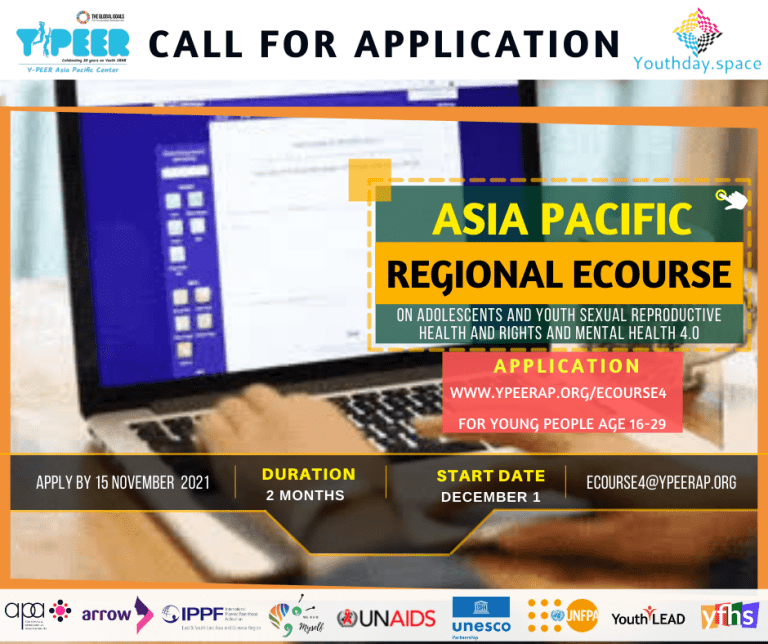
Call for Application! Asia Pacific Regional Ecourse on Adolescents and Youth SRHR and Mental Health 4.0
Call for Proposal, EOI & RFPCoursesOnline CoursesPublic Health OpportunitiesPublic Health OpportunitySouth-East Asia RegionWestern Pacific Region

Call for Application! Asia Pacific Regional Ecourse on Adolescents and Youth SRHR and Mental Health 4.0

by Public Health Update October 31, 2021
written by Public Health Update

“Asia Pacific Regional Ecourse on Adolescents and Youth Sexual Reproductive Health and Rights and Mental Health 4.0” 

Introduction: In 2020, Y-PEER Asia Pacific Center, UNFPA Asia and the Pacific Regional Office and partners implemented a regional e-course in sexual reproductive health and rights (SRHR) in context to COVID19.  This year, considering the effectiveness of the previous e-courses, Y-PEER Asia Pacific in collaboration with partner organizations has planned to replicate the e-course in a similar manner on the same topics regionally excluding Live sessions.

Like last year, this e-course not only intends to build the capacities of young people in SRHR issues but also to fill the gaps in missed opportunities resulting from the COVID-19 pandemic. Many global and regional face-to-face meetings and conferences have been canceled for the last two years. Young people also face disrupted education and cancellation of in-person capacity-building opportunities. This course also intends to complete some of the unfinished agenda planned for The Asia Pacific Forum on Sustainable Development (APFSD2020), Asia Pacific Conference on Reproductive and  Sexual Health and Rights (APCRSHR10) and other youth-focused gatherings at the regional level. Therefore, this e-course aims to provide young people with an alternative platform to continue building their expertise in SRHR and to exchange ideas and network with fellow youth advocates within and outside their countries.

Purpose:  To build capacities of young participants as SRHR youth advocates including those in remote / difficult-to-reach settings and those who are not affiliated with any organization/group.  It also aims to provide an online platform giving participants an equal platform to enhance, share and update their knowledge and skills in the field of SRHR including emerging topics that were not included in previous e-courses.

Objectives: 

By the end of this e-course, participants will be able to :

  • Have up-to-date knowledge in emerging trends, opportunities, and challenges related to SRHR of young people in Asia and the Pacific 
  • Identify some possible ways to address these challenges either as an individual or a group
  • Make action plans to advocate for improved SRHR of young people in their community using knowledge and skills gained through this course, including action plans for major international days relevant for youth

8 Topics to be included: 

  1. Adolescent sexual and reproductive health in the broad context of adolescent health and wellbeing
  2. Gender equality (including GBV, empowerment of women, engaging men and boys)
  3. SRHR in humanitarian crises & climate change
  4. Comprehensive sexuality education (CSE)
  5. Adolescents friendly services & Universal Health Coverage (AFS and UHC)
  6. Mental health and SRHR
  7. SRHR issues of Young Key Populations(YKPs) and LGBTIQ
  8. Cyberbullying, online safety and privacy

Organiser: Y-PEER Asia Pacific Center 

Partners: Asia Pacific Alliance for Sexual and Reproductive Health and Rights (APA) , The Asian-Pacific Resource and Research Center for Women (ARROW) , The International Planned Parenthood Federation South Asia Regional Office (IPPF SARO) , The Joint United Nations Programme on HIV/AIDS (UNAIDS Asia Pacific), The United Nations Educational, Scientific and Cultural Organization (UNESCO- Bangkok), Asia Pacific Network of Young Key Population (YouthLEAD), Me for Myself (M4M), and United Nations Population Fund (UNFPA APRO)

Application Details

I. Timeline of the E-course: Nov 2021 – January 2022

II. Who can apply:  Any young person between age 16-29  from Asia-Pacific countries who are interested in SRHR and topics mentioned above.

III. What is the cost: The E-course is free of charge

IV. Opportunities and other benefits:

  • Certificate signed by regional partners upon successful completion
  • Small grants to be provided for strong proposals for country or community-level e-courses
  • Possible opportunities for scholarships for future workshops and training

V. Application link: https://forms.gle/3ZSHh2JpQA9kKsKH7

VI. Deadline of application: 15th November, 2021

VII. If any questions/concerns:

Email: ecourse4@ypeerap.org  or  chat us at www.fb.com/ypeer.asiapacific


Do you have a website? Looking for the best hosting provider? Here’s a discount code.

Latest Public Health Jobs

Latest Posts

  • International Wellness Day: Promoting Global Wellness for All
  • Summit Declaration: The 12th National Summit of Health and Population Scientists in Nepal
  • Joint political declaration on the reform of the global health architecture
  • World Health Day 2026: Together for Health. Stand with Science.
  • World Water Day 2026 | Water & Gender Equality

Thanks for visiting us.
Disclaimer: The resources, documents, guidelines, and information on this blog have been collected from various sources and are intended for informational purposes only. Information published on or through this website and affiliated social media channels does not represent the intention, plan, or strategies of an organization that the initiator is associated with in a professional or personal capacity, unless explicitly indicated.
If you have any complaints, information, or suggestions about the content published on Public Health Update, please feel free to contact us at blog.publichealthupdate@gmail.com.
#StayUpdated



  • WordPress
  • Link
  • Facebook
  • Mail
  • Facebook
  • Twitter
  • Twitter
  • LinkedIn
  • Instagram
  • Facebook
October 31, 2021 0 comments
0 FacebookTwitterPinterestLinkedinTumblrVKOdnoklassnikiRedditStumbleuponWhatsappTelegramLINEPocketSkypeViberEmail
National Adaptation Plan (2021-2050) Summary for Policymakers
Environmental Health & Climate ChangeNational Plan, Policy & GuidelinesResearch & Publication

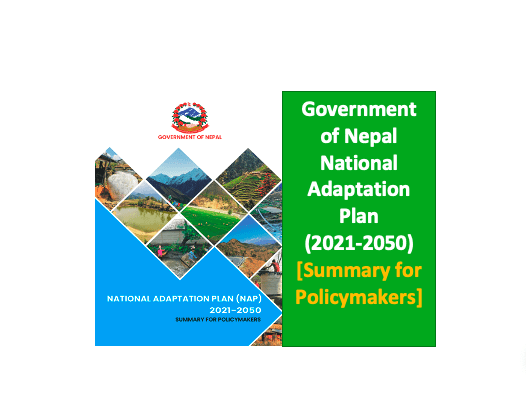
Nepal National Adaptation Plan, 2021-2050 [Summary for Policymakers]

by Public Health Update October 30, 2021
written by Public Health Update

Summary

The National Adaptation Plan has been approved on 28 October 2021 by the Council of Ministers of the Government of Nepal.

The NAP sets out priority programmes in the nine thematic sectors as outlined in the National Climate Change Policy (2019). The programmes include adaptation actions that are best able to address climate vulnerabilities and risks in the short (2025), medium (2030), and long-term (2050); as well as adaptation actions that contribute to the achievement of national economic and development priorities. A total of 64 priority programmes were identified in the Nepal NAP. The total budget of Nepal NAP implementation is USD 47.4 billion to implement priority programmes until 2050. Nepal will contribute USD 1.5 billion and external support totaling USD 45.9 billion is required to implement the NAP to 2050. The government requires USD 2.1 billion per year for the delivery of adaptation services through the implementation of NAP for medium term.

WHO’S 10 CALLS FOR CLIMATE ACTION TO ASSURE SUSTAINED RECOVERY FROM COVID-19

The institutions involved in the implementation of the NAP process are the Environmental Protection and Climate Change Management National Council, Inter-Ministerial Climate Change Coordination Committee, Ministry of Forests and Environment, National Planning Commission, Thematic and Cross Cutting Working Groups, Province Climate Change Coordination Committee, sectoral and provincial ministries, local climate change management committees including academia, development partners, occupational federations, non-state stakeholders, media and private sector.

On behalf of the government, MoFE, the climate change focal point, is responsible for reviewing and reporting on the implementation of the NAP. Nepal NAP also serves as the instrument of adaptation communication. A review of the implementation of the NAP and adaptation interventions will take place in every five years. The Nepal NAP will also be reviewed and updated in 2031, at that time the long-term programmes will be revisited and restructured to reflect changes in the country’s economy, development, policy framework, international commitments, and assessed climate change hazards, vulnerabilities, and risks. Institutional arrangements, monitoring and review framework and financial strategy are being developed separately as the integral suite of Nepal NAP.

Vision

To contribute to the socio-economic prosperity of the nation by building a climate-resilient society and reducing the risk of climate change impacts on people and ecosystems through the integration of adaptation across sectors and levels of government.

Goals

  • Build the adaptive capacity and resilience of key natural, social, and economic sectors vulnerable to and at risk of climate change, and service providers.
  • Integrate climate change issues into policies, strategies, plans, and programs of all sectors and at local, provincial, and federal levels emphasizing Gender Equality, Social Inclusion, Livelihoods and Governance (GESILG) concerns.
  • Ensure equitable resource mobilization and distribution of resources for climate change adaptation through national and international financing, research, technology, and extension services related to climate change adaptation.

Principles

  • Responsiveness to the actual adaptation needs through the identification of actions that reduce the adverse impacts of climate change and maximize resilience, informed by a robust body of research and analysis undertaken through the NAP process.
  • Policy coherence with:
    – National policies, strategies, plans, development goals, and priorities; and International commitments under the UN conventions including the UNFCCC, Paris Agreement, SDGs, Sendai Framework for Disaster Risk Reduction, UNCCD, and UNCBD.
  • Integration of climate change adaptation in the planning, budgeting, and implementation of actions at the three levels of government – federal, provincial, and local.
  • Gender responsive and social inclusive actions to ensure that people of all genders are engaged in all stages of climate adaptation planning, budgeting, implementation, and monitoring and evaluation.
  • Multi Stakeholder engagement, coordination, and cooperation to promote transparency, better decision making, and enhanced implementation of adaptation.
  • Ecosystem integrity to maintain naturally biodiverse, healthy, and resilient ecosystems.
  • ‘Leave-No-One-Behind’ through commitment to an inclusive NAP process that prioritizes planning and implementation of adaptation actions by identifying who is left behind, identifying measures to meet their needs, and generating evidence and data to monitor progress.

Priority Adaptation Programmes and Budgets

Sector: Agriculture and Food Security (11.2 billion USD)

  1. Programme on Sustainable Agriculture, Food and Nutrition Security, and Climate Resilient Health and Hygiene.
  2. Commercial Animal Husbandry for Climate Resilient Rural Livelihoods (753 Model Demonstration Projects).
  3. Development of Insurance, and Community and Peasant Friendly Climate Induced Risk Sharing Model and Expansion in both Agriculture and Livestock.
  4. Genetic Resource Conservation Programme for Climate Resilient Agriculture in Nepal.
  5. Enhancing Agriculture Productivity through Building Climate Resilient Water Management Systems.
  6. Climate Smart Transformative Collective Agriculture Promotion in the Hills and Mountains.
  7. Integrated Soil and Nutrient Management for Resilient Agriculture Strengthening Climate Services and Agriculture Information System.
  8. National Capacity Building of Agriculture and Livestock Institutions and Professionals on Climate Change Adaptation Research, Planning and Implementation.

Sector: Forest, Biodiversity and Watershed Conservation (8.7 billion USD)

  1. Forests Fire Preparedness, Prevention and Control.
  2. Karnali Watershed Management Programme for Reducing Climate Risks and Vulnerabilities and Promoting Irrigation Facilities in the Downstream.
  3. Integrated Sub-Watershed Management for Climate Resilience and Increased Water Availability and Agricultural Productivity.
  4. Improvement of Forest Health and Restoration of Rare, Endangered, Endemic, and Threatened Species for Building Resilient Forest.
  5. Restoration of Habitats and Strengthening Ecological Connectivity for Wildlife and Biodiversity.
  6. Promotion of Multiple Uses of Protected Areas and Natural Heritage and Generation of Climate Adaptation Services by Maximizing the Utility of Protected Areas.
  7. Control of Climate Induced Disasters and Extension of the Network of Protected Areas for Resilient Ecosystems.
  8. Development and Strengthening of Ponds/Lakes in Community Forests for Resilient Biodiversity (One Community Forest- One Wetland).
  9. Wetlands Development, Conservation and Management at the Foothills of Chure.
  10. Integrated Green Economy and Green Job Promotion Programme through Sustainable Forest Management and Circular Economy in the Hills and Mountains.
  11. Upland Conservation and Climate Resilient Livelihoods Programme in High Mountains.

Sector: Water Resources and Energy (5.35 billion USD)

  1. National Capacity Building on Policy Reform, Bridging Climate Information Gaps, Promoting Climate-Informed Decision Making, and Developing Climate-Smart Design and Guidelines for Water Resources Infrastructure.
  2. Promoting Energy Mix System for Industrial Sustainability and Climate Resilient Livelihoods.
  3. Establishing GLOF Risk Reduction and Early Warning Systems (EWS) in Glaciated River Basins (Gandaki, Koshi, Karnali).
  4. Promoting Water Pumping Technology in Water Scarce Areas (To Address Water Stress for Food Security in Hilly Areas).
  5. Promoting Climate Resilient Renewable Energy in Rural Vulnerable Settlements and Institutions.
  6. Constructing Climate Resilient Check Dams on the Rivers of Nepal to Sustain Life.
  7. Programme on Sustainability of Run-of-River Systems and Backing by Reservoir Systems at Feasible Locations Together with Climate Change Awareness Raising and Capacity Building of Hydropower Developers and Stakeholders.
  8. Efficient Energy and Clean Technology Development and Retrofitting to Build Resilient Systems and Infrastructure.

Sector:Rural and Urban Settlements (2.85 billion USD)

  1. Promoting the Circular Economy for Sustainable Urban Development (Piloting, Integration, Capacity Building, and Implementation).
  2. Developing Integrated Settlement and Urbanization Models for Climate Risk Reduction and Supplying Climate Adaptation Services through Nature-based Solutions and Policy Reform.
  3. Updating and Promoting Climate Resilient Building Designs, Codes, Practices and Construction Technologies and National Capacity Building to Further Implementation.

Sector: Industry, Transport and Physical Infrastructure (3.05 billion USD)

  1. Developing and Strengthening Capacity, Awareness, Resources (Databases), Institutions, Technologies and Policies for Building Climate Resilient and Environment Friendly Industries, Transport Systems and Physical Infrastructure.
  2. Diversifying the Energy Supply for Industrial Districts.
  3. Developing and Promoting Clean Energy-based Transportation Systems through National Capacity Building and Policy Reform.
  4. Developing Climate Resilient Infrastructure Systems for Climate Risks, Hazards and Pandemics.
  5. Upgrading, Maintaining, and Relocating Vulnerable Industries, Physical Infrastructure, and Transport Sector to Increase Resilience to Climate Risks.

Sector: Tourism, Natural and Cultural Heritage (1.13 billion USD)

  1. Climate Resilient Tourism for Ecological Sustainability and Economic Prosperity.
  2. Climate Risk and Tourism Information System for Resilient, Safe and Sustainable Tourism.
  3. Establishment and Operation of Emergency Relief and Rescue Services in Adventure Tourism.
  4. Regulatory Framework Development, Awareness Raising and Capacity Building on Climate Proofing, Protection, Retrofitting and Use of Natural and Cultural Heritage.
  5. Develop Climate Resilient Infrastructure and Explore and Enhance Knowledge and Capacities for Resilient Mountain Tourism.
  6. Community-Based Adaptation through Eco- and Cultural Tourism.
  7. Promotion of ‘One Local Level One Tourism Destination’ and Planning for Functional Climate Resilient Tourism Destinations (Piloting, Demonstration and Replication. One Project in each Province)
  8. Diversifying and Promoting Alternative Destinations and Products for Climate Resilient Tourism Business.

Sector: Health, Drinking Water and Sanitation (4.75 billion USD)

  1. Capacity Building of Health and Hygiene Service Providers (Institution and Personnel) on Climate Resilient Health and Hygiene Service Planning and Implementation.
  2. Climate Change Resilience Development through Capacity Building, Innovation, Improvement and Construction of WASH Services and Facilities.
  3. Strengthening of Climate Sensitive Disease Surveillance System with Emergency Preparedness and Response.
  4. Health Promoting Cities: Health, Environment and Life (HEAL)
  5. Promotion and Conservation of Water Sources along with Watershed Management for Sustainable Water Supply Service.
  6. Policy Reform, Strategy Development and National Level Awareness Raising on Climate Resilient Health and WASH Programme, Planning, Operationalization and Sustainability.
  7. Research, Innovation and Development of Climate Resilient Measures/Technologies for Water Supply, Sanitation and Health Systems.

Sector: Disaster Risk Reduction and Management (8.05 billion USD)

  1. Building Climate Resilience by Developing and Harmonizing DRRM and CCA at Federal to Local Levels through Policy Reforms (Integration of DRR in Local Adaptation Plans).
  2. Strengthening Adaptive Social Protection/ Shock Responsive Practices Initiatives for Transferring Climate Risk.
  3. Maintenance, Upgradation and Strengthening Early Warning Systems and MultiHazard Monitoring to Facilitate Climate Adaptive Function of Key Economic and Service Sectors
  4. Development of Federal and Provincial Strategy and Action Plans on Control of Climate Induced (Primarily Water Borne) Disasters in the Forest Areas of Nepal and Phase-Wise Implementation Under the Leadership of Forest Authorities
  5. Develop Regulatory Framework for Domestic and Industrial Fire Control and Mitigation, and Implementation Strategy and Build National Capacities with Supply of Technology and Equipment.
  6. Promote Culture of Safety and Build Climate Resilience through Climate Risk Sensitive Land Use Plan (RSLUP) Guideline and Standards.

Sector: Gender, Social Inclusion, Livelihoods and Governance (0.7 billion USD)

  1. Strategy and Action Plan on Restrengthening, Establishing and Functionalizing Climate Change Aware Gender Focal Desks in all State and Non-State Institutions (Including Private Organizations).
  2. Building Human Capital for an Inclusive Climate and Disaster Resilient Society through Promoting Safe and Equitable Access to Disaster Reduction Response Services.
  3. Integrating GESI and Climate Foresight in Social Protection and Development Interventions (Piloting and Replication) Enhancing Resilience to Climate Change through GESI Responsive Livelihood Programmes.

Sector: National Capacity Building, Research and Awareness Raising (0.16 billion USD)

  • Continue to Implement the NAP Process including Research on Climate Risks and Vulnerabilities, and Capacity Building of Actors and Stakeholders on Climate Change Matters.
  • Strengthen Capacities of Federal Thematic Ministries and Provincial Governments on Developing and Implementing the NAP Process.
  • Establish and Operationalize Climate Change Data Management System and Programme Monitoring Centre at Federal and Provincial Levels.

NAP SPM Briefing Paper in English: Click here
NAP SPM Briefing Paper in Nepali: Click here 
Press Release on Nepal’s participation in COP26: Click here 


Recommended reading: National Climate Change Policy, 2076 (2019)

  • COP26 Special Report on Climate Change and Health
  • Collateral Threats of COVID-19 and Climate Change
  • World hunger again on the rise, driven by conflict and climate change, new UN report says
  • WHO South-East Asia Region commits to building health systems resilience to climate change

Do you have a website? Looking for the best hosting provider? Here’s a discount code.

Latest Public Health Jobs

Latest Posts

  • International Wellness Day: Promoting Global Wellness for All
  • Summit Declaration: The 12th National Summit of Health and Population Scientists in Nepal
  • Joint political declaration on the reform of the global health architecture
  • World Health Day 2026: Together for Health. Stand with Science.
  • World Water Day 2026 | Water & Gender Equality

Thanks for visiting us.
Disclaimer: The resources, documents, guidelines, and information on this blog have been collected from various sources and are intended for informational purposes only. Information published on or through this website and affiliated social media channels does not represent the intention, plan, or strategies of an organization that the initiator is associated with in a professional or personal capacity, unless explicitly indicated.
If you have any complaints, information, or suggestions about the content published on Public Health Update, please feel free to contact us at blog.publichealthupdate@gmail.com.
#StayUpdated


  • WordPress
  • Link
  • Facebook
  • Mail
  • Facebook
  • Twitter
  • Twitter
  • LinkedIn
  • Instagram
  • Facebook
October 30, 2021 0 comments
0 FacebookTwitterPinterestLinkedinTumblrVKOdnoklassnikiRedditStumbleuponWhatsappTelegramLINEPocketSkypeViberEmail
School of Public HealthPublic HealthPublic Health OpportunitiesPublic Health OpportunityUniversitiesUniversities & School of Public Health

Post-Secondary Educational Programs Related to Public Health in Canada

by Public Health Update October 30, 2021
written by Public Health Update

Here are some Universities and School of public health offers Master of Public health (MPH) course in Canada.

British Columbia

  • Simon Fraser University, Faculty of Health Sciences
  • University of British Columbia, Faculty of Medicine – School of Population & Public Health
  • University of Northern British Columbia, School of Health Sciences
  • University of Victoria  Faculty of Human & Social Development – School of Public Health & Social Policy
  • British Columbia Institute of Technology, School of Health Sciences

PUBLIC HEALTH COURSES IN UK

Alberta

  • University of Alberta  School of Public Health
  • University of Calgary, Faculty of Community Health Sciences
  • Concordia University of Edmonton, Department of Public Health
  • University of Lethbridge, Faculty of Health Sciences
  • Saskatchewan University of Saskatchewan, School of Public Health
  • First Nations University of Canada, Department of Indigenous Science

Masters of Public Health (MPH) in USA (Universities & Specialization)

Manitoba       

  • University of Manitoba, Faculty of Health Sciences, College of Medicine – Community Health Sciences

Ontario

  • Lakehead University, Faculty of Health and Behavioural Sciences – Department of Health Sciences
  • McMaster University, Faculty of Health Sciences & Faculty of Social Sciences
  • Queen’s University, Department of Kinesiology & Health Studies, Faculty of Health Sciences – Department of Public Health Sciences
  • University of Guelph, Ontario Veterinary College – Department of Population Medicine
  • University of Ontario Institute of Technology, Faculty of Health Sciences
  • University of Toronto, Dalla Lana School of Public Health, Faculty of Dentistry – Dental Public Health, Department of Anthropology & Health Studies
  • Ryerson University, School of Occupational & Public Health
  • York University, Faculty of Health – School of Health Policy and Management, Faculty of Health
  • University of Western Ontario, Schulich School of Medicine and Dentistry
  • Brock University, Department of Health Sciences, Faculty of Applied Health Sciences
  • University of Ottawa, Faculty of Medicine – School of Epidemiology, Public Health & Preventive Medicine
  • Wilfrid Laurier University Faculty of Human and Social Sciences
  • University of Waterloo, School of Public Health and Health Systems, Faculty of Applied Health Sciences
  • Laurentian University, Department of Sociology, School of Rural and Northern Health

Universities for Doctor of Public Health (DrPH) IN USA

Quebec

  • McGill University, Faculty of Medicine – Department of Epidemiology, Biostatistics and Occupational Health
  • Université de Montréal, École de santé publique
  • Université Laval, Faculté de médecine – Département de Médecine sociale et preventive
  • Nova Scotia, Dalhousie University, Faculty of Medicine – Department of Community Health & Epidemiology, Faculty of Health
  • Cape Breton University, School of Professional Studies

Newfoundland

  • Memorial University   Faculty of Medicine – Division of Community Health & Humanities

Source of info: https://www.canada.ca/en


Do you have a website? Looking for the best hosting provider? Here’s a discount code.

Latest Public Health Jobs

Latest Posts

  • International Wellness Day: Promoting Global Wellness for All
  • Summit Declaration: The 12th National Summit of Health and Population Scientists in Nepal
  • Joint political declaration on the reform of the global health architecture
  • World Health Day 2026: Together for Health. Stand with Science.
  • World Water Day 2026 | Water & Gender Equality

Thanks for visiting us.
Disclaimer: The resources, documents, guidelines, and information on this blog have been collected from various sources and are intended for informational purposes only. Information published on or through this website and affiliated social media channels does not represent the intention, plan, or strategies of an organization that the initiator is associated with in a professional or personal capacity, unless explicitly indicated.
If you have any complaints, information, or suggestions about the content published on Public Health Update, please feel free to contact us at blog.publichealthupdate@gmail.com.
#StayUpdated


  • WordPress
  • Link
  • Facebook
  • Mail
  • Facebook
  • Twitter
  • Twitter
  • LinkedIn
  • Instagram
  • Facebook
October 30, 2021 1 comment
0 FacebookTwitterPinterestLinkedinTumblrVKOdnoklassnikiRedditStumbleuponWhatsappTelegramLINEPocketSkypeViberEmail
Universities for Doctor of Public Health (DrPH) IN USA
CoursesOnline CoursesPublic Health OpportunitiesPublic Health OpportunitySchool of Public HealthUniversitiesUniversities & School of Public Health

Universities for Doctor of Public Health (DrPH) IN USA

by Public Health Update October 30, 2021
written by Public Health Update

A Doctor of Public Health (DrPH) is a highest attainable course for public health professionals. Here is the list of universities and course available with specialization in the United States (USA).

Boston University School of Public Health, Boston, Massachusetts

  • DrPH – Leadership, Management, and Policy

Claremont Graduate University Master of Public Health Program, Claremont, California

  • DrPH – Public Health Practice

Colorado School of Public Health: University of Colorado | Colorado State University | University of Northern Colorado, Aurora, Colorado

  • DrPH – Community and Behavioral Health
  • DrPH – Environmental and Occupational Health
  • DrPH – Epidemiology

MASTERS OF PUBLIC HEALTH (MPH) IN USA (UNIVERSITIES & SPECIALIZATION)

Columbia University Mailman School of Public Health, New York, New York

  • DrPH – Biostatistics
  • DrPH – Environmental Health Sciences
  • DrPH – Epidemiology
  • DrPH – Population and Family Health
  • DrPH – Sociomedical Sciences

Pages: 1 2 3 4 5 6

Drexel University Dornsife School of Public Health, Philadelphia, Pennsylvania

  • DrPH – Health Management and Policy
  • PhD – Community Health and Prevention

East Tennessee State University College of Public Health, Johnson City, Tennessee

  • DrPH – Community Health
  • DrPH – Epidemiology
  • DrPH – Health Management and Policy

Florida A&M University Public Health Program, Tallahassee, Florida

  • DrPH – Doctor of Public Health

PUBLIC HEALTH COURSES IN UK

George Washington University Milken Institute School of Public Health, Washington, District of Columbia

  • DrPH – Doctor of Public Health (DrPH)

Georgia Southern University Jiann-Ping Hsu College of Public Health, Statesboro, Georgia

  • DrPH – Biostatistics
  • DrPH – Community Health Behavior and Education
  • DrPH – Epidemiology
  • DrPH – Health Policy and Management
  • DrPH – Public Health Leadership

Pages: 1 2 3

October 30, 2021 3 comments
0 FacebookTwitterPinterestLinkedinTumblrVKOdnoklassnikiRedditStumbleuponWhatsappTelegramLINEPocketSkypeViberEmail
Newer Posts
Older Posts

Search

Follow Us

Facebook Twitter Instagram Pinterest Linkedin Youtube

Categories

  • Abstracts (25)
  • Activities (91)
  • Adolescent Sexual and Reproductive Health (ASRH) (25)
  • Advice & Tips (4)
  • African Region (5)
  • AI and Health (1)
  • Annual Meeting (6)
  • Antimicrobial Resistance (AMR) (21)
  • Award (19)
  • Awards (16)
  • Books (9)
  • Call for Proposal, EOI & RFP (103)
  • Call for Research Participants (8)
  • Clinical Doctor Jobs (6)
  • Communicable Diseases (107)
  • Competition (20)
  • Conference (129)
  • Consultant (1)
  • Courses (205)
  • Dashboard (2)
  • Digital Health & Health Informatics (10)
  • Drug and Medicine (18)
  • Eastern Mediterranean Region (3)
  • Education (15)
  • Environment (3)
  • Environmental Health & Climate Change (47)
  • European Region (42)
  • Exchange Program (1)
  • Fact Sheet (117)
  • FCHVs (1)
  • Fellowships, Studentship & Scholarships (168)
  • Financial Aid (13)
  • Form Formats (2)
  • Fully funded (22)
  • Global Health News (434)
  • Grants and Funding Opportunities (193)
  • Guest Post (44)
  • Health Assistant Jobs (1)
  • Health Equity (7)
  • Health Financing and Economics (24)
  • Health in Data (115)
  • Health Insurance (5)
  • Health Jobs (52)
  • Health Literacy, Health Education & Promotion (50)
  • Health Organization Profile (42)
  • Health Systems (83)
  • Human Resource for Health (33)
  • Humanitarian Health & Emergency Response (44)
  • Hypertension (5)
  • Implementation Research (48)
  • International Health (3)
  • International Jobs & Opportunities (373)
  • International Plan, Policy & Guidelines (210)
  • Internships (4)
  • Jobs Vacancies (56)
  • Journals (8)
  • Life Style & Public Health Nutrition (39)
  • Live (10)
  • Master's Degree (48)
  • Maternal, Newborn and Child Health (88)
  • Mentorship Program (2)
  • Miscellaneous (16)
  • National Health News (158)
  • National Plan, Policy & Guidelines (468)
  • Neglected Tropical Diseases (NTDs) (51)
  • Non- Communicable Diseases (NCDs) (121)
  • Notice (103)
  • Nursing Jobs (6)
  • Nutritionist Jobs (1)
  • One Health (18)
  • Online & Distance Learning (22)
  • Online Courses (90)
  • Op-Ed Article (3)
  • Opportunities by Region (83)
  • Outbreak News (213)
  • Partially funded (6)
  • PCL Health Science Jobs (3)
  • PH Important Day (534)
  • Pharmacist Jobs (3)
  • PhD (54)
  • Photos (5)
  • Planetary Health (4)
  • PostDoc (14)
  • Presentation Slides (26)
  • Primary Health Care (25)
  • Provincial Plan, Policies and Guidelines (14)
  • Public Health (1,283)
  • Public Health Epidemiology & Biostatistics (13)
  • Public Health Events (306)
  • Public Health Information (20)
  • Public Health Innovation (9)
  • Public Health Jobs (52)
  • Public Health News (554)
  • Public Health Notes (120)
  • Public Health Opportunities (507)
  • Public Health Opportunity (491)
  • Public Health Programs (108)
  • Public Health Seminar (2)
  • Public Health Tools (1)
  • Public Health Update (564)
  • Quality Improvement & Infection Prevention (20)
  • Region of America (8)
  • Reports (184)
  • Research & Project Grants (39)
  • Research & Project Grants (32)
  • Research & Publication (647)
  • Research Articles (10)
  • Road Traffic Accidents (RTA) (9)
  • School of Public Health (60)
  • Self funded (2)
  • South-East Asia Region (26)
  • Success Stories (17)
  • Summer and Winter Courses (40)
  • Summer Courses (28)
  • Sustainable Development Goals (SDGs) (14)
  • Syllabus (61)
  • Symposium (9)
  • Tobacco Control (35)
  • Training (40)
  • Travel Grants (15)
  • Trick, Technique & Skills (8)
  • Uncategorized (3)
  • Undergraduate Degree (7)
  • Universal Health Coverage (36)
  • Universities (29)
  • Universities & School of Public Health (58)
  • Vacancy Announcement (26)
  • Vaccine Preventable Diseases (40)
  • Vector-Borne Diseases(VBDs) (30)
  • Videos (3)
  • View Points (1)
  • Webinar (4)
  • Western Pacific Region (13)
  • Workshop (18)
  • World News (117)
Post New Jobs: Vacancy Announcement Service

Public Health Update (Sagun’s Blog) is a popular public health portal in Nepal. Thousands of health professionals are connected with Public Health Update to get up-to-date public health updates, search for jobs, and explore opportunities.
#1 Public Health Blog for sharing Job opportunities and updates in Nepal

”Public Health Information For All”
– – Sagun Paudel, Founder

  • HOT JOBS
    • Public Health Jobs
    • Medical Doctor Jobs
    • Nursing Jobs
    • Health Assistant Jobs
    • Pharmacist Jobs
    • NGOs Jobs
    • Government Jobs
  • Top Categories
    • National Plan, Policy & Guidelines Top
    • Public Health Calendar
    • Fellowships & Scholarships
    • Health Systems
    • Health Organization Profiles
    • International Jobs & Opportunities
    • Public Health Opportunity

PUBLIC HEALTH INITIATIVE

    • Submit your Vacancies New
    • Partnership Opportunities

Contact: blog.publichealthupdate@gmail.com

https://wa.me/+9779856036932

Public Health Initiative, A Registered Non-profit organization – All Right Reserved. 2011-2024. Contact us. 

Facebook Twitter Instagram Youtube Envelope
Public Health Update
  • Home
  • Public Health
    • Home 1
      • Adolescent Sexual and Reproductive Health (ASRH)
      • Antimicrobial Resistance (AMR)
      • Communicable Diseases
      • Digital Health & Health Informatics
      • Environmental Health & Climate Change
      • Health Financing and Economics
      • Health Equity
    • Home 2
      • Health Literacy, Health Education & Promotion
      • Human Resource for Health
      • Humanitarian Health & Emergency Response
      • Implementation Research
      • International Health
      • Life Style & Public Health Nutrition
      • Maternal, Newborn and Child Health
    • Home 3
      • Neglected Tropical Diseases (NTDs)
      • Non- Communicable Diseases (NCDs)
      • One Health
      • Planetary Health
      • Public Health Epidemiology & Biostatistics
      • Primary Health Care
      • Quality Improvement & Infection Prevention
    • Home 4
      • Road Traffic Accidents (RTA)
      • Sustainable Development Goals (SDGs)
      • Tobacco Control
      • Universal Health Coverage
      • Vaccine Preventable Diseases
      • Vector-Borne Diseases(VBDs)
      • Notices
  • Public Health Update
    • Home 1
      • Public Health News
      • Global Health News
      • Outbreak News
      • National Health News
      • COVID-19
    • Home 2
      • Fact Sheet
      • Health in Data
      • PH Important Day
      • Public Health Events
      • Public Health Programs
    • Home 3
      • Health Systems
      • Health Insurance
      • Health Organization Profile
      • Success Stories
      • Public Health Innovation
  • Public Health Opportunities
    • Fully funded
    • Travel Grants
    • Grants and Funding Opportunities
    • Opportunities by Region
    • International Jobs & Opportunities
    • Research & Project Grants
    • Fellowships, Studentship & Scholarships
    • Conference
  • Jobs
    • Home 1
      • Health Jobs
      • Public Health Jobs
      • Clinical doctor Jobs
      • Health Assistant Jobs
      • Nursing Jobs
      • PCL Health Science Jobs
    • Home 2
      • Dental Jobs
      • Pharmacist Jobs
      • TSLC (Health Jobs)
      • Laboratory Jobs
      • Nutritionist Jobs
  • Downloads
    • International Plan, Policy & Guidelines
    • National Plan, Policy & Guidelines
    • Reports
    • Books
    • Research Articles
  • School of Public Health
    • Home 1
      • Courses
      • Master’s Degree
      • Undergraduate Degree
      • PhD
    • Home 2
      • Universities
      • Syllabus
      • Public Health Notes
      • Mentorship Program
      • Startup Project
    • Home
      • Summer and Winter Courses
      • Summer Courses
      • Online Courses
      • Workshop
      • Training
Public Health Update
  • Home
  • Public Health
    • Home 1
      • Adolescent Sexual and Reproductive Health (ASRH)
      • Antimicrobial Resistance (AMR)
      • Communicable Diseases
      • Digital Health & Health Informatics
      • Environmental Health & Climate Change
      • Health Financing and Economics
      • Health Equity
    • Home 2
      • Health Literacy, Health Education & Promotion
      • Human Resource for Health
      • Humanitarian Health & Emergency Response
      • Implementation Research
      • International Health
      • Life Style & Public Health Nutrition
      • Maternal, Newborn and Child Health
    • Home 3
      • Neglected Tropical Diseases (NTDs)
      • Non- Communicable Diseases (NCDs)
      • One Health
      • Planetary Health
      • Public Health Epidemiology & Biostatistics
      • Primary Health Care
      • Quality Improvement & Infection Prevention
    • Home 4
      • Road Traffic Accidents (RTA)
      • Sustainable Development Goals (SDGs)
      • Tobacco Control
      • Universal Health Coverage
      • Vaccine Preventable Diseases
      • Vector-Borne Diseases(VBDs)
      • Notices
  • Public Health Update
    • Home 1
      • Public Health News
      • Global Health News
      • Outbreak News
      • National Health News
      • COVID-19
    • Home 2
      • Fact Sheet
      • Health in Data
      • PH Important Day
      • Public Health Events
      • Public Health Programs
    • Home 3
      • Health Systems
      • Health Insurance
      • Health Organization Profile
      • Success Stories
      • Public Health Innovation
  • Public Health Opportunities
    • Fully funded
    • Travel Grants
    • Grants and Funding Opportunities
    • Opportunities by Region
    • International Jobs & Opportunities
    • Research & Project Grants
    • Fellowships, Studentship & Scholarships
    • Conference
  • Jobs
    • Home 1
      • Health Jobs
      • Public Health Jobs
      • Clinical doctor Jobs
      • Health Assistant Jobs
      • Nursing Jobs
      • PCL Health Science Jobs
    • Home 2
      • Dental Jobs
      • Pharmacist Jobs
      • TSLC (Health Jobs)
      • Laboratory Jobs
      • Nutritionist Jobs
  • Downloads
    • International Plan, Policy & Guidelines
    • National Plan, Policy & Guidelines
    • Reports
    • Books
    • Research Articles
  • School of Public Health
    • Home 1
      • Courses
      • Master’s Degree
      • Undergraduate Degree
      • PhD
    • Home 2
      • Universities
      • Syllabus
      • Public Health Notes
      • Mentorship Program
      • Startup Project
    • Home
      • Summer and Winter Courses
      • Summer Courses
      • Online Courses
      • Workshop
      • Training
Public Health Initiative, A Registered Non-profit organization – All Right Reserved. 2011-2023