Public Health Update
  • Home
  • Public Health Update
  • Nepal Health Jobs
    • Public Health Job Board
    • Organization List
  • Opportunities
    • Fellowships, Studentship & Scholarships
    • Grants and Funding Opportunities
    • Fully funded
    • Conference
  • Downloads
    • International Plan, Policy & Guidelines
    • National Plan, Policy & Guidelines
    • Reports
    • Public Health Notes
    • Syllabus
    • Form Formats
  • School of Public Health
    • PhD
    • Master’s Degree
    • Online Courses
  • Notice
  • Home
  • Public Health Update
  • Nepal Health Jobs
    • Public Health Job Board
    • Organization List
  • Opportunities
    • Fellowships, Studentship & Scholarships
    • Grants and Funding Opportunities
    • Fully funded
    • Conference
  • Downloads
    • International Plan, Policy & Guidelines
    • National Plan, Policy & Guidelines
    • Reports
    • Public Health Notes
    • Syllabus
    • Form Formats
  • School of Public Health
    • PhD
    • Master’s Degree
    • Online Courses
  • Notice
LOGIN / REGISTER
Public Health Update
SUBSCRIBE
Public Health Update
  • Home
  • Public Health Update
  • Nepal Health Jobs
    • Public Health Job Board
    • Organization List
  • Opportunities
    • Fellowships, Studentship & Scholarships
    • Grants and Funding Opportunities
    • Fully funded
    • Conference
  • Downloads
    • International Plan, Policy & Guidelines
    • National Plan, Policy & Guidelines
    • Reports
    • Public Health Notes
    • Syllabus
    • Form Formats
  • School of Public Health
    • PhD
    • Master’s Degree
    • Online Courses
  • Notice

All Right Reserved. Designed and Developed by PenciDesign

World Cancer Day
PH Important DayNon- Communicable Diseases (NCDs)Public HealthPublic Health EventsPublic Health Update

World Cancer Day 2021: I Am And I Will

by Public Health Update February 2, 2021
written by Public Health Update

World Cancer Day 2021: I Am And I Will! Together, all of our actions matter.

World Cancer Day, every 4 February is the global uniting initiative led by the Union for International Cancer Control (UICC). By raising worldwide awareness, improving education and catalysing personal, collective and government action, we’re working together to reimagine a world where millions of preventable cancer deaths are saved and access to life-saving cancer treatment and care is equal for all – no matter who you are or where you live. Because, we believe that cancer isn’t just a health issue but a human issue that touches all of us.

World Cancer Day aims to save millions of preventable deaths each year by raising awareness and education about cancer, and pressing governments and individuals across the world to take action against the disease.

Why cancer?

  • Cancer is a critical health and human issue.
  • Today, 9.6 million people each year will die from cancer. Making it the second-most deadly disease.
  • 70%of cancer deaths occur in low-to-middle income countries.
  • The total annual economic cost of cancer is estimated at approximately US$1.16 trillion.
  • At least one third of common cancers are preventable.
  • Less than 30%of low-income countries have cancer treatment services available (compared to 90% in high-income countries).
  • Up to 3.7 million lives could be saved each year through resource appropriate strategies for prevention, early detection and timely and quality treatment.

Campaign theme:I Am and I Will

2021 – the ultimate year of the ‘I Am and I Will’ campaign – shows us that our actions have an impact on everyone around us, within our neighbourhood, communities and cities. And that more than ever, our actions are also being felt across borders and oceans. This year is a reminder of the enduring power of cooperation and collective action. When we choose to come together, we can achieve what we all wish for: a healthier, brighter world without cancer.

Related

  • Global strategy to accelerate the elimination of cervical cancer as a public health problem
  • October: Breast Cancer Awareness Month
  • Cervical and Breast Cancer Screening Program Implementation Guideline 2077
  • World Health Assembly adopts global strategy to accelerate cervical cancer elimination

#WorldCancerDay#IAmAndIWill #cancer


More info: Official website
February 2, 2021 1 comment
0 FacebookTwitterPinterestLinkedinTumblrVKOdnoklassnikiRedditStumbleuponWhatsappTelegramLINEPocketSkypeViberEmail
Universitas Gadjah Mada, Indonesia
Fellowships, Studentship & ScholarshipsGrants and Funding OpportunitiesImplementation ResearchMaster's DegreePublic Health OpportunitiesPublic Health OpportunitySchool of Public Health

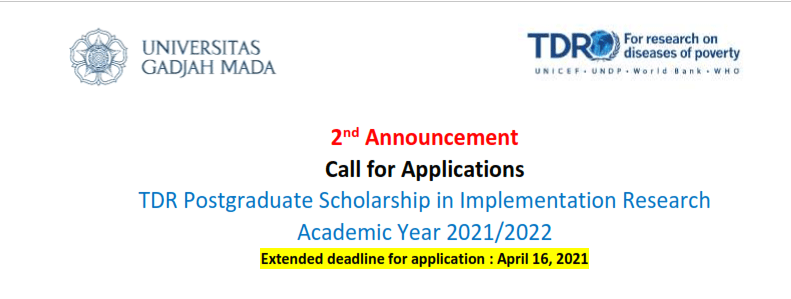
Call for applications! TDR Postgraduate Scholarship in Implementation Research- Universitas Gadjah Mada

by Public Health Update February 2, 2021
written by Public Health Update

Call for applications! TDR Postgraduate Scholarship in Implementation Research Academic Year 2021/2022

Faculty of Medicine, Public Health and Nursing, Universitas Gadjah Mada (UGM) of Yogyakarta, Indonesia, invites suitably qualified candidates to apply for a place in the following full-time postgraduate programme, with a focus on Implementation Research for the 2021-2022 academic year.
Funding for these full scholarshipsis from TDR, the Special Programme for Research and Training in Tropical Diseases, based at the World Health Organization in Geneva (TDR Postgraduate training support). Only applicants from low- and middle-income countries of WHO South-East Asia and Western Pacific Regions are eligible.
The training will be focused on courses relevant to a career in implementation research on infectious diseases of poverty, including neglected tropical diseases, malaria, TB/HIV and COVID-19. Implementation research is a growing field that supports the identification of health system bottlenecks and approaches to address them, and is particularly useful in low- and middle- income countries where many health interventions do not reach those who need them the most. The goal of this scheme is to enhance postgraduate training capacity and boost the number of researchers in low- and middle-income countries.
Further information on implementation research is available from: IR training and IR toolkit A limited number of scholarships will be offered for the 2021/2022 academic year in the International Master Programme in Public Health, leading to an MPH degree (2 years duration). The programme is taught in English.

Recipients will be enrolled as postgraduate students, and their careers will be tracked through the TDR postgraduate alumni platform, IR Connect, which monitors the impact of the programme and provides networking and opportunities to increase visibility for students and alumni.

ELIGIBILITY FOR SCHOLARSHIP

Applicants should:

  • Be nationals of, and residents in, low- and middle income countries (as defined by the World Bank) of WHO South-East Asia region and West Pacific region.
  • Be under 35 years old for the Master programme.
  • Meet the University requirements for international postgraduate students
  • Meet the academic requirements:
    – A bachelor’s degree with a cumulative Grade Point Average of at least 3.00 out of 4 AcEPT score of at least 268 or TOEFL score of at least 550 or IELTS score of at least 5.5
    – Desk evaluation on undergraduate academic documents
  • Consent to meet health requirements in line with regulations of the Indonesian government and UGM.

THE SCHOLARSHIP PACKAGE

The scholarship covers:

  • Return economy airfare between the home country of the student and Yogyakarta, Indonesia;
  • Tuition fees and a basic medical and accident insurance;
  • Support for research project/thesis expenses, including travel and sustenance during data collection in home country;
  • Indonesian language course to improve integration in the university’s environment; and
  • Monthly stipend to cover living expenses equivalent to local living cost.
APPLYING FOR THE TDR POSTGRADUATE SCHOLARSHIP SCHEME AT UGM

To apply for a TDR Postgraduate Scholarship, you must complete the following two steps:
Step 1. Apply for Master Programme
a. International applicants:
please log in or sign up at https://admission.ugm.ac.id/ and choose “TDR Postgraduate Scholarship in Implementation Research” for Master Programme. Please send the online form and all documents with good quality to graduate.fk@ugm.ac.id
b. Indonesian applicants: please send the application form and requirements mentioned in um.ugm.ac.id to graduate.fk@ugm.ac.id. Please write a motivation letter and scholarship application form in English.
Step 2. Complete the TDR postgraduate scholarship application form (attached) and email this form to: graduate.fk@ugm.ac.id.
Only completed forms will be further processed.

CALENDAR FOR APPLICATION

Application open: 1 February 2021
Deadline for application: 26 March 2021
Announcement of selection result: 3 May 2021
Selected applicants will receive a letter of offer from the University and have 3 calendar days to confirm acceptance after the notification. Faculty of Medicine, Public Health and Nursing, UGM reserves the right to refuse or end attribution of the scholarship if the provided information has been proven false.
Application deadline: 26 March 2021 (Extended deadline for application April 16, 2021)

MORE INFORMATION
For more information on the scheme at Faculty of Medicine, Public Health and Nursing, UGM, please contact:
Ms Yuyun Yohana
The Graduate Programme Office, Faculty of Medicine, Public Health and Nursing, UGM
Tel no : (+62-274) 560300 ext. 205
Fax no : (+62-274) 581876
E-mail : graduate.fk@ugm.ac.id
Website: http://graduate.fk.ugm.ac.id/

OFFICIAL NOTICE
WHO TDR


Do you have a website? Looking for the best hosting provider? Here’s a discount code.

Latest Public Health Jobs

Latest Posts

  • Joint political declaration on the reform of the global health architecture
  • World Health Day 2026: Together for Health. Stand with Science.
  • World Water Day 2026 | Water & Gender Equality
  • Nepal Antimicrobial Resistance (AMR) Bulletin FY 2081/82
  • Call for applications! Short Course on Qualitative Research Methods in Public Health, 2026

Thanks for visiting us.
Disclaimer: The resources, documents, guidelines, and information on this blog have been collected from various sources and are intended for informational purposes only. Information published on or through this website and affiliated social media channels does not represent the intention, plan, or strategies of an organization that the initiator is associated with in a professional or personal capacity, unless explicitly indicated.
If you have any complaints, information, or suggestions about the content published on Public Health Update, please feel free to contact us at blog.publichealthupdate@gmail.com.
#StayUpdated


  • WordPress
  • Link
  • Facebook
  • Mail
  • Facebook
  • Twitter
  • Twitter
  • LinkedIn
  • Instagram
  • Facebook
February 2, 2021 0 comments
0 FacebookTwitterPinterestLinkedinTumblrVKOdnoklassnikiRedditStumbleuponWhatsappTelegramLINEPocketSkypeViberEmail
February: National Iodine Month
Public HealthPH Important DayPublic Health EventsPublic Health NewsPublic Health ProgramsPublic Health Update

February : National Iodine Awareness Month

by Public Health Update January 31, 2021
written by Public Health Update

Iodine Month

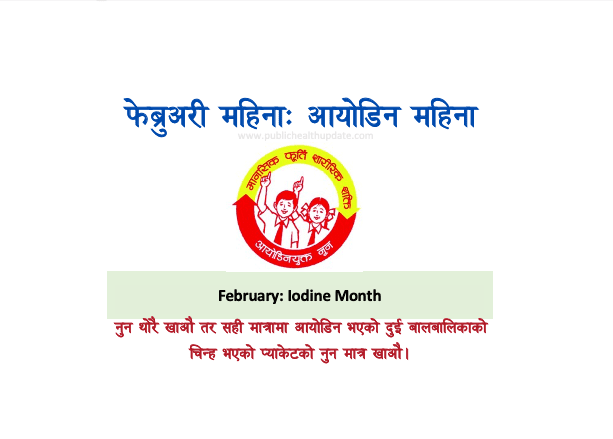
National Iodine Month has been celebrated in February each year to raise awareness on the use of two child-logo salt for optimum iodine intake to combat iodine deficiency disorders in Nepal.

Screen Shot 2021 01 31 at 19.57.32
February: National Iodine Month

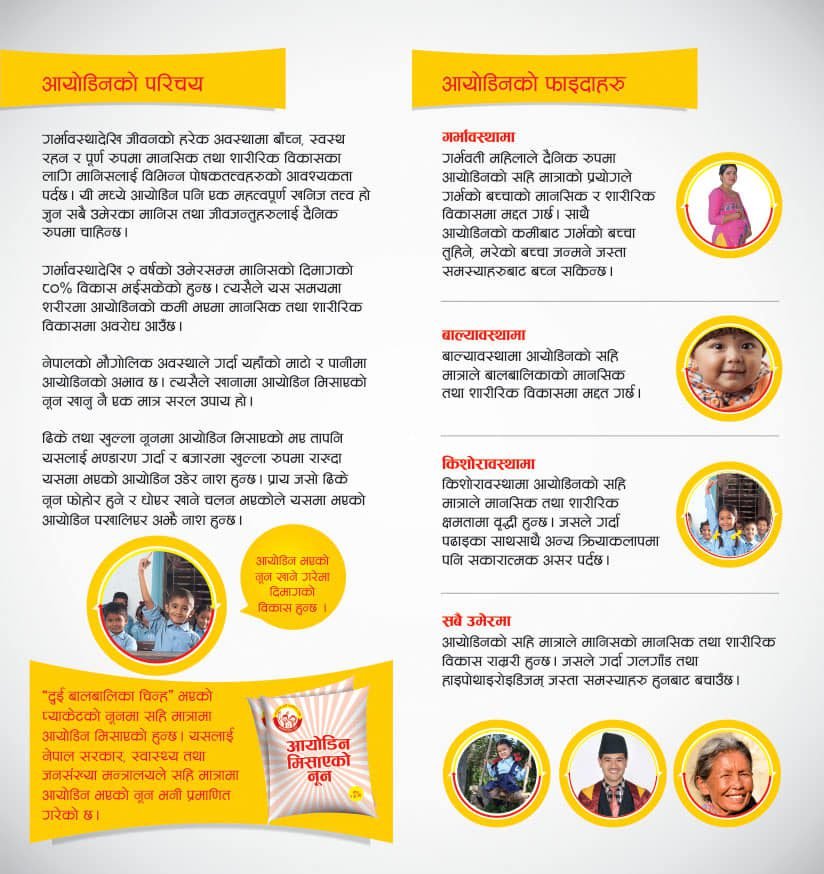
The MoHP adopted a policy to fortify all edible salt in 1973 to address iodine deficiency disorders (IDD) through universal salt iodization. The Salt Trading Corporation is responsible for the iodine fortification of all edible salt and its distribution, while MoHP is responsible for promoting iodized salt and its marketing to increase consumption.

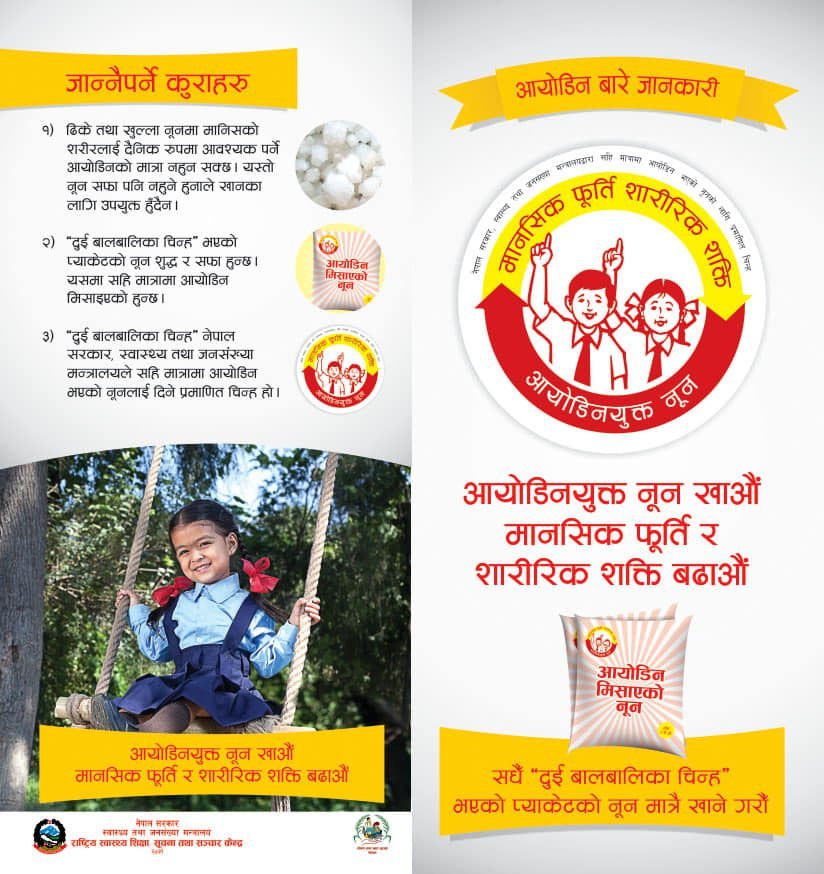
The government uses the Two-Child Logo to certify adequately iodized salt and DoHS has been implementing a social marketing campaign of this salt to improve awareness of its use in households.

National surveys reports an increase in the number of households using adequately iodized salt from 55 percent in 1998 to 95 percent in 2016. However, there is disparities in the use of iodized salt. The NDHS 2016 found the Province 2 to have the highest coverage (99.3 percent), while the Province 6 had the lowest (85.1 percent).

Government’s strategies to control of iodine deficiency disorders

  • The universal iodization of salt.
  • Strengthen implementation of the Iodized Salt Act, 2055 to ensure that all edible salt is iodized.
  • The social marketing of certified two-child logo iodized salt.
  • Ensure the systematic monitoring of iodized salt.
  • Increase the accessibility and market share of iodized packet salt with the two-child logo.
  • Create awareness about the importance of using iodized salt to control iodine deficiency disorder (IDD) through social marketing campaign.
12 1
23

Related readings

  • Iodized Salt (Production, Sale and Distribution)Act, 2055(1998)
  • World Thyroid Day & International Thyroid Awareness Week (May 22 to 28) – “It’s not you. It‘s your thyroid”
  • World Thyroid Day 2018: Lifestyle and diet change for better thyroid management
  • Nepal National Micronutrient Status Survey 2016
  • Child Health Program: Plan, Policies and Documents
  • Multi-sector Nutrition Plan II (2018-2022), Nepal
  • National Nutrition Policy, Nepal-2004
  • February: National Iodine Month (Prevention and Control of Iodine Deficiency Disorder)
  • Nutrition programmes implemented by FWD Nutrition Section (1993–2018)

CHANGE YOUR PROFILE PICTURE


Do you have a website? Looking for the best hosting provider? Here’s a discount code.

Latest Public Health Jobs

Latest Posts

  • Joint political declaration on the reform of the global health architecture
  • World Health Day 2026: Together for Health. Stand with Science.
  • World Water Day 2026 | Water & Gender Equality
  • Nepal Antimicrobial Resistance (AMR) Bulletin FY 2081/82
  • Call for applications! Short Course on Qualitative Research Methods in Public Health, 2026

Thanks for visiting us.
Disclaimer: The resources, documents, guidelines, and information on this blog have been collected from various sources and are intended for informational purposes only. Information published on or through this website and affiliated social media channels does not represent the intention, plan, or strategies of an organization that the initiator is associated with in a professional or personal capacity, unless explicitly indicated.
If you have any complaints, information, or suggestions about the content published on Public Health Update, please feel free to contact us at blog.publichealthupdate@gmail.com.
#StayUpdated


  • WordPress
  • Link
  • Facebook
  • Mail
  • Facebook
  • Twitter
  • Twitter
  • LinkedIn
  • Instagram
  • Facebook
January 31, 2021 1 comment
0 FacebookTwitterPinterestLinkedinTumblrVKOdnoklassnikiRedditStumbleuponWhatsappTelegramLINEPocketSkypeViberEmail
World Leprosy Day 2021 #BeatLeprosy
PH Important DayNeglected Tropical Diseases (NTDs)Public Health EventsPublic Health Update

Messages for World Leprosy Day 2021

by Public Health Update January 29, 2021
written by Public Health Update

Yohei Sasakawa, WHO Goodwill Ambassador for Leprosy Elimination

Over the past year, the headlines have been dominated by COVID-19. It is easy to overlook other diseases, especially a disease such as leprosy that many people think is a disease of the past.

But leprosy requires our attention. There are still some 200,000 new cases diagnosed worldwide each year. Millions of people are living with some form of disability as a result of leprosy.

Both the label “leprosy” and the disability that can result if this age-old disease goes untreated can lead to social exclusion. Persons affected by leprosy continue to face discrimination, reinforced in some countries by outdated laws that make leprosy grounds for divorce, prevent people with the disease from participating in public life or place other restrictions on their activities.

As WHO Goodwill Ambassador for Leprosy Elimination, I have seen for myself how leprosy has marginalized individuals. Women and children are particularly vulnerable to the social and economic consequences of the disease.

Overcoming leprosy involves more than early diagnosis and prompt treatment. It also requires changing mindsets so that leprosy is no longer a source of shame or prejudice. We must remove all barriers in the way of those seeking medical care. We must eliminate the obstacles that prevent affected individuals and their families from living in dignity and enjoying all their basic human rights as full members of society.

I often talk about leprosy in terms of a motorcycle. The front wheel represents curing the disease and the rear wheel symbolizes ending discrimination. Only when both wheels are turning at the same time will we make progress toward our destination of a leprosy-free world.

As I survey the road ahead, I am confident we are moving in the right direction: the WHO’s Global Leprosy Strategy for 2021-2030 will generate renewed momentum; organizations of persons affected by leprosy are becoming more influential, and their calls for change more powerful; and the UN Special Rapporteur on leprosy is working tirelessly to see that principles and guidelines on the elimination of discrimination against persons affected by leprosy and their family members are fully implemented.

I believe we will achieve a world without leprosy one day. But along the way, we need to realize an inclusive society in which everyone has access to quality treatment and services, and a diagnosis of leprosy no longer comes with a possibility of devastating physical, social, economic or psychological consequences.

Compared to other diseases, leprosy may only affect a small number of people, but we are all responsible for building an inclusive world.

Official link
WHO


Do you have a website? Looking for the best hosting provider? Here’s a discount code.

Latest Public Health Jobs

Latest Posts

  • Joint political declaration on the reform of the global health architecture
  • World Health Day 2026: Together for Health. Stand with Science.
  • World Water Day 2026 | Water & Gender Equality
  • Nepal Antimicrobial Resistance (AMR) Bulletin FY 2081/82
  • Call for applications! Short Course on Qualitative Research Methods in Public Health, 2026

Thanks for visiting us.
Disclaimer: The resources, documents, guidelines, and information on this blog have been collected from various sources and are intended for informational purposes only. Information published on or through this website and affiliated social media channels does not represent the intention, plan, or strategies of an organization that the initiator is associated with in a professional or personal capacity, unless explicitly indicated.
If you have any complaints, information, or suggestions about the content published on Public Health Update, please feel free to contact us at blog.publichealthupdate@gmail.com.
#StayUpdated


  • WordPress
  • Link
  • Facebook
  • Mail
  • Facebook
  • Twitter
  • Twitter
  • LinkedIn
  • Instagram
  • Facebook
January 29, 2021 0 comments
0 FacebookTwitterPinterestLinkedinTumblrVKOdnoklassnikiRedditStumbleuponWhatsappTelegramLINEPocketSkypeViberEmail
WHO announces updated definitions of extensively drug-resistant tuberculosis
ActivitiesCommunicable DiseasesGlobal Health NewsPublic Health NewsPublic Health Update

WHO announces updated definitions of extensively drug-resistant tuberculosis

by Public Health Update January 27, 2021
written by Public Health Update

27 January 2021 | GENEVA – The definition of extensively drug-resistant tuberculosis (XDR-TB) has been revised by the World Health Organization (WHO)’s Global TB Programme, who have also defined pre-XDR-TB for the first time, highlighting the seriousness of these forms of TB. New definitions for pre-XDR and XDR-TB will help to define more precisely groups of TB patients who require complex treatment regimens. These new definitions are also expected to lead to better reporting, surveillance and monitoring of drug-resistant TB in countries. They may also stimulate the development of better treatment regimens for these dangerous forms of TB disease.

“Drug resistant TB is a serious clinical condition and remains a global public health concern. The new definitions will enable access to more effective treatment options for patients with drug resistant TB. We hope that they will also stimulate further capacity building in national laboratories and future research on rapid drug susceptibility testing for new and repurposed TB medicines,” said Dr Tereza Kasaeva, Director of WHO’s Global TB Programme.  “We urge national TB programmes to transition to these new definitions.”

The new definition of pre-XDR-TB is: TB caused by Mycobacterium tuberculosis (M. tuberculosis) strains that fulfil the definition of multidrug resistant and rifampicin-resistant TB (MDR/RR-TB) and which are also resistant to any fluoroquinolone. The definition of MDR-TB* remains unchanged.
 
The updated definition of XDR-TB is: TB caused by Mycobacterium tuberculosis (M. tuberculosis) strains that fulfil the definition of MDR/RR-TB and which are also resistant to any fluoroquinolone and at least one additional Group A drug (Group A drugs are the most potent group of drugs in the ranking of second-line medicines for the treatment of drug-resistant forms of TB using longer treatment regimens and comprise levofloxacin, moxifloxacin, bedaquiline and linezolid).
 
The two definitions of pre-XDR-TB and XDR-TB point to increasing progression of the severity of the disease, due to resistance to additional medicines. Subsequently, a more limited number of medicines are at a clinician’s disposal to effectively treat it.
 
The new definitions of pre-XDR and XDR-TB apply from January 2021. National TB programmes will need to orient their staff, laboratory and surveillance systems to accommodate the new definitions. The changes required for the definition of XDR-TB require scale up of rapid molecular tests to detect fluoroquinolone-resistance as well as laboratory capacity to perform DST for bedaquiline and linezolid.
 
The definitions were updated in October 2020 following a consultation convened by WHO’s Global TB Programme that brought together over 70 participants, representing countries, bilateral and multilateral agencies, international organizations, nongovernmental organizations, civil society and academia.
 
About 470,000 people fall ill with MDR/RR-TB and about 180,000 die from this form of TB each year, according to WHO estimates. Globally, in 105 countries with representative data, 20% of the people with MDR/RR-TB  also have resistance to another potent drug for the treatment of drug-resistant TB – a fluoroquinolone. Extensively drug resistant TB is a more serious form of MDR-TB, with poorer treatment outcomes reported for those affected by this condition.
 
* MDR-TB: Resistance of Mycobacterium tuberculosis strains to at least isoniazid and rifampicin, the cornerstone medicines for the treatment of TB. Rifampicin-resistant disease on its own requires similar clinical management as MDR-TB.

The World Health Organization (WHO) consultation meeting on the definition of extensively drug resistant (XDR) tuberculosis (TB) was held on 27, 28 and 29 October 2020 as an online meeting, organized by the Global TB Programme, WHO, Geneva, Switzerland. Over 70 participants attended the meeting, representing countries, bilateral and multilateral agencies, international organizations, nongovernmental organizations, civil society and academia.

Read More
Official LINK


Do you have a website? Looking for the best hosting provider? Here’s a discount code.

Latest Public Health Jobs

Latest Posts

  • Joint political declaration on the reform of the global health architecture
  • World Health Day 2026: Together for Health. Stand with Science.
  • World Water Day 2026 | Water & Gender Equality
  • Nepal Antimicrobial Resistance (AMR) Bulletin FY 2081/82
  • Call for applications! Short Course on Qualitative Research Methods in Public Health, 2026

Thanks for visiting us.
Disclaimer: The resources, documents, guidelines, and information on this blog have been collected from various sources and are intended for informational purposes only. Information published on or through this website and affiliated social media channels does not represent the intention, plan, or strategies of an organization that the initiator is associated with in a professional or personal capacity, unless explicitly indicated.
If you have any complaints, information, or suggestions about the content published on Public Health Update, please feel free to contact us at blog.publichealthupdate@gmail.com.
#StayUpdated


  • WordPress
  • Link
  • Facebook
  • Mail
  • Facebook
  • Twitter
  • Twitter
  • LinkedIn
  • Instagram
  • Facebook
January 27, 2021 2 comments
0 FacebookTwitterPinterestLinkedinTumblrVKOdnoklassnikiRedditStumbleuponWhatsappTelegramLINEPocketSkypeViberEmail
COVID-19 Vaccine FAQs
Outbreak NewsActivitiesNoticePublic Health EventsPublic Health Programs

COVID-19 Vaccine FAQs (Nepali)

by Public Health Update January 26, 2021
written by Public Health Update

The Ministry of Health & Population has released Frequently Asked Questions (FAQs) on the COVID-19 vaccine. The COVID-19 vaccination campaign will be launched from Jan 27, 2021 in Nepal.

Download PDF FILE
MOHP WEBSITE
COVID-19 Vaccine FAQs (Nepali)
Download PDF FILE
MOHP WEBSITE


Do you have a website? Looking for the best hosting provider? Here’s a discount code.

Latest Public Health Jobs

Latest Posts

  • Joint political declaration on the reform of the global health architecture
  • World Health Day 2026: Together for Health. Stand with Science.
  • World Water Day 2026 | Water & Gender Equality
  • Nepal Antimicrobial Resistance (AMR) Bulletin FY 2081/82
  • Call for applications! Short Course on Qualitative Research Methods in Public Health, 2026

Thanks for visiting us.
Disclaimer: The resources, documents, guidelines, and information on this blog have been collected from various sources and are intended for informational purposes only. Information published on or through this website and affiliated social media channels does not represent the intention, plan, or strategies of an organization that the initiator is associated with in a professional or personal capacity, unless explicitly indicated.
If you have any complaints, information, or suggestions about the content published on Public Health Update, please feel free to contact us at blog.publichealthupdate@gmail.com.
#StayUpdated


  • WordPress
  • Link
  • Facebook
  • Mail
  • Facebook
  • Twitter
  • Twitter
  • LinkedIn
  • Instagram
  • Facebook
January 26, 2021 2 comments
0 FacebookTwitterPinterestLinkedinTumblrVKOdnoklassnikiRedditStumbleuponWhatsappTelegramLINEPocketSkypeViberEmail
World Leprosy Day 2021 #BeatLeprosy
Health Literacy, Health Education & PromotionNeglected Tropical Diseases (NTDs)PH Important DayPublic Health EventsPublic Health Update

World Leprosy Day 2021 #BeatLeprosy

by Public Health Update January 24, 2021
written by Public Health Update

World Leprosy Day 2021 #BeatLeprosy

The World Leprosy Day (WLD) takes place on the last Sunday of January worldwide except India. In India, WLD is celebrated on 30 January, the anniversary of Mahatma Gandhi’s death. It was established in 1954 by French philanthropist and writer, Raoul Follereau, as a way to raise global awareness and call attention to the fact that leprosy can be prevented, treated and cured.

World NTD Day: A new day in the fight against NTDs

World Leprosy Day is the global platform to raise public awareness of leprosy, including the medical and social implications of the disease and the rights of persons affected.

About diseases

Leprosy, also known as Hansen’s disease, is a chronic infectious disease caused by Mycobacterium leprae. The disease mainly affects the skin, the peripheral nerves, mucosal surfaces of the upper respiratory tract and the eyes. Leprosy is known to occur at all ages ranging from early infancy to very old age. Leprosy is curable and treatment in the early stages can prevent disability.

Leprosy is likely transmitted via droplets, from the nose and mouth, during close and frequent contact with untreated cases.

Day 2021

This year, World Leprosy Day takes place on 31 January 2020, and we celebrate the efforts to #BeatLeprosy. WLD aims to help spread the word that #LeprosyIsCurable, the fight to #EndStigma, and advocate for the #MentalWellbeing of persons who have experienced leprosy and other neglected tropical diseases.

WORLD NTD DAY: A NEW DAY IN THE FIGHT AGAINST NTDS

www.publichealthupdate.com

Message

  • DYK? #LeprosyIsCurable! With Multi-drug therapy, people are no longer infectious and can lead healthy, productive lives.
  • Why do people hide their #leprosy symptoms? Stigma and discrimination are major barriers to seeking a diagnosis. Luckily, #LeprosyIsCurable and treatment is free!
  • With Multi-drug therapy, people are no longer infectious and can lead healthy, productive lives.
  • #LeprosyIsCurable, and it’s possible to stop transmission. Single-dose rifampicin post-exposure prophylaxis is a viable way to interrupt #leprosy transmission.
  • This #WorldLeprosyDay, we recognize the impacts of #COVID19 on the #leprosy community and celebrate the persons affected by #leprosy who are leading response efforts on the ground
  • This #WorldLeprosyDay, we recognize the impacts of #COVID19 on the #leprosy community and celebrate the persons affected by #leprosy who are leading response efforts on the ground.

Source of info: WHO & Zero Leprosy


#WorldLeprosyDay #BeatLeprosy #LeprosyIsCurable #EndStigma #ZeroDiscrimination #MentalWellbeing #WLD2021 #BeatNTDs #NTDs


Do you have a website? Looking for the best hosting provider? Here’s a discount code.

Latest Public Health Jobs

Latest Posts

  • Joint political declaration on the reform of the global health architecture
  • World Health Day 2026: Together for Health. Stand with Science.
  • World Water Day 2026 | Water & Gender Equality
  • Nepal Antimicrobial Resistance (AMR) Bulletin FY 2081/82
  • Call for applications! Short Course on Qualitative Research Methods in Public Health, 2026

Thanks for visiting us.
Disclaimer: The resources, documents, guidelines, and information on this blog have been collected from various sources and are intended for informational purposes only. Information published on or through this website and affiliated social media channels does not represent the intention, plan, or strategies of an organization that the initiator is associated with in a professional or personal capacity, unless explicitly indicated.
If you have any complaints, information, or suggestions about the content published on Public Health Update, please feel free to contact us at blog.publichealthupdate@gmail.com.
#StayUpdated


  • WordPress
  • Link
  • Facebook
  • Mail
  • Facebook
  • Twitter
  • Twitter
  • LinkedIn
  • Instagram
  • Facebook
January 24, 2021 1 comment
0 FacebookTwitterPinterestLinkedinTumblrVKOdnoklassnikiRedditStumbleuponWhatsappTelegramLINEPocketSkypeViberEmail
AwardsCompetitionGrants and Funding Opportunities

The Murray-Lopez Award: Nomination Open

by Public Health Update January 23, 2021
written by Public Health Update

Purpose


In 2018, Professor Christopher Murray, Director of the Institute for Health Metrics and Evaluation (IHME) at the University of Washington and University of Melbourne Laureate Professor Alan Lopez were jointly awarded the prestigious 2018 John Dirks Canada Gairdner Global Health Award for their pioneering work in establishing and developing the Global Burden of Disease (GBD) Study over three decades earlier. Subsequently, the GBD has greatly influenced debates about global health priorities and the development of health services and systems worldwide, and enabled the tracking of progress towards global and national health and development goals. Both have donated the shared proceeds of this award to their respective universities to establish the Murray-Lopez Award. The primary aim of the award is to support emerging global health researchers to carry out innovative research to improve the measurement and knowledge about burden of disease in populations.

Nominations are now open for the 2021 Murray-Lopez Award. The Murray-Lopez Award was created in 2020 to support emerging global health researchers to carry out innovative research to improve the measurement and knowledge about burden of disease in populations. Each year, the winner of the University of Washington Murray-Lopez Award will receive the value of $5,000 USD.

Eligibility


Nominations must be submitted on behalf of the nominee. Self-nominations will not be reviewed.

The Murray-Lopez Award is open to individuals who meet the following criteria:

  • An early‐career professional (this may include students pursuing a terminal degree and no more than five years post terminal degree)
  • Demonstrable evidence that the nominee can carry out Global Burden of Disease (GBD) research(1) of the highest scientific quality, focused on either:
    • Methods improvement; or
    • Application of GBD methods in low and middle income countries (LMIC)(2)
  • Preference will be given to candidates who are based in a LMIC.

(1) “GBD-related research” defined as research or analysis that fits under the rubric of the Global Burden of Disease Study.

(2) “LMIC” defined by the World Bank as: “For the current 2020 fiscal year, low-income economies are defined as those with a GNI per capita, calculated using the World Bank Atlas method, of $1,025 or less in 2018; lower middle-income economies are those with a GNI per capita between $1,026 and $3,995; upper middle-income economies are those with a GNI per capita between $3,996 and $12,375; high-income economies are those with a GNI per capita of $12,376 or more.”

Nominations for 2021 should be received no later than March 29, 2021.

Submit a Nomination
External Link

January 23, 2021 0 comments
0 FacebookTwitterPinterestLinkedinTumblrVKOdnoklassnikiRedditStumbleuponWhatsappTelegramLINEPocketSkypeViberEmail
Determinants of Maternal Health and Family Planning Service Coverage in Nepal: Modelling of Routine Data
Public HealthFact SheetMaternal, Newborn and Child HealthNational Plan, Policy & GuidelinesResearch & PublicationResearch Articles

Determinants of Maternal Health and Family Planning Service Coverage in Nepal: Modelling of Routine Data

by Public Health Update January 21, 2021
written by Public Health Update

Determinants of Maternal Health and Family Planning Service Coverage in Nepal: Modelling of Routine Data (Determinants of Maternal Health and Family Planning Service Coverage in Nepal)

Objectives

This analysis identifies the determinants of maternal health and FP services coverage in Nepal using statistical models.

Conclusions

  • The districts with a higher proportion of female household heads had higher coverage of institutional delivery.
  • Compared to districts in Province 1, districts in Province 2, Bagmati Province, and Gandaki province had lower composite coverage of maternal health services.
  • Districts with Limbu and Rai as the predominant cast had lower composite coverage of maternal health services, while the districts with Magar as predominant caste had higher coverage compared to districts with Brahmin as predominant caste.
  • Compared to fiscal year 2014/2015, the coverage of maternal health services improved significantly in the year 2018/2019.
  • Districts with Rai, Limbu, Chhetri and Newar as predominant caste had lower mCPR while districts with Magar, Gurung and Tharu as predominant caste had higher mCPR compared to districts with Brahmins as predominant caste.
  • Compared to Province 1, Gandaki Province, Lumbini Province and Bagmati Province had lower mCPR while other provinces did not differ significantly.
  • Based on 95% CI, study revealed significant variation in composite coverage of maternal health services as well as FP service.
  • The number of districts with less than the average value of composite coverage of maternal health services and mCPR was 30 and 37 respectively out of 77 districts.

Recommendations

  • With the current federal structure where delivery of essential health services has been devolved to local level governments (LLGs), there is greater opportunity for tailored targeted interventions in districts with low coverage of maternal health services and FP services. Low coverage districts for both the maternal health and FP services should be a priority focus.
  • Similar analysis can be replicated in the future considering municipality as a unit of analysis once the data on dependent and independent variables is available. This could help LLGs for formulating specific plans to address the gap.
  • Predictors of service coverage may change with the impact of policy initiatives, expansion of health services and overall development of the districts. Regular analysis identifying districts lagging in terms of service coverage could be useful.
  • The study revealed variations across districts based on predominant caste of the district. For example, districts with Limbu as predominant caste have lower composite coverage of maternal health services as well as mCPR compared to Brahmin. Further studies will be useful to determine if certain caste specific cultural practices are serving as facilitator or barrier to service utilisation.
  • Poverty gap in the district, which is the measure of the depth or intensity of poverty was not associated with any of the coverage indicators. Further studies are indicated to assess if the intensity of poverty is still a determinant of service coverage particularly for services covered in this study which are offered free of cost, and in some cases with financial incentives.
  • Such studies with individual as unit of analysis may also reveal if the disparities within the districts are masked at district level.

Department of Health Services (DoHS), Ministry of Health and Population (MoHP), Nepal; UKaid Nepal Health Sector Programme 3 (NSHP3)/Monitoring, Evaluation and Operational Research (MEOR), USAID’s Strengthening Systems for Better Health (SSBH). 2020. Determinants of maternal health and family planning service coverage in Nepal: modelling of routine data. Kathmandu, Nepal: DoHS, MoHP, Nepal.

Download Full Report
DoHS Website


Do you have a website? Looking for the best hosting provider? Here’s a discount code.

Latest Public Health Jobs

Latest Posts

  • Joint political declaration on the reform of the global health architecture
  • World Health Day 2026: Together for Health. Stand with Science.
  • World Water Day 2026 | Water & Gender Equality
  • Nepal Antimicrobial Resistance (AMR) Bulletin FY 2081/82
  • Call for applications! Short Course on Qualitative Research Methods in Public Health, 2026

Thanks for visiting us.
Disclaimer: The resources, documents, guidelines, and information on this blog have been collected from various sources and are intended for informational purposes only. Information published on or through this website and affiliated social media channels does not represent the intention, plan, or strategies of an organization that the initiator is associated with in a professional or personal capacity, unless explicitly indicated.
If you have any complaints, information, or suggestions about the content published on Public Health Update, please feel free to contact us at blog.publichealthupdate@gmail.com.
#StayUpdated


  • WordPress
  • Link
  • Facebook
  • Mail
  • Facebook
  • Twitter
  • Twitter
  • LinkedIn
  • Instagram
  • Facebook
January 21, 2021 0 comments
0 FacebookTwitterPinterestLinkedinTumblrVKOdnoklassnikiRedditStumbleuponWhatsappTelegramLINEPocketSkypeViberEmail
World NTD Day: A new day in the fight against NTDs
Public HealthNeglected Tropical Diseases (NTDs)PH Important DayPublic Health EventsPublic Health ProgramsPublic Health Update

World NTD Day: A new day in the fight against NTDs

by Public Health Update January 17, 2021
written by Public Health Update

The World Neglected Tropical Diseases (NTD) Day is an international awareness day for NTDs observed on 30 January. It was originally announced by the Crown Prince Court of Abu Dhabi at the 2019 Reaching the Last Mile Forum.

The first-ever World NTD Day was celebrated on 30 January 2020. World NTD Day aims to bring together civil society advocates, community leaders, global health experts and policymakers working across the diverse NTD landscape, and unifies partners behind a common goal: to Face NTDs and #EndTheNeglect.

Key Messages

EQUITY: Affecting over 1.7 billion globally, NTDs are responsible for thousands of preventable deaths each year and cause impairments that perpetuate the cycle of poverty-keeping millions of adults out of work and children out of school. Join us 1/30, #WorldNTDDay, to #EndTheNeglect.

COVID-19: Global attention has been focused on #COVID_19, but the crisis has also diverted resources and attention away from other critical global health issues like NTDs, further exacerbating the health risks to already vulnerable populations. #EndTheNeglect

PROGRESS: 2020 marks the end of the World Health Organization’s first roadmap and the London Declaration; as the @WHO releases its #NTDRoadmap2030, there are many successes to highlight on the progress made to date as we launch the next phase of global coordination. Let’s #beatNTDs.

COLLABORATION: Looking forward, there is opportunity to apply the unprecedented collaboration around #COVID_19 to address NTDs. This includes cross-sector, cross-industry partnerships, building strong political will, and generating resources necessary to reach the last mile. #EndTheNeglect

GETTING IT DONE: The @WHO #NTDRoadmap2030 has many ambitious goals. These goals CAN be achieved by building thriving universal healthcare systems, deferring to local leadership, enhancing coordination across sectors, and moving towards integrated approaches. Let’s get the job done and #beatNTDs

#EndtheNeglect #BeatNTDs

Official website for World NTD Day


Related readings

  • NTDs and SDGs
  • List of Neglected tropical diseases (NTDs)
  • The Road map for Neglected Tropical Diseases (NTDs) 2021–2030
  • World Neglected Tropical Diseases (NTD) Day: Beat NTDs: For Good. For All.


Do you have a website? Looking for the best hosting provider? Here’s a discount code.

Latest Public Health Jobs

Latest Posts

  • Joint political declaration on the reform of the global health architecture
  • World Health Day 2026: Together for Health. Stand with Science.
  • World Water Day 2026 | Water & Gender Equality
  • Nepal Antimicrobial Resistance (AMR) Bulletin FY 2081/82
  • Call for applications! Short Course on Qualitative Research Methods in Public Health, 2026

Thanks for visiting us.
Disclaimer: The resources, documents, guidelines, and information on this blog have been collected from various sources and are intended for informational purposes only. Information published on or through this website and affiliated social media channels does not represent the intention, plan, or strategies of an organization that the initiator is associated with in a professional or personal capacity, unless explicitly indicated.
If you have any complaints, information, or suggestions about the content published on Public Health Update, please feel free to contact us at blog.publichealthupdate@gmail.com.
#StayUpdated


  • WordPress
  • Link
  • Facebook
  • Mail
  • Facebook
  • Twitter
  • Twitter
  • LinkedIn
  • Instagram
  • Facebook
January 17, 2021 2 comments
0 FacebookTwitterPinterestLinkedinTumblrVKOdnoklassnikiRedditStumbleuponWhatsappTelegramLINEPocketSkypeViberEmail
Newer Posts
Older Posts

Search

Follow Us

Facebook Twitter Instagram Pinterest Linkedin Youtube

Categories

  • Abstracts (25)
  • Activities (91)
  • Adolescent Sexual and Reproductive Health (ASRH) (25)
  • Advice & Tips (3)
  • African Region (5)
  • AI and Health (1)
  • Annual Meeting (6)
  • Antimicrobial Resistance (AMR) (21)
  • Award (19)
  • Awards (16)
  • Books (9)
  • Call for Proposal, EOI & RFP (103)
  • Call for Research Participants (8)
  • Clinical Doctor Jobs (6)
  • Communicable Diseases (107)
  • Competition (20)
  • Conference (128)
  • Consultant (1)
  • Courses (205)
  • Dashboard (2)
  • Digital Health & Health Informatics (10)
  • Drug and Medicine (18)
  • Eastern Mediterranean Region (3)
  • Education (15)
  • Environment (3)
  • Environmental Health & Climate Change (47)
  • European Region (42)
  • Exchange Program (1)
  • Fact Sheet (117)
  • FCHVs (1)
  • Fellowships, Studentship & Scholarships (168)
  • Financial Aid (13)
  • Form Formats (2)
  • Fully funded (22)
  • Global Health News (434)
  • Grants and Funding Opportunities (193)
  • Guest Post (44)
  • Health Assistant Jobs (1)
  • Health Equity (7)
  • Health Financing and Economics (24)
  • Health in Data (115)
  • Health Insurance (5)
  • Health Jobs (52)
  • Health Literacy, Health Education & Promotion (49)
  • Health Organization Profile (42)
  • Health Systems (83)
  • Human Resource for Health (33)
  • Humanitarian Health & Emergency Response (44)
  • Hypertension (5)
  • Implementation Research (48)
  • International Health (3)
  • International Jobs & Opportunities (373)
  • International Plan, Policy & Guidelines (210)
  • Internships (4)
  • Jobs Vacancies (56)
  • Journals (8)
  • Life Style & Public Health Nutrition (39)
  • Live (10)
  • Master's Degree (48)
  • Maternal, Newborn and Child Health (88)
  • Mentorship Program (2)
  • Miscellaneous (16)
  • National Health News (157)
  • National Plan, Policy & Guidelines (468)
  • Neglected Tropical Diseases (NTDs) (51)
  • Non- Communicable Diseases (NCDs) (120)
  • Notice (103)
  • Nursing Jobs (6)
  • Nutritionist Jobs (1)
  • One Health (18)
  • Online & Distance Learning (22)
  • Online Courses (90)
  • Op-Ed Article (3)
  • Opportunities by Region (83)
  • Outbreak News (213)
  • Partially funded (6)
  • PCL Health Science Jobs (3)
  • PH Important Day (533)
  • Pharmacist Jobs (3)
  • PhD (54)
  • Photos (5)
  • Planetary Health (4)
  • PostDoc (14)
  • Presentation Slides (26)
  • Primary Health Care (25)
  • Provincial Plan, Policies and Guidelines (14)
  • Public Health (1,282)
  • Public Health Epidemiology & Biostatistics (13)
  • Public Health Events (306)
  • Public Health Information (20)
  • Public Health Innovation (9)
  • Public Health Jobs (52)
  • Public Health News (553)
  • Public Health Notes (120)
  • Public Health Opportunities (507)
  • Public Health Opportunity (491)
  • Public Health Programs (108)
  • Public Health Seminar (2)
  • Public Health Tools (1)
  • Public Health Update (562)
  • Quality Improvement & Infection Prevention (20)
  • Region of America (8)
  • Reports (184)
  • Research & Project Grants (39)
  • Research & Project Grants (32)
  • Research & Publication (647)
  • Research Articles (10)
  • Road Traffic Accidents (RTA) (9)
  • School of Public Health (60)
  • Self funded (2)
  • South-East Asia Region (26)
  • Success Stories (17)
  • Summer and Winter Courses (40)
  • Summer Courses (28)
  • Sustainable Development Goals (SDGs) (14)
  • Syllabus (61)
  • Symposium (9)
  • Tobacco Control (35)
  • Training (40)
  • Travel Grants (15)
  • Trick, Technique & Skills (8)
  • Uncategorized (3)
  • Undergraduate Degree (7)
  • Universal Health Coverage (36)
  • Universities (29)
  • Universities & School of Public Health (58)
  • Vacancy Announcement (26)
  • Vaccine Preventable Diseases (40)
  • Vector-Borne Diseases(VBDs) (30)
  • Videos (3)
  • View Points (1)
  • Webinar (4)
  • Western Pacific Region (13)
  • Workshop (18)
  • World News (117)
Post New Jobs: Vacancy Announcement Service

Public Health Update (Sagun’s Blog) is a popular public health portal in Nepal. Thousands of health professionals are connected with Public Health Update to get up-to-date public health updates, search for jobs, and explore opportunities.
#1 Public Health Blog for sharing Job opportunities and updates in Nepal

”Public Health Information For All”
– – Sagun Paudel, Founder

  • HOT JOBS
    • Public Health Jobs
    • Medical Doctor Jobs
    • Nursing Jobs
    • Health Assistant Jobs
    • Pharmacist Jobs
    • NGOs Jobs
    • Government Jobs
  • Top Categories
    • National Plan, Policy & Guidelines Top
    • Public Health Calendar
    • Fellowships & Scholarships
    • Health Systems
    • Health Organization Profiles
    • International Jobs & Opportunities
    • Public Health Opportunity

PUBLIC HEALTH INITIATIVE

    • Submit your Vacancies New
    • Partnership Opportunities

Contact: blog.publichealthupdate@gmail.com

https://wa.me/+9779856036932

Public Health Initiative, A Registered Non-profit organization – All Right Reserved. 2011-2024. Contact us. 

Facebook Twitter Instagram Youtube Envelope
Public Health Update
  • Home
  • Public Health
    • Home 1
      • Adolescent Sexual and Reproductive Health (ASRH)
      • Antimicrobial Resistance (AMR)
      • Communicable Diseases
      • Digital Health & Health Informatics
      • Environmental Health & Climate Change
      • Health Financing and Economics
      • Health Equity
    • Home 2
      • Health Literacy, Health Education & Promotion
      • Human Resource for Health
      • Humanitarian Health & Emergency Response
      • Implementation Research
      • International Health
      • Life Style & Public Health Nutrition
      • Maternal, Newborn and Child Health
    • Home 3
      • Neglected Tropical Diseases (NTDs)
      • Non- Communicable Diseases (NCDs)
      • One Health
      • Planetary Health
      • Public Health Epidemiology & Biostatistics
      • Primary Health Care
      • Quality Improvement & Infection Prevention
    • Home 4
      • Road Traffic Accidents (RTA)
      • Sustainable Development Goals (SDGs)
      • Tobacco Control
      • Universal Health Coverage
      • Vaccine Preventable Diseases
      • Vector-Borne Diseases(VBDs)
      • Notices
  • Public Health Update
    • Home 1
      • Public Health News
      • Global Health News
      • Outbreak News
      • National Health News
      • COVID-19
    • Home 2
      • Fact Sheet
      • Health in Data
      • PH Important Day
      • Public Health Events
      • Public Health Programs
    • Home 3
      • Health Systems
      • Health Insurance
      • Health Organization Profile
      • Success Stories
      • Public Health Innovation
  • Public Health Opportunities
    • Fully funded
    • Travel Grants
    • Grants and Funding Opportunities
    • Opportunities by Region
    • International Jobs & Opportunities
    • Research & Project Grants
    • Fellowships, Studentship & Scholarships
    • Conference
  • Jobs
    • Home 1
      • Health Jobs
      • Public Health Jobs
      • Clinical doctor Jobs
      • Health Assistant Jobs
      • Nursing Jobs
      • PCL Health Science Jobs
    • Home 2
      • Dental Jobs
      • Pharmacist Jobs
      • TSLC (Health Jobs)
      • Laboratory Jobs
      • Nutritionist Jobs
  • Downloads
    • International Plan, Policy & Guidelines
    • National Plan, Policy & Guidelines
    • Reports
    • Books
    • Research Articles
  • School of Public Health
    • Home 1
      • Courses
      • Master’s Degree
      • Undergraduate Degree
      • PhD
    • Home 2
      • Universities
      • Syllabus
      • Public Health Notes
      • Mentorship Program
      • Startup Project
    • Home
      • Summer and Winter Courses
      • Summer Courses
      • Online Courses
      • Workshop
      • Training
Public Health Update
  • Home
  • Public Health
    • Home 1
      • Adolescent Sexual and Reproductive Health (ASRH)
      • Antimicrobial Resistance (AMR)
      • Communicable Diseases
      • Digital Health & Health Informatics
      • Environmental Health & Climate Change
      • Health Financing and Economics
      • Health Equity
    • Home 2
      • Health Literacy, Health Education & Promotion
      • Human Resource for Health
      • Humanitarian Health & Emergency Response
      • Implementation Research
      • International Health
      • Life Style & Public Health Nutrition
      • Maternal, Newborn and Child Health
    • Home 3
      • Neglected Tropical Diseases (NTDs)
      • Non- Communicable Diseases (NCDs)
      • One Health
      • Planetary Health
      • Public Health Epidemiology & Biostatistics
      • Primary Health Care
      • Quality Improvement & Infection Prevention
    • Home 4
      • Road Traffic Accidents (RTA)
      • Sustainable Development Goals (SDGs)
      • Tobacco Control
      • Universal Health Coverage
      • Vaccine Preventable Diseases
      • Vector-Borne Diseases(VBDs)
      • Notices
  • Public Health Update
    • Home 1
      • Public Health News
      • Global Health News
      • Outbreak News
      • National Health News
      • COVID-19
    • Home 2
      • Fact Sheet
      • Health in Data
      • PH Important Day
      • Public Health Events
      • Public Health Programs
    • Home 3
      • Health Systems
      • Health Insurance
      • Health Organization Profile
      • Success Stories
      • Public Health Innovation
  • Public Health Opportunities
    • Fully funded
    • Travel Grants
    • Grants and Funding Opportunities
    • Opportunities by Region
    • International Jobs & Opportunities
    • Research & Project Grants
    • Fellowships, Studentship & Scholarships
    • Conference
  • Jobs
    • Home 1
      • Health Jobs
      • Public Health Jobs
      • Clinical doctor Jobs
      • Health Assistant Jobs
      • Nursing Jobs
      • PCL Health Science Jobs
    • Home 2
      • Dental Jobs
      • Pharmacist Jobs
      • TSLC (Health Jobs)
      • Laboratory Jobs
      • Nutritionist Jobs
  • Downloads
    • International Plan, Policy & Guidelines
    • National Plan, Policy & Guidelines
    • Reports
    • Books
    • Research Articles
  • School of Public Health
    • Home 1
      • Courses
      • Master’s Degree
      • Undergraduate Degree
      • PhD
    • Home 2
      • Universities
      • Syllabus
      • Public Health Notes
      • Mentorship Program
      • Startup Project
    • Home
      • Summer and Winter Courses
      • Summer Courses
      • Online Courses
      • Workshop
      • Training
Public Health Initiative, A Registered Non-profit organization – All Right Reserved. 2011-2023