
Public Health Update
  • Home
  • Public Health Update
  • Nepal Health Jobs
    • Public Health Job Board
    • Organization List
  • Opportunities
    • Fellowships, Studentship & Scholarships
    • Grants and Funding Opportunities
    • Fully funded
    • Conference
  • Downloads
    • International Plan, Policy & Guidelines
    • National Plan, Policy & Guidelines
    • Reports
    • Public Health Notes
    • Syllabus
    • Form Formats
  • School of Public Health
    • PhD
    • Master’s Degree
    • Online Courses
  • Notice
  • Home
  • Public Health Update
  • Nepal Health Jobs
    • Public Health Job Board
    • Organization List
  • Opportunities
    • Fellowships, Studentship & Scholarships
    • Grants and Funding Opportunities
    • Fully funded
    • Conference
  • Downloads
    • International Plan, Policy & Guidelines
    • National Plan, Policy & Guidelines
    • Reports
    • Public Health Notes
    • Syllabus
    • Form Formats
  • School of Public Health
    • PhD
    • Master’s Degree
    • Online Courses
  • Notice
LOGIN / REGISTER
Public Health Update
SUBSCRIBE
Public Health Update
  • Home
  • Public Health Update
  • Nepal Health Jobs
    • Public Health Job Board
    • Organization List
  • Opportunities
    • Fellowships, Studentship & Scholarships
    • Grants and Funding Opportunities
    • Fully funded
    • Conference
  • Downloads
    • International Plan, Policy & Guidelines
    • National Plan, Policy & Guidelines
    • Reports
    • Public Health Notes
    • Syllabus
    • Form Formats
  • School of Public Health
    • PhD
    • Master’s Degree
    • Online Courses
  • Notice

All Right Reserved. Designed and Developed by PenciDesign

International Classification of Diseases
Global Health NewsPublic Health NewsPublic Health Update

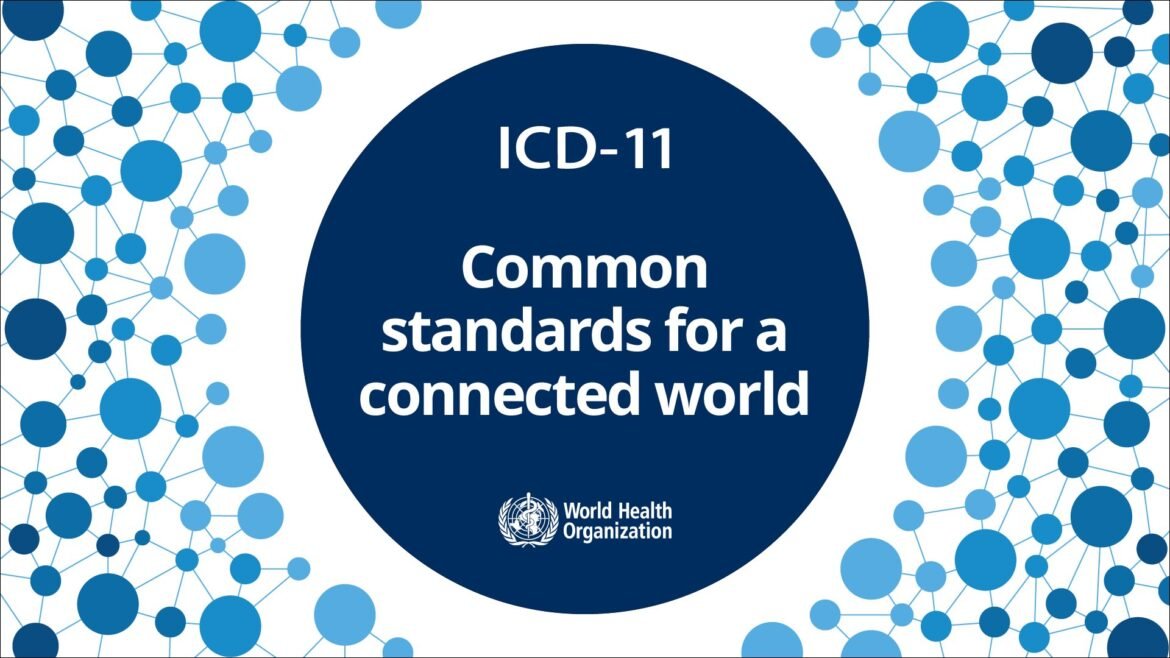
WHO’s new International Classification of Diseases (ICD-11) comes into effect

by Public Health Update February 11, 2022
written by Public Health Update

Overview

The World Health Organization (WHO) Eleventh Revision of the International Classification of Diseases (ICD-11) has now come into effect, with the latest update going online today.

The ICD provides a common language that allows health professionals to share standardized information across the world. It is the foundation for identifying health trends and statistics worldwide, containing around 17 000 unique codes for injuries, diseases and causes of death, underpinned by more than 120 000 codable terms. By using code combinations, more than 1.6 million clinical situations can now be coded.

Compared with previous versions, ICD-11 is entirely digital with a new user-friendly format and multilingual capabilities that reduce the chance of error. It has been compiled and updated with input from over 90 countries and unprecedented involvement of health-care providers, enabling evolution from a system imposed on clinicians into a truly enabling clinical classification and terminology database that serves a broad range of uses for recording and reporting statistics on health.

“International classification of diseases is the cornerstone of a robust health information system”, said Dr Samira Asma, the Assistant Director-General for Data, Analytics and Delivery for Impact at the World Health Organization (WHO). “ICD has been instrumental in helping us respond to the COVID-19 pandemic using standardized data and continues to be crucial for tracking progress towards universal health coverage. We hope all countries will take advantage of ICD-11’s powerful new features.”

Among other updates, ICD-11 improves the clarity of terms for the general public and facilitates the coding of important details such as the spread of a cancer or the exact site and type of a fracture. The new version also includes updated diagnostic recommendations for mental health conditions and digital documentation of COVID-19 certificates.

These updates reflect recent progress in medicine and advances in scientific understanding. For example, codes relating to antimicrobial resistance are now aligned with the Global Antimicrobial Resistance Surveillance System (GLASS). ICD-11 is also more capable of capturing data on health-care safety, thus identifying and reducing unnecessary events that may harm health such as unsafe workflows in hospitals.

ICD is used by health insurers who make reimbursement decisions on the basis of ICD coding, by national health programme managers, by data collection specialists, and by anyone who tracks progress in global health and determines health resource allocation.

“A key principle in this revision was to simplify the coding and provide users with all necessary electronic tooling – this will allow health-care professionals to more easily and completely record conditions,” says Dr Robert Jakob, Team Lead, Classifications Terminologies and Standards, WHO. 

In addition to coding and capability updates, ICD-11 includes new chapters on traditional medicine, sexual health, and gaming disorder – which has now been added to the section on addictive disorders.

ICD-11 was adopted at the World Health Assembly in May 2019 and Member States committed to start using it for mortality and morbidity reporting in 2022. Since 2019, early adopter countries, translators, and scientific groups have recommended further refinements to produce the version that is posted online today.

WHO remains committed to supporting all countries as they move towards implementing and scaling-up ICD-11.

ICD-11 Highlights

  • Legally mandated health data standard (WHO Constitution and Nomenclature Regulations).
  • In effect from January 2022.
  • Conceptual framework independent of language and culture.
  • Integration of terminology and classification.
  • End-to-end digital solution (API, tools, online and offline).
  • Up-to-date scientific knowledge.
  • Comparable statistics and semantic interoperability – for 150 years.
  • ICD-11 is accessible to everybody.
  • ICD-11 is distributed under Creative Commons Attribution-NoDerivs 3.0 IGO license.
  • ICD-11 enables, for the first time, the counting of traditional medicine services and encounters.
  • The 11th revision is more extensive and has greater implications for what can be done with the ICD, and how, than any revision since the 6th, in 1948.

ICD purpose and uses

As a classification and terminology ICD-11: 

  • allows the systematic recording, analysis, interpretation and comparison of mortality and morbidity data collected in different countries or regions and at different times;
  • ensures semantic interoperability and reusability of recorded data for the different use cases beyond mere health statistics, including decision support, resource allocation, reimbursement, guidelines and more.

Learn More (International Statistical Classification of Diseases and Related Health Problems) :WHO Website


Do you have a website? Looking for the best hosting provider? Here’s a discount code.

Latest Public Health Jobs

Latest Posts

  • International Wellness Day: Promoting Global Wellness for All
  • Summit Declaration: The 12th National Summit of Health and Population Scientists in Nepal
  • Joint political declaration on the reform of the global health architecture
  • World Health Day 2026: Together for Health. Stand with Science.
  • World Water Day 2026 | Water & Gender Equality

Thanks for visiting us.
Disclaimer: The resources, documents, guidelines, and information on this blog have been collected from various sources and are intended for informational purposes only. Information published on or through this website and affiliated social media channels does not represent the intention, plan, or strategies of an organization that the initiator is associated with in a professional or personal capacity, unless explicitly indicated.
If you have any complaints, information, or suggestions about the content published on Public Health Update, please feel free to contact us at blog.publichealthupdate@gmail.com.
#StayUpdated


  • WordPress
  • Link
  • Facebook
  • Mail
  • Facebook
  • Twitter
  • Twitter
  • LinkedIn
  • Instagram
  • Facebook
February 11, 2022 0 comments
0 FacebookTwitterPinterestLinkedinTumblrVKOdnoklassnikiRedditStumbleuponWhatsappTelegramLINEPocketSkypeViberEmail
Standard Treatment Protocol (STP) For Basic Health Services (BHS) Package 2078
National Plan, Policy & GuidelinesHealth SystemsResearch & Publication

Standard Treatment Protocol (STP) For Basic Health Services (BHS) Package 2078

by Public Health Update February 11, 2022
written by Public Health Update

Overview

The Curative Service Division, DoHS, Ministry of Health and Population (MoHP) has disseminated the Standard Treatment Protocol (STP) for Basic Health Services (BHS) Package 2078. The STP includes guidance on several diseases.

PART ONE: GENERAL INFORMATION

Chapter I – People-Centered Care and Rational Prescribing 2

  • People-Centered Care
  • Principles of Appropriate Prescribing
  • Rational Use of Antibiotics
  • Prescription and Its Contents
  • Infection Prevention and Control and Waste Management at Basic Health Care Centres

Recommended reading: Basic Health Service Package 2075

PART TWO: COMMON EMERGENCIES

Chapter II– Common Emergency Conditions

  • Surgical Skills – Dressing, Suturing, Incision and Drainage
  • Shock
  • Unconscious Patient
  • Convulsions
  • Primary Trauma Care (PTC)
  • Management of Fracture and Dislocation in Trauma Patients
  • Burns and Scalds
  • Drowning
  • Snake Bite
  • Poisoning
  • Common ENT and Eye Emergency Conditions

Chapter III – Common Symptoms

  • General Considerations on Pain
  • Chest Pain
  • Breathlessness/Shortness of Breath
  • Cough
  • Abdominal Pain
  • Nausea and Vomiting
  • Headache
  • Fever
  • Dizziness or Vertigo
  • Syncope (Sudden Collapse or Loss of Consciousness)
  • Itching (Pruritus)
  • Fatigue and Weakness (Generalised)

PART THREE: PREVENTIVE AND PROMOTIVE HEALTH SERVICES

Chapter IV – National Immunization Program

  • National Immunization Program
  • Case Surveillance for Vaccine Preventable Diseases
  • Chapter V – Integrated Management of Neonatal and Childhood Illness
  • Management of Children Under 2 Months
  • Management of Children 2 Months To 5 Years

Chapter VI – National Nutrition Programme and Nutrition Disorder

  • Causes of Malnutrition
  • Acute Malnutrition
  • Growth Monitoring and Promotion (GMP) Of Under 2 Years
  • Infant and Young Child Feeding
  • Micronutrient Supplementation and Deworming
  • Body Mass Index, Overweight, Obesity

Chapter VII – Safe Motherhood, Safe Abortion Care and PMTCT

  • Antenatal Care
  • Anaemia in Pregnancy
  • Normal Labour and Birth
  • Postpartum Care of The Mother and Immediate Newborn Care
  • Management of Complications: Emergency Obstetric and Newborn Care
  • Obstetric First Aid and Referral
  • Safe Abortion Services
  • Prevention of Mother-To-Child Transmission of HIV (PMTCT)
  • Referral and Emergency Response System

Chapter VIII – Family Planning and Reproductive Health Services

  • Family Planning
  • Uterine Prolapse/Pelvic Organ Prolapse
  • Fistula
  • Cervical Cancer – VIA, Counselling and Referral
  • Breast Lumps and Cancer

PART FOUR: CURATIVE SERVICES

Chapter IX – Communicable Diseases

  • HIV/AIDS
  • Tuberculosis
  • Animal Bite and Rabies
  • Malaria
  • Leprosy
  • Kala-Azar
  • Dengue
  • Lymphatic Filariasis
  • Gastrointestinal Infections
  • Respiratory Infections
  • Eruptive Skin Lesions
  • Genitourinary Infections
  • Urinary Tract Infection (UTI)

Chapter X – Non-Communicable Diseases (NCD)

  • Hypertension (HTN)
  • Diabetes Mellitus (DM)
  • Asthma and Chronic Obstructive Pulmonary Disease
  • Musculoskeletal Pain
  • Acid Peptic Disease
  • Disability
  • Mental Health Disorders: Common Neurotic and Psychotic Disorders And Idiopathic Epilepsy
  • Adolescent Health Services
  • Health of the Elderly, Physiotherapy & Rehabitation

Chapter XI – Common Eye, ENT, Oral, Skin Conditions

  • Eye Disorders
  • Ear, Nose and Throat Disorders
  • Oral Health Problems
  • Skin and Soft Tissue Infections

PART FIVE: AYURVEDA AND ALTERNATIVE MEDICINE

Chapter XIII – Homeopathic Medicine

PART SIX: HEALTH PROMOTION

Chapter XIV– Health Promotion

  • Health Education
  • Information, Education and Communication (IEC)
  • Behavioral Change Communication (BCC)
  • Public Awareness

PART SEVEN

Chapter XV – Investigations and Drugs in Basic Health Care Facilities

  • Basic Investigations at BHS Facilities
  • Drug List and Dosage Charts
  • Adverse Drug Reactions (ADRS), Prevention and ADR Reporting Form

DOWNLOAD PDF FILE

DOWNLOAD PDF FILE


Do you have a website? Looking for the best hosting provider? Here’s a discount code.

Latest Public Health Jobs

Latest Posts

  • International Wellness Day: Promoting Global Wellness for All
  • Summit Declaration: The 12th National Summit of Health and Population Scientists in Nepal
  • Joint political declaration on the reform of the global health architecture
  • World Health Day 2026: Together for Health. Stand with Science.
  • World Water Day 2026 | Water & Gender Equality

Thanks for visiting us.
Disclaimer: The resources, documents, guidelines, and information on this blog have been collected from various sources and are intended for informational purposes only. Information published on or through this website and affiliated social media channels does not represent the intention, plan, or strategies of an organization that the initiator is associated with in a professional or personal capacity, unless explicitly indicated.
If you have any complaints, information, or suggestions about the content published on Public Health Update, please feel free to contact us at blog.publichealthupdate@gmail.com.
#StayUpdated


  • WordPress
  • Link
  • Facebook
  • Mail
  • Facebook
  • Twitter
  • Twitter
  • LinkedIn
  • Instagram
  • Facebook
February 11, 2022 1 comment
0 FacebookTwitterPinterestLinkedinTumblrVKOdnoklassnikiRedditStumbleuponWhatsappTelegramLINEPocketSkypeViberEmail
Nepal Health Jobs! Latest trending health jobs and opportunities! Explore health jobs in Nepal
Vacancy AnnouncementHealth JobsJobs VacanciesPublic Health Jobs

Vacancy Announcement for Provincial Health Officer (PHO)

by Public Health Update February 11, 2022
written by Public Health Update

Position: Provincial Health Officer (PHO)  – (2200931)  
Grade: No grade
Contractual Arrangement: Special Services Agreement (SSA)
Contract Duration (Years, Months, Days): 1 Year
Job Posting : Feb 11, 2022, 11:35:32 AM
Closing Date: Mar 4, 2022, 4:44:00 AM
Primary Location: Nepal
Organization : SE_NEP WR Office, Nepal
Schedule: Full-time  

IMPORTANT NOTICE: Please note that the deadline for receipt of applications indicated above reflects your personal device’s system settings. 

Objectives of the Programme

Inadequate human resources in provincial and local governments has profound impact on delivery of essential health services, which also undermines efforts towards advancing Universal Health Coverage (UHC). Health system strengthening support to provinces will remain a key priority for WHO as outlined in Country Cooperation Strategy. This support for federalization at federal and sub-national level will include health systems approach enabling greater interaction and collaboration across different technical programs, in support of an integrated health system and UHC with more focus on building local capacity.  In federal context, the more technical support is needed in localisation SDGs as well as measuring, tracking and reporting of health sector SDG at large.

The incumbent will provide policy and strategic inputs to implement existing health acts, regulations, policies, strategies, framework, guidelines protocols, standards and capacity building initiatives of provincial and local governments with an emphasis on achieving Universal Health Coverage, Human Resource for Health, Coordination between provincial and local governments and identifying bottlenecks in delivery of basic health services and other critical health services.

 In addition, they will support technically in strategic planning, enhancing evidence-based planning and decision-making for identified health priorities at sub-national level with emphasis on translating national policies and guidelines into local practice with special attention to health service delivery and essential health service package. S/he will play a coordinating and liaising role in provinces and directly support and work with the health chief/high-level officials at Ministry of Social Development/Ministry of health/Ministry of Health and Population.

Description of Duties

Under the overall guidance of the WHO Representative and direct supervision of Public Health Administrator, the incumbent will work closely with planning and monitoring section in health service division of Ministry of Social Development/Provincial Ministry of Health/Ministry of Health and Population/Ministry of Health, Population and Family welfare (MoSD/MoH/MoHP/MoHPFW) and Provincial Health Directorate. S/he will support in formulating, implementing, and monitoring health sector policies, strategies, guidance, protocols, frameworks, planning and budgeting essentially to invest and improve health services delivery in the province where they are positioned.

These PHOs will work in close coordination with liaison officer stationed at federal Ministry of Health and Population with technical support from programme staff at WHO Country Office to implement health interventions priorities across health system strengthening program. Each quarter, quarterly periodic review will ensure regular progress of the quarter and the plan for next quarter. Each PHO will submit monthly progress report to the supervisor as well as quarterly report to Health coordination Division at Ministry of health and population through liaison officer.

The scope of work has been refined to provide technical support to the provincial government mainly in the areas of health systems with specific health sector priority interventions;

1.Technical guidance in policy and strategy development with emphasis on achieving UHC, HRH, coordination between provincial government and municipalities and identifying bottlenecks in delivery of essential health package and basic health services.

2.Support in federalization of health system, at provincial and local government levels with emphasis on translating acts, regulations, framework, policies, strategies, guidelines, standards into local practice with special attention to health service delivery and essential health package.

3.Support to roll out, tracking and monitoring of basic health services package, UHC framework, Service readiness assessment and health related SDGs.

4.Technical support in preparation of Provincial health profile and its regular update.

5.Strengthening support in integrated health information systems through regular monitoring in use of health management information, logistics management information, health facility registry, electronic health record.

6.Support in implementation and monitoring of health financing strategy with regular advocacy for increased investment in health sector, reducing out of pocket expenditure.

7.Support in strengthening regulatory practices and institutional development for Human Resource for Health (HRH) strategic action plan.

8.Support in collating and using HRH registry, HRH profiling, demand and supply, identifying human resource gaps, development of provincial HRH strategic and action plan for next 10 years.

9.Support in integrated capacity development package for province and local level as per capacity need assessment and provincial demand.

10.Technical support in regular review and monitoring of priority public health programs, reporting and health sector planning.

11.Technical support in strengthening birth and death data registration system at provinces.

12.Support in strengthening water, sanitation and hygiene in health care facilities, public health facilities as effective public health measures.

13.Collaborate with academy, universities and other relevant stakeholders to promote implementation research in health sector for evidence-based planning, programming and decision making.

14.Coordination and partnerships with other EDPs in technical areas of health system such as health governance, health information system, human resource for health and health financing to further strengthen and harmonize provincial support, resource mobilization and creating synergies in service delivery at sub-national level.

15.Support and facilitate to ensure Health-in All policies at province and sub-province level.

16.Support Ministries and health directorate for the conduction of policy dialogues and stakeholder engagement activities to promote health and well-beings.

17.Support provincial government to formulate and implement the provincial development plan especially health intervention in close collaboration with provincial planning commission.

 18.Facilitate capacity development needs assessment and action planning for municipal/rural level health section chief/coordinators.

19.Collect case studies, success stories and best practices at field level and contribute to produce reports to generate meaningful evidence.

20.Other responsibilities as assigned by supervisor. S/he may be deployed to assist in case of public health emergencies, outbreak, and pandemic.

Qualification:

Education:

Essential:

  • University Degree in Public health, Medicine, Nursing and other health science with master’s degree in public health (MPH).
  • Registered in respective health professional councils.

Experience:

Essential:

  • At least 7 years’ experience in managing health sector programs and policies at national and sub-national level.

Required Knowledge and Skills:

  • Intensive experience on developing and updating acts, regulations, policies, strategies, framework, standards, protocols, guidelines to health sectors.
  • Having proven track experience and understanding of international and national health sector commitments, mainstreaming SDGs and UHC, health service delivery model especially in the federal context, health system priorities and indicators, health system needs and bottlenecks.
  • Understanding of health governance, health information flow system, monitoring and evaluation and other crosscutting issues in federal context.
  • Demonstrated experience in working and delivering participatory evidence-based programming approach in health sector.
  • Experience in working with local capacity need assessments, planning and mainstreaming health as development and investment agenda with participatory approach.  
  • Good communication, coordination and resource mobilization skills.
  • Good leadership skills, negotiation skills, with an aptitude for external representation and networking.
  • Knowledge and skills on promoting implementation skills research and supporting evidence-based planning, programming and monitoring.
  • Good basic computer skills to perform and support in office software packages (MS office, SPSS, Stata)

WHO Competencies:

  • Teamwork
  • Respecting and Promoting individual and cultural differences
  • Communication
  • Ensuring effective use of resources

Use of Language Skills: Essential: Expert knowledge of English and Nepali

REMUNERATION:

Monthly Salary: (Net of tax) NPR 2,39,245 at single rate (taxable as per Nepal Government laws and appointment will be through Special Services Agreement (SSA)

Grade: Level 9

Duty Station:  Ministry of Social Development/Provincial Ministry of Health/Ministry of Health and Population/Ministry of Health, Population and Family welfare (MoSD/MoH/MoHP/MoHPFW) and Provincial Health Directorate.

ADDITIONAL INFORMATION

  • This Vacancy Notice may be used to fill similar positions at the same level.
  • Only candidates under serious consideration will be contacted.
  • A written test and interviews will be used as a form of screening
  • WHO is committed to workforce diversity.
  • WHO prides itself on a workforce that adheres to the highest ethical and professional standards and that is committed to put the WHO Values Charter into practice.
  • WHO has a smoke-free environment and does not recruit smokers or users of any form of tobacco.
  • This post is subject to local recruitment and will be filled by persons recruited in the local commuting area of the duty station.
  • In the event that your candidature is retained for an interview, you will be required to provide, in advance, a scanned copy of the degree(s)/diploma(s)/certificate(s) required for this position. WHO only considers higher educational qualifications obtained from an institution accredited/recognized in the World Higher Education Database (WHED), a list updated by the International Association of Universities (IAU)/United Nations Educational, Scientific and Cultural Organization (UNESCO). The list can be accessed through the link: http://www.whed.net/. Some professional certificates may not appear in the WHED and will require individual review.
  • For information on WHO’s operations please visit: http://www.who.int.
  • WHO has zero tolerance towards sexual exploitation and abuse (SEA), sexual harassment and other types of abusive conduct (i.e., discrimination, abuse of authority and harassment). All members of the WHO workforce have a role to play in promoting a safe and respectful workplace and should report to WHO any actual or suspected cases of SEA, sexual harassment and other types of abusive conduct. To ensure that individuals with a substantiated history of SEA, sexual harassment or other types of abusive conduct are not hired by the Organization, WHO will conduct a background verification of final candidates.

APPLICATION PROCESS: ONLINE (OFFICIAL LINK)


Do you have a website? Looking for the best hosting provider? Here’s a discount code.

Latest Public Health Jobs

Latest Posts

  • International Wellness Day: Promoting Global Wellness for All
  • Summit Declaration: The 12th National Summit of Health and Population Scientists in Nepal
  • Joint political declaration on the reform of the global health architecture
  • World Health Day 2026: Together for Health. Stand with Science.
  • World Water Day 2026 | Water & Gender Equality

Thanks for visiting us.
Disclaimer: The resources, documents, guidelines, and information on this blog have been collected from various sources and are intended for informational purposes only. Information published on or through this website and affiliated social media channels does not represent the intention, plan, or strategies of an organization that the initiator is associated with in a professional or personal capacity, unless explicitly indicated.
If you have any complaints, information, or suggestions about the content published on Public Health Update, please feel free to contact us at blog.publichealthupdate@gmail.com.
#StayUpdated


  • WordPress
  • Link
  • Facebook
  • Mail
  • Facebook
  • Twitter
  • Twitter
  • LinkedIn
  • Instagram
  • Facebook
February 11, 2022 0 comments
0 FacebookTwitterPinterestLinkedinTumblrVKOdnoklassnikiRedditStumbleuponWhatsappTelegramLINEPocketSkypeViberEmail
Nepal National Health Accounts 2017/18
Public HealthReportsResearch & Publication

Nepal National Health Accounts 2017/18

by Public Health Update February 10, 2022
written by Public Health Update

About Nepal National Health Accounts

The Nepal National Health Accounts 2017/18 report was prepared adhering to System of Health Accounts 2011 (SHA 2011), a global standard framework for producing health accounts with necessary refinements relevant to the country context.

This report provides the estimates of healthcare expenditures occurred in the health system of Nepal estimated based on the pre established expenditure boundaries, data sources, classification codes and estimation methodology. All reasonable precautions have been taken to justify the information presented in this publication. The estimates presented in this report could be further improved. Readers are welcome to contact the NHA team with suggestions and/or for further clarifications.

Recommended reading: Nepal National Health Accounts 2016/17

This report does not present or suggest the policy implications of healthcare expenditures. While limited analysis has been done in this report, it is the responsibility of the readers and stakeholders to use, interpret, and draw inferences from the data in this publication.

Objective

This round of NHA exercise was conducted between October 2019 and November 2020. The primary objective was to estimate and track the flow and level of spending by various entities such as government, households, external donors, national and international NGOs, private sectors, employers, insurance providers, etc. in the country’s health system and how the funding was used to deliver the health services and goods to the people.

The purpose was to understand the country’s health financing landscape and mechanism for evidence-based policymaking. The aim was to create demand and use health accounts to answer the key policy questions and inform policy decisions for health financing reforms. The key questions that this round of NHA intended to answer include:

  • How much did Nepal spend on healthcare? Who funds the healthcare in Nepal and how much did they contribute?
  • How sustainable are the overall resources for health in Nepal?
  • How were the healthcare funds managed and distributed? What is the role of government and donors in managing health care resources in Nepal?
  • What inputs were used to produce and deliver the overall healthcare services?
  • Who managed the healthcare funds in Nepal? What was the share of household out-of-pocket in overall healthcare financing in Nepal?
  • Who used the funds to deliver the healthcare services and how was the fund distributed at different levels of the health system of Nepal?
  • What kinds of healthcare services and goods were purchased with the healthcare funds?
  • Which diseases and health conditions Nepal spent on?
  • How is the health resource flow at the subnational level? Who finances health care and how the funds are managed and distributed at the provinces?

Executive Summary

Health Accounts aim to provide a systematic, comprehensive, and consistent record of health expenditure by estimating expenditure on the consumption of health services and goods in a country for the reference year. It provides a comprehensive understanding of the health financing system and the multisectoral contribution to a country’s health sector. Health Accounts track the expenditure of different sectors such as government, households, external donors, national and international nongovernmental organizations, private sector, employers, insurers, etc. in the country’s health system and how the funds were used to provide health services and goods to the population. Tracking health expenditure is an important decision making tool for policy and planning purposes.

Nepal has been conducting health accounts since 2000, and six rounds of Nepal National Health Accounts (NHA) have been completed so far. This is the seventh round of NHA, covering the 2017/18 fiscal year. The objective was to understand the landscape of health financing mechanisms in the country through evidence based on health expenditure estimates and find answers to key policy questions. In this round of NHA, necessary adjustments were made to some variables, the disease
account, further analysis of capital expenditure continues and for the first time, an estimate of health expenditure at the sub-national level is carried out, which becomes relevant as this is the year that decentralization was operationalized.

New on this report

  • This is the 7th round of NHA conducted by Nepal.
  • This round of NHA estimates was based on the six-dimensional classification of the System of Health Accounts (SHA) 2011 Framework.
  • Health expenditure data were compiled from various primary and secondary sources and checked for completeness, comprehensiveness, consistency, and plausibility.
  • The Health Accounts Production Tool (HAPT) was used for data validation and analysis.
  • This round of NHA estimates that noncommunicable disease spending has increased since the fiscal year 2016/17 which accounted more than half of the total CHE for the disease category.

Facts

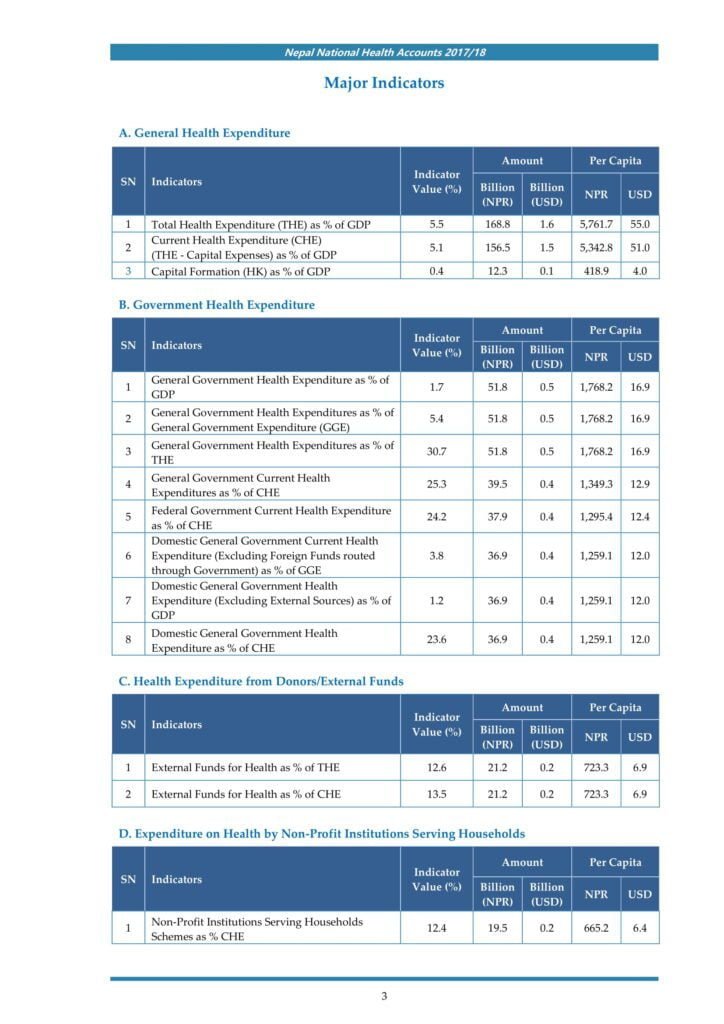
  • Current health expenditure (CHE) in nominal prices was estimated at NPR 156.5 billion (5.1% of GDP) in 2017/18 and capital expenditure at NPR 12.3 billion (0.4% of GDP).
  • Capital expenditure has declined slightly since the fiscal year 2016/17, with more than half of the total investment going to new and upgraded buildings.
  • Total Health Expenditure (THE), which is the sum of CHE and capital expenditure, was estimated at NPR 168.8 billion (USD 1.6 billion), equivalent to 5.5% of GDP, and per capita expenditure was NPR 5761.7 (USD 55.0) in 2017/18.
  • General Government Health Expenditure (GGHE) using all sources (recurrent and capital) amounted to NPR 53.1 billion (USD 0.5 billion), which was about one-third of THE and 5.5% of total government expenditure.
  • The share of GGHE in GDP was estimated at 1.7%.
  • The share of GGHE in CHE slightly increased from 25.3% since the fiscal year 2016/17 to 26.1% in the fiscal year 2017/18.
  • In the federal government system, the MoHP was the largest agency for managing government health expenditure, accounting for about 37.1% of GGHE, followed by provincial and local governments with about 33.5% and other ministries and public bodies 25.5%.
  • Curative care accounted for the largest share of government health expenditure in 2017/18 (47.3%), followed by preventive care (14.9%).
  • Total external funding for health was estimated at 13.5% of CHE, which includes direct foreign transfers and foreign transfers distributed for health through the government.
  • Of the non-government transfers, more than half came from private donors, philanthropic organizations, and the remainder from bilateral and multilateral organizations (1.9% and 2.5% of CHE).
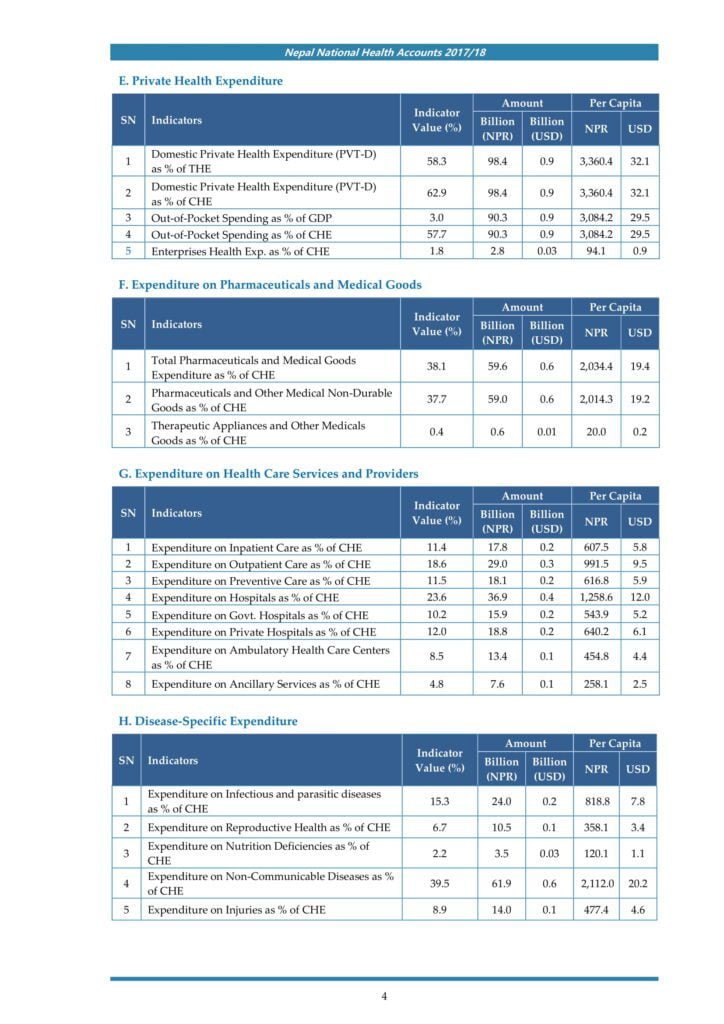
  • Household OOP payments for health care were the largest source and payer for their health care, with a share of 57.7% of the current health expenditure in Nepal’s health system.
  • The estimated household OOP expenditure was NPR 90,340.3 million (per capita NPR 3,084.2; USD 29.5).
  • As much as 65.6% of OOP payments for health care were for pharmaceuticals and medical supplies, followed by curative care at 23.2%. OOP at hospitals was estimated at 20.8% of total OOP where majority (16.6% of total OOP) was made at the private hospitals and the OOP at public hospitals was 4.2% of total OOP.
  • An analysis of disease-related expenditure shows that non-communicable diseases accounted for more than half of total household OOP expenditure.
  • As much as 38.1% of CHE was spent on pharmaceuticals and medical supplies, while curative care took up about 31.5% of CHE, where around 18.6% and 11.4% of CHE was spent on outpatient and inpatient care respectively.
  • Preventive and promotive care services claimed about 11.5% of CHE, which has declined since the fiscal year 2016/17.
  • In the FY 2017/18, total spending on medical laboratories, imaging, and patient transportation was estimated at 4.8% of CHE.
  • This round of NHA estimates that noncommunicable disease spending has increased since the fiscal year 2016/17 which accounted more than half of the total CHE for the disease category, that could be classified. The CHE for infectious and parasitic diseases was 15.3%.
  • Health expenditure estimates for the health provider classification showed that there was more expenditure in non public hospitals than in public hospitals (12.3% vs. 10.2% of CHE). Among public health care facilities, health care expenditures in public primary care facilities, was 7.1% of CHE.
  • Health expenditures incurred exclusively in primary health care facilities (both public and non-public) were estimated at 8.5% of CHE, a slight increase since the fiscal year 2016/17.
  • The government source was the main source of funding for public health facilities, although in public facilities foreign sources and household OOP made significant financial contributions.

Provincial status

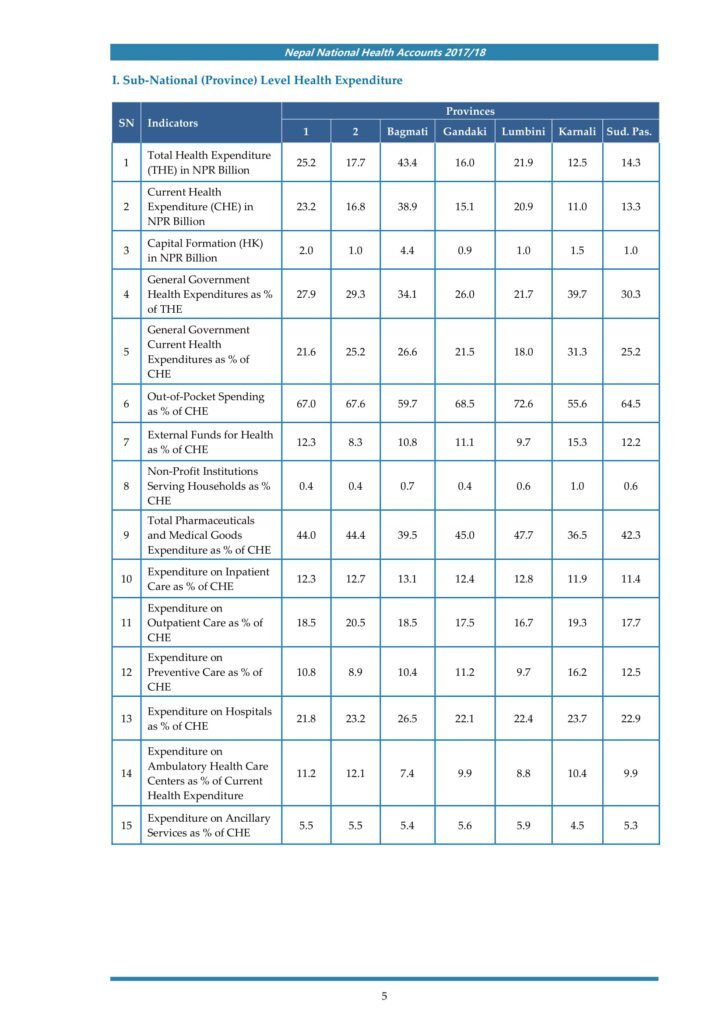
  • The distribution of health expenditure by province showed that Bagmati Province had the highest share of current and capital health expenditure, with provincial THE estimated at NPR 43.4 billion, followed by Province 1 and Lumbini Province with provincial THE of NPR 25.2 billion and NPR 21.9 billion, respectively. Karnali Province had the lowest provincial THE, estimated at NPR 12.5 billion.
  • About 11% of the national level Total Health Expenditure could not be distributed to the provinces.

Major Indicators

Nepal National Health Accounts 2017/18

Download: Nepal National Health Accounts 2017/18

MOHP (2022). NEPAL NATIONAL HEALTH ACCOUNTS 2017/18, MINISTRY OF HEALTH AND POPULATION, KATHMANDU.

Related document

  • Nepal National Health Accounts 2016/17
  • Progress of the Health and Population Sector, 2020/21 (NJAR Report)
  • Dissemination of Findings and Recommendations of Joint External Monitoring Mission(JEMM) of Nepal National Tuberculosis Program
  • Emergency Contraceptive Pills (ECP) Program Implementation Guideline 2078
  • National Standards on WASH for Health Institutions 2078
  • Pocket Book of Clinical Management of COVID-19 in Healthcare Setting: 2nd Edition with Revision
  • Tuberculosis Free Nepal Declaration Initiative Implementation Guideline

Do you have a website? Looking for the best hosting provider? Here’s a discount code.

Latest Public Health Jobs

Latest Posts

  • International Wellness Day: Promoting Global Wellness for All
  • Summit Declaration: The 12th National Summit of Health and Population Scientists in Nepal
  • Joint political declaration on the reform of the global health architecture
  • World Health Day 2026: Together for Health. Stand with Science.
  • World Water Day 2026 | Water & Gender Equality

Thanks for visiting us.
Disclaimer: The resources, documents, guidelines, and information on this blog have been collected from various sources and are intended for informational purposes only. Information published on or through this website and affiliated social media channels does not represent the intention, plan, or strategies of an organization that the initiator is associated with in a professional or personal capacity, unless explicitly indicated.
If you have any complaints, information, or suggestions about the content published on Public Health Update, please feel free to contact us at blog.publichealthupdate@gmail.com.
#StayUpdated



  • WordPress
  • Link
  • Facebook
  • Mail
  • Facebook
  • Twitter
  • Twitter
  • LinkedIn
  • Instagram
  • Facebook

February 10, 2022 0 comments
0 FacebookTwitterPinterestLinkedinTumblrVKOdnoklassnikiRedditStumbleuponWhatsappTelegramLINEPocketSkypeViberEmail
Nepal Health Jobs! Latest trending health jobs and opportunities! Explore health jobs in Nepal
Jobs VacanciesHealth JobsPublic Health JobsVacancy Announcement

Vacancy Announcement for Country Director

by Public Health Update February 9, 2022
written by Public Health Update

Chemonics seeks a Country Director for the Global Health Supply Chain – Procurement and Supply Management (GHSC-PSM) project in Nepal. GHSC-PSM is the primary vehicle through which USAID procures and provides health commodities, provides technical assistance to improve partner countries’ management of the supply chain, and collaborates with key international stakeholders to support global health initiatives. The Country Director is responsible for providing overall strategic direction and leadership for the GHSC-PSM project in Nepal. The County Director will manage the development of technical strategies and work plans; monitor programmatic, financial and administrative performance; supervise the administration of standard project operating and financial procedures; manage short and long-term technical assistance; and maintain effective communication with the client, the home office, the public and private sectors, and other donors and cooperating agencies. This is a long-term position based in Kathmandu, Nepal.

Responsibilities include:

  • Maintain strong and positive working relationships with clients and partners including USAID and host country government.
  • Develop and implement annual work plans and budgets that reflect the priorities of USAID, the ministry of health, and other stakeholders.
  • Strategically identify capacity gaps and arrange for appropriate training of field staff.
  • Ensure the use of appropriate management methodologies to plan, organize and control resources to achieve goals.
  • Develop, update and implement performance monitoring plan that encompasses commodity security and logistics management indicators and includes project-wide performance measures.
  • Oversee regular data collection and reporting and lead quarterly reviews of performance analysis to identify issues and drive evidence-based interventions.
  • Coordinate with relevant stakeholders in the provision of assistance to build the capacity and capability of national systems.
  • Report results of the projects’ work to USAID, ministry of health, other funders, and the home office. Ensure timely submission of all regular and ad hoc deliverables.
  • Other duties as assigned by supervisor.

Qualifications:

  • Advanced degree in health, supply chain, or management-related discipline preferred.
  • Minimum 8 years of experience in public health program management, pharmaceuticals and medical supplies, supply chain management systems, and/or systems strengthening
  • Experience leading implementation of Management Information systems (MIS) is strongly preferred.
  • Skilled in leading and managing high-performing teams.
  • Demonstrated ability to work with cooperating partners in implementing complex programs.
  • Experience working on USAID programs in close collaboration with USAID is preferred.
  • Fluent spoken and written English is required.
  • Relevant country or regional experience is preferred.

Application Instructions:

Please send your CV and cover letter to psmnepalrecruit@chemonics.com by February 28, 2022. Please include “Nepal Country Director” in the subject line. Applications will be considered on a rolling basis, finalists will be contacted.

subject line. Applications will be considered on a rolling basis, finalists will be contacted.

Chemonics is an equal opportunity/affirmative action employer and does not discriminate in its selection and employment practices. All qualified applicants will receive consideration for employment without regard to race, color, religion, sex, national origin, political affiliation, sexual orientation, gender identity, marital status, disability, protected veteran status, genetic information, age, or other legally protected characteristics. Military veterans, AmeriCorps, Peace Corps, and other national service alumni are encouraged to apply.

Chemonics values the protection of your personal data. If you are in the European Union, please read our EU Recruiting Data Privacy Notice to learn how we process personal data. You may access the notice via the following link: https://chemonics.com/eu-recruiting-data-privacy-notice/


Do you have a website? Looking for the best hosting provider? Here’s a discount code.

Latest Public Health Jobs

Latest Posts

  • International Wellness Day: Promoting Global Wellness for All
  • Summit Declaration: The 12th National Summit of Health and Population Scientists in Nepal
  • Joint political declaration on the reform of the global health architecture
  • World Health Day 2026: Together for Health. Stand with Science.
  • World Water Day 2026 | Water & Gender Equality

Thanks for visiting us.
Disclaimer: The resources, documents, guidelines, and information on this blog have been collected from various sources and are intended for informational purposes only. Information published on or through this website and affiliated social media channels does not represent the intention, plan, or strategies of an organization that the initiator is associated with in a professional or personal capacity, unless explicitly indicated.
If you have any complaints, information, or suggestions about the content published on Public Health Update, please feel free to contact us at blog.publichealthupdate@gmail.com.
#StayUpdated


  • WordPress
  • Link
  • Facebook
  • Mail
  • Facebook
  • Twitter
  • Twitter
  • LinkedIn
  • Instagram
  • Facebook
February 9, 2022 0 comments
0 FacebookTwitterPinterestLinkedinTumblrVKOdnoklassnikiRedditStumbleuponWhatsappTelegramLINEPocketSkypeViberEmail
Nepal Health Jobs! Latest trending health jobs and opportunities! Explore health jobs in Nepal
Jobs VacanciesHealth JobsPublic Health JobsVacancy Announcement

Vacancy Announcement Consultancy to support WASH knowledge management activities

by Public Health Update February 9, 2022
written by Public Health Update

Consultancy to support WASH knowledge management activities in South Asia Regional and Country Offices

Job no: 548184
Contract type: Consultancy
Level: Consultancy
Location: Nepal
Categories: WASH (Water, Sanitation and Hygiene)

UNICEF works in some of the world’s toughest places, to reach the world’s most disadvantaged children. To save their lives. To defend their rights. To help them fulfill their potential.

Across 190 countries and territories, we work for every child, everywhere, every day, to build a better world for everyone.

And we never give up.

For every child, a future

How can you make a difference?

1. Background and Rationale:

In the frame of UNICEF’s work in WASH, knowledge management (KM) activities represent one of the strategic tools to support the achievements of sectoral output results for children. KM underpins the effectiveness and efficacy of the WASH programme to maximize its impact with the available resources. KM should be used to generate, capture, use and share UNICEF’s organizational WASH knowledge to improve the quality, equity and sustainability of WASH services.

UNICEF aims to ensure that programmes design is based on the best available information and knowledge and that advocacy is based on rigorously analysed evidence. As WASH sector leader, UNICEF aims at sharing and applying knowledge and innovative practice with global partners, international institutions and across the wider development community, to support global decision making and advocacy and help building best practice.

UNICEF WASH programme’s KM actions are based on the WASH KM strategic framework, that focuses on the 4 pillars of KM, which are generating, customizing, disseminating knowledge and building staff capacity.

The UNICEF Regional Office for South Asia (ROSA) WASH section is supporting country offices (CO) in the region to strengthen their KM activities, in accordance with the WASH and ROSA frameworks. A key element is to support the country offices to develop high quality knowledge products such as short publications, outreach and advocacy materials, (studies, research, evaluation, reports, etc.).

SAR UNICEF country offices’ WASH sections are very active in Knowledge generation and they produce multiple knowledge products every year, in the frame of the implementation of their WASH programmes, both internally and in coordination with the sector partners, and often in collaboration with Academy or with other external support. Examples of these knowledge products are: studies, researches, evaluations, reports, field notes and other global templated items, etc. 

While knowledge generation is not perceived as an issue, the transfer of tacit to explicit knowledge is time consuming and often stretches the capacity (related to availability of time and writing skills) of CO staff. Therefore, regional support is often requested to facilitate and support knowledge product development, which includes, re-packaging of existing documents, development of knowledge products using global WASH sector templates and dissemination to external knowledge platforms, as well as regional research to strengthen national level advocacy efforts. The format and content of publications will depend on the audiences to whom they are addressed, and the same document could have different shapes according to its final users.

Based on the above analysis, UNICEF ROSA is seeking the support of an experienced WASH expert and editor to support UNICEF country offices in the region to develop knowledge products as per annual rolling workplans using innovative formats as well as existing UNICEF templates.

The UNICEF Regional Office for South Asia (ROSA) WASH section is supporting country offices (CO) in the region to strengthen their KM activities, in accordance with the WASH and ROSA frameworks. A key element is to support the country offices to develop high quality knowledge products such as short publications, outreach and advocacy materials, (studies, research, evaluation, reports, etc.).

SAR UNICEF country offices’ WASH sections are very active in Knowledge generation and they produce multiple knowledge products every year, in the frame of the implementation of their WASH programmes, both internally and in coordination with the sector partners, and often in collaboration with Academy or with other external support. Examples of these knowledge products are: studies, researches, evaluations, reports, field notes and other global templated items, etc. 

While knowledge generation is not perceived as an issue, the transfer of tacit to explicit knowledge is time consuming and often stretches the capacity (related to availability of time and writing skills) of CO staff. Therefore, regional support is often requested to facilitate and support knowledge product development, which includes, re-packaging of existing documents, development of knowledge products using global WASH sector templates and dissemination to external knowledge platforms, as well as regional research to strengthen national level advocacy efforts. The format and content of publications will depend on the audiences to whom they are addressed, and the same document could have different shapes according to its final users.

Based on the above analysis, UNICEF ROSA is seeking the support of an experienced WASH expert and editor to support UNICEF country offices in the region to develop knowledge products as per annual rolling workplans using innovative formats as well as existing UNICEF templates.

2. Purpose:

The purpose of this consultancy is to support UNICEF country offices in South Asia and ROSA in their WASH knowledge management activities, particularly to enhance the knowledge and capacities of the WASH staff by supporting the development of high-quality technical WASH knowledge products.  The main objective of this consultancy is to ensure WASH staff in the region are supported with the analysis of information and data available to enhance knowledge of staff and partners are kept informed and updated on latest technological advancements, new developments and project information of the countries in the region. Analytical expertise will also be used for the elaboration of several high-quality WASH knowledge products using UNICEF WASH templates and extracting and synthesizing from existing knowledge initiatives developed by the country offices.  The knowledge products elaborated by the consultancy will be ready for dissemination and use by UNICEF and partners in the region and beyond.

3. Key Assignments and Tasks:

The elaboration of each WASH knowledge product will include the following detailed activities, estimated no. of working days, and final deliverables:

  • Identification, analysis and compilation of global advancements in Water, Sanitation, Hygiene, Climate change related sectors on a regular basis.
  • Elaborate a zero draft of knowledge products per batch (total of 4), using agreed templates,
  • Discuss the zero draft with ROSA and country office focal points as necessary and get initial comments and inputs.  Incorporate the comments and inputs and elaborate the second draft of the knowledge products, per batch.
  • Present the second draft to ROSA and get the final comments and inputs.  Incorporate the final comments and inputs and elaborate the final knowledge products, per batch.
  • Publish and disseminate products through UNICEF formats for the benefit of WASH staff in the region.

4. Key Deliverables:

Deliverables                                   estimated number of working days               Due date

Knowledge products Batch 1                       25                                                   15 May 2022

Knowledge products Batch 2                       25                                                   15 August 2022

Knowledge products Batch 3                       25                                                   15 November 2022

Knowledge products Batch 4                       25                                                   31 January 2023

Working modalities: Work from home

Duration of consultancy assignments: 20 February 2022 – 31 January 2023 (100 effective days of work)

Note: Please submit your application with the financial proposals indicating your fees. 

To qualify as an advocate for every child you will have…

Education:

•        Master University degree in public health, hydrogeology, or any related discipline.

•       A University degree with equal years of relevant work experience in lieu of a Master degree is acceptable.

Work Experience:

  • A minimum of 8 years’ experience in the WASH sector, related with management of water and/or sanitation programmes in developing countries.
  • Experience in editing and writing on different topics related to the WASH sector and social science.
  • Excellent writing skills and demonstrated record of high quality publications on WASH, social science and development issues.
  • Knowledge and demonstrate experience of review, editing, report writing and proofreading.
  • Previous experience editing and writing for UNICEF and familiarity with UNICEF’s style guidelines would be an asset.
  • Excellent communication skills.

Language Proficiency:

The consultant should be proficient in English, with proven ability to write high level papers for different type of audiences.


For every Child, you demonstrate…

Competencies:

The Consultant should be familiar with working on standard graphics and UNICEF global templates.

UNICEF’s values of Care, Respect, Integrity, Trust, and Accountability (CRITA).

To view our competency framework, please visit here.

UNICEF is committed to diversity and inclusion within its workforce, and encourages all candidates, irrespective of gender, nationality, religious and ethnic backgrounds, including persons living with disabilities, to apply to become a part of the organization.

UNICEF has a zero-tolerance policy on conduct that is incompatible with the aims and objectives of the United Nations and UNICEF, including sexual exploitation and abuse, sexual harassment, abuse of authority and discrimination. UNICEF also adheres to strict child safeguarding principles. All selected candidates will be expected to adhere to these standards and principles and will therefore undergo rigorous reference and background checks. Background checks will include the verification of academic credential(s) and employment history. Selected candidates may be required to provide additional information to conduct a background check.

Remarks:

Mobility is a condition of international professional employment with UNICEF and an underlying premise of the international civil service.

Only shortlisted candidates will be contacted and advance to the next stage of the selection process.

Individuals engaged under a consultancy or individual contract will not be considered “staff members” under the Staff Regulations and Rules of the United Nations and UNICEF’s policies and procedures, and will not be entitled to benefits provided therein (such as leave entitlements and medical insurance coverage). Their conditions of service will be governed by their contract and the General Conditions of Contracts for the Services of Consultants and Individual Contractors. Consultants and individual contractors are responsible for determining their tax liabilities and for the payment of any taxes and/or duties, in accordance with local or other applicable laws.

Advertised: 04 Feb 2022 Nepal Standard Time
Deadline: 11 Feb 2022 Nepal Standard Time

APPLY NOW


Do you have a website? Looking for the best hosting provider? Here’s a discount code.

Latest Public Health Jobs

Latest Posts

  • International Wellness Day: Promoting Global Wellness for All
  • Summit Declaration: The 12th National Summit of Health and Population Scientists in Nepal
  • Joint political declaration on the reform of the global health architecture
  • World Health Day 2026: Together for Health. Stand with Science.
  • World Water Day 2026 | Water & Gender Equality

Thanks for visiting us.
Disclaimer: The resources, documents, guidelines, and information on this blog have been collected from various sources and are intended for informational purposes only. Information published on or through this website and affiliated social media channels does not represent the intention, plan, or strategies of an organization that the initiator is associated with in a professional or personal capacity, unless explicitly indicated.
If you have any complaints, information, or suggestions about the content published on Public Health Update, please feel free to contact us at blog.publichealthupdate@gmail.com.
#StayUpdated


  • WordPress
  • Link
  • Facebook
  • Mail
  • Facebook
  • Twitter
  • Twitter
  • LinkedIn
  • Instagram
  • Facebook
February 9, 2022 0 comments
0 FacebookTwitterPinterestLinkedinTumblrVKOdnoklassnikiRedditStumbleuponWhatsappTelegramLINEPocketSkypeViberEmail
Nepal Health Jobs! Latest trending health jobs and opportunities! Explore health jobs in Nepal
Vacancy AnnouncementHealth JobsJobs VacanciesPublic Health Jobs

Vacancy for Health Specialist-Health and Immunization Financing

by Public Health Update February 9, 2022
written by Public Health Update

Health Specialist-Health and Immunization Financing, (P-4), ROSA, Nepal#117222

Job no: 548104
Contract type: Fixed Term Appointment
Level: P-4
Location: Nepal
Categories: Health, Expanded Programme Immunization

UNICEF works in some of the world’s toughest places, to reach the world’s most disadvantaged children. To save their lives. To defend their rights. To help them fulfill their potential.

Across 190 countries and territories, we work for every child, everywhere, every day, to build a better world for everyone.

And we never give up.

For every child, inspiration

UNICEF ROSA health agenda is driven by multi-sectoral coordination and investments to strengthen Primary Health Care (PHC) toward the achievement of Universal Health Coverage (UHC) in the South Asia Region. The focus will be on accelerating the unfinished agenda on newborn, child, and adolescent health, in building resilient primary health care in the context of the COVID-19 pandemic. While moving these agenda forward, investments will be made in health and community systems strengthening with a focus on building internal and local capacity for evidence generation and use to influence policies, plans, strategies, and priorities, including sustainable health financing. In the area of health financing, the focus will be on strengthening domestic resource mobilization efforts and improved management and efficiency of available funds. Despite progress made, health expenditure is still pushing millions of families into poverty in South Asia.  Data from 2019 showed that an average of less than 2% percent of Southeast Asian countries’ GDPs goes toward healthcare. Therefore, health financing is still relying heavily on out-of-pocket spending and development assistance.

How can you make a difference?

The Health Specialist, Health and Immunization Financing is based at the UNICEF Regional Office for South Asia (ROSA), and provides technical assistance to the countries of South Asian and the East Asia and the Pacific region (EAPRO). Under the overall supervision and guidance of the Regional Health Adviser, the Health Specialist is responsible for the strategic and operational guidance, and technical support in the areas of health financing, including immunization financing. This includes support to managing, implementing, monitoring, evaluating, and reporting on health expenditures and financing for maternal, newborn, child, and adolescent health, with a focus on immunization.  

  • Provide strategic and programmatic guidance and technical support to the countries in UNICEF South Asia and East Asia and the Pacific regions (ROSA & EAPRO) to improve the linkages between planning, costing, budgeting, and financing of child health programs with a focus on immunization.
  • Align child health and immunization financing to broader health financing, focusing on efficiency and sustainability.
  • Ensure that policy dialogue and resource mobilization issues are addressed from a sector wide and “Health in All Policies” approach with the focus that sustainability is not seen solely in terms of additional resources but also as requiring efforts to improve efficiency in the use of the existing resources, being domestic or external. 
  • Strategically leverage immunization resources to strengthen the pillars of the health system to impact broader MNCAH services with a focus on decentralized health systems management, innovative service delivery, and equitable access to quality services.  
  • Provide technical assistance to governments and other relevant stakeholders in costing of PHC, particularly the operational costs of health and immunization related strategic and operational plans with a focus on allocative efficiency. 
  • Work with national governments, health, and immunization partners on sustainability strategies in the context of PHC, including identifying new funding sources especially through domestic resource mobilization.
  • Support the development of research agendas and special initiatives related to improving health policy and financing.

To qualify as an advocate for every child you will have…

  • An advanced university degree (Master’s or higher) in health economics or in Public Health with a focus on health economics or health financing, or an advanced degree in economics or financing with a focus on Health Systems Strengthening and/or other related field.
  • A minimum of eight years of relevant professional experience in health economics analysis and Public Financial Management in Health.
  • Experience working in a developing country preferably in Asia is considered as an asset.
  • Relevant experience in a UN system agency or organization is considered as an asset.
  • Strong relationship building skills in the global health community, particularly among donors, multilateral partners, and implementers
  • Developing country work experience and/or familiarity with emergency is considered an asset.
  • Fluency in English is required. Knowledge of another official UN language (Arabic, Chinese, French, Russian or Spanish) or a local language is an asset.

For detailed description-refer to the attached JD- JD- Health Specialist-Health and Immunization Financing FT-P4.pdf

For every Child, you demonstrate…

UNICEF’s values of Care, Respect, Integrity, Trust, and Accountability (CRITA).

The UNICEF competencies required for this post are…

  • Demonstrates Self Awareness and Ethical Awareness (1)
  • Works Collaboratively with others (1)
  • Builds and Maintains Partnerships (1)
  • Innovates and Embraces Change (1)
  • Thinks and Acts Strategically (1)
  • Drive to achieve impactful results (1)
  • Manages ambiguity and complexity (1)

To view our competency framework, please visit here.

UNICEF is committed to diversity and inclusion within its workforce, and encourages all candidates, irrespective of gender, nationality, religious and ethnic backgrounds, including persons living with disabilities, to apply to become a part of the organization.

UNICEF has a zero-tolerance policy on conduct that is incompatible with the aims and objectives of the United Nations and UNICEF, including sexual exploitation and abuse, sexual harassment, abuse of authority and discrimination. UNICEF also adheres to strict child safeguarding principles. All selected candidates will be expected to adhere to these standards and principles and will therefore undergo rigorous reference and background checks. Background checks will include the verification of academic credential(s) and employment history. Selected candidates may be required to provide additional information to conduct a background check.

Remarks:

Mobility is a condition of international professional employment with UNICEF and an underlying premise of the international civil service.

Only shortlisted candidates will be contacted and advance to the next stage of the selection process.

“UNICEF only considers higher educational qualifications obtained from an institution accredited/recognized in the World Higher Education Database (WHED), a list updated by the International Association of Universities (IAU) / United Nations Educational, Scientific and Cultural Organization (UNESCO). The list can be accessed at http://www.whed.net/”

Advertised: 02 Feb 2022 Nepal Standard Time
Deadline: 16 Feb 2022 Nepal Standard Time

APPLY NOW


Do you have a website? Looking for the best hosting provider? Here’s a discount code.

Latest Public Health Jobs

Latest Posts

  • International Wellness Day: Promoting Global Wellness for All
  • Summit Declaration: The 12th National Summit of Health and Population Scientists in Nepal
  • Joint political declaration on the reform of the global health architecture
  • World Health Day 2026: Together for Health. Stand with Science.
  • World Water Day 2026 | Water & Gender Equality

Thanks for visiting us.
Disclaimer: The resources, documents, guidelines, and information on this blog have been collected from various sources and are intended for informational purposes only. Information published on or through this website and affiliated social media channels does not represent the intention, plan, or strategies of an organization that the initiator is associated with in a professional or personal capacity, unless explicitly indicated.
If you have any complaints, information, or suggestions about the content published on Public Health Update, please feel free to contact us at blog.publichealthupdate@gmail.com.
#StayUpdated


  • WordPress
  • Link
  • Facebook
  • Mail
  • Facebook
  • Twitter
  • Twitter
  • LinkedIn
  • Instagram
  • Facebook
February 9, 2022 0 comments
0 FacebookTwitterPinterestLinkedinTumblrVKOdnoklassnikiRedditStumbleuponWhatsappTelegramLINEPocketSkypeViberEmail
Nepal Health Jobs! Latest trending health jobs and opportunities! Explore health jobs in Nepal
Nursing JobsHealth JobsJobs VacanciesVacancy Announcement

Vacancy Announcement for Assistant Nurse

by Public Health Update February 9, 2022
written by Public Health Update

The Gurkha Contingent, Singapore Police Force (GC, SPF) based in Singapore invites applications from suitably qualified individuals (female) for the post of Assistant Nurse.

Brief Job Description

The principal job responsibilities include:

  • Provision of antenatal care; postnatal care; and care of newborn babies; making home visits as required; provide care for families dealing with pregnancies;
  • Provision of first aid and basic nursing care, particularly for wives and children; child immunisation, child development assessment; and infection control;
  • Perform assessments of health status, determining the need and level of nursing and/or medical care; Communication with Singaporean health practitioners and agencies;
  • Participate in an on-call rota providing a 24hrs midwifery / nursing service in GC;
  • Assist in the day-to-day operations and Busines Continuity Plan of the GC Medical Centre; Provide counselling support to GC families;
  • Provide education on nutrition, healthy lifestyle choices, children’s health and safety.

Requirements

The requirements for Midwife/ Assistant Nurse are as under:

  • Must be a Female Nepali citizen, between 25 – 35 years of age, with a valid passport; Must have passed 10+2 (majoring in English) or equivalent;
  • Must have a minimum PCL Midwife / Nursing Qualification, or other equivalent qualifications (References and Certificates will be required);
  • Must have 3 years of experience in Midwife / Nursing care and practices (References as a registered nurse in Nepal are required);
  • Nutritionist, Counsellor and/or Social Worker qualifications would be an added advantage (References and Certificates are required);
  • Must have good communication and presentation skills and able to communicate clearly in English and Nepali, both written and spoken;
  • Must be compassionate with good inter-personal skills and able to establish good rapport with GC community and other agencies;
  • Must be single or be willing to serve unaccompanied if married.

Remuneration / Benefits

The successful candidate will:

  • Be appointed on an initial 2-year contract (renewable);
  • Paid a salary in Singapore Dollars, starting at SGD $1,150 per month; Receive a lump sum gratuity payable at the end of each contract;
  • Be entitled to 14 days leave per annum;
  • Be provided a furnished apartment, on a co-share basis; Be provided subsidised rations;
  • Receive free economy class air passage on appointment and return passage on completion of each contract;
  • Receive additional baggage allowance on first arrival and on completion of final contract; Be entitled to Medical and Dental benefits.

Contract

The contract terms and conditions will be based upon the Singapore Civil Service, Terms and Conditions of Service.

Application

Online application together with full Curriculum Vitae (CV) and copies of qualifications, experience and references are to be submitted in PDF file via FormSG link/QR code provided below. Closing date for applications is on 24 February 2022.

Internet URL: www.form.gov.sg/61d3d2d82e38540012538d7a

Interview

Shortlisted candidates will be notified via GC SPF Representative in early March 2022 for an interview. All original documents are to be produced during the interview.

Vaccination

The selected candidate should be fully vaccinated/inoculated (i.e. 14 days after completion of full doses) before departing to Singapore. She is to produce the proof of vaccination.

For inquiries, contact GCSPF Representative (Tel 01 5547193), British Gurkhas Nepal, Manbhawan, Lalitpur.

February 9, 2022 0 comments
0 FacebookTwitterPinterestLinkedinTumblrVKOdnoklassnikiRedditStumbleuponWhatsappTelegramLINEPocketSkypeViberEmail
Nepal Health Jobs! Latest trending health jobs and opportunities! Explore health jobs in Nepal
Public Health JobsHealth JobsJobs VacanciesVacancy Announcement

Vacancy Announcement for NPO (Project and Partnerships Management)

by Public Health Update February 9, 2022
written by Public Health Update

NPO (Project and Partnerships Management) – (2200391)

Grade: NO-B

Contractual Arrangement: Fixed-term appointment

Contract Duration (Years, Months, Days): 1 Year

Job Posting: Jan 31, 2022, 4:37:24 PM

Closing Date : Feb 22, 2022, 4:44:00 AM

Primary Location : Nepal-Kathmandu

Organization: SE_NEP WR Office, Nepal

Schedule : Full-time  

IMPORTANT NOTICE: Please note that the deadline for receipt of applications indicated above reflects your personal device’s system settings. 

OBJECTIVES OF THE PROGRAMME

The objective of the WHO Nepal Country Office is to implement the Country Cooperation Strategy by supporting the Ministry of Health and Population (MoHP), Government of Nepal (GoN) in the formulation, implementation and evaluation of national health policies, strategies and plans and developing and managing WHO’s technical cooperation programmes at the country level. The Country Office collaborates with the Government of Nepal and relevant stakeholders in support of their efforts of achieving national health goals, of ensuring the attainment of universal health coverage and of contributing to global and regional public health action by providing need-based technical assistance in national level policy formulation, setting norms and standards, improving knowledge dissemination and management, monitoring country health situation and building sustainable institutional capacity, to play a greater leadership role in different national level policy technical forums. The WHO Health Emergencies Programme (WHE) supports the MoHP, GoN to direct and coordinate and provide life-saving emergency health interventions at scale. In the aftermath of multi-hazard emergencies and disasters, WHE subsequently assists in the early recovery activities of the heath sector in collaboration with national and international partners. WHE provides technical support to the MoHP and partners to enhance health sector emergency risk management through prevention, risk reduction or mitigation, preparedness, and response readiness to improve resiliency to multi-hazard disasters including public health emergencies. Within this framework, Operational partners and WHO Readiness’ objective is to build effective partnerships with implementing organizations, research interests and application requirements of donors and other potential sources of funding to the country, and strengthen WHO readiness for emergency response through capacity-building and disaster risk reduction, activities, in consultation with the Regional Office and HQ, as needed.

DESCRIPTION OF DUTIES

Under the overall guidance of the WHO Representative and the direct supervision of the Team leader – WHE Programme, in close collaboration with other members of the WHE team of WCO Nepal and in collaboration with other team members within WCO Nepal and key external stakeholders, the incumbent will perform the following tasks:

Operational partnerships:

1. Develop a flexible and innovative resource mobilization strategy to ensure sustainable financing for core positions and emergency activities at the country level. In coordination with TL-WHE, write the donor briefing materials, funding proposals, and other WHO and UN appeal documents; to be used an advocacy and fundraising tools;

2. Identify main emergency response implementing partners and donors to the country in consultation with TL-WHE and WR and proactively contribute to negotiations for rapid proposal development and donor agreements. This includes management support for stand-by partnerships and development of roster of implementing partners with duly completed capacity assessment, due diligence, and risk assessment;

3. Oversee the overall activities related to mobilization of resources, grants management, funding needs and gaps, and the award management process at the country office level. Maintain project calendars and milestones; analyze information on project activities and monitor progress towards targets using various project management databases; evaluate the progress status of selected projects through field missions;

4. Work closely with the relevant Regional Office and HQ focal points as required to secure on the required clearance, including legal and financial clearances for proposals, grant letters of agreement (GLOA), and donor agreements before signature. Provide technical guidance to the respective staff with the recalibration of inputs, outputs; ensure that timely donor approval is requested for project amendments;

5. In coordination with communications team, effectively utilize the communication products to inform donors about both Health Sector and WHO’s strategies and work to encourage them to fund the overall health sector response to affected populations and WHO’s strategic plans and proposals;

6. Coordinate the development of various written reports, documents and communications, e.g. donor reports, concepts notes, proposals, donor agreements, presentations, annual reports, etc.;

7. Coordinate technical support on monitoring and evaluation to ensure that monitoring and evaluation aspects are fully integrated into Country Cooperation Strategy and WHE managed work plans.

WHO readiness:

8. Planning and assessments

8.1. Conduct hazard, vulnerability and capacity assessment and support preparation and updating of risk-informed and prioritized multi-hazard health sector emergency / disaster risk reduction and management plans, standard operating protocols including appropriate monitoring and evaluation strategies;

8.2. Support implementation, monitoring, and periodic testing (e.g. through designing and conducting table top or simulation exercises), evaluation and updating of approved health sector emergency / disaster risk reduction and management plans; including supporting HEOC and provincial HEOCs (PHEOCs) in designing and conducting table-top exercises, functional drills, simulation exercises, and after-action reviews;

8.3. Undertake planned capacity-building, operations research and monitoring and evaluation activities to strengthen health sector disaster risk reduction and management capabilities to address multi-hazard  risks;

9. Coordination

9.1. Support humanitarian partner coordination, communication, and information management functions throughout the humanitarian program cycle with focus on health sector emergency preparedness and response interventions;

9.2. Assist to conduct initial rapid assessments, sectoral/multi-sectoral assessments and post disaster needs assessment following an emergency / disaster;

9.3. Assist to effectively manage health sector recovery following an emergency / disaster ensuring adherence to “build-back-better” principles.

10. Response

10.1. Support monitoring, verification, reporting and investigation of events with potential or actual health impact;

10.2. Assist in response activities addressing public health emergencies and health needs arising from other emergencies or disasters;

10.3. Support documentation of lessons learned and best practices related to health sector disaster risk reduction, preparedness, response and recovery interventions and provision of effective public health, pre- hospital, hospital and post-hospital care services in responding to emergencies / disasters and mass casualty events; and

11. Perform any additional duties and discharge any additional responsibilities assigned by the TL-WHE or the WHO Representative as needed.

REQUIRED QUALIFICATIONS

Education

Essential: University degree in public/business administration or international relations or social/health-related sciences, from a recognized University.
Desirable: Advanced university degree in public health or disaster risk reduction. Post graduate training in project management. Specific studies on resource mobilization, communication, emergency response or humanitarian work.

Experience

Essential: At least two years of relevant professional experience in programme/project management, reporting, evaluation, and working with humanitarian partners and donor government institutions. Experience in health sector humanitarian emergency response.
Desirable: Resource mobilization experience for WHO and/or similar agencies. Proven experience in designing and implementing health emergency response plans and table-top or simulation exercises.

Skills

a. Excellent knowledge on international humanitarian issues and multilateral partnership development.

b. Thorough knowledge of programme monitoring and reporting to donors and respective tools.

c. Strong analytical skills combined with good judgement of programme proposals and budgets.

d. Excellent communication (written and oral) and training skills.

e. Mature judgment, strong technical, analytical and conceptual skills; demonstrated ability to assess, analyze, synthesize and provide recommendation on key programmatic and partnership issues in health emergency response.

f. Strong interpersonal, representational, and organizational skills, with proven ability to facilitate and strengthen the involvement and collaboration of a broad range of internal and external partners.

g. Demonstrated success in resource mobilization, including the ability to conceptualize resource mobilization strategies and approaches and promote consensus with donors and partners.

h. Sound understanding of the impact of emergencies and crises on social and economic development, and its burden on populations.

i. Ability to “think out of the box” and to make innovative proposals as related to mobilization of resources.

j. Good knowledge of WHO mandate and goals in the emergency incident management context is an asset.

k.Technical expertise and Overall attitude at work are also required mandatory competencies.

WHO Competencies

1. Teamwork
2. Respecting and promoting individual and cultural differences
3. Communication
4. Producing results
5. Ensuring the effective use of resources

Use of Language Skills

Essential: Expert knowledge of English. Expert knowledge of Nepali.

REMUNERATION

Remuneration comprises an annual base salary starting at NPR 2,982,903 (subject to mandatory deductions for pension contributions and health insurance, as applicable) and 30 days of annual leave.

ADDITIONAL INFORMATION

  • This vacancy notice may be used to fill other similar positions at the same grade level.
  • Only candidates under serious consideration will be contacted.
  • A written test and the interview may be used as a form of screening.
  • Any appointment/extension of appointment is subject to WHO Staff Regulations, Staff Rules and Manual. Any extension of appointment would be subject to programmatic requirements, performance of the incumbent and availability of funds.
  • In the event that your candidature is retained for an interview, you will be required to provide, in advance, a scanned copy of the degree(s)/diploma(s)/certificate(s) required for this position. WHO only considers higher educational qualifications obtained from an institution accredited/recognized in the World Higher Education Database (WHED), a list updated by the International Association of Universities (IAU)/United Nations Educational, Scientific and Cultural Organization (UNESCO). The list can be accessed through the link: http://www.whed.net/. Some professional certificates may not appear in the WHED and will require individual review.
  • Any misrepresentative of facts would disqualify the candidate.
  • No telephone enquiries or paper applications please.
  • WHO is committed to workforce diversity.
  • Applications from qualified female candidates, particularly from disadvantaged and socially excluded groups, are strongly encouraged.
  • For information on WHO’s operations please visit: http://www.who.int.
  • WHO prides itself on a workforce that adheres to the highest ethical and professional standards and that is committed to put the WHO Values Charter into practice.
  • WHO has zero tolerance towards sexual exploitation and abuse (SEA), sexual harassment and other types of abusive conduct (i.e., discrimination, abuse of authority and harassment). All members of the WHO workforce have a role to play in promoting a safe and respectful workplace and should report to WHO any actual or suspected cases of SEA, sexual harassment and other types of abusive conduct. To ensure that individuals with a substantiated history of SEA, sexual harassment or other types of abusive conduct are not hired by the Organization, WHO will conduct a background verification of final candidates.
  • WHO has a smoke-free environment and does not recruit smokers or users of any form of tobacco.
  • This is a National Professional Officer position and subject to local recruitment. Therefore, only applications from nationals of the country where the duty station is located will be accepted. Applicants who are not nationals of this country will not be considered.

APPLICATION PROCESS: ONLINE SYSTEM


Do you have a website? Looking for the best hosting provider? Here’s a discount code.

Latest Public Health Jobs

Latest Posts

  • International Wellness Day: Promoting Global Wellness for All
  • Summit Declaration: The 12th National Summit of Health and Population Scientists in Nepal
  • Joint political declaration on the reform of the global health architecture
  • World Health Day 2026: Together for Health. Stand with Science.
  • World Water Day 2026 | Water & Gender Equality

Thanks for visiting us.
Disclaimer: The resources, documents, guidelines, and information on this blog have been collected from various sources and are intended for informational purposes only. Information published on or through this website and affiliated social media channels does not represent the intention, plan, or strategies of an organization that the initiator is associated with in a professional or personal capacity, unless explicitly indicated.
If you have any complaints, information, or suggestions about the content published on Public Health Update, please feel free to contact us at blog.publichealthupdate@gmail.com.
#StayUpdated


  • WordPress
  • Link
  • Facebook
  • Mail
  • Facebook
  • Twitter
  • Twitter
  • LinkedIn
  • Instagram
  • Facebook
February 9, 2022 0 comments
0 FacebookTwitterPinterestLinkedinTumblrVKOdnoklassnikiRedditStumbleuponWhatsappTelegramLINEPocketSkypeViberEmail
Nepal Health Jobs! Latest trending health jobs and opportunities! Explore health jobs in Nepal
Vacancy AnnouncementHealth JobsJobs VacanciesPublic Health Jobs

Vacancy Announcement for Program Officer- MS Ladies

by Public Health Update February 9, 2022
written by Public Health Update

Sunaulo Parivar Nepal (SPN), a local implementing partner of Marie Stopes International in Nepal, is a well-established NGO which is delivering Family Planning and Sexual Reproductive Health services through‐out Nepal via different service delivery channels: Centres, Outreach and Marie Stopes (MS) Ladies. It works in partnership with Marie Stopes International UK (MSI), a global charity for providing reproductive health services across the world with a mission of ensuring individual’s fundamental right to have children by choice not chance.We are looking for qualified and competent candidates for the following position:

Program Officer- MS Ladies

Required Number: 1

Job Location: Baglung

Employment Type: Contractual

Job Description:

The Program Officer is responsible for a successful implementation and management of MS Ladies program of SPN in various district of Nepal. S/he ensures the attainment of SPN goals and objectives and provide leadership to the SPN MS Ladies team to develop, implement and expand the MS Ladies program efficiently and effectively.

Qualification and Experience Required:

  • Minimum bachelor’s degree in social science or management or Public Health.
  • Minimum 3 years of related work experience especially in project implementation preferable in Family planning.
Applying Procedure

For detailed job description of above position, please visit  https://www.mariestopes.org.np/join-our-team/

To apply for this job please  CLICK HERE

Suitable candidates meeting the above criteria are requested to apply by February 15, 2022. 

Only shortlisted candidates will be invited for further selection process. For more details, please log on to www.mariestopes.org.np. You are requested to clearly mention the position you are applying for in the subject of the email.

SPN reserves all rights to qualify/disqualify applications in any case. SPN accepts applications from Nepalese citizens only.

SPN is as an equal opportunities employer and all team members are required to sign up to and adhere to our Code of Conduct

Our organization is committed to safeguarding and promoting the welfare of children, young people and vulnerable adults and expects all staff and post holders to share this commitment.


Do you have a website? Looking for the best hosting provider? Here’s a discount code.

Latest Public Health Jobs

Latest Posts

  • International Wellness Day: Promoting Global Wellness for All
  • Summit Declaration: The 12th National Summit of Health and Population Scientists in Nepal
  • Joint political declaration on the reform of the global health architecture
  • World Health Day 2026: Together for Health. Stand with Science.
  • World Water Day 2026 | Water & Gender Equality

Thanks for visiting us.
Disclaimer: The resources, documents, guidelines, and information on this blog have been collected from various sources and are intended for informational purposes only. Information published on or through this website and affiliated social media channels does not represent the intention, plan, or strategies of an organization that the initiator is associated with in a professional or personal capacity, unless explicitly indicated.
If you have any complaints, information, or suggestions about the content published on Public Health Update, please feel free to contact us at blog.publichealthupdate@gmail.com.
#StayUpdated


  • WordPress
  • Link
  • Facebook
  • Mail
  • Facebook
  • Twitter
  • Twitter
  • LinkedIn
  • Instagram
  • Facebook
February 9, 2022 0 comments
0 FacebookTwitterPinterestLinkedinTumblrVKOdnoklassnikiRedditStumbleuponWhatsappTelegramLINEPocketSkypeViberEmail
Newer Posts
Older Posts

Search

Follow Us

Facebook Twitter Instagram Pinterest Linkedin Youtube

Categories

  • Abstracts (25)
  • Activities (91)
  • Adolescent Sexual and Reproductive Health (ASRH) (25)
  • Advice & Tips (4)
  • African Region (5)
  • AI and Health (1)
  • Annual Meeting (6)
  • Antimicrobial Resistance (AMR) (21)
  • Award (19)
  • Awards (16)
  • Books (9)
  • Call for Proposal, EOI & RFP (103)
  • Call for Research Participants (8)
  • Clinical Doctor Jobs (6)
  • Communicable Diseases (107)
  • Competition (20)
  • Conference (129)
  • Consultant (1)
  • Courses (205)
  • Dashboard (2)
  • Digital Health & Health Informatics (10)
  • Drug and Medicine (18)
  • Eastern Mediterranean Region (3)
  • Education (15)
  • Environment (3)
  • Environmental Health & Climate Change (47)
  • European Region (42)
  • Exchange Program (1)
  • Fact Sheet (117)
  • FCHVs (1)
  • Fellowships, Studentship & Scholarships (168)
  • Financial Aid (13)
  • Form Formats (2)
  • Fully funded (22)
  • Global Health News (434)
  • Grants and Funding Opportunities (193)
  • Guest Post (44)
  • Health Assistant Jobs (1)
  • Health Equity (7)
  • Health Financing and Economics (24)
  • Health in Data (115)
  • Health Insurance (5)
  • Health Jobs (52)
  • Health Literacy, Health Education & Promotion (50)
  • Health Organization Profile (42)
  • Health Systems (83)
  • Human Resource for Health (33)
  • Humanitarian Health & Emergency Response (44)
  • Hypertension (5)
  • Implementation Research (48)
  • International Health (3)
  • International Jobs & Opportunities (373)
  • International Plan, Policy & Guidelines (210)
  • Internships (4)
  • Jobs Vacancies (56)
  • Journals (8)
  • Life Style & Public Health Nutrition (39)
  • Live (10)
  • Master's Degree (48)
  • Maternal, Newborn and Child Health (88)
  • Mentorship Program (2)
  • Miscellaneous (16)
  • National Health News (158)
  • National Plan, Policy & Guidelines (468)
  • Neglected Tropical Diseases (NTDs) (51)
  • Non- Communicable Diseases (NCDs) (121)
  • Notice (103)
  • Nursing Jobs (6)
  • Nutritionist Jobs (1)
  • One Health (18)
  • Online & Distance Learning (22)
  • Online Courses (90)
  • Op-Ed Article (3)
  • Opportunities by Region (83)
  • Outbreak News (213)
  • Partially funded (6)
  • PCL Health Science Jobs (3)
  • PH Important Day (534)
  • Pharmacist Jobs (3)
  • PhD (54)
  • Photos (5)
  • Planetary Health (4)
  • PostDoc (14)
  • Presentation Slides (26)
  • Primary Health Care (25)
  • Provincial Plan, Policies and Guidelines (14)
  • Public Health (1,283)
  • Public Health Epidemiology & Biostatistics (13)
  • Public Health Events (306)
  • Public Health Information (20)
  • Public Health Innovation (9)
  • Public Health Jobs (52)
  • Public Health News (554)
  • Public Health Notes (120)
  • Public Health Opportunities (507)
  • Public Health Opportunity (491)
  • Public Health Programs (108)
  • Public Health Seminar (2)
  • Public Health Tools (1)
  • Public Health Update (564)
  • Quality Improvement & Infection Prevention (20)
  • Region of America (8)
  • Reports (184)
  • Research & Project Grants (39)
  • Research & Project Grants (32)
  • Research & Publication (647)
  • Research Articles (10)
  • Road Traffic Accidents (RTA) (9)
  • School of Public Health (60)
  • Self funded (2)
  • South-East Asia Region (26)
  • Success Stories (17)
  • Summer and Winter Courses (40)
  • Summer Courses (28)
  • Sustainable Development Goals (SDGs) (14)
  • Syllabus (61)
  • Symposium (9)
  • Tobacco Control (35)
  • Training (40)
  • Travel Grants (15)
  • Trick, Technique & Skills (8)
  • Uncategorized (3)
  • Undergraduate Degree (7)
  • Universal Health Coverage (36)
  • Universities (29)
  • Universities & School of Public Health (58)
  • Vacancy Announcement (26)
  • Vaccine Preventable Diseases (40)
  • Vector-Borne Diseases(VBDs) (30)
  • Videos (3)
  • View Points (1)
  • Webinar (4)
  • Western Pacific Region (13)
  • Workshop (18)
  • World News (117)
Post New Jobs: Vacancy Announcement Service

Public Health Update (Sagun’s Blog) is a popular public health portal in Nepal. Thousands of health professionals are connected with Public Health Update to get up-to-date public health updates, search for jobs, and explore opportunities.
#1 Public Health Blog for sharing Job opportunities and updates in Nepal

”Public Health Information For All”
– – Sagun Paudel, Founder

  • HOT JOBS
    • Public Health Jobs
    • Medical Doctor Jobs
    • Nursing Jobs
    • Health Assistant Jobs
    • Pharmacist Jobs
    • NGOs Jobs
    • Government Jobs
  • Top Categories
    • National Plan, Policy & Guidelines Top
    • Public Health Calendar
    • Fellowships & Scholarships
    • Health Systems
    • Health Organization Profiles
    • International Jobs & Opportunities
    • Public Health Opportunity

PUBLIC HEALTH INITIATIVE

    • Submit your Vacancies New
    • Partnership Opportunities

Contact: blog.publichealthupdate@gmail.com

https://wa.me/+9779856036932

Public Health Initiative, A Registered Non-profit organization – All Right Reserved. 2011-2024. Contact us. 

Facebook Twitter Instagram Youtube Envelope
Public Health Update
  • Home
  • Public Health
    • Home 1
      • Adolescent Sexual and Reproductive Health (ASRH)
      • Antimicrobial Resistance (AMR)
      • Communicable Diseases
      • Digital Health & Health Informatics
      • Environmental Health & Climate Change
      • Health Financing and Economics
      • Health Equity
    • Home 2
      • Health Literacy, Health Education & Promotion
      • Human Resource for Health
      • Humanitarian Health & Emergency Response
      • Implementation Research
      • International Health
      • Life Style & Public Health Nutrition
      • Maternal, Newborn and Child Health
    • Home 3
      • Neglected Tropical Diseases (NTDs)
      • Non- Communicable Diseases (NCDs)
      • One Health
      • Planetary Health
      • Public Health Epidemiology & Biostatistics
      • Primary Health Care
      • Quality Improvement & Infection Prevention
    • Home 4
      • Road Traffic Accidents (RTA)
      • Sustainable Development Goals (SDGs)
      • Tobacco Control
      • Universal Health Coverage
      • Vaccine Preventable Diseases
      • Vector-Borne Diseases(VBDs)
      • Notices
  • Public Health Update
    • Home 1
      • Public Health News
      • Global Health News
      • Outbreak News
      • National Health News
      • COVID-19
    • Home 2
      • Fact Sheet
      • Health in Data
      • PH Important Day
      • Public Health Events
      • Public Health Programs
    • Home 3
      • Health Systems
      • Health Insurance
      • Health Organization Profile
      • Success Stories
      • Public Health Innovation
  • Public Health Opportunities
    • Fully funded
    • Travel Grants
    • Grants and Funding Opportunities
    • Opportunities by Region
    • International Jobs & Opportunities
    • Research & Project Grants
    • Fellowships, Studentship & Scholarships
    • Conference
  • Jobs
    • Home 1
      • Health Jobs
      • Public Health Jobs
      • Clinical doctor Jobs
      • Health Assistant Jobs
      • Nursing Jobs
      • PCL Health Science Jobs
    • Home 2
      • Dental Jobs
      • Pharmacist Jobs
      • TSLC (Health Jobs)
      • Laboratory Jobs
      • Nutritionist Jobs
  • Downloads
    • International Plan, Policy & Guidelines
    • National Plan, Policy & Guidelines
    • Reports
    • Books
    • Research Articles
  • School of Public Health
    • Home 1
      • Courses
      • Master’s Degree
      • Undergraduate Degree
      • PhD
    • Home 2
      • Universities
      • Syllabus
      • Public Health Notes
      • Mentorship Program
      • Startup Project
    • Home
      • Summer and Winter Courses
      • Summer Courses
      • Online Courses
      • Workshop
      • Training
Public Health Update
  • Home
  • Public Health
    • Home 1
      • Adolescent Sexual and Reproductive Health (ASRH)
      • Antimicrobial Resistance (AMR)
      • Communicable Diseases
      • Digital Health & Health Informatics
      • Environmental Health & Climate Change
      • Health Financing and Economics
      • Health Equity
    • Home 2
      • Health Literacy, Health Education & Promotion
      • Human Resource for Health
      • Humanitarian Health & Emergency Response
      • Implementation Research
      • International Health
      • Life Style & Public Health Nutrition
      • Maternal, Newborn and Child Health
    • Home 3
      • Neglected Tropical Diseases (NTDs)
      • Non- Communicable Diseases (NCDs)
      • One Health
      • Planetary Health
      • Public Health Epidemiology & Biostatistics
      • Primary Health Care
      • Quality Improvement & Infection Prevention
    • Home 4
      • Road Traffic Accidents (RTA)
      • Sustainable Development Goals (SDGs)
      • Tobacco Control
      • Universal Health Coverage
      • Vaccine Preventable Diseases
      • Vector-Borne Diseases(VBDs)
      • Notices
  • Public Health Update
    • Home 1
      • Public Health News
      • Global Health News
      • Outbreak News
      • National Health News
      • COVID-19
    • Home 2
      • Fact Sheet
      • Health in Data
      • PH Important Day
      • Public Health Events
      • Public Health Programs
    • Home 3
      • Health Systems
      • Health Insurance
      • Health Organization Profile
      • Success Stories
      • Public Health Innovation
  • Public Health Opportunities
    • Fully funded
    • Travel Grants
    • Grants and Funding Opportunities
    • Opportunities by Region
    • International Jobs & Opportunities
    • Research & Project Grants
    • Fellowships, Studentship & Scholarships
    • Conference
  • Jobs
    • Home 1
      • Health Jobs
      • Public Health Jobs
      • Clinical doctor Jobs
      • Health Assistant Jobs
      • Nursing Jobs
      • PCL Health Science Jobs
    • Home 2
      • Dental Jobs
      • Pharmacist Jobs
      • TSLC (Health Jobs)
      • Laboratory Jobs
      • Nutritionist Jobs
  • Downloads
    • International Plan, Policy & Guidelines
    • National Plan, Policy & Guidelines
    • Reports
    • Books
    • Research Articles
  • School of Public Health
    • Home 1
      • Courses
      • Master’s Degree
      • Undergraduate Degree
      • PhD
    • Home 2
      • Universities
      • Syllabus
      • Public Health Notes
      • Mentorship Program
      • Startup Project
    • Home
      • Summer and Winter Courses
      • Summer Courses
      • Online Courses
      • Workshop
      • Training
Public Health Initiative, A Registered Non-profit organization – All Right Reserved. 2011-2023