Public Health Update
  • Home
  • Public Health Update
  • Nepal Health Jobs
    • Public Health Job Board
    • Organization List
  • Opportunities
    • Fellowships, Studentship & Scholarships
    • Grants and Funding Opportunities
    • Fully funded
    • Conference
  • Downloads
    • International Plan, Policy & Guidelines
    • National Plan, Policy & Guidelines
    • Reports
    • Public Health Notes
    • Syllabus
    • Form Formats
  • School of Public Health
    • PhD
    • Master’s Degree
    • Online Courses
  • Notice
  • Home
  • Public Health Update
  • Nepal Health Jobs
    • Public Health Job Board
    • Organization List
  • Opportunities
    • Fellowships, Studentship & Scholarships
    • Grants and Funding Opportunities
    • Fully funded
    • Conference
  • Downloads
    • International Plan, Policy & Guidelines
    • National Plan, Policy & Guidelines
    • Reports
    • Public Health Notes
    • Syllabus
    • Form Formats
  • School of Public Health
    • PhD
    • Master’s Degree
    • Online Courses
  • Notice
LOGIN / REGISTER
Public Health Update
SUBSCRIBE
Public Health Update
  • Home
  • Public Health Update
  • Nepal Health Jobs
    • Public Health Job Board
    • Organization List
  • Opportunities
    • Fellowships, Studentship & Scholarships
    • Grants and Funding Opportunities
    • Fully funded
    • Conference
  • Downloads
    • International Plan, Policy & Guidelines
    • National Plan, Policy & Guidelines
    • Reports
    • Public Health Notes
    • Syllabus
    • Form Formats
  • School of Public Health
    • PhD
    • Master’s Degree
    • Online Courses
  • Notice

All Right Reserved. Designed and Developed by PenciDesign

Public Health Update | Up to date public health info & Opportunities
Global Health NewsPublic HealthPublic Health Update

Five billion people unprotected from trans fat leading to heart disease

by Public Health Update January 24, 2023
written by Public Health Update

Five billion people globally remain unprotected from harmful trans fat, a new status report from WHO has found, increasing their risk of heart disease and death.

Since WHO first called for the global elimination of industrially produced trans fat in 2018 – with an elimination target set for 2023 – population coverage of best-practice policies has increased almost six-fold. Forty-three countries have now implemented best-practice policies for tackling trans fat in food, with 2.8 billion people protected globally.

Despite substantial progress, however, this still leaves 5 billion worldwide at risk from trans fat’s devastating health impacts with the global goal for its total elimination in 2023 remaining unattainable at this time.

Industrially produced trans fat (also called industrially produced trans-fatty acids) is commonly found in packaged foods, baked goods, cooking oils and spreads. Trans fat intake is responsible for up to 500 000 premature deaths from coronary heart disease each year around the world.

“Trans fat has no known benefit, and huge health risks that incur huge costs for health systems,” said WHO Director-General, Dr Tedros Adhanom Ghebreyesus. “By contrast, eliminating trans fat is cost effective and has enormous benefits for health. Put simply, trans fat is a toxic chemical that kills, and should have no place in food. It’s time to get rid of it once and for all.”

Currently, 9 of the 16 countries with the highest estimated proportion of coronary heart disease deaths caused by trans fat intake do not have a best-practice policy. They are Australia, Azerbaijan, Bhutan, Ecuador, Egypt, Iran (Islamic Republic of), Nepal, Pakistan and Republic of Korea.

Best-practices in trans fat elimination policies follow specific criteria established by WHO and limit industrially produced trans fat in all settings. There are two best-practice policy alternatives: 1) mandatory national limit of 2 grams of industrially produced trans fat per 100 grams of total fat in all foods; and 2) mandatory national ban on the production or use of partially hydrogenated oils (a major source of trans fat) as an ingredient in all foods.

“Progress in eliminating trans fat is at risk of stalling, and trans fat continues to kill people,” said Dr Tom Frieden, President and CEO of Resolve to Save Lives. “Every government can stop these preventable deaths by passing a best-practice policy now. The days of trans fat killing people are numbered – but governments must act to end this preventable tragedy.”

While most trans fat elimination policies to date have been implemented in higher-income countries (largely in the Americas and in Europe), an increasing number of middle-income countries are implementing or adopting these policies, including Argentina, Bangladesh, India, Paraguay, Philippines and Ukraine. Best-practice policies are also being considered in Mexico, Nigeria and Sri Lanka in 2023. If passed, Nigeria would be the second and most populous country in Africa to put a best-practice trans fat elimination policy in place. No low-income countries have yet adopted a best-practice policy to eliminate trans fat.

In 2023, WHO recommends that countries focus on these four areas: adopting best-practice policy, monitoring and surveillance, healthy oil replacements and advocacy. WHO guidance has been developed to help countries make rapid advances in these areas.

WHO also encourages food manufacturers to eliminate industrially produced trans fat from their products, aligning to the commitment made by the International Food and Beverage Alliance (IFBA). Major suppliers of oils and fats are asked to remove industrially produced trans fat from the products sold to food manufacturers globally.

The report, called Countdown to 2023 WHO Report on global trans fat elimination 2022, is an annual status report published by WHO in collaboration with Resolve to Save Lives, to track progress towards the goal of trans fat elimination in 2023.

WHO News release

January 24, 2023 0 comments
0 FacebookTwitterPinterestLinkedinTumblrVKOdnoklassnikiRedditStumbleuponWhatsappTelegramLINEPocketSkypeViberEmail
Public Health Update | Up to date public health info & Opportunities
Drug and MedicinePublic Health Update

WHO urges action to protect children from contaminated medicines

by Public Health Update January 24, 2023
written by Public Health Update
WHO is releasing an urgent call to action to countries to prevent, detect and respond to incidents of substandard and falsified medical products.


Over the past four months, countries have reported on several incidents of over-the-counter cough syrups for children with confirmed or suspected contamination with high levels of diethylene glycol (DEG) and ethylene glycol (EG). The cases are from at least seven countries, associated with more than 300 fatalities in three of these countries. Most are young children under the age of five. These contaminants are toxic chemicals used as industrial solvents and antifreeze agents that can be fatal even taken in small amounts, and should never be found in medicines.

Based on country reports, WHO has issued three global medical alerts addressing these incidents. The  Medical Product Alert N°6/2022 on 5 October 2022 focused on the outbreak in the Gambia, Medical Product Alert N°7/2022 on 6 November 2022 focused on Indonesia, and Medical Product Alert No1/2023 on 11 January 2023 focused on Uzbekistan. 

WHO’s medical product alerts were rapidly disseminated to the national health authorities of all 194 WHO Member States.  These medical product alerts requested, inter alia: (a) the detection and removal of contaminated medicines from circulation in the markets, (b) increased surveillance and diligence within the supply chains of countries and regions likely to be affected, (c) immediate notification to WHO if these substandard products are discovered in-country; and otherwise inform the public of the dangers and toxic effects of the substandard medicines at issue.

Since these are not isolated incidents WHO calls on various key stakeholders engaged in the medical supply chain to take immediate and coordinated action.

WHO calls on regulators and governments to:


  • detect and remove from circulation in their respective markets any substandard medical products that have been identified in the WHO medical alerts referred to above as potential causes of deaths and disease;
  • ensure that all medical products in their respective markets are approved for sale by competent authorities and obtainable from authorized/licensed suppliers;
  • assign appropriate resources to improve and increase risk-based inspections of manufacturing sites within their jurisdiction in accordance with international norms and standards;
  • increase market surveillance including risk-based targeted testing for medical products released in their respective markets including informal markets; and
  • enact and enforce, where relevant and as appropriate, laws and other relevant legal measures to help combat the manufacture, distribution and/or use of substandard and falsified medicines.

WHO calls on manufacturers of medicines to:

  • only purchase pharmaceutical grade excipients from qualified and bona fide suppliers;
  • conduct comprehensive testing upon receipt of supplies and before use in manufacture of finished products;
  • provide assurance of product quality including through certificates of analyses based on appropriate testing results; and
  • keep accurate, complete and proper records of purchase of materials, testing, manufacture, and distribution to facilitate traceability during investigations in case of incidents.

WHO urges all suppliers and distributors of medical products to:

  • always check for signs of falsification and physical condition of medicines and other health products they distribute and/or sell;
  • only distribute and/or sell medicines authorized by, and from sources approved by, competent authorities;
  • keep accurate, complete and proper records relating to the medicines and their distribution and/or sale; and
  • engage competent personnel to handle medicines and provide advice to the public on appropriate use of the medicines.

In addition, WHO will continue to work with the Member State Mechanism on substandard and falsified medical products in implementing its mandate to promote effective collaboration in the prevention, detection and response to substandard and falsified medical products to save lives.

23 January 2023 Statement WHO

January 24, 2023 0 comments
0 FacebookTwitterPinterestLinkedinTumblrVKOdnoklassnikiRedditStumbleuponWhatsappTelegramLINEPocketSkypeViberEmail
Notice for Upgrade of Health Workers
National Health NewsNoticePublic Health

Notice for Upgrade of Health Workers (Form and Required Documents)

by Public Health Update December 31, 2022
written by Public Health Update

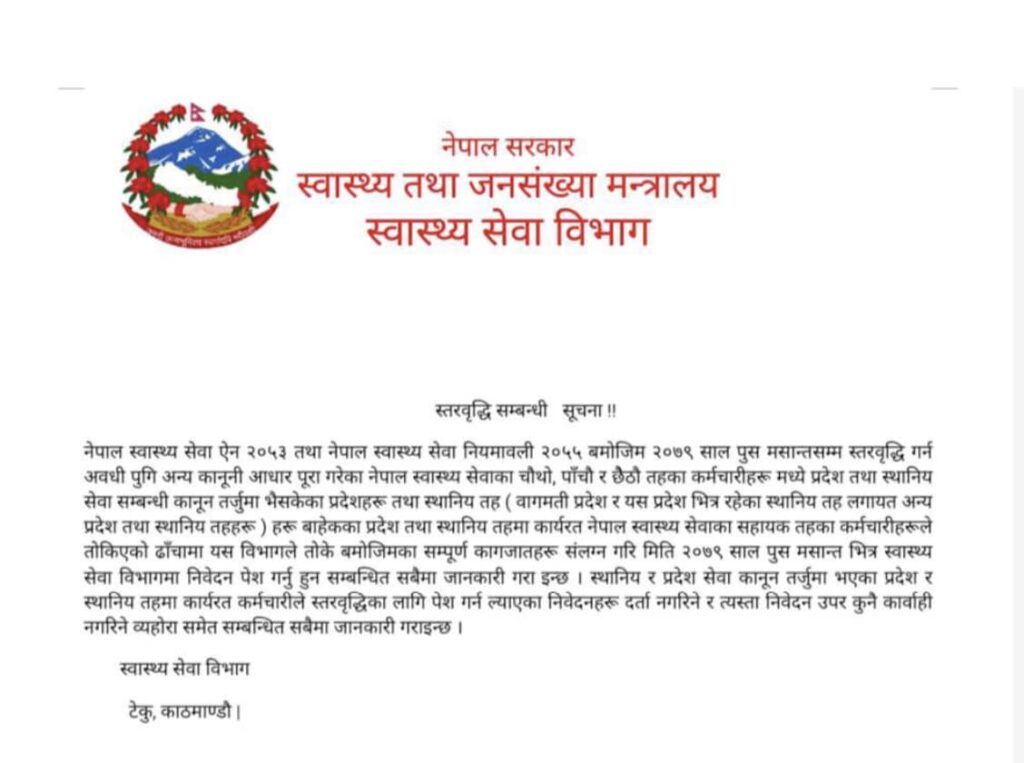
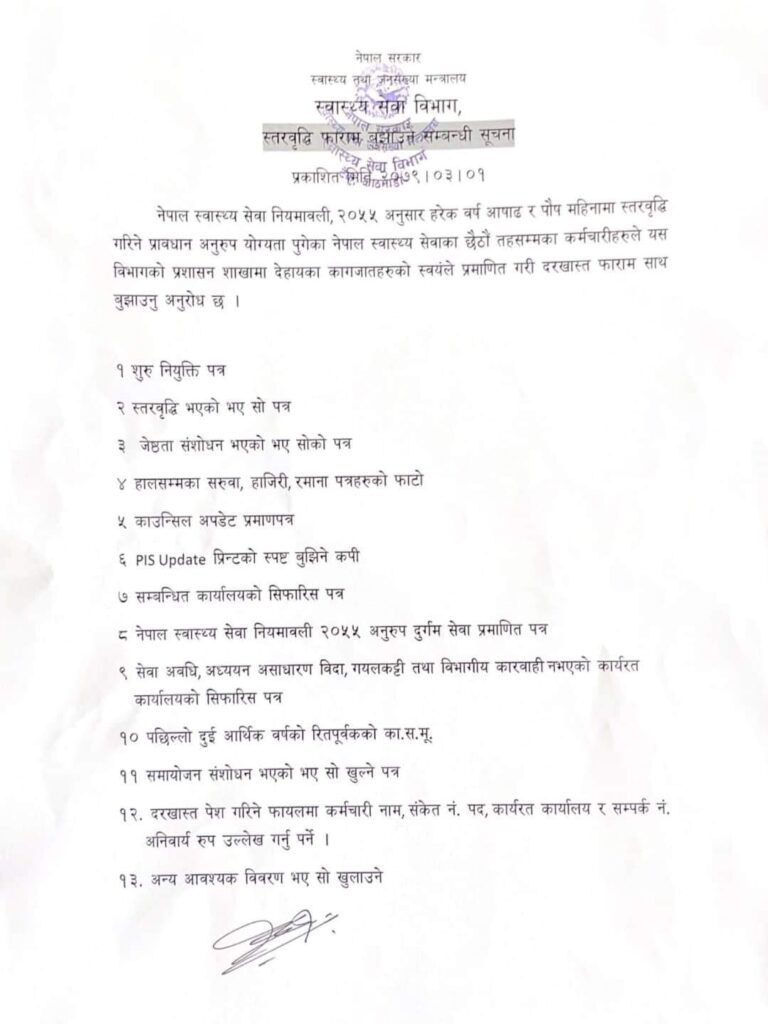
The Department Health Services (DoHS) invites application for the update of health workers under Nepal Health Service Regulation 2055.

Notice

Required documents

  1. 1st Appointment letter
  2. Upgraded letter if any
  3. Seniority revision letter if any
  4. Transfer, attendance, and transfer record
  5. Updated Professional council certificate
  6. Updated PIS
  7. Recommendation letter of current office
  8. Remote and rural service record
  9. Service record, Leave and other records
  10. Performance appraisal record of last two fiscal year
  11. Staff adjustment and update if any
  12. Application form with detail information (Name, No., Position, Office and contact information)
288214957 437250611739456 7318461495836012317 n

StarbriddI FORM

List of application form & formats for Government Officials, Nepal

December 31, 2022 0 comments
0 FacebookTwitterPinterestLinkedinTumblrVKOdnoklassnikiRedditStumbleuponWhatsappTelegramLINEPocketSkypeViberEmail
London School of Hygiene & Tropical Medicine
Fellowships, Studentship & ScholarshipsGrants and Funding OpportunitiesInternational Jobs & OpportunitiesPublic Health OpportunitiesPublic Health OpportunitySchool of Public HealthUniversities & School of Public Health

LSHTM Fund Scholarship 2023-24

by Public Health Update December 28, 2022
written by Public Health Update

London School of Hygiene & Tropical Medicine invites applications from eligible students for the LSHTM Fund Scholarship 2023-24.

These scholarships have been made possible by donors to the LSHTM Fund. Supported by hundreds of alumni and friends, the LSHTM Fund provides scholarships for the next generation of global health leaders. This year’s two scholarships are intended to support excellent candidates who would be unable to take up a place of study without this financial support.

Award details

Two LSHTM Fund Scholarships are available for 2023-24. The scholarship award comprises

  • 2023-24 tuition fees (at the overseas fee rate), including any mandatory field trip fees, and
  • a tax-free stipend (living allowance) of GBP 19,500.00

Eligibility criteria

This scholarship is open to applicants intending to study on a one-year, full-time, London-based MSc programme at the London School of Hygiene & Tropical Medicine (LSHTM) in 2023-24.

To be eligible for these scholarships, applicants must meet all of the following criteria:

  • be nationals of, and resident in, low to middle income countries (as defined by the World Bank);
  • intend to return to a low to middle income country on completion of their MSc year at LSHTM;
  • confirm in writing that they would not otherwise be able to pay for the proposed programme of study;
  • meet LSHTM’s minimum English language requirements (as required by LSHTM’s Admissions system);
  • a first or upper second-class honours undergraduate degree of a UK university, or an overseas qualification of an equivalent standard;
  • hold an offer of admission for 2023-24 for one of LSHTM’s 19 London-based (intensive) MSc programmes of study.

The selection panel awarding this highly competitive scholarship will consider applicants’ experience, qualifications and potential, looking for those with the greatest potential to accelerate in their career and make significant contributions to public and global health, and/or health-related research in a low- to middle income country (following a year’s study at LSHTM).

How to apply

The application process has two steps. To be considered for the funding, applicants must meet all eligibility criteria and complete both steps outlined below by the scholarship deadline of 23:59 (GMT) on Wednesday 1 March 2023.

Step 1: Submit an application for 2023-24 for an eligible MSc programme of study, by following the instructions under the ‘How to Apply’ tab on the relevant programme of study page. Applicants should ensure that all necessary supplementary admissions documents (including references) are submitted by the scholarship deadline.

Step 2: Submit an online scholarships application, selecting this scholarship option ‘2023-24 LSHTM Fund Scholarship’ from the drop-down menu. A completed Supplementary Questions Form for this scholarship must be uploaded as part of this application. This is the only attachment required in Step 2 (as applicants should already have uploaded references, a CV, passport, transcripts etc with their admissions application).

Application notes

  • Applicants are advised to complete Step 1 early to allow time for their GBP 50.00 LSHTM admissions application fee payment to be processed. Until the payment is processed applicants will be unable to submit an application for study or an application for the scholarship. We would therefore recommend that applicants for this funding complete and submit their application for study at least 1-2 weeks before the scholarships deadline to ensure that there are no Admissions or payment processing delays which could impact on meeting the scholarship deadline.
  • Applicants who have already submitted a completed 2023-24 London-based MSc application and/or have been made an Offer of Admission should apply for the scholarship by completing the scholarship application (Step 2 above) and submitting this by the scholarship deadline.
  • Incomplete applications will not be considered for this funding. Incomplete applications include those with missing supplementary documentation at either Steps 1 or 2 above. Both the application to study and the scholarship application must be complete by the scholarship deadline.
  • This scholarship is open to applicants for any of the 19 intensive Masters programmes offered by LSHTM (including our joint programmes: MSc Global Mental Health; MSc Health Policy, Planning & Financing; MSc One Health: ecosystems, humans and animals; MSc Veterinary Epidemiology). Please note that for the following programmes you will be directed to the joint provider to complete your application to study as LSHTM does not administer the admissions for these courses: MSc Global Mental Health; MSc One Health; MSc Veterinary Epidemiology. 
  • Applicants whose application for study is successful will be asked to pay a deposit within 28 days of the offer of admission being sent. Applicants applying for scholarships at LSHTM must email the Admissions Team to advise that they are awaiting the scholarship outcome (applicants must provide the Admissions team with both the name of the scholarship and the expected decision date in this email). This must be repeated for every application for which the applicant has applied. The Admissions team will then extend the deposit deadline to match the decision deadline of the scholarship funding.
  • Applicants who encounter any technical difficulties whilst using the online scholarships application form should, in the first instance, try clearing their browser cache and ensuring that they are using the latest version of Chrome, Firefox, Internet Explorer or Safari. If this does not fix the technical issue, please contact LSHTM’s IT Services team, providing the full name of the applicant; the scholarship that is being applied for; and the technical issue that has been encountered. Please also attach a screen shot where possible: servicedesk@lshtm.ac.uk.
  • For any queries about the application process, scholarship requirements or application deadline, please contact the LSHTM Scholarships team: scholarships@lshtm.ac.uk
  • By applying for this funding applicants agree to its terms and conditions.
  • Please note that all applications will only be reviewed and processed after the deadline. All applications that are submitted before the deadline will be considered equally, regardless of submission date.  
  • Decisions are expected to be reached, and the successful applicants notified, by 26 May 2023.

More Info


December 28, 2022 0 comments
0 FacebookTwitterPinterestLinkedinTumblrVKOdnoklassnikiRedditStumbleuponWhatsappTelegramLINEPocketSkypeViberEmail
Mahidol University
Fellowships, Studentship & ScholarshipsGrants and Funding OpportunitiesInternational Jobs & OpportunitiesPublic HealthPublic Health OpportunitiesPublic Health OpportunitySchool of Public HealthUniversities & School of Public Health

Mahidol University Scholarships for Master of PHC Management program

by Public Health Update December 23, 2022
written by Public Health Update

Mahidol University invites application for Scholarships for students in the Master of Primary Health Care Management program (International Program) Academic Year 2023

According to the Master of Primary Health Care Management program (International Program), ASEAN Institute for Health Development (AIHD), Mahidol University will offer scholarships for outstanding students at the graduate level to support their education and research.

Objective

  1. To promote and support education at the graduate level and to support highly motivated students for performing ASEAN Institute for Health Development research
  2. To support and develop capacity in Health Service Management, based on Primary Health Care Management in collaboration with the office of the Permanent Secretary of the Ministry of Public Health: MOPH, which would lead to effective healthcare services and integrate lifelong health services by using Primary Health Care Approaches.

Offering Scholarships

  1. Scholarships for Thai students
    There will be
    1 scholarship for Thai students in the Primary Health Care Management program (International Program)
    1.1   Education Services Fee
    1.2   Research Supply Fee
  2. Scholarships for International students
    There will be
    1 scholarship for International students in the Primary Health Care Management program (International Program)
    1.1   Education Services Fee
    1.2   Research Supply Fee

Qualifications

  1. Hold a Bachelor’s degree in the field of Public Health from a domestic or overseas institution approved by the Ministry of Education.
  2. Have a minimum grade point average of 3.00.
  3. Provide English proficiency with evidence according to Mahidol University regulations.
  4. Intend to apply knowledge to develop their career.
  5. Submit a motivational letter for scholarship (English version) with 1000 words about Primary Health Care.
  6. Include curriculum-vitae.

Selection Process and Announcement

The selection committee for student recruitment, for the academic year will review and determine the successful candidates.

Application Deadline

From now until 10 February 2023

The scholarship will be provided from 1 August 2023 – 31 July 2024.

Application

Download the application :     

Submit related document to :     Submit Document

Contact Person

Mr. Jeevan Bhatta; Foreign Instructor
Email: jeevan.bha@mahidol.edu

Official link: https://aihd.mahidol.ac.th/main/AIHD_EN/Education_MPHM_Scholar.php

December 23, 2022 0 comments
0 FacebookTwitterPinterestLinkedinTumblrVKOdnoklassnikiRedditStumbleuponWhatsappTelegramLINEPocketSkypeViberEmail
International Maternal Newborn Health Conference (IMNHC) Fellowship Program
Fellowships, Studentship & ScholarshipsInternational Jobs & OpportunitiesOpportunities by RegionPublic Health OpportunitiesPublic Health Opportunity

International Maternal Newborn Health Conference (IMNHC) Fellowship Program

by Public Health Update December 23, 2022
written by Public Health Update

Overview

The International Maternal Newborn Health Conference (IMNHC) Fellowship Program is designed for early career professionals who are interested in building the skills and networks that will enable them to become effective maternal newborn health (MNH) change agents at the country, regional, and global levels. IMNHC fellows want to contribute to, shape, and define global MNH priorities. They are viewed by their colleagues and peers as current and future MNH leaders. The IMNHC Fellowship Program seeks fellows with a diversity of MNH experience and backgrounds, including researchers, academics, health workers, public health professionals, program implementers, managers, and health administrators.

The Fellowship Program will be a cohort-focused program, running from February through June 2023, that includes pre-, during-, and post-conference activities to enhance the IMNHC experience for early career professionals. These activities will include networking opportunities with MNH leaders, tailored sessions, opportunities to speak or moderate at IMNHC 2023, and a co-creation workshop where fellows will help design the future of the Fellowship Program. In this co-creation workshop, fellows will collaborate with IMNHC organizers to consider the curriculum, structure, and format of the Fellowship Program for future IMNHCs.

The IMNHC organizers are accepting applications for the Fellowship Program from 1 December 2022 through 4 January 2023. Ultimately, 20 fellows will be accepted to comprise this first IMNHC Fellowship cohort.

Interested candidates should:

  • be between 18 and 35 years of age on 8 May 2023
  • have fewer than five years of professional experience in maternal and/or newborn health
  • have a minimum of a professional degree

The IMNHC organizers strive for a diverse and representative group of fellows, especially with respect to geography, gender, and experience.

Guidance

To be eligible for the International Maternal Newborn Health Conference (IMNHC) Fellowship Program, candidates must meet ALL requirements below:

  • Be between 18 and 35 years old on 8 May 2023
  • Have 5 years or less of professional experience in maternal and/or newborn health
  •  Have a minimum of a professional degree (e.g., associate’s degree)

The application process:
Applications for the Fellowship Program are open from 1 December 2022 to 4 January 2023. The application has three components:

  1. Responses to questions: Applicants should respond to the following questions during the application process. Responses can be submitted either in written format (an essay of no more than 1,200 words) or in video format (an MP4 file, maximum 3 min. in length).
    • Tell us why you are interested in joining the Fellowship Program, explaining both how this program will enhance your professional development AND what experience or perspective you will bring to the program. Please also speak to what you will bring to the co-creation workshop to design the future iterations of the Fellowship Program.
    • What does this year’s conference theme—Together 2023—mean to you? Applicants are encouraged to consider ways in which their work in MNH will support this theme.
  2. Submit an updated CV/Resume (PDF format)
  3. Submit a letter of reference (PDF format): This may be written by a peer, colleague, educator, or supervisor, with contact information included.

Kindly note that while IMNHC 2023 Fellowship Program activities will be conducted in English, application materials can be submitted in English, French, Portuguese, and Spanish. IMNHC will include translations for select sessions in English, French, Portuguese, and Spanish.

Selection criteria:

The IMNHC organizers will use the following questions to guide the evaluation of Fellowship Program applications:

  • How well does the applicant demonstrate how the Fellowship Program will enhance their professional development goals and objectives?
  • Does the applicant’s experience and/or education add a valuable perspective to the Fellowship Program?
  • Does the applicant demonstrate a deep understanding of the conference theme, Together 2023, and how it contributes to their work in maternal newborn health?
  • Does the applicant demonstrate strong potential for leadership in maternal newborn health, based on their experience and education?
  • Does the letter of reference provide evidence of strong interpersonal skills and leadership qualities?

In reviewing the applications for the Fellowship Program, the IMNHC organizers will also seek to ensure that the group as a whole is diverse and representative, with particular respect to geography, gender, and diversity of experience. As such, secondary criteria that prioritize a balanced Fellowship cohort overall will also be utilized.

Submission

Applications for the International Maternal Newborn Health Conference (IMNHC) Fellowship Program are now open! Thank you for your interest in submitting an application. Please note that applications may be submitted from 1 December 2022 until 4 January 2023, 11:59 P.M. SAST. Please click here for general information and guidance on applications. Please also review this short video with additional details on the application process as well as this step by step guidance on submitting an application. All frequently asked questions may be found here. All other questions can be directed to fellowships@imnhc.org.

Official Link: https://imnhc2023.org/fellows-program/submission/

December 23, 2022 0 comments
0 FacebookTwitterPinterestLinkedinTumblrVKOdnoklassnikiRedditStumbleuponWhatsappTelegramLINEPocketSkypeViberEmail
Public Health Opportunity! Explore world's trending global health opportunities! Visit us for latest public health opportunities.
AbstractsCall for Proposal, EOI & RFPPublic HealthPublic Health OpportunitiesPublic Health Opportunity

Call for Abstracts 11th Southeast Asia and Western Pacific Bi-regional TEPHINET Scientific Conference

by Public Health Update December 15, 2022
written by Public Health Update

TEPHINET, the South Asia Field Epidemiology and Technology Network (SAFETYNET), and the Australian Field Epidemiology Training Program (FETP-MAE), are pleased to launch the call for abstracts for the 11th Southeast Asia and Western Pacific Bi-regional TEPHINET Scientific Conference. The conference will be held in-person at the Australian National University in Canberra, Australia from September 12-15, 2023.

Eligibility

Current trainees and recent graduates (those who graduated on or after January 1, 2019) from any level (frontline, intermediate, or advanced) of public health, veterinary or one health field or applied epidemiology training programs in the Southeast Asia and Western Pacific regions are invited to submit abstracts.

Abstracts must focus on epidemiological studies conducted between 2019 and 2022, and should be submitted in English.

Abstracts submitted for consideration should be original. Additionally, the abstract should not have already been presented at an international conference.

Submission of Abstracts

The abstract submission period is from December 15, 2022 to February 28, 2023. The deadline to submit abstracts is February 28, 2023 at 11:59pm Eastern Standard Time. There will be NO extension to this deadline.

All abstracts must be submitted through Ex Ordo, an online platform managed by TEPHINET, at this link: https://tephinetbiregional2023.exordo.com. This is the only method of abstract submission. Abstracts not submitted through this online platform will not be considered. 

Program directors must submit abstracts on behalf of current trainees. Currently enrolled trainees must coordinate submissions with their program directors. Abstracts submitted directly by current trainees will not be considered for review.

Alumni and recent graduates may submit abstracts on their own behalf. 

Each primary author is allowed to have up to two (2) abstracts submitted.

Selection: TEPHINET will assign three qualified reviewers from our pool of abstract reviewers to review each submitted abstract. Abstracts will be considered as candidates for either oral or poster sessions. Once an abstract is accepted, the Scientific Program Committee will determine whether it is more appropriate for oral or poster presentation.

Acceptance: FETP Program Directors will receive a complete list of accepted abstracts submitted from their programs in June, 2023. Upon receipt of the results, directors are expected to communicate the results to those who submitted abstracts. Alumni will be informed of the results of their submissions directly. Those whose abstracts are accepted for oral or poster presentation will also be informed and sent joint invitation letters from TEPHINET, SAFETYNET and the ANU MAE program. They also will receive guidelines regarding the structure and delivery of their oral or poster presentations.


Instructions for Writing Abstracts

  • Type and save your abstract in word processing software such as Microsoft Word, Pages (for Apple), or Google Docs; then copy and paste your abstract from your document into our web-based abstract submission system (link above). See the sample abstract below for the required format.
  • Abstracts may not exceed 300 words in length. This word count excludes the headings of the structured abstract (Background, Methods, Results, Conclusions) and the title and authors’ names. You can easily obtain your word count by selecting the appropriate text of the abstract and then choosing the “Word Count” command in the “Tools” menu of MS Word or of Google Docs.
  • No graphics will be accepted.

The web-based system, Ex Ordo, will request the following information:

1. Authors and Training Program Affiliation
Please have the following information with you when you submit an abstract online:

  • Name and email address of primary author (presenter)
  • Names and email addresses of co-author/s (Please ensure that all of your co-authors have agreed to being listed on the paper prior to submitting your abstract.)
  • Home country in which FETP is based as well as the FETP host institution (university, ministry of health, ministry of agriculture, etc.)
  • Name of FETP Program Director
  • Email address of FETP Program Director
  • Status of primary author: current trainee or graduate/alumnus
  • Level of training (frontline, intermediate, advanced)
  • Year graduated or expected to graduate (if current trainee)
  • Primary author’s First Nations identification
  • Primary author’s gender identity

2. Title

  • Be brief. Avoid subtitles if possible.
  • Capitalize major words only. Capitalize the second component of hyphenated terms. Do NOT use abbreviations or acronyms in titles.
  • Give geographic location (country, province or city) and dates of study or investigation. Do not abbreviate geographic locations; separate them from the rest of the title by an m-dash, e.g., Dengue Fever Outbreak — Ho Chi Minh City, 2015.

3. Abstract Text

  • Structure the abstract using the following subheadings to identify each section: Background, Methods, Results, Conclusions.
  • Each subheading should be typed flush left, in bold font, and followed by a colon.
  • The Background section should address both 1) the public health significance of the subject and 2) the scientific background and rationale for the study (see sample abstract).
  • The Results section must contain data. It should not include such statements as “Data will be discussed.” If considerable work is needed before the conference, please state in the abstract that results are preliminary.
  • Because of time constraints, changes cannot be made to the abstract after it is submitted. You may find, however, that the results and conclusions of the study do change, based on data analysis done after submission. If your abstract is accepted and significant changes have been made after submission of the abstract, please highlight the changes in your presentation, whether oral or poster.

4. Key Words
Please include 4-6 key words; use terms listed in the Medical Subject Headings (MeSH) from the Index Medicus (https://meshb.nlm.nih.gov/search).

5. Topic of abstract: A list of topics will be provided on the online submission portal. You will be asked to select up to 3 topics from a provided list.

Please refer to the Sample Abstract, and Evaluation Criteria documents in the below section to inform your submission. 

Official Link

December 15, 2022 0 comments
0 FacebookTwitterPinterestLinkedinTumblrVKOdnoklassnikiRedditStumbleuponWhatsappTelegramLINEPocketSkypeViberEmail
The WHO Consolidated Guidelines on Tuberculosis, Module 4: Treatment - Drug-Resistant Tuberculosis Treatment, 2022 update
Communicable DiseasesGlobal Health NewsInternational Plan, Policy & GuidelinesPublic HealthPublic Health NewsPublic Health UpdateResearch & Publication

WHO announces landmark changes in treatment of drug-resistant tuberculosis

by Public Health Update December 15, 2022
written by Public Health Update

15 December 2022 | Geneva 

WHO has just released updated consolidated guidelines on the treatment of drug-resistant TB (DR-TB) featuring major improvements in treatment options for people with multidrug-resistant or rifampicin-resistant tuberculosis (MDR/RR-TB). The guidelines include a new recommendation on the use of a novel all-oral 6-month regimen composed of bedaquiline, pretomanid, linezolid and moxifloxacin (BPaLM) in people suffering from MDR/RR-TB or MDR/RR-TB with additional resistance to fluoroquinolones (pre-XDR-TB). The newly recommended BPaLM regimen offers better outcomes, remarkably shortens the duration of treatment, and thus significantly improves quality of life for people with MDR/RR-TB.

The WHO Consolidated Guidelines on Tuberculosis, Module 4: Treatment – Drug-Resistant Tuberculosis Treatment, 2022 update includes all the current recommendations on treatment of DR-TB, and is  complemented by an operational handbook designed to assist the implementation of WHO recommendations by Member States, technical partners and others who are involved in the management of patients with DR-TB. The WHO Operational Handbook on Tuberculosis, Module 4: Treatment – Drug-Resistant Tuberculosis Treatment, 2022 update provides practical guidance on how to put in place the recommended treatment options at the scale needed to achieve national and global impact.

The updated guidelines and supporting operational handbook are designed for use by national TB programmes, or their equivalents in Ministries of Health, policy makers and technical organizations working on TB and infectious diseases in public and private sectors and in the community. These documents aim to facilitate uptake of WHO policy in the field and thus improve the overall quality of TB services.

WHO welcomes new initiatives by the public and private sectors to reduce the pricing of pretomanid and potentially other component medicines – that will lower the cost of the new BPaLM/BPaL treatment regimen and make it more accessible.

To facilitate and promote implementation of the new regimen for the treatment of DR-TB WHO will set up a regular online discussion platform that will include high MDR/RR-TB burden countries, civil society, technical partners and donor community.

Download Guideline

Recommended readings

  • GLOBAL TUBERCULOSIS REPORT 2021
  • Global Tuberculosis Report 2020
  • Global Tuberculosis Report 2019: Latest status of the tuberculosis epidemic
  • Global Tuberculosis Report 2018
  • WHO Global Tuberculosis report 2015
  • Global tuberculosis report 2014: Improved data reveals higher global burden of tuberculosis
  • National Tuberculosis Programme Annual Report 2018
  • National Tuberculosis Program Update in Nepal #WorldTBDay #EndTB
  • National TB Prevalence Survey, 2018-19 Key findings
  • World Tuberculosis Day 2020! It’s time to End TB!
  • National Guideline on Drug Resistant TB Management 2019, Nepal
  • National Tuberculosis Management Guideline 2019, Nepal
  • Global Tuberculosis Report 2019: Latest status of the tuberculosis epidemic
  • National TB Prevalence Survey, 2018-19 Key findings
  • New WHO recommendations to prevent tuberculosis aim to save millions of lives
  • World Health Organization (WHO) Information Note Tuberculosis and COVID-19
  • World Tuberculosis Day 2020! It’s time to End TB!
  • People-centred framework for tuberculosis programme planning and prioritization, User guide
  • Global Tuberculosis Report 2019: Latest status of the tuberculosis epidemic
  • Dissemination of Findings and Recommendations of Joint External Monitoring Mission(JEMM) of Nepal National Tuberculosis Program
  • National Tuberculosis Programme Annual Report 2018
  • National Strategic Plan for Tuberculosis Prevention, Care and Control 2016 – 2021
  • NTP, Nepal: New TB Treatment Algorithm & Regimen (Updated)
  • WHO announces landmark changes in MDR-TB treatment regimens
  • TB Vaccine results announce a promising step towards ending the emergency
  • 7 million people receive record levels of lifesaving TB treatment but 3 million still miss out
December 15, 2022 0 comments
0 FacebookTwitterPinterestLinkedinTumblrVKOdnoklassnikiRedditStumbleuponWhatsappTelegramLINEPocketSkypeViberEmail
WHO and UN-Water’s Global Analysis and Assessment of Sanitation and Drinking-Water (GLAAS) report
Global Health NewsPublic Health NewsReportsResearch & Publication

Accelerated action needed to ensure safe drinking-water, sanitation and hygiene for all

by Public Health Update December 14, 2022
written by Public Health Update

WHO 14 December 2022 News release

Urgent action is needed globally and locally to achieve safe and sustainably managed water, sanitation and hygiene for all in order to prevent devastating impacts on the health of millions of people.

Findings from WHO and UN-Water’s Global Analysis and Assessment of Sanitation and Drinking-Water (GLAAS) report show that acceleration is needed in many countries to achieve the UN Sustainable Development Goal (SDG) 6 – water and sanitation for all by 2030.

While 45% of countries are on track to achieve their nationally-defined drinking-water coverage targets, only 25% of countries are on track to achieve their national sanitation targets. Less than a third of countries reported to have sufficient human resources required to carry out key drinking-water, sanitation and hygiene (WASH) functions.

The GLAAS 2022 report, which details the latest status of WASH systems in more than 120 countries, is the largest data collection from the greatest number of countries to date.

While there has been an increase in WASH budgets in some countries, a large number–over 75% of countries reported insufficient funding to implement their WASH plans and strategies.

“We are facing an urgent crisis: poor access to safe drinking water, sanitation and hygiene claim millions of lives each year, while the increasing frequency and intensity of climate-related extreme weather events continue to hamper the delivery of safe WASH services,” said Dr Tedros Adhanom Ghebreyesus, WHO Director-General. “We call on governments and development partners to strengthen WASH systems and dramatically increase investment to extend access to safely managed drinking water and sanitation services to all by 2030, beginning with the most vulnerable.”

The GLAAS data show, however, that most WASH policies and plans do not address risks of climate change to WASH services, nor the climate resilience of WASH technologies and management systems. Just over two thirds of countries have measures in WASH policies to reach populations disproportionately affected by climate change. However, only about one third monitor progress or allocate explicit funding to these populations.

“The world is seriously off-track to achieve SDG 6 on water and sanitation for all, by 2030. This leaves billions of people dangerously exposed to infectious diseases, especially in the aftermath of disasters, including climate related events,” said Gilbert F. Houngbo, Chair of UN-Water and Director General of the International Labour Organization. “The new data from GLAAS will inform the voluntary commitments the international community will make at the UN 2023 Water Conference in March, helping us target the most vulnerable communities and solve the global water and sanitation crisis.”

Urgency and opportunities

Dire consequences of climate change and extreme weather events bring more attention to the issues, underlining an urgent need for a whole-of-society approach and global cooperation to act together. The GLAAS 2022 report shows that countries making progress demonstrated high level of political commitment and investments in improving safe WASH systems.

With the GLAAS 2022 report, WHO and UN-Water call on all governments and stakeholders to scale up support for WASH service delivery, through strengthened governance, financing, monitoring, regulation, and capacity development.

The report sets the scene for action ahead of a historic water and sanitation meeting planned in 2023. For the first time in 50 years, the global community—through the United Nations—will review progress and make firm commitments to renew action on water and sanitation with global leaders. The UN 2023 Water Conference – formally known as the 2023 Conference for the Midterm Comprehensive Review of Implementation of the UN Decade for Action on Water and Sanitation (2018-2028) – will take place at UN Headquarters in New York, 22-24 March 2023.

DOWNLOAD REPORT

December 14, 2022 0 comments
0 FacebookTwitterPinterestLinkedinTumblrVKOdnoklassnikiRedditStumbleuponWhatsappTelegramLINEPocketSkypeViberEmail
Public Health Opportunity! Explore world's trending global health opportunities! Visit us for latest public health opportunities.
Public Health OpportunitiesPublic Health OpportunityTraining

Manuscript Writing Training for Early Career Researchers and Students

by Public Health Update December 13, 2022
written by Public Health Update

PHASE Nepal is pleased to invite applications to participate in four days research paper writing workshop designated for early career researchers and students in order to develop writing and publication skills. The training aims to equip early career researchers and students with scientific writing and publishing skills. The participants will learn how to write papers that will make an impact and strategies for publication. The training will guide participants on literature search, critical review of scientific papers, plagiarism, synthesis of research output, structure a scientific paper for publication, authorship, and selection of journal. Participants will be able to prepare first draft of research paper ready for internal review to submit to the scientific journal.

Description

Facilitator: Dr. Jiban Karki (PhD), PDRA, Liverpool School of Tropical Medicine, UK 

Mode of delivery: The training will be delivered through interactive and individual hands-on practice.

Date: 25-28 December 2022 (10 to 13 Poush 2079)

Course fee: It is a part of PHASE Nepal’s initiative to develop research skills in young researchers and will be provided free of cost. Participants will be provided with tea and lunch. There will be no per diem or refund of travel costs for the participants. Participants need to bring their own laptops.

Venue: The training will be conducted in PHASE Nepal central office, Suryabinayak-4, Bhaktapur (https://tinyurl.com/wvap9xcf)

Number of participants: Maximum 12-15 people

Eligibility:

  • At least have master’s degree in public health or health-related background (nutrition, health and promotion) or who have completed their thesis and have data ready for manuscript writing on above subjects.
  • Applicants should be fluent in English speaking and writing.

Learning outcomes:

  • Hands on usage of related tools and techniques of scientific writing
  • Undertake critical review of scientific paper
  • Write a publishable scientific research paper
  • Able to prepare abstract of the research paper

Application Method

Application Method:

If you are interested to participate on this course, please show your interest by completing the following form by 5 PM Nepal time 18th Dec 2022:  https://ee.humanitarianresponse.info/single/JU8AVL9E.

December 13, 2022 0 comments
0 FacebookTwitterPinterestLinkedinTumblrVKOdnoklassnikiRedditStumbleuponWhatsappTelegramLINEPocketSkypeViberEmail
Newer Posts
Older Posts

Search

Follow Us

Facebook Twitter Instagram Pinterest Linkedin Youtube

Categories

  • Abstracts (25)
  • Activities (91)
  • Adolescent Sexual and Reproductive Health (ASRH) (25)
  • Advice & Tips (4)
  • African Region (5)
  • AI and Health (1)
  • Annual Meeting (6)
  • Antimicrobial Resistance (AMR) (21)
  • Award (19)
  • Awards (16)
  • Books (9)
  • Call for Proposal, EOI & RFP (103)
  • Call for Research Participants (8)
  • Clinical Doctor Jobs (6)
  • Communicable Diseases (107)
  • Competition (20)
  • Conference (129)
  • Consultant (1)
  • Courses (205)
  • Dashboard (2)
  • Digital Health & Health Informatics (10)
  • Drug and Medicine (18)
  • Eastern Mediterranean Region (3)
  • Education (15)
  • Environment (3)
  • Environmental Health & Climate Change (47)
  • European Region (42)
  • Exchange Program (1)
  • Fact Sheet (117)
  • FCHVs (1)
  • Fellowships, Studentship & Scholarships (168)
  • Financial Aid (13)
  • Form Formats (2)
  • Fully funded (22)
  • Global Health News (434)
  • Grants and Funding Opportunities (193)
  • Guest Post (44)
  • Health Assistant Jobs (1)
  • Health Equity (7)
  • Health Financing and Economics (24)
  • Health in Data (115)
  • Health Insurance (5)
  • Health Jobs (52)
  • Health Literacy, Health Education & Promotion (50)
  • Health Organization Profile (42)
  • Health Systems (83)
  • Human Resource for Health (33)
  • Humanitarian Health & Emergency Response (44)
  • Hypertension (5)
  • Implementation Research (48)
  • International Health (3)
  • International Jobs & Opportunities (373)
  • International Plan, Policy & Guidelines (210)
  • Internships (4)
  • Jobs Vacancies (56)
  • Journals (8)
  • Life Style & Public Health Nutrition (39)
  • Live (10)
  • Master's Degree (48)
  • Maternal, Newborn and Child Health (88)
  • Mentorship Program (2)
  • Miscellaneous (16)
  • National Health News (158)
  • National Plan, Policy & Guidelines (468)
  • Neglected Tropical Diseases (NTDs) (51)
  • Non- Communicable Diseases (NCDs) (121)
  • Notice (103)
  • Nursing Jobs (6)
  • Nutritionist Jobs (1)
  • One Health (18)
  • Online & Distance Learning (22)
  • Online Courses (90)
  • Op-Ed Article (3)
  • Opportunities by Region (83)
  • Outbreak News (213)
  • Partially funded (6)
  • PCL Health Science Jobs (3)
  • PH Important Day (534)
  • Pharmacist Jobs (3)
  • PhD (54)
  • Photos (5)
  • Planetary Health (4)
  • PostDoc (14)
  • Presentation Slides (26)
  • Primary Health Care (25)
  • Provincial Plan, Policies and Guidelines (14)
  • Public Health (1,283)
  • Public Health Epidemiology & Biostatistics (13)
  • Public Health Events (306)
  • Public Health Information (20)
  • Public Health Innovation (9)
  • Public Health Jobs (52)
  • Public Health News (554)
  • Public Health Notes (120)
  • Public Health Opportunities (507)
  • Public Health Opportunity (491)
  • Public Health Programs (108)
  • Public Health Seminar (2)
  • Public Health Tools (1)
  • Public Health Update (564)
  • Quality Improvement & Infection Prevention (20)
  • Region of America (8)
  • Reports (184)
  • Research & Project Grants (39)
  • Research & Project Grants (32)
  • Research & Publication (647)
  • Research Articles (10)
  • Road Traffic Accidents (RTA) (9)
  • School of Public Health (60)
  • Self funded (2)
  • South-East Asia Region (26)
  • Success Stories (17)
  • Summer and Winter Courses (40)
  • Summer Courses (28)
  • Sustainable Development Goals (SDGs) (14)
  • Syllabus (61)
  • Symposium (9)
  • Tobacco Control (35)
  • Training (40)
  • Travel Grants (15)
  • Trick, Technique & Skills (8)
  • Uncategorized (3)
  • Undergraduate Degree (7)
  • Universal Health Coverage (36)
  • Universities (29)
  • Universities & School of Public Health (58)
  • Vacancy Announcement (26)
  • Vaccine Preventable Diseases (40)
  • Vector-Borne Diseases(VBDs) (30)
  • Videos (3)
  • View Points (1)
  • Webinar (4)
  • Western Pacific Region (13)
  • Workshop (18)
  • World News (117)
Post New Jobs: Vacancy Announcement Service

Public Health Update (Sagun’s Blog) is a popular public health portal in Nepal. Thousands of health professionals are connected with Public Health Update to get up-to-date public health updates, search for jobs, and explore opportunities.
#1 Public Health Blog for sharing Job opportunities and updates in Nepal

”Public Health Information For All”
– – Sagun Paudel, Founder

  • HOT JOBS
    • Public Health Jobs
    • Medical Doctor Jobs
    • Nursing Jobs
    • Health Assistant Jobs
    • Pharmacist Jobs
    • NGOs Jobs
    • Government Jobs
  • Top Categories
    • National Plan, Policy & Guidelines Top
    • Public Health Calendar
    • Fellowships & Scholarships
    • Health Systems
    • Health Organization Profiles
    • International Jobs & Opportunities
    • Public Health Opportunity

PUBLIC HEALTH INITIATIVE

    • Submit your Vacancies New
    • Partnership Opportunities

Contact: blog.publichealthupdate@gmail.com

https://wa.me/+9779856036932

Public Health Initiative, A Registered Non-profit organization – All Right Reserved. 2011-2024. Contact us. 

Facebook Twitter Instagram Youtube Envelope
Public Health Update
  • Home
  • Public Health
    • Home 1
      • Adolescent Sexual and Reproductive Health (ASRH)
      • Antimicrobial Resistance (AMR)
      • Communicable Diseases
      • Digital Health & Health Informatics
      • Environmental Health & Climate Change
      • Health Financing and Economics
      • Health Equity
    • Home 2
      • Health Literacy, Health Education & Promotion
      • Human Resource for Health
      • Humanitarian Health & Emergency Response
      • Implementation Research
      • International Health
      • Life Style & Public Health Nutrition
      • Maternal, Newborn and Child Health
    • Home 3
      • Neglected Tropical Diseases (NTDs)
      • Non- Communicable Diseases (NCDs)
      • One Health
      • Planetary Health
      • Public Health Epidemiology & Biostatistics
      • Primary Health Care
      • Quality Improvement & Infection Prevention
    • Home 4
      • Road Traffic Accidents (RTA)
      • Sustainable Development Goals (SDGs)
      • Tobacco Control
      • Universal Health Coverage
      • Vaccine Preventable Diseases
      • Vector-Borne Diseases(VBDs)
      • Notices
  • Public Health Update
    • Home 1
      • Public Health News
      • Global Health News
      • Outbreak News
      • National Health News
      • COVID-19
    • Home 2
      • Fact Sheet
      • Health in Data
      • PH Important Day
      • Public Health Events
      • Public Health Programs
    • Home 3
      • Health Systems
      • Health Insurance
      • Health Organization Profile
      • Success Stories
      • Public Health Innovation
  • Public Health Opportunities
    • Fully funded
    • Travel Grants
    • Grants and Funding Opportunities
    • Opportunities by Region
    • International Jobs & Opportunities
    • Research & Project Grants
    • Fellowships, Studentship & Scholarships
    • Conference
  • Jobs
    • Home 1
      • Health Jobs
      • Public Health Jobs
      • Clinical doctor Jobs
      • Health Assistant Jobs
      • Nursing Jobs
      • PCL Health Science Jobs
    • Home 2
      • Dental Jobs
      • Pharmacist Jobs
      • TSLC (Health Jobs)
      • Laboratory Jobs
      • Nutritionist Jobs
  • Downloads
    • International Plan, Policy & Guidelines
    • National Plan, Policy & Guidelines
    • Reports
    • Books
    • Research Articles
  • School of Public Health
    • Home 1
      • Courses
      • Master’s Degree
      • Undergraduate Degree
      • PhD
    • Home 2
      • Universities
      • Syllabus
      • Public Health Notes
      • Mentorship Program
      • Startup Project
    • Home
      • Summer and Winter Courses
      • Summer Courses
      • Online Courses
      • Workshop
      • Training
Public Health Update
  • Home
  • Public Health
    • Home 1
      • Adolescent Sexual and Reproductive Health (ASRH)
      • Antimicrobial Resistance (AMR)
      • Communicable Diseases
      • Digital Health & Health Informatics
      • Environmental Health & Climate Change
      • Health Financing and Economics
      • Health Equity
    • Home 2
      • Health Literacy, Health Education & Promotion
      • Human Resource for Health
      • Humanitarian Health & Emergency Response
      • Implementation Research
      • International Health
      • Life Style & Public Health Nutrition
      • Maternal, Newborn and Child Health
    • Home 3
      • Neglected Tropical Diseases (NTDs)
      • Non- Communicable Diseases (NCDs)
      • One Health
      • Planetary Health
      • Public Health Epidemiology & Biostatistics
      • Primary Health Care
      • Quality Improvement & Infection Prevention
    • Home 4
      • Road Traffic Accidents (RTA)
      • Sustainable Development Goals (SDGs)
      • Tobacco Control
      • Universal Health Coverage
      • Vaccine Preventable Diseases
      • Vector-Borne Diseases(VBDs)
      • Notices
  • Public Health Update
    • Home 1
      • Public Health News
      • Global Health News
      • Outbreak News
      • National Health News
      • COVID-19
    • Home 2
      • Fact Sheet
      • Health in Data
      • PH Important Day
      • Public Health Events
      • Public Health Programs
    • Home 3
      • Health Systems
      • Health Insurance
      • Health Organization Profile
      • Success Stories
      • Public Health Innovation
  • Public Health Opportunities
    • Fully funded
    • Travel Grants
    • Grants and Funding Opportunities
    • Opportunities by Region
    • International Jobs & Opportunities
    • Research & Project Grants
    • Fellowships, Studentship & Scholarships
    • Conference
  • Jobs
    • Home 1
      • Health Jobs
      • Public Health Jobs
      • Clinical doctor Jobs
      • Health Assistant Jobs
      • Nursing Jobs
      • PCL Health Science Jobs
    • Home 2
      • Dental Jobs
      • Pharmacist Jobs
      • TSLC (Health Jobs)
      • Laboratory Jobs
      • Nutritionist Jobs
  • Downloads
    • International Plan, Policy & Guidelines
    • National Plan, Policy & Guidelines
    • Reports
    • Books
    • Research Articles
  • School of Public Health
    • Home 1
      • Courses
      • Master’s Degree
      • Undergraduate Degree
      • PhD
    • Home 2
      • Universities
      • Syllabus
      • Public Health Notes
      • Mentorship Program
      • Startup Project
    • Home
      • Summer and Winter Courses
      • Summer Courses
      • Online Courses
      • Workshop
      • Training
Public Health Initiative, A Registered Non-profit organization – All Right Reserved. 2011-2023