Public Health Update
  • Home
  • Public Health Update
  • Nepal Health Jobs
    • Public Health Job Board
    • Organization List
  • Opportunities
    • Fellowships, Studentship & Scholarships
    • Grants and Funding Opportunities
    • Fully funded
    • Conference
  • Downloads
    • International Plan, Policy & Guidelines
    • National Plan, Policy & Guidelines
    • Reports
    • Public Health Notes
    • Syllabus
    • Form Formats
  • School of Public Health
    • PhD
    • Master’s Degree
    • Online Courses
  • Notice
  • Home
  • Public Health Update
  • Nepal Health Jobs
    • Public Health Job Board
    • Organization List
  • Opportunities
    • Fellowships, Studentship & Scholarships
    • Grants and Funding Opportunities
    • Fully funded
    • Conference
  • Downloads
    • International Plan, Policy & Guidelines
    • National Plan, Policy & Guidelines
    • Reports
    • Public Health Notes
    • Syllabus
    • Form Formats
  • School of Public Health
    • PhD
    • Master’s Degree
    • Online Courses
  • Notice
LOGIN / REGISTER
Public Health Update
SUBSCRIBE
Public Health Update
  • Home
  • Public Health Update
  • Nepal Health Jobs
    • Public Health Job Board
    • Organization List
  • Opportunities
    • Fellowships, Studentship & Scholarships
    • Grants and Funding Opportunities
    • Fully funded
    • Conference
  • Downloads
    • International Plan, Policy & Guidelines
    • National Plan, Policy & Guidelines
    • Reports
    • Public Health Notes
    • Syllabus
    • Form Formats
  • School of Public Health
    • PhD
    • Master’s Degree
    • Online Courses
  • Notice

All Right Reserved. Designed and Developed by PenciDesign

From 30 million cases to zero: China is certified malaria-free by WHO
Vector-Borne Diseases(VBDs)Global Health NewsPublic HealthPublic Health News

From 30 million cases to zero: China is certified malaria-free by WHO

by Public Health Update June 30, 2021
written by Public Health Update

Following a 70-year effort, China has been awarded a malaria-free certification from WHO – a notable feat for a country that reported 30 million cases of the disease annually in the 1940s.

“Today we congratulate the people of China on ridding the country of malaria,” said Dr Tedros Adhanom Ghebreyesus, WHO Director-General. “Their success was hard-earned and came only after decades of targeted and sustained action. With this announcement, China joins the growing number of countries that are showing the world that a malaria-free future is a viable goal.”

China is the first country in the WHO Western Pacific Region to be awarded a malaria-free certification in more than 3 decades. Other countries in the region that have achieved this status include Australia (1981), Singapore (1982) and Brunei Darussalam (1987).

“Congratulations to China on eliminating malaria,” said Dr Takeshi Kasai, Regional Director, WHO Western Pacific Regional Office. “China’s tireless effort to achieve this important milestone demonstrates how strong political commitment and strengthening national health systems can result in eliminating a disease that once was a major public health problem. China’s achievement takes us one step closer towards the vision of a malaria-free Western Pacific Region.”

Globally, 40 countries and territories have been granted a malaria-free certification from WHO – including, most recently, El Salvador (2021), Algeria (2019), Argentina (2019), Paraguay (2018) and Uzbekistan (2018).

China’s elimination journey

Beginning in the 1950s, health authorities in China worked to locate and stop the spread of malaria by providing preventive antimalarial medicines for people at risk of the disease as well as treatment for those who had fallen ill. The country also made a major effort to reduce mosquito breeding grounds and stepped up the use of insecticide spraying in homes in some areas.

In 1967, the Chinese Government launched the “523 Project” – a nation-wide research programme aimed at finding new treatments for malaria. This effort, involving more than 500 scientists from 60 institutions, led to the discovery in the 1970s of artemisinin – the core compound of artemisinin-based combination therapies (ACTs), the most effective antimalarial drugs available today.

“Over many decades, China’s ability to think outside the box served the country well in its own response to malaria, and also had a significant ripple effect globally,” notes Dr Pedro Alonso, Director of the WHO Global Malaria Programme. “The Government and its people were always searching for new and innovative ways to accelerate the pace of progress towards elimination.”

In the 1980s, China was one of the first countries in the world to extensively test the use of insecticide-treated nets (ITNs) for the prevention of malaria, well before nets were recommended by WHO for malaria control. By 1988, more than 2.4 million nets had been distributed nation-wide. The use of such nets led to substantial reductions in malaria incidence in the areas where they were deployed.   

By the end of 1990, the number of malaria cases in China had plummeted to 117 000, and deaths were reduced by 95%. With support from the Global Fund to Fight AIDS, Tuberculosis and Malaria, beginning in 2003, China stepped up training, staffing, laboratory equipment, medicines and mosquito control, an effort that led to a further reduction in cases; within 10 years, the number of cases had fallen to about 5000 annually.

In 2020, after reporting 4 consecutive years of zero indigenous cases, China applied for an official WHO certification of malaria elimination. Members of the independent Malaria Elimination Certification Panel travelled to China in May 2021 to verify the country’s malaria-free status as well as its programme to prevent re-establishment of the disease.

Keys to success

China provides a basic public health service package for its residents free of charge. As part of this package, all people in China have access to affordable services for the diagnosis and treatment of malaria, regardless of legal or financial status.

Effective multi-sector collaboration was also key to success. In 2010, 13 ministries in China – including those representing health, education, finance, research and science, development, public security, the army, police, commerce, industry, information technology, media and tourism – joined forces to end malaria nationwide.

In recent years, the country further reduced its malaria caseload through a strict adherence to the timelines of the “1-3-7” strategy. The “1” signifies the one-day deadline for health facilities to report a malaria diagnosis; by the end of day 3, health authorities are required to confirm a case and determine the risk of spread; and, within 7 days, appropriate measures must be taken to prevent further spread of the disease.

Keeping malaria at bay

The risk of imported cases of malaria remains a key concern, particularly in southern Yunnan Province, which borders 3 malaria-endemic countries: Lao People’s Democratic Republic, Myanmar and Viet Nam. China also faces the challenge of imported cases among Chinese nationals returning from sub-Saharan Africa and other malaria-endemic regions.

To prevent re-establishment of the disease, the country has stepped up its malaria surveillance in at-risk zones and has engaged actively in regional malaria control initiatives. Throughout the COVID-19 pandemic, China has maintained trainings for health providers through an online platform and held virtual meetings for the exchange of information on malaria case investigations, among other topics.

OFFICIAL INFO
WHO

Interim Guideline for Malaria Program During COVID-19 in Nepal (Updated)

WHO launches effort to stamp out malaria in 25 more countries by 2025

World Malaria Day 2021: Reaching the zero malaria target

El Salvador certified as malaria-free by WHO

WHO Guidelines for Malaria (Consolidated Guidelines for Malaria)

Malaria Risk Areas Micro-stratification 2020

World Malaria Report 2020


Do you have a website? Looking for the best hosting provider? Here’s a discount code.

Latest Public Health Jobs

Latest Posts

  • International Wellness Day: Promoting Global Wellness for All
  • Summit Declaration: The 12th National Summit of Health and Population Scientists in Nepal
  • Joint political declaration on the reform of the global health architecture
  • World Health Day 2026: Together for Health. Stand with Science.
  • World Water Day 2026 | Water & Gender Equality

Thanks for visiting us.
Disclaimer: The resources, documents, guidelines, and information on this blog have been collected from various sources and are intended for informational purposes only. Information published on or through this website and affiliated social media channels does not represent the intention, plan, or strategies of an organization that the initiator is associated with in a professional or personal capacity, unless explicitly indicated.
If you have any complaints, information, or suggestions about the content published on Public Health Update, please feel free to contact us at blog.publichealthupdate@gmail.com.
#StayUpdated

  • WordPress
  • Link
  • Facebook
  • Mail
  • Facebook
  • Twitter
  • Twitter
  • LinkedIn
  • Instagram
  • Facebook
June 30, 2021 0 comments
0 FacebookTwitterPinterestLinkedinTumblrVKOdnoklassnikiRedditStumbleuponWhatsappTelegramLINEPocketSkypeViberEmail
Public Health Inspector (PHI) Mobilization Guideline 2078 (Revised)
Public HealthNational Plan, Policy & GuidelinesResearch & Publication

Public Health Inspector (PHI) Mobilization Guideline 2078 (Revised)

by Public Health Update June 29, 2021
written by Public Health Update

The Ministry of Health and Population (MoHP) has endorsed a guideline for Public Health Inspector (PHI) Mobilization. 2078.

Related document: Ordinance for COVID-19 Crisis Management, 2078 (Nepal)

DOWNLOAD REVISED GUIDELINE

DOWNLOAD PDF (HEOC)
FILE


Do you have a website? Looking for the best hosting provider? Here’s a discount code.

Latest Public Health Jobs

Latest Posts

  • International Wellness Day: Promoting Global Wellness for All
  • Summit Declaration: The 12th National Summit of Health and Population Scientists in Nepal
  • Joint political declaration on the reform of the global health architecture
  • World Health Day 2026: Together for Health. Stand with Science.
  • World Water Day 2026 | Water & Gender Equality

Thanks for visiting us.
Disclaimer: The resources, documents, guidelines, and information on this blog have been collected from various sources and are intended for informational purposes only. Information published on or through this website and affiliated social media channels does not represent the intention, plan, or strategies of an organization that the initiator is associated with in a professional or personal capacity, unless explicitly indicated.
If you have any complaints, information, or suggestions about the content published on Public Health Update, please feel free to contact us at blog.publichealthupdate@gmail.com.
#StayUpdated


  • WordPress
  • Link
  • Facebook
  • Mail
  • Facebook
  • Twitter
  • Twitter
  • LinkedIn
  • Instagram
  • Facebook
June 29, 2021 0 comments
0 FacebookTwitterPinterestLinkedinTumblrVKOdnoklassnikiRedditStumbleuponWhatsappTelegramLINEPocketSkypeViberEmail
Ethics and governance of artificial intelligence for health
Digital Health & Health InformaticsInternational Plan, Policy & GuidelinesPublic HealthReports

Six principles to ensure AI works for the public interest in all countries

by Public Health Update June 29, 2021
written by Public Health Update

Overview

The World Health Organization issues first global report on Artificial Intelligence (AI) in health and six guiding principles for its design and use. This report points out that opportunities are linked to challenges and risks, including unethical collection and use of health data; biases encoded in algorithms, and risks of AI to patient safety, cybersecurity, and the environment.   

The WHO guidance on Ethics & Governance of Artificial Intelligence for Health is the product of eighteen months of deliberation amongst leading experts in ethics, digital technology, law, human rights, as well as experts from Ministries of Health.  While new technologies that use artificial intelligence hold great promise to improve diagnosis, treatment, health research and drug development and to support governments carrying out public health functions, including surveillance and outbreak response, such technologies, according to the report, must put ethics and human rights at the heart of its design, deployment, and use.

The report identifies the ethical challenges and risks with the use of artificial intelligence of health, six consensus principles to ensure AI works to the public benefit of all countries. It also contains a set of recommendations that can ensure the governance of artificial intelligence for health maximizes the promise of the technology and holds all stakeholders – in the public and private sector – accountable and responsive to the healthcare workers who will rely on these technologies and the communities and individuals whose health will be affected by its use.


Six principles to ensure AI works for the public interest in all countries 

To limit the risks and maximize the opportunities intrinsic to the use of AI for health, WHO provides the following principles as the basis for AI regulation and governance:

Protecting human autonomy: In the context of health care, this means that humans should remain in control of health-care systems and medical decisions; privacy and confidentiality should be protected, and patients must give valid informed consent through appropriate legal frameworks for data protection.

Promoting human well-being and safety and the public interest. The designers of AI technologies should satisfy regulatory requirements for safety, accuracy and efficacy for well-defined use cases or indications. Measures of quality control in practice and quality improvement in the use of AI must be available.

Ensuring transparency, explainability and intelligibility. Transparency requires that sufficient information be published or documented before the design or deployment of an AI technology. Such information must be easily accessible and facilitate meaningful public consultation and debate on how the technology is designed and how it should or should not be used.

Fostering responsibility and accountability. Although AI technologies perform specific tasks, it is the responsibility of stakeholders to ensure that they are used under appropriate conditions and by appropriately trained people. Effective mechanisms should be available for questioning and for redress for individuals and groups that are adversely affected by decisions based on algorithms.

Ensuring inclusiveness and equity. Inclusiveness requires that AI for health be designed to encourage the widest possible equitable use and access, irrespective of age, sex, gender, income, race, ethnicity, sexual orientation, ability or other characteristics protected under human rights codes.

Promoting AI that is responsive and sustainable. Designers, developers and users should continuously and transparently assess AI applications during actual use to determine whether AI responds adequately and appropriately to expectations and requirements. AI systems should also be designed to minimize their environmental consequences and increase energy efficiency. Governments and companies should address anticipated disruptions in the workplace, including training for health-care workers to adapt to the use of AI systems, and potential job losses due to use of automated systems.         

These principles will guide future WHO work to support efforts to ensure that the full potential of AI for healthcare and public health will be used for the benefits of all.

DOWNLOAD
REPORT


Do you have a website? Looking for the best hosting provider? Here’s a discount code.

Latest Public Health Jobs

Latest Posts

  • International Wellness Day: Promoting Global Wellness for All
  • Summit Declaration: The 12th National Summit of Health and Population Scientists in Nepal
  • Joint political declaration on the reform of the global health architecture
  • World Health Day 2026: Together for Health. Stand with Science.
  • World Water Day 2026 | Water & Gender Equality

Thanks for visiting us.
Disclaimer: The resources, documents, guidelines, and information on this blog have been collected from various sources and are intended for informational purposes only. Information published on or through this website and affiliated social media channels does not represent the intention, plan, or strategies of an organization that the initiator is associated with in a professional or personal capacity, unless explicitly indicated.
If you have any complaints, information, or suggestions about the content published on Public Health Update, please feel free to contact us at blog.publichealthupdate@gmail.com.
#StayUpdated


  • WordPress
  • Link
  • Facebook
  • Mail
  • Facebook
  • Twitter
  • Twitter
  • LinkedIn
  • Instagram
  • Facebook
June 29, 2021 0 comments
0 FacebookTwitterPinterestLinkedinTumblrVKOdnoklassnikiRedditStumbleuponWhatsappTelegramLINEPocketSkypeViberEmail
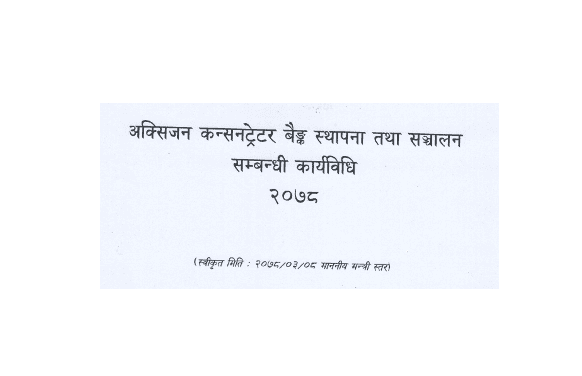
Procedures for Establishment and Operation of Oxygen Concentrator Bank, 2078
National Plan, Policy & GuidelinesOutbreak NewsResearch & Publication

Procedures for Establishment and Operation of Oxygen Concentrator Bank, 2078

by Public Health Update June 28, 2021
written by Public Health Update

The Ministry of Health and Population has endorsed a new guideline for the establishment and Operation of Oxygen Concentrator Bank at central, province and district level. This document will provide necessary guidance to the health authorities to maintain the demand and supply of Oxygen Concentrator at province, district and sub-district levels.

Download PDF
PDF FILE
Download PDF
PDF FILE


Do you have a website? Looking for the best hosting provider? Here’s a discount code.

Latest Public Health Jobs

Latest Posts

  • International Wellness Day: Promoting Global Wellness for All
  • Summit Declaration: The 12th National Summit of Health and Population Scientists in Nepal
  • Joint political declaration on the reform of the global health architecture
  • World Health Day 2026: Together for Health. Stand with Science.
  • World Water Day 2026 | Water & Gender Equality

Thanks for visiting us.
Disclaimer: The resources, documents, guidelines, and information on this blog have been collected from various sources and are intended for informational purposes only. Information published on or through this website and affiliated social media channels does not represent the intention, plan, or strategies of an organization that the initiator is associated with in a professional or personal capacity, unless explicitly indicated.
If you have any complaints, information, or suggestions about the content published on Public Health Update, please feel free to contact us at blog.publichealthupdate@gmail.com.
#StayUpdated


  • WordPress
  • Link
  • Facebook
  • Mail
  • Facebook
  • Twitter
  • Twitter
  • LinkedIn
  • Instagram
  • Facebook
June 28, 2021 0 comments
0 FacebookTwitterPinterestLinkedinTumblrVKOdnoklassnikiRedditStumbleuponWhatsappTelegramLINEPocketSkypeViberEmail
Syllabus for MPH Program
CoursesResearch & PublicationSyllabus

Syllabus for Licensing Examination of Master of Public Health (MPH) 2021

by Public Health Update June 24, 2021
written by Public Health Update

The Nepal health professional council (NHPC) has published a Syllabus for Licensing Examination of Master of Public Health (MPH) 2021.

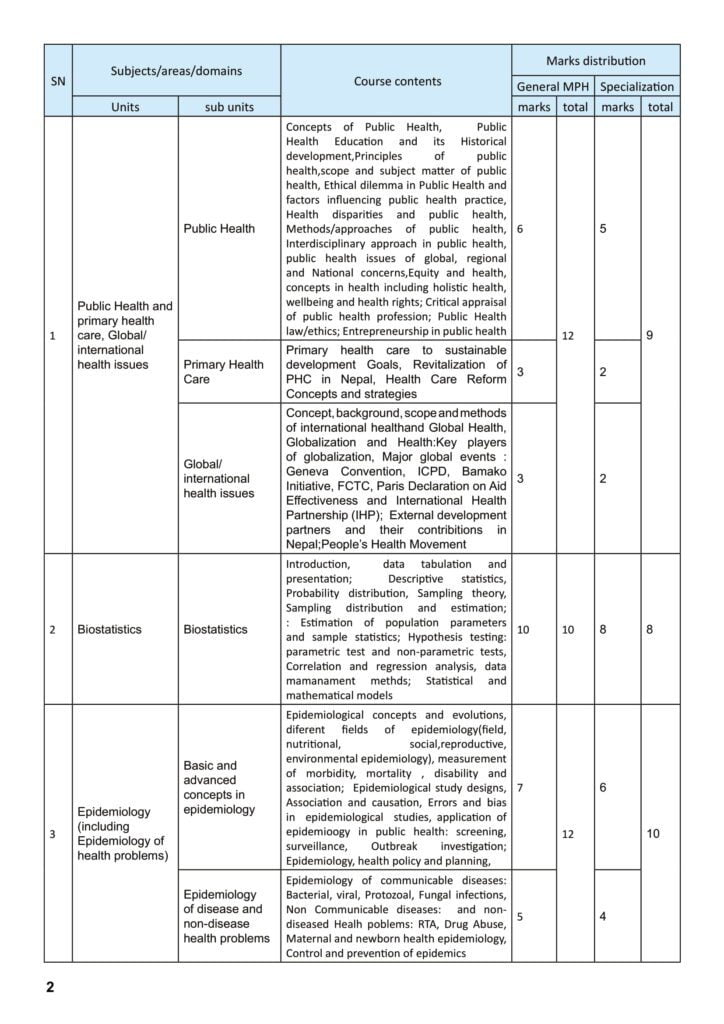
Subjects/areas/domains

A. Public Health and primary health care, Global/ international health issues
1. Public Health:
Concepts of Public Health, Public Health Education and its Historical development,Principles of public health,scope and subject matter of public health, Ethical dilemma in Public Health and factors influencing public health practice, Health disparities and public health, Methods/approaches of public health, Interdisciplinary approach in public health, public health issues of global, regional and National concerns,Equity and health, concepts in health including holistic health, wellbeing and health rights; Critical appraisal of public health profession; Public Health law/ethics; Entrepreneurship in public health.

2. Primary Health Care: Primary health care to sustainable development Goals, Revitalization of PHC in Nepal, Health Care Reform Concepts and strategies.

3. Global/ international health issues: Concept, background, scope and methods of international health and Global Health, Globalization and Health:Key players of globalization, Major global events : Geneva Convention, ICPD, Bamako Initiative, FCTC, Paris Declaration on Aid Effectiveness and International Health Partnership (IHP); External development partners and their contributions in Nepal;People’s Health Movement.

B.Biostatistics

1. Biostatistics: Introduction, data tabulation and presentation; Descriptive statistics, Probability distribution, Sampling theory, Sampling distribution and estimation; : Estimation of population parameters and sample statistics; Hypothesis testing: parametric test and non-parametric tests, Correlation and regression analysis, data management methods; Statistical and mathematical models.

C. Epidemiology (including Epidemiology of health problems)

1. Basic and advanced concepts in epidemiology: Epidemiological concepts and evolutions,
different fields of epidemiology(field, nutritional, social,reproductive, environmental epidemiology), measurement of morbidity, mortality , disability and association; Epidemiological study designs, Association and causation, Errors and bias in epidemiological studies, application of epidemiology in public health: screening, surveillance, Outbreak investigation; Epidemiology, health policy and planning.

2. Epidemiology of disease and non-disease health problems
Epidemiology of communicable diseases: Bacterial, viral, Protozoal, Fungal infections, Non Communicable diseases: and non diseased Health problems: RTA, Drug Abuse, Maternal and newborn health epidemiology, Control and prevention of epidemics.

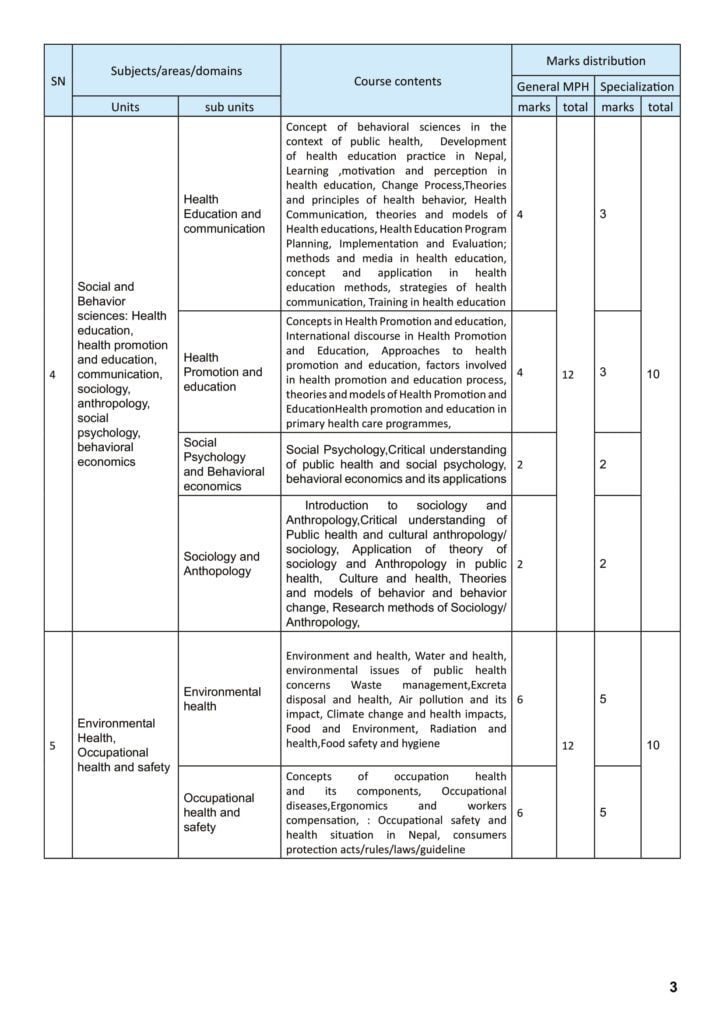
D. Social and Behavioral sciences: Health education, health promotion and education, communication, sociology, anthropology, social psychology, behavioral economics

  1. Health Education and communication: Concept of behavioral sciences in the context of public health, Development of health education practice in Nepal, Learning ,motivation and perception in health education, Change Process,Theories and principles of health behavior, Health Communication, theories and models of Health educations, Health Education Program Planning, Implementation and Evaluation; methods and media in health education, concept and application in health
    education methods, strategies of health communication, Training in health education.
  2. Health Promotion and education: Concepts in Health Promotion and education, International discourse in Health Promotion and Education, Approaches to health promotion and education, factors involved in health promotion and education process, theories and models of Health Promotion and Education Health promotion and education in primary health care programmes.
  3. Social Psychology and Behavioral economics: Social Psychology,Critical understanding of public health and social psychology, behavioral economics and its applications.
  4. Sociology and Anthropology: Introduction to sociology and Anthropology,Critical understanding of Public health and cultural anthropology/ sociology, Application of theory of sociology and Anthropology in public health, Culture and health, Theories and models of behavior and behavior change, Research methods of Sociology/ Anthropology.

E. Environmental Health, Occupational health and safety

  1. Environmental health: Environment and health, Water and health, environmental issues of public health concerns Waste management,Excreta disposal and health, Air pollution and its impact, Climate change and health impacts, Food and Environment, Radiation and health,Food safety and hygiene.
  2. Occupational health and safety: Concepts of occupation health and its components, Occupational diseases,Ergonomics and workers compensation, : Occupational safety and health situation in Nepal, consumers protection acts/rules/laws/guideline.

F. Health policy and systems: Health Service Management, Health policy, governance and administration/ management

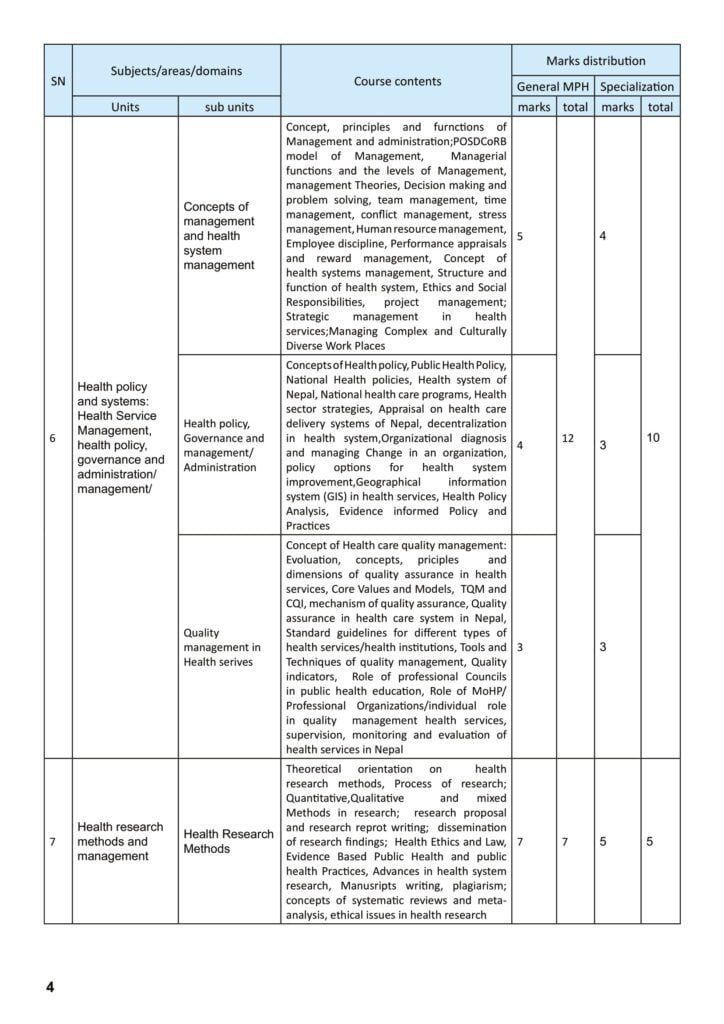
1. Concepts of management and health system management: Concept, principles and functions of Management and administration;POSDCoRB model of Management, Managerial functions and the levels of Management, management Theories, Decision making and problem solving, team management, time management, conflict management, stress management, Human resource management, Employee discipline, Performance appraisals and reward management, Concept of health systems management, Structure and function of health system, Ethics and Social Responsibilities, project management; Strategic management in health services; Managing Complex and Culturally Diverse Workplaces.

2. Health policy, Governance and management/ Administration: Concepts of Health policy, Public Health Policy, National Health policies, Health system of Nepal, National health care programs, Health sector strategies, Appraisal on health care delivery systems of Nepal, decentralization in health system,Organizational diagnosis and managing Change in an organization, policy options for health system improvement,Geographical information system (GIS) in health services, Health Policy Analysis, Evidence informed Policy and Practices.

3. Quality management in Health services: Concept of Healthcare quality management: Evolution, concepts, principles and dimensions of quality assurance in health services, Core Values and Models, TQM and CQI, mechanism of quality assurance, Quality assurance in health care system in Nepal, Standard guidelines for different types of health services/health institutions, Tools and Techniques of quality management, Quality indicators, Role of professional Councils in public health education, Role of MoHP/ Professional Organizations/individual role in quality management health services, supervision, monitoring and evaluation of health services in Nepal.

G. Health research methods and management
1. Health Research Methods: Theoretical orientation on health research methods, Process of research; Quantitative,Qualitative and mixed Methods in research; research proposal and research report writing; dissemination of research findings; Health Ethics and Law, Evidence Based Public Health and public health Practices, Advances in health system research, Manuscripts writing, plagiarism; concepts of systematic reviews and meta analysis, ethical issues in health research.

H. Demography, Reproductive health and family health issues
1. Demography and Population studies
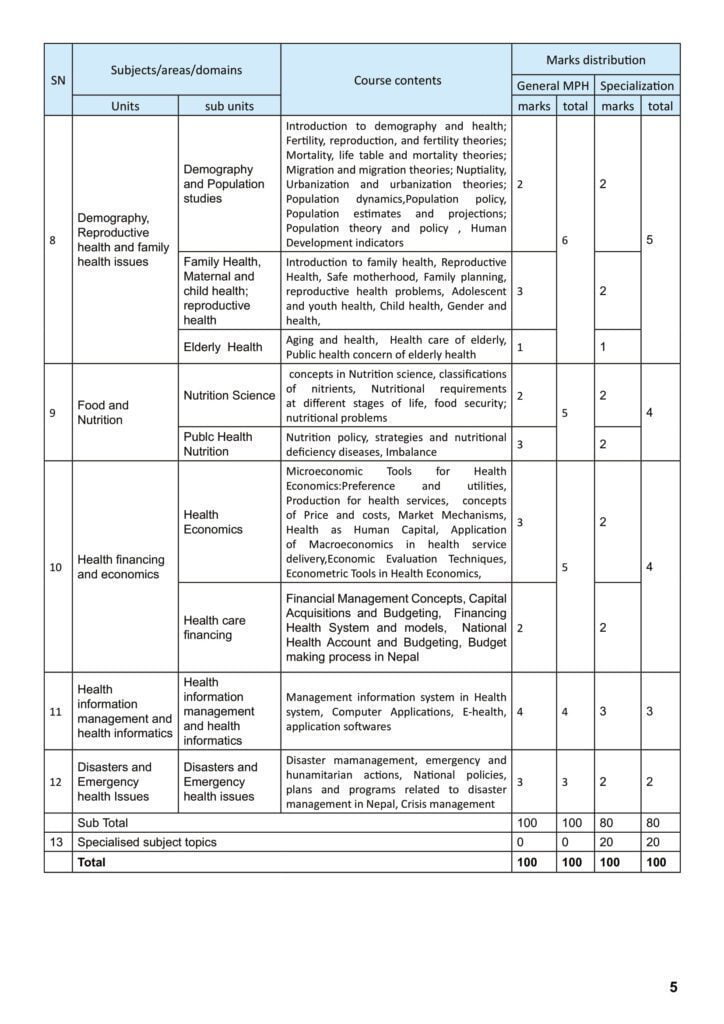
: Introduction to demography and health; Fertility, reproduction, and fertility theories; Mortality, life table and mortality theories; Migration and migration theories; Nuptiality, Urbanization and urbanization theories; Population dynamics,Population policy, Population estimates and projections; Population theory and policy , Human Development indicators.

2. Family Health, Maternal and child health; reproductive health: Introduction to family health, Reproductive Health, Safe motherhood, Family planning, reproductive health problems, Adolescent and youth health, Child health, Gender and health,

3. Elderly Health: Aging and health, Health care of elderly, Public health concern of elderly health.

I. Food and Nutrition
1. Nutrition Science
concepts in Nutrition science, classifications of nutrients, Nutritional requirements at different stages of life, food security; nutritional problems
2. Public Health Nutrition: Nutrition policy, strategies and nutritional deficiency diseases, Imbalance.

J. Health financing and economics

  1. Health Economics: Microeconomic Tools for Health Economics:Preference and utilities, Production for health services, concepts of Price and costs, Market Mechanisms, Health as Human Capital, Application of Macroeconomics in health service delivery,Economic Evaluation Techniques, Econometric Tools in Health Economics, Health care
    financing
  2. Financial Management: Concepts, Capital Acquisitions and Budgeting, Financing Health System and models, National Health Account and Budgeting, Budget making process in Nepal.

K. Health information management and health informatics
1. Health information management and health informatics
: Management information system in Health system, Computer Applications, E-health, application softwares

L. Disasters and Emergency health Issues
1. Disasters and Emergency health issues: Disaster management, emergency and humanitarian actions, National policies, plans and programs related to disaster management in Nepal, Crisis management.


Syllabus for MPH Program
DOWNLOAD PDF
NHPC


Do you have a website? Looking for the best hosting provider? Here’s a discount code.

Latest Public Health Jobs

Latest Posts

  • International Wellness Day: Promoting Global Wellness for All
  • Summit Declaration: The 12th National Summit of Health and Population Scientists in Nepal
  • Joint political declaration on the reform of the global health architecture
  • World Health Day 2026: Together for Health. Stand with Science.
  • World Water Day 2026 | Water & Gender Equality

Thanks for visiting us.
Disclaimer: The resources, documents, guidelines, and information on this blog have been collected from various sources and are intended for informational purposes only. Information published on or through this website and affiliated social media channels does not represent the intention, plan, or strategies of an organization that the initiator is associated with in a professional or personal capacity, unless explicitly indicated.
If you have any complaints, information, or suggestions about the content published on Public Health Update, please feel free to contact us at blog.publichealthupdate@gmail.com.
#StayUpdated


  • WordPress
  • Link
  • Facebook
  • Mail
  • Facebook
  • Twitter
  • Twitter
  • LinkedIn
  • Instagram
  • Facebook
June 24, 2021 0 comments
0 FacebookTwitterPinterestLinkedinTumblrVKOdnoklassnikiRedditStumbleuponWhatsappTelegramLINEPocketSkypeViberEmail
Syllabus for Licensing Examination of Certificate in Medical Laboratory Technology 2021
SyllabusCoursesResearch & Publication

Syllabus for Licensing Examination of Certificate in Medical Laboratory Technology 2021

by Public Health Update June 24, 2021
written by Public Health Update

Nepal Health Professional Council has approved a syllabus for Licensing Examination of Certificate in Medical Laboratory Technology 2021.

Nepal Health Professional Council (NHPC)

Overview

  1. Clinical Biochemistry 20%
  2. Clinical Haematology 20%
  3. Clinical Microbiology and Immunology 20%
  4. Histo/Cytopatological Techniques 10%
  5. Anatomy and Physiology 10%
  6. Clinical Parasitology 5%
  7. Instrumentation and Automation 5%
  8. Blood Banking 5%
  9. Pathology 5%
    Total 100%

Details

Subject:Clinical Biochemistry
Unit 1
Colorimeters, Water bath, Incubator, Centrifuges, Balances, and pH meter, Paper chromatography, Electrophoresis, Spectrophotometer, Flame photometer, Semiauto and Auto analyser, Dispensers and Auto-pipettes, Polymerase Chain Reaction (PCR)

Unit 2
Laboratory hazards and precautions. Preparation of Solution and its types. Define acid, base, salt, neutralization, Titration of Acid and bases. Cleaning of glassware. Filters, Monochromometers, Triangle law of light and concept of complimentary colours, Optical density, Bear’s & Lambert’s law. Common anticoagulants, Preservation of Chemical Reagents and preservatives, Changes occurring in the blood after collection, Store blood and take precautions during blood storage,

Unit 3
Definition, classification and metabolism of biomolecules (carbohydrate, protein and lipid). Blood sugar regulation in the body including hormonal regulations, Diabetes mellitus & abnormalities of metabolism of carbohydrates

Unit 4:
Define, classify and enumerate the properties of enzymes, units of enzyme, (IU & common units), enzyme reaction and enzyme substrate reactions and effects of various factors Plasma proteins and identify the plasma protein abnormalities.

Unit 5:
Principle, procedure, precautions, calibration of graph & normal value in the estimation of samples: Sugar, Urea, Amylase, GPT, GOT, Acid phosphatase, Alkaline phosphatase, calcium, phosphorus, sodium Potassium, chloride, Creatinine, Cholesterol, Triglycerides, HDL, LDL, uric acid, protein, and bilirubin.

Unit 6:
Hormones and tumour markers, Quality Control in biochemistry laboratory.

Subject: Clinical Haematology
Unit 1 Haematopoiesis

The site of blood formation, process of erythropoiesis, leucopoiesis and thrombopoiesis. Physiology and metabolism of the blood cells and its disorders

Unit 2: Red Cell Disorders
Erythrocytic disorder, Haemoglobin, its structure and function, List normal and abnormal haemoglobins, Haemoglobinopathies and thalassemia, polycythaemia. Define and classify anaemia,

Unit 3: White Blood Cell Disorders
Morphological and functional disorders of white blood cells. Leucocytes disorders and leukaemia

Unite 4: Coagulation mechanisms
Process of Coagulation, Coagulation factor and arrest the bleeding. Bleeding time, coagulation time, prothrombin time, activated partial thrombin time , the thrombocytic disorders and bleeding disorder

Unit 5: Haematological Techniques
Haematological instruments, Flow cytometry, Fluorescent and Electron microscopy glassware and chemicals.
Anticoagulant; describe various anticoagulants and state their mechanism of action. Blood sample collection, Defebrination technique. Different stain, Blood smear. Heamatological tests: Total blood cell count, Differential leukocyte count, Erythrocyte sedimentation rate, haemoglobin, packed cell volume (PCV), Blood indices (MCV, MCH, and MCHC), Reticulocyte count and their significance Stain of Bone marrow smears, Errors and precaution on haematological work Quality control measures.

Subject: Microbiology and Immunology
Unit 1 Clinical Bacteriology
Cell structure, morphological classification of bacteria.
Explain bacterial growth requirements.
Describe the principles of various staining techniques and normal bacterial flora of human body.
Bacterial culture techniques, culture media, controlling microbial growth, sterilization,
disinfection and antisepsis.
Various methods for the identification and antimicrobial susceptibility testing of bacteria
Various quality control methods, safety precautions and disposal of contaminated materials in bacteriology laboratory.
Classification, culture characteristic, morphology, identification and antibiotics/
sensitivity of the following common bacteria from clinical samples.

Syllabus for Licensing Examination of PCL in Ophthalmic Science


Unit 2 Clinical Mycology
Morphological Classification of medically important fungi.
Describe briefly superficial/cutaneous, systemic mycosis and aetiological agents.
Describe the collection techniques of various clinical samples for the diagnosis of fungal
infection (skin/nail/hair sample, corneal scraping, sputum and biopsy materials).
Describe fungal culture media (SDA, RSA, DTM)

Unit 3 Clinical Virology
Multiplication process of viruses
Common and emerging viral diseases.
Basic laboratory procedure used in the diagnosis of viral diseases.
Clean and sterilize glassware used in virology laboratory.
Perform Giemsa staining for viral inclusion bodies.
Prepare samples for virus culture/investigation.
Demonstration of ELISA and Western blot for the diagnosis of HIV infection.
Prepare media for transporting virus culture and its storage.

Unit 4 Immunology (27 Hours)
Immunity, antigen/ hapten, antibody.
Innate and acquired defence mechanism.
Classification of antigen antibody reactions
Describe vaccine. List out the common vaccine against vaccine preventable diseases in Nepal.
Perform intradermal skin test (Mantoux Test), VDRL, ASO titre, RA factor, CRP, Widal and
Brucella agglutination Test

Subject: Histopathology and Cytology Techniques
Unit 1 Histopathology
Fixatives and preservatives
Prepare simple and compound fixatives (10% formalin, 10% normal saline and Zenker’s fluid).
Define principle of basic histological stain: Hematoxylin and Eosin, PAS, Alcian Blue, ZiehlNeelsen and Congo Red stains. Histokinette and its principle.
Principle of processing of histopathological tissues (fixation, dehydration, clearing, embedding, trimming and labelling).
Types of microtomes including cryostat, and cut the sections of desired thickness.
Types of microtome knives and sharpening procedures.
Decalcification of bone and different types of decalcifying agents.
Mounting media (DPX, glycerine).
Maintain record and prepare the charts of investigation.

Unit 2 Cytological Procedures
Collect various types of cytological specimens (sputum, urine, effusion fluids, and tissue fluids)
Principle and techniques of sample processing: Uniform smear, thick and thin smear, fishfail smear.
Smear preparation of cytological specimens (sputum, urine, effusion fluids, and various body fluids). FNAC, Stain: Papanicolaou stain. Giemsa stain Aceto-orcein stain.
Sex chromatin detection and semen analysis.
Subject: Anatomy and physiology
Important anatomical terminologies
The composition and function of blood
The structure and functions of alimentary canal, digestive system, circulatory system,
endocrine system, urinary system & respiratory system
Subject: Clinical Parasitology

Unit 1: Protozoa
Pathogenesis and laboratory diagnosis of:
Entamoeba histolytica and E. coli, E. hartmanni, Endolimax nana Iodamoeba buetschlii, Giardia lamblia, Trichcmonas vaginalis and T. hominis, Leishmania: (L. donovari, L. tropica, L. mexicana and L. braziliensis) Plasmodium: (P. vivax, P. ovale, P. falciparum, P. malariae), Toxoplasma gondii. Cryptosporidium parvum, Cyclospora cayetanensis, Isospora belli, Balantidium coli

Unit 2: Helminths
Nematodes
Pathogenesis and laboratory diagnosis of:
Hookworm: Necator americanus and Ancylostoma duodenale, Ascaris lumbricoidea,
Enterobius vermicularis , Trichuris trichiura , Strongyloides stercoralis, Microfilaria:
Wuchereria bancrofti, Brugia malayi, and Loa loa.
Cestodes (Tape worms)
Pathogenesis and laboratory diagnosis of:
Taenia solium and Taenia saginata, Echinococcus granulosus and Hymenolepis nana.
Trematodes (Flukes, intestinal, hepatic, pulmonary and blood)
Pathogenesis and laboratory diagnosis of:
Fasciola hepatica, Faciolopsis buski, Paragonimus westermani , Schistosoma haematobium, S. mansoni, and S. japanicum

Unit 4: Laboratory techniques
Procedure for clinical specimens collection for parasitic investigations (stool, urine, blood, sputum, exdudates, swabs and aspirates).
Preparation of reagents required for routine diagnostic purposes (, iodine solution, brine solution, 33% zinc sulphate solution, normal saline solution, Stooll’s reagent, Giemsa and
Leishman’s stain and benzidine solution).Various laboratory technique:
a) Feacel (stool) examination: physical, chemical-reducing substances and occult blood, and microscopic.
b) Blood examination by wet and stained smears preparation for blood parasites.
c) Urine, sputum examination for urinary and respiratory tract parasites.
d) Various concentration methods (floatation and sedimentation) to detect the blood and intestinal parasites.

Unit 5: Explain the collection, preservation and transportation of urine.
Method of examination of urine samples: physical, chemical and microscopic.
Urine albumin, sugar, bile salt, urobilinogen, porphobilinogen, chyle and Benze-John’s protein.
Cerebrospinal fluid (CSF); constituents, normal reference values, method of sample collection and examination (CSF protein, sugar cells and microorganisms.
Body fluids: transudets and exudets, normal reference value, method of sample collection and examination (body fluid protein, sugar and cells and microorganisms.

Subject: Instrumentation and Automation
Unit: 1
Describe types of automatic analyzers:
a) Continuous flow systems
b) Discrete analyzers
c) Centrifugal analyzers
d) Thin film analyzers
e) Automated electrolyte analyzers

Unit: 2
Describe: the use of blood cell analyzers, use ELISA reader and washer, blood gas and acidbase analytical systems.
Explain the main features of automated blood gas analysers. Laboratory computer aids, photometric system used in peripheral laboratory, essential features of centrifugal analysers, maintenance of laboratory instruments, laboratory management with reference to placing of instruments and bio-safety zones

Subject: Blood Bank
Describe the scope, importance and principle of blood banking.
Describe blood grouping system and various blood groups.
Explain blood donors and preparation of blood donors.
State the principle and procedures of the proper storage of blood.
Describe the various method for compatible blood for recipient and understand the risk of incompatible blood, Identify antiserum, blood bags and transfusion sets of delivery of safe blood for transfusion
Describe principal, procedure and precaution on
a) ABO and Rh. blood grouping
b) Cross-matching
c) Direct and indirect Coomb’s tests.
d) Anti-d antibody titration.
e) Screening of blood bags
Describe transfusion reaction and counter check blood transfusion reaction
Describe the erythroblastosis foetalis.

Subject: Basic Pathology
Unit 1: Introduction to General Pathology
Understanding of Pathology, Field of pathology, Importance of Pathology, Scope and method, Application of in Laboratory investigation in Pathology diagnosis

Unit 2: Basics of cell injury
Introduction , Types and its causes , Common terminology used in cell injury, Clinical diagnosis and laboratory interpretation

Unit 3: Infection and inflammation
Causative organisms and its types in infection and inflammation.
Terminology used in Benign clinical interpretation (Atrophy, Hypertrophy, Hyperplasia, Metaplasia, Necrosis, Apoptosis, Hypoxia, Ischemia, Oedema, exudates and transudates etc. Laboratory investigation and interpretation Immunological investigation

Unit 4: Neoplasia
Introduction , Benign and malignant tumours , Terminology used in Malignant clinical interpretation (carcinoma, sarcoma, lymphoma, dysgerminoma, etc) Laboratory investigation and interpretation Application of Immunological investigations , Essential Histo and cytochemical investigations , Introduction of tumour marker.

DOWNLOAD PDF
NHPC

Syllabus for Licensing Examination of Certificate Level in General Medicine 2021


  • International Wellness Day: Promoting Global Wellness for All
  • Summit Declaration: The 12th National Summit of Health and Population Scientists in Nepal
  • Joint political declaration on the reform of the global health architecture
  • World Health Day 2026: Together for Health. Stand with Science.
  • World Water Day 2026 | Water & Gender Equality
June 24, 2021 0 comments
0 FacebookTwitterPinterestLinkedinTumblrVKOdnoklassnikiRedditStumbleuponWhatsappTelegramLINEPocketSkypeViberEmail
NHPC Syllabus for Licensing Examination of PCL in Ophthalmic Science
SyllabusCoursesResearch & Publication

Syllabus for Licensing Examination of PCL in Ophthalmic Science

by Public Health Update June 24, 2021
written by Public Health Update

NHPC Syllabus for Licensing Examination of PCL in Ophthalmic Science.

Nepal Health Professional Council (NHPC)

Overview

  1. Basic of preparatory/general sciences (Physics biochemistry, zoology, Botany)- 5%
  2. General Anatomy and Physiology (organ system)- 10 %
  3. Ocular Anatomy and Physiology – 10%
  4. Ocular Pharmacology – 10%
  5. Ocular Pathology – 10%
  6. Systemic Disease and Eye – 5%
  7. Binocular Single Vision and its abnormalities – 5%
  8. Optics and Refraction- 5%
  9. Investigative Ophthalmology – 5%
  10. Ophthalmic Nursing Care and Operation Theatre Management – 10%
  11. Ocular Surgery Assisting – 10%
  12. Community Ophthalmology- 10%
  13. Code of Ethics – 5%
    Total 100%

Details

  1. Basic of preparatory/general sciences (Physics biochemistry, zoology, Botany)
    This includes essential knowledge
    Laws of reflection and refraction, Refractive index
    Types of chemical bond.
    Characteristics of acids, bases and salts.
    Antacids and antabases and their medical uses
    Structure (Linear Cyclic) of glucose,
    Functions of Carbohydrates
    Introduction of lipid, fat and oil and their natural sources.
    types of tissues
    muscular tissue and its types, striated, smooth and
    cardiac muscles of animals.
    Nervous tissue and its types.
    Morphology of fungal plant
    Characteristics of a virus
  2. General Anatomy and Physiology (Systems of the Body)
    This includes general concepts of anatomy and physiology of human body:
    Anatomical terms,
    Accessory organs and glands of the skin.
    Structures and functions of the heart, Components and function of the blood.
    Terms related to the skeletal system : axial ,appendicular ,articular cartilage
    ,diaphysis, epiphysis fontanel , hematopoiesis , periosteum
    Classifications of joints,
    structure and Divisions of the central nervous system:Classifications of neurons and
    neuralgia
    self-healing nature of body cells and tissues.
    Physiological terms: Cardiovascular, Digestion ,Excretion ,Organ ,Peritoneal
    ,Pericardial ,Thoracic Visceral ,Homeostasis
    Factors affecting growth and repair. Coagulation factors.
    Cranial nerves and their function
    Measurement of pulse and blood pressure
  3. Ocular Anatomy and Physiology
    This includes general concepts of basic knowledge of the anatomy and physiology of the eye. This includes :
    Embryology of the eye
    Anatomy along with blood and nerve supply of eye lids and adnexa, conjunctiva,
    cornea, sclera, uveal tract, lens, vitreous humor, retina, angle structure
    Physiology of the cornea, aqueous humour, metabolism of cornea, lens and vitreous
    Anatomy of orbit and its walls
    Anatomy of extraocular muscles
    Anatomy and functions of cranial nerves related to eye
    Anatomy of lacrimal drainage systems
    Formation and drainage of aqueous humour
    Anatomy and physiology of visual pathway
    Anatomy of pupillary pathway and pupillary reflex
  4. Ocular Pharmacology
    This includes concepts on pharmacology with special reference to eye. Selection of appropriate drugs for specific disease/conditions, their actions, indications,
    contraindications and side effects.
    This includes
    Pharmacological terminologies like half life, plasma concentration of drug,
    bioavailability, shelf life, expiry date
    Concepts of pharmacodynamics, pharmacokinetics
    Routes of administration of drugs
    Mechanism of action, indication, contraindication, side effects precautions of:
    Different types of antibiotics, their mechanism of action and spectrum of activity
    Drugs used in gastrointestinal systems, respiratory system, cardiovascular system,
    Central Nervous System
    Analgesic, antipyretic and anti-inflammatory drugs: Mechanism of action, indication,
    contraindication, side effects and precautions
    Steroidal drugs
    Nutritional Supplements
    Antihistamines and allergic
    Mydriatics and Cycloplegics
    Miotics and Antiglaucoma drugs
    Lubricating drugs
  5. Ocular Pathology
    This includes different aspects of ocular pathology with special reference to eye. Includes:
    Microbiology
    Morphology, classification, structure of bacteria, virus, fungus, parasites
    Epidemiology, mode of infection, pathogenicity, laboratory diagnosis of common
    bacteria, virus, fungus, parasites
    Culture media of bacteria, fungus
    Different staining techniques, antibiotic susceptibility testing
    General composition of blood, types of blood cells with their function
    Total Leucocyte count, Differential Leucocyte count with their normal values
    Different methods of sterilization and disinfection
  6. Systemic Disease of the eye
    This includes ideas of disease in general medicine related to the eyes. This includes
    Diabetes Mellitus and its effects on eye
    Hypertension and its effects on eye
    Thyroid Eye Disease and its effects on eye
    Vitamin A deficiency and its effects on eye
    Tuberculosis
    Leprosy
    Syphilis
    Gonorrhea
    Rubella
    Toxoplasmosis
    HIV/AIDS
  7. Binocular Single Vision and its abnormalities
    This includes identification and management of different binocular vision abnormalities. This includes:
    Understand the function of EOM
    Different types of eye movement
    Accommodation: Introduction, anomalies and assessment
    Latent and Manifest misalignment of the eyes
    Motor and Sensory adaptation to strabismus
    Basic Tests in Orthoptics setting
    Hirschberg and Krimsky test
    Cover test and its types
    Test of convergence and accommodative problems
    Test for suppression
    Test for stereopsis
    Test for Prism Fusion range
    Amblyopia and its management
  8. Optics and Refraction
    This includes basic knowledge of optics and refraction, understanding of the light and its clinical implications, different optical condition of the eye. This includes
    Light, its nature and interaction with reflective and refractive medium
    Cardinal points
    Schematic Eye
    Lens design options in minus and plus lens
    Meniscus lens, Lenticular lens and Myodisc
    Manufacturing of Ophthalmic lenses
    Properties of Ophthalmic lens
    Lens aberrations
    Myopia and its classification based on etiology
    Hyperopia and classification based on etiology
    Astigmatism and types of astigmatism
    Accommodation and its physiology
    Presbyopia and its classification
    Parts of retinoscope, optical priniciple, reflex characteristics and procedure
    Techniques of subjective refraction and its importance
    Specifying lens power, prescription writing and power verification
  9. Investigative Ophthalmology
    This includes different investigation procedures for specific eye problems and interpretation the findings of the investigations. This includes
    Visual acuity (near and distance)
    Colour vision and contrast sensitivity assessment
    Intraocular pressure
    Visual field
    Ultrasonography
    FFA
    Anterior segment and fundus photography
    Exophthalmometry
    Pachymetry
    Keratometry
    Gonioscopy
    Direct Ophthalmoscopy
    Indirect Ophthalmoscopy
    Slit lamp bio microscopy
    Biometry
  10. Ophthalmic Nursing Care and Operation Theatre Management
    This includes basic ophthalmic nursing procedure required to perform during, after and before surgery. This includes
    Respiration: definition, types, characteristics, factors affecting temperature, pulse,
    respiration and blood pressure
    Principles, Techniques and Measurement of temperature, pulse, respiration and
    blood pressure
    Objective of Operation Theatre
    Operation Theatre management and aseptic technique
    Trolley preparation in different eye surgery
    Scrub and circulation
    OT Hazards and risk management
    Definition, types of ocular anesthesia, equipment
    Management of recovery patient
    Pre and post operative management of different types of ocular surgery
    Routes of administration of drugs
  11. Ocular Surgery Assisting
    This includes knowledge and skills on ocular surgical procedures to assist the ophthalmologist. Includes:
    Instruments, step, consumable and medicines in
    cataract surgery
    glaucoma surgery
    nasolacrimal passage surgery
    Strabismus surgery
    Keratoplasty surgery
    Vitro-retinal surgery
    Lid surgery
    Orbitotomy surgery
    Enucleation, evisceration and extentration surgery
    Excisional biopsy
    Electroepilation
    Pterygium excision and conjunctival graft
    Preparation of patient, surgical area, step of surgery, possible complication and
    management of extra ocular surgeries
    Trolley preparation, consumable and post operative management of
    Entropion
    Chalazion
    lid laceration repair
    incision and drainage of lid abscess and externum
  12. Community Ophthalmology
    This includes planning, implementing, monitoring and evaluating the eye health and interventions in defined population. Developing tools to assess the magnitude of eye problem, calculating disease burden and making conversation with current national and global eye health strategies and planning on eye health. This includes
    Concept of health given by Alma-Ata declaration/WHO
    Primary health care, its definition and elements
    Measuring disease burden in community (Magnitude, prevalence, incidence)
    Concepts, Importance, Components of community participation
    Health/Eye health status indicators
    Basic Health profile of Nepal
    Prevalence of blindness and visual impairment in Nepal
    Calculation of WHO standard of visual outcome
    Sustainable Development Goals
    WHO action Plan
    WHO and IAPB eye health strategies at global and regional level
  13. Code of Ethics
DOWNLOAD PDF
NHPC
Syllabus for Licensing Examination of Certificate Level in General Medicine 2021


Do you have a website? Looking for the best hosting provider? Here’s a discount code.

Latest Public Health Jobs

Latest Posts

  • International Wellness Day: Promoting Global Wellness for All
  • Summit Declaration: The 12th National Summit of Health and Population Scientists in Nepal
  • Joint political declaration on the reform of the global health architecture
  • World Health Day 2026: Together for Health. Stand with Science.
  • World Water Day 2026 | Water & Gender Equality

Thanks for visiting us.
Disclaimer: The resources, documents, guidelines, and information on this blog have been collected from various sources and are intended for informational purposes only. Information published on or through this website and affiliated social media channels does not represent the intention, plan, or strategies of an organization that the initiator is associated with in a professional or personal capacity, unless explicitly indicated.
If you have any complaints, information, or suggestions about the content published on Public Health Update, please feel free to contact us at blog.publichealthupdate@gmail.com.
#StayUpdated


  • WordPress
  • Link
  • Facebook
  • Mail
  • Facebook
  • Twitter
  • Twitter
  • LinkedIn
  • Instagram
  • Facebook
June 24, 2021 0 comments
0 FacebookTwitterPinterestLinkedinTumblrVKOdnoklassnikiRedditStumbleuponWhatsappTelegramLINEPocketSkypeViberEmail
Research & PublicationNational Plan, Policy & GuidelinesSyllabus

Syllabus for Licensing Examination of Certificate Level in General Medicine 2021

by Public Health Update June 24, 2021
written by Public Health Update

The Nepal Health Professional Council (NHPC) has endorsed the Syllabus for Licensing Examination of Certificate Level in General Medicine 2021.

Overview

  • Anatomy and Physiology – 10%
  • Community Health: Health education & Health Promotion, Environmental health, PHC and Family Health, Epidemiology and Disease control, Nutrition, Community Diagnosis – Health Management – 25%
  • General Medicine: Clinical methods, Systemic diseases, Pediatric and Neonatology, Skin Diseases, Veneral diseases, Psychiatry – 25%
  • Pharmacology and pharmacy: Pharmacology, Pharmacy – 10%
  • General Surgery: Basic surgery- First aid and emergency care – Obs.& Gyne – Eye,ENT and Oral Health – 25%
  • Clinical Pathology: Biochemistry, Microbiology, Parasitology, Hematology – 5%
  • Total 100%

Details

  1. Anatomy and Physiology
    Introduction of Anatomy & physiology, structure and function of the Skin and integumentary system, Skeletal system, Muscular system, Nervous system, Somatic and special senses, Endocrine system, Blood, Cardiovascular system, Lymphatic system and immunity, Digestive system, Respiratory system, Urinary system, Male reproductive system, Female reproductive system and Human Growth & Development.

2. Community Health
2.1. Health education and health promotion
Overview of health education, Fundamental Factors of Health Education, Methods of Health Education, Media of Health Education, Planning of Health Education Programmes, Implementation of Health Education Programmes, Evaluation of Health Education Programmes, Health Promotion, Applied Health Education.
2.2. Environmental Health
Water Purification, Waste Management, Food Hygiene, Sanitation of public places, Health Hazards, Sanitary Latrines, Basic Measures in Controlling Rodents, Medical Importance and Measures of Controlling Common Vectors and Insects.
2.3. Primary health care and family Health
Health care of people: Concept of health, determinants of health, indicators of health, Primary Health Care and Health for All, Community participation in PHC, Challenges of PHC in Nepal, Role of Health Post Incharge in PHC, Introduction of family planning, Adolescent Health, Demography, Common Neo-natal Problems,Common Child Health Problems like CDD, ARI, Malaria and Malnutrition.Nutritional Interventions, Immunizations Services. Safe Motherhood. Community Mobilization & Local Governance( Female Community Health volunteers (FCHV) and Mother’s
Groups, Primary Health Care Outreach Clinic, Free Drug Programme (FDP), Mobilization of Local
Health Leaders and Committees, Decentralized Management of Health Services.
2.4. Epidemiology and Disease control
Definition, Scope, Causes of Disease and Infection, Management of Disasters, Management of Epidemics, Causes, Signs, Symptoms, Management, Prevention and Control of Gastroenteritis, Dysentery, Cholera, Typhoid Fever, Giardiasis, Malaria, Filariasis, Encephalitis, Kala-azar, Dengue, Fever, Parasitic Infestation, Scabies, Chicken Pox, Influenza, Mumps, Rabies, Hepatitis, Ring Worm, Leprosy, Tuberculosis, Helmenthiasis, Pertusis, Measles,Diphtheria, HIV and AIDS,
sexually transmitted infection(STI) and COVID.
2.5. Nutrition
Introduction, Proteins, Fats & Carbohydrate, Vitamins, Minerals, Balanced diet, Assessment of nutritional status, Under nutrition, Nutritional problems of public health, Nutrition Factors in Selected Diseases, Nutrition education and food taboos and myths.
2.6. Community diagnosis
Concept of Culture and Health, Introduction to Community Diagnosis, Data collection, Data processing, Community presentation, Micro Health Project.
2.7. Health Management
Community Health Diagnosis & Health Profile, Micro Planning of Health Programme, Supervision, Monitoring and Evaluation of Health Programmes, Health Management Information System (HMIS),Planning and Management of Camps, Cold Chain Management, Health Training Management in different settings, Logistic Management, Organizational Structure and Functions of Ministry of Health and Population (MOHP), Department of Health Service (DoHS), Provincial Health Directorate (PHD),Health Office (HO),Municipality Health section, Primary Health Care Center (PHCC), Health Post (HP) and Basic Health service Centre (BHSC),Nepal Health Professional Council Act, 2053 and Regulation, 2056.

  1. General Medicine
    3.1. Clinical methods
    History taking & Physical Examination, Principles and procedures for collecting and interpreting clinical data, Procedure of general physical examination and systemic examinations in regard to all systems, Bedside history and clinical examination practice.
    3.2. Systemic diseases
    Hematological & Cardiovascular Conditions, Respiratory Disorders, Gastrointestinal Disorders, Endocrine System Disorders, Hepatic Disorders, Central Nervous System Disorders,
    3.3. Pediatric and Neonatology
    Pediatric examination, Neonatal conditions, Neonatal disorders, systemic disorders of children, Infectious diseases-Mumps, diphtheria, whooping cough, rheumatic fever, poliomyelitis, Skin disorders, Helminthes infestations, Nutritional disorders, Integrated Management of Childhood Illness (IMCI), Infection Prevention, Neonatology,
    3.4. Skin Diseases
    Introduction to Dermatology, Bacterial Infections of the skin, Fungal infection of the skin, Viral infection of skin, Parasitic infections of the skin, Allergic conditions of the skin, Acne vulgaris,Psoriasis, Vitiligo, Miliaria,
    3.5. Veneral diseases
    Gonorrhoea, Chlamydia, Syphilis, chancroid, Venereal warts, genital herpes, Syndromic case management of STI
    3.6. Psychiatry
    Mental Health Services in Nepal, Psychiatric assessment, Causes of Mental Illness, Psychosis, Neurosis – anxiety disorders, Neurosis – depressive disorders, Bipolar disorder, Alcohol and drug abuse, Childhood Mental disorders, Psychosexual Disorders, Psychological trauma, Epilepsy, Mental Retardation.
  1. Pharmacology and pharmacy
    4.1. Clinical Pharmacology
    Introduction to pharmacology, Locally acting drugs, Anti-cancer and Antimicrobial agents, Drugs used in Common GI problems, Drugs used in common respiratory problems, Rehydration therapy, Vaccines, antisera and immunoglobulins, Vitamins and minerals, NSAIDS, Hormones and related drugs, CNS acting drugs, Drugs used in cardiovascular problems, Diuretics,
    4.2. Pharmacy
    Pharmaco daynamic and pharmaco kinetic, Rational drug therapy, Inventory management, packing, labelling, dispensing, Preparation of solution, lotion, ointment and suspension (Gentian violet, Mercurochrome, acriflavin, potassium permanganate, Whitfield and sulfur ointment, Lugol’s solution and tincture of iodine and antacid according to accepted formula.
  2. General Surgery
    5.1. Basic surgery
    Haemorrhage, Management of inflammation, Septicemia, Toxemia, Sinus, fistula, Gangrene, Wound, Tetanus, Acute Pain Abdomen, , Hernia, Anal Fissure, Piles, Acute Retention of Urine, Causes of Frequent Urination and Nocturia, Management of Rupture of Urethra, Haematuria, Phymosis, Paraphymosis, Hydrocele, Head Injury, Clinical features and management of Osteomyelitis, Local Anesthesia, Sterilization of Surgical Instruments.
    5.2. First aid and emergency care
    Shock, Poisoning, Injuries, Haemorrhage, External bleeding, Thermal and Chemical Burns, Fracture and Dislocation, Frost Bite, Insect bite, Animal bite, Snake bite and Drowning, Abscess and Cellulites.
    5.3. Obstetrics and Gynecology
    Male and Female reproductive System, mechanism of Menstruation, Conception, Evolution, Vaginal Discharge, Management of Per Vaginal Bleeding, Post-Menopausal Bleeding, Uterine Prolapsed, Pelvic Inflammatory Diseases; causes, Sign, Symptoms and Complication of Ectopic pregnancy, Management of Mastitis. and Breast Abscess, Management of Normal Labor and Early Diagnosis and referral of Complicated Pregnancy, Labor, Puerperium, Safe Abortions, Permanent and Temporary Contraceptives.
    5.4. Eye, ENT and Oral Health
    General Examination procedures of Eye, Ear, Nose and Throat, Sign and Symptoms and General Managements of Eye Lid complications, Red Eyes, Trachoma, Corneal ulcer, Night Blindness, Cataract, Pterygium, Iridocyclitis,Xeropthalmia,Glaucoma and foreign body in the eyes. Removal of Wax and Foreign Bodies, Sign and Symptoms and Managements of Otitis Media, Otitis Externa and referral conditions of hearing problems, Deviated nasal Septum, Nasal polyps, Epistaxis and Sinusitis, Clinical Features, Complications and management of Acute Tonsillitis, Pharyngitis and Laryngitis, Dental plaques and calculus, Dental Carries, Periodontitis, Periodontal pockets and Abscess, Importance and Maintenance of Oral Hygiene.
  3. Clinical Pathology
    6.1. Biochemistry
    Carbohydrates, Proteins, Lipids, Enzymes, Vitamins,
    6.2. Microbiology
    Introduction to Microbiology, Basic bacteriological investigations, Bacterial growth and sterilization,
    6.3. Parasitology
    Intestinal Parasites-Ascaris, Hookworm, Trichuris, Enterobius, Taenia, Echinococus, Hymenolepis Entamoeba,Giardia,Trichomouas. Mode of infection, pathogenicity, laboratory diagnosis and prevention of intestinal parasites. Blood and tissue parasites, Defense mechanisms of the body.
    6.4. Hematology
    Blood and anticoagulants, Blood characteristics, hematological tests, and blood collection techniques, Hormones.
DOWNLOAD PDF
NHPC


Do you have a website? Looking for the best hosting provider? Here’s a discount code.

Latest Public Health Jobs

Latest Posts

  • International Wellness Day: Promoting Global Wellness for All
  • Summit Declaration: The 12th National Summit of Health and Population Scientists in Nepal
  • Joint political declaration on the reform of the global health architecture
  • World Health Day 2026: Together for Health. Stand with Science.
  • World Water Day 2026 | Water & Gender Equality

Thanks for visiting us.
Disclaimer: The resources, documents, guidelines, and information on this blog have been collected from various sources and are intended for informational purposes only. Information published on or through this website and affiliated social media channels does not represent the intention, plan, or strategies of an organization that the initiator is associated with in a professional or personal capacity, unless explicitly indicated.
If you have any complaints, information, or suggestions about the content published on Public Health Update, please feel free to contact us at blog.publichealthupdate@gmail.com.
#StayUpdated


  • WordPress
  • Link
  • Facebook
  • Mail
  • Facebook
  • Twitter
  • Twitter
  • LinkedIn
  • Instagram
  • Facebook
June 24, 2021 0 comments
0 FacebookTwitterPinterestLinkedinTumblrVKOdnoklassnikiRedditStumbleuponWhatsappTelegramLINEPocketSkypeViberEmail
Standard Treatment Protocol (STP) for BHS 2078 (Draft)
National Plan, Policy & GuidelinesResearch & Publication

Standard Treatment Protocol (STP) for BHS 2078 (Draft)

by Public Health Update June 24, 2021
written by Public Health Update

The Ministry of Health and Population calls public feedback on the draft of Standard Treatment Protocol (STP) for Basic Health Services Package (BHS) 2078.

Curative Service Division (CSD)- Department of Health Services

STP draft includes following topics;

  • People-Centred Care and Rational Prescribing
  • People-Centred Care
  • Principles of Appropriate Prescribing
  • Rational Use of Antibiotics
  • Prescription And Its Contents
  • Infection Prevention and Control and Waste Management at Basic Health Care Centres
  • Common Emergencies
  • Surgical Skills – Dressing, Suturing, Incision and Drainage
  • Shock
  • Unconscious Patient
  • Convulsions
  • Primary Trauma Care (PTC)
  • Management Of Fracture and Dislocation in Trauma Patients
  • Burns And Scalds
  • Drowning
  • Snake Bite
  • Poisoning
  • Common Symptoms
  • General Considerations on Pain
  • Chest Pain
  • Breathlessness/Shortness of Breath
  • Cough
  • Abdominal Pain
  • Nausea And Vomiting Headache
  • Fever
  • Dizziness Or Vertigo
  • Syncope (Sudden Collapse or Loss of Consciousness)
  • Itching (Pruritus)
  • Fatigue And Weakness (Generalised)
  • Preventive And Promotive Health Services
  • National Immunization Program
  • National Immunisation Programme
  • AEFI Surveillance
  • Vaccine Preventable Diseases Surveillance
  • Integrated Management of Neonatal And Childhood Illness Management Of Children Under Months
  • Management Of Children 2 Months To 5 Years
  • Triage
  • The Safe Transfer of Sick Children
  • National Nutrition Programme and Nutrition Disorders
  • Causes Of Malnutrition
  • Acute Malnutrition
  • Growth Monitoring and Promotion (GMP) of Under 2 Years Infant and Young Child Feeding
  • Micronutrient Supplementation and Deworming
  • Body Mass Index, Overweight, Obesity
  • Safe Motherhood, Safe Abortion Care and PMTCT
  • Antenatal Care
  • Anaemia In Pregnancy
  • Normal Labour and Birth
  • Obstetric First Aid and Referral
  • Safe Abortion Services
  • Prevention of Mother-to-Child Transmission of HIV
  • Referral And Emergency Response System
  • Family Planning and Reproductive Health Services
  • Family Planning
  • Uterine Prolapse/Pelvic Organ Prolapse
  • Fistula
  • Cervical Cancer – Via, Counselling And Referral
  • Breast Lumps and Cancer
  • Curative Services
  • Communicable Diseases
  • HIV/AIDs
  • Malaria
  • Leprosy
  • Kala-azar
  • Dengue
  • Lymphatic Filariasis
  • Gastrointestinal Infections
  • Respiratory Infections
  • Eruptive Skin Lesions
  • Genitourinary Infections
  • Urinary Tract Infection (UTI)
  • Non-Communicable Diseases (NCD)
  • Hypertension (HTN)
  • Diabetes Mellitus (DM)
  • Asthma and Chronic Obstructive Pulmonary Disease
  • Musculoskeletal Pain
  • Acid Peptic Disease
  • Disability
  • Mental Health Disorders: Common Neurotic and Psychotic Disorders and Idiopathic Epilepsy
  • Motivational Interviewing
  • Negotiating for Behaviour Change
  • Adolescent Health Services
  • Common Eye, Ent, Oral, Skin Conditions
  • Eye Disorders
  • Oral Health Problems
  • Skin and Soft Tissue Infections
  • Ayurveda And Alternative Medicine
  • Health Promotion
  • Investigations and Drugs in Basic Health Care Facilities
  • Basic Investigations at BH facilities
  • Drug List and Dosage Charts
  • Adverse Drug Reactions, Prevention and Reporting Form
DOWNLOAD
REVIEW

Comments suggestions and inputs are requested to poma.thapa@gmail.com.


Do you have a website? Looking for the best hosting provider? Here’s a discount code.

Latest Public Health Jobs

Latest Posts

  • International Wellness Day: Promoting Global Wellness for All
  • Summit Declaration: The 12th National Summit of Health and Population Scientists in Nepal
  • Joint political declaration on the reform of the global health architecture
  • World Health Day 2026: Together for Health. Stand with Science.
  • World Water Day 2026 | Water & Gender Equality

Thanks for visiting us.
Disclaimer: The resources, documents, guidelines, and information on this blog have been collected from various sources and are intended for informational purposes only. Information published on or through this website and affiliated social media channels does not represent the intention, plan, or strategies of an organization that the initiator is associated with in a professional or personal capacity, unless explicitly indicated.
If you have any complaints, information, or suggestions about the content published on Public Health Update, please feel free to contact us at blog.publichealthupdate@gmail.com.
#StayUpdated


  • WordPress
  • Link
  • Facebook
  • Mail
  • Facebook
  • Twitter
  • Twitter
  • LinkedIn
  • Instagram
  • Facebook
June 24, 2021 0 comments
0 FacebookTwitterPinterestLinkedinTumblrVKOdnoklassnikiRedditStumbleuponWhatsappTelegramLINEPocketSkypeViberEmail
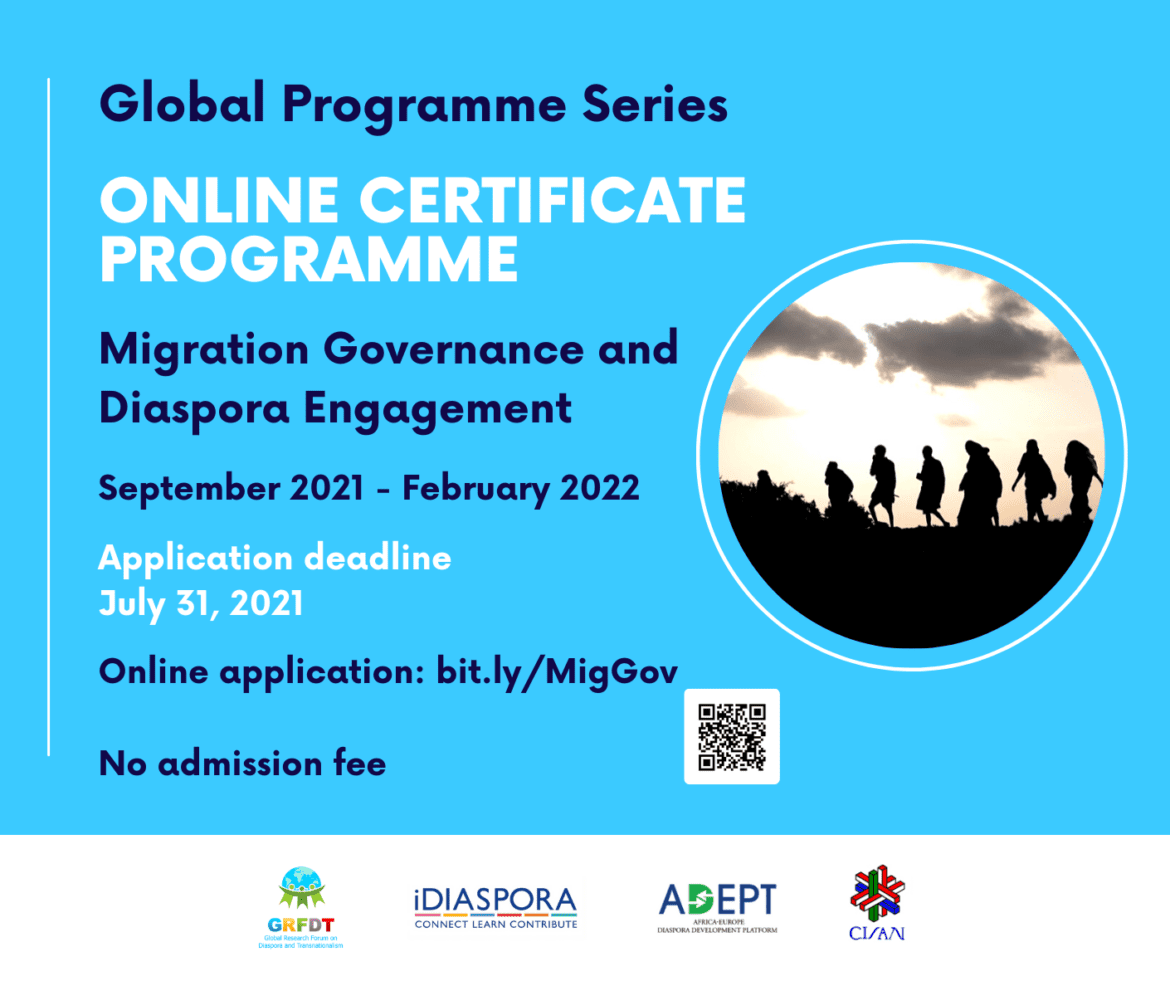
Online Certificate Programme: Migration Governance and Diaspora Engagement
Online CoursesCoursesInternational Jobs & OpportunitiesOpportunities by RegionPublic Health OpportunitiesPublic Health OpportunitySummer and Winter Courses

Online Certificate Programme: Migration Governance and Diaspora Engagement

by Public Health Update June 21, 2021
written by Public Health Update

Introduction

Migration is a defining feature of the 21st century in more than one way. Both migration and diaspora are closely linked with processes of social, economic and political development as well as important for individual empowerment for millions of people, communities and nations. Target 10.7 of the Sustainable Development Goals (SDGs) emphasizes the facilitation of orderly, safe, and responsible migration and mobility of people, including through the implementation of planned and well-managed migration policies. 

The ‘Migration Governance and Diaspora Engagement’ Certificate Programme is interdisciplinary and policy oriented, with resource persons and lecturers  drawn from various sectors and thematic domains, regions and countries. They will share their  experiences to provide, not only multiple perspectives, but also help the learner to develop a nuanced understanding of the dynamics of international migration and diaspora engagement. 

The four organisations,  iDiaspora, GRFDT, CISAN and ADEPT,  have an outstanding global and sub-regional presence and will draw from their highly acclaimed networks of scholars and academics, policy institutions (international, regional, national and sub-regional), migrant organisations, diaspora organisations as well as  grassroot organisations. 

Programme Outcome

The programme will cover both theoretical and practical aspects of migration governance and diaspora engagement. Participants will work through a structured process from identifying learning needs to understanding the significant aspects necessary to evaluate the effectiveness of migration-related policies. The certificate programme will provide an opportunity for participants to reflect, share and build on the migration experiences and diasporic engagement through intellectually stimulated discussions based on realities in sending, transit and host countries and territories. Students will have the opportunity to publish their work on the organisations’ platforms such as GRFDT website and iDiaspora platform, facilitated by the IOM and designed to empower diaspora engagement. 

The programme will help students to gain deeper perspectives associated with migration governance and dive into prevailing developments, challenges and opportunities in diaspora engagement. The programme will also help professionals who are already working on migration related issues in various institutions to enhance their understanding. In addition, participants will be provided access and a platform to engage and share their contribution in cross-cutting sectors as well as engage with academia, journalism, civil society, private sector, NGOs, policy institutions and think-tanks. 

Objectives

  • To understand deeper nuances of migration governance and diaspora engagement  from interdisciplinary and intersectoral perspectives
  • To critically examine various perspectives, policies and, politics of migration governance and diaspora engagement

The Programme Structure

The Certificate is composed of three courses and eleven blocks:

  • Course 1: Theories, Concepts and Methodologies (6 Credits)
  • Course 2: Migration Governance (6 Credits)
  • Course 3: Migration Governance and Diaspora Engagement (6 Credits)

Programme Delivery
The programme will be offered through online platforms: Google classroom, ZOOM and iDIASPORA. The course
material will include both audio-video resources and texts. Students will be provided with access to interactive
online portals to facilitate connection among participants as well as encourage interactions.

Duration: Six months (September 2021 to February 2022)

Required attendance: Minimum 70% of all online classes.

Online application: bit.ly/MigGov

Application deadline: July 31, 2021


Do you have a website? Looking for the best hosting provider? Here’s a discount code.

Latest Public Health Jobs

Latest Posts

  • International Wellness Day: Promoting Global Wellness for All
  • Summit Declaration: The 12th National Summit of Health and Population Scientists in Nepal
  • Joint political declaration on the reform of the global health architecture
  • World Health Day 2026: Together for Health. Stand with Science.
  • World Water Day 2026 | Water & Gender Equality

Thanks for visiting us.
Disclaimer: The resources, documents, guidelines, and information on this blog have been collected from various sources and are intended for informational purposes only. Information published on or through this website and affiliated social media channels does not represent the intention, plan, or strategies of an organization that the initiator is associated with in a professional or personal capacity, unless explicitly indicated.
If you have any complaints, information, or suggestions about the content published on Public Health Update, please feel free to contact us at blog.publichealthupdate@gmail.com.
#StayUpdated


  • WordPress
  • Link
  • Facebook
  • Mail
  • Facebook
  • Twitter
  • Twitter
  • LinkedIn
  • Instagram
  • Facebook
June 21, 2021 0 comments
0 FacebookTwitterPinterestLinkedinTumblrVKOdnoklassnikiRedditStumbleuponWhatsappTelegramLINEPocketSkypeViberEmail
Newer Posts
Older Posts

Search

Follow Us

Facebook Twitter Instagram Pinterest Linkedin Youtube

Categories

  • Abstracts (25)
  • Activities (91)
  • Adolescent Sexual and Reproductive Health (ASRH) (25)
  • Advice & Tips (4)
  • African Region (5)
  • AI and Health (1)
  • Annual Meeting (6)
  • Antimicrobial Resistance (AMR) (21)
  • Award (19)
  • Awards (16)
  • Books (9)
  • Call for Proposal, EOI & RFP (103)
  • Call for Research Participants (8)
  • Clinical Doctor Jobs (6)
  • Communicable Diseases (107)
  • Competition (20)
  • Conference (129)
  • Consultant (1)
  • Courses (205)
  • Dashboard (2)
  • Digital Health & Health Informatics (10)
  • Drug and Medicine (18)
  • Eastern Mediterranean Region (3)
  • Education (15)
  • Environment (3)
  • Environmental Health & Climate Change (47)
  • European Region (42)
  • Exchange Program (1)
  • Fact Sheet (117)
  • FCHVs (1)
  • Fellowships, Studentship & Scholarships (168)
  • Financial Aid (13)
  • Form Formats (2)
  • Fully funded (22)
  • Global Health News (434)
  • Grants and Funding Opportunities (193)
  • Guest Post (44)
  • Health Assistant Jobs (1)
  • Health Equity (7)
  • Health Financing and Economics (24)
  • Health in Data (115)
  • Health Insurance (5)
  • Health Jobs (52)
  • Health Literacy, Health Education & Promotion (50)
  • Health Organization Profile (42)
  • Health Systems (83)
  • Human Resource for Health (33)
  • Humanitarian Health & Emergency Response (44)
  • Hypertension (5)
  • Implementation Research (48)
  • International Health (3)
  • International Jobs & Opportunities (373)
  • International Plan, Policy & Guidelines (210)
  • Internships (4)
  • Jobs Vacancies (56)
  • Journals (8)
  • Life Style & Public Health Nutrition (39)
  • Live (10)
  • Master's Degree (48)
  • Maternal, Newborn and Child Health (88)
  • Mentorship Program (2)
  • Miscellaneous (16)
  • National Health News (158)
  • National Plan, Policy & Guidelines (468)
  • Neglected Tropical Diseases (NTDs) (51)
  • Non- Communicable Diseases (NCDs) (121)
  • Notice (103)
  • Nursing Jobs (6)
  • Nutritionist Jobs (1)
  • One Health (18)
  • Online & Distance Learning (22)
  • Online Courses (90)
  • Op-Ed Article (3)
  • Opportunities by Region (83)
  • Outbreak News (213)
  • Partially funded (6)
  • PCL Health Science Jobs (3)
  • PH Important Day (534)
  • Pharmacist Jobs (3)
  • PhD (54)
  • Photos (5)
  • Planetary Health (4)
  • PostDoc (14)
  • Presentation Slides (26)
  • Primary Health Care (25)
  • Provincial Plan, Policies and Guidelines (14)
  • Public Health (1,283)
  • Public Health Epidemiology & Biostatistics (13)
  • Public Health Events (306)
  • Public Health Information (20)
  • Public Health Innovation (9)
  • Public Health Jobs (52)
  • Public Health News (554)
  • Public Health Notes (120)
  • Public Health Opportunities (507)
  • Public Health Opportunity (491)
  • Public Health Programs (108)
  • Public Health Seminar (2)
  • Public Health Tools (1)
  • Public Health Update (564)
  • Quality Improvement & Infection Prevention (20)
  • Region of America (8)
  • Reports (184)
  • Research & Project Grants (39)
  • Research & Project Grants (32)
  • Research & Publication (647)
  • Research Articles (10)
  • Road Traffic Accidents (RTA) (9)
  • School of Public Health (60)
  • Self funded (2)
  • South-East Asia Region (26)
  • Success Stories (17)
  • Summer and Winter Courses (40)
  • Summer Courses (28)
  • Sustainable Development Goals (SDGs) (14)
  • Syllabus (61)
  • Symposium (9)
  • Tobacco Control (35)
  • Training (40)
  • Travel Grants (15)
  • Trick, Technique & Skills (8)
  • Uncategorized (3)
  • Undergraduate Degree (7)
  • Universal Health Coverage (36)
  • Universities (29)
  • Universities & School of Public Health (58)
  • Vacancy Announcement (26)
  • Vaccine Preventable Diseases (40)
  • Vector-Borne Diseases(VBDs) (30)
  • Videos (3)
  • View Points (1)
  • Webinar (4)
  • Western Pacific Region (13)
  • Workshop (18)
  • World News (117)
Post New Jobs: Vacancy Announcement Service

Public Health Update (Sagun’s Blog) is a popular public health portal in Nepal. Thousands of health professionals are connected with Public Health Update to get up-to-date public health updates, search for jobs, and explore opportunities.
#1 Public Health Blog for sharing Job opportunities and updates in Nepal

”Public Health Information For All”
– – Sagun Paudel, Founder

  • HOT JOBS
    • Public Health Jobs
    • Medical Doctor Jobs
    • Nursing Jobs
    • Health Assistant Jobs
    • Pharmacist Jobs
    • NGOs Jobs
    • Government Jobs
  • Top Categories
    • National Plan, Policy & Guidelines Top
    • Public Health Calendar
    • Fellowships & Scholarships
    • Health Systems
    • Health Organization Profiles
    • International Jobs & Opportunities
    • Public Health Opportunity

PUBLIC HEALTH INITIATIVE

    • Submit your Vacancies New
    • Partnership Opportunities

Contact: blog.publichealthupdate@gmail.com

https://wa.me/+9779856036932

Public Health Initiative, A Registered Non-profit organization – All Right Reserved. 2011-2024. Contact us. 

Facebook Twitter Instagram Youtube Envelope
Public Health Update
  • Home
  • Public Health
    • Home 1
      • Adolescent Sexual and Reproductive Health (ASRH)
      • Antimicrobial Resistance (AMR)
      • Communicable Diseases
      • Digital Health & Health Informatics
      • Environmental Health & Climate Change
      • Health Financing and Economics
      • Health Equity
    • Home 2
      • Health Literacy, Health Education & Promotion
      • Human Resource for Health
      • Humanitarian Health & Emergency Response
      • Implementation Research
      • International Health
      • Life Style & Public Health Nutrition
      • Maternal, Newborn and Child Health
    • Home 3
      • Neglected Tropical Diseases (NTDs)
      • Non- Communicable Diseases (NCDs)
      • One Health
      • Planetary Health
      • Public Health Epidemiology & Biostatistics
      • Primary Health Care
      • Quality Improvement & Infection Prevention
    • Home 4
      • Road Traffic Accidents (RTA)
      • Sustainable Development Goals (SDGs)
      • Tobacco Control
      • Universal Health Coverage
      • Vaccine Preventable Diseases
      • Vector-Borne Diseases(VBDs)
      • Notices
  • Public Health Update
    • Home 1
      • Public Health News
      • Global Health News
      • Outbreak News
      • National Health News
      • COVID-19
    • Home 2
      • Fact Sheet
      • Health in Data
      • PH Important Day
      • Public Health Events
      • Public Health Programs
    • Home 3
      • Health Systems
      • Health Insurance
      • Health Organization Profile
      • Success Stories
      • Public Health Innovation
  • Public Health Opportunities
    • Fully funded
    • Travel Grants
    • Grants and Funding Opportunities
    • Opportunities by Region
    • International Jobs & Opportunities
    • Research & Project Grants
    • Fellowships, Studentship & Scholarships
    • Conference
  • Jobs
    • Home 1
      • Health Jobs
      • Public Health Jobs
      • Clinical doctor Jobs
      • Health Assistant Jobs
      • Nursing Jobs
      • PCL Health Science Jobs
    • Home 2
      • Dental Jobs
      • Pharmacist Jobs
      • TSLC (Health Jobs)
      • Laboratory Jobs
      • Nutritionist Jobs
  • Downloads
    • International Plan, Policy & Guidelines
    • National Plan, Policy & Guidelines
    • Reports
    • Books
    • Research Articles
  • School of Public Health
    • Home 1
      • Courses
      • Master’s Degree
      • Undergraduate Degree
      • PhD
    • Home 2
      • Universities
      • Syllabus
      • Public Health Notes
      • Mentorship Program
      • Startup Project
    • Home
      • Summer and Winter Courses
      • Summer Courses
      • Online Courses
      • Workshop
      • Training
Public Health Update
  • Home
  • Public Health
    • Home 1
      • Adolescent Sexual and Reproductive Health (ASRH)
      • Antimicrobial Resistance (AMR)
      • Communicable Diseases
      • Digital Health & Health Informatics
      • Environmental Health & Climate Change
      • Health Financing and Economics
      • Health Equity
    • Home 2
      • Health Literacy, Health Education & Promotion
      • Human Resource for Health
      • Humanitarian Health & Emergency Response
      • Implementation Research
      • International Health
      • Life Style & Public Health Nutrition
      • Maternal, Newborn and Child Health
    • Home 3
      • Neglected Tropical Diseases (NTDs)
      • Non- Communicable Diseases (NCDs)
      • One Health
      • Planetary Health
      • Public Health Epidemiology & Biostatistics
      • Primary Health Care
      • Quality Improvement & Infection Prevention
    • Home 4
      • Road Traffic Accidents (RTA)
      • Sustainable Development Goals (SDGs)
      • Tobacco Control
      • Universal Health Coverage
      • Vaccine Preventable Diseases
      • Vector-Borne Diseases(VBDs)
      • Notices
  • Public Health Update
    • Home 1
      • Public Health News
      • Global Health News
      • Outbreak News
      • National Health News
      • COVID-19
    • Home 2
      • Fact Sheet
      • Health in Data
      • PH Important Day
      • Public Health Events
      • Public Health Programs
    • Home 3
      • Health Systems
      • Health Insurance
      • Health Organization Profile
      • Success Stories
      • Public Health Innovation
  • Public Health Opportunities
    • Fully funded
    • Travel Grants
    • Grants and Funding Opportunities
    • Opportunities by Region
    • International Jobs & Opportunities
    • Research & Project Grants
    • Fellowships, Studentship & Scholarships
    • Conference
  • Jobs
    • Home 1
      • Health Jobs
      • Public Health Jobs
      • Clinical doctor Jobs
      • Health Assistant Jobs
      • Nursing Jobs
      • PCL Health Science Jobs
    • Home 2
      • Dental Jobs
      • Pharmacist Jobs
      • TSLC (Health Jobs)
      • Laboratory Jobs
      • Nutritionist Jobs
  • Downloads
    • International Plan, Policy & Guidelines
    • National Plan, Policy & Guidelines
    • Reports
    • Books
    • Research Articles
  • School of Public Health
    • Home 1
      • Courses
      • Master’s Degree
      • Undergraduate Degree
      • PhD
    • Home 2
      • Universities
      • Syllabus
      • Public Health Notes
      • Mentorship Program
      • Startup Project
    • Home
      • Summer and Winter Courses
      • Summer Courses
      • Online Courses
      • Workshop
      • Training
Public Health Initiative, A Registered Non-profit organization – All Right Reserved. 2011-2023