
25 July 2026
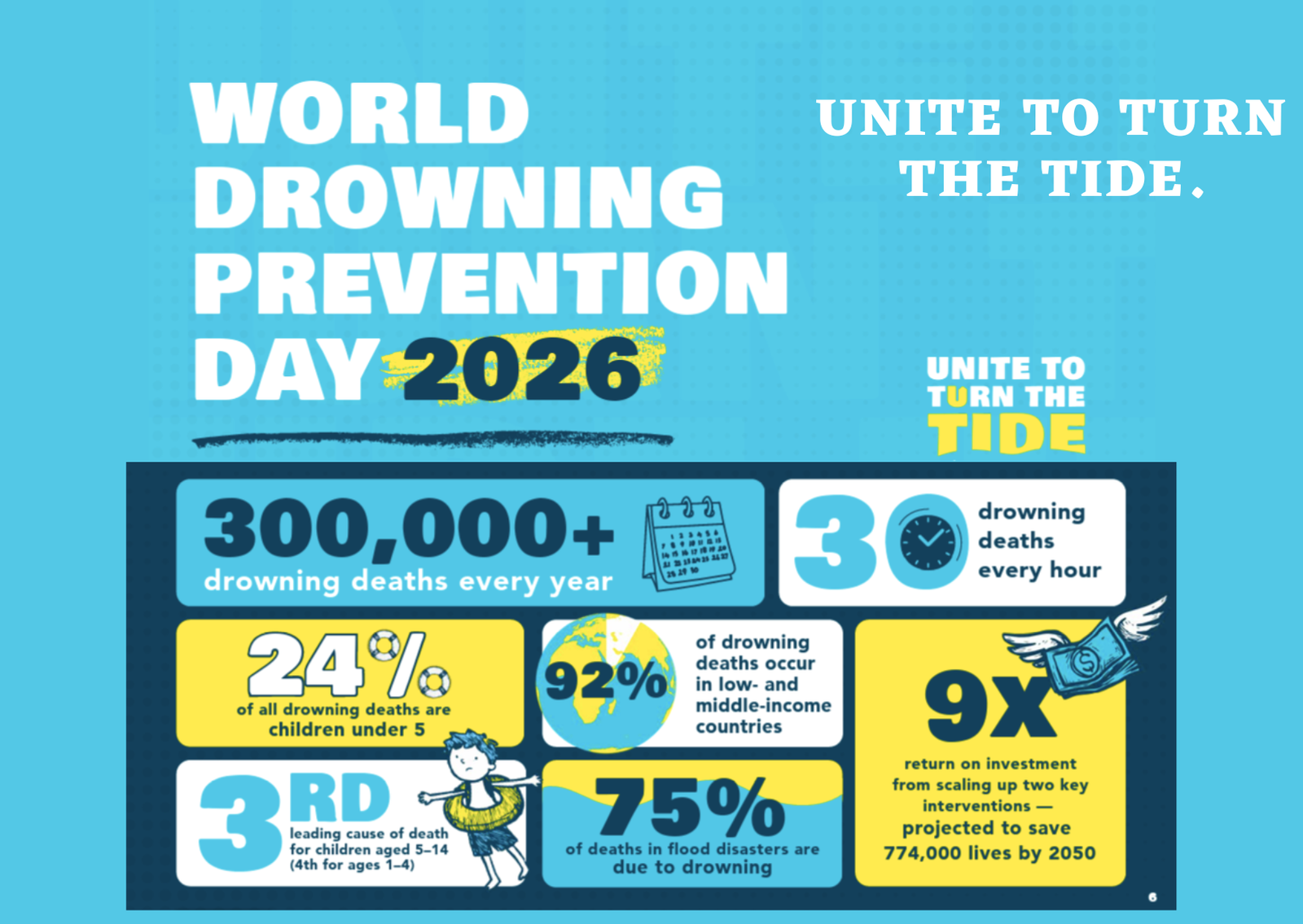
Every year, more than 300,000 people lose their lives to drowning—equivalent to nearly 30 preventable deaths every hour. Behind each statistic is a family, a community, and a future cut short. Drowning remains one of the world’s most neglected public health challenges despite being almost entirely preventable.
On 25 July, the global community observes World Drowning Prevention Day, established by the United Nations General Assembly through Resolution A/RES/75/273. The day serves as a global call to raise awareness, strengthen action, and promote evidence-based interventions that save lives.
Theme for 2026: Unite to Turn the Tide
The 2026 campaign theme, “Unite to Turn the Tide,” emphasizes that preventing drowning requires collective action. Governments, communities, schools, families, employers, health professionals, and individuals all have a role to play in making water safer.
The World Health Organization’s Global Strategy for Drowning Prevention, launched in 2025, sets an ambitious target of reducing drowning deaths by 35% by 2035. Achieving this goal will require coordinated efforts across sectors and sustained investments in proven interventions.
Drowning: A Preventable Public Health Crisis
Drowning is among the ten leading causes of death for children aged 5–14 years worldwide and disproportionately affects low- and middle-income countries, where over 90% of drowning deaths occur.
Most drowning incidents happen in everyday environments such as:
- Rivers and lakes
- Wells and irrigation canals
- Household water storage containers
- Swimming pools and ponds
Children living in rural communities are particularly vulnerable due to greater exposure to open water, inadequate supervision, limited swimming skills, and insufficient emergency response capacity.
Beyond the tragic loss of life, drowning has profound social and economic consequences, affecting families, livelihoods, education, and community resilience.
The PROTECT Framework: Seven Strategies to Prevent Drowning
To translate global commitments into practical action, WHO and the Global Alliance for Drowning Prevention introduced the PROTECT technical package—a set of seven evidence-informed strategies that countries can adapt to their local contexts.
P – Physical infrastructure that promotes safe interaction with water
Improve water safety through fencing, barriers, safe water storage, warning signs, and safer community environments.
R – Rescue and resuscitation capability
Strengthen the ability of communities, bystanders, and professional responders to conduct safe rescues and provide timely CPR and emergency care.
O – Occupational safety
Protect people whose livelihoods depend on working near or on water by ensuring access to safety equipment, lifejackets, and occupational safety standards.
T – Transport safety
Improve the safety of water transport through regulations, vessel inspections, lifejacket use, and emergency preparedness.
E – Education in swimming and water safety
Provide children and communities with basic swimming skills, water safety education, and survival techniques from an early age.
C – Child-care systems and safeguarding
Ensure young children receive appropriate supervision through safe childcare services and community-based child protection measures.
T – Threat preparedness
Strengthen preparedness for floods and other water-related disasters through early warning systems, community preparedness, and emergency response planning.
Together, these seven interconnected strategies provide a roadmap for governments and partners to substantially reduce drowning deaths.
Learning from Success: Thailand’s Story
Thailand demonstrates that meaningful progress is possible through sustained, community-led action.
In 2006, drowning was the leading cause of death among children under 15 years of age in the country. Communities responded by identifying hazardous water bodies, installing protective barriers, teaching swimming, expanding CPR training, and mobilizing thousands of local volunteers.
By 2022, child drowning deaths had declined by 57%.
Thailand’s experience illustrates that no single intervention solves the problem. Rather, many coordinated actions implemented consistently over time can save thousands of lives.
What Can We Do?
Preventing drowning is everyone’s responsibility.
Parents and caregivers can:
- Closely supervise children near water.
- Secure household water storage and fence swimming pools.
- Teach children swimming and water safety.
- Learn CPR and safe rescue techniques.
Schools can:
- Integrate water safety education into school curricula.
- Promote swimming and lifesaving skills.
- Share water safety information with students and families.
Communities can:
- Identify local drowning hazards.
- Organize swimming, rescue, and first aid training.
- Strengthen flood preparedness and early warning systems.
Employers and workers around water can:
- Promote occupational safety.
- Ensure the availability and use of lifejackets and rescue equipment.
- Follow established safety standards.
Governments can:
- Develop and implement national drowning prevention strategies.
- Invest in proven interventions.
- Strengthen multisectoral collaboration across health, education, disaster management, transport, and local government sectors.
Every Action Matters
Since 2000, the global drowning mortality rate has declined substantially, demonstrating that progress is possible. Yet hundreds of thousands of lives are still lost every year.
This World Drowning Prevention Day, let us recognize that every action—whether supervising a child, learning CPR, advocating for safer water environments, or strengthening national policies—can help save lives.
Every life counts. Every action matters. Everyone has a role to play.
Together, we can Unite to Turn the Tide and build safer communities for everyone.