
Public Health Update
  • Home
  • Public Health Update
  • Nepal Health Jobs
    • Public Health Job Board
    • Organization List
  • Opportunities
    • Fellowships, Studentship & Scholarships
    • Grants and Funding Opportunities
    • Fully funded
    • Conference
  • Downloads
    • International Plan, Policy & Guidelines
    • National Plan, Policy & Guidelines
    • Reports
    • Public Health Notes
    • Syllabus
    • Form Formats
  • School of Public Health
    • PhD
    • Master’s Degree
    • Online Courses
  • Notice
  • Home
  • Public Health Update
  • Nepal Health Jobs
    • Public Health Job Board
    • Organization List
  • Opportunities
    • Fellowships, Studentship & Scholarships
    • Grants and Funding Opportunities
    • Fully funded
    • Conference
  • Downloads
    • International Plan, Policy & Guidelines
    • National Plan, Policy & Guidelines
    • Reports
    • Public Health Notes
    • Syllabus
    • Form Formats
  • School of Public Health
    • PhD
    • Master’s Degree
    • Online Courses
  • Notice
LOGIN / REGISTER
Public Health Update
SUBSCRIBE
Public Health Update
  • Home
  • Public Health Update
  • Nepal Health Jobs
    • Public Health Job Board
    • Organization List
  • Opportunities
    • Fellowships, Studentship & Scholarships
    • Grants and Funding Opportunities
    • Fully funded
    • Conference
  • Downloads
    • International Plan, Policy & Guidelines
    • National Plan, Policy & Guidelines
    • Reports
    • Public Health Notes
    • Syllabus
    • Form Formats
  • School of Public Health
    • PhD
    • Master’s Degree
    • Online Courses
  • Notice

All Right Reserved. Designed and Developed by PenciDesign

Call for Participants: Free Course on Digital Health Planning National Systems
Public Health OpportunitiesCoursesDigital Health & Health InformaticsInternational Jobs & OpportunitiesOnline CoursesPublic Health Opportunity

Call for Participants: Free Course on Digital Health Planning National Systems

by Public Health Update August 13, 2022
written by Public Health Update

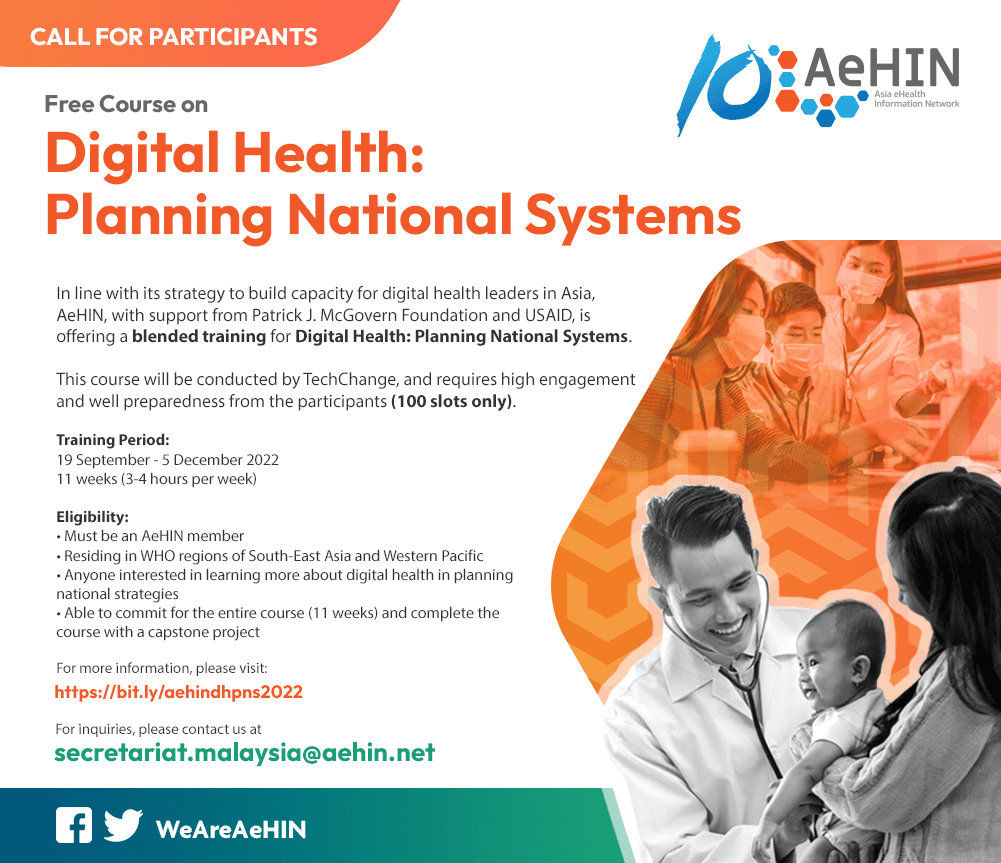
In line with its strategy to build capacity for digital health leaders in Asia, the Asia eHealth Information Network (AeHIN), with support from Patrick J. McGovern Foundation and USAID, is offering a blended training for Digital Health: Planning National Systems from 19th Sept 2022 – 5th Dec 2022 (total of 11 weeks). The training will require a commitment of the participants for about 3-4 hours per week. This course will be conducted by TechChange, and requires high engagement and well-preparedness from the participants. We will recruit a maximum of 100 participants to join this training.

Call for Participants: Free Course on Digital Health Planning National Systems

The course, Digital Health: Planning National Systems, is designed to train the digital health leaders of today to transform the digital health landscape for tomorrow.

The curriculum has been developed by USAID, Digital Square, TechChange, and Last Mile Health and is based on content compiled by the World Health Organization (WHO) and the International Telecommunications Union (ITU). It features critical technical concepts, existing best practices, and pragmatic methods, all framed according to the national planning cycle that Ministry of Health officials manage.

Course outline:

  • Module 1: Introduction to Digital Health
  • Module 2: Health Systems and Digital Health Interventions
  • Module 3: Digital Health National Strategy
  • Module 4: Digital Health Enterprise Planning Approach
  • Module 5: Digital Health Platform Implementation
  • Module 6: Digital Health Intervention Implementation
  • Module 7: Costing & Procurement
  • Module 8: Digital Health Governance, Policy, Regulation, & Workforce
  • Module 9: The Future of Digital Health

The course will be delivered in a blended mode (self-paced plus live activity session) over 11 weeks (a kick off week, one module per week, and a final Capstone Project week). Each module includes approximately 60-90 minutes of self-paced learning and 90 minutes of live activity per week. 

WHO ARE ELIGIBLE?

This course is designed to empower those engaging with digital health, including ministry leadership, health practitioners, health coordinators and planners, health programme coordinators, digital health implementers, and others who utilize digital tools to access health information. We welcome all who work in the academia, private sectors, government/public sector, and NGOs. 

  • Must be an AeHIN member (subscribed to the AeHIN mailing list. Not a member? Join here)
  • Residing in WHO regions of South-East Asia and Western Pacific (refer list of countries here)
  • Anyone interested in learning more about digital health in planning national strategies
  • Able to commit for the entire course (11 weeks) and complete the course with a capstone project

MECHANICS

  1. Eligible applicants must fill in their application form through this link on or before August 26, 2022 (5:00 PM MANILA TIME). 
  2. Applications will be reviewed by the AeHIN Governing Committee and Working Council. Selection will be based on fair distribution based on countries and the working sector.
  3. Applicants will be notified of their status via email.
  4. The selected applicants will receive further information regarding the Digital Health: Planning National System course via email.

For questions, please email secretariat.malaysia@aehin.net.

Official link


Do you have a website? Looking for the best hosting provider? Here’s a discount code.

Latest Public Health Jobs

Latest Posts

  • International Wellness Day: Promoting Global Wellness for All
  • Summit Declaration: The 12th National Summit of Health and Population Scientists in Nepal
  • Joint political declaration on the reform of the global health architecture
  • World Health Day 2026: Together for Health. Stand with Science.
  • World Water Day 2026 | Water & Gender Equality

Thanks for visiting us.
Disclaimer: The resources, documents, guidelines, and information on this blog have been collected from various sources and are intended for informational purposes only. Information published on or through this website and affiliated social media channels does not represent the intention, plan, or strategies of an organization that the initiator is associated with in a professional or personal capacity, unless explicitly indicated.
If you have any complaints, information, or suggestions about the content published on Public Health Update, please feel free to contact us at blog.publichealthupdate@gmail.com.
#StayUpdated



  • WordPress
  • Link
  • Facebook
  • Mail
  • Facebook
  • Twitter
  • Twitter
  • LinkedIn
  • Instagram
  • Facebook
August 13, 2022 0 comments
0 FacebookTwitterPinterestLinkedinTumblrVKOdnoklassnikiRedditStumbleuponWhatsappTelegramLINEPocketSkypeViberEmail
Enrolment open: AUTHORAID Course on 'Research and Proposal Writing in the Sciences'
Public Health OpportunitiesCoursesInternational Jobs & OpportunitiesOnline CoursesPublic Health Opportunity

Enrolment open: AUTHORAID Course on ‘Research and Proposal Writing in the Sciences’

by Public Health Update August 12, 2022
written by Public Health Update

Enrolment is open on our latest online course ‘Research and Proposal Writing in the Sciences’.

AuthorAID‘s award-winning online courses are designed for researchers and scientists in low- and middle-income countries. This course is designed for those working in a scientific field (life sciences / physical sciences / other related fields). It is suitable for early career researchers, or those with limited experience in publishing papers in reputable peer-reviewed journals.

Course duration: 8 weeks

Main topics covered in the course: 

  • Understanding previous research
  • Knowing the ethics of research
  • Preparing to write your research paper
  • Writing your research paper
  • Publishing your paper in a peer-reviewed journal
  • Writing a grant proposal – The basics

Course dates: 6th September to 1st November 2022

Course leaders: INASP team – Alejandra Arreola, Andy Nobes and Ravi Murugesan – along with experienced guest facilitators from the AuthorAID network.

Enrolment process
Complete information about the course along with enrolment instructions are available on the INASP Moodle website: https://moodle.inasp.info/course/view.php?name=RPW_Sci_2022. You will need to create an INASP Moodle account if you don’t already have one. Please follow the instructions carefully (you may need to click on the above link again after registering your account).

Please note that although this is an open course, we may have to limit enrolment due to server capacity. We suggest that you enrol in the course as soon as possible if you are interested.

INASP designs and runs capacity development activities that cater for both women and men’s interests and needs. We use methods that increase active participation and an inclusive learning environment, adopting attitudes and behaviours that value differential experiences and perspectives and ensuring listening and respect for each other’s experiences and views.

You can read more about our previous online courses here.


Do you have a website? Looking for the best hosting provider? Here’s a discount code.

Latest Public Health Jobs

Latest Posts

  • International Wellness Day: Promoting Global Wellness for All
  • Summit Declaration: The 12th National Summit of Health and Population Scientists in Nepal
  • Joint political declaration on the reform of the global health architecture
  • World Health Day 2026: Together for Health. Stand with Science.
  • World Water Day 2026 | Water & Gender Equality

Thanks for visiting us.
Disclaimer: The resources, documents, guidelines, and information on this blog have been collected from various sources and are intended for informational purposes only. Information published on or through this website and affiliated social media channels does not represent the intention, plan, or strategies of an organization that the initiator is associated with in a professional or personal capacity, unless explicitly indicated.
If you have any complaints, information, or suggestions about the content published on Public Health Update, please feel free to contact us at blog.publichealthupdate@gmail.com.
#StayUpdated


  • WordPress
  • Link
  • Facebook
  • Mail
  • Facebook
  • Twitter
  • Twitter
  • LinkedIn
  • Instagram
  • Facebook
August 12, 2022 0 comments
0 FacebookTwitterPinterestLinkedinTumblrVKOdnoklassnikiRedditStumbleuponWhatsappTelegramLINEPocketSkypeViberEmail
Roving Auxiliary Nurse Midwives (RANMs) Program Implementation Guideline 2076
Public HealthProvincial Plan, Policies and GuidelinesResearch & Publication

Roving Auxiliary Nurse Midwives (RANMs) Program Implementation Guideline 2076

by Public Health Update August 11, 2022
written by Public Health Update

The Ministry of Health (Former Ministry of Social Development), Bagmati province has initiated Roving Auxiliary Nurse Midwives (RANMs) program to increase the service access and utilization especially focused on remote and rural areas of provinces.

Roving Auxiliary Nurse Midwives (RANMs) are primarily responsible for health, sanitation and nutrition promotion, adoloscent sexual and reproductive health awareness, safe motherhood to increase utilization of basic healthcare services.

Download Guideline


Do you have a website? Looking for the best hosting provider? Here’s a discount code.

Latest Public Health Jobs

Latest Posts

  • International Wellness Day: Promoting Global Wellness for All
  • Summit Declaration: The 12th National Summit of Health and Population Scientists in Nepal
  • Joint political declaration on the reform of the global health architecture
  • World Health Day 2026: Together for Health. Stand with Science.
  • World Water Day 2026 | Water & Gender Equality

Thanks for visiting us.
Disclaimer: The resources, documents, guidelines, and information on this blog have been collected from various sources and are intended for informational purposes only. Information published on or through this website and affiliated social media channels does not represent the intention, plan, or strategies of an organization that the initiator is associated with in a professional or personal capacity, unless explicitly indicated.
If you have any complaints, information, or suggestions about the content published on Public Health Update, please feel free to contact us at blog.publichealthupdate@gmail.com.
#StayUpdated


  • WordPress
  • Link
  • Facebook
  • Mail
  • Facebook
  • Twitter
  • Twitter
  • LinkedIn
  • Instagram
  • Facebook
August 11, 2022 0 comments
0 FacebookTwitterPinterestLinkedinTumblrVKOdnoklassnikiRedditStumbleuponWhatsappTelegramLINEPocketSkypeViberEmail
Online Course on Measurement, Design, and Analysis Methods for Health Outcomes Research
Online CoursesCoursesInternational Jobs & OpportunitiesPublic Health OpportunitiesPublic Health OpportunitySummer and Winter CoursesSummer Courses

Online Course on Measurement, Design, and Analysis Methods for Health Outcomes Research

by Public Health Update August 11, 2022
written by Public Health Update

Program Overview

Health care systems around the world face growing pressures to provide more effective programs, treatments, and interventions. Health outcomes research is the scientific inquiry that provides the evidence required for optimally developing new therapies, implementing quality of care improvement protocols, and enhancing public health system capacity and capability.

Harvard University Free Online Courses for Health Professionals

In this online program, Harvard’s expert faculty in health outcomes research will guide you through the language and concepts needed to synthesize outcomes studies into useful knowledge for translation and implementation into practice. During this program you will learn the fundamentals for measuring, designing, and analyzing health outcomes research studies and data.

Why Health Outcomes Research is Important

Outcomes research is highly valued in public health due to the breadth of issues it addresses. A diverse and growing number of organizations – employers, health care delivery organizations, insurers, pharmaceutical companies, and governments – rely on health outcomes research for generating actionable data that will help them make better decisions about the value of different therapeutic and preventative options. Well-designed and executed health outcomes research studies can provide evidence for a broad range of medical and public health practices, such as:

  • Incorporating patient-centered outcomes measures such as patient preference and quality of life into the drug and device development process
  • Evaluating the impact of chronic disease therapies on physical, emotional and social functioning
  • Determining the cost-effectiveness of comparative medical treatments for chronic diseases
  • Assessing the population health risks and benefits associated with response and mitigation strategies for infectious diseases such as influenza and COVID-19.

Harvard T.H. Chan School of Public Health Yerby Fellowship Program

Learning Objectives

As a participant, you will learn to:

  • Conceptually define the meaning and purpose of outcomes research and evaluation
  • Understand the role of epidemiology, health economics, psychometrics and biostatistics in conducting outcomes research
  • Evaluate the usefulness of outcomes measures and the application of new technologies in medical institutions and industries, health care organizations and public health systems
  • Recognize the different types of measures used in outcomes research, including clinical, health status, quality of life, work/role performance, health care utilization, and patient satisfaction
  • Adopt new methods for modeling responses obtained from individuals completing questionnaires and surveys
  • Interpret and understand scale performance and measurement concepts such as reliability, validity, responsiveness, and sensitivity
  • Understand statistical methods appropriate for analyzing health outcomes data, such as longitudinal methods
  • Synthesize and interpret findings from different types of health outcomes research studies.

Who Should Participate

This program will be useful to anyone involved in improving health care cost, quality, or outcomes from across the health care industry. Ideal participants include:

  • Clinicians, including physicians, nurses, and allied health professionals involved in utilizing outcomes data or assessing, measuring, and evaluating outcomes
  • Health care executives and administrators who review and utilize outcomes data for clinical decision-making and improving quality of care
  • Insurance, managed care, and other payer executives and researchers seeking to understand the relative value of procedures and interventions
  • Pharmaceutical and biotechnology executives and researchers who need to measure patient-reported outcomes to support the benefit of their products
  • Other health sector researchers who are new to outcomes research and need an overview of the latest information in the field

Registration Criteria

Participants must have an advanced degree (e.g., MD, PhD, MS, MPH, PharmD) in a relevant discipline. Proficiency in written and spoken English is essential for a successful learning experience in the program.

READ MORE AND REGISTER NOW


Do you have a website? Looking for the best hosting provider? Here’s a discount code.

Latest Public Health Jobs

Latest Posts

  • International Wellness Day: Promoting Global Wellness for All
  • Summit Declaration: The 12th National Summit of Health and Population Scientists in Nepal
  • Joint political declaration on the reform of the global health architecture
  • World Health Day 2026: Together for Health. Stand with Science.
  • World Water Day 2026 | Water & Gender Equality

Thanks for visiting us.
Disclaimer: The resources, documents, guidelines, and information on this blog have been collected from various sources and are intended for informational purposes only. Information published on or through this website and affiliated social media channels does not represent the intention, plan, or strategies of an organization that the initiator is associated with in a professional or personal capacity, unless explicitly indicated.
If you have any complaints, information, or suggestions about the content published on Public Health Update, please feel free to contact us at blog.publichealthupdate@gmail.com.
#StayUpdated


  • WordPress
  • Link
  • Facebook
  • Mail
  • Facebook
  • Twitter
  • Twitter
  • LinkedIn
  • Instagram
  • Facebook
August 11, 2022 0 comments
0 FacebookTwitterPinterestLinkedinTumblrVKOdnoklassnikiRedditStumbleuponWhatsappTelegramLINEPocketSkypeViberEmail
12th World Congress for Hair Research 2022
ConferenceInternational Jobs & OpportunitiesPublic Health OpportunitiesPublic Health Opportunity

12th World Congress for Hair Research 2022

by Public Health Update August 11, 2022
written by Public Health Update

The 12th World Congress for Hair Research will be held at the Melbourne Convention & Exhibition Centre, Australia, from 18 – 21 November 2022 and will focus on new knowledge and emerging treatments of hair disease. Don’t miss your opportunity to connect with industry colleagues and friends at this world class event.

Key Dates

Early Bird Registration Deadline: 5 November 2022
Congress Dates: 18 – 21 November 2022

Hair Themes

At Hair 2022, authors are encouraged to submit abstracts on one of the following themes:

  • Morphogenesis, neogenesis and tissue engineering
  • Alopecia Areata
  • Hair Follicle Immunology
  • Male and female pattern hair loss
  • Gene discovery and Gene therapy
  • Cicatricial Alopecia
  • The Dermal Papilla
  • Lasers for hair removal & regrowth
  • Paediatric hair loss
  • Platelet Rich Plasma
  • Post Finasteride Syndrome
  • Trichoscopy
  • Stem Cells, Stem Cell Niches
  • Hair fibre structure and function and shine
  • Hair Transplantation
  • Trichology
  • Pigmentation
  • Hirsutes
  • Ethnic Hair
  • Emerging treatments for hair loss
  • Auxiliary cells
  • Free papers
  • Transgender Hair and Health (New!)
  • International Consensus and Global Registries (New!)

Read More and Register


Do you have a website? Looking for the best hosting provider? Here’s a discount code.

Latest Public Health Jobs

Latest Posts

  • International Wellness Day: Promoting Global Wellness for All
  • Summit Declaration: The 12th National Summit of Health and Population Scientists in Nepal
  • Joint political declaration on the reform of the global health architecture
  • World Health Day 2026: Together for Health. Stand with Science.
  • World Water Day 2026 | Water & Gender Equality

Thanks for visiting us.
Disclaimer: The resources, documents, guidelines, and information on this blog have been collected from various sources and are intended for informational purposes only. Information published on or through this website and affiliated social media channels does not represent the intention, plan, or strategies of an organization that the initiator is associated with in a professional or personal capacity, unless explicitly indicated.
If you have any complaints, information, or suggestions about the content published on Public Health Update, please feel free to contact us at blog.publichealthupdate@gmail.com.
#StayUpdated


  • WordPress
  • Link
  • Facebook
  • Mail
  • Facebook
  • Twitter
  • Twitter
  • LinkedIn
  • Instagram
  • Facebook
August 11, 2022 0 comments
0 FacebookTwitterPinterestLinkedinTumblrVKOdnoklassnikiRedditStumbleuponWhatsappTelegramLINEPocketSkypeViberEmail
4th Digital Health Society Summit 2022
ConferenceInternational Jobs & OpportunitiesPublic Health OpportunitiesPublic Health Opportunity

4th Digital Health Society Summit 2022

by Public Health Update August 11, 2022
written by Public Health Update

4th Digital Health Society Summit 2022: October 4th – 5th, 2022.

The 2-Day Virtual Summit promotes the latest thought leadership of the DHS, showcases innovation, research, European funded projects and addresses the latest digital and data challenges facing digital health.

The Summit will focus on the topic “Data & Digital services to support the recovery of health systems across the globe” which is one the 3 themes of the Global Health Connector Partnership Flagship events in 2022 in the US (Boston, Las Vegas and Washington), India (New Delhi), Africa (Kenya), Spain (Barcelona) and Switzerland. The DHS Summit will build on almost 1000 registrations from 68 countries across the globe.

Agenda

  • Data & Digital services to support the recovery of global health systems
  • How our ECHAlliance community has grown and what we are doing next with our International Ecosystems network
  • How do you maximise the use of health data for innovation and recovery?
  • What is the Global Health Connector and what is happening in India & Africa?
  • How can data guide the development of digital skills workforce recruitment, retention and resilience
  • The importance of evidence in digital health and pitfalls to avoid
  • Challenges and opportunities of the Green Digital twin transition in health and care.
  • Vaccination Information Systems: What does good look like?
  • Health Data Sharing a role for a Societal compact?
  • A panel looking at the latest developments with the European Health Data Space
  • A panel looking at the latest developments with the European Health Data Space
  • How to build successful consortia and bid for European and international projects?
  • How can we use data to tackle health inequalities
  • AI & healthcare
  • Tackling the gender bias in health data and services
  • Trio of Presidencies (Czech Rep, Sweden, Spain)
  • How can we support the rebuilding of the Ukrainian Health system in a digital way.

READ MORE AND REGISTER


Do you have a website? Looking for the best hosting provider? Here’s a discount code.

Latest Public Health Jobs

Latest Posts

  • International Wellness Day: Promoting Global Wellness for All
  • Summit Declaration: The 12th National Summit of Health and Population Scientists in Nepal
  • Joint political declaration on the reform of the global health architecture
  • World Health Day 2026: Together for Health. Stand with Science.
  • World Water Day 2026 | Water & Gender Equality

Thanks for visiting us.
Disclaimer: The resources, documents, guidelines, and information on this blog have been collected from various sources and are intended for informational purposes only. Information published on or through this website and affiliated social media channels does not represent the intention, plan, or strategies of an organization that the initiator is associated with in a professional or personal capacity, unless explicitly indicated.
If you have any complaints, information, or suggestions about the content published on Public Health Update, please feel free to contact us at blog.publichealthupdate@gmail.com.
#StayUpdated


  • WordPress
  • Link
  • Facebook
  • Mail
  • Facebook
  • Twitter
  • Twitter
  • LinkedIn
  • Instagram
  • Facebook
August 11, 2022 0 comments
0 FacebookTwitterPinterestLinkedinTumblrVKOdnoklassnikiRedditStumbleuponWhatsappTelegramLINEPocketSkypeViberEmail
The Global Plan to End TB 2023-2030
Public HealthCommunicable DiseasesInternational Plan, Policy & Guidelines

The Global Plan to End TB 2023-2030

by Public Health Update August 8, 2022
written by Public Health Update

Tuberculosis (TB) is one of the oldest infectious diseases in recorded history. TB is preventable, treatable, and curable, but still devastates lives, livelihoods, and economies globally. In the past 200 years, the disease has claimed over a billion lives. Now, TB kills more than 4,100 people a day.

The Global Plan to End TB 2023-2030 is a plan for ending TB as a public health challenge by 2030. It provides a blueprint of priority actions required and a detailed estimate of financial resources needed to end TB.

The Global Plan includes resources needed for implementing TB care and prevention and R&D into new tools. This Global Plan has already informed the Global Fund Investment Case and the 2022 G20 deliberations on TB. It will serve as a key document for inspiring and aligning global advocacy efforts, such as for the upcoming UN High Level Meeting on TB in 2023.

The Global Plan Chapters

This edition of the Global Plan was developed by a writing team working in collaboration with the Global Plan Task Force and a team of epidemiological and financial modellers, with inputs gathered from the international community through a series of public regional and global consultations. There are nine chapters.

Chapter 1: provides the international context that informs the Global Plan.

Chapters 2: through 9 describe priorities for action.

Priority actions:

  • Invest in a comprehensive investment package.
  • Scale up interventions to achieve key objectives and targets.

CHAPTER 3: Scaling up TB diagnosis and care

Priority actions:

  • Re-imagine TB care, delivering services through a people-centred approach.
  • Scale up the use of modern diagnostics.
  • Find the missing people with TB.
  • Expand early diagnosis, including at subclinical stages.
  • Develop and implement public communications strategies to raise TB awareness and promote early health seeking.
  • Integrate TB screening and testing into other health services, with a focus on services that address common comorbidities or risk groups, depending on local epidemiological context.
  • Provide support that enables people receiving TB care to complete a full course of treatment without an undue burden on them and their families, while avoiding catastrophic costs.
  • Strengthen procurement systems and supply chains.

CHAPTER 4: Scaling up TB prevention

Priority actions:

  • Implement airborne infection prevention and control measures in health care settings and high-risk indoor places where people congregate.
  • Provide TPT for those living with TB infection and who are at higher risk of progression to active TB disease.
  • Deploy effective vaccines once such vaccines are officially recommended and available.
  • Address TB risk factors and social determinants.

CHAPTER 5: Partnering with key stakeholders: communities and the private sector

Priority actions:

  • Increase funding support for engaging TB-affected communities in the TB response at least fourfold.
  • Support community-based and home-based models for delivering TB prevention and care.
  • Scale up public–private mix approaches to improve the quality of TB care, reduce out-of-pocket expenses and improve data reporting in the private health sector.
  • Support a multisectoral TB response through stronger partnerships.

CHAPTER 6.

Ending TB through universal health coverage, pandemic preparedness and response, and socioeconomic actions

Priority actions:

  • Expand access to TB services through universal health coverage initiatives.
  • Position the TB response at the centre of pandemic preparedness and response efforts.
  • Invest in poverty alleviation and sustainable development.

CHAPTER 7: Human rights, stigma, gender, and key and vulnerable populations

Priority actions:

  • Position universal human rights as the foundation of the TB response.
  • Eliminate TB-related stigma and discrimination.
  • Ensure that TB interventions are gender-sensitive and gender-transformative.
  • Prioritize, reach and involve key and vulnerable populations.

CHAPTER 8: Accelerating development of new TB tools

Priority actions:

  • Invest, at minimum, US$ 4 billion annually to accelerate the R&D of new TB diagnostics, medicines and vaccines. Resources need to be mobilized from governments and philanthropies, increased engagement with the private sector, and new approaches to innovative and sustainable financing.
  • Develop a new TB vaccine by 2025.
  • Accelerate the development of new tools to prevent, diagnose and treat TB by identifying innovative product-development pathways and improving collaboration among actors in product development.
  • Invest at least US$ 800 million annually in basic science research.
  • Expand the use of operational research.
  • Develop and implement digital tools.
  • Create an enabling environment for TB R&D.
  • Apply best practices in community engagement throughout the R&D process.
  • Apply access principles in rolling out and optimizing the use of new tools.
  • Strengthen advocacy for TB innovation.

CHAPTER 9: Resource needs, return on investment, and cost of inaction

Priority actions:

  • Mobilize US$ 209.8 billion in funding between 2023 and 2030 for TB care and prevention, of which US$ 52.6 billion is for vaccination once a new vaccine is available. The resources needed for care and prevention excluding vaccination total US$ 157.2 billion, which averages to US$ 19.65 billion per year.
  • Mobilize US$ 40.18 billion in funding between 2023 and 2030 for TB R&D and basic science research through a more diversified funding base.

Download: The Global Plan to End TB 2023-2030


Do you have a website? Looking for the best hosting provider? Here’s a discount code.

Latest Public Health Jobs

Latest Posts

  • International Wellness Day: Promoting Global Wellness for All
  • Summit Declaration: The 12th National Summit of Health and Population Scientists in Nepal
  • Joint political declaration on the reform of the global health architecture
  • World Health Day 2026: Together for Health. Stand with Science.
  • World Water Day 2026 | Water & Gender Equality

Thanks for visiting us.
Disclaimer: The resources, documents, guidelines, and information on this blog have been collected from various sources and are intended for informational purposes only. Information published on or through this website and affiliated social media channels does not represent the intention, plan, or strategies of an organization that the initiator is associated with in a professional or personal capacity, unless explicitly indicated.
If you have any complaints, information, or suggestions about the content published on Public Health Update, please feel free to contact us at blog.publichealthupdate@gmail.com.
#StayUpdated



  • WordPress
  • Link
  • Facebook
  • Mail
  • Facebook
  • Twitter
  • Twitter
  • LinkedIn
  • Instagram
  • Facebook
August 8, 2022 0 comments
0 FacebookTwitterPinterestLinkedinTumblrVKOdnoklassnikiRedditStumbleuponWhatsappTelegramLINEPocketSkypeViberEmail
Professional Writing Online Workshop
Public HealthPublic Health OpportunitiesPublic Health OpportunityWorkshop

Professional Writing Online Workshop

by Public Health Update August 8, 2022
written by Public Health Update

The Department of Public Health and Community Programs, Dhulikhel Hospital Kathmandu University Hospital invites application from eligible candidates to participate on Professional Writing Workshop.

The objective of this workshop is to orient participants on the relevance and scope of  professional writing.

Target participants: Current students and graduates of MPH

After successfully completing this course, participants can expect to be able to:

  • Understand how professional writing skills are different from English language skills such as vocabulary and grammar
  • Identify clarity as a goal of good writing and identify the ways to clearly present one’s own thoughts into writing
  • Understand the role of short, focused paragraphs in effective writing
  • Understand parallel structure and how to make lists
  • Identify the elements of effective short slide presentations
  • Identify the characteristics of strong verbs as an effective writing strategy

The details of the training are as follows:

Topic: 6-Days Professional Writing Online Workshop

Starting from: August 14, 2022

Time: 6:00 PM to 7:00 PM (Nepal Time)

Fees: No fees required

Instructor: Dr. Thomas Robertson (Senior Communication Advisor, Dhulikhel Hospital Kathmandu University Hospital)

All sessions will be conducted online via zoom.

The eligible applicants are encouraged to register for 6-days Professional Writing Online Workshop, starting from August 14, 2022.

Link for registration: https://forms.gle/QUU9ZcBat2PaxF6ZA

Deadline for registration: 11th August, 2022.


Latest Facebook updates


Do you have a website? Looking for the best hosting provider? Here’s a discount code.

Latest Public Health Jobs

Latest Posts

  • International Wellness Day: Promoting Global Wellness for All
  • Summit Declaration: The 12th National Summit of Health and Population Scientists in Nepal
  • Joint political declaration on the reform of the global health architecture
  • World Health Day 2026: Together for Health. Stand with Science.
  • World Water Day 2026 | Water & Gender Equality

Thanks for visiting us.
Disclaimer: The resources, documents, guidelines, and information on this blog have been collected from various sources and are intended for informational purposes only. Information published on or through this website and affiliated social media channels does not represent the intention, plan, or strategies of an organization that the initiator is associated with in a professional or personal capacity, unless explicitly indicated.
If you have any complaints, information, or suggestions about the content published on Public Health Update, please feel free to contact us at blog.publichealthupdate@gmail.com.
#StayUpdated


  • WordPress
  • Link
  • Facebook
  • Mail
  • Facebook
  • Twitter
  • Twitter
  • LinkedIn
  • Instagram
  • Facebook
August 8, 2022 0 comments
0 FacebookTwitterPinterestLinkedinTumblrVKOdnoklassnikiRedditStumbleuponWhatsappTelegramLINEPocketSkypeViberEmail
Nepal Mental Health Initiative
National Health NewsNon- Communicable Diseases (NCDs)Public HealthPublic Health News

Nepal Mental Health Website Launched

by Public Health Update August 7, 2022
written by Public Health Update

News

Nepal Mental Health Initiative represents a collective effort by six local organizations (Global Shapers Kathmandu Hub, ANTARANG, YUWA, Happy Minds, Nepal Institute for Research and Communications (NIRC), and Pahilo Kadam) to destigmatize mental health in our community. The initiative launched its website containing a publically generated directory of mental health professionals on Sunday, 08 August 2022, among attendees from mental health professionals, representatives from different mental health organizations, and colleges in a program held at National College Auditorium Hall.

National Mental Health Survey, Nepal-2020 Fact Sheet

Nepal Mental Health website represents the first collective effort of database despite individual, organizational attempts to develop similar databases in the past. According to Saurav Thapa Shrestha, a member of the initiative, “it is an attempt to make information readily available to those seeking mental health specialists and gives a platform that allows them to choose where they fit to take counselling from.” The website provides visitors access to information on mental health professionals from office hours to fees and the latest resources on the website. It also has a section where visitors can recommend professionals by filling in a form, which is added to the database.

Mental Health Policy, Nepal

The event had a discussion session on the importance of databases in mental health. The representatives in the discussion were from a different organization, Mr Anuj Poudel, Pahilo Kadam; Ms Sunita Shrestha, Antarang; Mr Drona Uprety, NIRC; Ms Riju Dhakal, YUWA and Ms Shreeya Giri from Happy Minds, and moderated by Gunjan Ghimire from Global Shapers Kathmandu Hub. Ms Riju Dhakal argues that the database is crucial when making decisions about establishing advocacy steps based on the analytics performed by the website. This information on the website is valuable to users, particularly service seekers, because it allows them to access various resources on mental health concerns published by institutions/organizations. “Bringing organizations together for this initiative is part of a larger goal to advocate for the de-stigmatization of mental health, and a collaborative effort for playing a critical role in making this issue a priority,” says Anamika Nehuray, Regional head at Pahilo Kadam.

One in five people facing mental health problems

The website represents a first step by the Nepal Mental Health Initiative with coordinated advocacy efforts planned to promote awareness across the spectrum of issues under mental health in the coming days. The initiative also plans to partner with other organizations to create a broader network to address mental health issues.

Major Services

  • Toll Free service 1660 010 2005 [Available between 8 AM to 6 PM]: Please call this number for psychological support and counselling/consultation. You can call this number free of cost from Nepal Telecom Network.
  • Database with contact details of Mental Health Professionals in Nepal (Psychiatrist, Psychotherapist, Clinical Psychologist, Counseling Psychologist, Psychologist & Therapist).
  • News & articles related to mental health
  • Download (SBC/IEC materials).
VISIT WEBSITE

Recommended Readings

  • Comprehensive Mental Health Action Plan 2013 – 2030
  • National Mental Health Strategy & Action Plan 2077
  • Standard Treatment Protocol for mental health services into the Primary Health Care System
  • WHO highlights urgent need to transform mental health and mental health care
  • The Mental Health Atlas 2020
  • World Mental Health Day 2021: Mental health care for all: let’s make it a reality!
  • The WHO and Angry Birds Friends team up for World Mental Health Day
  • Mental Health for All! Greater Investment–Greater Access.
  • Mental health status among health workers in Nepal during COVID-19 pandemic (Policy brief)
  • COVID19 & Mental Health: Effects and tips to keep our mind healthy!
  • Mental Health and Coronavirus disease (COVID19)
  • Policy Brief: COVID-19 and the Need for Action on Mental Health
  • Mental health and psychosocial considerations during the COVID-19 outbreak
  • Develop and implement strategies to prevent suicide and promote mental health
  • World Mental Health Day 2019: A day for ”40 seconds of action”
  • Young People and Mental Health in a Changing World #WorldMentalHealthDay
  • Recommendation of International Mental Health Conference Nepal (IMHCN) 2018
  • Informing the World: How to Change Public Attitudes to Mental Health
  • UN Environment and WHO agree to major collaboration on environmental health risks
  • Mental health in the workplace – World Mental Health Day 2017
August 7, 2022 0 comments
0 FacebookTwitterPinterestLinkedinTumblrVKOdnoklassnikiRedditStumbleuponWhatsappTelegramLINEPocketSkypeViberEmail
Outbreak NewsGlobal Health NewsHealth Literacy, Health Education & PromotionPublic Health News

Public health advice for gatherings during the current monkeypox outbreak

by Public Health Update August 5, 2022
written by Public Health Update

Overview

The purpose of this document is to provide public health advice to host governments, public health authorities, national or international organizers, and professional staff involved in the planning and delivery of gatherings, including people organizing smaller gatherings or attending gatherings of any type and size. 

During gatherings, the likely high density and mobility of attendees (crowding) represents a conducive environment for close, prolonged and frequent interactions between people. Furthermore, it may also be associated with the widespread adoption of risky behaviours and unsafe practices, including unsafe sexual practice, therefore playing a role in the spread of the monkeypox virus.

WHO recommends that the decision-making process related to gatherings of any size and type should rely on a risk-based approach, tailored to the characteristics of the event under consideration and be repeated at regular intervals. In the context of the current outbreak, monkeypox-associated risks should be considered and factored in when planning an event.  Postponing or cancelling gatherings in areas where monkeypox cases have been detected is not required as a default measure, and gatherings should be used as opportunities for information outreach and community engagement.

Information on this outbreak is changing rapidly. Check Monkeypox outbreak 2022 – Global for the most up to date information.

Background

The unexpected appearance of monkeypox in several WHO regions in the initial absence of epidemiological links to areas that have historically reported monkeypox suggests that there may have been undetected transmission for some time. Epidemiological investigations are ongoing. Most reported monkeypox cases have presented through sexual health or other health services in primary or secondary healthcare facilities.

The identification of confirmed and suspected cases of monkeypox with no direct travel links to previously affected areas is atypical, and even a single case of monkeypox in a newly affected country is considered an outbreak. For the latest information on transmission, signs and symptoms please refer to Clinical management and infection prevention and control for monkeypox: Interim rapid response guidance.

Scope

Gatherings are events characterized by the concentration of people at a specific location for a specific purpose over a set period of time, and may be public or private, planned or spontaneous, recurrent or one-off, and also of varying size, duration and visibility. They can be of different nature, including, although not limited to, sports, religious, cultural, entertainment, political, business and health-campaign events.

During gatherings, the likely high density and mobility of attendees (crowding) represents a conducive environment for close, prolonged and frequent interactions between people. Some gatherings may lead to attendees socially interacting with people previously unknown to them. For some, these new interactions could lead to sexual activity which can play a role in the spread of the monkeypox virus.

Risk-based approach for gatherings
Principles
WHO recommends that the decision-making process related to holding, modifying, postponing or cancelling gatherings of any size and type should rely on a risk-based approach, tailored to the characteristics of the event under consideration and be repeated at regular intervals.
The risk-based approach entails three steps:

  1. Risk evaluation: identification and quantification of the baseline risks based on the characteristics of the event and the context in which it takes place;
  2. Risk mitigation: application of a package of precautionary measures aimed at decreasing the baseline risk;
  3. Risk communication: proactive dissemination of information on the measures adopted, their rationale and purpose, and on how the relevant decisions were taken.

    In the context of the current outbreak, monkeypox associated risks should be considered and factored in when planning a gathering event.

    Postponing or cancelling gatherings in areas where monkeypox cases have been detected is not required as a default measure.

Monkeypox-associated risks during the current outbreak

In the context of the current monkeypox outbreak, cases have been primarily identified among some gay, bisexual and other men who have sex with men including those who have reported recent sex with a new partner or multiple partners. Key transmission routes include skin-to-skin, mouth-to mouth and mouth-to-skin contact during sexual activity.

Transmission can also occur through skin-to-skin contact not related to sexual practices, face-to-face contact via respiratory droplets and from contaminated surfaces or material; it is still unclear if infected people with no symptoms can transmit the monkeypox virus, making it important for anyone attending gatherings to exert additional care.

Public health advice for decision-makers (authorities and event organizers)

The following precautionary measures can be considered to decrease risk of monkeypox transmission associated with gathering events:

  • Health authorities are invited to:
    – identify those events in their jurisdiction that are most likely to be associated with risk of monkeypox virus transmission, based on the prevailing modes of transmission and the likely profile of the attendees;
    – ensure that monkeypox is included among the diseases regularly reported through routine surveillance; WHO has published guidance on surveillance, case investigation and contact tracing for monkeypox;
    – make provision to ensure prompt isolation and adequate clinical management of identified cases; WHO has published guidance in this regard;
    – keep the general population and event organizers informed on the evolution of the outbreak, and adequately monitor and address rumours and misinformation about monkeypox.
  • Event organizers should establish a liaison with the relevant health authorities and be aware of the epidemiology of monkeypox in the host area.
  • Gatherings should be used as opportunities for information outreach and for risk communication and community engagement (RCCE) activities; these should also target individual behaviours associated with side gatherings, unplanned congregation, and unstructured socialization in public or private spaces.
  • Health authorities and event organizers should facilitate the adoption of appropriate public health and social measures, including those aimed at infection prevention and control, to decrease the risk of transmission of monkeypox virus in conjunction with the event.
  • Staff responsible for dealing with people who fall ill at the event should be provided with information on how to identify and manage people with signs and symptoms consistent with monkeypox, and with the relevant personal protective equipment.
  • RCCE activities including the development of communication materials for travellers on signs and symptoms consistent with monkeypox, on infection prevention and control measures, and on how to seek medical care in countries where monkeypox cases have been reported, should be considered at points of entry.
Public health advice for people organizing smaller gatherings or attending gatherings of any size and type
  • People with signs and symptoms consistent with monkeypox should refrain from close contact with any other individual, should avoid attending gatherings, and should follow advice issued by relevant health authorities.
  • Close contact, including sexual contact, with someone who has signs and symptoms consistent with monkeypox should be avoided.
  • Anyone who feels they may have been exposed to monkeypox should exercise additional care. Information specifically designed for communities of gay, bisexual and other men who have sex with men is now available, including updated public health advice.

    Gatherings attendees should always be reminded to apply individual-level responsibility to their decisions and actions, with the aim of preserving their health, that of the people they interact with, and ultimately that of their community.

© World Health Organization 2022 (DOWNLOAD PDF FILE)

Information on this outbreak is changing rapidly. Check Monkeypox outbreak 2022 – Global for the most up to date information.


  • World Health Organization (WHO) declares Monkeypox a public health emergency
  • Monkeypox Endemic News: What is monkeypox?, Symptoms and Preventive Measures
August 5, 2022 0 comments
0 FacebookTwitterPinterestLinkedinTumblrVKOdnoklassnikiRedditStumbleuponWhatsappTelegramLINEPocketSkypeViberEmail
Newer Posts
Older Posts

Search

Follow Us

Facebook Twitter Instagram Pinterest Linkedin Youtube

Categories

  • Abstracts (25)
  • Activities (91)
  • Adolescent Sexual and Reproductive Health (ASRH) (25)
  • Advice & Tips (4)
  • African Region (5)
  • AI and Health (1)
  • Annual Meeting (6)
  • Antimicrobial Resistance (AMR) (21)
  • Award (19)
  • Awards (16)
  • Books (9)
  • Call for Proposal, EOI & RFP (103)
  • Call for Research Participants (8)
  • Clinical Doctor Jobs (6)
  • Communicable Diseases (107)
  • Competition (20)
  • Conference (129)
  • Consultant (1)
  • Courses (205)
  • Dashboard (2)
  • Digital Health & Health Informatics (10)
  • Drug and Medicine (18)
  • Eastern Mediterranean Region (3)
  • Education (15)
  • Environment (3)
  • Environmental Health & Climate Change (47)
  • European Region (42)
  • Exchange Program (1)
  • Fact Sheet (117)
  • FCHVs (1)
  • Fellowships, Studentship & Scholarships (168)
  • Financial Aid (13)
  • Form Formats (2)
  • Fully funded (22)
  • Global Health News (434)
  • Grants and Funding Opportunities (193)
  • Guest Post (44)
  • Health Assistant Jobs (1)
  • Health Equity (7)
  • Health Financing and Economics (24)
  • Health in Data (115)
  • Health Insurance (5)
  • Health Jobs (52)
  • Health Literacy, Health Education & Promotion (50)
  • Health Organization Profile (42)
  • Health Systems (83)
  • Human Resource for Health (33)
  • Humanitarian Health & Emergency Response (44)
  • Hypertension (5)
  • Implementation Research (48)
  • International Health (3)
  • International Jobs & Opportunities (373)
  • International Plan, Policy & Guidelines (210)
  • Internships (4)
  • Jobs Vacancies (56)
  • Journals (8)
  • Life Style & Public Health Nutrition (39)
  • Live (10)
  • Master's Degree (48)
  • Maternal, Newborn and Child Health (88)
  • Mentorship Program (2)
  • Miscellaneous (16)
  • National Health News (158)
  • National Plan, Policy & Guidelines (468)
  • Neglected Tropical Diseases (NTDs) (51)
  • Non- Communicable Diseases (NCDs) (121)
  • Notice (103)
  • Nursing Jobs (6)
  • Nutritionist Jobs (1)
  • One Health (18)
  • Online & Distance Learning (22)
  • Online Courses (90)
  • Op-Ed Article (3)
  • Opportunities by Region (83)
  • Outbreak News (213)
  • Partially funded (6)
  • PCL Health Science Jobs (3)
  • PH Important Day (534)
  • Pharmacist Jobs (3)
  • PhD (54)
  • Photos (5)
  • Planetary Health (4)
  • PostDoc (14)
  • Presentation Slides (26)
  • Primary Health Care (25)
  • Provincial Plan, Policies and Guidelines (14)
  • Public Health (1,283)
  • Public Health Epidemiology & Biostatistics (13)
  • Public Health Events (306)
  • Public Health Information (20)
  • Public Health Innovation (9)
  • Public Health Jobs (52)
  • Public Health News (554)
  • Public Health Notes (120)
  • Public Health Opportunities (507)
  • Public Health Opportunity (491)
  • Public Health Programs (108)
  • Public Health Seminar (2)
  • Public Health Tools (1)
  • Public Health Update (564)
  • Quality Improvement & Infection Prevention (20)
  • Region of America (8)
  • Reports (184)
  • Research & Project Grants (39)
  • Research & Project Grants (32)
  • Research & Publication (647)
  • Research Articles (10)
  • Road Traffic Accidents (RTA) (9)
  • School of Public Health (60)
  • Self funded (2)
  • South-East Asia Region (26)
  • Success Stories (17)
  • Summer and Winter Courses (40)
  • Summer Courses (28)
  • Sustainable Development Goals (SDGs) (14)
  • Syllabus (61)
  • Symposium (9)
  • Tobacco Control (35)
  • Training (40)
  • Travel Grants (15)
  • Trick, Technique & Skills (8)
  • Uncategorized (3)
  • Undergraduate Degree (7)
  • Universal Health Coverage (36)
  • Universities (29)
  • Universities & School of Public Health (58)
  • Vacancy Announcement (26)
  • Vaccine Preventable Diseases (40)
  • Vector-Borne Diseases(VBDs) (30)
  • Videos (3)
  • View Points (1)
  • Webinar (4)
  • Western Pacific Region (13)
  • Workshop (18)
  • World News (117)
Post New Jobs: Vacancy Announcement Service

Public Health Update (Sagun’s Blog) is a popular public health portal in Nepal. Thousands of health professionals are connected with Public Health Update to get up-to-date public health updates, search for jobs, and explore opportunities.
#1 Public Health Blog for sharing Job opportunities and updates in Nepal

”Public Health Information For All”
– – Sagun Paudel, Founder

  • HOT JOBS
    • Public Health Jobs
    • Medical Doctor Jobs
    • Nursing Jobs
    • Health Assistant Jobs
    • Pharmacist Jobs
    • NGOs Jobs
    • Government Jobs
  • Top Categories
    • National Plan, Policy & Guidelines Top
    • Public Health Calendar
    • Fellowships & Scholarships
    • Health Systems
    • Health Organization Profiles
    • International Jobs & Opportunities
    • Public Health Opportunity

PUBLIC HEALTH INITIATIVE

    • Submit your Vacancies New
    • Partnership Opportunities

Contact: blog.publichealthupdate@gmail.com

https://wa.me/+9779856036932

Public Health Initiative, A Registered Non-profit organization – All Right Reserved. 2011-2024. Contact us. 

Facebook Twitter Instagram Youtube Envelope
Public Health Update
  • Home
  • Public Health
    • Home 1
      • Adolescent Sexual and Reproductive Health (ASRH)
      • Antimicrobial Resistance (AMR)
      • Communicable Diseases
      • Digital Health & Health Informatics
      • Environmental Health & Climate Change
      • Health Financing and Economics
      • Health Equity
    • Home 2
      • Health Literacy, Health Education & Promotion
      • Human Resource for Health
      • Humanitarian Health & Emergency Response
      • Implementation Research
      • International Health
      • Life Style & Public Health Nutrition
      • Maternal, Newborn and Child Health
    • Home 3
      • Neglected Tropical Diseases (NTDs)
      • Non- Communicable Diseases (NCDs)
      • One Health
      • Planetary Health
      • Public Health Epidemiology & Biostatistics
      • Primary Health Care
      • Quality Improvement & Infection Prevention
    • Home 4
      • Road Traffic Accidents (RTA)
      • Sustainable Development Goals (SDGs)
      • Tobacco Control
      • Universal Health Coverage
      • Vaccine Preventable Diseases
      • Vector-Borne Diseases(VBDs)
      • Notices
  • Public Health Update
    • Home 1
      • Public Health News
      • Global Health News
      • Outbreak News
      • National Health News
      • COVID-19
    • Home 2
      • Fact Sheet
      • Health in Data
      • PH Important Day
      • Public Health Events
      • Public Health Programs
    • Home 3
      • Health Systems
      • Health Insurance
      • Health Organization Profile
      • Success Stories
      • Public Health Innovation
  • Public Health Opportunities
    • Fully funded
    • Travel Grants
    • Grants and Funding Opportunities
    • Opportunities by Region
    • International Jobs & Opportunities
    • Research & Project Grants
    • Fellowships, Studentship & Scholarships
    • Conference
  • Jobs
    • Home 1
      • Health Jobs
      • Public Health Jobs
      • Clinical doctor Jobs
      • Health Assistant Jobs
      • Nursing Jobs
      • PCL Health Science Jobs
    • Home 2
      • Dental Jobs
      • Pharmacist Jobs
      • TSLC (Health Jobs)
      • Laboratory Jobs
      • Nutritionist Jobs
  • Downloads
    • International Plan, Policy & Guidelines
    • National Plan, Policy & Guidelines
    • Reports
    • Books
    • Research Articles
  • School of Public Health
    • Home 1
      • Courses
      • Master’s Degree
      • Undergraduate Degree
      • PhD
    • Home 2
      • Universities
      • Syllabus
      • Public Health Notes
      • Mentorship Program
      • Startup Project
    • Home
      • Summer and Winter Courses
      • Summer Courses
      • Online Courses
      • Workshop
      • Training
Public Health Update
  • Home
  • Public Health
    • Home 1
      • Adolescent Sexual and Reproductive Health (ASRH)
      • Antimicrobial Resistance (AMR)
      • Communicable Diseases
      • Digital Health & Health Informatics
      • Environmental Health & Climate Change
      • Health Financing and Economics
      • Health Equity
    • Home 2
      • Health Literacy, Health Education & Promotion
      • Human Resource for Health
      • Humanitarian Health & Emergency Response
      • Implementation Research
      • International Health
      • Life Style & Public Health Nutrition
      • Maternal, Newborn and Child Health
    • Home 3
      • Neglected Tropical Diseases (NTDs)
      • Non- Communicable Diseases (NCDs)
      • One Health
      • Planetary Health
      • Public Health Epidemiology & Biostatistics
      • Primary Health Care
      • Quality Improvement & Infection Prevention
    • Home 4
      • Road Traffic Accidents (RTA)
      • Sustainable Development Goals (SDGs)
      • Tobacco Control
      • Universal Health Coverage
      • Vaccine Preventable Diseases
      • Vector-Borne Diseases(VBDs)
      • Notices
  • Public Health Update
    • Home 1
      • Public Health News
      • Global Health News
      • Outbreak News
      • National Health News
      • COVID-19
    • Home 2
      • Fact Sheet
      • Health in Data
      • PH Important Day
      • Public Health Events
      • Public Health Programs
    • Home 3
      • Health Systems
      • Health Insurance
      • Health Organization Profile
      • Success Stories
      • Public Health Innovation
  • Public Health Opportunities
    • Fully funded
    • Travel Grants
    • Grants and Funding Opportunities
    • Opportunities by Region
    • International Jobs & Opportunities
    • Research & Project Grants
    • Fellowships, Studentship & Scholarships
    • Conference
  • Jobs
    • Home 1
      • Health Jobs
      • Public Health Jobs
      • Clinical doctor Jobs
      • Health Assistant Jobs
      • Nursing Jobs
      • PCL Health Science Jobs
    • Home 2
      • Dental Jobs
      • Pharmacist Jobs
      • TSLC (Health Jobs)
      • Laboratory Jobs
      • Nutritionist Jobs
  • Downloads
    • International Plan, Policy & Guidelines
    • National Plan, Policy & Guidelines
    • Reports
    • Books
    • Research Articles
  • School of Public Health
    • Home 1
      • Courses
      • Master’s Degree
      • Undergraduate Degree
      • PhD
    • Home 2
      • Universities
      • Syllabus
      • Public Health Notes
      • Mentorship Program
      • Startup Project
    • Home
      • Summer and Winter Courses
      • Summer Courses
      • Online Courses
      • Workshop
      • Training
Public Health Initiative, A Registered Non-profit organization – All Right Reserved. 2011-2023