Public Health Update
  • Home
  • Public Health Update
  • Nepal Health Jobs
    • Public Health Job Board
    • Organization List
  • Opportunities
    • Fellowships, Studentship & Scholarships
    • Grants and Funding Opportunities
    • Fully funded
    • Conference
  • Downloads
    • International Plan, Policy & Guidelines
    • National Plan, Policy & Guidelines
    • Reports
    • Public Health Notes
    • Syllabus
    • Form Formats
  • School of Public Health
    • PhD
    • Master’s Degree
    • Online Courses
  • Notice
LOGIN / REGISTER
Public Health Update
SUBSCRIBE
Public Health Update
  • Home
  • Public Health Update
  • Nepal Health Jobs
    • Public Health Job Board
    • Organization List
  • Opportunities
    • Fellowships, Studentship & Scholarships
    • Grants and Funding Opportunities
    • Fully funded
    • Conference
  • Downloads
    • International Plan, Policy & Guidelines
    • National Plan, Policy & Guidelines
    • Reports
    • Public Health Notes
    • Syllabus
    • Form Formats
  • School of Public Health
    • PhD
    • Master’s Degree
    • Online Courses
  • Notice

All Right Reserved. Designed and Developed by PenciDesign

Global Media and Information Literacy (MIL) Week
Public HealthPH Important Day

Global Media and Information Literacy (MIL) Week 2020

by Public Health Update October 22, 2020
written by Public Health Update

Global Media and Information Literacy (MIL) Week, commemorated annually, is a major occasion for stakeholders to review and celebrate the progress achieved towards “MIL for All”.

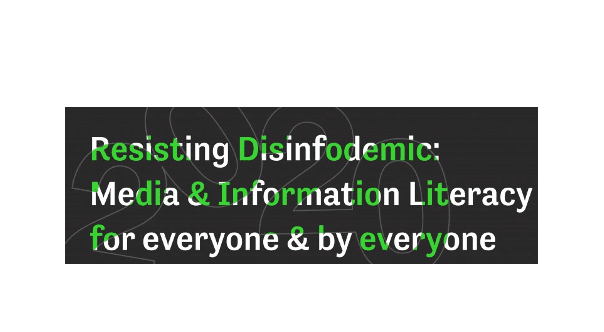
The 10th annual global celebration of Global Media and Information Literacy (MIL) Week will take place from 24 to 31 October 2020, under the theme “Resisting Disinfodemic: Media and Information Literacy for everyone and, by everyone”. Through Global MIL Week, UNESCO and WHO are joining forces to tackle disinformation and misinformation. 

The current COVID-19 pandemic is accompanied by an infodemic – the intersection between health, information, communication and technology is becoming one of the most significant dimensions of the public health response to the pandemic. The way in which people are exposed to information, both good and bad; the modalities of digital participation; trust and transparency; media and information literacy; and health literacy are all elements that influence resilience to mis and dis information. WHO is working with partners to manage the infodemic. 

Source of info: WHO & UNESCO


⚡ Looking for expert analysis, policy briefs, and high-level reviews on Nepal's health sector?

We are now offering premium subscription services to deliver timely, evidence-backed policy briefs, comprehensive technical reviews, and strategic analysis straight to your inbox. Tap into specialized consultant expertise and stay ahead on Nepal's emerging health strategies.

👉 [Contact Us]

Do you have a website? Looking for the best hosting provider? Here’s a discount code.

Latest Public Health Jobs

Latest Posts

  • World Atopic Eczema Day 2026: Breaking the Invisible Burden
  • DEVASTATING FLOODS IN NEPAL: PUBLIC HEALTH IMPACT AND A CALL FOR HUMANITARIAN SUPPORT
  • PEN-Plus Orientation Manual for Mid-Level Health Care Workers
  • National Health Training Strategy 2082
  • Simulation Accreditation Manual for Clinical Training Sites

Thanks for visiting us.
Disclaimer: The resources, documents, guidelines, and information on this blog have been collected from various sources and are intended for informational purposes only. Information published on or through this website and affiliated social media channels does not represent the intention, plan, or strategies of an organization that the initiator is associated with in a professional or personal capacity, unless explicitly indicated.
If you have any complaints, information, or suggestions about the content published on Public Health Update, please feel free to contact us at blog.publichealthupdate@gmail.com.
#StayUpdated
  • WordPress
  • Link
  • Facebook
  • Mail
  • Facebook
  • Twitter
  • Twitter
  • LinkedIn
  • Instagram
  • Facebook
October 22, 2020 0 comments
0 FacebookTwitterPinterestLinkedinTumblrVKOdnoklassnikiRedditStumbleuponWhatsappTelegramLINEPocketSkypeViberEmail
Public Health Service Regulation 2077
National Health NewsNational Plan, Policy & GuidelinesPublic HealthResearch & Publication

Public Health Service Regulation, 2077

by Public Health Update October 21, 2020
written by Public Health Update

Public Health Service Regulations, 2020
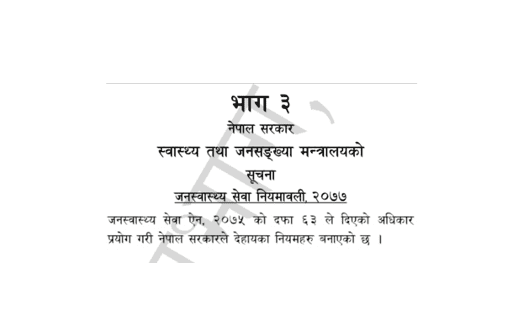
Using the rights given by Section 63 of the Public Health Service Act, 2018, the Government of Nepal has framed the following Rules.

  1. Brief Title and Commencement: (1) These Rules shall be collectively called “Public Health
    Service Regulations, 2020”.
    (2) These Regulations shall come into force immediately.
  2. Definition: Unless the subject or the context requires otherwise, in these Regulations:
    (a) “Hospital” means the health institution where the patient is admitted and a doctor
    provides health services.
    (b) “Basic Healthcare Centre” means the governmental health institution that provides
    basic health services.
    (c) “Act” means the Public Health Service Act, 2018.

Basic Health Services: Every citizen shall receive free basic health services from every basic health service centre and health institutions designated by the Government of Nepal, Provincial Government and Local Level as mentioned in Schedule 1 under the headings pursuant to Sub-Section (4) of Section 3 of the Act.

Download now (English Version)
PDF FILE

Related: Public Health Service Act, 2075 (2018).

Download now(Nepali Version)
PDF FILE

Related Documents

  • The Public Health Service Act, 2075 (2018)
  • National Mental Health Survey, Nepal-2020 Fact Sheet
  • Health Policy 2076 | MoSD, Karnali Province- Nepal
  • National Health Policy 2076- MoHP
  • Child Health Program: Plan, Policies and Documents
  • Right to Safe Motherhood and Reproductive Health Act 2075


⚡ Looking for expert analysis, policy briefs, and high-level reviews on Nepal's health sector?

We are now offering premium subscription services to deliver timely, evidence-backed policy briefs, comprehensive technical reviews, and strategic analysis straight to your inbox. Tap into specialized consultant expertise and stay ahead on Nepal's emerging health strategies.

👉 [Contact Us]

Do you have a website? Looking for the best hosting provider? Here’s a discount code.

Latest Public Health Jobs

Latest Posts

  • World Atopic Eczema Day 2026: Breaking the Invisible Burden
  • DEVASTATING FLOODS IN NEPAL: PUBLIC HEALTH IMPACT AND A CALL FOR HUMANITARIAN SUPPORT
  • PEN-Plus Orientation Manual for Mid-Level Health Care Workers
  • National Health Training Strategy 2082
  • Simulation Accreditation Manual for Clinical Training Sites

Thanks for visiting us.
Disclaimer: The resources, documents, guidelines, and information on this blog have been collected from various sources and are intended for informational purposes only. Information published on or through this website and affiliated social media channels does not represent the intention, plan, or strategies of an organization that the initiator is associated with in a professional or personal capacity, unless explicitly indicated.
If you have any complaints, information, or suggestions about the content published on Public Health Update, please feel free to contact us at blog.publichealthupdate@gmail.com.
#StayUpdated


  • WordPress
  • Link
  • Facebook
  • Mail
  • Facebook
  • Twitter
  • Twitter
  • LinkedIn
  • Instagram
  • Facebook
October 21, 2020 0 comments
0 FacebookTwitterPinterestLinkedinTumblrVKOdnoklassnikiRedditStumbleuponWhatsappTelegramLINEPocketSkypeViberEmail
Eligibility Guideline for Course in Foreign University/Institution 2077
National Plan, Policy & GuidelinesNoticeResearch & Publication

MEC Eligibility Guideline for Course in Foreign University/Institution 2077

by Public Health Update October 21, 2020
written by Public Health Update

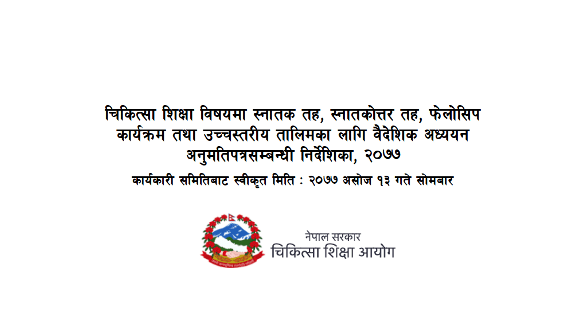
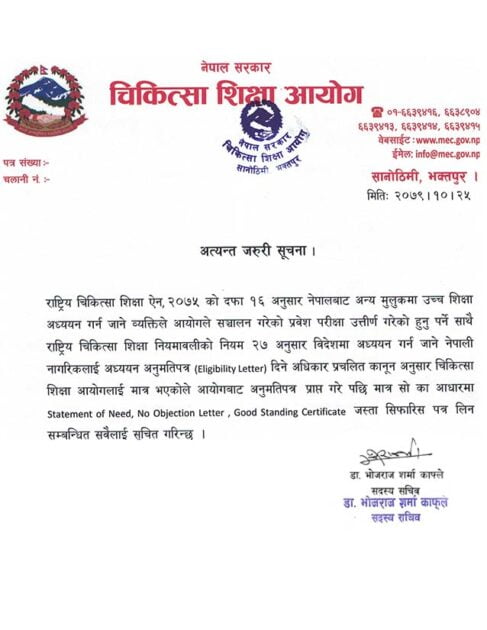
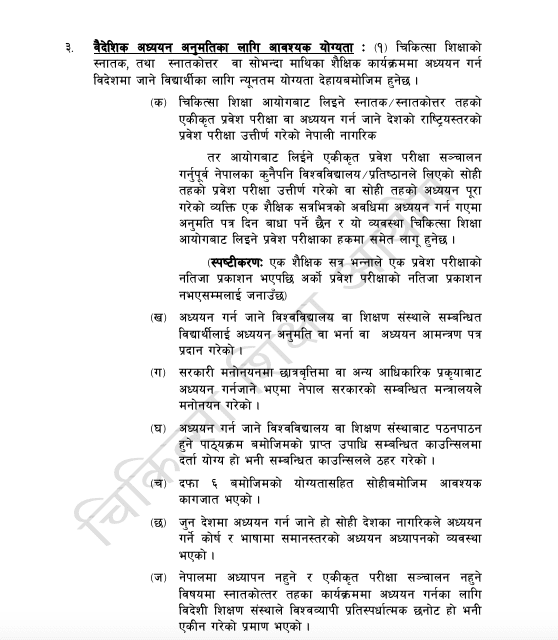
Government of Nepal, Medical Education Commission has published a guideline for Course in Foreign University/Institution 2077.

Medical Education Commission
Screen Shot 2021 01 09 at 11.58.44
MEC Eligibility Guideline

Medical Education Commission (MEC) Eligibility Certificate (Process and documents required)

Document Required & Application Process for No Objection Certification (HOW to apply for NOC)

MEC Eligibility Guideline for Course in Foreign University/Institution 2077

Download now
PDF FILE


⚡ Looking for expert analysis, policy briefs, and high-level reviews on Nepal's health sector?

We are now offering premium subscription services to deliver timely, evidence-backed policy briefs, comprehensive technical reviews, and strategic analysis straight to your inbox. Tap into specialized consultant expertise and stay ahead on Nepal's emerging health strategies.

👉 [Contact Us]

Do you have a website? Looking for the best hosting provider? Here’s a discount code.

Latest Public Health Jobs

Latest Posts

  • World Atopic Eczema Day 2026: Breaking the Invisible Burden
  • DEVASTATING FLOODS IN NEPAL: PUBLIC HEALTH IMPACT AND A CALL FOR HUMANITARIAN SUPPORT
  • PEN-Plus Orientation Manual for Mid-Level Health Care Workers
  • National Health Training Strategy 2082
  • Simulation Accreditation Manual for Clinical Training Sites

Thanks for visiting us.
Disclaimer: The resources, documents, guidelines, and information on this blog have been collected from various sources and are intended for informational purposes only. Information published on or through this website and affiliated social media channels does not represent the intention, plan, or strategies of an organization that the initiator is associated with in a professional or personal capacity, unless explicitly indicated.
If you have any complaints, information, or suggestions about the content published on Public Health Update, please feel free to contact us at blog.publichealthupdate@gmail.com.
#StayUpdated


  • WordPress
  • Link
  • Facebook
  • Mail
  • Facebook
  • Twitter
  • Twitter
  • LinkedIn
  • Instagram
  • Facebook
October 21, 2020 1 comment
0 FacebookTwitterPinterestLinkedinTumblrVKOdnoklassnikiRedditStumbleuponWhatsappTelegramLINEPocketSkypeViberEmail
World Osteoporosis Day: Love Your Bones!
PH Important DayPublic Health

World Osteoporosis Day: Love Your Bones!

by Public Health Update October 20, 2020
written by Public Health Update

World Osteoporosis Day (WOD) is marked on October 20 each year.
WOD is dedicated to raising global awareness of the prevention, diagnosis and treatment of osteoporosis and related musculoskeletal diseases.

It aims to put bone health and fracture prevention on the global health
agenda and reaches out to health-care professionals, the media,
policy makers, patients, and the public at large.

Osteoporosis is a very common condition. Currently, osteoporosis is vastly underdiagnosed and undertreated. Worldwide, millions of people at high risk of broken bones (fractures) remain unaware of the underlying silent disease. The huge human and socioeconomic cost, and severe impact of fractures on patients’ independence, is underestimated.

Theme 2020

THAT’S OSTEOPOROSIS

The year’s campaign objectives are to:
• improve understanding of the link between osteoporosis and broken
bones
• reveal the human costs of fractures through impactful patient portraits
• encourage the public to check their personal risk for osteoporosis by
driving use of the new IOF Osteoporosis Risk Check
• raise awareness of osteoporosis as an intergenerational disease that
concerns the whole family
• reveal the socioeconomic burden of fractures through impactful facts and
statistics
• urge health care authorities worldwide to implement post-fracture care for
secondary fracture prevention

Facts

  • By 2050, the worldwide incidence of hip fracture in men is projected to increase by 310% and by 240% in women compared to 1990.
  • Urbanization and ageing populations are driving rapid increases in the osteoporosis disease burden.
  • The majority of fragility fracture patients are neither assessed, nor treated by their health-care system hence there is failure to ‘Capture the Fracture’ and reduce risk of subsequent fractures.
  • Osteoporosis accounts for more days in the hospital than breast cancer, heart attack, diabetes & other diseases.
  • 1 in 5 women with a spinal fracture will suffer another one within one year.
  • Loss of independence after a hip fracture, approximately 60% require assistance a year later and 20% will require long-term nursing care.
  • Fracture risk up to 27% higher than prostate cancer risk.
  • 1 fracture occurs every 3 sec.
  • If you’ve suffered 1 fracture you’re twice at risk for another.
  • Aged 50+ 1/3 women 1/5 men: will suffer an osteoporotic fracture worldwide.
  • 9 million fractures annually.
  • A prior fracture is associated with an 86% increased risk of any fracture.
  • Only 1/3 of vertebral fractures come to clinical attention.
  • 80% of people who have had at least one osteoporotic fracture are neither identified nor treated for osteoporosis.
  • In men, the risk of fracture is up to 27% higher than the risk of prostate cancer.

The 5 steps to healthy bones and a fracture-free future

1. Exercise regularly: Weight-bearing, muscle-strengthening and balance-training exercises are best.
2. Ensure a diet rich in bone-healthy nutrients: Calcium, vitamin D and protein are the most important for bone health. Safe exposure to sunshine will help you get enough vitamin D.
3. Avoid negative lifestyle habits: Maintain a healthy body weight, avoid smoking and excessive drinking.
4. Find out whether you have risk factors: and bring these to your doctor’s attention, especially if you’ve had a previous fracture or have specific diseases and medications that affect bone health.
5. Get tested and treated if needed: If you’re at high risk you will likely need medication to ensure optimal protection against fracture.


Source of information: World Osteoporosis Day


⚡ Looking for expert analysis, policy briefs, and high-level reviews on Nepal's health sector?

We are now offering premium subscription services to deliver timely, evidence-backed policy briefs, comprehensive technical reviews, and strategic analysis straight to your inbox. Tap into specialized consultant expertise and stay ahead on Nepal's emerging health strategies.

👉 [Contact Us]

Do you have a website? Looking for the best hosting provider? Here’s a discount code.

Latest Public Health Jobs

Latest Posts

  • World Atopic Eczema Day 2026: Breaking the Invisible Burden
  • DEVASTATING FLOODS IN NEPAL: PUBLIC HEALTH IMPACT AND A CALL FOR HUMANITARIAN SUPPORT
  • PEN-Plus Orientation Manual for Mid-Level Health Care Workers
  • National Health Training Strategy 2082
  • Simulation Accreditation Manual for Clinical Training Sites

Thanks for visiting us.
Disclaimer: The resources, documents, guidelines, and information on this blog have been collected from various sources and are intended for informational purposes only. Information published on or through this website and affiliated social media channels does not represent the intention, plan, or strategies of an organization that the initiator is associated with in a professional or personal capacity, unless explicitly indicated.
If you have any complaints, information, or suggestions about the content published on Public Health Update, please feel free to contact us at blog.publichealthupdate@gmail.com.
#StayUpdated


  • WordPress
  • Link
  • Facebook
  • Mail
  • Facebook
  • Twitter
  • Twitter
  • LinkedIn
  • Instagram
  • Facebook
October 20, 2020 0 comments
0 FacebookTwitterPinterestLinkedinTumblrVKOdnoklassnikiRedditStumbleuponWhatsappTelegramLINEPocketSkypeViberEmail
Fellowships, Studentship & ScholarshipsFully funded

Schlumberger Foundation Faculty for the Future Fellowships 2021-2022

by Public Health Update October 18, 2020
written by Public Health Update

The Schlumberger Foundation is accepting new applications for the 2021–2022. Faculty for the Future Fellowships from September 9th to November 9th, 2020.

The Faculty for the Future program, launched in 2004, awards fellowships to women from developing and emerging countries to pursue PhD or Post doctoral research in science, technology, engineering and mathematics (STEM) fields at leading universities worldwide.

The program’s long-term goal is to accelerate gender equality in STEM by generating conditions that result in more women pursuing scientific careers through alleviating some of the barriers they encounter when enrolling in STEM disciplines. The program is committed to gender parity in science and recognizes that full access to and participation in a STEM curriculum is essential for the empowerment of women and girls. By accelerating gender equality in STEM, the talent and capacities of these women can be developed for the benefit of their local communities, regions and nations.

Since its launch in 2004, 739 women from 82 countries have received Faculty for the Future fellowships to pursue PhD and Post-doctoral research in STEM in leading universities outside of their home country.
Faculty for the Future grants are based on actual costs for eligible expenses up to a maximum of USD 50,000 per year for a PhD and maximum of USD 40,000 per year for a Post-doc and may be renewed through to completion of studies. Renewal grants are subject to performance, recommendations from supervisors and strong evidence of re-integration plans in the home country.
Candidates should have applied to, have been admitted to, or be currently enrolled in a university abroad when submitting their grant application. Candidates must hold an excellent academic record, demonstrate leadership skills, community outreach activities and have a track record in encouraging girls and women into STEM fields. Candidates should also prove their commitment to return to their home countries upon completion of their studies to contribute to the economic, social and technological advancement of their home regions by strengthening the STEM teaching and research faculties of their home institutions as well as through their leadership in science-based entrepreneurship.

Eligibility Criteria

To be eligible to apply for this Fellowship applicants must meet the following criteria:

You:

  • are a female and are a citizen of a developing country or emerging economy where women are underrepresented in Science, Technology, Engineering and Mathematics (STEM) disciplines.
  • You are not eligible to apply if you hold dual citizenship of which one is citizenship of a developed country. (N.B. If you have been awarded a Faculty for the Future grant and after the award you obtain citizenship of a developed country, the grant will be discontinued as of the date of such additional citizenship);
  • are preparing for a PhD degree or post-doctoral research in a STEM discipline. The Faculty for the Future program does not fund Master level studies;
  • are enrolled, admitted or have applied to a host university/research institute abroad (applications are no longer accepted where a candidate has not yet applied to a university). If you are applying for a sandwich course the final degree must be awarded by the Host University abroad or jointly (i.e., but not solely from the home country university);
  • hold an excellent academic record; – are willing to go back to your home country or region upon completion of your studies to contribute to its socio-economic development;
  • have a proven record of teaching experience in your home country and can demonstrate your commitment to going back home to:
    i) an academic or research position in a STEM faculty;
    ii) and/or to using your knowledge to become a STEM entrepreneur to help resolve regional challenges in your local community/region;
    iii) and/or to demonstrating leadership by contributing to the public sector using your scientific skills to help provide evidence-based support for STEM policy making, including topics of gender representation; Schlumberger-Private – can demonstrate leadership skills, active community outreach and have a track record in encouraging girls and women into STEM.
  • If you do not meet the above criteria, please do not apply for a grant, as your application will not be retained in the selection process.

Application

New applications will be accepted from September 9th to November 9th 2020 for the 2021 Fellowships (the deadline for reference letters is November 16th, 2020).

October 18, 2020 0 comments
0 FacebookTwitterPinterestLinkedinTumblrVKOdnoklassnikiRedditStumbleuponWhatsappTelegramLINEPocketSkypeViberEmail
WHO Guidance for Climate Resilient and Environmentally Sustainable Health Care Facilities
Environmental Health & Climate ChangeInternational Plan, Policy & GuidelinesResearch & Publication

WHO Guidance for Climate Resilient and Environmentally Sustainable Health Care Facilities

by Public Health Update October 18, 2020
written by Public Health Update

The World Health Organization (WHO) published guidance on climate-resilient and environmentally sustainable health care facilities.

Aim of Guideline

The aim of this guidance is to enhance the capacity of health care facilities to protect and improve the health of their target communities in an unstable and changing climate; and to empower health care facilities to be environmentally sustainable, by optimizing the use of resources and minimizing the release of waste into the environment.

Climate resilient and environmentally sustainable health care facilities contribute to high quality of care and accessibility of services, and by helping reduce facility costs also ensure better affordability. They are, therefore, an important component of universal health coverage (UHC).

This document aims to:

This guidance document provides a set of suggested interventions, along the lines of four fundamental requirements for providing safe and quality care in the context of climate change:

  • Guide professionals working in health care settings to understand and effectively prepare for the additional health risks posed by climate change.
  • Monitor, anticipate, manage and adapt to the health risks associated with climate change.
  • Guide health care facility officials to work with health determining sectors (including water and sanitation, energy, transportation, food, urban planning, environment) to prepare for additional health risks posed by climate change through a resilience approach, and to promote environmentally sustainable practices in providing these services.
  • Provide tools to assist health care facility officials assess their resilience to climate change threats, and their environmental sustainability based upon the appropriate use of resources (in particular water and energy and sustainable procurement), and release of hazards (biological, chemical, radiological), to their surrounding environment.
  • Promote actions to ensure that health care facilities are constantly and increasingly strengthened and continue to be efficient and responsive to improve health and contribute to reducing inequities and vulnerability within their local settings.
  1. the health workforce;
  2. water, sanitation, hygiene and health care waste management;
  3. sustainable energy services; and
  4. Infrastructure, technologies and products.
Download now
GUIDELINE


⚡ Looking for expert analysis, policy briefs, and high-level reviews on Nepal's health sector?

We are now offering premium subscription services to deliver timely, evidence-backed policy briefs, comprehensive technical reviews, and strategic analysis straight to your inbox. Tap into specialized consultant expertise and stay ahead on Nepal's emerging health strategies.

👉 [Contact Us]

Do you have a website? Looking for the best hosting provider? Here’s a discount code.

Latest Public Health Jobs

Latest Posts

  • World Atopic Eczema Day 2026: Breaking the Invisible Burden
  • DEVASTATING FLOODS IN NEPAL: PUBLIC HEALTH IMPACT AND A CALL FOR HUMANITARIAN SUPPORT
  • PEN-Plus Orientation Manual for Mid-Level Health Care Workers
  • National Health Training Strategy 2082
  • Simulation Accreditation Manual for Clinical Training Sites

Thanks for visiting us.
Disclaimer: The resources, documents, guidelines, and information on this blog have been collected from various sources and are intended for informational purposes only. Information published on or through this website and affiliated social media channels does not represent the intention, plan, or strategies of an organization that the initiator is associated with in a professional or personal capacity, unless explicitly indicated.
If you have any complaints, information, or suggestions about the content published on Public Health Update, please feel free to contact us at blog.publichealthupdate@gmail.com.
#StayUpdated


  • WordPress
  • Link
  • Facebook
  • Mail
  • Facebook
  • Twitter
  • Twitter
  • LinkedIn
  • Instagram
  • Facebook

October 18, 2020 0 comments
0 FacebookTwitterPinterestLinkedinTumblrVKOdnoklassnikiRedditStumbleuponWhatsappTelegramLINEPocketSkypeViberEmail
Fellowships, Studentship & ScholarshipsFully fundedGrants and Funding Opportunities

Government of Ireland Postdoctoral Fellowship Programme

by Public Health Update October 17, 2020
written by Public Health Update

In partnership with the Irish Research Council, the Department of Rural and Community Development (DRCD) invites applications from all disciplines for a Social Enterprise Impact Fellowship. Applicants who choose to apply for a strategic funding partner fellowship will also be considered for a Government of Ireland Postdoctoral Fellowship.

This programme aims to support suitably qualified applicants in any discipline to pursue a postdoctoral fellowship at an eligible higher education institution in Ireland. Fellows will hold a Government of Ireland Postdoctoral Fellowship. These fellowships can be held for either one or two years.

Eligibility

An applicant must have either graduated or have been certified as having fulfilled all the requirements for the award of a doctoral degree, including the submission of the hardbound corrected thesis, within the five-year period between 31 May 2016 and 31 May 2021.

What we offer

  • a salary of €31,275 per annum
  • employer’s PRSI contribution of €3,455 per annum (11.05% of salary)
  • employer’s pension contribution, where applicable, of €6,255 per annum (20% of salary)
  • eligible direct research expenses of €5,000 per annum

How to apply

All participants must create and submit their forms via the online system, available in the left sidebar. Guides on how to submit your application on the online system can be found in the right sidebar.

Social Enterprise Impact Fellowship (funded by DRCD)

In partnership with the Department of Rural and Community Development (DRCD), we invite applications from all disciplines for a Social Enterprise Impact Fellowship. A Social Enterprise is an enterprise whose objective is to achieve a social, societal or environmental impact. They are part of the wider social economy and make a valuable contribution to the social and economic progress of Ireland through the creation of jobs and through the delivery of a broad range of services in areas such as homecare, child care, employment activation, retail, hospitality and catering, environmental services, and social housing.

The main purpose of the DRCD Impact Fellowship in Social Enterprise is to support pioneering research on Social Enterprise in Ireland as part of the Government of Ireland Postdoctoral Fellowship Programme. Research is encouraged in particular towards developing a rigorous impact-measurement methodology for the spectrum of social enterprise in Ireland in light of the new National Social Enterprise Policy and international best practice. Research may also consider data collection, verification and reliability as part of establishing the broader evidence-base.

The Call Documentation in the right sidebar includes full details and guidance about the DRCD Social Enterprise Impact Fellowship and about the non-directed call.

Applicants who choose to apply for this strategic funding partner fellowship will also be considered for a Government of Ireland Postdoctoral Fellowship.

Key dates

Applicant deadline16:00 (Irish time) 19 November 2020
Mentor and referee deadline16:00 (Irish time) 26 November 2020
Research office endorsement deadline16:00 (Irish time) 03 December 2020
Call outcomeEnd of March 2021
Fellowship start date1 October 2021
OFFICIAL LINK
Link

  • World Atopic Eczema Day 2026: Breaking the Invisible Burden
  • DEVASTATING FLOODS IN NEPAL: PUBLIC HEALTH IMPACT AND A CALL FOR HUMANITARIAN SUPPORT
  • PEN-Plus Orientation Manual for Mid-Level Health Care Workers
  • National Health Training Strategy 2082
  • Simulation Accreditation Manual for Clinical Training Sites
October 17, 2020 0 comments
0 FacebookTwitterPinterestLinkedinTumblrVKOdnoklassnikiRedditStumbleuponWhatsappTelegramLINEPocketSkypeViberEmail
The International Day for the Eradication of Poverty
ActivitiesPH Important Day

International Day for the Eradication of Poverty #EndPoverty

by Public Health Update October 17, 2020
written by Public Health Update

The International Day for the Eradication of Poverty marked every year on 17 October. International Day for the Eradication is an opportunity to acknowledge the effort and struggle of people living in poverty, a chance for them to make their concerns heard, and a moment to recognize that poor people are the first ones to fight against poverty.

Persons living in poverty experience many interrelated and mutually reinforcing deprivations that prevent them from realizing their rights and perpetuate their poverty, including:

  • dangerous work conditions
  • unsafe housing
  • lack of nutritious food
  • unequal access to justice
  • lack of political power
  • limited access to health care

Theme for 2020

Acting together to achieve social and environmental justice for all

The theme for the Day this year addresses the challenge of achieving social and environmental justice for all. The growing recognition of the multi dimensionality of poverty means that these two issues are inseparably intertwined, and that social justice cannot be fully realized without aggressively rectifying environmental injustices at the same time.

Poverty Facts and Figures

  • 736 million people lived below the international poverty line of US $ 1.90 a day in 2015.
  • In 2018, almost 8 per cent of the world’s workers and their families lived on less than US$1.90 per person per day.
  • Most people living below the poverty line belong to two regions: Southern Asia and sub-Saharan Africa.
  • High poverty rates are often found in small, fragile and conflict-affected countries.
  • As of 2018, 55 per cent of the world’s population have no access to at least one social protection cash benefit.

Source of info: https://www.un.org


  • COVID-19 fallout could push half a billion people into poverty in developing countries
  • World Bank and WHO: Half the world lacks access to essential health services, 100 million still pushed into extreme poverty because of health expenses
  • The Nepal NCDI Poverty Commission Report
  • Bridging a Gap in Universal Health Coverage for the Poorest Billion


⚡ Looking for expert analysis, policy briefs, and high-level reviews on Nepal's health sector?

We are now offering premium subscription services to deliver timely, evidence-backed policy briefs, comprehensive technical reviews, and strategic analysis straight to your inbox. Tap into specialized consultant expertise and stay ahead on Nepal's emerging health strategies.

👉 [Contact Us]

Do you have a website? Looking for the best hosting provider? Here’s a discount code.

Latest Public Health Jobs

Latest Posts

  • World Atopic Eczema Day 2026: Breaking the Invisible Burden
  • DEVASTATING FLOODS IN NEPAL: PUBLIC HEALTH IMPACT AND A CALL FOR HUMANITARIAN SUPPORT
  • PEN-Plus Orientation Manual for Mid-Level Health Care Workers
  • National Health Training Strategy 2082
  • Simulation Accreditation Manual for Clinical Training Sites

Thanks for visiting us.
Disclaimer: The resources, documents, guidelines, and information on this blog have been collected from various sources and are intended for informational purposes only. Information published on or through this website and affiliated social media channels does not represent the intention, plan, or strategies of an organization that the initiator is associated with in a professional or personal capacity, unless explicitly indicated.
If you have any complaints, information, or suggestions about the content published on Public Health Update, please feel free to contact us at blog.publichealthupdate@gmail.com.
#StayUpdated


  • WordPress
  • Link
  • Facebook
  • Mail
  • Facebook
  • Twitter
  • Twitter
  • LinkedIn
  • Instagram
  • Facebook
October 17, 2020 0 comments
0 FacebookTwitterPinterestLinkedinTumblrVKOdnoklassnikiRedditStumbleuponWhatsappTelegramLINEPocketSkypeViberEmail
Fellowships, Studentship & ScholarshipsPublic Health EventsRegion of America

WomenLift Health US Leadership Program 2021

by Public Health Update October 16, 2020
written by Public Health Update

WomenLift Health is now accepting applications for our 2021 U.S Leadership Journey. The fully-funded, 12-month WomenLift Health Leadership Journey imparts contextualized leadership skills to address the individual, organizational, and societal challenges that women leaders in global health face. The Journey will be buttressed by virtual learning, mentoring, coaching touchpoints, week-long learning residencies*, as well as a Leadership Project. 

This Journey is designed for the working woman leader. We realize that work-life harmony is a key challenge holding many women back from climbing up the ladder of success, and we do not want to add further burden to their personal and professional life.

As a result of participating in the Leadership Journey, women leaders will be better able to: 

  • Build confidence 
  • Develop skill at risk-taking
  • Improve their executive presence
  • Leverage power and collective leadership for professional development 
  • Take their global mindset to a deeper level
  • Use the relationship with a mentor as a career catalyst 
  • Develop an influence strategy for addressing structural and institutional barriers
  • Understand the value of social network analysis
  • Share in the collective wisdom of work-life integration

The 2021-2022 Leadership Journey will take place from March 2021 – March 2022 in an all-virtual format*. The full calendar can be found in the Timeline section below. 

There is NO cost to participate if you are selected.

Eligibility

You are eligible for consideration if you meet all of the following criteria: 

  • Identify as a woman
  • Possess sufficient, relevant experience in global health (10+ years)
  • Live in the United States (any nationality is welcome)

Twenty-four applicants will be selected for participation in the cohort. WomenLift Health is committed to selecting diverse cohort members, representing different sectors (public, private, academia, NGO, philanthropy), disciplines, cultural backgrounds, and regions. 

There is NO cost to participate if you are selected.

Commitments & Expectations

If accepted, you will be required to attend each virtual and in-person learning residency* as detailed in the 2021 Leadership Journey Calendar and to complete the deliverables associated with the Leadership Project.

  • The time commitment for the required Leadership Journey activities (all virtual touchpoints and video assignments) will not exceed 2 hours any given week. This estimate does not include the time required for the design, planning, and implementation phases of your Leadership Project, so please consider that as well.
  • You will also be asked to complete a “360-evaluation” and Personality Assessments, which will enrich your conversations with your mentor and coach. The 360-evaluation will involve soliciting feedback from your superior, boss, peers, direct reports, and others. 

Please ensure you have access to a computer and internet in order to attend the virtual touchpoints. 

While the following are not technical requirements, our hope is that you will bring your drive, passion, and commitment to this journey, engage actively with your peers, mentors, and coaches, and take full advantage of the resources that we provide. As our approach involves human-centered design, we will ask you to evaluate the experience and contribute ideas for how to enhance the Leadership Journey for the cohorts that follow. 

How to Apply

Apply here by November 13, 2020, close of business. To see a PDF version of the full application, click here. 

Within the application, you will be asked to describe your Leadership Project idea and to submit a resume & letter of recommendation.

The Leadership Project, required of every cohort member, is an opportunity for each member to design and lead an effort that taps into each woman’s expertise, network, passion, and creativity. Implementation of the project does not have to be fully complete by the end of the Journey and will likely continue beyond it. There are only 4 rules for the Leadership Project: 

  • It should focus on improving health and/or gender equality; 
  • It should leverage your leadership skills; 
  • It should be in your scope of control or influence; 
  • You should be passionate about it

The Leadership Project could accomplish one or more of the following:

  • answer a research question;
  • promote health or gender education in a particular group;
  • develop a new or better technology;
  • innovate a better way to collect/analyze/use health/gender data;
  • improve a gender or health-related process/system in your organization;
  • empower or enable women in your community or organization to be successful;
  • incorporate a gender lens into a policy, practice or research project where it was absent

Please include a letter of recommendation from your supervisor. If unable to obtain a letter of recommendation from your direct supervisor, you may submit a letter written by a senior leader at your current organization or a leader in the global health community who has experience working with you.

The letter of recommendation may speak to:

  • The significant contributions you have made to your professional field that demonstrate leadership capacity
  • Your strongest personal quality which distinguishes and qualifies you for selection to participate in this Leadership Journey
  • How this Leadership Journey will help you enhance your leadership knowledge and skills

  • World Atopic Eczema Day 2026: Breaking the Invisible Burden
  • DEVASTATING FLOODS IN NEPAL: PUBLIC HEALTH IMPACT AND A CALL FOR HUMANITARIAN SUPPORT
  • PEN-Plus Orientation Manual for Mid-Level Health Care Workers
  • National Health Training Strategy 2082
  • Simulation Accreditation Manual for Clinical Training Sites
October 16, 2020 0 comments
0 FacebookTwitterPinterestLinkedinTumblrVKOdnoklassnikiRedditStumbleuponWhatsappTelegramLINEPocketSkypeViberEmail
Health in DataFact SheetInternational Plan, Policy & GuidelinesNational Plan, Policy & GuidelinesResearch & PublicationResearch Articles

The Global Burden of Disease (GBD) 2019 Country Profile: Nepal

by Public Health Update October 16, 2020
written by Public Health Update

The Country Profile provides an overview of findings from the Global Burden of Disease (GBD). Data are based on over 80,000 different data sources used by researchers to produce the most scientifically rigorous estimates possible. Estimates from the GBD study may differ from national statistics due to differences in data sources and methodology.

Country Profile: Nepal

  • 2019 population- 30.4M
  • 2019 fertility rate- 2.1
  • 2019 educational attainment (years)- 4.7

How well is this country or territory providing effective, essential health services?

UHC effective coverage index: The Universal Health Coverage (UHC) effective coverage index aims to represent service coverage across population health needs and how much these services could contribute to improved health.

  • 1990- 29.3
  • 2010- 44.9
  • 2019- 47.3

What causes the most deaths? Top 10 causes of total number of deaths in 2019 (2019 ranking)

  1. COPD
  2. Ischemic heart disease
  3. Stroke
  4. Lower respiratory infect
  5. Neonatal disorders
  6. Cirrhosis
  7. Tuberculosis
  8. Asthma
  9. Diarrhoeal diseases
  10. Chronic Kidney diseases
    13. Self-harm
What risk factors drive the most death and disability combined? Top 10 risks contributing to total number of DALYs in 2019 (2019 ranking)
  1. Malnutrition
  2. Air
  3. Tobacco
  4. High blood pressure
  5. Dietary risks
  6. Occupational risks
  7. High fasting plasma glucose
  8. High fasting plasma glucose
  9. Alcohol use
  10. WaSH
    13. Non-optimal temperature
Screen Shot 2020 10 16 at 20.15.53
Global Burden of Diseases Nepal

⚡ Looking for expert analysis, policy briefs, and high-level reviews on Nepal's health sector?

We are now offering premium subscription services to deliver timely, evidence-backed policy briefs, comprehensive technical reviews, and strategic analysis straight to your inbox. Tap into specialized consultant expertise and stay ahead on Nepal's emerging health strategies.

👉 [Contact Us]

Do you have a website? Looking for the best hosting provider? Here’s a discount code.

Latest Public Health Jobs

Latest Posts

  • World Atopic Eczema Day 2026: Breaking the Invisible Burden
  • DEVASTATING FLOODS IN NEPAL: PUBLIC HEALTH IMPACT AND A CALL FOR HUMANITARIAN SUPPORT
  • PEN-Plus Orientation Manual for Mid-Level Health Care Workers
  • National Health Training Strategy 2082
  • Simulation Accreditation Manual for Clinical Training Sites

Thanks for visiting us.
Disclaimer: The resources, documents, guidelines, and information on this blog have been collected from various sources and are intended for informational purposes only. Information published on or through this website and affiliated social media channels does not represent the intention, plan, or strategies of an organization that the initiator is associated with in a professional or personal capacity, unless explicitly indicated.
If you have any complaints, information, or suggestions about the content published on Public Health Update, please feel free to contact us at blog.publichealthupdate@gmail.com.
#StayUpdated


  • WordPress
  • Link
  • Facebook
  • Mail
  • Facebook
  • Twitter
  • Twitter
  • LinkedIn
  • Instagram
  • Facebook
READ MORE
GBD2019 (OFFICIAL LINK)

The Global Burden of Disease Study 2019 #GBDstudy


⚡ Looking for expert analysis, policy briefs, and high-level reviews on Nepal's health sector?

We are now offering premium subscription services to deliver timely, evidence-backed policy briefs, comprehensive technical reviews, and strategic analysis straight to your inbox. Tap into specialized consultant expertise and stay ahead on Nepal's emerging health strategies.

👉 [Contact Us]

Do you have a website? Looking for the best hosting provider? Here’s a discount code.

Latest Public Health Jobs

Latest Posts

  • World Atopic Eczema Day 2026: Breaking the Invisible Burden
  • DEVASTATING FLOODS IN NEPAL: PUBLIC HEALTH IMPACT AND A CALL FOR HUMANITARIAN SUPPORT
  • PEN-Plus Orientation Manual for Mid-Level Health Care Workers
  • National Health Training Strategy 2082
  • Simulation Accreditation Manual for Clinical Training Sites

Thanks for visiting us.
Disclaimer: The resources, documents, guidelines, and information on this blog have been collected from various sources and are intended for informational purposes only. Information published on or through this website and affiliated social media channels does not represent the intention, plan, or strategies of an organization that the initiator is associated with in a professional or personal capacity, unless explicitly indicated.
If you have any complaints, information, or suggestions about the content published on Public Health Update, please feel free to contact us at blog.publichealthupdate@gmail.com.
#StayUpdated


  • WordPress
  • Link
  • Facebook
  • Mail
  • Facebook
  • Twitter
  • Twitter
  • LinkedIn
  • Instagram
  • Facebook
October 16, 2020 1 comment
0 FacebookTwitterPinterestLinkedinTumblrVKOdnoklassnikiRedditStumbleuponWhatsappTelegramLINEPocketSkypeViberEmail
Newer Posts
Older Posts

Search

Follow Us

Facebook Twitter Instagram Pinterest Linkedin Youtube

Categories

  • Abstracts (25)
  • Activities (91)
  • Adolescent Sexual and Reproductive Health (ASRH) (25)
  • Advice & Tips (4)
  • African Region (5)
  • AI and Health (1)
  • Annual Meeting (6)
  • Antimicrobial Resistance (AMR) (21)
  • Award (20)
  • Awards (17)
  • Books (9)
  • Call for Proposal, EOI & RFP (103)
  • Call for Research Participants (8)
  • Clinical Doctor Jobs (6)
  • Communicable Diseases (107)
  • Competition (20)
  • Conference (129)
  • Consultant (1)
  • Courses (206)
  • Dashboard (2)
  • Digital Health & Health Informatics (10)
  • Drug and Medicine (18)
  • Eastern Mediterranean Region (3)
  • Education (16)
  • Environment (3)
  • Environmental Health & Climate Change (47)
  • European Region (42)
  • Exchange Program (1)
  • Fact Sheet (118)
  • FCHVs (1)
  • Fellowships, Studentship & Scholarships (168)
  • Financial Aid (13)
  • Form Formats (2)
  • Fully funded (22)
  • Global Health News (440)
  • Grants and Funding Opportunities (193)
  • Guest Post (44)
  • Health Assistant Jobs (1)
  • Health Equity (7)
  • Health Financing and Economics (24)
  • Health in Data (118)
  • Health Insurance (5)
  • Health Jobs (52)
  • Health Literacy, Health Education & Promotion (51)
  • Health Organization Profile (42)
  • Health Systems (85)
  • Human Resource for Health (33)
  • Humanitarian Health & Emergency Response (45)
  • Hypertension (5)
  • Implementation Research (49)
  • International Health (3)
  • International Jobs & Opportunities (374)
  • International Plan, Policy & Guidelines (212)
  • Internships (5)
  • Jobs Vacancies (57)
  • Journals (8)
  • Life Style & Public Health Nutrition (39)
  • Live (10)
  • Master's Degree (48)
  • Maternal, Newborn and Child Health (88)
  • Mentorship Program (2)
  • Miscellaneous (16)
  • National Health News (160)
  • National Plan, Policy & Guidelines (473)
  • Neglected Tropical Diseases (NTDs) (51)
  • Non- Communicable Diseases (NCDs) (123)
  • Notice (103)
  • Nursing Jobs (6)
  • Nutritionist Jobs (1)
  • One Health (18)
  • Online & Distance Learning (22)
  • Online Courses (91)
  • Op-Ed Article (3)
  • Opportunities by Region (83)
  • Outbreak News (213)
  • Partially funded (6)
  • PCL Health Science Jobs (3)
  • PH Important Day (538)
  • Pharmacist Jobs (3)
  • PhD (54)
  • Photos (5)
  • Planetary Health (4)
  • PostDoc (14)
  • Presentation Slides (26)
  • Primary Health Care (25)
  • Provincial Plan, Policies and Guidelines (17)
  • Public Health (1,288)
  • Public Health Epidemiology & Biostatistics (14)
  • Public Health Events (307)
  • Public Health Information (21)
  • Public Health Innovation (9)
  • Public Health Jobs (52)
  • Public Health News (558)
  • Public Health Notes (120)
  • Public Health Opportunities (509)
  • Public Health Opportunity (493)
  • Public Health Programs (108)
  • Public Health Seminar (2)
  • Public Health Tools (2)
  • Public Health Update (574)
  • Quality Improvement & Infection Prevention (20)
  • Region of America (8)
  • Reports (187)
  • Research & Project Grants (39)
  • Research & Project Grants (33)
  • Research & Publication (651)
  • Research Articles (10)
  • Road Traffic Accidents (RTA) (9)
  • School of Public Health (60)
  • Self funded (2)
  • South-East Asia Region (26)
  • Success Stories (17)
  • Summer and Winter Courses (40)
  • Summer Courses (28)
  • Sustainable Development Goals (SDGs) (14)
  • Syllabus (61)
  • Symposium (9)
  • Tobacco Control (35)
  • Training (40)
  • Travel Grants (15)
  • Trick, Technique & Skills (8)
  • Uncategorized (3)
  • Undergraduate Degree (7)
  • Universal Health Coverage (36)
  • Universities (29)
  • Universities & School of Public Health (58)
  • Vacancy Announcement (26)
  • Vaccine Preventable Diseases (40)
  • Vector-Borne Diseases(VBDs) (31)
  • Videos (3)
  • View Points (1)
  • Webinar (4)
  • Western Pacific Region (13)
  • Workshop (18)
  • World News (120)
Post New Jobs: Vacancy Announcement Service

Search Box

Public Health Update (Sagun’s Blog) is a popular public health portal in Nepal. Thousands of health professionals are connected with Public Health Update to get up-to-date public health updates, search for jobs, and explore opportunities.
#1 Public Health Blog for sharing Job opportunities and updates in Nepal

”Public Health Information For All”
– – Sagun Paudel, Founder

  • HOT JOBS
    • Public Health Jobs
    • Medical Doctor Jobs
    • Nursing Jobs
    • Health Assistant Jobs
    • Pharmacist Jobs
    • NGOs Jobs
    • Government Jobs
  • Top Categories
    • National Plan, Policy & Guidelines Top
    • Public Health Calendar
    • Fellowships & Scholarships
    • Health Systems
    • Health Organization Profiles
    • International Jobs & Opportunities
    • Public Health Opportunity

PUBLIC HEALTH INITIATIVE

    • Submit your Vacancies New
    • Partnership Opportunities

Contact: blog.publichealthupdate@gmail.com

https://wa.me/+9779856036932

All Right Reserved. 2011-2026. Contact us. 

Facebook Twitter Instagram Youtube Envelope
Public Health Update
  • Home
  • Public Health
    • Home 1
      • Adolescent Sexual and Reproductive Health (ASRH)
      • Antimicrobial Resistance (AMR)
      • Communicable Diseases
      • Digital Health & Health Informatics
      • Environmental Health & Climate Change
      • Health Financing and Economics
      • Health Equity
    • Home 2
      • Health Literacy, Health Education & Promotion
      • Human Resource for Health
      • Humanitarian Health & Emergency Response
      • Implementation Research
      • International Health
      • Life Style & Public Health Nutrition
      • Maternal, Newborn and Child Health
    • Home 3
      • Neglected Tropical Diseases (NTDs)
      • Non- Communicable Diseases (NCDs)
      • One Health
      • Planetary Health
      • Public Health Epidemiology & Biostatistics
      • Primary Health Care
      • Quality Improvement & Infection Prevention
    • Home 4
      • Road Traffic Accidents (RTA)
      • Sustainable Development Goals (SDGs)
      • Tobacco Control
      • Universal Health Coverage
      • Vaccine Preventable Diseases
      • Vector-Borne Diseases(VBDs)
      • Notices
  • Public Health Update
    • Home 1
      • Public Health News
      • Global Health News
      • Outbreak News
      • National Health News
      • COVID-19
    • Home 2
      • Fact Sheet
      • Health in Data
      • PH Important Day
      • Public Health Events
      • Public Health Programs
    • Home 3
      • Health Systems
      • Health Insurance
      • Health Organization Profile
      • Success Stories
      • Public Health Innovation
  • Public Health Opportunities
    • Fully funded
    • Travel Grants
    • Grants and Funding Opportunities
    • Opportunities by Region
    • International Jobs & Opportunities
    • Research & Project Grants
    • Fellowships, Studentship & Scholarships
    • Conference
  • Jobs
    • Home 1
      • Health Jobs
      • Public Health Jobs
      • Clinical doctor Jobs
      • Health Assistant Jobs
      • Nursing Jobs
      • PCL Health Science Jobs
    • Home 2
      • Dental Jobs
      • Pharmacist Jobs
      • TSLC (Health Jobs)
      • Laboratory Jobs
      • Nutritionist Jobs
  • Downloads
    • International Plan, Policy & Guidelines
    • National Plan, Policy & Guidelines
    • Reports
    • Books
    • Research Articles
  • School of Public Health
    • Home 1
      • Courses
      • Master’s Degree
      • Undergraduate Degree
      • PhD
    • Home 2
      • Universities
      • Syllabus
      • Public Health Notes
      • Mentorship Program
      • Startup Project
    • Home
      • Summer and Winter Courses
      • Summer Courses
      • Online Courses
      • Workshop
      • Training
Public Health Initiative, A Registered Non-profit organization – All Right Reserved. 2011-2023