Public Health Update
  • Home
  • Public Health Update
  • Nepal Health Jobs
    • Public Health Job Board
    • Organization List
  • Opportunities
    • Fellowships, Studentship & Scholarships
    • Grants and Funding Opportunities
    • Fully funded
    • Conference
  • Downloads
    • International Plan, Policy & Guidelines
    • National Plan, Policy & Guidelines
    • Reports
    • Public Health Notes
    • Syllabus
    • Form Formats
  • School of Public Health
    • PhD
    • Master’s Degree
    • Online Courses
  • Notice
  • Home
  • Public Health Update
  • Nepal Health Jobs
    • Public Health Job Board
    • Organization List
  • Opportunities
    • Fellowships, Studentship & Scholarships
    • Grants and Funding Opportunities
    • Fully funded
    • Conference
  • Downloads
    • International Plan, Policy & Guidelines
    • National Plan, Policy & Guidelines
    • Reports
    • Public Health Notes
    • Syllabus
    • Form Formats
  • School of Public Health
    • PhD
    • Master’s Degree
    • Online Courses
  • Notice
LOGIN / REGISTER
Public Health Update
SUBSCRIBE
Public Health Update
  • Home
  • Public Health Update
  • Nepal Health Jobs
    • Public Health Job Board
    • Organization List
  • Opportunities
    • Fellowships, Studentship & Scholarships
    • Grants and Funding Opportunities
    • Fully funded
    • Conference
  • Downloads
    • International Plan, Policy & Guidelines
    • National Plan, Policy & Guidelines
    • Reports
    • Public Health Notes
    • Syllabus
    • Form Formats
  • School of Public Health
    • PhD
    • Master’s Degree
    • Online Courses
  • Notice

All Right Reserved. Designed and Developed by PenciDesign

World Psoriasis Day 2020: BE INFORMED!
PH Important DayActivitiesPublic HealthPublic Health Events

World Psoriasis Day 2020: BE INFORMED!

by Public Health Update October 29, 2020
written by Public Health Update

World Psoriasis Day observed every year on 29th of October. It was created by International Federation of Psoriasis Associations (IFPA) in 2004, World Psoriasis Day has grown into a leading platform for everyone to unite voices and promote psoriasis advocacy efforts.

Recommended: World Stroke Day is observed on October 29

Psoriasis patient associations, partner organizations, and corporate sponsors, get together to celebrate a day dedicated to people living with psoriasis and/or psoriatic arthritis.

Aims

  • Raise awareness
  • Spread information
  • Improve access to treatment
  • Give the psoriasis community a voice

Impact of Psoriasis

Physically. People with psoriasis might experience constant itching or burning. Psoriatic arthritis can cause pain and persistent fatigue. Further, people with psoriasis have been shown to have an increased incidence of other non communicable diseases (NCDs) including, type 2 diabetes, psoriatic arthritis, cardiovascular disease, and stroke.
Emotionally. Psoriasis is associated with a variety of psychological difficulties, including poor self-esteem, sexual dysfunction, anxiety, depression, and suicidal ideation. The visibility of psoriatic lesions means that social stigmatisation and rejection are common experiences for people with psoriasis.
Socially. Physical discomfort, impaired emotional functioning, and negative body- and self-image leads to limitations in daily activities, avoidance of interpersonal situations or public places and thus, reduced social and occupational opportunities.
Economically. Psoriasis imposes a substantial economic burden on the individual and society. Besides the direct financial burden of treatment, psoriasis causes significant occupational disability. Not surprisingly, patients with more severe psoriasis must spend more time and money on treatment, which can ultimately affect their work status. Indirect costs include lost productivity and disability caused by limitations in activities of daily living.

Theme

The theme for World Psoriasis Day 2020 is “INFORMED”. 

Informed
  • Informed patients can manage their condition better and motivate behavior change in their communities.
  • Informed patient associations are effective in advocating the needs of psoriasis patients and helping them with social and psychological issues, something physicians have little time to do.
  • Informed patient associations are effective in advocating the needs of psoriasis patients and helping them with social and psychological issues, something physicians have little time to do.
  • Informed medical professionals have the ability to deliver positive, solid information about psoriasis and its treatments.
  • Informed society will know that psoriasis is not transmittable to/from another person by touch or close contact, which will help to lessen the stigma, discrimination and exclusion of people living with psoriasis.
  • Informed decision makers will be empowered to implement the recommendations stated in the WHO Resolution on Psoriasis, to create national guidelines/action plans and devote resources to support early screening of psoriasis patients.

Source of info: World Psoriasis Day Campaign materials


Do you have a website? Looking for the best hosting provider? Here’s a discount code.

Latest Public Health Jobs

Latest Posts

  • Multisectoral Action Plan for the Prevention and Control of NCDs, 2026-2030 (Draft)
  • National Standard Operating Procedure for Early Warning, Alert and Response System (EWARS), 2025
  • Priority Infectious Diseases for Community-Based Surveillance in Nepal
  • Community Based Disease Surveillance Guideline, 2082
  • Political declaration of the fourth high-level meeting of the General Assembly on the prevention and control of NCDs and the promotion of mental health and well-being

Thanks for visiting us.
Disclaimer: The resources, documents, guidelines, and information on this blog have been collected from various sources and are intended for informational purposes only. Information published on or through this website and affiliated social media channels does not represent the intention, plan, or strategies of an organization that the initiator is associated with in a professional or personal capacity, unless explicitly indicated.
If you have any complaints, information, or suggestions about the content published on Public Health Update, please feel free to contact us at blog.publichealthupdate@gmail.com.
#StayUpdated
  • WordPress
  • Link
  • Facebook
  • Mail
  • Facebook
  • Twitter
  • Twitter
  • LinkedIn
  • Instagram
  • Facebook
October 29, 2020 0 comments
0 FacebookTwitterPinterestLinkedinTumblrVKOdnoklassnikiRedditStumbleuponWhatsappTelegramLINEPocketSkypeViberEmail
World Stroke Day 2020! Know your risk and prevent a stroke!
PH Important DayPublic HealthPublic Health Events

World Stroke Day 2020! Know your risk and prevent a stroke!

by Public Health Update October 29, 2020
written by Public Health Update

World Stroke Day is observed on October 29 to raise awareness, preventive measures and treatment of the condition, and ensure better care and support for survivors.

Facts

  • Stroke affects about 1 in 4 people worldwide.
  • It can happen to anyone.
  • 80% of first strokes may be prevented. 
  • WHO estimates that more than 17.5 million people died of cardiovascular diseases such as heart attack or stroke in 2012. 

Prevention of stroke

  • Eat a healthy diet: A balanced diet is crucial to a healthy heart and circulation system.
  • Take regular physical activity: At least 30 minutes of regular physical activity every day helps to maintain cardiovascular fitness; at least 60 minutes on most days of the week helps to maintain healthy weight.
  • Avoid tobacco use
  • Check and control your overall cardiovascular risk
    – Know your blood pressure
    – Know your blood lipids
    – Know your blood sugar
    .

Source of info: WHO & www.world-stroke.org.


Do you have a website? Looking for the best hosting provider? Here’s a discount code.

Latest Public Health Jobs

Latest Posts

  • Multisectoral Action Plan for the Prevention and Control of NCDs, 2026-2030 (Draft)
  • National Standard Operating Procedure for Early Warning, Alert and Response System (EWARS), 2025
  • Priority Infectious Diseases for Community-Based Surveillance in Nepal
  • Community Based Disease Surveillance Guideline, 2082
  • Political declaration of the fourth high-level meeting of the General Assembly on the prevention and control of NCDs and the promotion of mental health and well-being

Thanks for visiting us.
Disclaimer: The resources, documents, guidelines, and information on this blog have been collected from various sources and are intended for informational purposes only. Information published on or through this website and affiliated social media channels does not represent the intention, plan, or strategies of an organization that the initiator is associated with in a professional or personal capacity, unless explicitly indicated.
If you have any complaints, information, or suggestions about the content published on Public Health Update, please feel free to contact us at blog.publichealthupdate@gmail.com.
#StayUpdated


  • WordPress
  • Link
  • Facebook
  • Mail
  • Facebook
  • Twitter
  • Twitter
  • LinkedIn
  • Instagram
  • Facebook
October 29, 2020 0 comments
0 FacebookTwitterPinterestLinkedinTumblrVKOdnoklassnikiRedditStumbleuponWhatsappTelegramLINEPocketSkypeViberEmail
Health: A Political Choice – Act Now, Together (Book)
BooksInternational Plan, Policy & GuidelinesPublic HealthResearch & PublicationUniversal Health Coverage

Health: A Political Choice – Act Now, Together [Book]

by Public Health Update October 26, 2020
written by Public Health Update

Health: A Political Choice – Act Now, Together is the latest in a series of titles published by the Global Governance Project in collaboration with WHO. At the occasion of the World Health Summit 2020 and the 75th anniversary of the United Nations, a new book has been launched that calls on world leaders and politicians to unite in their response to the COVID-19 pandemic and other threats to health and the global economy.

This year’s edition features another prestigious line-up of authors, including Amina J Mohammed, deputy secretary-general of the UN, Dr Tedros Adhanom Ghebreyesus, Director-General of WHO and President of South Africa Cyril Ramaphosa. Calling for coordinated action in response to COVID-19 and on other pressing health-related issues, the publication focuses on five key areas:

  1. Inclusive economics, defined by a new social contract and the pursuit of progress for all
  2. The fundamental requirements for a healthy life and equitable health care
  3. Equitable investments and how to make universal health coverage a reality
  4. Health in the digital age and how technology can help reshape the human rights agenda
  5. The long-term outlook on global health

Dr Tedros, WHO Director-General, said: “It has never been clearer that health is a political and economic choice. In the past 20 years, countries have invested heavily in preparing for terrorist attacks, but relatively little in preparing for the attack of a virus – which, as the COVID-19 pandemic has proven, can be far more deadly, disruptive and costly.” 

WHO NEWS
Download now
PDF FILE


Do you have a website? Looking for the best hosting provider? Here’s a discount code.

Latest Public Health Jobs

Latest Posts

  • Multisectoral Action Plan for the Prevention and Control of NCDs, 2026-2030 (Draft)
  • National Standard Operating Procedure for Early Warning, Alert and Response System (EWARS), 2025
  • Priority Infectious Diseases for Community-Based Surveillance in Nepal
  • Community Based Disease Surveillance Guideline, 2082
  • Political declaration of the fourth high-level meeting of the General Assembly on the prevention and control of NCDs and the promotion of mental health and well-being

Thanks for visiting us.
Disclaimer: The resources, documents, guidelines, and information on this blog have been collected from various sources and are intended for informational purposes only. Information published on or through this website and affiliated social media channels does not represent the intention, plan, or strategies of an organization that the initiator is associated with in a professional or personal capacity, unless explicitly indicated.
If you have any complaints, information, or suggestions about the content published on Public Health Update, please feel free to contact us at blog.publichealthupdate@gmail.com.
#StayUpdated


  • WordPress
  • Link
  • Facebook
  • Mail
  • Facebook
  • Twitter
  • Twitter
  • LinkedIn
  • Instagram
  • Facebook
October 26, 2020 0 comments
0 FacebookTwitterPinterestLinkedinTumblrVKOdnoklassnikiRedditStumbleuponWhatsappTelegramLINEPocketSkypeViberEmail
Eighth International Lead Poisoning Prevention Week 2020
Public HealthActivitiesEnvironmental Health & Climate ChangePH Important Day

Eighth International Lead Poisoning Prevention Week 2020

by Public Health Update October 26, 2020
written by Public Health Update

The eighth International Lead Poisoning Prevention Week (ILPPW) takes place on 25–31 October 2020. ILPPW is an initiative of the Global Alliance to Eliminate Lead Paint (the Lead Paint Alliance), which is jointly led by the UN Environment Programme and WHO.  

International Lead Poisoning Prevention Week (ILPPW) raises awareness and promotes actions to address the health impacts of lead exposure, especially on children, pregnant women, and workers. During the week, governments, academia, civil society organizations, and industry advance efforts to prevent childhood lead poisoning, and accelerate efforts to phase out the use of lead in paint.

Lead poisoning and health (Key Facts)

  • Lead is a cumulative toxicant that affects multiple body systems and is particularly harmful to young children.
  • Lead in the body is distributed to the brain, liver, kidney and bones. It is stored in the teeth and bones, where it accumulates over time. Human exposure is usually assessed through the measurement of lead in blood.
  • Lead in bone is released into blood during pregnancy and becomes a source of exposure to the developing fetus.
  • There is no level of exposure to lead that is known to be without harmful effects.
  • Lead exposure is preventable.
  • Lead exposure can have serious consequences for the health of children.
  • At high levels of exposure, lead attacks the brain and central nervous system to cause coma, convulsions and even death.
  • Children who survive severe lead poisoning may be left with mental retardation and behavioural disorders.
  • At lower levels of exposure that cause no obvious symptoms lead is now known to produce a spectrum of injury across multiple body systems. In particular lead can affect children’s brain development resulting in reduced intelligence quotient (IQ), behavioural changes such as reduced attention span and increased antisocial behavior, and reduced educational attainment.
  • Lead exposure also causes anaemia, hypertension, renal impairment, immunotoxicity and toxicity to the reproductive organs.
  • The neurological and behavioural effects of lead are believed to be irreversible.

    MORE INFO: WHO

Actions for Government, Industry and Civil Society

What can governments do?

  • What can governments do for #ILPPW2020? Governments without legal limits should establish and implement limits, building on the Model Law & Guidance for Regulating Lead Paint, developed by the Global Alliance to Eliminate Lead Paint. https://www.unenvironment.org/resources/publication/model-law-and-guidance-regulating-lead-paint
  • What can governments do for #ILPPW2020? Where lead paint laws exist but are not protective of public health, governments are encouraged to strengthen regulations. Take all necessary measures to ensure full compliance with legal limits. https://www.who.int/campaigns/international-lead-poisoning-prevention-week/2020
  • What can governments do for #ILPPW2020? Serve as government “champions” to share experiences and encourage others to take action in passing laws on lead paint, especially through regional efforts and activities. https://www.who.int/campaigns/international-lead-poisoning-prevention-week/2020
  • What can governments do for #ILPPW2020?  Spread awareness, including on-line and in social media, and organize events to promote action to address lead paint. Register your event here: https://www.who.int/campaigns/international-lead-poisoning-prevention-week/2020

What can industry do?

  • What can industry do for #ILPPW2020? Voluntarily stop the manufacture, import and sale of lead paint where legal limits are not yet in place, and show commitment to comply with a legal limit where it exists or is being established. hhttps://www.who.int/campaigns/international-lead-poisoning-prevention-week/2020
  • What can industry do for #ILPPW2020? Identify ways for regional paint associations and large manufacturers to support other companies in stopping their use of lead additives, and assist national governments in setting legal limits. https://www.who.int/campaigns/international-lead-poisoning-prevention-week/2020 
  • What can industry do for #ILPPW2020? Act as “champions” by engaging specifically with small and medium enterprises to encourage their reformulation of lead paint. https://www.who.int/campaigns/international-lead-poisoning-prevention-week/2020
  • What can industry do for #ILPPW2020? Engage with governments to support the development and implementation of protective legal limits on lead in paint.  https://www.who.int/campaigns/international-lead-poisoning-prevention-week/2020
  • What can industry do? Spread awareness, including on-line and in social media, of the risks of lead paint during industry events and through #ILPPW2020. Register campaign events here: https://www.who.int/campaigns/international-lead-poisoning-prevention-week/2020/registration

What can civil society do?

  • What can civil society organizations do for #ILPPW2020? Engage with governments and industry to support development and implementation of legal limits on lead in paint and encourage reformulation of lead paint.  https://www.who.int/campaigns/international-lead-poisoning-prevention-week/2020
  • What can civil society organizations do for #ILPPW2020? Educate policy makers, parents and others on the dangers of lead paint and how to prevent lead poisoning; and continue paint sampling studies to support new and stronger legal limits. https://www.who.int/campaigns/international-lead-poisoning-prevention-week/2020
  • What can civil society organizations do for #ILPPW2020? The legal community can urge lawyers, firms, and bar associations to support legal limits on lead paint through pro bono support and educational initiatives. https://www.who.int/campaigns/international-lead-poisoning-prevention-week/2020
  • What can civil society organizations do for #ILPPW2020? Health organizations can engage the medical community and health care providers, reach out to schools, and engage with governments and industry to support legal limits on lead in paint. https://www.who.int/campaigns/international-lead-poisoning-prevention-week/2020
  • What can civil society organizations do for #ILPPW2020?  Conduct awareness raising and consumer education about the hazards of lead paint. Register your event here: https://www.who.int/campaigns/international-lead-poisoning-prevention-week/2020

#BanLeadPaint #ILPPW2020

Source of info: Eighth International Lead Poisoning Prevention Week


Do you have a website? Looking for the best hosting provider? Here’s a discount code.

Latest Public Health Jobs

Latest Posts

  • Multisectoral Action Plan for the Prevention and Control of NCDs, 2026-2030 (Draft)
  • National Standard Operating Procedure for Early Warning, Alert and Response System (EWARS), 2025
  • Priority Infectious Diseases for Community-Based Surveillance in Nepal
  • Community Based Disease Surveillance Guideline, 2082
  • Political declaration of the fourth high-level meeting of the General Assembly on the prevention and control of NCDs and the promotion of mental health and well-being

Thanks for visiting us.
Disclaimer: The resources, documents, guidelines, and information on this blog have been collected from various sources and are intended for informational purposes only. Information published on or through this website and affiliated social media channels does not represent the intention, plan, or strategies of an organization that the initiator is associated with in a professional or personal capacity, unless explicitly indicated.
If you have any complaints, information, or suggestions about the content published on Public Health Update, please feel free to contact us at blog.publichealthupdate@gmail.com.
#StayUpdated


  • WordPress
  • Link
  • Facebook
  • Mail
  • Facebook
  • Twitter
  • Twitter
  • LinkedIn
  • Instagram
  • Facebook
October 26, 2020 0 comments
0 FacebookTwitterPinterestLinkedinTumblrVKOdnoklassnikiRedditStumbleuponWhatsappTelegramLINEPocketSkypeViberEmail
United Nations Day: Shaping our future together #UN75
PH Important DayPublic HealthPublic Health Events

United Nations Day: Shaping our future together #UN75

by Public Health Update October 24, 2020
written by Public Health Update

24 October has been celebrated as United Nations Day since 1948. In 1971, the United Nations General Assembly recommended that the day be observed by Member States as a public holiday. UN Day marks the anniversary of the entry into force in 1945 of the UN Charter.

The 75th anniversary

The year 2020 marks the 75th anniversary of the United Nations and its founding Charter. This anniversary comes in a time of great disruption for the world, compounded by an unprecedented global health crisis due to the COVID-19 pandemic, with severe economic and social impacts. But it is also a reminder that times of struggle can become an opportunity for positive change and transformation.

To commemorate the 75 years of the United Nations, Member States hold a high-level event on 21 September 2020, where they reaffirmed and recognized that our challenges are interconnected and can only be addressed through reinvigorated multilateralism.

Across this anniversary year, we have engaged in a global conversation. And the results are striking. People are thinking big – they are also expressing an intense yearning for international cooperation and global solidarity. Now is the time to respond to these aspirations and realize these aims. In this 75th anniversary year, we face our own 1945 moment. We must meet that moment. We must show unity like never before to overcome today’s emergency, get the world moving and working and prospering again, and uphold the vision of the Charter.
– UN Secretary-General António Guterres


#UN75 REPORT: TOP TEN KEY FINDINGS

#1 Amidst the current crisis, the immediate priority of most respondents everywhere is improved access to basic services: healthcare, safe water and sanitation, and education.

#2 The next main priority is greater international solidarity and increased support to the places hardest hit by the pandemic. This includes tackling poverty, inequalities and boosting employment.

#3 While health is the most pressing issue now, respondents were hopeful about this area improving. They also believe access to education and women’s rights will improve.

#4 When looking to the future, respondents’ priorities corresponded to those areas where they believe things will get worse. Most participants across all regions are worried about the future impact of climate change. Our inability to stem the climate crisis and the destruction of the natural environment is viewed by respondents as the most overwhelming medium- and long-term concern.

#5 Other major priorities for the future include ensuring greater respect for human rights, settling conflicts, tackling poverty and reducing corruption.

#6 When it comes to the future, younger participants and those in many developing countries tend to be more optimistic than those who are older, or living in developed countries.

#7 87% of those surveyed believe international cooperation is vital to deal with today’s challenges. And the majority of respondents believe the COVID-19 crisis has made international cooperation even more urgent.

#8 Looking to the past, six in ten respondents believe the UN has made the world a better place. Looking to the future, 74% see the UN as “essential” in tackling global challenges. At the same time, over half still see the UN as remote from their lives and say they don’t know much about it.

Moreover, while just under half currently see the UN as contributing “somewhat” to advancing key global challenges, only about a third see the UN as contributing “ a lot” in this regard. The areas where the UN is perceived to be contributing most are in upholding human rights and in promoting peace.

#9 Dialogue participants overwhelmingly called for the UN to be more inclusive of the diversity of actors in the 21st century. They identified in particular the need for greater inclusion of civil society, women, youth, vulnerable groups, cities and local authorities, businesses, regional organisations and other international organisations.

#10 Participants in dialogues also called for the UN to innovate in other ways, with stronger leadership and more consistency in exercising its moral authority to uphold the UN Charter. There are calls for increased accountability, transparency and impartiality, including through better engagement and communication with communities, as well as strengthening implementation of programmes and operations.


Source of information: https://www.un.org/en/observances/un-day


Do you have a website? Looking for the best hosting provider? Here’s a discount code.

Latest Public Health Jobs

Latest Posts

  • Multisectoral Action Plan for the Prevention and Control of NCDs, 2026-2030 (Draft)
  • National Standard Operating Procedure for Early Warning, Alert and Response System (EWARS), 2025
  • Priority Infectious Diseases for Community-Based Surveillance in Nepal
  • Community Based Disease Surveillance Guideline, 2082
  • Political declaration of the fourth high-level meeting of the General Assembly on the prevention and control of NCDs and the promotion of mental health and well-being

Thanks for visiting us.
Disclaimer: The resources, documents, guidelines, and information on this blog have been collected from various sources and are intended for informational purposes only. Information published on or through this website and affiliated social media channels does not represent the intention, plan, or strategies of an organization that the initiator is associated with in a professional or personal capacity, unless explicitly indicated.
If you have any complaints, information, or suggestions about the content published on Public Health Update, please feel free to contact us at blog.publichealthupdate@gmail.com.
#StayUpdated


  • WordPress
  • Link
  • Facebook
  • Mail
  • Facebook
  • Twitter
  • Twitter
  • LinkedIn
  • Instagram
  • Facebook
October 24, 2020 0 comments
0 FacebookTwitterPinterestLinkedinTumblrVKOdnoklassnikiRedditStumbleuponWhatsappTelegramLINEPocketSkypeViberEmail
World Polio Day: One Day. One Focus: Ending Polio!
PH Important DayPublic HealthPublic Health Events

World Polio Day: One Day. One Focus: Ending Polio!

by Public Health Update October 23, 2020
written by Public Health Update

World Polio Day is observed every year on 24 October. It was established by Rotary International. World Polio Day provides an opportunity to highlight global efforts toward a polio-free world.

What is Poliomyelitis?

Poliomyelitis is a highly infectious disease that most commonly affects children under the age of 5. Poliomyelitis, or polio, is a paralyzing and potentially fatal disease that still threatens children in some parts of the world.

Recommended: National Immunization Schedule, Nepal (Revised)

Poliovirus invades the nervous system and can cause total paralysis in hours. It can strike people of any age but mainly affects children under five. Polio can be prevented by vaccines, but it is not curable. Unlike most diseases, polio can be eradicated.

Facts

  • There are 2 forms of vaccine available to ward off polio – oral polio vaccine (OPV) and inactivated polio vaccine (IPV).
  • Large-scale vaccination rounds help rapidly boost immunity.
  • Every child must be vaccinated to eradicate polio.
  • Polio mainly affects children under age 5.
  • One in 200 infections leads to irreversible paralysis. Among those paralysed, 5–10% die when their breathing muscles become immobilized.
  • There is no cure, but polio is preventable with a vaccine.
  • Only two countries remain endemic.
  • Wild Poliovirus in Two Remaining Countries – Pakistan and Afghanistan.
  • We’ve reduced cases by 99.9% since 1988.
  • Until we end polio forever, every child is at risk.
  • Once polio is eradicated, the world can celebrate the delivery of a major global public good that will benefit all people equally, no matter where they live. Economic modelling has found that the eradication of polio would save at least US$ 40–50 billion, mostly in low-income countries. Most importantly, success will mean that no child will ever again suffer the terrible effects of lifelong polio-paralysis.

Source of info: CDC, ROTARY International & WHO

Related readings

  • Africa Kicks Out Wild Polio!
  • WHO’s polio surveillance team, other field staff join COVID19 fight
  • A milestone for humanity: Two strains of polio are now eradicated
  • One Day. One Focus: Ending Polio! #WorldPolioDay
  • Global Commission for Certification of Poliomyelitis Eradication (GCC) meet in Geneva to review criteria for certification
  • Fractional Dose of Inactivated Polio Vaccine-fIPV


Do you have a website? Looking for the best hosting provider? Here’s a discount code.

Latest Public Health Jobs

Latest Posts

  • Multisectoral Action Plan for the Prevention and Control of NCDs, 2026-2030 (Draft)
  • National Standard Operating Procedure for Early Warning, Alert and Response System (EWARS), 2025
  • Priority Infectious Diseases for Community-Based Surveillance in Nepal
  • Community Based Disease Surveillance Guideline, 2082
  • Political declaration of the fourth high-level meeting of the General Assembly on the prevention and control of NCDs and the promotion of mental health and well-being

Thanks for visiting us.
Disclaimer: The resources, documents, guidelines, and information on this blog have been collected from various sources and are intended for informational purposes only. Information published on or through this website and affiliated social media channels does not represent the intention, plan, or strategies of an organization that the initiator is associated with in a professional or personal capacity, unless explicitly indicated.
If you have any complaints, information, or suggestions about the content published on Public Health Update, please feel free to contact us at blog.publichealthupdate@gmail.com.
#StayUpdated


  • WordPress
  • Link
  • Facebook
  • Mail
  • Facebook
  • Twitter
  • Twitter
  • LinkedIn
  • Instagram
  • Facebook
October 23, 2020 1 comment
0 FacebookTwitterPinterestLinkedinTumblrVKOdnoklassnikiRedditStumbleuponWhatsappTelegramLINEPocketSkypeViberEmail
Global Media and Information Literacy (MIL) Week
Public HealthPH Important Day

Global Media and Information Literacy (MIL) Week 2020

by Public Health Update October 22, 2020
written by Public Health Update

Global Media and Information Literacy (MIL) Week, commemorated annually, is a major occasion for stakeholders to review and celebrate the progress achieved towards “MIL for All”.

The 10th annual global celebration of Global Media and Information Literacy (MIL) Week will take place from 24 to 31 October 2020, under the theme “Resisting Disinfodemic: Media and Information Literacy for everyone and, by everyone”. Through Global MIL Week, UNESCO and WHO are joining forces to tackle disinformation and misinformation. 

The current COVID-19 pandemic is accompanied by an infodemic – the intersection between health, information, communication and technology is becoming one of the most significant dimensions of the public health response to the pandemic. The way in which people are exposed to information, both good and bad; the modalities of digital participation; trust and transparency; media and information literacy; and health literacy are all elements that influence resilience to mis and dis information. WHO is working with partners to manage the infodemic. 

Source of info: WHO & UNESCO


Do you have a website? Looking for the best hosting provider? Here’s a discount code.

Latest Public Health Jobs

Latest Posts

  • Multisectoral Action Plan for the Prevention and Control of NCDs, 2026-2030 (Draft)
  • National Standard Operating Procedure for Early Warning, Alert and Response System (EWARS), 2025
  • Priority Infectious Diseases for Community-Based Surveillance in Nepal
  • Community Based Disease Surveillance Guideline, 2082
  • Political declaration of the fourth high-level meeting of the General Assembly on the prevention and control of NCDs and the promotion of mental health and well-being

Thanks for visiting us.
Disclaimer: The resources, documents, guidelines, and information on this blog have been collected from various sources and are intended for informational purposes only. Information published on or through this website and affiliated social media channels does not represent the intention, plan, or strategies of an organization that the initiator is associated with in a professional or personal capacity, unless explicitly indicated.
If you have any complaints, information, or suggestions about the content published on Public Health Update, please feel free to contact us at blog.publichealthupdate@gmail.com.
#StayUpdated


  • WordPress
  • Link
  • Facebook
  • Mail
  • Facebook
  • Twitter
  • Twitter
  • LinkedIn
  • Instagram
  • Facebook
October 22, 2020 0 comments
0 FacebookTwitterPinterestLinkedinTumblrVKOdnoklassnikiRedditStumbleuponWhatsappTelegramLINEPocketSkypeViberEmail
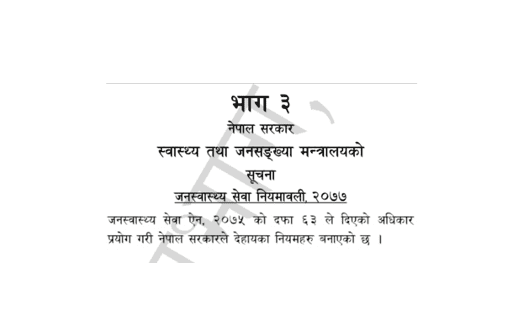
Public Health Service Regulation 2077
National Health NewsNational Plan, Policy & GuidelinesPublic HealthResearch & Publication

Public Health Service Regulation, 2077

by Public Health Update October 21, 2020
written by Public Health Update

Public Health Service Regulations, 2020
Using the rights given by Section 63 of the Public Health Service Act, 2018, the Government of Nepal has framed the following Rules.

  1. Brief Title and Commencement: (1) These Rules shall be collectively called “Public Health
    Service Regulations, 2020”.
    (2) These Regulations shall come into force immediately.
  2. Definition: Unless the subject or the context requires otherwise, in these Regulations:
    (a) “Hospital” means the health institution where the patient is admitted and a doctor
    provides health services.
    (b) “Basic Healthcare Centre” means the governmental health institution that provides
    basic health services.
    (c) “Act” means the Public Health Service Act, 2018.

Basic Health Services: Every citizen shall receive free basic health services from every basic health service centre and health institutions designated by the Government of Nepal, Provincial Government and Local Level as mentioned in Schedule 1 under the headings pursuant to Sub-Section (4) of Section 3 of the Act.

Download now (English Version)
PDF FILE

Related: Public Health Service Act, 2075 (2018).

Download now(Nepali Version)
PDF FILE

Related Documents

  • The Public Health Service Act, 2075 (2018)
  • National Mental Health Survey, Nepal-2020 Fact Sheet
  • Health Policy 2076 | MoSD, Karnali Province- Nepal
  • National Health Policy 2076- MoHP
  • Child Health Program: Plan, Policies and Documents
  • Right to Safe Motherhood and Reproductive Health Act 2075


Do you have a website? Looking for the best hosting provider? Here’s a discount code.

Latest Public Health Jobs

Latest Posts

  • Multisectoral Action Plan for the Prevention and Control of NCDs, 2026-2030 (Draft)
  • National Standard Operating Procedure for Early Warning, Alert and Response System (EWARS), 2025
  • Priority Infectious Diseases for Community-Based Surveillance in Nepal
  • Community Based Disease Surveillance Guideline, 2082
  • Political declaration of the fourth high-level meeting of the General Assembly on the prevention and control of NCDs and the promotion of mental health and well-being

Thanks for visiting us.
Disclaimer: The resources, documents, guidelines, and information on this blog have been collected from various sources and are intended for informational purposes only. Information published on or through this website and affiliated social media channels does not represent the intention, plan, or strategies of an organization that the initiator is associated with in a professional or personal capacity, unless explicitly indicated.
If you have any complaints, information, or suggestions about the content published on Public Health Update, please feel free to contact us at blog.publichealthupdate@gmail.com.
#StayUpdated


  • WordPress
  • Link
  • Facebook
  • Mail
  • Facebook
  • Twitter
  • Twitter
  • LinkedIn
  • Instagram
  • Facebook
October 21, 2020 0 comments
0 FacebookTwitterPinterestLinkedinTumblrVKOdnoklassnikiRedditStumbleuponWhatsappTelegramLINEPocketSkypeViberEmail
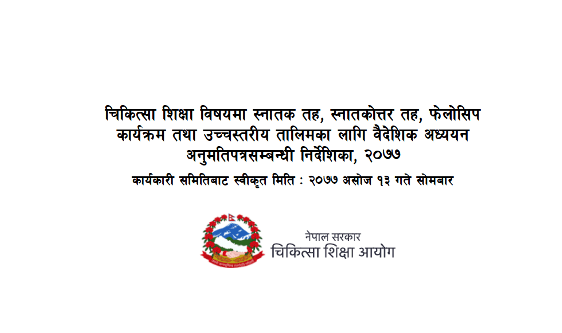
Eligibility Guideline for Course in Foreign University/Institution 2077
National Plan, Policy & GuidelinesNoticeResearch & Publication

MEC Eligibility Guideline for Course in Foreign University/Institution 2077

by Public Health Update October 21, 2020
written by Public Health Update

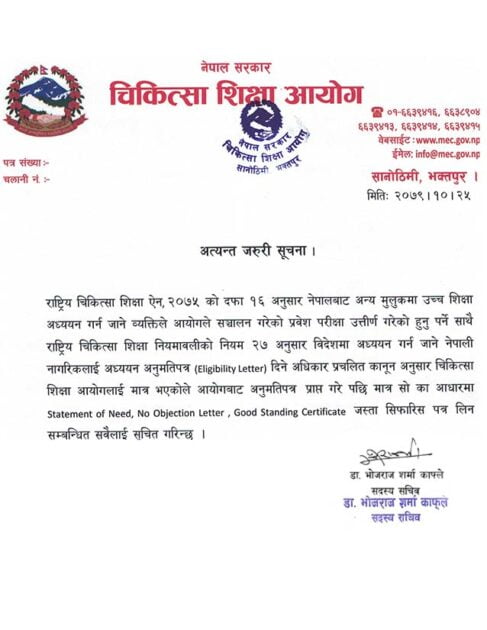
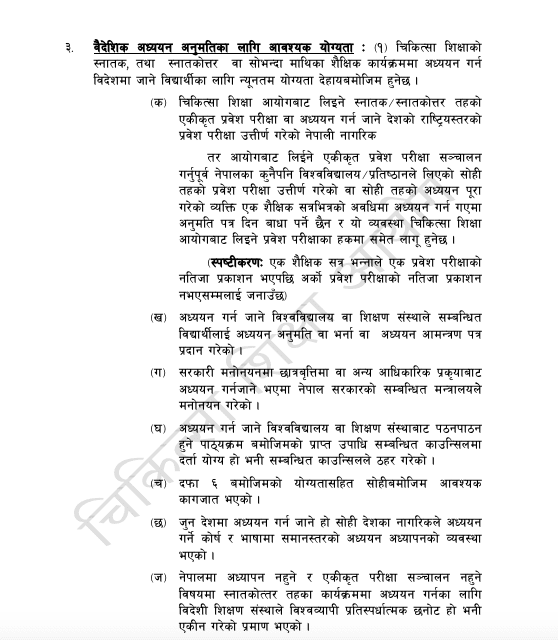
Government of Nepal, Medical Education Commission has published a guideline for Course in Foreign University/Institution 2077.

Medical Education Commission
Screen Shot 2021 01 09 at 11.58.44
MEC Eligibility Guideline

Medical Education Commission (MEC) Eligibility Certificate (Process and documents required)

Document Required & Application Process for No Objection Certification (HOW to apply for NOC)

MEC Eligibility Guideline for Course in Foreign University/Institution 2077

Download now
PDF FILE


Do you have a website? Looking for the best hosting provider? Here’s a discount code.

Latest Public Health Jobs

Latest Posts

  • Multisectoral Action Plan for the Prevention and Control of NCDs, 2026-2030 (Draft)
  • National Standard Operating Procedure for Early Warning, Alert and Response System (EWARS), 2025
  • Priority Infectious Diseases for Community-Based Surveillance in Nepal
  • Community Based Disease Surveillance Guideline, 2082
  • Political declaration of the fourth high-level meeting of the General Assembly on the prevention and control of NCDs and the promotion of mental health and well-being

Thanks for visiting us.
Disclaimer: The resources, documents, guidelines, and information on this blog have been collected from various sources and are intended for informational purposes only. Information published on or through this website and affiliated social media channels does not represent the intention, plan, or strategies of an organization that the initiator is associated with in a professional or personal capacity, unless explicitly indicated.
If you have any complaints, information, or suggestions about the content published on Public Health Update, please feel free to contact us at blog.publichealthupdate@gmail.com.
#StayUpdated



  • WordPress
  • Link
  • Facebook
  • Mail
  • Facebook
  • Twitter
  • Twitter
  • LinkedIn
  • Instagram
  • Facebook
October 21, 2020 1 comment
0 FacebookTwitterPinterestLinkedinTumblrVKOdnoklassnikiRedditStumbleuponWhatsappTelegramLINEPocketSkypeViberEmail
World Osteoporosis Day: Love Your Bones!
PH Important DayPublic Health

World Osteoporosis Day: Love Your Bones!

by Public Health Update October 20, 2020
written by Public Health Update

World Osteoporosis Day (WOD) is marked on October 20 each year.
WOD is dedicated to raising global awareness of the prevention, diagnosis and treatment of osteoporosis and related musculoskeletal diseases.

It aims to put bone health and fracture prevention on the global health
agenda and reaches out to health-care professionals, the media,
policy makers, patients, and the public at large.

Osteoporosis is a very common condition. Currently, osteoporosis is vastly underdiagnosed and undertreated. Worldwide, millions of people at high risk of broken bones (fractures) remain unaware of the underlying silent disease. The huge human and socioeconomic cost, and severe impact of fractures on patients’ independence, is underestimated.

Theme 2020

THAT’S OSTEOPOROSIS

The year’s campaign objectives are to:
• improve understanding of the link between osteoporosis and broken
bones
• reveal the human costs of fractures through impactful patient portraits
• encourage the public to check their personal risk for osteoporosis by
driving use of the new IOF Osteoporosis Risk Check
• raise awareness of osteoporosis as an intergenerational disease that
concerns the whole family
• reveal the socioeconomic burden of fractures through impactful facts and
statistics
• urge health care authorities worldwide to implement post-fracture care for
secondary fracture prevention

Facts

  • By 2050, the worldwide incidence of hip fracture in men is projected to increase by 310% and by 240% in women compared to 1990.
  • Urbanization and ageing populations are driving rapid increases in the osteoporosis disease burden.
  • The majority of fragility fracture patients are neither assessed, nor treated by their health-care system hence there is failure to ‘Capture the Fracture’ and reduce risk of subsequent fractures.
  • Osteoporosis accounts for more days in the hospital than breast cancer, heart attack, diabetes & other diseases.
  • 1 in 5 women with a spinal fracture will suffer another one within one year.
  • Loss of independence after a hip fracture, approximately 60% require assistance a year later and 20% will require long-term nursing care.
  • Fracture risk up to 27% higher than prostate cancer risk.
  • 1 fracture occurs every 3 sec.
  • If you’ve suffered 1 fracture you’re twice at risk for another.
  • Aged 50+ 1/3 women 1/5 men: will suffer an osteoporotic fracture worldwide.
  • 9 million fractures annually.
  • A prior fracture is associated with an 86% increased risk of any fracture.
  • Only 1/3 of vertebral fractures come to clinical attention.
  • 80% of people who have had at least one osteoporotic fracture are neither identified nor treated for osteoporosis.
  • In men, the risk of fracture is up to 27% higher than the risk of prostate cancer.

The 5 steps to healthy bones and a fracture-free future

1. Exercise regularly: Weight-bearing, muscle-strengthening and balance-training exercises are best.
2. Ensure a diet rich in bone-healthy nutrients: Calcium, vitamin D and protein are the most important for bone health. Safe exposure to sunshine will help you get enough vitamin D.
3. Avoid negative lifestyle habits: Maintain a healthy body weight, avoid smoking and excessive drinking.
4. Find out whether you have risk factors: and bring these to your doctor’s attention, especially if you’ve had a previous fracture or have specific diseases and medications that affect bone health.
5. Get tested and treated if needed: If you’re at high risk you will likely need medication to ensure optimal protection against fracture.


Source of information: World Osteoporosis Day


Do you have a website? Looking for the best hosting provider? Here’s a discount code.

Latest Public Health Jobs

Latest Posts

  • Multisectoral Action Plan for the Prevention and Control of NCDs, 2026-2030 (Draft)
  • National Standard Operating Procedure for Early Warning, Alert and Response System (EWARS), 2025
  • Priority Infectious Diseases for Community-Based Surveillance in Nepal
  • Community Based Disease Surveillance Guideline, 2082
  • Political declaration of the fourth high-level meeting of the General Assembly on the prevention and control of NCDs and the promotion of mental health and well-being

Thanks for visiting us.
Disclaimer: The resources, documents, guidelines, and information on this blog have been collected from various sources and are intended for informational purposes only. Information published on or through this website and affiliated social media channels does not represent the intention, plan, or strategies of an organization that the initiator is associated with in a professional or personal capacity, unless explicitly indicated.
If you have any complaints, information, or suggestions about the content published on Public Health Update, please feel free to contact us at blog.publichealthupdate@gmail.com.
#StayUpdated


  • WordPress
  • Link
  • Facebook
  • Mail
  • Facebook
  • Twitter
  • Twitter
  • LinkedIn
  • Instagram
  • Facebook
October 20, 2020 0 comments
0 FacebookTwitterPinterestLinkedinTumblrVKOdnoklassnikiRedditStumbleuponWhatsappTelegramLINEPocketSkypeViberEmail
Newer Posts
Older Posts

Search

Follow Us

Facebook Twitter Instagram Pinterest Linkedin Youtube

Categories

  • Abstracts (25)
  • Activities (91)
  • Adolescent Sexual and Reproductive Health (ASRH) (25)
  • Advice & Tips (3)
  • African Region (5)
  • AI and Health (1)
  • Annual Meeting (6)
  • Antimicrobial Resistance (AMR) (20)
  • Award (19)
  • Awards (16)
  • Books (9)
  • Call for Proposal, EOI & RFP (103)
  • Call for Research Participants (8)
  • Clinical Doctor Jobs (6)
  • Communicable Diseases (107)
  • Competition (20)
  • Conference (128)
  • Consultant (1)
  • Courses (204)
  • Dashboard (2)
  • Digital Health & Health Informatics (10)
  • Drug and Medicine (18)
  • Eastern Mediterranean Region (3)
  • Education (15)
  • Environment (3)
  • Environmental Health & Climate Change (47)
  • European Region (42)
  • Exchange Program (1)
  • Fact Sheet (116)
  • FCHVs (1)
  • Fellowships, Studentship & Scholarships (165)
  • Financial Aid (13)
  • Form Formats (2)
  • Fully funded (22)
  • Global Health News (433)
  • Grants and Funding Opportunities (192)
  • Guest Post (44)
  • Health Assistant Jobs (1)
  • Health Equity (7)
  • Health Financing and Economics (24)
  • Health in Data (113)
  • Health Insurance (5)
  • Health Jobs (52)
  • Health Literacy, Health Education & Promotion (49)
  • Health Organization Profile (42)
  • Health Systems (81)
  • Human Resource for Health (32)
  • Humanitarian Health & Emergency Response (44)
  • Hypertension (5)
  • Implementation Research (48)
  • International Health (3)
  • International Jobs & Opportunities (369)
  • International Plan, Policy & Guidelines (208)
  • Internships (4)
  • Jobs Vacancies (56)
  • Journals (8)
  • Life Style & Public Health Nutrition (39)
  • Live (10)
  • Master's Degree (48)
  • Maternal, Newborn and Child Health (87)
  • Mentorship Program (2)
  • Miscellaneous (16)
  • National Health News (157)
  • National Plan, Policy & Guidelines (468)
  • Neglected Tropical Diseases (NTDs) (51)
  • Non- Communicable Diseases (NCDs) (120)
  • Notice (103)
  • Nursing Jobs (6)
  • Nutritionist Jobs (1)
  • One Health (17)
  • Online & Distance Learning (22)
  • Online Courses (90)
  • Op-Ed Article (3)
  • Opportunities by Region (82)
  • Outbreak News (213)
  • Partially funded (6)
  • PCL Health Science Jobs (3)
  • PH Important Day (532)
  • Pharmacist Jobs (3)
  • PhD (53)
  • Photos (5)
  • Planetary Health (4)
  • PostDoc (14)
  • Presentation Slides (26)
  • Primary Health Care (25)
  • Provincial Plan, Policies and Guidelines (14)
  • Public Health (1,278)
  • Public Health Epidemiology & Biostatistics (13)
  • Public Health Events (305)
  • Public Health Information (20)
  • Public Health Innovation (9)
  • Public Health Jobs (52)
  • Public Health News (552)
  • Public Health Notes (120)
  • Public Health Opportunities (502)
  • Public Health Opportunity (486)
  • Public Health Programs (108)
  • Public Health Seminar (2)
  • Public Health Tools (1)
  • Public Health Update (557)
  • Quality Improvement & Infection Prevention (20)
  • Region of America (8)
  • Reports (182)
  • Research & Project Grants (38)
  • Research & Project Grants (31)
  • Research & Publication (647)
  • Research Articles (10)
  • Road Traffic Accidents (RTA) (9)
  • School of Public Health (60)
  • Self funded (2)
  • South-East Asia Region (26)
  • Success Stories (17)
  • Summer and Winter Courses (39)
  • Summer Courses (27)
  • Sustainable Development Goals (SDGs) (14)
  • Syllabus (61)
  • Symposium (9)
  • Tobacco Control (35)
  • Training (40)
  • Travel Grants (15)
  • Trick, Technique & Skills (8)
  • Uncategorized (3)
  • Undergraduate Degree (7)
  • Universal Health Coverage (36)
  • Universities (29)
  • Universities & School of Public Health (57)
  • Vacancy Announcement (26)
  • Vaccine Preventable Diseases (40)
  • Vector-Borne Diseases(VBDs) (30)
  • Videos (3)
  • View Points (1)
  • Webinar (4)
  • Western Pacific Region (13)
  • Workshop (18)
  • World News (116)
Post New Jobs: Vacancy Announcement Service

Public Health Update (Sagun’s Blog) is a popular public health portal in Nepal. Thousands of health professionals are connected with Public Health Update to get up-to-date public health updates, search for jobs, and explore opportunities.
#1 Public Health Blog for sharing Job opportunities and updates in Nepal

”Public Health Information For All”
– – Sagun Paudel, Founder

  • HOT JOBS
    • Public Health Jobs
    • Medical Doctor Jobs
    • Nursing Jobs
    • Health Assistant Jobs
    • Pharmacist Jobs
    • NGOs Jobs
    • Government Jobs
  • Top Categories
    • National Plan, Policy & Guidelines Top
    • Public Health Calendar
    • Fellowships & Scholarships
    • Health Systems
    • Health Organization Profiles
    • International Jobs & Opportunities
    • Public Health Opportunity

PUBLIC HEALTH INITIATIVE

    • Submit your Vacancies New
    • Partnership Opportunities

Contact: blog.publichealthupdate@gmail.com

https://wa.me/+9779856036932

Public Health Initiative, A Registered Non-profit organization – All Right Reserved. 2011-2024. Contact us. 

Facebook Twitter Instagram Youtube Envelope
Public Health Update
  • Home
  • Public Health
    • Home 1
      • Adolescent Sexual and Reproductive Health (ASRH)
      • Antimicrobial Resistance (AMR)
      • Communicable Diseases
      • Digital Health & Health Informatics
      • Environmental Health & Climate Change
      • Health Financing and Economics
      • Health Equity
    • Home 2
      • Health Literacy, Health Education & Promotion
      • Human Resource for Health
      • Humanitarian Health & Emergency Response
      • Implementation Research
      • International Health
      • Life Style & Public Health Nutrition
      • Maternal, Newborn and Child Health
    • Home 3
      • Neglected Tropical Diseases (NTDs)
      • Non- Communicable Diseases (NCDs)
      • One Health
      • Planetary Health
      • Public Health Epidemiology & Biostatistics
      • Primary Health Care
      • Quality Improvement & Infection Prevention
    • Home 4
      • Road Traffic Accidents (RTA)
      • Sustainable Development Goals (SDGs)
      • Tobacco Control
      • Universal Health Coverage
      • Vaccine Preventable Diseases
      • Vector-Borne Diseases(VBDs)
      • Notices
  • Public Health Update
    • Home 1
      • Public Health News
      • Global Health News
      • Outbreak News
      • National Health News
      • COVID-19
    • Home 2
      • Fact Sheet
      • Health in Data
      • PH Important Day
      • Public Health Events
      • Public Health Programs
    • Home 3
      • Health Systems
      • Health Insurance
      • Health Organization Profile
      • Success Stories
      • Public Health Innovation
  • Public Health Opportunities
    • Fully funded
    • Travel Grants
    • Grants and Funding Opportunities
    • Opportunities by Region
    • International Jobs & Opportunities
    • Research & Project Grants
    • Fellowships, Studentship & Scholarships
    • Conference
  • Jobs
    • Home 1
      • Health Jobs
      • Public Health Jobs
      • Clinical doctor Jobs
      • Health Assistant Jobs
      • Nursing Jobs
      • PCL Health Science Jobs
    • Home 2
      • Dental Jobs
      • Pharmacist Jobs
      • TSLC (Health Jobs)
      • Laboratory Jobs
      • Nutritionist Jobs
  • Downloads
    • International Plan, Policy & Guidelines
    • National Plan, Policy & Guidelines
    • Reports
    • Books
    • Research Articles
  • School of Public Health
    • Home 1
      • Courses
      • Master’s Degree
      • Undergraduate Degree
      • PhD
    • Home 2
      • Universities
      • Syllabus
      • Public Health Notes
      • Mentorship Program
      • Startup Project
    • Home
      • Summer and Winter Courses
      • Summer Courses
      • Online Courses
      • Workshop
      • Training
Public Health Update
  • Home
  • Public Health
    • Home 1
      • Adolescent Sexual and Reproductive Health (ASRH)
      • Antimicrobial Resistance (AMR)
      • Communicable Diseases
      • Digital Health & Health Informatics
      • Environmental Health & Climate Change
      • Health Financing and Economics
      • Health Equity
    • Home 2
      • Health Literacy, Health Education & Promotion
      • Human Resource for Health
      • Humanitarian Health & Emergency Response
      • Implementation Research
      • International Health
      • Life Style & Public Health Nutrition
      • Maternal, Newborn and Child Health
    • Home 3
      • Neglected Tropical Diseases (NTDs)
      • Non- Communicable Diseases (NCDs)
      • One Health
      • Planetary Health
      • Public Health Epidemiology & Biostatistics
      • Primary Health Care
      • Quality Improvement & Infection Prevention
    • Home 4
      • Road Traffic Accidents (RTA)
      • Sustainable Development Goals (SDGs)
      • Tobacco Control
      • Universal Health Coverage
      • Vaccine Preventable Diseases
      • Vector-Borne Diseases(VBDs)
      • Notices
  • Public Health Update
    • Home 1
      • Public Health News
      • Global Health News
      • Outbreak News
      • National Health News
      • COVID-19
    • Home 2
      • Fact Sheet
      • Health in Data
      • PH Important Day
      • Public Health Events
      • Public Health Programs
    • Home 3
      • Health Systems
      • Health Insurance
      • Health Organization Profile
      • Success Stories
      • Public Health Innovation
  • Public Health Opportunities
    • Fully funded
    • Travel Grants
    • Grants and Funding Opportunities
    • Opportunities by Region
    • International Jobs & Opportunities
    • Research & Project Grants
    • Fellowships, Studentship & Scholarships
    • Conference
  • Jobs
    • Home 1
      • Health Jobs
      • Public Health Jobs
      • Clinical doctor Jobs
      • Health Assistant Jobs
      • Nursing Jobs
      • PCL Health Science Jobs
    • Home 2
      • Dental Jobs
      • Pharmacist Jobs
      • TSLC (Health Jobs)
      • Laboratory Jobs
      • Nutritionist Jobs
  • Downloads
    • International Plan, Policy & Guidelines
    • National Plan, Policy & Guidelines
    • Reports
    • Books
    • Research Articles
  • School of Public Health
    • Home 1
      • Courses
      • Master’s Degree
      • Undergraduate Degree
      • PhD
    • Home 2
      • Universities
      • Syllabus
      • Public Health Notes
      • Mentorship Program
      • Startup Project
    • Home
      • Summer and Winter Courses
      • Summer Courses
      • Online Courses
      • Workshop
      • Training
Public Health Initiative, A Registered Non-profit organization – All Right Reserved. 2011-2023