Public Health Update
  • Home
  • Public Health Update
  • Nepal Health Jobs
    • Public Health Job Board
    • Organization List
  • Opportunities
    • Fellowships, Studentship & Scholarships
    • Grants and Funding Opportunities
    • Fully funded
    • Conference
  • Downloads
    • International Plan, Policy & Guidelines
    • National Plan, Policy & Guidelines
    • Reports
    • Public Health Notes
    • Syllabus
    • Form Formats
  • School of Public Health
    • PhD
    • Master’s Degree
    • Online Courses
  • Notice
  • Home
  • Public Health Update
  • Nepal Health Jobs
    • Public Health Job Board
    • Organization List
  • Opportunities
    • Fellowships, Studentship & Scholarships
    • Grants and Funding Opportunities
    • Fully funded
    • Conference
  • Downloads
    • International Plan, Policy & Guidelines
    • National Plan, Policy & Guidelines
    • Reports
    • Public Health Notes
    • Syllabus
    • Form Formats
  • School of Public Health
    • PhD
    • Master’s Degree
    • Online Courses
  • Notice
LOGIN / REGISTER
Public Health Update
SUBSCRIBE
Public Health Update
  • Home
  • Public Health Update
  • Nepal Health Jobs
    • Public Health Job Board
    • Organization List
  • Opportunities
    • Fellowships, Studentship & Scholarships
    • Grants and Funding Opportunities
    • Fully funded
    • Conference
  • Downloads
    • International Plan, Policy & Guidelines
    • National Plan, Policy & Guidelines
    • Reports
    • Public Health Notes
    • Syllabus
    • Form Formats
  • School of Public Health
    • PhD
    • Master’s Degree
    • Online Courses
  • Notice

All Right Reserved. Designed and Developed by PenciDesign

The Hubert H. Humphrey Fellowship Program
Fellowships, Studentship & ScholarshipsGrants and Funding OpportunitiesInternational Jobs & OpportunitiesPublic Health OpportunitiesPublic Health Opportunity

The Hubert H. Humphrey Fellowship Program 2026-27

by Public Health Update June 6, 2025
written by Public Health Update

The prestigious Hubert H. Humphrey Fellowship Program is now accepting applications for the 2026–27 academic year. This fully funded, 10-month fellowship in the United States is designed for mid-career professionals who are passionate about public service and leadership in their respective fields.

About programme

The Hubert H. Humphrey Fellowship Program was established in 1978 to honor the legacy of the late U.S. Senator and Vice President Hubert H. Humphrey. A part of the prestigious Fulbright exchange, the program brings accomplished mid-career professionals from around the world to the United States for a ten-month, non-degree Fellowship focused on academic enrichment and professional development.

Fellows are selected through a rigorous, competitive process based on their leadership potential and commitment to public service in the public or private sectors. Since its inception, the program has welcomed more than 6,600 Fellows from 163 countries, creating a vibrant global network of changemakers.

The 10-month long program empowers international professionals to collaborate with U.S. counterparts, exchange best practices, and build expertise in areas critical to social progress, such as human rights, sustainable development, institutional capacity building, and community advancement. Through tailored academic study, leadership training, and practical professional experiences, Humphrey Fellows strengthen their ability to address both local and global challenges.

By fostering mutual understanding and long-term partnerships, the Humphrey Fellowship contributes to a more connected, knowledgeable, and cooperative world. It also supports cross-cultural dialogue and increases U.S. citizens’ awareness of global issues and diverse cultures.

Program Components

  • Non-Degree Academic Study: Humphrey Fellows engage in individualized academic programs at one of approximately 13 selected U.S. universities. These host institutions are chosen through a competitive process based on their ability to offer strong academic and professional resources in the Fellows’ fields of interest.
  • Because the program is non-degree, Fellows have the flexibility to design a self-directed course of study free from the constraints of a traditional degree curriculum. Fellows take academic courses relevant to their professional goals, participate in seminars, and connect with faculty advisors and coordinators who provide ongoing academic and administrative support.

Leadership and Professional Development

A key feature of the Humphrey Fellowship is its focus on practical leadership development and professional growth. Fellows participate in:

  • Professional visits
  • Conferences and training workshops
  • Skill-building seminars
  • A Professional Affiliation (PA) – a full-time placement in a U.S.-based organization for a minimum of six weeks, offering real-world exposure and hands-on learning in the Fellow’s field

With support from faculty advisors and campus coordinators, each Fellow creates a customized professional development plan aligned with their goals and the program’s objectives.

Program Duration

The Fellowship begins in August or early September and continues through the following June (10 months). In some cases, Fellows may be required to arrive 8–16 weeks earlier for intensive English language training prior to starting their university program.

All Fellows must commit to participating fully in both the English language training (if applicable) and the academic year program.

Financial Support

The Humphrey Fellowship provides comprehensive financial support, including:

  • A monthly living stipend
  • Health and accident insurance
  • Tuition and mandatory university fees
  • Round-trip international airfare
  • Domestic travel for required program activities
  • Settling-in and book allowances
  • A professional development allowance
  • A computer subsidy (when applicable)

Dependents: Fellows may bring family members on J-2 visas at their own expense. Dependents may not join the Fellow during the English language training period or within the first month of arrival. Proof of financial resources must be provided to support dependents during the Fellowship.

Eligibility requirements

Candidates must be policymakers, managers, or administrators in leadership positions with commitment to public service from the public or private sectors including non-governmental organizations. Fellowships are competitive and will be awarded based on excellence in professional and personal qualifications as well as leadership potential. 

All applicants must:

  • Possess Nepali citizenship 
  • Be employed at a mid-career, policy level with progressively more responsible working experience in the government, NGO or private sector 
  • Have at least 5 years of progressively responsible professional experience in Nepal as of the application submission deadline. Volunteer jobs, internships, and work done as a requirement for an academic degree shall not be counted towards the required duration of work experience. 
  • Professional experience should be in the relevant field, after the completion of a university degree, i.e. a 4-year bachelor’s degree, or, if the bachelor’s degree is of 2-year/3-year duration, then a master’s degree is also required. Candidates who have two or more 2-year/3-year bachelor’s degrees in different fields, but who do not have a master’s degree, are not eligible to apply. 
  • Be proficient in speaking, reading and writing English (see the Supplemental English Program) 
  • Have a demonstrable commitment to public service and potential for national leadership 
  • Have the intention to develop problem-solving capacities, enhance capabilities to assume greater career responsibilities, and return to a significant public service role upon completion of the Humphrey Program 

The Humphrey competition is not open to: 

  • Recent university graduates (even if they have significant positions)
  • University teachers with no management or policy responsibilities, except for teachers of English as a foreign language, and specialists in substance abuse prevention and treatment
  • Individuals who have spent substantial time in the U.S. (more than 3 years) and have not been back in Nepal and employed at a level of professional responsibility for at least four years since returning
  • Individuals who have attended a graduate school in the U.S. for one academic year or more during the seven years prior to August 2026
  • Individuals with more than six months of U.S. experience during the five years prior to August 2026
  • Individuals who have participated in U.S. government- sponsored exchange programs within the last three years prior to August 2026
  • Individuals with, or in the process of obtaining, dual U.S. citizenship or U.S. permanent resident status are ineligible for a J visa
  • Local employees of the U.S. Mission in Nepal who work for the Department of State or the U.S. Agency for International Development, including temporary employees and contractors, and their spouses and dependent children (they are not eligible for grants during the period of their employment and for one year following the termination of employment).
Key dates
DATEMILESTONE
JUNE 1Application Opens
JULY 31Application Deadline
AUGUSTScreening and Interview Candidates Notified
SEPTEMBERInterviews and Nomination Notification
APRILFinal Selection Notification
JUNEEnglish Language Training
AUGUSTHumphrey Fellowship Start
JUNE (following year)End of Fellowship

Application portal

Application Deadline: July 31, 2025, at 11:59 PM NPT
  • Humphrey Fellowship Program
  • Hubert H. Humphrey Fellowship
  • 2025-2026 Hubert H. Humphrey Fellowship Program
  • Hubert H. Humphrey Fellowship Program 2024-2025
  • AY 2023-2024 Hubert H. Humphrey Fellowship Program Application Open
  • Hubert H. Humphrey Fellowship Program 2022-2023

Official announcement: USEF Nepal


Do you have a website? Looking for the best hosting provider? Here’s a discount code.

Latest Public Health Jobs

Latest Posts

  • DoHS Annual Health Report 2081/82
  • WHA79: Key Takeaways from the 2026 World Health Assembly
  • Seventy-ninth World Health Assembly WHA79
  • World health statistics 2026: monitoring health for the SDGs, sustainable development goals
  • Health Reform Manual: Eight Practical Steps

Thanks for visiting us.
Disclaimer: The resources, documents, guidelines, and information on this blog have been collected from various sources and are intended for informational purposes only. Information published on or through this website and affiliated social media channels does not represent the intention, plan, or strategies of an organization that the initiator is associated with in a professional or personal capacity, unless explicitly indicated.
If you have any complaints, information, or suggestions about the content published on Public Health Update, please feel free to contact us at blog.publichealthupdate@gmail.com.
#StayUpdated
  • WordPress
  • Link
  • Facebook
  • Mail
  • Facebook
  • Twitter
  • Twitter
  • LinkedIn
  • Instagram
  • Facebook
June 6, 2025 0 comments
0 FacebookTwitterPinterestLinkedinTumblrVKOdnoklassnikiRedditStumbleuponWhatsappTelegramLINEPocketSkypeViberEmail
Polio Advanced Course in Vaccinology (PVAC ) 2025
CoursesGrants and Funding OpportunitiesInternational Jobs & OpportunitiesPublic Health OpportunitiesPublic Health OpportunityTrainingVaccine Preventable Diseases

Polio Advanced Course in Vaccinology (PVAC ) 2025

by Public Health Update June 1, 2025
written by Public Health Update

Overview

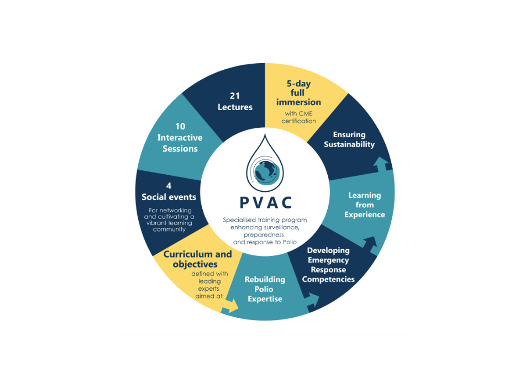
Polio Advanced Course in Vaccinology (PVAC ) is co-organized by the University of Geneva, the Qatar University in Doha (for the session in English), and the Cheikh Anta Diop University in Dakar (for the session in French). PVAC is a dynamic, specialized 5-day training program aimed at re-engaging health professionals and key stakeholders, reinforcing the global priority of Polio eradication, and enhancing the effectiveness of surveillance and response systems.

PVAC is designed to strengthen decision-making skills and technical capacity in support of the global effort to eradicate polio. Tailored for early- and mid-career health professionals, the course offers in-depth training in vaccinology with a specific focus on polio.

The course covers essential topics such as immunology, epidemiology, vaccine development, immunization strategies, regulatory frameworks, risk and crisis communication, and the social, ethical, and financial dimensions of eradication programs. Using a 360° approach to learning, PVAC combines scientific updates, real-world case studies, scenario-based planning, and interactive sessions led by experts.

Course date:

  • English session in Doha from October 26 to 30. 
  • French session in Dakar from December 15 to 19.

Participants will:

  • Gain practical skills in emergency preparedness and outbreak response
  • Critically assess eradication strategies and lessons learned
  • Apply scenario-based planning tools
  • Engage effectively with stakeholders and communities
  • Join the PVAC Alumni Network to build long-term professional collaborations

The course fosters cross-disciplinary understanding, expanding participants’ expertise beyond their immediate field, encouraging global thinking, and introducing new technologies and approaches. It empowers professionals to contribute meaningfully to the polio eradication mission—both in the field and at the policy level.

Selection Criteria

To ensure a meaningful and effective learning experience, we must limit the number of participants to a maximum of 50 people per session. We strongly encourage you to dedicate time and effort to submit a robust application to increase your chances of being selected.

Poliomyelitis (polio)

Participants will be selected by the PVAC Scientific Committee according to their: educational background, work experience, decision-making level of responsibilities in vaccinology, and expected impact of the Course at personal, institutional and national levels.  Each application is assessed individually by at least 6 Scientific Committee members.

Registration fees

Course participation, accommodation, and travel costs are covered by a fellowship for selected participants from Low- and Middle-Income Countries (LMICs)

What services are included?

  • Participation in the program
  • Travel and Internal transfers between hotel and campus
  • Accommodation in a single room at a selected hotel close to Campus
  • Breakfasts, lunches, diners and coffee break services for the 5 days (including social events)
  • Account to Alumni network.

Application process

To complete your application, please gather the following documents and information:

  • Cover Letter: Outline your reasons for participating in the PVAC course and explain how it will contribute to your professional development. Discuss the impact you expect the program to have on your career, your institution, and vaccination strategies. This section is crucial for the selection committee. Maximum length: 450 words
  • Education: In this section, please provide details of your academic background, including degrees, certifications, and relevant training. For each education entry, you will need to include the following information:
    • University / Institution Name (Name of the university, school, or training organization)
    • Dates (From: Start Year – To: End Year)
    • Degree or Certification Name (Example: Bachelor’s in Biology)
    • Field of Study / Description (Special mention, specialization, important project completed, etc. – up to 30 words)
  • WorkExperience: This section should reflect your professional background. For each work experience entry, you will need to include the following information:
    • Company/Organization Name
    • Location (Country)
    • Dates (Start month and year – End month and year or “Current” if ongoing position)
    • Function / Job Title (Example: Project Management Intern)
  • Short Biography: Provide a concise summary (up to 300 words) of your most relevant past experiences and current activities in vaccinology.
  • Letters of Recommendation: Please submit twosigned and recentletters of recommendation on official letterhead:
    1. One letter from a senior authority at your current institution, confirming that your participation is supported (including the time you will be away for the course) and detailing your present and expected future responsibilities.
    2. One letter from an external expert with whom you have collaborated in the past.
      Note: If your institution is recommending more than one applicant, each applicant must submit a separate letter.
      Action: Scan the letters and attach them as PDF files to your application.
  • Identity Document:  To attend the course and arrange your travel, a valid passport is required. If selected, you will be asked to provide a scanned copy of your passport valid through the course dates. Please ensure your passport is up to date to complete administrative and travel documentation.

Application Form Template: Please find here the template of the application form for your information.

ATTENTION: If you are applying for the French session, you must submit your application in French. If you are applying for the English session, you must submit your application in English.

  • Please note that only complete applications will be reviewed. If you encounter any issues or need assistance for your Application, please email poliocourse@unige.ch
  • Deadline for application submission: June 6, 2025.
  • If selected, you will receive a confirmation of participation and be asked to complete the administrative registration of official documents. Notification of the selection outcome will be sent by end of July 2025.
  • Travel Planning: Once administrative registration of official documents is complete you will be contacted for the booking of your travel.

Read more an apply

  • DoHS Annual Health Report 2081/82
  • WHA79: Key Takeaways from the 2026 World Health Assembly
  • Seventy-ninth World Health Assembly WHA79
  • World health statistics 2026: monitoring health for the SDGs, sustainable development goals
  • Health Reform Manual: Eight Practical Steps
June 1, 2025 0 comments
0 FacebookTwitterPinterestLinkedinTumblrVKOdnoklassnikiRedditStumbleuponWhatsappTelegramLINEPocketSkypeViberEmail
Wentworth Institute of Science and Health STEM Conference Grant
Grants and Funding OpportunitiesInternational Jobs & OpportunitiesPublic Health OpportunitiesPublic Health OpportunityTravel Grants

Wentworth Institute of Science and Health STEM Conference Grant

by Public Health Update May 29, 2025
written by Public Health Update

Overview

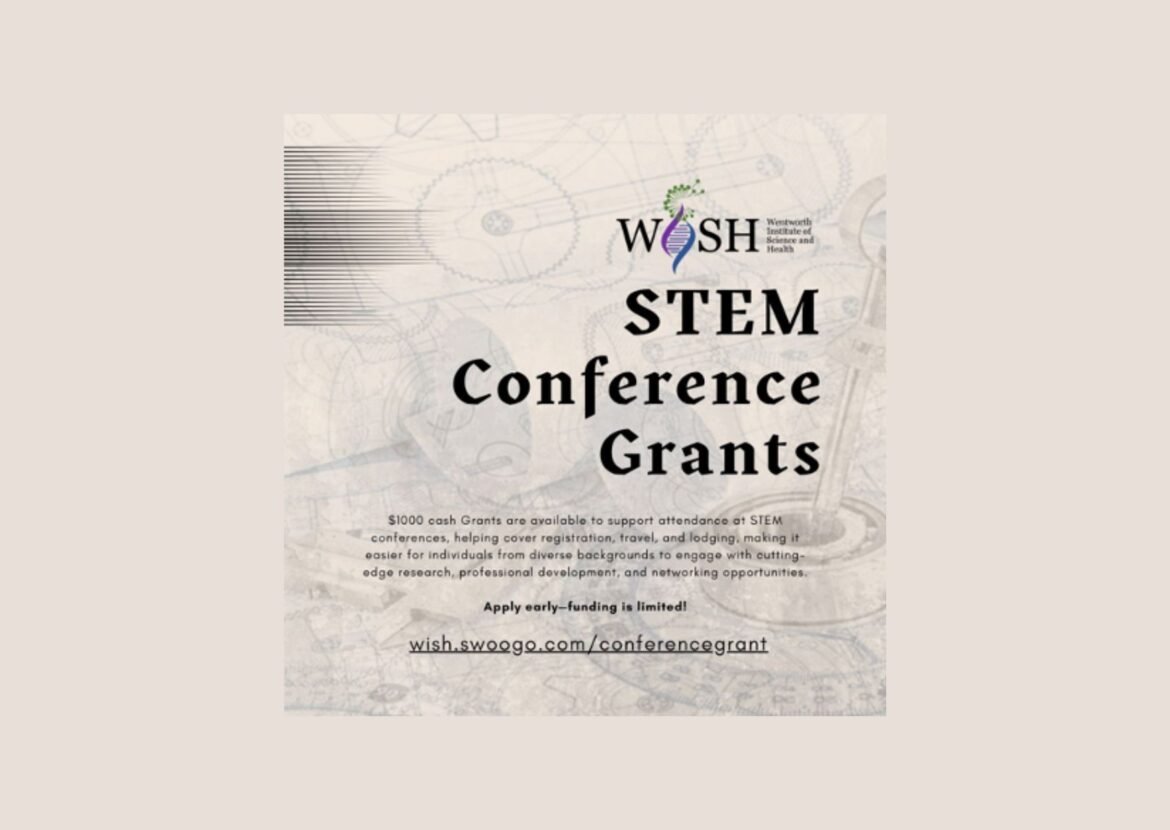
The Wentworth Institute of Science and Health (W.I.S.H) is dedicated to supporting the development of future scientists by offering financial assistance, hands-on learning, and expert mentorship. Through its annual WineSTEM 5K fundraiser, W.I.S.H. provides $500 scholarships to U.S. high school students entering STEM fields and $1,000 travel grants to post-secondary students attending STEM conferences. Businesses can also sponsor these awards, with W.I.S.H. handling the full administrative process to ensure fair and effective distribution.

Scholarship and Grant Programs

W.I.S.H flagship programs are primarily funded through the annual W.I.S.H. WineSTEM 5K (held on the last Sunday of October). These programs include:

  • $500 scholarships for high school students in the United States entering STEM fields, including traditional universities, trade schools, and apprenticeships.
  • $1000 STEM Conference Travel Grants for post-secondary students across the United States.
  • Additionally, businesses can sponsor individual high school scholarships or STEM Conference Travel Grants, with W.I.S.H. providing full administrative support, including personalized application development, unbiased evaluation, and fund distribution.

W.I.S.H. Neil Keefe Memorial Grant

Neil graduated with a degree in Physics from the University of Bristol, but quickly transitioned into the IT field, eventually rising to become the VP of Product at eTouches in the Event Technology industry. In 2015, alongside industry veterans Leonora Valvo and Tim Cummins, he co-founded Swoogo, an intuitive event management platform that revolutionized registration, marketing, and event logistics.

In 2020, the Swoogo team lost their “product leader, chief ‘did you test it’ advocate, quiet jokester, loyal friend, and incredible teammate.” Neil spent his final years bravely battling Amyloidosis, a rare and under-researched heart condition.

At W.I.S.H., we hope that you, the applicant for this grant, find inspiration in Neil’s life. May you pursue your knowledge and ambitions with the same passion and dedication, living life to the fullest, just as he did.

Sammy Hason Memorial Conference Grant

Sammy Hason, Sr. was a dedicated lifelong learner and exemplified that by always setting personal and professional goals for himself. He was an accomplished pharmacist of 20 years as well as an adept entrepreneur. He graduated from the University of Georgia and later married his wife, Nadia, who is also a UGA pharmacy school graduate. Sammy greatly enjoyed precepting pharmacy students and earned recognition for his ability to do so effectively. He also earned his CCIM designation in commercial real estate, a profession that he was very actively involved in. Even with these career accolades, he always believed that his biggest life achievement was being a loving father and role model to his two sons. He has left an incredible legacy for them. 

Sammy was a wonderful storyteller and had the innate ability to teach others in a way that sparked inspiration. This ability was most likely due to the fact that he was an avid and zealous reader. You could often find him writing pearls of wisdom from his life experiences as well as what he discovered from books. One of his favorite passions that he acquired from his reading was learning to become a chef. He even created two large books full of his carefully crafted recipes for others to enjoy. He inspired those around him with his incredible passion for life and his thirst for knowledge. 

Additionally, Sammy loved traveling and particularly enjoyed the beach. Many of the Hason family trips were taken to places where they could all enjoy the fresh ocean air.

Although he is no longer physically with us, his bright light will always be remembered.

Sammy will forever be known as “Egyptian Magic.”

W.I.S.H. is profoundly honored to be able to name one of our Conference Grants after this amazing individual who touched so many lives.

Grant Submission Eligibility

  • The Wentworth Institute of Science and Health will award two grants, up to $1000 each, to undergraduate students, graduate students or early post-graduate research fellows to attend to a research related STEM meeting or conference.
  • Applicants must be pursuing an undergraduate, advanced degree, or early post-graduate fellowship in a STEM (science, technology, engineering, or mathematics) related field of study.
  • Funds will be given from WISH directly to the grant recipient.
  • WISH requests permission to showcase recipients with a photo and relevant information on the WISH website and through social media and to maintain contact for updates on activities throughout schooling.
  • Full Meeting/Conference Information.
  • Pre-Conference Statement.
  • Budget of all anticipated expenses.
  • Letter of Support from P.I./Advisor.
  • Post-Travel Documents (Updated budget and Conference Synopsis – to be submitted after travel).

Read more and Apply

  • DoHS Annual Health Report 2081/82
  • WHA79: Key Takeaways from the 2026 World Health Assembly
  • Seventy-ninth World Health Assembly WHA79
  • World health statistics 2026: monitoring health for the SDGs, sustainable development goals
  • Health Reform Manual: Eight Practical Steps

Do you have a website? Looking for the best hosting provider? Here’s a discount code.

Latest Public Health Jobs

Latest Posts

  • DoHS Annual Health Report 2081/82
  • WHA79: Key Takeaways from the 2026 World Health Assembly
  • Seventy-ninth World Health Assembly WHA79
  • World health statistics 2026: monitoring health for the SDGs, sustainable development goals
  • Health Reform Manual: Eight Practical Steps

Thanks for visiting us.
Disclaimer: The resources, documents, guidelines, and information on this blog have been collected from various sources and are intended for informational purposes only. Information published on or through this website and affiliated social media channels does not represent the intention, plan, or strategies of an organization that the initiator is associated with in a professional or personal capacity, unless explicitly indicated.
If you have any complaints, information, or suggestions about the content published on Public Health Update, please feel free to contact us at blog.publichealthupdate@gmail.com.
#StayUpdated


  • WordPress
  • Link
  • Facebook
  • Mail
  • Facebook
  • Twitter
  • Twitter
  • LinkedIn
  • Instagram
  • Facebook
May 29, 2025 0 comments
0 FacebookTwitterPinterestLinkedinTumblrVKOdnoklassnikiRedditStumbleuponWhatsappTelegramLINEPocketSkypeViberEmail
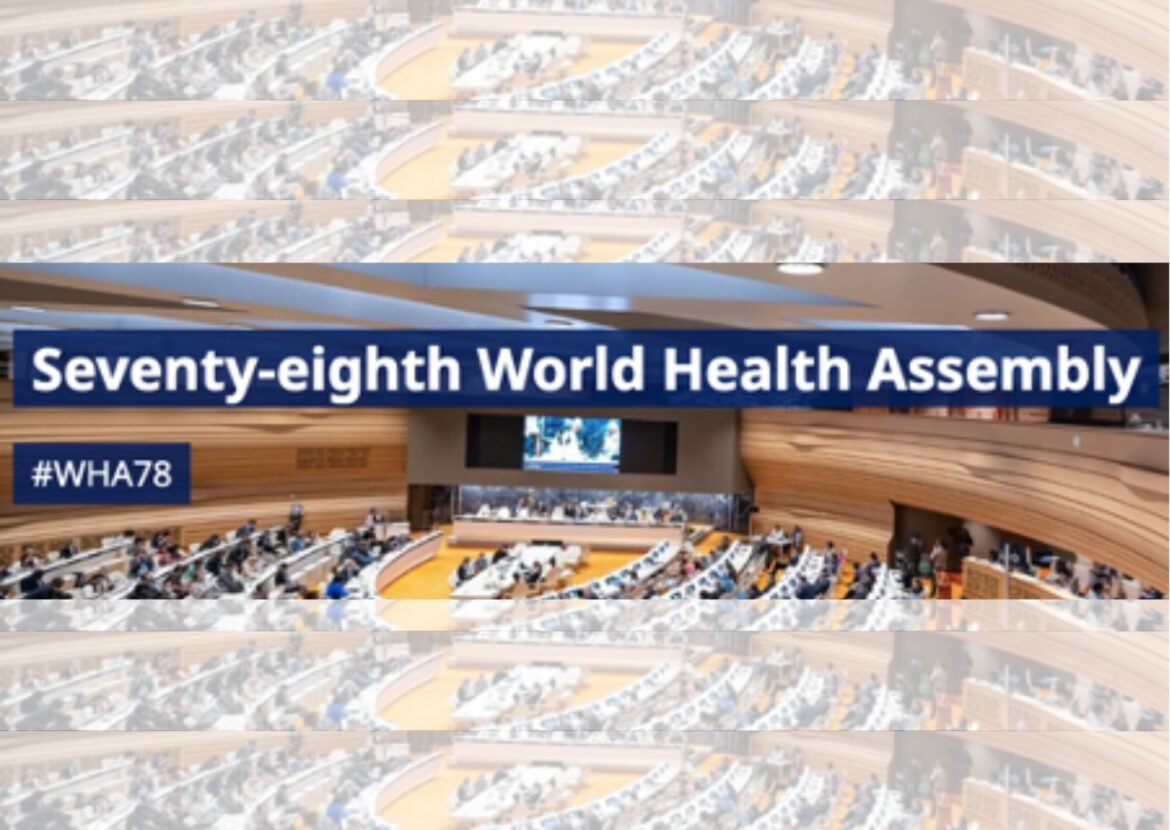
What You Need to Know from the 78th World Health Assembly (#WHA78)
Global Health NewsInternational Plan, Policy & GuidelinesNational Health NewsPublic HealthPublic Health NewsPublic Health ProgramsPublic Health UpdateWorld News

What You Need to Know from the 78th World Health Assembly (#WHA78)

by Public Health Update May 29, 2025
written by Public Health Update

Overview

The Seventy-eighth World Health Assembly (WHA78), the premier decision-making body of the World Health Organization (WHO), concluded on 27 May 2025 in Geneva, marking a week of major public health milestones and reaffirmed international cooperation. Held from 19 to 27 May 2025 under the theme “One World for Health,” the assembly brought together delegates from WHO Member States to discuss and adopt critical resolutions shaping the global health agenda.

In a historic moment on 20 May, Member States adopted the world’s first WHO Pandemic Agreement, aimed at preventing the recurrence of devastation witnessed during COVID-19. The agreement resulting from three years of intense negotiations focuses on strengthening global coordination, ensuring equitable access to health tools, and balancing international solidarity with national sovereignty. Member States will now begin consultations on the Pathogen Access and Benefit Sharing (PABS) system, a key annex to the agreement.

During the World Health Assembly, numerous bilateral meetings, high-level discussions, strategic dialogues, and formal commitments were convened. In addition to its main sessions, WHA78 featured a vibrant lineup of nearly 300 side events and sessions, drawing attention to urgent global health issues such as Universal Health Coverage (UHC), climate and health, noncommunicable diseases (NCDs), communicable diseases, health emergencies, human resources for health, health financing, and digital innovation. Global health professionals, parliamentarians, health ministers, delegates from member states, students, and other stakeholders gathered throughout the week to engage, collaborate, and advocate for more inclusive and effective global health governance.

Key updates

**World Health Assembly adopts historic Pandemic Agreement to make the world more equitable and safer from future pandemics**
Member States of the World Health Organization (WHO) formally adopted by consensus the world’s first Pandemic Agreement. The landmark decision by the WHA78 culminates more than three years of intensive negotiations launched by governments in response to the devastating impacts of the COVID-19 pandemic and driven by the goal of making the world safer from – and more equitable in response to – future pandemics.

Documents

  • Draft resolution on the WHO Pandemic Agreement A78/10 Add.1

**World Health Assembly commits to historic 20% increase in Assessed Contributions (membership fees), approves WHO’s Base Programme Budget for 2026–2027 of US$ 4.2 billion**
Delegates at the WHA78 approved the base programme budget of US$ 4.2 billion for 2026–2027, the first to be fully developed based on the Fourteenth General Programme of Work, 2025–2028 (GPW 14), the global health strategy for the next four years. GPW 14 prioritizes advancing health equity and strengthening health systems resilience. Member States also approved the gradual second 20% increase of the assessed contributions (AC), or membership fees which had been previously adopted by the Member State Working Group on sustainable financing. This ensures that WHO funding is not only predictable, but also resilient and flexible, which is critical given the rapidly changing financial landscape.

Documents

  • A78/6, Proposed programme budget 2026–2027 (Corrigendum 1) (Add.1)
  • A78/37, Report of the Programme, Budget and Administration Committee of the Executive Board to the Seventy-eighth World Health Assembly
  • A78/INF./8, General Programme of Work, 2025–2028: baselines and
    targets for outcome and output indicators
  • A78/4, Consolidated report by the Director-General
  • A78/5, Governance reform (Add.1)
  • A78/39, Governance reform, Process of handling and investigating potential allegations against WHO Directors-General

**Report on the health conditions in the occupied Palestinian territory, including east Jerusalem, and in the occupied Syrian Golan**
The WHA78 noted a report from the Director-General, outlining WHO’s humanitarian and emergency health response in the occupied Palestinian territory, including east Jerusalem, and in the occupied Syrian Golan, from January 2024 to February 2025.

Documents

  • A78/16: Health conditions in the occupied Palestinian territory, including east Jerusalem, and in the occupied Syrian Golan
  • A78/B/CONF./1: Health conditions in the occupied Palestinian territory, including east Jerusalem, and in the occupied Syrian Golan
  • A78/B/CONF./1 Add.1: Financial and administrative implications for the Secretariat of decisions proposed for adoption by the Health Assembly.

**Health progress despite financial challenges**
Committee B noted the Results Report 2024, and the financing and implementation of the Programme budget 2024–2025. Member States commended the transparency, and the level of detail provided. At the same time, Member States noted with concern that while some important achievements have been realized, progress is insufficient in reaching the SDG targets. In addition, Member States also advocated for more equitable funding across the Organization. The committee approved decision 78/17 Add.1 and 78/17 Add.2. 

Delegates welcomed WHO’s Investment Round (IR), which will fund the Organization’s Fourteenth General Programme of Work – 2025–2028 (GPW 14) – its global health strategy for the next four years that has the potential to save 40 million lives if fully funded.  By April 2025, pledges of US$ 1.7 billion had been received. During the Health Assembly at least an additional US $210 million was committed, with further amounts expected. Since the start of the Investment Round, 62 pledges have been made by Member States, with a further 20 pledges by philanthropic organizations. Of the 62 pledgers, 35 had not previously provided voluntary contributions to WHO. 

Documents:

  •  A78/17 Results report 2024 and financial report and audited financial statements for the year ended 31 December 2024
  • A78/17 Add.1 Draft decision: Results report 2024 (Programme budget 2024–2025: performance assessment) and Financial report and audited financial statements for the year ended 31 December 2024
  • A78/17 Add.2 Draft decision: Partial and temporary suspension of Financial Regulation VIII, 8.2
  • A78/18 Audited Financial Statements for the year ended
  • A78/36 Results report 2024 (Programme budget 2024–2025: performance assessment) and Financial report and audited financial statements for the year ended 31 December 2024
  • A78/INF./3 Voluntary contributions by fund and by contributor, 2024
  •  A78/19 Financing and implementation of the Programme budget 2024–2025
  • A78/20 Financing and implementation of the Programme budget 2024–2025: Reporting on operational efficiencies
  • A78/INF./4 Financing and implementation of the Programme budget 2024–2025 WHO presence in countries, territories and areas
  • A78/21 Sustainable financing: WHO investment round
  • A78/37 Proposed programme budget 2026–2027 – Sustainable financing: WHO investment round (Report of the Programme, Budget and Administration Committee of the Executive Board to the Seventy-eighth World Health Assembly)

**Strengthening health emergency preparedness and response**
On 21–22 May 2025, the WHA78 discussed WHO’s work in health emergencies. Over the last year, WHO responded to 51 graded emergencies across 89 countries and territories, including global outbreaks of cholera and Mpox – a public health emergency of international concern – as well as multiple humanitarian crises. Working with over 900 partners across 28 health clusters, WHO helped provide health assistance for 72 million people in humanitarian settings. Nearly 60% of new emergencies were climate-related, highlighting the growing health impacts of climate change. Member States noted the WHO Director-General’s report on the implementation of the health emergency prevention, preparedness, response and resilience (HEPR) framework. Delegates noted the report of the Independent Oversight and Advisory Committee (IOAC) for WHO’s Health Emergencies Programme.

Documents:  

  • A78/13 WHO’s work in health emergencies
  • A78/12 Health emergencies preparedness and response: The Independent Oversight and Advisory Committee for the WHO Health Emergencies Programme
  • A78/9 Strengthening the global architecture for health emergency prevention, preparedness, response and resilience
  • A78/4 Consolidated report by the Director-General (including UHPR)

**International Health Regulations remain a cornerstone of global health security**
Member States noted the Director-General’s report on progress made in implementing the International Health Regulations (2005), which outline the rights and obligations of countries in managing public health events and emergencies that have the potential to cross borders.

Member States recommended to the Assembly the adoption of a decision for the Director-General to notify Palestine of the International Health Regulations (2005). This is a step prior to Palestine expressing interest in becoming a States Party to the Regulations. This follows the resolution approved during the World Health Assembly last year on aligning the participation of Palestine in WHO with its participation in the United Nations. The Assembly also noted the Standing Recommendations issued by the Director-General on COVID-19 (valid until April 2026) and mpox (valid until August 2025).

Related documents:

  • A78/11 Implementation of the International Health Regulations (2005)
  • A78/A/CONF./4 Notifying the International Health Regulations (2005) to Palestine
  • Resolution WHA77.15 (2024): Aligning the participation of Palestine in the World Health Organization with its participation in the United Nations
  • A78/INF./6 Implementation of the International Health Regulations (2005) Extension of the standing recommendations for mpox
  • A78/INF./7 Implementation of the International Health Regulations (2005) Extension of the standing recommendations for COVID-19.

**Member States urge research into public health and social measures to control outbreaks and pandemics**
Member States approved a decision related to public health and social measures, urging the strengthening of the research base on these interventions. Public health and social measures are nonpharmaceutical interventions used to reduce the spread of an infectious disease and lower hospitalizations and death.

Documents:

  • EB156/2025/REC/1, decision EB156(31) Strengthening the evidence-base for public health and social measures

**WHO’s response to health needs in Ukraine and refugee-hosting countries**
Delegates noted the Director-General’s report on the implementation of a resolution on WHO’s response to the health emergency triggered by the Russian Federation’s aggression against Ukraine. The draft decision proposed by Ukraine and other countries to continue, among other things, to restore and strengthen Ukraine’s health-care system was approved. Suggested amendments to the draft decision proposed by the Russian Federation and other countries were rejected.

Related documents:

  • A78/14 Implementation of resolution WHA75.11 (2022) 
  • A78/A/CONF./3 Health emergency in Ukraine and refugee-receiving and -hosting countries, stemming from the Russian Federation’s aggression
  • A78/A/CONF./3 Add.1 Amendments proposed by Belarus, China, Nicaragua and the Russian Federation
  • A78/A/CONF./3 Add.2 Financial and administrative implications for the Secretariat of decisions proposed for adoption by the Health Assembly.

**Health conditions in the occupied Palestinian territory, including east Jerusalem**
Delegates noted the Director-General’s report on the current health conditions in the occupied Palestinian territory, with the Gaza Strip facing an unprecedented humanitarian crisis, with widespread displacement, destruction and death. The Member States noted the report and commended WHO’s efforts towards the continuity of health services under difficult conditions. Delegates approved an accompanying resolution.

Related documents:

  • A78/15 Health conditions in the occupied Palestinian territory, including east Jerusalem
  • EB156/2025/REC/1, resolution EB156.R3 Health conditions in the occupied Palestinian territory, including east Jerusalem.

**New guideline calls for improved global access to controlled medicines**
The World Health Organization (WHO) has released a rapid communication outlining its new guideline on balanced national policies for controlled medicines. The guideline was officially presented during a high level side event at the Seventy-eighth World Health Assembly. The updated WHO guideline offers a clear roadmap for Member States to develop and implement balanced national policies that support the medical and scientific use of controlled medicines while protecting individuals and communities from the risks associated with non-medical use. 

 Document: 

  • WHO guideline on balanced national controlled medicines policies to ensure medical access and safety: rapid communication 

**Landmark resolution on lung health approved**
Member States approved a landmark resolution on lung health, recognizing the urgent need to tackle respiratory diseases and their major risk factors, including air pollution and tobacco use. The Resolution aims to strengthen national and global actions to prevent, diagnose, and manage common lung conditions such as asthma, chronic obstructive pulmonary disease (COPD), lung cancer, pneumonia and tuberculosis. 
The Resolution calls for improved access to affordable care, greater investment in clean air policies, and integrated strategies linking lung health with broader efforts on NCDs and climate resilience. This milestone reaffirms global commitment to protecting respiratory health and preventing millions of avoidable premature deaths each year.  

Document:

  • EB156(19) 

**Assembly approves first-ever resolution on kidney health**
The first-ever WHA resolution on kidney health, led by Guatemala and co-sponsored by multiple Member States, was approved – recognizing  kidney disease as a growing global public health issue. It urges countries to integrate kidney care into national health strategies, expand prevention, early detection and treatment efforts, and strengthen primary health-care services. This Resolution represents a major step forward in reducing the global burden of kidney disease as part of the efforts to address NCDs and advancing UHC. 

Document: 

  • EB156(20) 

**Resolution calls for scaling up eye, hearing care and prevention**
Resolution on primary prevention and integrated care for sensory impairments invites countries to adopt or adapt and implement the recommendations outlined in the World report on vision and World report on hearing. 

Document:

  • EB156(21)

**World Cervical Cancer Elimination Day announced as official health campaign** 

The Assembly reaffirmed its commitment to cervical cancer elimination and established World Cervical Cancer Elimination Day, to be marked on November 17, annually. 

Documents:

  • EB156(22)
  • Global strategy to accelerate the elimination of cervical cancer as a public health problem

**Countries agree to extend timeline for global action plan on dementia**
Countries have endorsed a decision to extend the Global action plan on the public health response to dementia from 2025 to 2031, following a recommendation from WHO’s Executive Board. The revised timeline brings it in line with the Global action plan on epilepsy and other neurological Disorders 2022 2031, supporting a more coherent approach to the global response to neurological conditions. 

Documents: 

  • A78/4
  • EB156/36  
  • WHO’s work on dementia
  • Global action plan on the public health response to dementia
  • Global action plan on epilepsy and other neurological disorders

**Countries commit to improve nutrition for mothers and young children**
Countries recommitted to tackling malnutrition in mothers, infants and young children, and agreed to new indicators to advance progress in critical areas like diversifying diets and breastfeeding. This Resolution also extended the deadline for meeting the targets of the current global comprehensive plan until 2030. 

Documents:

  • EB156(37) 
  • Global nutrition targets 2025: policy brief series   

**Global digital health strategy extended to support health system transformation**
In a decisive move to advance digitized health systems, Member States agreed to extend the Global Strategy on Digital Health 2020–2025 through to 2027. They also approved a decision for the development of a new Global Strategy on Digital Health for 2028–2033, ensuring alignment with efforts such as the UN Pact for the Future and the Sustainable Development Goals.

Documents:

  • EB156(35)
  • Global strategy on digital health 2020-2025 

**Global Strategic Directions for Nursing and Midwifery extended to 2030** 
Delegates welcomed WHO’s recommendation to extend the Global Strategic Directions for Nursing and Midwifery to 2030, underlining the essential role of nurses and midwives in delivering health services and strengthening systems. The recently launched State of the world’s nursing report 2025 reveals that nurses account for approximately 39% of the global health workforce shortage, emphasizing the urgent need to address nursing deficits to achieve universal health coverage.

Related documents:

  • EB 156(34)
  • State of the world’s nursing report 2025
  • The WHO Global Strategic Directions for Nursing and Midwifery (2021–2025) 

**Member States commit to urgently address social connection**

A historic resolution adopted by the World Health Assembly recognized the crucial role that social connection plays in health and well-being for people of all ages. The Assembly agreed that social connection, which is characterized as the ways people relate to and interact with others, needs to be addressed as a public health priority, based on growing evidence linking it to improved health outcomes and reduced risk of early death. This phenomenon is becoming increasingly relevant in the context of rapid technological shifts and long-term social trends. 

Documents:

  • EB156/8
  • WHO Commission on Social Connection 

**Sustain polio eradication through stronger health systems**
Member States reaffirmed support for a polio-free world, commending progress in stopping a wild poliovirus outbreak in several countries in Africa and addressing remaining challenges in Afghanistan and Pakistan. They welcomed advances in ending variant outbreaks, including success in Madagascar, while noting persistent risks in regions such as Nigeria, Democratic Republic of Congo, Somalia and Yemen. Emphasis was placed on vaccine trust, gender equity, and humanitarian access, exemplified by successful campaigns in Gaza. Members stressed the urgency of sustaining eradication through strong health systems, containment, and strategic transition of polio assets. They backed the extended strategy to 2029, calling for innovative, diversified funding and continued political and financial commitment. 

Documents: 

  • A78/4
  • EB156/22 
  •  A critical moment for global public health: Polio eradication at the 2025 World Health Assembly

**Report on smallpox eradication: destruction of variola virus stocks**

Although smallpox was eradicated in 1980, the virus is held in two locations under WHO supervision to enable research, one being in the Russian Federation and the other in the United States of America. Delegates noted the report, recalling the importance of achieving smallpox eradication, and their commitment to the responsible destruction of variola virus, while recognizing the importance of ongoing essential research with transparency and international oversight.  

Documents:

  • A78/34 Rev.1
  • Resolution WHA60.1 (2007)
  • Smallpox: World Health Assembly resolutions and reports to WHA 

**Enhancement of laboratory biosafety**

Delegates noted a report on efforts towards enhancement of laboratory biosafety. Laboratories require stringent measures to safely contain high-consequence and other impact microbiological agents and toxins.

Documents:

  • A78/34 Rev. 1
  • Resolution WHA77.7 (2024)
  • Resolution WHA58.29 (2005)

**First-ever rare diseases resolution underscores equity and inclusion** 

Member States adopted a landmark resolution declaring rare diseases a global health priority in an effort to ensure that no patients are left behind.

Documents:

  • EB 156/6  
  • International Classification of Diseases: Rare diseases 

** Countries endorse resolution to tackle global health financing emergency **

The Seventy-eighth World Health Assembly approved a new resolution on strengthening health financing globally, reaffirming their commitment to delivering universal health coverage (UHC) through advancing people-centred primary health care.

Documents:

  • EB156(16)
  • Global spending on health: coping with the pandemic 
  • WHO Director-General’s opening remarks at the Strategic Roundtable: Data and Sustainable Financing: Twin Foundations to Accelerate UHC – 21 May 2025
  • WHO Director-General’s opening remarks at the WHA78 side event – Towards universal health coverage: the centrality of public financing of health at times of crisis – the perils of financialisation – 22 May 2025 

**Countries back resolution to boost science-driven health policy and implementation**

In a major step to strengthen evidence-based health systems, Member States approved a resolution to enhance national capacities for developing and adapting public health guidance grounded in high-quality scientific evidence. 

Related documents:

  • EB156/2025/REC/1
  • EB156(14): Strengthening National Capacities in Evidence-Based Decision-Making for the Uptake and Impact of Norms and Standards 

**Stepping up efforts to eradicate Guinea worm disease**

The world stands at a turning point in the fight against Guinea worm disease. Fourteen years after the last resolution, Member States have adopted a new one — reaffirming global commitment and signaling renewed momentum for eradication. With only 15 human cases reported in 2024 and transmission confined to five endemic countries, this is a pivotal moment to press forward. 
The Resolution underscores the urgent need for sustained political will, financial commitment cross border collaboration, capacity building and investment in safe water access — key to achieving the 2030 eradication target set in the road map for neglected tropical diseases. 

Documents:

  • EB 56(23)
  • Fact sheet: Guinea worm disease 
  • Road map for neglected tropical diseases

**Member States recognize skin diseases as a global public health priority**

A resolution on “Skin diseases as a global public health priority” was adopted. The Resolution expresses the unanimous commitment by Member States to address the burden of all conditions primarily affecting the skin as well as those that are systemic but associated with skin manifestations.

Documents: 

  • EB156(24)
  • The strategic framework for skin-related neglected tropical diseases. 

** Reassignment of Indonesia from the South-East Asia Region to the Western Pacific Region **
Member States considered the request from the Government of Indonesia for the reassignment of Indonesia from the South-East Asia Region to the Western Pacific Region. Committee B noted the report and approved the Resolution proposed, resolving that Indonesia shall form part of the WHO Western Pacific Region. 

Document: 

  • A78/31 

**Countries overwhelmingly agree on a new voluntary target for air pollution and health ** 
Member States at the Seventy-eighth World Health Assembly strongly approved an updated road map for an enhanced global response to the adverse health effects of air pollution, reaffirming their commitment to protect populations from the world’s largest environmental health risk. 

Documents:

  • A78/4, EB156/24, EB156/2025/REC/1, decision EB156(33) 

** Countries commit to regulate the digital marketing of formula milk and baby foods **

In a new resolution, Member States agreed to expand the provisions of the International Code of Marketing of Breast-milk Substitutes (the Code) to tackle the digital marketing of formula milk and baby foods. The Code is a landmark public health agreement passed by the World Health Assembly in 1981, which aims to protect caregivers from aggressive marketing practices by the baby food industry.

Documents:

  • EB156/CONF./16 Rev. 1 
  • Guidance on regulatory measures aimed at restricting digital marketing of breast-milk substitutes 
  • Scope and impact of digital marketing strategies for promoting breast-milk substitutes 

** Member States commit to accelerate action on health and care workforce **
Member States reaffirmed their commitment to protect and invest in the global health and care workforce, identifying specific actions to address national shortages, conditions of work and the increasing rates of health worker migration.  The Assembly reviewed the Global Strategy on Human Resources for Health: Workforce 2030, which highlights a slowdown in progress and an increase in the projected global shortfall in health workers to 11.1 million by 2030 – up from the 2022 estimate of 10.2 million. 
Countries adopted a resolution – calling for accelerated investment in health professionals’ education, job creation, and retention; improved working conditions; and a harnessing of the potential of digital technologies and AI in support of health workers. 
The Assembly also considered new data and recommendations on the international migration of health workers and how to strengthen ethical recruitment in alignment with the WHO Global Code of Practice on the International Recruitment of Health Personnel. A record 105 countries reported on international migration. 

Documents:

  • EB156/CONF./14 
  • EB156/14

** Countries approve a landmark resolution for a lead-free future ** 
With broad support, countries approved a resolution galvanizing global support for a lead-free future. The Resolution affirms the global health sector’s commitment to tackle exposure to lead, one of WHO’s top 10 chemicals of major public health concern. 

Documents:  

  • The impact of chemicals, waste and pollution on human health A78/4
  • EB156/2025/REC/1
  • EB156(32) 

** Member States agree on a new global traditional medicine strategy for 2025–2034 **

Members of the World Health Assembly agreed on the new WHO global traditional medicine strategy to take forward development of evidence-based practice of Traditional, Complementary and Integrative Medicine (TCIM) into the next decade.

Documents:

  • EB156(28)

** World Prematurity Day approved as a mandated global health campaign **

Endorsing the urgent need for action on preterm births, Member States agreed to announce World Prematurity Day as an official WHO health campaign. The campaign will complement efforts to improve prevention of preterm births and ensure lifesaving health care for babies born early or small. 
The campaign was approved as part of discussions on the Global Strategy for Women’s, Children’s and Adolescents’ Health (2016-2030), and is aligned with last year’s Resolution to accelerate progress in improving maternal, newborn, and child survival. 

Documents:

  • EB156/CONF./12 
  • Fact sheet on preterm birth

** Member States agree on actions addressing the health impacts of nuclear war **
Countries agreed on a resolution entitled “Effects of Nuclear War on Public Health”.

Documents:

  • A78/A/CONF./1
  • World Health Assembly, 36. (‎1983)‎. Effects of nuclear war on health and health services: report of the International Committee of Experts in Medical Sciences and Public Health to implement resolution WHA34.38. World Health Organization.
  • World Health Assembly, 46. (‎1993)‎. Health and environmental effects of nuclear weapons: report by the Director-General. World Health Organization.

** Assembly to review substandard and falsified medical products report in 2026 **
Countries approved a decision to provide additional time to finalize the report of the fourteenth meeting of the Member State mechanism (MsM) regarding global health threats posed by substandard and falsified (SF) medical products. The final report will now be submitted to the Seventy-ninth World Health Assembly in 2026, via the 158th session of the Executive Board. 

Documents:

  • Resolution WHA65.19 
  • WHA76(10)
  • EB156/12
  • Substandard and falsified medical products 
  • WHO Member State Mechanism 

** Flags of non-Member Observer States **

Delegates decided that “the flags of non-Member Observer States at the United Nations shall be raised at the World Health Organization and does not constitute Member State status in the World Health Organization.” The discussion focused specifically on having the Palestinian flag raised at WHO, as a non-Member Observer State, and cited UN resolution 20.15 as a basis for the flag to be raised there.  

Documents:

  • A78/B/CONF./2

** Considering the withdrawal of a Member State **
There was a request for the Executive Board, at its meeting in January 2026, to consider the withdrawal of Argentina and to submit a report thereon to the Seventy-ninth World Health Assembly. 

Documents:

  • A78/33 Add.1 

** Countries agree to update action plan to reduce deaths from antimicrobial resistance **

The Seventy-eighth World Health Assembly approved a decision to update the Global action plan (GAP) on antimicrobial resistance (AMR), for discussion at next year’s World Health Assembly (WHA79) in 2026.

Documents:

  • A78/8: Antimicrobial resistance – Report by the Director-General

**Assembly adopts the Global action plan on climate change and health for 2025–2028**
At the Seventy-eighth World Health Assembly in 2025, Member States expressed support for the first ever draft Global action plan on climate change and health, marking an important step forward in global health and climate policy. The draft Global action plan 2025–2028 (EB156(40)) acknowledged the urgent need to address the health impacts of climate change, positioning health systems as part of the climate solution.

Documents:

  • Climate change and health: Draft Global Action Plan on Climate Change and Health A78/4 Add.2
  • Documents A78/4, A78/4 Add.2 and EB156/2025/REC/1, decision EB156(40)
  • Draft Global Action Plan on Climate Change and Health as contained in decision EB156(40) and
  • EB156/25)

List of key decisions, resolutions and approvals

  • Adopted a new target to halve the health impacts of air pollution by 2040
  • Adopted a resolution on science-driven norms and standards for health policy and implementation.
  • Adopted a resolution on the global health financing emergency
  • Adopted a resolution to address rare diseases, protecting the over 300 million people globally who live with one of more than 7000 rare diseases
  • Adoption of the first-ever Global action plan on climate change and health for 2025–2028
  • Agreement to ask WHO to assess Effects of nuclear war on public health
  • Approved a global traditional medicine strategy 2025–2034
  • Approved resolution on Regulating the digital marketing of breast-milk substitutes
  • Deadline extended to meet targets of the current global comprehensive plan until 2030 for Improving nutrition for mothers and young children,
  • Decision on report on Health conditions in the occupied Palestinian territory, including east Jerusalem, and in the occupied Syrian Golan
  • Decision on research into public health and social measures to control outbreaks and pandemics
  • Decision on WHO finances: Using reserves for salaries and severance; Partial and temporary suspension of Financial Regulation VIII, 8.2
  • Decision to update: Global action plan (GAP) on antimicrobial resistance (AMR).
  • First-ever resolution on kidney health
  • Global digital health strategy extended to support digitized health systems
  • Global Strategic Directions for Nursing and Midwifery extended to 2030
  • Member States commit to urgently address social connection
  • Noted a report on the enhancement of laboratory biosafety
  • Notifying the International Health Regulations (2005) to Palestine
  • Noting the implementation health needs in Ukraine and refugee-hosting countries
  • On polio eradication through stronger health systems
  • Raising the flags of non-Member Observer States at the World Health Organization
  • Resolution on lung health approved
  • Resolution on scaling up eye, hearing care and prevention
  • Results report 2024 (Programme budget 2024–2025: performance assessment) and financial report and audited financial statements for the year ended 31 December 2024
  • Timeline extended for global action plan on dementia
  • World Cervical Cancer Elimination Day approved


Do you have a website? Looking for the best hosting provider? Here’s a discount code.

Latest Public Health Jobs

Latest Posts

  • DoHS Annual Health Report 2081/82
  • WHA79: Key Takeaways from the 2026 World Health Assembly
  • Seventy-ninth World Health Assembly WHA79
  • World health statistics 2026: monitoring health for the SDGs, sustainable development goals
  • Health Reform Manual: Eight Practical Steps

Thanks for visiting us.
Disclaimer: The resources, documents, guidelines, and information on this blog have been collected from various sources and are intended for informational purposes only. Information published on or through this website and affiliated social media channels does not represent the intention, plan, or strategies of an organization that the initiator is associated with in a professional or personal capacity, unless explicitly indicated.
If you have any complaints, information, or suggestions about the content published on Public Health Update, please feel free to contact us at blog.publichealthupdate@gmail.com.
#StayUpdated


  • WordPress
  • Link
  • Facebook
  • Mail
  • Facebook
  • Twitter
  • Twitter
  • LinkedIn
  • Instagram
  • Facebook
May 29, 2025 0 comments
0 FacebookTwitterPinterestLinkedinTumblrVKOdnoklassnikiRedditStumbleuponWhatsappTelegramLINEPocketSkypeViberEmail
Call for nominations for UN NCD Task Force Award 2025
AwardAwardsCall for Proposal, EOI & RFPInternational Jobs & OpportunitiesNon- Communicable Diseases (NCDs)Public Health OpportunitiesPublic Health Opportunity

Call for nominations for UN NCD Task Force Award 2025

by Public Health Update May 26, 2025
written by Public Health Update

Recognising the work of organizations that are working to prevent and control obesity.

Overview

The United Nations Inter-Agency Task Force on the Prevention and Control of Non-communicable Diseases announces a call for nominations for the 2025 Task Force Awards. Since 2018, these Awards have recognized achievements on multisectoral action in the prevention and control of NCDs, mental health and the wider NCD-related Sustainable Development Goals (SDGs). This year, the Task Force is recognising organizations working to prevent and control obesity.

Awards

Awards will be made in three categories:

  1. Ministries of health and government health agencies.
  2. Ministries and government agencies outside health.
  3. Non-governmental organizations, academia and foundations. 

Organizations being nominated should demonstrate an outstanding contribution to proven results in designing, developing and/or promoting interventions to prevent and manage obesity. The nomination should describe how the institution, agency or organization being nominated has demonstrated the ability to: 

  • Create new and innovative approaches and activities.
  • Lead the agenda and work with partners.
  • Mobilize resources, knowledge and expertise.
  • Meet challenges and overcome significant obstacles.
  • Act as an exemplar to others.

We encourage nominations that highlight action that targets inequities and marginalized communities.

Nominations cannot come from an individual working in the institution being nominated or a board member of the institution being nominated. 

How to submit a nomination

The nomination form can be accessed here and should be completed in English by the person making the nomination.

This form should be returned to unncdtaskforce@who.int.

In addition, for non-governmental organizations, academia and foundations, the nomination form should be accompanied by the following for the organization being nominated:

  1. The standard WHO arms and tobacco disclosure statement, which should be completed and signed by the organization being nominated.
  2. A copy of the organization’s legal status.
  3. The composition of its decision-making body (such as the Board, Council, or Assembly).
  4. Sources of funding (lists of donors and sponsors).
  5. Affiliations (parent entity, subsidiaries, or branches).

If these elements are available on the organization’s webpage, the nomination may direct us to the relevant pages and confirm its accuracy at the time of submission.

How the winners are selected

Winners will be selected by a panel that consists of the Secretariat and members of the Task Force.

Closing date: 30 May 2025

Announcement of awards

Awards will be announced during the high-level week of the 80th session of the UN General Assembly in September 2025.

Official link


Do you have a website? Looking for the best hosting provider? Here’s a discount code.

Latest Public Health Jobs

Latest Posts

  • DoHS Annual Health Report 2081/82
  • WHA79: Key Takeaways from the 2026 World Health Assembly
  • Seventy-ninth World Health Assembly WHA79
  • World health statistics 2026: monitoring health for the SDGs, sustainable development goals
  • Health Reform Manual: Eight Practical Steps

Thanks for visiting us.
Disclaimer: The resources, documents, guidelines, and information on this blog have been collected from various sources and are intended for informational purposes only. Information published on or through this website and affiliated social media channels does not represent the intention, plan, or strategies of an organization that the initiator is associated with in a professional or personal capacity, unless explicitly indicated.
If you have any complaints, information, or suggestions about the content published on Public Health Update, please feel free to contact us at blog.publichealthupdate@gmail.com.
#StayUpdated


  • WordPress
  • Link
  • Facebook
  • Mail
  • Facebook
  • Twitter
  • Twitter
  • LinkedIn
  • Instagram
  • Facebook
May 26, 2025 0 comments
0 FacebookTwitterPinterestLinkedinTumblrVKOdnoklassnikiRedditStumbleuponWhatsappTelegramLINEPocketSkypeViberEmail
Department of Health Services (DoHS)Annual Health Report 2080/81 (2023/24)
Public Health UpdateReportsResearch & Publication

Department of Health Services (DoHS)Annual Health Report 2080/81 (2023/24)

by Public Health Update May 18, 2025
written by Public Health Update

Overview

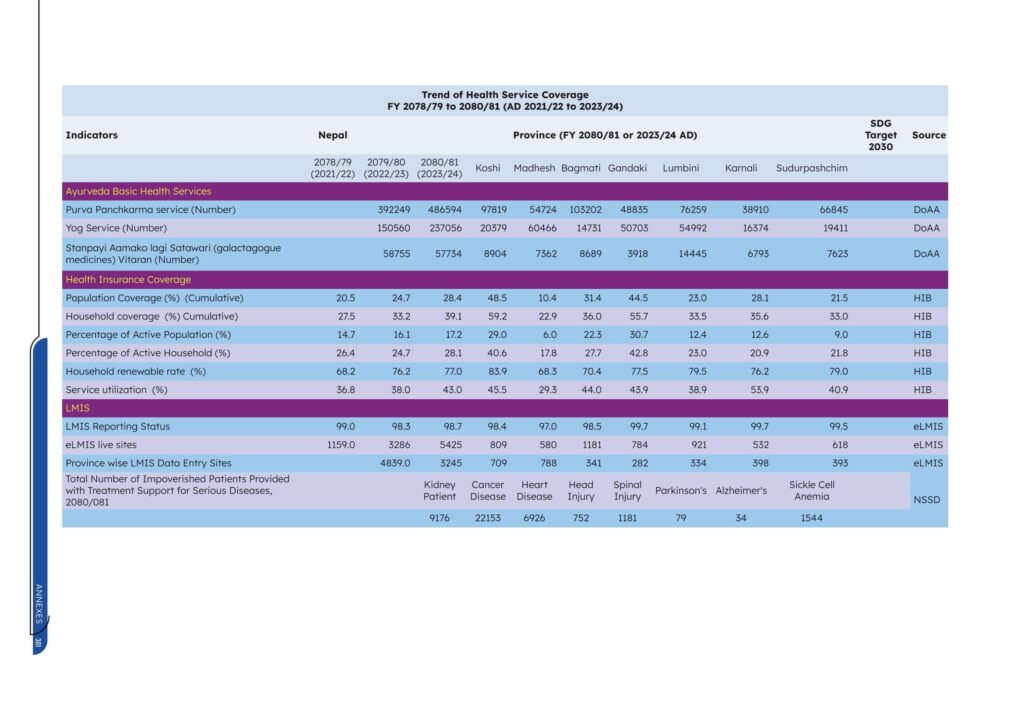
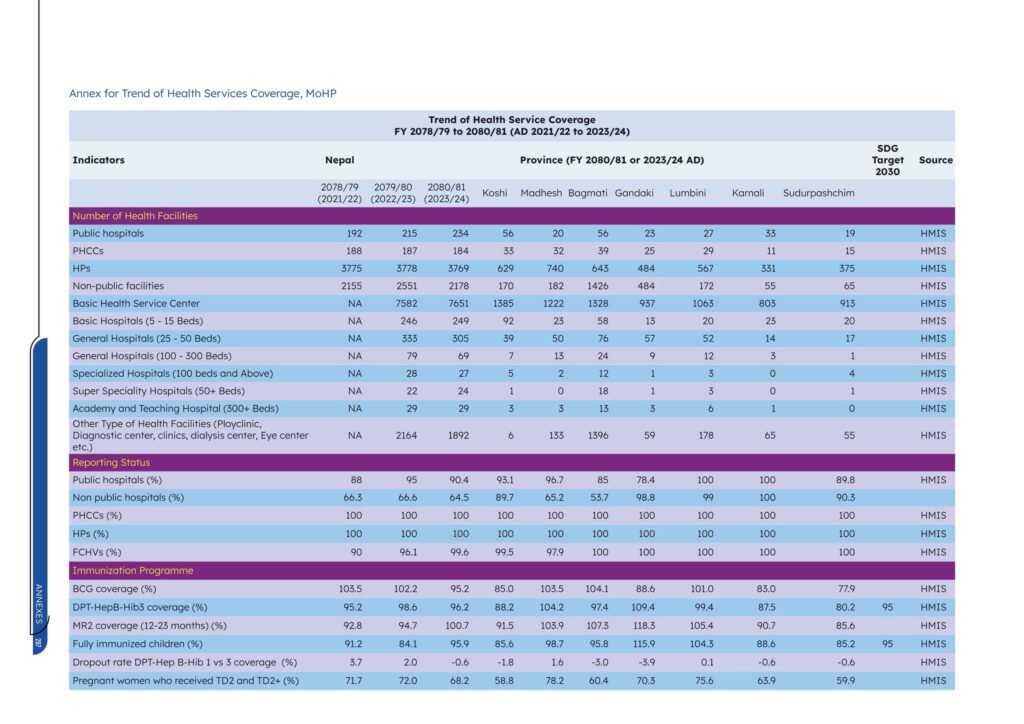
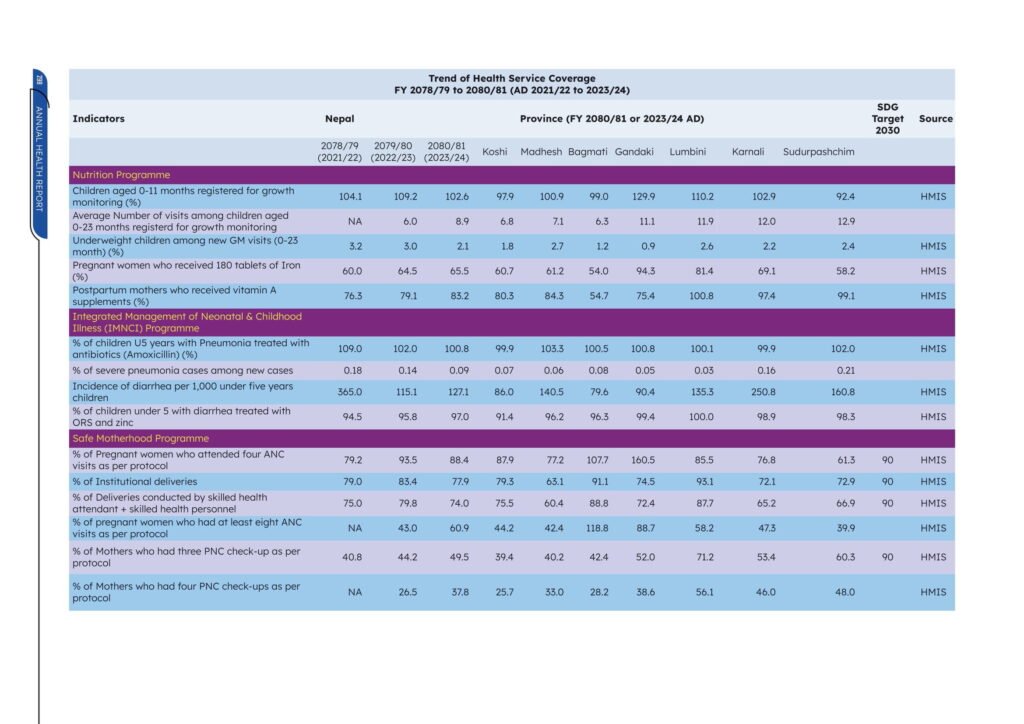
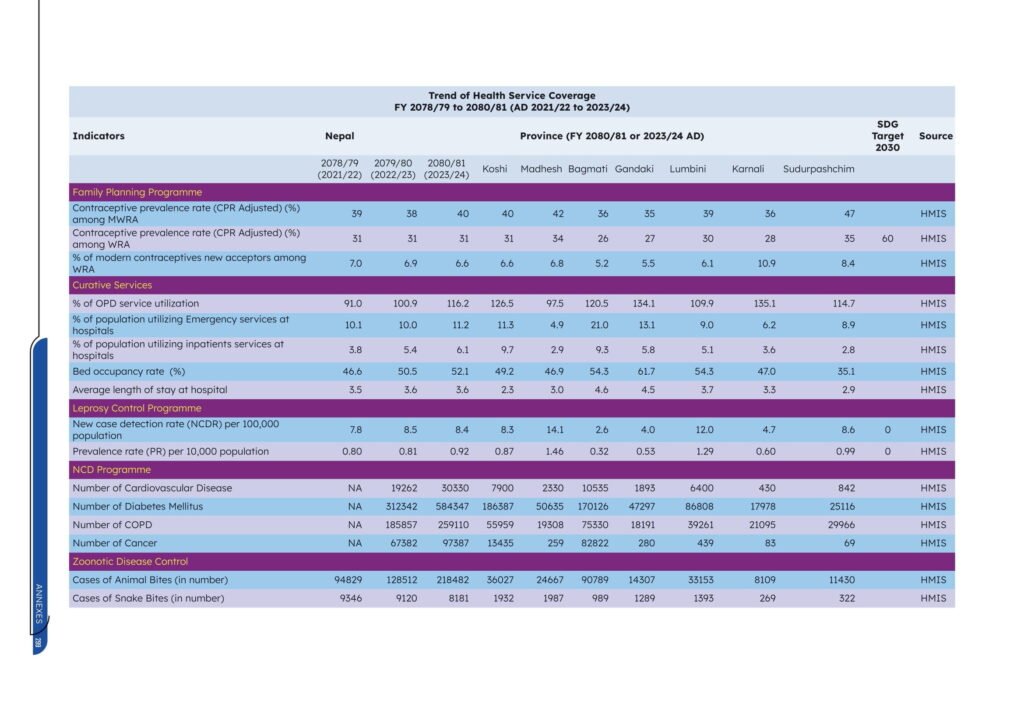
The Department of Health Services (DoHS), MoHP released its Annual Health Report (AHR) for the fiscal year 2080/81 (2023/24). This report is the 30th edition of its kind and serves as a key document for systematic monitoring and evaluation of the progress of planned programs, as well as analyzing changes in coverage and utilization statistics.

Related: DoHS Annual Health Report 2079/80

Key facts

Annual Health Report 208081 331
DOHS Annual Health Report 2023/24 (2080/81): Key facts
Annual Health Report 208081 332
DOHS Annual Health Report 2023/24 (2080/81): Key facts
Annual Health Report 208081 333
DOHS Annual Health Report 2023/24 (2080/81): Key facts
Annual Health Report 208081 334
DOHS Annual Health Report 2023/24 (2080/81): Key facts
Annual Health Report 208081 335

DOWNLOAD PDF

DOWNLOAD PDF

Related reports

  • DoHS Annual Health Report 2079/80
  • Department Health Services (DoHS) Annual Report 2078/79 (2021/22)
  • Nepal Health Sector Strategic Plan 2023-2030
  • Annual Report of the Department of Health Services (DoHS) 2077/78
  • Glimpse of Annual Report Department of Health Services 2073/74 (2016/17)
  • Annual report of the Department of Health Services (DoHS) 2073/74 (2016/2017)
  • Annual Report Department of Health Services 2072/73 (2015/2016)
  • Annual Report of the Department of Health Services (DoHS) – 2071/72 (2014/2015)
  • Annual Report of DOHS 2070/71 (2013/2014)
  • Annual Report of DoHS 2069/2070 (2012-2013)
  • National Annual Review, MoHP – 2017/18 (Presentation Slides)
  • Health Sector Progress Report 2018, Ministry of Health & Population
  • Glimpse of Annual Report Department of Health Services 2073/74 (2016/17)
  • Key Findings (Nepali & English) – The 2016 Nepal Demographic and Health Survey (2016 NDHS)
  • Nepal Health Sector Strategy(NHSS) Implementation Plan 2016-21
May 18, 2025 0 comments
0 FacebookTwitterPinterestLinkedinTumblrVKOdnoklassnikiRedditStumbleuponWhatsappTelegramLINEPocketSkypeViberEmail
NTNU Doctoral Research Fellowships Opportunity
Public Health

NTNU Doctoral Research Fellowships (PhD Candidate in Global Health) Opportunity

by Public Health Update May 14, 2025
written by Public Health Update

Overview

The Department of Public Health and Nursing at the Norwegian University of Science and Technology (NTNU) is offering two fully funded Doctoral Research Fellowships, starting September 1, 2025. These positions are part of the international BetterNutrition4Adolescent project funded by The Research Council of Norway (https://www.forskningsradet.no/en/), addressing critical challenges in adolescent nutrition in low-resource settings.

Successful candidates will join a vibrant, interdisciplinary research team and collaborate closely with leading public health experts from Public Health Foundation of India (https://phfi.org/), Delhi and Institute for Implementation Science and Health, Nepal (https://www.iish.org.np/). This unique opportunity includes extensive fieldwork in urban communities in Delhi and Budhanilkantha in Nepal allowing candidates to gain hands-on experience in global health research and community-based intervention design.

The fellowships offer an immersive experience that combines rigorous training, real-world impact, and cross-cultural engagement—perfect for candidates passionate about global health, adolescent well-being, and sustainable development.

About the project

Malnutrition—encompassing both undernutrition and the growing prevalence of obesity—remains a critical public health concern among adolescents in low-resource settings such as India and Nepal. Poor nutritional status during adolescence significantly increases the risk of early-onset non-communicable diseases, including diabetes, cardiovascular conditions, and mental health disorders, leading to lasting impacts on overall well-being. Schools have the potential to act as key platforms for promoting healthy eating habits. However, many existing school-based nutrition programs fall short by not adequately addressing the specific challenges faced by disadvantaged families or by failing to actively involve the broader school community in creating supportive food environments.

The BetterNutrition4Adolescent aims to fill these critical gaps by working with low-fee schools located in marginalized, peri-urban communities in Delhi (India) and Budhanilkantha (Nepal). The project will adopt a participatory, stakeholder-driven approach—engaging students, parents, teachers, school administrators, food vendors, and canteen staff—to identify the barriers and facilitators shaping the school food environment. Through this inclusive process, the project will co-design multicomponent interventions tailored to the local contexts. The project will also develop practical implementation strategies that consider logistical and cultural challenges to ensure the interventions are smoothly integrated into daily school routines. The interventions will be evaluated for their acceptability, feasibility, and effectiveness in improving key health outcomes. 

This is a global health project hosted by the Norwegian University of Science and Technology (NTNU), carried out in equitable partnership with experienced institutions: the Public Health Foundation of India (PHFI), the Institute for Implementation Science and Health (IISH) in Nepal, and the University of Birmingham in the UK. 

The PhD candidate(s) will spend nearly two years conducting fieldwork in Delhi, India and Budhanilkantha, Nepal with the remaining one year based at NTNU in Norway. The research fellow is expected to submit a PhD thesis within three years from the date of commence. 

Duties of the position

  • Complete the coursework and doctoral education until obtaining a doctorate
  • Carry out research of good quality within the framework described above
  • Academic publications and popular science dissemination
  • Conduct fieldwork at the study sites in Nepal/Delhi under close supervision of local supervisors
  • Participate in international activities such as conferences and/or research stays at foreign educational institutions

Be prepared for changes to your work duties after employment. 

Required selection criteria

  • You must have a Master’s degree in Community Medicine, Global Health, Public Health, Epidemiology, Nursing, Health Sciences or equivalent. Your course of study must correspond to a five-year Norwegian course, where 120 credits have been obtained at master’s level. Master’s students can apply, but the master’s degree must be obtained and documented before starting the position and no later than 01.06.2025.
  • You must have a strong academic background from your previous studies and have an average grade from your Master’s degree study, or equivalent education, which is equal to B or better compared to NTNU’s grading scale. If you do not have letter grades from previous studies, you must have an equally good academic foundation. If you have a weaker grade background, you may be considered if you can document that you are particularly suitable for a PhD education
  • You must meet the requirements for admission to the PhD programme in Medicine and Health Sciences
  • Good oral and written presentation skills in both English and Nepali/Hindi language equivalent to level 
  • Documented experience with qualitative and quantitative research methods, either through a master thesis or previous academic publications
  • Previous relevant research experience working in low-resource settings

The appointment is to be made in accordance with Regulations for the Universities and Colleges Act (university and colleges regulations) and Regulations for the degrees philosophiae doctor (ph.d.) and philosophiae doctor (ph.d.) in artistic development work at the Norwegian University of Science and Technology (NTNU) for general criteria for the position.

Preferred selection criteria

  • Familiar with SPSS, STATA, R, or Python for quantitative analysis
  • Knowledge of NVivo or Atlas.ti for qualitative data analysis
Personal characteristics

To complete a doctoral degree (PhD), it is important that you are able to: 

  • Ability to work independently and in an interdisciplinary team 
  • Well-structured approach to work and time use 
  • A collegiate attitude and willingness to collaborate across disciplines 
  • Analyse data, assess different perspectives and draw well-founded conclusions 

Emphasis will be placed on personal qualities.

Offer

  • An exciting job with an important mission in society
  • Developing tasks in a strong and international professional environment
  • Open and inclusive working environment with committed colleagues
  • As a public employee, you have favourable benefits as a member of the Norwegian Public Service Pension Fund (SPK)

When in Norway you will be employed as a PhD Candidate at NTNU and will have access to employee benefits and discounts. 

Application requirements

The attachments (including a description of your scientific work) must accompany the application as these documents form the basis of the application assessment. The documents must be in English. 

Required documents

  • Transcripts and diplomas for Bachelor’s and Master’s degrees
  • CV 
  • Copy of Master’s thesis. If you have recently submitted your Master’s thesis, you can attach a draft of the thesis. Documentation of a completed Master’s degree must be presented before taking up the position.
  • Short letter of motivation (500-600 words)
  • Possibly publications etc. other relevant research work
  • Possibly certificates
  • Names and contact information of three relevant referees

If you think this position looks interesting and in line with your qualifications, you are welcome to apply.

If you have any questions about the position, please contact Dr. Abhijit Sen (Associate Professor), abhijit.sen@ntnu.no , Prof. Monika Arora, monika.arora@phfi.org or Dr. Tina Rawal tina.rawal@phfi.org and for IISH-Nepal implementationscienceinstitute@gmail.com 

If you have any questions about the recruitment process, please contact HR Consultant Anita Finserås Bretun, e-mail: anita.f.bretun@ntnu.no

Application deadline: 23.05.2025

For practical information about working at NTNU, please visit this webpage. 

Official Information


Do you have a website? Looking for the best hosting provider? Here’s a discount code.

Latest Public Health Jobs

Latest Posts

  • DoHS Annual Health Report 2081/82
  • WHA79: Key Takeaways from the 2026 World Health Assembly
  • Seventy-ninth World Health Assembly WHA79
  • World health statistics 2026: monitoring health for the SDGs, sustainable development goals
  • Health Reform Manual: Eight Practical Steps

Thanks for visiting us.
Disclaimer: The resources, documents, guidelines, and information on this blog have been collected from various sources and are intended for informational purposes only. Information published on or through this website and affiliated social media channels does not represent the intention, plan, or strategies of an organization that the initiator is associated with in a professional or personal capacity, unless explicitly indicated.
If you have any complaints, information, or suggestions about the content published on Public Health Update, please feel free to contact us at blog.publichealthupdate@gmail.com.
#StayUpdated


  • WordPress
  • Link
  • Facebook
  • Mail
  • Facebook
  • Twitter
  • Twitter
  • LinkedIn
  • Instagram
  • Facebook

May 14, 2025 0 comments
0 FacebookTwitterPinterestLinkedinTumblrVKOdnoklassnikiRedditStumbleuponWhatsappTelegramLINEPocketSkypeViberEmail
The State of the World’s Nursing Report 2025
Global Health NewsHealth in DataHuman Resource for HealthPublic Health UpdateReports

The State of the World’s Nursing Report 2025

by Public Health Update May 12, 2025
written by Public Health Update

Overview

The World Health Organization (WHO), International Council of Nurses (ICN), and partners have published the State of the World’s Nursing 2025 Report, revealing significant growth in the global nursing workforce from 27.9 million in 2018 to 29.8 million in 2023.

The 2025 edition of the State of the world’s nursing provides the most comprehensive and up-to-date analysis of the nursing workforce. The report features new indicators on critical areas for nursing, such as education capacity, advanced practice nursing and remuneration. In addition to the 12 policy priorities from the Global strategic directions for nursing and midwifery 2021–2025, there are five additional policy priorities and a compilation of data from each WHO region. Country profiles reflect each country’s national data and are available for download from the WHO National Health Workforce Accounts data portal.

Key findings

  • The global nursing workforce has grown from 27.9 million in 2018 to 29.8 million in 2023, with a promising reduction in the global shortage—from 6.2 million in 2020 to 5.8 million in 2023. Projections suggest this could drop to 4.1 million by 2030.
  • The overall progress still masks deep regional disparities: approximately 78% of the world’s nurses are concentrated in countries representing just 49% of the global population. LMICs are facing challenges in graduating, employing and retaining nurses in the health system and will need to raise domestic investments to create and sustain jobs.
  • Gender and equity remain central concerns in the nursing workforce. Women continue to dominate the profession, making up 85% of the global nursing workforce.
  • Findings suggest that 1 in 7 nurses worldwide – and 23% in high-income countries – are foreign-born, highlighting reliance on international migration.

Policy priorities for 2026–2030

The report introduces forward-looking policy priorities, calling on countries to:

  • Expand and equitably distribute nursing jobs, especially in underserved regions;
  • Strengthen domestic education systems and align qualifications with defined roles;
  • Improve working conditions, pay equity, and mental well-being support;
  • Further develop nursing regulation and advanced practice nursing roles;
  • Promote gender equity and protect nurses working in fragile, conflict-affected settings;
  • Harness digital technologies and prepare nurses for climate-responsive care; and
  • Advance nursing leadership and ensure leadership development opportunities are equitable.

Featured story from Nepal: School Health and Nursing Service Programme in Nepal

The Ministry of Health and Population endorsed the School Health and Nursing Service Programme in 2019 to ensure the presence of health personnel in schools and deliver essential health services. The programme aims to promote a healthy lifestyle among adolescents by certifying schools as “Health Promoting Schools” and implement national health initiatives such as nutrition, vaccination and sexual and reproductive health education. It fosters a safe, supportive school environment, emphasizing health education for behavioural change, mental health promotion, first aid, and protection from accidents, injuries and substance abuse. Regular health screenings and timely referrals to health facilities help address health issues, while the programme works to reduce absenteeism and dropout rates. Achievements include successful implementation of deworming programmes, iron and folic acid supplementation for adolescent girls, and vaccination coverage (COVID-19; measles, mumps and rubella – MMR; typhoid). Health education has raised awareness on disease prevention and healthy lifestyles, contributing to safer communities. School absenteeism has decreased, and mental health initiatives through counselling and socioemotional learning have been promoted. Additionally, schools have developed disaster preparedness plans with regular drills.The programme plays a vital role in improving adolescent health and advancing Nepal’s UHC goals.. (p.23)

Happy International Nurses Day 2025: Our Nurses. Our Future. Caring for nurses strengthens economies!

Download the State of the World’s Nursing Report 2025


Related readings

  • State of the World’s Nursing Report – 2020
  • International Nurses Day
  • State of the World’s Nursing Report-2020: Country Profile- Nepal
May 12, 2025 0 comments
0 FacebookTwitterPinterestLinkedinTumblrVKOdnoklassnikiRedditStumbleuponWhatsappTelegramLINEPocketSkypeViberEmail
Call for Applications! Training workshop on 'Building Your Biostatistics Toolbox'
CoursesPublic Health Epidemiology & BiostatisticsPublic Health OpportunitiesPublic Health OpportunitySummer CoursesTraining

Call for Applications! Training workshop on ‘Building Your Biostatistics Toolbox’

by Public Health Update May 10, 2025
written by Public Health Update

Overview

The Nepal Health Economics Association (NHEA) invites applications from interested candidates for a two-day hands-on training workshop on “Building Your Biostatistics Toolbox” led by the esteemed Prof. Mousumi Banerjee from the University of Michigan.

Workshop details:

  • Title: Building Your Biostatistics Toolbox
  • Date: May 19–20, 2025
  • Time: May 19: 0900-1715, May 20: 0900-1500)
  • Venue: Auditorium Hall, 3rd Floor, Nepal Eye Hospital, Tripureshwor, Kathmandu
  • Instructor: Prof. Mousumi Banerjee, University of Michigan

Course focus: This intensive workshop will cover key biostatistical methods, including:

Linear Regression

  • Simple & multiple linear regression
  • Model fitting
  • Estimation and hypothesis testing
  • Confounding and effect modification
  • Scientific interpretation of data

Model Selection and Analysis

  • Models for inference vs. prediction
  • Model selection, model diagnostics
  • Multicollinearity, outliers, and influence diagnostics
  • Missing data

Logistic Regression

  • Simple and multiple logistic regression
  • Odds and odds ratio, relative risk vs. odds ratio
  • Categorical and continuous covariates
  • Interpretation of coefficients
  • Model fit diagnostics, model selection
  • Prediction using logistic regression

Eligibility: At least a Bachelor’s degree in Public Health, economics and health sciences or related field with demonstrated experience in biostatistics, epidemiology, health economics, or public health research.

There is no application or registration fee for this course.

Application Form: [Google Form]

Google Form Embed

Google Form

Forms must be submitted before 13 May 2025 (CoB). Only shortlisted candidates will be contacted for participation. For any inquiries, please contact the Nepal Health Economics Association (sumansapkota178 @ gmail.com (Only for course-related inquiries).


  • DoHS Annual Health Report 2081/82
  • WHA79: Key Takeaways from the 2026 World Health Assembly
  • Seventy-ninth World Health Assembly WHA79
  • World health statistics 2026: monitoring health for the SDGs, sustainable development goals
  • Health Reform Manual: Eight Practical Steps
May 10, 2025 0 comments
0 FacebookTwitterPinterestLinkedinTumblrVKOdnoklassnikiRedditStumbleuponWhatsappTelegramLINEPocketSkypeViberEmail
Global Health NewsNational Health NewsPublic Health EventsPublic Health NewsWorld News

The Seventy-eighth World Health Assembly convenes 19-27 May, 2025

by Public Health Update May 5, 2025
written by Public Health Update

The Seventy-eighth session of the World Health Assembly (WHA78) will take place from 19-27 May in Geneva, Switzerland. This year’s theme is “One World for Health.”

Member States will review the progress achieved during the past two years, including the results report, the last under the Triple Billion General Programme of Work 13. 

Discussions will be forward looking, to focus on prioritization of activities as well as looking at the future with the approval of the first full Programme Budget 2026-2027 under WHO’s Fourteenth General Programme of Work (GPW14), WHO’s strategy for global health for 2025 – 2028.  The Health Assembly will be invited to confirm the scheduled increase in the Assessed Contribution as part of WHO’s journey towards sustainable financing.

The Assembly will also consider the proposal by the Intergovernmental Negotiating Body to adopt the WHO Pandemic Agreement. In addition, the Agenda of this year Assembly contains over 70 other Items.

The Executive Board, which will meet on 28 and 29 May following the Health Assembly will have the election of the next Regional Director for WHO’s African Region on its agenda. See full Agenda of the Executive Board. the 157th meeting of the Executive Board

The Health Assembly agenda can be found here: (https://apps.who.int/gb/ebwha/pdf_files/WHA78/A78_1-en.pdf) and all relevant documents will be found on this page (https://apps.who.int/gb/e/e_wha78.html). More information and links here.

WHA78 takes place in a challenging environment. Several actions have been taken by the WHO in an effort to contain costs, including shortening the length of the meeting, limiting evening sessions as well as hospitality and events costs, amongst other administrative cost saving measures.

Public meetings of the WHA78 will be webcast live here.

Seventy-eighth World Health Assembly
#WHA78


Do you have a website? Looking for the best hosting provider? Here’s a discount code.

Latest Public Health Jobs

Latest Posts

  • DoHS Annual Health Report 2081/82
  • WHA79: Key Takeaways from the 2026 World Health Assembly
  • Seventy-ninth World Health Assembly WHA79
  • World health statistics 2026: monitoring health for the SDGs, sustainable development goals
  • Health Reform Manual: Eight Practical Steps

Thanks for visiting us.
Disclaimer: The resources, documents, guidelines, and information on this blog have been collected from various sources and are intended for informational purposes only. Information published on or through this website and affiliated social media channels does not represent the intention, plan, or strategies of an organization that the initiator is associated with in a professional or personal capacity, unless explicitly indicated.
If you have any complaints, information, or suggestions about the content published on Public Health Update, please feel free to contact us at blog.publichealthupdate@gmail.com.
#StayUpdated


  • WordPress
  • Link
  • Facebook
  • Mail
  • Facebook
  • Twitter
  • Twitter
  • LinkedIn
  • Instagram
  • Facebook
May 5, 2025 0 comments
0 FacebookTwitterPinterestLinkedinTumblrVKOdnoklassnikiRedditStumbleuponWhatsappTelegramLINEPocketSkypeViberEmail
Newer Posts
Older Posts

Search

Follow Us

Facebook Twitter Instagram Pinterest Linkedin Youtube

Categories

  • Abstracts (25)
  • Activities (91)
  • Adolescent Sexual and Reproductive Health (ASRH) (25)
  • Advice & Tips (4)
  • African Region (5)
  • AI and Health (1)
  • Annual Meeting (6)
  • Antimicrobial Resistance (AMR) (21)
  • Award (19)
  • Awards (16)
  • Books (9)
  • Call for Proposal, EOI & RFP (103)
  • Call for Research Participants (8)
  • Clinical Doctor Jobs (6)
  • Communicable Diseases (107)
  • Competition (20)
  • Conference (129)
  • Consultant (1)
  • Courses (205)
  • Dashboard (2)
  • Digital Health & Health Informatics (10)
  • Drug and Medicine (18)
  • Eastern Mediterranean Region (3)
  • Education (15)
  • Environment (3)
  • Environmental Health & Climate Change (47)
  • European Region (42)
  • Exchange Program (1)
  • Fact Sheet (118)
  • FCHVs (1)
  • Fellowships, Studentship & Scholarships (168)
  • Financial Aid (13)
  • Form Formats (2)
  • Fully funded (22)
  • Global Health News (438)
  • Grants and Funding Opportunities (193)
  • Guest Post (44)
  • Health Assistant Jobs (1)
  • Health Equity (7)
  • Health Financing and Economics (24)
  • Health in Data (118)
  • Health Insurance (5)
  • Health Jobs (52)
  • Health Literacy, Health Education & Promotion (50)
  • Health Organization Profile (42)
  • Health Systems (85)
  • Human Resource for Health (33)
  • Humanitarian Health & Emergency Response (44)
  • Hypertension (5)
  • Implementation Research (48)
  • International Health (3)
  • International Jobs & Opportunities (373)
  • International Plan, Policy & Guidelines (212)
  • Internships (4)
  • Jobs Vacancies (56)
  • Journals (8)
  • Life Style & Public Health Nutrition (39)
  • Live (10)
  • Master's Degree (48)
  • Maternal, Newborn and Child Health (88)
  • Mentorship Program (2)
  • Miscellaneous (16)
  • National Health News (158)
  • National Plan, Policy & Guidelines (469)
  • Neglected Tropical Diseases (NTDs) (51)
  • Non- Communicable Diseases (NCDs) (121)
  • Notice (103)
  • Nursing Jobs (6)
  • Nutritionist Jobs (1)
  • One Health (18)
  • Online & Distance Learning (22)
  • Online Courses (90)
  • Op-Ed Article (3)
  • Opportunities by Region (83)
  • Outbreak News (213)
  • Partially funded (6)
  • PCL Health Science Jobs (3)
  • PH Important Day (535)
  • Pharmacist Jobs (3)
  • PhD (54)
  • Photos (5)
  • Planetary Health (4)
  • PostDoc (14)
  • Presentation Slides (26)
  • Primary Health Care (25)
  • Provincial Plan, Policies and Guidelines (14)
  • Public Health (1,285)
  • Public Health Epidemiology & Biostatistics (14)
  • Public Health Events (306)
  • Public Health Information (20)
  • Public Health Innovation (9)
  • Public Health Jobs (52)
  • Public Health News (556)
  • Public Health Notes (120)
  • Public Health Opportunities (507)
  • Public Health Opportunity (491)
  • Public Health Programs (108)
  • Public Health Seminar (2)
  • Public Health Tools (1)
  • Public Health Update (570)
  • Quality Improvement & Infection Prevention (20)
  • Region of America (8)
  • Reports (187)
  • Research & Project Grants (39)
  • Research & Project Grants (32)
  • Research & Publication (648)
  • Research Articles (10)
  • Road Traffic Accidents (RTA) (9)
  • School of Public Health (60)
  • Self funded (2)
  • South-East Asia Region (26)
  • Success Stories (17)
  • Summer and Winter Courses (40)
  • Summer Courses (28)
  • Sustainable Development Goals (SDGs) (14)
  • Syllabus (61)
  • Symposium (9)
  • Tobacco Control (35)
  • Training (40)
  • Travel Grants (15)
  • Trick, Technique & Skills (8)
  • Uncategorized (3)
  • Undergraduate Degree (7)
  • Universal Health Coverage (36)
  • Universities (29)
  • Universities & School of Public Health (58)
  • Vacancy Announcement (26)
  • Vaccine Preventable Diseases (40)
  • Vector-Borne Diseases(VBDs) (31)
  • Videos (3)
  • View Points (1)
  • Webinar (4)
  • Western Pacific Region (13)
  • Workshop (18)
  • World News (119)
Post New Jobs: Vacancy Announcement Service

Public Health Update (Sagun’s Blog) is a popular public health portal in Nepal. Thousands of health professionals are connected with Public Health Update to get up-to-date public health updates, search for jobs, and explore opportunities.
#1 Public Health Blog for sharing Job opportunities and updates in Nepal

”Public Health Information For All”
– – Sagun Paudel, Founder

  • HOT JOBS
    • Public Health Jobs
    • Medical Doctor Jobs
    • Nursing Jobs
    • Health Assistant Jobs
    • Pharmacist Jobs
    • NGOs Jobs
    • Government Jobs
  • Top Categories
    • National Plan, Policy & Guidelines Top
    • Public Health Calendar
    • Fellowships & Scholarships
    • Health Systems
    • Health Organization Profiles
    • International Jobs & Opportunities
    • Public Health Opportunity

PUBLIC HEALTH INITIATIVE

    • Submit your Vacancies New
    • Partnership Opportunities

Contact: blog.publichealthupdate@gmail.com

https://wa.me/+9779856036932

Public Health Initiative, A Registered Non-profit organization – All Right Reserved. 2011-2024. Contact us. 

Facebook Twitter Instagram Youtube Envelope
Public Health Update
  • Home
  • Public Health
    • Home 1
      • Adolescent Sexual and Reproductive Health (ASRH)
      • Antimicrobial Resistance (AMR)
      • Communicable Diseases
      • Digital Health & Health Informatics
      • Environmental Health & Climate Change
      • Health Financing and Economics
      • Health Equity
    • Home 2
      • Health Literacy, Health Education & Promotion
      • Human Resource for Health
      • Humanitarian Health & Emergency Response
      • Implementation Research
      • International Health
      • Life Style & Public Health Nutrition
      • Maternal, Newborn and Child Health
    • Home 3
      • Neglected Tropical Diseases (NTDs)
      • Non- Communicable Diseases (NCDs)
      • One Health
      • Planetary Health
      • Public Health Epidemiology & Biostatistics
      • Primary Health Care
      • Quality Improvement & Infection Prevention
    • Home 4
      • Road Traffic Accidents (RTA)
      • Sustainable Development Goals (SDGs)
      • Tobacco Control
      • Universal Health Coverage
      • Vaccine Preventable Diseases
      • Vector-Borne Diseases(VBDs)
      • Notices
  • Public Health Update
    • Home 1
      • Public Health News
      • Global Health News
      • Outbreak News
      • National Health News
      • COVID-19
    • Home 2
      • Fact Sheet
      • Health in Data
      • PH Important Day
      • Public Health Events
      • Public Health Programs
    • Home 3
      • Health Systems
      • Health Insurance
      • Health Organization Profile
      • Success Stories
      • Public Health Innovation
  • Public Health Opportunities
    • Fully funded
    • Travel Grants
    • Grants and Funding Opportunities
    • Opportunities by Region
    • International Jobs & Opportunities
    • Research & Project Grants
    • Fellowships, Studentship & Scholarships
    • Conference
  • Jobs
    • Home 1
      • Health Jobs
      • Public Health Jobs
      • Clinical doctor Jobs
      • Health Assistant Jobs
      • Nursing Jobs
      • PCL Health Science Jobs
    • Home 2
      • Dental Jobs
      • Pharmacist Jobs
      • TSLC (Health Jobs)
      • Laboratory Jobs
      • Nutritionist Jobs
  • Downloads
    • International Plan, Policy & Guidelines
    • National Plan, Policy & Guidelines
    • Reports
    • Books
    • Research Articles
  • School of Public Health
    • Home 1
      • Courses
      • Master’s Degree
      • Undergraduate Degree
      • PhD
    • Home 2
      • Universities
      • Syllabus
      • Public Health Notes
      • Mentorship Program
      • Startup Project
    • Home
      • Summer and Winter Courses
      • Summer Courses
      • Online Courses
      • Workshop
      • Training
Public Health Update
  • Home
  • Public Health
    • Home 1
      • Adolescent Sexual and Reproductive Health (ASRH)
      • Antimicrobial Resistance (AMR)
      • Communicable Diseases
      • Digital Health & Health Informatics
      • Environmental Health & Climate Change
      • Health Financing and Economics
      • Health Equity
    • Home 2
      • Health Literacy, Health Education & Promotion
      • Human Resource for Health
      • Humanitarian Health & Emergency Response
      • Implementation Research
      • International Health
      • Life Style & Public Health Nutrition
      • Maternal, Newborn and Child Health
    • Home 3
      • Neglected Tropical Diseases (NTDs)
      • Non- Communicable Diseases (NCDs)
      • One Health
      • Planetary Health
      • Public Health Epidemiology & Biostatistics
      • Primary Health Care
      • Quality Improvement & Infection Prevention
    • Home 4
      • Road Traffic Accidents (RTA)
      • Sustainable Development Goals (SDGs)
      • Tobacco Control
      • Universal Health Coverage
      • Vaccine Preventable Diseases
      • Vector-Borne Diseases(VBDs)
      • Notices
  • Public Health Update
    • Home 1
      • Public Health News
      • Global Health News
      • Outbreak News
      • National Health News
      • COVID-19
    • Home 2
      • Fact Sheet
      • Health in Data
      • PH Important Day
      • Public Health Events
      • Public Health Programs
    • Home 3
      • Health Systems
      • Health Insurance
      • Health Organization Profile
      • Success Stories
      • Public Health Innovation
  • Public Health Opportunities
    • Fully funded
    • Travel Grants
    • Grants and Funding Opportunities
    • Opportunities by Region
    • International Jobs & Opportunities
    • Research & Project Grants
    • Fellowships, Studentship & Scholarships
    • Conference
  • Jobs
    • Home 1
      • Health Jobs
      • Public Health Jobs
      • Clinical doctor Jobs
      • Health Assistant Jobs
      • Nursing Jobs
      • PCL Health Science Jobs
    • Home 2
      • Dental Jobs
      • Pharmacist Jobs
      • TSLC (Health Jobs)
      • Laboratory Jobs
      • Nutritionist Jobs
  • Downloads
    • International Plan, Policy & Guidelines
    • National Plan, Policy & Guidelines
    • Reports
    • Books
    • Research Articles
  • School of Public Health
    • Home 1
      • Courses
      • Master’s Degree
      • Undergraduate Degree
      • PhD
    • Home 2
      • Universities
      • Syllabus
      • Public Health Notes
      • Mentorship Program
      • Startup Project
    • Home
      • Summer and Winter Courses
      • Summer Courses
      • Online Courses
      • Workshop
      • Training
Public Health Initiative, A Registered Non-profit organization – All Right Reserved. 2011-2023