
Public Health Initiative, A Registered Non-profit organization – All Right Reserved. 2011-2024. Contact us.
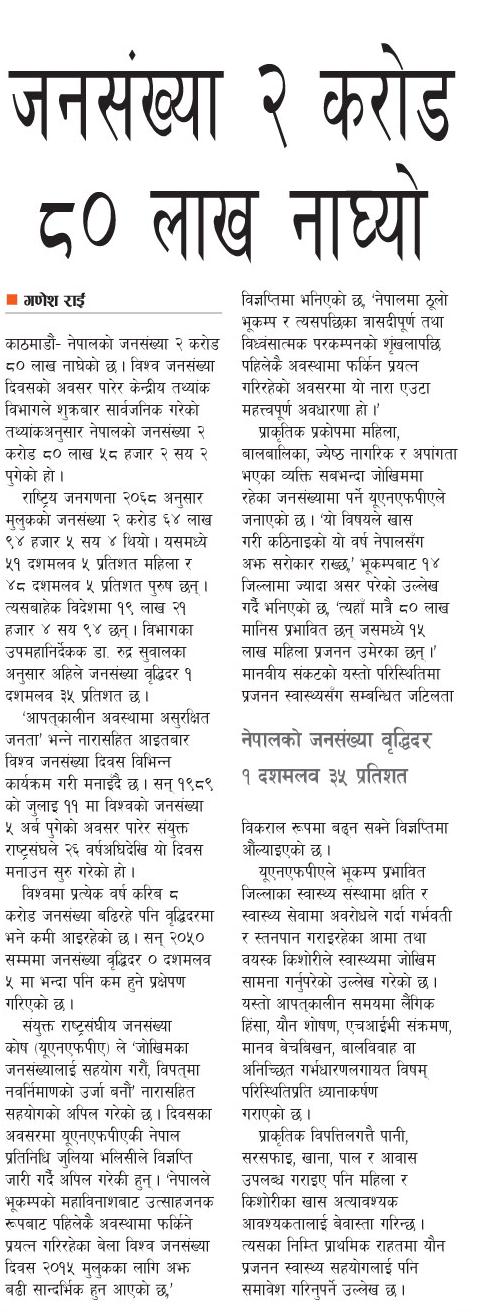
One month after the first of two major earthquakes hit Nepal, an estimated 70,000 children under five are at risk of malnutrition and require urgent humanitarian support, said United Nation Children’s Fund. Additionally, some 55,000 children with moderate acute malnutrition require supplementary feeding and care to bring them back to healthy growth and development.“Before the earthquake, more than 1 in 10 children across Nepal were already suffering from acute malnutrition, while close to 4 in 10 had stunted growth due to chronic under-nutrition,” said Tomoo Hozumi, UNICEF’s Representative in Nepal in the statement. “Now we have serious concerns that the situation could deteriorate in the wake of this disaster and undo the gains in nutrition that this country has achieved in the past few years.”The statement said that UNICEF is working double speed with its partners to provide urgent feeding and care to protect the lives of these children and to build their resistance against diseases, especially water-borne diseases, during the upcoming monsoon season.According to the statement, UNICEF is working with national and international partners and the government of Nepal to deliver a comprehensive nutrition response that includes protecting and promoting breastfeeding for children under two years of age, providing essential micronutrient supplements for more than 120,000 children and counseling mothers and families on how to feed young children with family food.Other activities included supporting community screening to identify children with severe acute malnutrition in affected districts and delivering specialised ready-to-use therapeutic foods to treat over 3,000 such children among others.Across nearly two dozen districts affected by the earthquake, 1.7 million children remain in urgent need of humanitarian aid — with the risk of long-term physical and emotional conditions climbing.“We are already seeing a growth in chronic conditions — such as children with acute respiratory infections provoked by the dust from the debris in the towns and villages,” said Hozumi.According to the statement, over the past month,
UNICEF has mobilised a substantial aid response to help children in urgent need, including supplying clean water to over 305,109 people and adequate sanitation and hand washing facilities to over 45,201 people, giving 10,000 children in displaced communities access to Child Friendly Spaces, providing nearly 9,000 children and more than 2,000 parents with Psychosocial First Aid, vaccination to more than 3,000 children against measles and rubella in the most affected districts. “A lot has been done, but much more needs to be done urgently,” said Hozumi. “The road to recovery for Nepal may be a long and challenging one, but UNICEF will be there, however long it takes to help Nepal’s children bounce back to a better and brighter future.”“We need all the support we can get, as the support we give now will have long-term consequences that will impact generations to come.”
of the Universidad de Oviedo (Spain), the Division of Global Health of the Karolinska Institutet (Sweden) and the Centre for Research on Epidemiology of Disasters of the Université catholique de Louvain designed to deliver high quality education and training in the field of Public Health in disaster situations. The Programme is sponsored by the European Union and also involves thirteen associated universities and institutions around the world.
The list of past work placements should be well documented. The CV must specify the position held, main responsibilities and how long it lasted. Documentation of relevant courses, workshops, seminars etc can also be included.
DownloadPDF Document Click Here
On World Malaria Day 2015, the World Health Organization is calling for high-level commitment to the vision of a world free of malaria. The theme, set by the Roll Back Malaria Partnership, is Invest in the future: Defeat malaria. This reflects the ambitious goals and targets set out in a draft post-2015 strategy to be presented to the World Health Assembly in May. The new strategy aims to reduce malaria cases and deaths by 90% by 2030 from current levels. Four countries have been certified free of malaria in the last decade and the post-2015 strategy sets the goal of eliminating the disease from a further 35 countries by 2030.
Public Health Update (Sagun’s Blog) is a popular public health portal in Nepal. Thousands of health professionals are connected with Public Health Update to get up-to-date public health updates, search for jobs, and explore opportunities.
#1 Public Health Blog for sharing Job opportunities and updates in Nepal
”Public Health Information For All”
– – Sagun Paudel, Founder
Contact: blog.publichealthupdate@gmail.com
Public Health Initiative, A Registered Non-profit organization – All Right Reserved. 2011-2024. Contact us.