Public Health Update
  • Home
  • Public Health Update
  • Nepal Health Jobs
    • Public Health Job Board
    • Organization List
  • Opportunities
    • Fellowships, Studentship & Scholarships
    • Grants and Funding Opportunities
    • Fully funded
    • Conference
  • Downloads
    • International Plan, Policy & Guidelines
    • National Plan, Policy & Guidelines
    • Reports
    • Public Health Notes
    • Syllabus
    • Form Formats
  • School of Public Health
    • PhD
    • Master’s Degree
    • Online Courses
  • Notice
  • Home
  • Public Health Update
  • Nepal Health Jobs
    • Public Health Job Board
    • Organization List
  • Opportunities
    • Fellowships, Studentship & Scholarships
    • Grants and Funding Opportunities
    • Fully funded
    • Conference
  • Downloads
    • International Plan, Policy & Guidelines
    • National Plan, Policy & Guidelines
    • Reports
    • Public Health Notes
    • Syllabus
    • Form Formats
  • School of Public Health
    • PhD
    • Master’s Degree
    • Online Courses
  • Notice
LOGIN / REGISTER
Public Health Update
SUBSCRIBE
Public Health Update
  • Home
  • Public Health Update
  • Nepal Health Jobs
    • Public Health Job Board
    • Organization List
  • Opportunities
    • Fellowships, Studentship & Scholarships
    • Grants and Funding Opportunities
    • Fully funded
    • Conference
  • Downloads
    • International Plan, Policy & Guidelines
    • National Plan, Policy & Guidelines
    • Reports
    • Public Health Notes
    • Syllabus
    • Form Formats
  • School of Public Health
    • PhD
    • Master’s Degree
    • Online Courses
  • Notice

All Right Reserved. Designed and Developed by PenciDesign

Pharmacovigilance Network in Nepal
Public HealthDrug and MedicinePublic Health InformationPublic Health Notes

Pharmacovigilance Network in Nepal

by Public Health Update November 2, 2022
written by Public Health Update

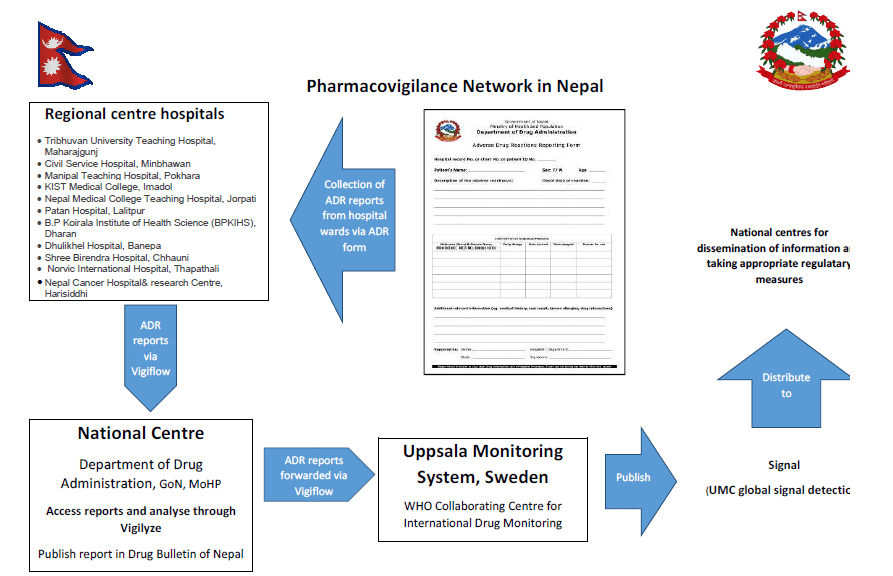
Government of Nepal nominated Department of Drug Administration (DDA) in October 2004 as the focal point (National Pharmacovigilance centre) to liaison with WHO collaborating centre for International Drug Monitoring, Sweden and started collecting adverse drug reactions. Nepal became a WHO programme member in July 2006.

At present, there are 15 regional pharmacovigilance centers in Nepal

  1. Tribhuvan University Teaching Hospital, Maharajgunj
  2. Civil Service Hospital, Minbhawan
  3. Manipal Teaching Hospital, Pokhara
  4. KIST Medical College, Imadol
  5. Nepal Medical College Teaching Hospital, Jorpati
  6. Patan Hospital, Lalitpur
  7. B.P Koirala Institute of Health Science (BPKIHS), Dharan
  8. Dhulikhel Hospital, Banepa
  9. Shree Birendra Hospital, Chhauni
  10. Norvic International Hospital, Thapathali
  11. Nepal Cancer Hospital and Research Center, Harisiddhi
  12. College of Medical Sciences – Teaching Hospital
  13. Nepal Mediciti, Kathmandu.
  14. Chitwan Medical College, Chitwan.
  15. National Tuberculosis Control Center, Bhaktapur.

These regional pharmacovigilance centers operate under DDA (DDA being the National centre for ADR monitoring). The regional centers reports ADRs to the National center (DDA) via ‘Vigiflow’ (an online program) which are then forwarded to the Uppsala Monitoring Center (UMC) by the National Centre. The National database contains about 972 ADR reports so far.

Source of Info: DDA Website

Pharmacovigilance Network in Nepal Reporting mechanism
Pharmacovigilance Network in Nepal (Reporting mechanism)

DOWNLOAD REPORTING FORMAT


Related readings

  • Department of Drug Administration (DDA)
  • List of Domestic Industries listed in DDA DAMS
  • WHO GMP Certified Pharmaceutical Companies in Nepal
  • List of Narcotics and Psychotropic Substances identified for Import and Use in Nepal
  • Pharmacovigilance Network in Nepal
  • Drug and Medicine Related Act, Rules, Regulations, Policies, Guidelines & Directives in Nepal
  • New Drug Registration Process & Format of Documents for Import in Nepal
November 2, 2022 0 comments
0 FacebookTwitterPinterestLinkedinTumblrVKOdnoklassnikiRedditStumbleuponWhatsappTelegramLINEPocketSkypeViberEmail
List of Narcotics and Psychotropic Substances identified for Import and Use in Nepal
Public HealthDrug and MedicineHealth Literacy, Health Education & PromotionNational Plan, Policy & GuidelinesPublic Health Information

List of Narcotics and Psychotropic Substances identified for Import and Use in Nepal

by Public Health Update November 2, 2022
written by Public Health Update

Here is the list of Narcotics and Psychotropic Substances identified for Import and Use in Nepal.

Narcotics

  1. Codeine
  2. Dextropropoxyphene
  3. Ethylmorphine
  4. Etorphine
  5. Fentanyl
  6. Methadone
  7. Morphine
  8. Phethidene
  9. Pholcodine

Psychotropic Substances Schedule III

  1. Buprenorphine
  2. Glutethiamide
  3. Pentazocine
  4. Pentobarbital

Schedule IV

  1. Alprazolam
  2. Chlordiazepoxide
  3. Clobazam
  4. Clonazepam
  5. Diazepam
  6. Flurazepam
  7. Lorazepam
  8. Medazepam
  9. Meprobamate
  10. Midazolam
  11. Nitrazepam
  12. Oxazepam
  13. Oxazolam
  14. Phenobarbital
  15. Phentermine
  16. Prazepam
  17. Triazolam
  18. Zolpidem

Download form for recording of narcotic psychotropic drugs

Retailer’s Record For Narcotics and Psychotropic Medicines AND Importer and Wholesale Record For Narcotics and Psychotropic Medicines

Related readings

  • Department of Drug Administration (DDA)
  • List of Domestic Industries listed in DDA DAMS
  • WHO GMP Certified Pharmaceutical Companies in Nepal
  • List of Narcotics and Psychotropic Substances identified for Import and Use in Nepal
  • Pharmacovigilance Network in Nepal
  • Drug and Medicine Related Act, Rules, Regulations, Policies, Guidelines & Directives in Nepal
  • New Drug Registration Process & Format of Documents for Import in Nepal
November 2, 2022 0 comments
0 FacebookTwitterPinterestLinkedinTumblrVKOdnoklassnikiRedditStumbleuponWhatsappTelegramLINEPocketSkypeViberEmail
Public HealthDrug and MedicinePublic Health InformationPublic Health Update

WHO GMP Certified Pharmaceutical Companies in Nepal

by Public Health Update November 2, 2022
written by Public Health Update

The Department of Drug Administration (DDA) has updated the list of WHO GMP Certified Pharmaceutical Companies in Nepal. Here is the updated list of registered pharmaceutical companies that are certified for World Health Organization Good Manufacturing Practices (WHO GMP).

Good Manufacturing Practices (GMP, also referred to as ‘cGMP’ or ‘current Good Manufacturing Practice’) is the aspect of quality assurance that ensures that medicinal products are consistently produced and controlled to the quality standards appropriate to their intended use and as required by the product specification. GMP defines quality measures for both production and quality control and defines general measures to ensure that processes necessary for production and testing are clearly defined, validated, reviewed, and documented, and that the personnel, premises and materials are suitable for the production of pharmaceuticals and biologicals including vaccines. GMP also has legal components, covering responsibilities for distribution, contract manufacturing and testing, and responses to product defects and complaints. Specific GMP requirements relevant to classes of products such as sterile pharmaceuticals or biological medicinal products are provided in a series of annexes to the general GMP requirements. (WHO)

S.NoPharmaceutical Company
1Alive Pharmaceuticals Pvt. Ltd
2Amtech Med Pvt. Ltd
3Apex Pharmaceuticals Pvt. Ltd
4Apple Pharmaceuticals Pvt. Ltd
5Asian Pharmaceuticals Pvt. Ltd
6Bhaskar Herbaceuticals Pvt. Ltd
7Biogain Remedies Pvt. Ltd
8CTL Pharmaceuticals Pvt. Ltd
9Curex Pharmaceuticals Pvt. Ltd
10Deurali-Janta Pharmaceuticals Pvt. Ltd
11Everest Pharmaceuticals Pvt. Ltd
12Florid Laboratories Pvt. Ltd
13Genetica Laboratories Pvt. Ltd
14Grace Pharmaceuticals Pvt. Ltd
15Grace Pharmaceuticals Pvt. Ltd
16Hester Biosciences Nepal Pvt. Ltd
17Kasturi Pharmaceuticl Pvt. Ltd
18Lomus Parenterals and Formulations Pvt. Ltd
19Lomus Pharmaceuticals Pvt. Ltd
20Magnus Pharmaceuticals Pvt. Ltd
21Maruti Pharma Pvt. Ltd
22National Healthcare Pvt. Ltd
23Nepal Pharmaceuticals Lab. Pvt. Ltd
24Nova Genetica Pvt. Ltd
25Ohm Pharmaceuticals Laboratories Pvt. Ltd
26Omnica Laboratories Pvt. Ltd
27Panas Pharmaceuticals Pvt. Ltd
28Pharmaco Industries Pvt. Ltd
29QbD Pharmaceuticals Pvt. Ltd
30Qmed Formulation Pvt. Ltd.
31Quest Pharmaceuticals Pvt. Ltd
32Samar Pharma Company Pvt. Ltd
33Siddhartha Pharmaceuticals Pvt. Ltd
34Simca Laboratories Pvt. Ltd
35Sumy Pharmaceutical Pvt. Ltd
36Supreme Healthcare Pvt. Ltd
37Time Pharmaceuticals Pvt. Ltd
38Unique Pharmaceuticals Pvt. Ltd
39Vega Pharmaceuticals Pvt. Ltd
40Vijayadeep Laboratories Pvt. Ltd
WHO GMP Certified Pharmaceutical Companies in Nepal

Related readings

  • Department of Drug Administration (DDA)
  • List of Domestic Industries listed in DDA DAMS
  • WHO GMP Certified Pharmaceutical Companies in Nepal
  • List of Narcotics and Psychotropic Substances identified for Import and Use in Nepal
  • Pharmacovigilance Network in Nepal
  • Drug and Medicine Related Act, Rules, Regulations, Policies, Guidelines & Directives in Nepal
  • New Drug Registration Process & Format of Documents for Import in Nepal
November 2, 2022 0 comments
0 FacebookTwitterPinterestLinkedinTumblrVKOdnoklassnikiRedditStumbleuponWhatsappTelegramLINEPocketSkypeViberEmail
List of Domestic Industries listed in DDA DAMS
Public HealthDrug and MedicinePublic Health Information

List of Domestic Industries listed in DDA DAMS

by Public Health Update November 2, 2022
written by Public Health Update

The Department of Drug Administration (DDA) has published the list of Domestic Industries listed in DAMS as of 29/09/2022.

Updated: 29/09/2022

S. No.Manufacturer NameSystem
1A S HERBAL INDUSTRYAYURVEDIC
2Aadee Remedies Pvt LtdALLOPATHY
3ABHICOM PHARMACEUTICALS PVT LTDALLOPATHY
4Accord Pharmaceuticals Pvt LtdALLOPATHY
5Adonis Biofarma Private LimitedALLOPATHY
6Alive Pharmaceutical Pvt LtdALLOPATHY
7Alliance Pharmaceuticals Private LimitedALLOPATHY
8AMTECH MED PVT LTDALLOPATHY
9Anu Health Care Pvt LtdALLOPATHY
10Apex Pharmaceuticals Pvt LtdALLOPATHY
11Apple international Pharmaceuticals Pvt LtdALLOPATHY
12Arrow Pharmaceuticals Pvt LtdALLOPATHY
13Arya Pharmalab Pvt LtdALLOPATHY
14Asian Pharmaceuticals Pvt LtdALLOPATHY
15Big B formulation pvt ltdVETERENARY
16Biogain Remedies Private LimitedALLOPATHY
17Biovac Nepal Pvt LtdVETERENARY
18Chemidrug Industries Pvt LtdALLOPATHY
19CITIZEN PHARMACEUTICALS PVT LTDVETERENARY
20Corel PharmaceuticalsALLOPATHY
21CTL Pharmaceuticals Pvt LtdALLOPATHY
22CTL Pharmaceuticals Pvt. Ltd. ,Chitwan UnitALLOPATHY
23Curex Pharmaceuticals Pvt LtdALLOPATHY
24DENIUM LABORATORIES PVT LTDALLOPATHY
25Derren Pharmaceuticals Private LimitedALLOPATHY
26DEURALI JANTA PHARMACEUTICALS PVT LTDALLOPATHY
27Deurali Janta Pharmaceuticals Pvt Ltd Unit IIIALLOPATHY
28Divine Health Care Pvt LtdALLOPATHY
29Elixir Life Science Private LimitedALLOPATHY
30EMVOLIO LIFE SCIENCES PVT LTDVETERENARY
31Evans Life Sciences Pvt LtdALLOPATHY
32Everest Parenterals Pvt LtdALLOPATHY
33Everest Pharmaceuticals Pvt LtdALLOPATHY
34Florid Laboratories pvt ltdALLOPATHY
35GD Pharmaceutical Pvt LtdALLOPATHY
36GENERICA PHARMACEUTICALS PVT LTDALLOPATHY
37Genetica Laboratory Pvt LtdALLOPATHY
38Global Pharmaceuticals Pvt LtdALLOPATHY
39Grace Pharmaceuticals Pvt LtdAYURVEDIC
40Gurans Pharmaceutical Pvt LtdVETERENARY
41Haps formulations pvt ltdALLOPATHY
42Harvard Pharmaceuticals Private LimitedALLOPATHY
43Hester Biosciences Nepal Pvt ltdVETERENARY
44HIMALAYAN ESSENCE PVT LTDALLOPATHY
45Himgiri Health Care UdhyogALLOPATHY
46Hukam Pharmaceuticals Pvt LtdALLOPATHY
47IDEAL PHARMACEUTICALS COMPANY PRIVATE LIMITEDALLOPATHY
48Innovative pharma lab private limitedALLOPATHY
49Jio Phramaceuticals Pvt LtdALLOPATHY
50JJ Laboratories Pvt LtdALLOPATHY
51Kalika Pharmaceuticals Pvt LtdALLOPATHY
52Kantipur Laboratories Pvt LtdALLOPATHY
53KANTIPUR PHARMACEUTICALS LAB PVT LTDVETERENARY
54Kasturi Pharmaceuticals Pvt LtdALLOPATHY
55Keva Pharmaceuticals Pvt LtdALLOPATHY
56Life Solutions Pvt LtdALLOPATHY
57LIFESTAR PHARMACEUTICALS PRIVATE LIMITEDALLOPATHY
58Livecare Pharmaceuticals Pvt LtdVETERENARY
59Lomus Parenterals and Formulation Pvt LtdALLOPATHY
60LOMUS PHARMACEUTICALS PVT LTDALLOPATHY
61LORD BUDDHA PHARMACHEM PVT LTDALLOPATHY
62Lucius Pharmaceuticals Pvt LtdALLOPATHY
63M.D.H. Pharmaceuticals Pvt.LtdVETERENARY
64Magnus Pharma Pvt LtdALLOPATHY
65MANOJ CHEMICAL WORKSALLOPATHY
66MANOJ PHARMACEUTICAL WORKSALLOPATHY
67Mark Formulations Private LimitedALLOPATHY
68Maruti Pharma Private LimitedALLOPATHY
69MAX PHARMA PVT LTDALLOPATHY
70Medrik Pharmaceuticals Pvt LtdALLOPATHY
71MEERA BIOTECH PRIVATE LIMITEDALLOPATHY
72Mesa Pharmaceutical Pvt LtdALLOPATHY
73Mountain Glacier Pharmaceuticals Pvt LtdALLOPATHY
74National Healthcare Pvt. Ltd.ALLOPATHY
75Nepacare Pharmaceuticals Private LimitedALLOPATHY
76Nepal Aushadhi LimitedALLOPATHY
77nepal ayurvedAYURVEDIC
78Nepal CRS CompanyALLOPATHY
79Nepal Pharmaceuticals Laboratory PVt LtdALLOPATHY
80Nepal Remedies Pvt LtdALLOPATHY
81Nippon Pharmaceuticals Pvt LtdALLOPATHY
82Nova Genetica Private LimitedALLOPATHY
83NUMARKS PHARMACEUTICALS P LTDALLOPATHY
84OHM Pharmaceuticals Laboratories Pvt LtdALLOPATHY
85Om Megashree Pharmaceuticals LtdALLOPATHY
86OMNICA LABORATORIES PVT LTDALLOPATHY
87OSHIN UDYOGALLOPATHY
88Panas Pharmaceuticals Pvt LtdALLOPATHY
89PHARMACO INDUSTRIES PVT LTDALLOPATHY
90PHARMONICS LIFE SCIENCES PVT LTDALLOPATHY
91Pokhara Pharmaceuticals Pvt ltdALLOPATHY
92Prakash Udhyog 
93Prime Pharmaceuticals Pvt LtdALLOPATHY
94QbD Pharmaceuticals Pvt LtdALLOPATHY
95Qmed Formulation P LtdALLOPATHY
96Quest Pharmaceuticals Private LimitedALLOPATHY
97Rajdevi Pharmaceuticals Private LimitedALLOPATHY
98Rhododendron Biotech Private LimitedALLOPATHY
99Rijalco Hygiene IndustriesALLOPATHY
100Royal Pharmaceuticals Pvt LtdALLOPATHY
101Royal Sasa Nepal PharmaceuticlasALLOPATHY
102S R DRUG LABORATORIES PVT LTDALLOPATHY
103Samar Pharma Company Pvt LtdALLOPATHY
104SHIV PHARMACEUTICAL LABORATORIESALLOPATHY
105SHIVAM PHARMACEUTICAL PVT LTDALLOPATHY
106Siddhartha Pharmaceuticals Pvt LtdALLOPATHY
107Simca Laboratories Pvt LtdVETERENARY
108Sopan Pharmaceuticals LimitedALLOPATHY
109Sumy Pharnaceuticals Pvt LtdALLOPATHY
110Sunrise Pharmaceuticals Pvt LtdALLOPATHY
111Supreme chemicalsALLOPATHY
112Supreme Health Care Pvt LtdALLOPATHY
113SUPRIYA CHEMICAL AND PACKING INDUSTRYALLOPATHY
114SWORNIM PHARMACEUTICALS PVT LTDALLOPATHY
115Symbiotech Healthcare Pvt LtdALLOPATHY
116Taurus Pharma Pvt LtdALLOPATHY
117Time Pharmaceuticals Pvt LtdALLOPATHY
118TIZIG PHARMA PVT LTDALLOPATHY
119Toreva Pharmaceuticals Private LimitedALLOPATHY
120UNIQUE PHARMACEUTICALS PRIVATE LIMITEDALLOPATHY
121UNITED PHARMACEUTICALS INDUSTRY PVT LTDVETERENARY
122Universal Formulations Pvt LtdALLOPATHY
123V M C Pharmaceuticals Pvt LtdVETERENARY
124Vega Pharmaceuticals Pvt LtdALLOPATHY
125Vijayadeep Laboratories LimitedALLOPATHY
126Win tech ChemicalALLOPATHY
127ZENITH PHARMACHEM INDUSTRIES PVT LTDALLOPATHY
128Zydin Biotech Pvt LtdALLOPATHY

Related readings

  • Department of Drug Administration (DDA)
  • List of Domestic Industries listed in DDA DAMS
  • WHO GMP Certified Pharmaceutical Companies in Nepal
  • List of Narcotics and Psychotropic Substances identified for Import and Use in Nepal
  • Pharmacovigilance Network in Nepal
  • Drug and Medicine Related Act, Rules, Regulations, Policies, Guidelines & Directives in Nepal
  • New Drug Registration Process & Format of Documents for Import in Nepal
November 2, 2022 0 comments
0 FacebookTwitterPinterestLinkedinTumblrVKOdnoklassnikiRedditStumbleuponWhatsappTelegramLINEPocketSkypeViberEmail
Australia Awards Fellowships
Public HealthGrants and Funding OpportunitiesInternational Jobs & OpportunitiesPublic Health OpportunitiesPublic Health Opportunity

Australia Awards Fellowships Round 18 

by Public Health Update November 2, 2022
written by Public Health Update

Overview

Australia Awards are an Australian Government initiative bringing together prestigious international scholarships, Fellowships and short courses administered by the Department of Foreign Affairs and Trade (DFAT), and the Australian Centre for International Agricultural Research. Australia Awards managed by DFAT are provided as part of Australia’s development program.

The overall goal of DFAT’s Australia Awards is to support partner countries to progress their development goals and have positive relationships with Australia that advance mutual interests. Australia Awards support emerging leaders to undertake study, research and professional development activities that build skills, knowledge and people to people links with the aim of contributing to the long-term development needs of Australia’s partner countries.

The Awards strive to develop leadership potential and stimulate lasting change by empowering a global network of talented individuals through high-quality education experiences in Australia and overseas. Australia Awards Scholars and Fellows return home with new ideas, knowledge and networks, and the ability to make a significant contribution to their home countries as leaders in their field. Through the Awards, alumni develop links to Australia and Australians, helping to build positive relationships between individuals, organisations and businesses in Australia and partner countries.

The Australia Awards administered by DFAT include: Australia Awards Scholarships; Australia Awards Pacific Scholarships; Australia Awards Fellowships; and Australia Awards Short Courses.

Australia Awards Fellowships

Australia Awards Fellowships offer eligible Australian organisations, from all sectors, the opportunity to deepen and broaden their links with leaders and professionals in developing countries by hosting Fellows from overseas partner organisations. Australian organisations identify their relevant development expertise and submit a Fellowship proposal with an overall aim of:

  • strengthening partnerships and links between Australian organisations and partner organisations in developing countries, in support of Australia’s strategic development objectives; and
  • increasing the capability and professional development of selected Fellows to advance priority development issues bilaterally, sub-regionally and/or regionally.

The program is designed to complement Australia’s individual bilateral and regional development programs and long-term scholarships by offering future leaders and mid-career professionals who will be in a position to advance priority development and foreign affairs issues on their return home. Fellowship activities aim to provide high-quality training, exchange of expertise, skills and knowledge, and opportunities to enhance networks on issues of shared interest. Activities can include a combination of short-term study and/or training, research, professional attachments and networking experiences.

Funding of up to $30,000 per Fellow is offered on a competitive basis to Australian organisations to host Fellows from eligible countries for activities delivered both in Australia and offshore for between minimum 2 weeks and maximum 52 weeks, the majority (over 70%) of the Fellowship must be conducted in Australia. Australian organisations must demonstrate commitment to the program and ongoing collaboration by providing a co-contribution to the Fellowship costs.

Who Can Apply?

Australian organisations such as government institutions, business and non-government organisations are eligible to apply. Organisations must be legal entities with an Australian Business Number and must be able to demonstrate links with partner organisations in participating countries, and provide in-kind or financial contributions to support Fellowships. Individuals cannot apply.

Fellow Eligibility

Australian organisations must ensure that all nominated Fellows meet the following general eligibility requirements:

  • be a minimum of 18 years of age at the time of commencing the Fellowship
  • not be a permanent resident or be applying for permanent residency in Australia or partner someone who is
  • be a citizen of an eligible country
  • not be current serving military personnel
  • be able to satisfy all requirements of the Department of Home Affairs for (DFAT sponsored) student visas subclass 500
  • be able to participate in the Fellowship.
  • Be able to travel without family members as DFAT will only fund and provide visa support letters for individual Fellows, not their family members
  • Fellows with a disability that requires assistance must travel with a carer
Participating Countries
Southeast Asia

Brunei Darussalam, Cambodia, Indonesia, Lao People’s Democratic Republic, Malaysia, Myanmar, Philippines, Singapore, Thailand, Timor-Leste and Vietnam

South Asia and Middle East

Bangladesh, Bhutan, India, Iraq, Jordan, Maldives, Mongolia, Nepal, Pakistan, Palestinian Territories and Sri Lanka

Pacific

Federated States of Micronesia, Fiji, French Polynesia, Kiribati, Marshall Islands, Nauru, New Caledonia, Papua New Guinea, Samoa, Solomon Islands, Tonga, Tuvalu, Vanuatu and Wallis and Futuna

Africa

Botswana, Democratic Republic of Congo, Egypt, Ghana, Kenya, Madagascar, Malawi, Mauritius, Morocco, Mozambique, Namibia, Nigeria, Rwanda, Senegal, South Africa, Tanzania, Uganda, Zambia, Zimbabwe

Europe

Ukraine

Priority Areas

Fellowship programs must align with the following six development priority areas:

  • Climate change and resilience (including green energy transition)
  • Health and health security
  • Gender equality and social inclusion
  • Digital economy (including cyber and critical technology engagement)
  • Maritime and the blue economy
  • Infrastructure and connectivity
How to Apply

Applications must be submitted online.

PLEASE NOTE: You have until 11.59pm (AEDT) on January 22, 2023 to submit your online application.

Late or incomplete applications will not be accepted for assessment.

Emailed or faxed applications will not be accepted for assessment.

OFFICIAL LINK


November 2, 2022 0 comments
0 FacebookTwitterPinterestLinkedinTumblrVKOdnoklassnikiRedditStumbleuponWhatsappTelegramLINEPocketSkypeViberEmail
Minimum Service Standards for Ayurveda Hospital, Health Centre & Aushadhalaya
Public HealthHealth SystemsNational Plan, Policy & GuidelinesQuality Improvement & Infection Prevention

Minimum Service Standards for Ayurveda Hospital, Health Centre & Aushadhalaya

by Public Health Update November 1, 2022
written by Public Health Update

Overview

The Minimum Service Standards (MSS) for Ayurveda health institutions is the readiness tool that sets in minimum set of standards to be fulfilled by the Ayurveda Hospital, Health Centre & Aushadhalayaand to be able to provide the services that it claims to provide. The Ayurveda Hospital, Health Centre & Aushadhalaya can thrive to provide more than what has been enlisted in the MSS but it is crucial that they have first fulfilled the MSS requirements.

The MSS is complementary to the existing quality improvement tools in the sense that it will ensure inputs in place before checking on the processes and outputs. It does not detail out how the services are to be provided which is basically the scope of Standard Treatment Protocols.

During the development of the MSS for Ayurveda Hospitals, the framework was prepared with three basic components- governance and management, clinical service management and support service management. The development of MSS for Ayurveda Hospitals is based the guidance of the Department of Ayurveda and Alternative Medicines.

Minimum Service Standards (MSS) for Ayurveda Aushadhalaya

Download: Minimum Service Standards (MSS) for Ayurveda Aushadhalaya


Minimum Service Standards (MSS) for Ayurveda Health Centre-District Level

Download: Minimum Service Standards (MSS) for Ayurveda Health Centre-District Level


Minimum Service Standards (MSS) for Ayurveda Hospital Provincial Level

Download: Minimum Service Standards (MSS) for Ayurveda Hospital Provincial Level


Minimum Service Standards (MSS) for Ayurveda Hospital Central Level

Download: Minimum Service Standards (MSS) for Ayurveda Hospital Central Level


Related reading

  • Implementation Guide for Minimum Service Standards (MSS)-2077
  • Minimum Service Standards (MSS) Tools (Health Post, Hospitals)
  • Guideline for Basic Health Services (BHS) Monitoring Framework
  • ORGANOGRAM AND REPORTING MECHANISM OF NEPALESE HEALTH SYSTEM IN FEDERAL CONTEXT
November 1, 2022 0 comments
0 FacebookTwitterPinterestLinkedinTumblrVKOdnoklassnikiRedditStumbleuponWhatsappTelegramLINEPocketSkypeViberEmail
Global Tuberculosis Report 2022
Public Health

Global Tuberculosis Report 2022

by Public Health Update November 1, 2022
written by Public Health Update

Overview

The WHO Global Tuberculosis Report 2022 provides a comprehensive and up-to-date assessment of the TB epidemic, and of progress in prevention, diagnosis and treatment of the disease, at global, regional and country levels. This is done in the context of global TB commitments, strategies and targets.

The 2022 edition of the report is as usual, based primarily on data gathered by WHO from national ministries of health in annual rounds of data collection. In 2022, 202 countries and territories with more than 99% of the world’s population and TB cases reported data.

Please note that direct comparisons between estimates of TB disease burden in the latest report and previous reports are not appropriate. The most recent time-series of estimates are published in this global TB report.

Highlights

  • TB case notifications: Big fall in 2020, partial recovery in 2021
  • Deaths caused by TB: Global increases in 2020 and 2021
  • Number of people developing TB: Global rise in 2021, years of decline reversed
  • TB deaths and incidence beyond 2021: Further worsening possible
  • Estimation of TB disease burden: New direct measurements needed

Top findings and messages in the 2022 report

  • The COVID-19 pandemic continues to have a damaging impact on access to TB diagnosis and treatment and the burden of TB disease. Progress made in the years up to 2019 has slowed, stalled or reversed, and global TB targets are off track.
  • The most obvious and immediate impact was a large global drop in the reported number of people newly diagnosed with TB. From a peak of 7.1 million in 2019, this fell to 5.8 million in 2020 (–18%), back to the level last seen in 2012.
  • In 2021, there was a partial recovery, to 6.4 million (the level of 2016–2017). The three countries that accounted for most of the reduction in 2020 were India, Indonesia and the Philippines (67% of the global total).
  • They made partial recoveries in 2021, but still accounted for 60% of the global reduction compared with 2019. Other high TB burden countries with large relative year-to-year reductions (>20%) included Bangladesh (2020), Lesotho (2020 and 2021), Myanmar
  • (2020 and 2021), Mongolia (2021) and Viet Nam (2021).
  • Reductions in the reported number of people diagnosed with TB in 2020 and 2021 suggest that the number of people with undiagnosed and untreated TB has grown, resulting first in an increased number of TB deaths and more community transmission of infection and then, with some lag-time, increased numbers of people developing TB.
  • Globally, the estimated number of deaths from TB increased between 2019 and 2021, reversing years of decline between 2005 and 2019. In 2021, there were an estimated 1.4 million deaths among HIV-negative people (95% uncertainty interval [UI]: 1.3–1.5 million) and 187 000 deaths (95% UI: 158 000–218 000) among HIV-positive people,a for a combined total of 1.6 million.
  • This was up from best estimates of 1.5 million in 2020 and 1.4 million in 2019, and back to the level of 2017. The net reduction from 2015 to 2021 was 5.9%, about one sixth of the way to the first milestone of the WHO End TB Strategy.
  • An estimated 10.6 million people (95% UI: 9.9–11 million) fell ill with TB in 2021, an increase of 4.5% from 10.1 million (95% UI: 9.5–10.7 million) in 2020. The TB incidence rate (new cases per 100 000 population per year) rose by 3.6% between 2020 and 2021, reversing declines of about 2% per year for most of the previous 2 decades. The net reduction from 2015 to 2021 was 10%, only halfway to the first milestone of the End TB Strategy.
  • The burden of drug-resistant TB (DR-TB) is also estimated to have increased between 2020 and 2021, with 450 000 (95% UI: 399 000–501 000) new cases of rifampicinresistantb TB (RR TB) in 2021.
  • Estimating TB disease burden during the COVID-19 pandemic is difficult and relies heavily on country- and region-specific dynamic models for low- and middleincome countries (LMICs). New national populationbased surveys of TB disease and up-to-date cause-ofdeath data from national vital registration systems of high quality and coverage are needed for more accurate estimation in the wake of the pandemic.
  • Other negative impacts on TB during the COVID-19 pandemic include a fall between 2019 and 2020 in the number of people provided with treatment for RR-TB and multidrug resistant TB (MDR-TB) (–17%, from 181 533 to 150 469, about 1 in 3 of those in need), with a partial recovery (+7.5%) to 161 746 in 2021; and a decline in global spending on essential TB services (from US$ 6.0 billion in 2019 to US$ 5.4 billion in 2021, less than half of what is needed).
  • There is a strong and enduring relationship between TB incidence rates per capita and indicators of development such as average income and undernourishment. Economic and financial barriers can affect access to health care for TB diagnosis and completion of TB treatment; about half of TB patients and their households face catastrophic total costsc due to TB disease. Progress towards universal health coverage (UHC), better levels of social protection and multisectoral action on broader TB determinants are all essential to reduce the burden of TB disease.

There are some positive findings and success stories.

  • Globally, the success rate for people treated for TB in 2020 was 86%, the same level as 2019, suggesting that the quality of care was maintained in the first year of the COVID-19 pandemic.
  • In the WHO African Region, the impact of COVIDrelated disruptions on the reported number of people newly diagnosed with TB was limited. There was a relatively small decrease (–2.3%) from 2019–2020 and an increase in 2021.
  • Following large falls in 2020, the reported number of people newly diagnosed with TB in 2021 recovered to 2019 levels (or beyond) in five high TB burden countries: Bangladesh, the Congo, Pakistan, Sierra Leone and Uganda.
  • The global number of people provided with TB preventive treatment recovered in 2021, to close to 2019 levels, and the global target for provision of treatment to people living with HIV was surpassed.
  • Three high TB burden countries have reached or passed the first milestones of the End TB Strategy for both reductions in TB incidence and TB deaths: Kenya (in 2018), the United Republic of Tanzania (in 2019) and Zambia (in 2021). Ethiopia is very close.
  • Intensified efforts backed by increased funding are urgently required to mitigate and reverse the negative impacts of the COVID-19 pandemic on TB. The need for action has become even more pressing in the context of war in Ukraine, ongoing conflicts in other parts of the world, a global energy crisis and associated risks to food security, which are likely to worsen some of the broader determinants of TB.

Download Global TB Report

Recommended readings

  • GLOBAL TUBERCULOSIS REPORT 2021
  • Global Tuberculosis Report 2020
  • Global Tuberculosis Report 2019: Latest status of the tuberculosis epidemic
  • Global Tuberculosis Report 2018
  • WHO Global Tuberculosis report 2015
  • Global tuberculosis report 2014: Improved data reveals higher global burden of tuberculosis
  • National Tuberculosis Programme Annual Report 2018
  • National Tuberculosis Program Update in Nepal #WorldTBDay #EndTB
  • National TB Prevalence Survey, 2018-19 Key findings
  • World Tuberculosis Day 2020! It’s time to End TB!
  • National Guideline on Drug Resistant TB Management 2019, Nepal
  • National Tuberculosis Management Guideline 2019, Nepal
  • Global Tuberculosis Report 2019: Latest status of the tuberculosis epidemic
  • National TB Prevalence Survey, 2018-19 Key findings
  • New WHO recommendations to prevent tuberculosis aim to save millions of lives
  • World Health Organization (WHO) Information Note Tuberculosis and COVID-19
  • World Tuberculosis Day 2020! It’s time to End TB!
  • People-centred framework for tuberculosis programme planning and prioritization, User guide
  • Global Tuberculosis Report 2019: Latest status of the tuberculosis epidemic
  • Dissemination of Findings and Recommendations of Joint External Monitoring Mission(JEMM) of Nepal National Tuberculosis Program
  • National Tuberculosis Programme Annual Report 2018
  • National Strategic Plan for Tuberculosis Prevention, Care and Control 2016 – 2021
  • NTP, Nepal: New TB Treatment Algorithm & Regimen (Updated)
  • WHO announces landmark changes in MDR-TB treatment regimens
  • TB Vaccine results announce a promising step towards ending the emergency
  • 7 million people receive record levels of lifesaving TB treatment but 3 million still miss out
November 1, 2022 1 comment
0 FacebookTwitterPinterestLinkedinTumblrVKOdnoklassnikiRedditStumbleuponWhatsappTelegramLINEPocketSkypeViberEmail
Call for proposals
Implementation ResearchCall for Proposal, EOI & RFPGrants and Funding OpportunitiesInternational Jobs & OpportunitiesNon- Communicable Diseases (NCDs)Public Health OpportunitiesPublic Health OpportunityResearch & Project GrantsResearch & Project Grants

Call for proposals! Implementation research for the prevention and control of NCDs

by Public Health Update October 29, 2022
written by Public Health Update

Overview

The World Health Organization (WHO) Noncommunicable Disease Department and the Alliance for Health Policy and Systems Research invite proposals for implementation research that addresses integrated service delivery for the prevention and management of NCDs in low- or middleincome countries (LMICs). This call is tailored to the needs of implementers in LMICs, to support their desire to conduct implementation research, to address implementation bottlenecks, and ultimately sustainably scale-up NCD care. The Principal Investigator (PI) must be a researcher based in a research institution in a LMIC. Priority will be given to countries engaged in existing capacity strengthening activities for NCD-related implementation research (Ethiopia, Ghana, India, Myanmar and Nepal). Other LMIC countries will be considered based on strength of proposal and funding opportunities.

This call is tailored to the needs of implementers in LMICs, to support their desire to conduct implementation research, to address implementation bottlenecks, and ultimately sustainably scale-up NCD care.

Scope: what areas are being considered?

Types of intervention:

  • Implementation of multiple interventions or service packages for priority NCDs (such as WHO PEN or HEARTS package);
  • Innovative (such as digital technology), municipal and communitybased solutions to address critical challenges and barriers of delivering NCD services;
  • Strengthening health systems and primary health care to provide NCD services;
  • Integrated services through people-centred primary health care approaches; Integration with other disease services (platform or programme) – such as mental health, HIV, TB, RMNCH, severe NCDs, or neglected tropic diseases – to maximize impact;
  • Effective models of care, including evolution and changing strategy to meet new priorities of the population and improve the performance of the health system; and
  • Projects targeting multiple sites/districts within one country, or including multiple countries.
    Project proposals should:
  • Contain an element of equity and resilience tailored to the essential health care needs of a post-COVID-19 environment;
  • Emphasize the engagement of research teams, service providers or clinical teams and local communities through implementation;
  • Show potential of generating policy to transform or change of health care practice; and
  • Include any technical assistance required to support the development of the research protocol or deliver the research project.

Timelines

The timeline for the activities for call for proposal is March 2023–March 2024. The eligible research teams from each country, once selected, have the option to receive mentoring and support through relevant partners in the WHO implementation research network.

Eligibility

The Principal Investigator (PI) must be a researcher based in a research institution in a low- or middle-income country. Priority will be given to countries engaged in existing capacity strengthening activities for NCDrelated implementation research (Ethiopia, Ghana, India, Myanmar, Nepal).

Other LMIC countries will be considered based on strength of proposal and funding opportunities. Teams must be gender balanced with women comprising at least 50% of the research team. Teams must have the ability to engage directly with and coproduce the research with national or subnational health policy-makers. Teams must, in their proposals, be able to demonstrate their plans for engaging with policy-makers.
Application process: Deadline: 30 November 2022, 23:59 CET

READ MORE AND APPLY


Do you have a website? Looking for the best hosting provider? Here’s a discount code.

Latest Public Health Jobs

Latest Posts

  • International Wellness Day: Promoting Global Wellness for All
  • Summit Declaration: The 12th National Summit of Health and Population Scientists in Nepal
  • Joint political declaration on the reform of the global health architecture
  • World Health Day 2026: Together for Health. Stand with Science.
  • World Water Day 2026 | Water & Gender Equality

Thanks for visiting us.
Disclaimer: The resources, documents, guidelines, and information on this blog have been collected from various sources and are intended for informational purposes only. Information published on or through this website and affiliated social media channels does not represent the intention, plan, or strategies of an organization that the initiator is associated with in a professional or personal capacity, unless explicitly indicated.
If you have any complaints, information, or suggestions about the content published on Public Health Update, please feel free to contact us at blog.publichealthupdate@gmail.com.
#StayUpdated


  • WordPress
  • Link
  • Facebook
  • Mail
  • Facebook
  • Twitter
  • Twitter
  • LinkedIn
  • Instagram
  • Facebook
October 29, 2022 0 comments
0 FacebookTwitterPinterestLinkedinTumblrVKOdnoklassnikiRedditStumbleuponWhatsappTelegramLINEPocketSkypeViberEmail
The Global Hygiene Summit 2023
Public HealthConferencePublic Health Events

The Global Hygiene Summit 2023

by Public Health Update October 27, 2022
written by Public Health Update

Overview

The world’s first Global Hygiene Summit intends to become the global meeting place for the diverse audiences involved in hygiene. Through the provision of greater context to this, currently, fragmentary field and through the development of clearly defined boundaries the Global Hygiene Summit will articulate the shape, scope and importance of the hygiene field, motivate multi-level and multi-disciplinary working by bridging epidemiology, behaviour and policy. In doing so it intends to gain consensus on how to effectively measure behavioural change (ROI), and economic impact and how to present this to engage policymakers. By establishing the need and basis for a holistic, co-ordinated approach the Global Hygiene Summit will create clarity around hygiene and the positive impact that could be gained in global health and societal outcomes. 

Established towards the end of 2020 with the mission of enabling and accelerating a portfolio of hygiene science to improve public health through better outcomes and behaviours the Reckitt Global Hygiene Institute (RGHI) will organize the world’s first Global Hygiene Summit in Singapore on 15th and 16th February 2023 and raise hygiene, and the role it plays in our health, up the public health agenda.

Summit Aims and Outputs

It will bring together scientists, politicians, the private sector and civil society to generate impact through the intersection between health and hygiene ~ which is vital to safeguarding the physical and economic wellbeing of populations worldwide, both amid COVID-19 and beyond.  

RGHI is focussed on plugging significant gaps in the health research space and improving access to information that will bridge epidemiology, public health, and behaviour change. The Global Hygiene Summit will align with this aim by informing the global health agenda stimulating discussion that could lead to the adoption of better and more sustainable hygienic practises globally.

In addition to these learnings, the Global Hygiene Summit 2023 will motivate the [Singapore] Declaration; a guide for structural change that will be brought about by co-discussion and global co-operation and set the agenda for future change.

Topics and Themes

The Global Hygiene Summit will consider three main topics:

  • What is Hygiene and what role can it play in improving public health?
  • The Global burden of preventable hygiene-related diseases
  • Synthesizing Lessons towards an Actionable Plan for Global Hygiene

These topics will be viewed, and debated through the perspective of the following themes:

  • Science
  • Practice
  • Policy

Delegate Registration

Registration for the Global Hygiene Summit 2023 is now open.

On registering you will be asked to create an account.

In addition to registering to attend the Summit, you will be able to choose breakout sessions, book accommodation, register for Partner Programme activities and request assistance with letters for visa applications.

Once registered, you will receive notifications when additional elements (such as confirmed breakout sessions or Partner Programme activities) become available to book.

The Global Hygiene Summit will have a limited number of opportunities for individuals wishing to be sponsored to attend the event.

Global Hygiene Summit 2023 Declaration
The Global Hygiene Summit intends to work towards actionable outcomes

To this end the Global Hygiene Summit 2023 will endorse the GHS Declaration; a guide for structural change, with commitments to improve hygiene behaviours and institute systems changes, which will be brought about by co-discussion and global co-operation and set the agenda for future change.

More Info: Conference Website


Do you have a website? Looking for the best hosting provider? Here’s a discount code.

Latest Public Health Jobs

Latest Posts

  • International Wellness Day: Promoting Global Wellness for All
  • Summit Declaration: The 12th National Summit of Health and Population Scientists in Nepal
  • Joint political declaration on the reform of the global health architecture
  • World Health Day 2026: Together for Health. Stand with Science.
  • World Water Day 2026 | Water & Gender Equality

Thanks for visiting us.
Disclaimer: The resources, documents, guidelines, and information on this blog have been collected from various sources and are intended for informational purposes only. Information published on or through this website and affiliated social media channels does not represent the intention, plan, or strategies of an organization that the initiator is associated with in a professional or personal capacity, unless explicitly indicated.
If you have any complaints, information, or suggestions about the content published on Public Health Update, please feel free to contact us at blog.publichealthupdate@gmail.com.
#StayUpdated


  • WordPress
  • Link
  • Facebook
  • Mail
  • Facebook
  • Twitter
  • Twitter
  • LinkedIn
  • Instagram
  • Facebook
October 27, 2022 0 comments
0 FacebookTwitterPinterestLinkedinTumblrVKOdnoklassnikiRedditStumbleuponWhatsappTelegramLINEPocketSkypeViberEmail
WHO Internship Programme: For future leaders in public health
Public HealthInternational Jobs & OpportunitiesInternshipsOpportunities by RegionPublic Health OpportunitiesPublic Health Opportunity

WHO Internship Programme: For future leaders in public health

by Public Health Update October 27, 2022
written by Public Health Update

Overview

A competent and dynamic health workforce at the heart of each health system is essential to advance global health goals. Countries need a pool of health professionals trained and exposed to the systems and processes in the health sector and who understand how stakeholders interact within the international health arena.

WHO, as the leader in global public health issues, is committed to building a diverse pool of future leaders in public health. WHO’s Internship Programme offers a wide range of opportunities for students and recent graduates to gain insight into the technical and administrative programmes of WHO and enrich their knowledge and experience in various areas, thereby contributing to the advancement of public health.

Objectives

  • Provide a framework for assigning eligible students from diverse academic backgrounds to WHO programmes where their educational experience can be enhanced through capacity building opportunities.
  • Provide an opportunity for WHO programmes to benefit from engagement from students specializing in various fields related to technical and administrative programmes of WHO.
  • WHO offers internships in technical areas and administrative programmes such as communication, external relations or human resources.

 Eligibility

Age: You are at least twenty years of age on the date of application.

Education: You are enrolled in a course of study at a university or equivalent institution leading to a formal qualification (undergraduate, graduate, or postgraduate), in a public health, medical or social field related to the technical work of WHO, or in a management, administrative, communications, or external relations-related field. Applicants who have already completed a qualification may also qualify for consideration, if they apply to the internship within six months following the completion of the formal qualification. You have completed three years of full-time studies at a university or equivalent institution prior to starting (bachelor’s level or equivalent) the internship.

Languages: You are fluent at least in one of the working languages of the office of assignment.

Family relation: You are not related to a WHO staff member (e.g., son/daughter, brother/sister, or mother/father).

Nationality: You hold a valid passport of a WHO Member State.

Other: You have not previously participated in WHO’s Internship Programme.

Benefits

WHO provides all interns with medical and accident insurance coverage during the duration of the internship period. Insurance coverage before the start date of the internship and after the end date of the internship, including travel to and from the duty station location, is the sole personal and financial responsibility of the individual intern.  

As of January 2020, WHO provides living allowance to eligible selected interns who need financial support. All interns must complete a legal Declaration of Interests form. This form requires intern candidates to declare any relevant financial disclosures, including any financial support in the form of grants bursaries, scholarships, etc. Based on the information provided in this form, the  intern candidates’ eligibility to receive financial support from WHO will be assessed.  

Lunch vouchers may be provided at some duty stations.

How to apply?

We invite candidates from across the world to apply to the WHO Global Internship Programme.   

All applications must be made through the internship position vacancy notices posted on the WHO Careers site using the WHO online recruitment system (Stellis). There is no possibility to apply for an internship at WHO outside Stellis. More information on the recruitment process can be found in the FAQs section. 

Internship positions are available in various areas of work and in different organizational locations (regional offices, country offices or headquarters). As internship opportunities are posted on a continuous basis, with each containing different requirements and application deadlines, we encourage you to check the internship page regularly for new opportunities.

Official Information: WHO


Do you have a website? Looking for the best hosting provider? Here’s a discount code.

Latest Public Health Jobs

Latest Posts

  • International Wellness Day: Promoting Global Wellness for All
  • Summit Declaration: The 12th National Summit of Health and Population Scientists in Nepal
  • Joint political declaration on the reform of the global health architecture
  • World Health Day 2026: Together for Health. Stand with Science.
  • World Water Day 2026 | Water & Gender Equality

Thanks for visiting us.
Disclaimer: The resources, documents, guidelines, and information on this blog have been collected from various sources and are intended for informational purposes only. Information published on or through this website and affiliated social media channels does not represent the intention, plan, or strategies of an organization that the initiator is associated with in a professional or personal capacity, unless explicitly indicated.
If you have any complaints, information, or suggestions about the content published on Public Health Update, please feel free to contact us at blog.publichealthupdate@gmail.com.
#StayUpdated


  • WordPress
  • Link
  • Facebook
  • Mail
  • Facebook
  • Twitter
  • Twitter
  • LinkedIn
  • Instagram
  • Facebook
October 27, 2022 0 comments
0 FacebookTwitterPinterestLinkedinTumblrVKOdnoklassnikiRedditStumbleuponWhatsappTelegramLINEPocketSkypeViberEmail
Newer Posts
Older Posts

Search

Follow Us

Facebook Twitter Instagram Pinterest Linkedin Youtube

Categories

  • Abstracts (25)
  • Activities (91)
  • Adolescent Sexual and Reproductive Health (ASRH) (25)
  • Advice & Tips (4)
  • African Region (5)
  • AI and Health (1)
  • Annual Meeting (6)
  • Antimicrobial Resistance (AMR) (21)
  • Award (19)
  • Awards (16)
  • Books (9)
  • Call for Proposal, EOI & RFP (103)
  • Call for Research Participants (8)
  • Clinical Doctor Jobs (6)
  • Communicable Diseases (107)
  • Competition (20)
  • Conference (129)
  • Consultant (1)
  • Courses (205)
  • Dashboard (2)
  • Digital Health & Health Informatics (10)
  • Drug and Medicine (18)
  • Eastern Mediterranean Region (3)
  • Education (15)
  • Environment (3)
  • Environmental Health & Climate Change (47)
  • European Region (42)
  • Exchange Program (1)
  • Fact Sheet (117)
  • FCHVs (1)
  • Fellowships, Studentship & Scholarships (168)
  • Financial Aid (13)
  • Form Formats (2)
  • Fully funded (22)
  • Global Health News (434)
  • Grants and Funding Opportunities (193)
  • Guest Post (44)
  • Health Assistant Jobs (1)
  • Health Equity (7)
  • Health Financing and Economics (24)
  • Health in Data (115)
  • Health Insurance (5)
  • Health Jobs (52)
  • Health Literacy, Health Education & Promotion (50)
  • Health Organization Profile (42)
  • Health Systems (83)
  • Human Resource for Health (33)
  • Humanitarian Health & Emergency Response (44)
  • Hypertension (5)
  • Implementation Research (48)
  • International Health (3)
  • International Jobs & Opportunities (373)
  • International Plan, Policy & Guidelines (210)
  • Internships (4)
  • Jobs Vacancies (56)
  • Journals (8)
  • Life Style & Public Health Nutrition (39)
  • Live (10)
  • Master's Degree (48)
  • Maternal, Newborn and Child Health (88)
  • Mentorship Program (2)
  • Miscellaneous (16)
  • National Health News (158)
  • National Plan, Policy & Guidelines (468)
  • Neglected Tropical Diseases (NTDs) (51)
  • Non- Communicable Diseases (NCDs) (121)
  • Notice (103)
  • Nursing Jobs (6)
  • Nutritionist Jobs (1)
  • One Health (18)
  • Online & Distance Learning (22)
  • Online Courses (90)
  • Op-Ed Article (3)
  • Opportunities by Region (83)
  • Outbreak News (213)
  • Partially funded (6)
  • PCL Health Science Jobs (3)
  • PH Important Day (534)
  • Pharmacist Jobs (3)
  • PhD (54)
  • Photos (5)
  • Planetary Health (4)
  • PostDoc (14)
  • Presentation Slides (26)
  • Primary Health Care (25)
  • Provincial Plan, Policies and Guidelines (14)
  • Public Health (1,283)
  • Public Health Epidemiology & Biostatistics (13)
  • Public Health Events (306)
  • Public Health Information (20)
  • Public Health Innovation (9)
  • Public Health Jobs (52)
  • Public Health News (554)
  • Public Health Notes (120)
  • Public Health Opportunities (507)
  • Public Health Opportunity (491)
  • Public Health Programs (108)
  • Public Health Seminar (2)
  • Public Health Tools (1)
  • Public Health Update (564)
  • Quality Improvement & Infection Prevention (20)
  • Region of America (8)
  • Reports (184)
  • Research & Project Grants (39)
  • Research & Project Grants (32)
  • Research & Publication (647)
  • Research Articles (10)
  • Road Traffic Accidents (RTA) (9)
  • School of Public Health (60)
  • Self funded (2)
  • South-East Asia Region (26)
  • Success Stories (17)
  • Summer and Winter Courses (40)
  • Summer Courses (28)
  • Sustainable Development Goals (SDGs) (14)
  • Syllabus (61)
  • Symposium (9)
  • Tobacco Control (35)
  • Training (40)
  • Travel Grants (15)
  • Trick, Technique & Skills (8)
  • Uncategorized (3)
  • Undergraduate Degree (7)
  • Universal Health Coverage (36)
  • Universities (29)
  • Universities & School of Public Health (58)
  • Vacancy Announcement (26)
  • Vaccine Preventable Diseases (40)
  • Vector-Borne Diseases(VBDs) (30)
  • Videos (3)
  • View Points (1)
  • Webinar (4)
  • Western Pacific Region (13)
  • Workshop (18)
  • World News (117)
Post New Jobs: Vacancy Announcement Service

Public Health Update (Sagun’s Blog) is a popular public health portal in Nepal. Thousands of health professionals are connected with Public Health Update to get up-to-date public health updates, search for jobs, and explore opportunities.
#1 Public Health Blog for sharing Job opportunities and updates in Nepal

”Public Health Information For All”
– – Sagun Paudel, Founder

  • HOT JOBS
    • Public Health Jobs
    • Medical Doctor Jobs
    • Nursing Jobs
    • Health Assistant Jobs
    • Pharmacist Jobs
    • NGOs Jobs
    • Government Jobs
  • Top Categories
    • National Plan, Policy & Guidelines Top
    • Public Health Calendar
    • Fellowships & Scholarships
    • Health Systems
    • Health Organization Profiles
    • International Jobs & Opportunities
    • Public Health Opportunity

PUBLIC HEALTH INITIATIVE

    • Submit your Vacancies New
    • Partnership Opportunities

Contact: blog.publichealthupdate@gmail.com

https://wa.me/+9779856036932

Public Health Initiative, A Registered Non-profit organization – All Right Reserved. 2011-2024. Contact us. 

Facebook Twitter Instagram Youtube Envelope
Public Health Update
  • Home
  • Public Health
    • Home 1
      • Adolescent Sexual and Reproductive Health (ASRH)
      • Antimicrobial Resistance (AMR)
      • Communicable Diseases
      • Digital Health & Health Informatics
      • Environmental Health & Climate Change
      • Health Financing and Economics
      • Health Equity
    • Home 2
      • Health Literacy, Health Education & Promotion
      • Human Resource for Health
      • Humanitarian Health & Emergency Response
      • Implementation Research
      • International Health
      • Life Style & Public Health Nutrition
      • Maternal, Newborn and Child Health
    • Home 3
      • Neglected Tropical Diseases (NTDs)
      • Non- Communicable Diseases (NCDs)
      • One Health
      • Planetary Health
      • Public Health Epidemiology & Biostatistics
      • Primary Health Care
      • Quality Improvement & Infection Prevention
    • Home 4
      • Road Traffic Accidents (RTA)
      • Sustainable Development Goals (SDGs)
      • Tobacco Control
      • Universal Health Coverage
      • Vaccine Preventable Diseases
      • Vector-Borne Diseases(VBDs)
      • Notices
  • Public Health Update
    • Home 1
      • Public Health News
      • Global Health News
      • Outbreak News
      • National Health News
      • COVID-19
    • Home 2
      • Fact Sheet
      • Health in Data
      • PH Important Day
      • Public Health Events
      • Public Health Programs
    • Home 3
      • Health Systems
      • Health Insurance
      • Health Organization Profile
      • Success Stories
      • Public Health Innovation
  • Public Health Opportunities
    • Fully funded
    • Travel Grants
    • Grants and Funding Opportunities
    • Opportunities by Region
    • International Jobs & Opportunities
    • Research & Project Grants
    • Fellowships, Studentship & Scholarships
    • Conference
  • Jobs
    • Home 1
      • Health Jobs
      • Public Health Jobs
      • Clinical doctor Jobs
      • Health Assistant Jobs
      • Nursing Jobs
      • PCL Health Science Jobs
    • Home 2
      • Dental Jobs
      • Pharmacist Jobs
      • TSLC (Health Jobs)
      • Laboratory Jobs
      • Nutritionist Jobs
  • Downloads
    • International Plan, Policy & Guidelines
    • National Plan, Policy & Guidelines
    • Reports
    • Books
    • Research Articles
  • School of Public Health
    • Home 1
      • Courses
      • Master’s Degree
      • Undergraduate Degree
      • PhD
    • Home 2
      • Universities
      • Syllabus
      • Public Health Notes
      • Mentorship Program
      • Startup Project
    • Home
      • Summer and Winter Courses
      • Summer Courses
      • Online Courses
      • Workshop
      • Training
Public Health Update
  • Home
  • Public Health
    • Home 1
      • Adolescent Sexual and Reproductive Health (ASRH)
      • Antimicrobial Resistance (AMR)
      • Communicable Diseases
      • Digital Health & Health Informatics
      • Environmental Health & Climate Change
      • Health Financing and Economics
      • Health Equity
    • Home 2
      • Health Literacy, Health Education & Promotion
      • Human Resource for Health
      • Humanitarian Health & Emergency Response
      • Implementation Research
      • International Health
      • Life Style & Public Health Nutrition
      • Maternal, Newborn and Child Health
    • Home 3
      • Neglected Tropical Diseases (NTDs)
      • Non- Communicable Diseases (NCDs)
      • One Health
      • Planetary Health
      • Public Health Epidemiology & Biostatistics
      • Primary Health Care
      • Quality Improvement & Infection Prevention
    • Home 4
      • Road Traffic Accidents (RTA)
      • Sustainable Development Goals (SDGs)
      • Tobacco Control
      • Universal Health Coverage
      • Vaccine Preventable Diseases
      • Vector-Borne Diseases(VBDs)
      • Notices
  • Public Health Update
    • Home 1
      • Public Health News
      • Global Health News
      • Outbreak News
      • National Health News
      • COVID-19
    • Home 2
      • Fact Sheet
      • Health in Data
      • PH Important Day
      • Public Health Events
      • Public Health Programs
    • Home 3
      • Health Systems
      • Health Insurance
      • Health Organization Profile
      • Success Stories
      • Public Health Innovation
  • Public Health Opportunities
    • Fully funded
    • Travel Grants
    • Grants and Funding Opportunities
    • Opportunities by Region
    • International Jobs & Opportunities
    • Research & Project Grants
    • Fellowships, Studentship & Scholarships
    • Conference
  • Jobs
    • Home 1
      • Health Jobs
      • Public Health Jobs
      • Clinical doctor Jobs
      • Health Assistant Jobs
      • Nursing Jobs
      • PCL Health Science Jobs
    • Home 2
      • Dental Jobs
      • Pharmacist Jobs
      • TSLC (Health Jobs)
      • Laboratory Jobs
      • Nutritionist Jobs
  • Downloads
    • International Plan, Policy & Guidelines
    • National Plan, Policy & Guidelines
    • Reports
    • Books
    • Research Articles
  • School of Public Health
    • Home 1
      • Courses
      • Master’s Degree
      • Undergraduate Degree
      • PhD
    • Home 2
      • Universities
      • Syllabus
      • Public Health Notes
      • Mentorship Program
      • Startup Project
    • Home
      • Summer and Winter Courses
      • Summer Courses
      • Online Courses
      • Workshop
      • Training
Public Health Initiative, A Registered Non-profit organization – All Right Reserved. 2011-2023