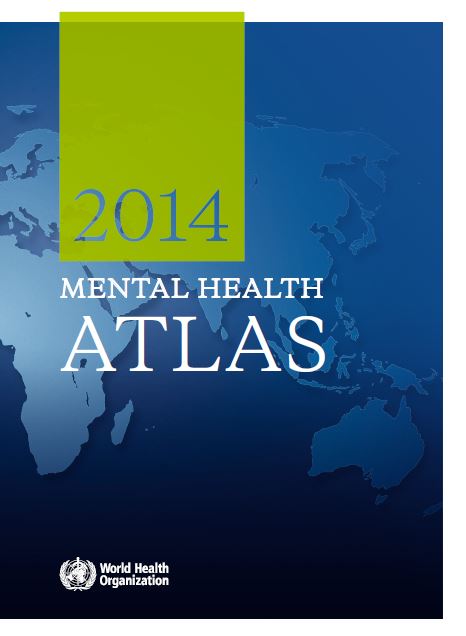
The report states global spending on mental health is still very low. Low and middle-income countries spend less than US$ 2 per capita per year on mental health, whereas high-income countries spend more than US$ 50.
- 80% of countries will have developed or updated their policies or plans for mental health in line with international and regional human rights instruments by the year 2020. Baseline: 45% of all WHO Member States
- 50% of countries will have developed or updated their law for mental health in line with international and regional human rights instruments by the year 2020. Baseline: 34% of all WHO Member States
- Service coverage for severe mental disorders will have increased by 20% by the year 2020. Baseline: Currently not computable from Atlas 2014 data
- 80% of countries will have at least two functioning national, multisectoral mental health promotion and prevention programmes by the year 2020. Baseline: 41% of all WHO Member States
- The rate of suicide in countries will be reduced by 10%. Baseline: 11.4 per 100 000 population 80% of countries will be routinely collecting and reporting at least a core set of mental health indicators every two years through their national health and social information systems by the year 2020.
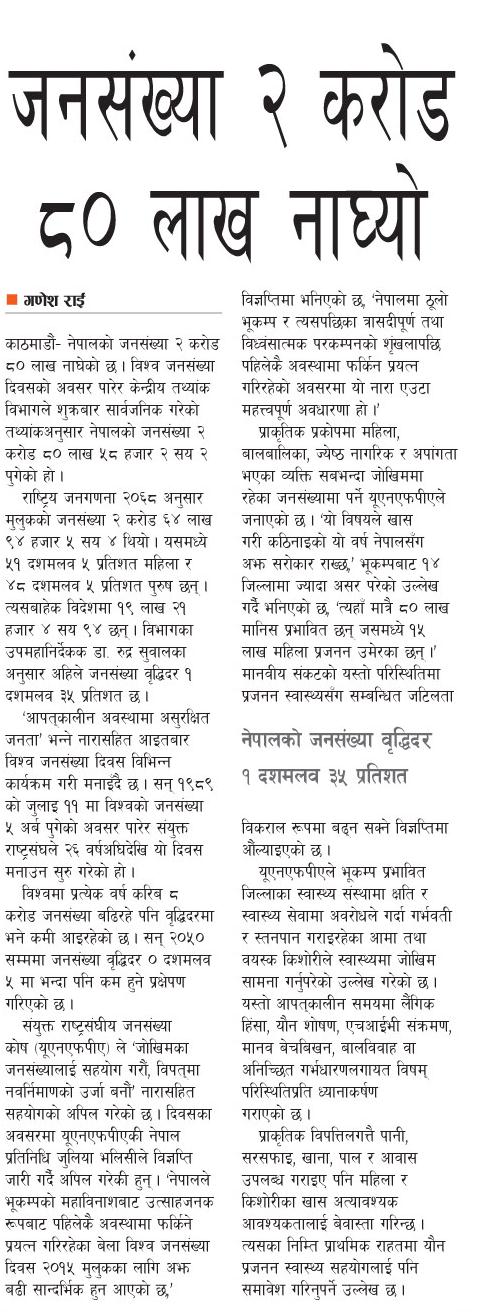
Fast facts (Source: The Himalayantimes News)
- Eight million people, alone in the 14 most-affecte
d districts, were affected when the devastating quake hit the country on April 25 - Among them are 1.5 million women of reproductive age
- With damaged health institutions and disrupted health and reproductive health services, many women, especially pregnant women, breastfeeding mothers and adolescent girls are facing increased health risks
- Vulnerable people in time of emergencies are more likely to endure the consequences of a crisis such as gender-based violence, sexual exploitation, HIV infection, human trafficking, child marriage or even unwanted pregnancies
- In the aftermath of a disaster, provisions of water, sanitation, food, tents and housing are automatically delivered while specific and essential needs for women and girls are often overlooked. Sexual reproductive health support to women and girls should also be integrated in the relief package.
- Monitor tobacco use and prevention policies;
- Protect people from tobacco smoke;
- Offer help to quit tobacco use;
- Warn people about the dangers of tobacco;
- Enforce bans on tobacco advertising, promotion and sponsorship; and
- Raise taxes on tobacco.
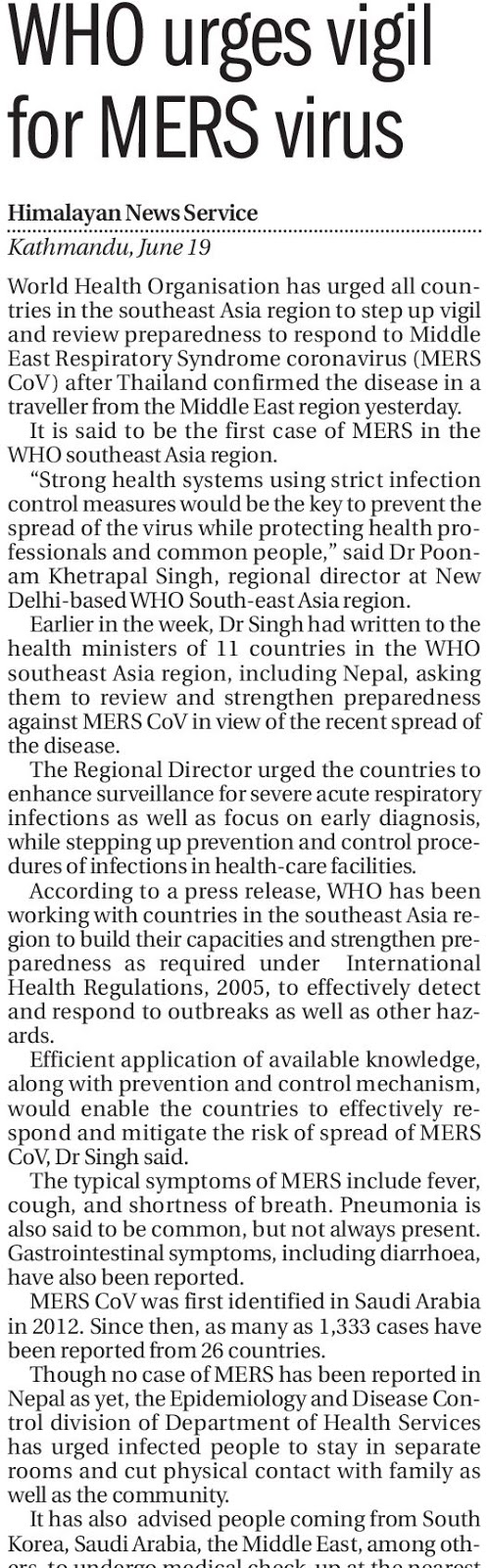
WHO urges vigil for MERS virus- Himalayan News Service (20th June 2015)
It is said to be the first case of MERS in the WHO southeast Asia region. “Strong health systems using strict infection control measures would be the key to prevent the spread of the virus while protecting health professionals and common people,” said Dr Poonam Khetrapal Singh, regional director at New Delhi-based WHO South-east Asia region. Earlier in the week, Dr Singh had written to the health ministers of 11 countries in the WHO southeast Asia region, including Nepal, asking them to review and strengthen preparedness against MERS CoV in view of the recent spread of the disease.
The Regional Director urged the countries to enhance surveillance for severe acute respiratory infections as well as focus on early diagnosis, while stepping up prevention and control procedures of infections in health-care facilities. According to a press release, WHO has been working with countries in the southeast Asia region to build their capacities and strengthen preparedness as required under International Health Regulations, 2005, to effectively detect and respond to outbreaks as well as other hazards. Efficient application of available knowledge, along with prevention and control mechanism, would enable the countries to effectively respond and mitigate the risk of spread of MERS CoV, Dr Singh said. The typical symptoms of MERS include fever, cough, and shortness of breath. Pneumonia is also said to be common, but not always present.
Gastrointestinal symptoms, including diarrhoea, have also been reported. MERS CoV was first identified in Saudi Arabia in 2012. Since then, as many as 1,333 cases have been reported from 26 countries. Though no case of MERS has been reported in Nepal as yet, the Epidemiology and Disease Control division of Department of Health Services has urged infected people to stay in separate rooms and cut physical contact with family as well as the community. It has also advised people coming from South Korea, Saudi Arabia, the Middle East, among others, to undergo medical check-up at the nearest health facility if they have symptoms of fever, cough and pneumonia.
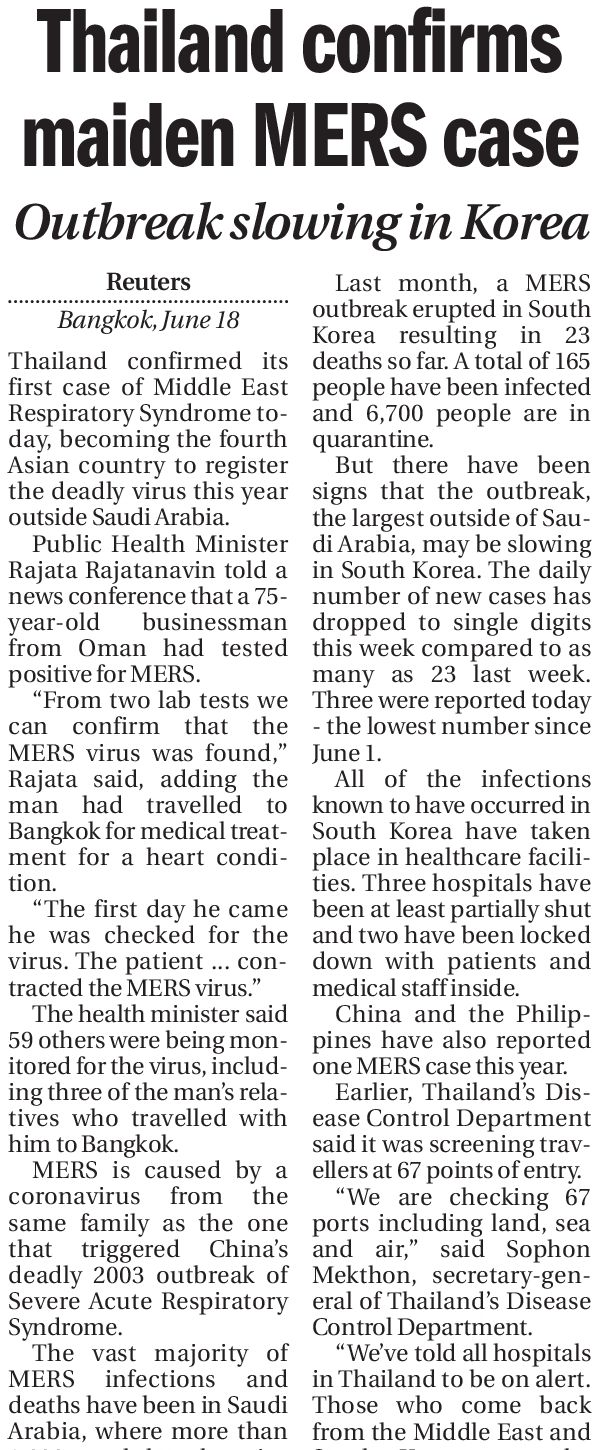
Thailand confirms maiden MERS case- The Himalayan Times News ( 19th June 2015)
Public Health Minister Rajata Rajatanavin told a news conference that a 75-year-old businessman from Oman had tested positive for MERS.“From two lab tests we can confirm that the MERS virus was found,” Rajata said, adding the man had travelled to Bangkok for medical treatment for a heart condition.“The first day he came he was checked for the virus.
The vast majority of MERS infections and deaths have been in Saudi Arabia, where more than 1,000 people have been infected since 2012, and about 454 have died. Last month, a MERS outbreak erupted in South Korea resulting in 23 deaths so far. A total of 165 people have been infected and 6,700 people are in quarantine.But there have been signs that the outbreak, the largest outside of Saudi Arabia, may be slowing in South Korea. The daily number of new cases has dropped to single digits this week compared to as many as 23 last week. Three were reported today – the lowest number since June 1.All of the infections known to have occurred in South Korea have taken place in healthcare facilities.
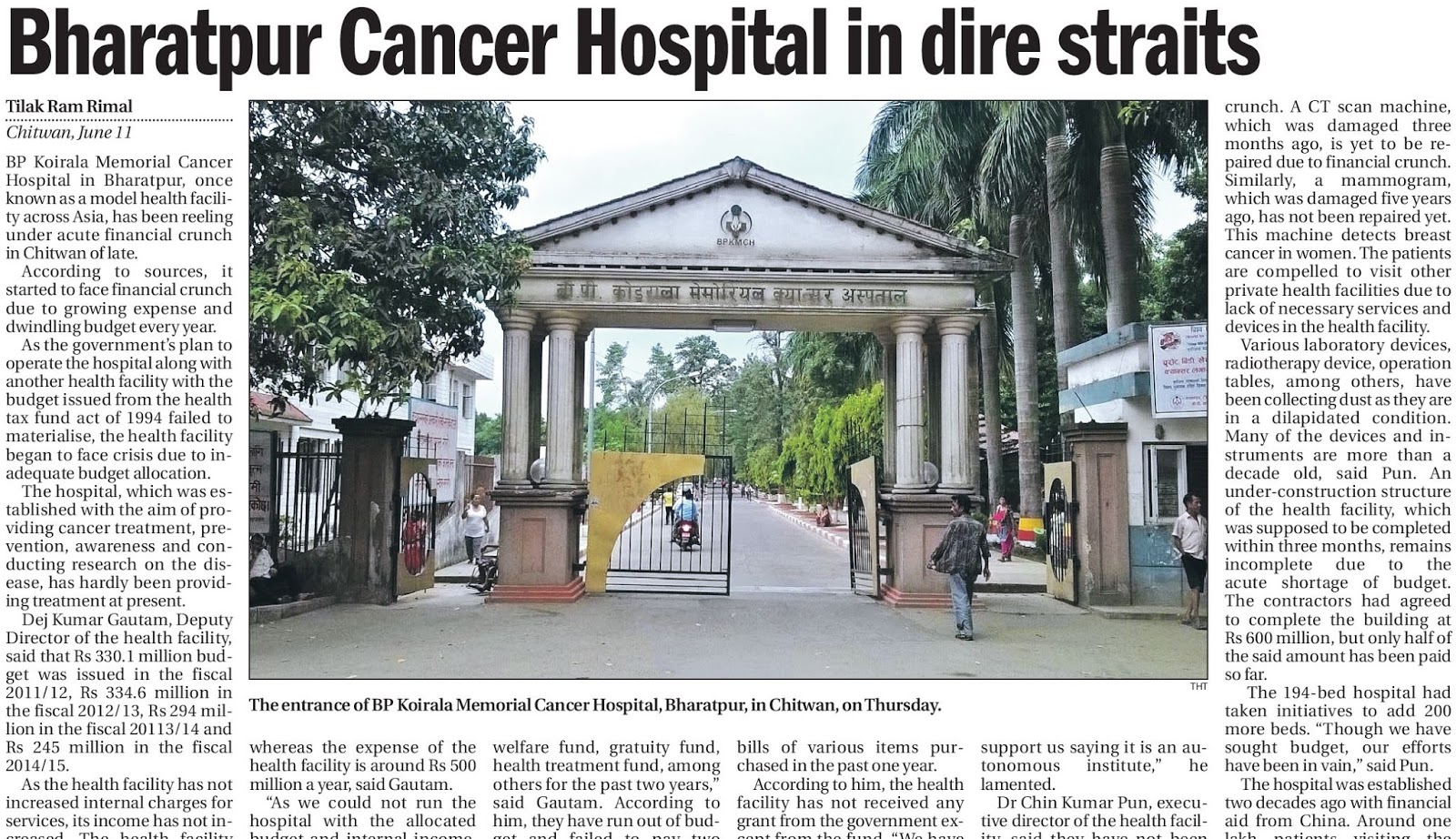
charges for services, its income has not increased. The health facility earns around Rs 100 million from services every year, whereas the expense of the health facility is around Rs 500 million a year, said Gautam. “As we could not run the hospital with the allocated budget and internal income, we have spent Rs 280 million collected in the employee’s welfare fund, gratuity fund, health treatment fund, among others for the past two years,” said Gautam. According to him, they have run out of budget and failed to pay two months’ salary to employees. They are also yet to clear all the bills of various items purchased in the past one year. According to him, the health facility has not received any grant from the government except from the fund. “We have been facing acute budget crunch as the state doesn’t support us saying it is an autonomous institute,” he lamented. Dr Chin Kumar Pun, executive director of the health facility, said they have not been able to purchase necessary instruments due to budget crunch. A CT scan machine, which was damaged three months ago, is yet to be repaired due to financial crunch. Similarly, a mammogram, which was damaged five years ago, has not been repaired yet. This machine detects breast cancer in women.
Overview
The Ministry of Health of His Majesty’s Government of Nepal developed a 20-year Second Long-Term Health Plan (SLTHP) for FY 2054-74 (1997-2017). The aim of the SLTHP is to guide health sector development in the improvement of the health of the population, particularly those whose health needs are not often met.
The SLTHP addresses disparities in healthcare, assuring gender sensitivity and equitable community access to quality healthcare services. The aims of the SLTHP are to provide a guiding framework to build successive periodic and annual health plans that improve the health status of the population; to develop appropriate strategies, programmes, and action plans that reflect national health priorities that are affordable and consistent with available resources; and to establish co-ordination among public, private and NGO sectors and development partners.
The SLTHP vision is a healthcare system with equitable access and quality services in both rural and urban areas. The system would encompass the concepts of sustainability, full community participation, decentralisation, gender sensitivity, effective and efficient management, and private and NGO participation.
Objectives
- To improve the health status of the population of the most vulnerable groups, particularly those whose health needs often are not met-women and children, the rural population, the poor, the underprivileged, and the marginalized population.
- To extend to all districts cost-effective public health measures and essential curative services for the appropriate treatment of common diseases and injuries.
- To provide the appropriate numbers, distribution and types of technically competent and socially responsible health personnel for quality healthcare throughout the country, particularly in under-served areas.
- To improve the management and organisation of the public health sector and to increase the efficiency and effectiveness of the healthcare system.
- To develop appropriate roles for NGOs, and the public and private sectors in providing and financing health services.
- To improve inter-and intra-sectoral co-ordination and to provide the necessary conditions and support for effective decentralisation with full community participation.
Targets
The targets of the SLTHP are as follows:
- To reduce the infant mortality rate to 34.4 per thousand live births;
- To reduce the under-five mortality rate to 62.5 per thousand;
- To reduce the total fertility rate to 3.05;
- To increase life expectancy to 68.7 years;
- To reduce the crude birth rate to 26.6 per thousand;
- To reduce the crude death rate to 6 per thousand;
- To reduce the maternal mortality rate to 250 per hundred thousand births;
- To increase the contraceptive prevalence rate to 58.2 percent;
- To increase the percentage of deliveries attended by trained personnel to 95%;
- To increase the percentage of pregnant women attending a minimum of four antenatal visits to 80%;
- To reduce the percentage of iron-deficiency anaemia among pregnant women to 15%;
- To increase the percentage of women of child-bearing age (15-44) who receive tetanus toxoid (TT2) to 90%;
- To decrease the percentage of newborns weighing less than 2500 grams to 12%;
- To have essential healthcare services (EHCS) in the districts available to 90% of the population living within 30 minutes’ travel time of facilities;
- To have essential drugs available at 100% of facilities;
- To equip 100% of facilities with full staff to deliver essential health care services; and
- To increase total health expenditures to 10% of total government expenditures.
⚡ Looking for expert analysis, policy briefs, and high-level reviews on Nepal's health sector?
We are now offering premium subscription services to deliver timely, evidence-backed policy briefs, comprehensive technical reviews, and strategic analysis straight to your inbox. Tap into specialized consultant expertise and stay ahead on Nepal's emerging health strategies.
👉 [Contact Us]
Do you have a website? Looking for the best hosting provider? Here’s a discount code.
Latest Public Health Jobs
Latest Posts
- Call for Registration! National Health Promotion Conference 2026
- World Atopic Eczema Day 2026: Breaking the Invisible Burden
- DEVASTATING FLOODS IN NEPAL: PUBLIC HEALTH IMPACT AND A CALL FOR HUMANITARIAN SUPPORT
- PEN-Plus Orientation Manual for Mid-Level Health Care Workers
- National Health Training Strategy 2082
Thanks for visiting us.
Disclaimer: The resources, documents, guidelines, and information on this blog have been collected from various sources and are intended for informational purposes only. Information published on or through this website and affiliated social media channels does not represent the intention, plan, or strategies of an organization that the initiator is associated with in a professional or personal capacity, unless explicitly indicated.
If you have any complaints, information, or suggestions about the content published on Public Health Update, please feel free to contact us at blog.publichealthupdate@gmail.com.
#StayUpdated