Public Health Update
  • Home
  • Public Health Update
  • Nepal Health Jobs
    • Public Health Job Board
    • Organization List
  • Opportunities
    • Fellowships, Studentship & Scholarships
    • Grants and Funding Opportunities
    • Fully funded
    • Conference
  • Downloads
    • International Plan, Policy & Guidelines
    • National Plan, Policy & Guidelines
    • Reports
    • Public Health Notes
    • Syllabus
    • Form Formats
  • School of Public Health
    • PhD
    • Master’s Degree
    • Online Courses
  • Notice
LOGIN / REGISTER
Public Health Update
SUBSCRIBE
Public Health Update
  • Home
  • Public Health Update
  • Nepal Health Jobs
    • Public Health Job Board
    • Organization List
  • Opportunities
    • Fellowships, Studentship & Scholarships
    • Grants and Funding Opportunities
    • Fully funded
    • Conference
  • Downloads
    • International Plan, Policy & Guidelines
    • National Plan, Policy & Guidelines
    • Reports
    • Public Health Notes
    • Syllabus
    • Form Formats
  • School of Public Health
    • PhD
    • Master’s Degree
    • Online Courses
  • Notice

All Right Reserved. Designed and Developed by PenciDesign

National Health NewsPublic Health News

Docs stress condom use to avoid STIs

by Public Health Update February 13, 2018
written by Public Health Update

Docs stress condom use to avoid STIs

 According to Nepal Demographic Health Survey 2016, 72 per cent of women and 92 per cent of men know that use of condom prevents HIV transmission and other sexually transmitted infections. However, the increasing number of HIV infected people in the country suggests that many of them either don’t know how to use condoms correctly or don’t use them consistently.
Data with National Centre for AIDS and STD Control, a total of 30,646 HIV cases have been reported in the country as of July 15, 2017. Among them, 18,989 are males, 11,535 females and 122 are transgender.
Health practitioners in the country, therefore, suggest that people should use condoms consistently and correctly to avoid the infections. As the world is celebrating International Condom Day on February 13 with the aim of making people aware of safe sex practices, health experts have suggested that people use the correct type of condoms to stay safe from sexually transmitted infections.
“Condoms help in prevention of HIV and other STIs and also provide protection from unwanted pregnancy if used consistently and correctly,” said Dr Anup Bastola, HIV clinician at Sukraraj Tropical and Infectious Disease Hospital, Teku.   “However, people in Nepal feel awkward buying condoms and many of them even believe that condom kills sexual pleasure,” added Bastola.
Similarly Dr Bastola also suggested using water based, silicone based lubricants. “Oil based lubricant shouldn’t be used. Similarly use of baby oil, lotions and cooking oil can damage condoms. Such kind of activities should be avoided. Condoms shouldn’t be kept in heat as heat damages them. Instead, it should be kept in cool and dry place. Similarly the same condom should also not be re-used and more than one condom shouldn’t be used at a time as it can damage the condom and also there are chances for slippage. Only latex and polyurethane condoms should only be used,” added Dr Bastola.
A condom acts as a barrier or wall to keep blood, or semen, or vaginal fluids from passing from one person to the other during intercourse. These fluids can harbour germs such as HIV and other sexually transmitted infections. If no condom is used, germs can pass from the infected partner to the uninfected partner.

HIMALAYAN NEWS SERVICE
Kathmandu, February 12

ORIGINAL SOURCE OF INFO

February 13, 2018 0 comments
0 FacebookTwitterPinterestLinkedinTumblrVKOdnoklassnikiRedditStumbleuponWhatsappTelegramLINEPocketSkypeViberEmail
PH Important DayPublic Health

International Condom Day – ‘Condoms are always in fashion’

by Public Health Update February 13, 2018
written by Public Health Update

International Condom Day – ‘Condoms are always in fashion’

2/13/2018: International Condom Day seeks to promote the use of condoms as a means of preventing unwanted pregnancies and sexually transmitted infections (STIs).  Condoms are thin rubber covers that a man wears on his penis during sexual intercourse as a contraceptive or as protection against STIs. Condoms are made from various materials such as latex, non-latex, lambskin and even female condoms. Condoms, latex and polyurethane versions, are the only method available to prevent transmission of STIs and HIV.
International Condom Day is promoted by the AIDS Healthcare Foundation in an effort to reduce the spread of HIV through safe sex practices.  Since its inception in 2009, it has been an informal observance celebrated in conjunction with Valentine’s Day.

Key Message: International Condom Day – ‘Condoms are always in fashion’

ORIGINAL SOURCE OF INFO

February 13, 2018 0 comments
0 FacebookTwitterPinterestLinkedinTumblrVKOdnoklassnikiRedditStumbleuponWhatsappTelegramLINEPocketSkypeViberEmail
Guest PostResearch & Publication

Need of The Ministry of Health in Federal Democratic Republic of Nepal

by Public Health Update February 12, 2018
written by Public Health Update

Need of The Ministry of Health in Federal Democratic Republic of Nepal

Kiran Regmi, Health Secretary, Ministry of Health, Government of Nepal, Kathmandu, Nepal
 Meera Upadhyay, National Professional Officer, WHO Country Office Nepal, Lalitpur, Nepal
 Ehsanullah Tarin, Health Systems Strengthening, Consultant WHO Country Office Nepal, Lalitpur, Nepal
 Padam Bahadur Chand Advisor, Ministry of Health, Government of Nepal, Kathmandu, Nepal
 Senendra Raj Uprety, Ex-Health Secretary, Ministry of Health, Government of Nepal, Kathmandu, Nepal
 Susheel Chandra Lekhak, National Professional Officer, WHO Country Office Nepal, Lalitpur, Nepal

Abstract

The constitution of Nepal provides appointing a council of ministers both at federal and provincial levels without defining portfolios. There is a political agreement that MOH will be retained at the federal level. This article draws evidences around the world to meet health needs of Nepalese, the role of provincial ministry of health and coordinating structure at district/local level.
The constitution emphasises on health and pronounced in 46 articles which provides guidance for the creation of federalized governance levels at federal, provincial and local levels. Retaining ministry of health at federal level without creating devolved structure at province and local levels in health sector will create difficulty in translating the spirit of the constitution and may not be effective in addressing health issues nationally and meeting global achievements like SDGs.
It is suggested to establish an elaborate health system accordingly in Nepal to ensure constitutional mandate of health as a basic human right.

VIEW POINT J Nepal Med Assoc 2017;56(206):281-87
JNMA I VOL 56 I ISSUE 206 I APR-JUN 2017

Download : Journal of Nepal Medical Association

The information contained on https://publichealthupdate.com website is for general information purposes only.

February 12, 2018 0 comments
0 FacebookTwitterPinterestLinkedinTumblrVKOdnoklassnikiRedditStumbleuponWhatsappTelegramLINEPocketSkypeViberEmail
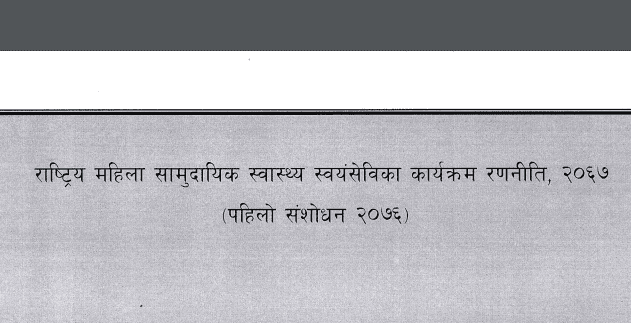
National Female Community Health Volunteer Program Strategy (First Revision 2076)
National Plan, Policy & GuidelinesPublic Health NotesResearch & Publication

National Female Community Health Volunteer Program Strategy (First Revision 2076)

by Public Health Update February 12, 2018
written by Public Health Update

National Female Community Health Volunteer Program Strategy (First Revision 2076)

Goal: The goal of FCHV program is to support the national goal on health through community involvement in public health activities. This includes imparting knowledge and skills for empowerment of women, increasing awareness on health related issues and involvement of local institutions in promoting health care.

DOWNLOAD New version : National Female Community Health Volunteer Program Strategy


Female Community Health Volunteer (FCHV) Programme, Nepal

Objectives:

  • To activate the women for tackling health problems by imparting relevant knowledge and skills
  • To prepare a pool of self-motivated volunteers as a focal person for bridging the health programs with community.
  • To prepare a pool of volunteers to provide services for community-based health programs
  • To increase the participation of community in improving health
  • To develop FCHV as a motivator of health
  • To increase utilization of health care services through demand creation

Role of FCHV

  • The main role of FCHV will be concentrated on the health promoti onal activities of mothers and children in their working area. Besides, they will also help in promoti ng uti lization of available health services and raise awareness on health through MGH
  • FCHV will help in various health programs such as family planning, safer motherhood, newborn care, immunizati on, nutrition, communicable and epidemic diseases, acute respiratory diseases and diarrheal diseases control, environmental sanitation, health education and other national programs
  • FCHV will also provide recommended services like drug distribution and diseases management as directed by Nepal government based on community based approach
  • Other health programs also might involve FCHV through their guidelines. However, the involvement of FCHV in other programs should be mandatorily endorsed by central level FCHV Coordinati on sub-committee.
  • FCHV has to submit an annual report to local health institution and her MGH.
  • FCHV has to submit a monthly report of her activities to local health worker or supervisor every month
  • FCHV can be selected by her respective MGH for a term of 5 years
  • FCHVs are entitled to abide by the code of ethics.

fchvs
Explanation of logo: 
When a small pebble is thrown into a pond, it creates a wave, which gradually spreads all over the surface of pond. Similarly, the activities of FCHV starts at ward level and gradually spreads to VDC level. Subsequently, the district will be covered with such actions and ultimately, whole nation will be developed through FCHV’s action The innermost circle shows that the action starts at community or ward level by individual FCHV, (as community is the center of health activities) Second circle shows the action is spread in the enti re VDC Third circle depicts whole district will be covered by FCHV’s actions The outermost circle shows that the action of FCHV will cover the whole nation. (National Female Community Health Volunteer Program Strategy)
Selection of FCHV
A meeting of MGH will select FCHV on the following basis. The decision of selection of a new FCHV should be communicated formally to local health institution and local government.
Basis of selection of FCHV

  • Permanent resident of the related ward of VDC
  • Interested to work as FCHV for at least 10 years
  • Age between 25-45 years d) Married or single (priority to be given to women having up to 3 children in case of a married woman)
  • Having commitment to serve the community
  • Priority will be given to those, who can read and write
  • Priority will be given to women from Dalit, Janajati and Marginalized groups
  • Those who are interested to be FCHV will have to submit an application to MGH
  • However, those women who are involved in a paid job, will not be allowed to be FCHV.

Retirement

  • FCHV attaining the age of 60 years will be bidden honored farewell on the recommendati on of MGH
  • A letter of honor as well as a designated amount of money may be provided to the retiring FCHV after serving satisfactorily for a period of years.
  • Retiring FCHV will be requested to be a honored member of the MGH
  • Retiring FCHV might continue to get the benefits of an active FCHV like obtaining free essential health care as per the guidelines.

DOWNLOAD : National Female Community Health Volunteer Program Strategy

Female Community Health Volunteer (FCHV) Programme, Nepal

27545632 1645906012161697 2762986854543107454 n

February 12, 2018 2 comments
0 FacebookTwitterPinterestLinkedinTumblrVKOdnoklassnikiRedditStumbleuponWhatsappTelegramLINEPocketSkypeViberEmail
National Health NewsPublic Health News

Health facilities facing shortage of vital drugs for pregnant women, new mothers

by Public Health Update February 11, 2018
written by Public Health Update

Health facilities facing shortage of vital drugs for pregnant women, new mothers

Kathmandu, February 9
Health facilities in Kathmandu Valley are facing shortage of essential drugs like ‘magnesium sulphate’ due to delay in procurement.
Magnesium sulphate (MgSo4) is an essential drug for controlling seizures associated with pre-eclampsia and eclampsia. Eclampsia is one of the main causes for maternal death in the country.
Community nursing officer Keshu Kafle said health budget had already been allocated to the local levels to buy essential drugs including oxytocin, which are used to stop excessive bleeding in new mothers during delivery. Eclampsia should be available at every health facility because if a woman in labour needs to be referred to another heath facility, she should be injected with the first dose of eclampsia.
Similarly, if a pregnant woman develops seizures before and during delivery or after 42 days of delivery, she must be given this drug to control seizures. Lack of timely intervention in such cases may lead to the death of a patient due to breathing difficulties.
Government of Nepal has invested millions of rupees to control maternal death but it has all gone down the drain. A survey carried out in the year 2016 shows that the current maternal mortality rate is 239 per 100,000 live births while it was 281 in 2006 and 543 in 1996.
Community nursing officer Keshu Kafle further said there was a need to find out why the government’s efforts failed to control maternal mortality rate, adding that local levels must take the responsibility to control this.
“It is local level’s responsibility to release the budget on time for purchase of medicines. Many health facilities are facing medicine crunch due to delay in releasing health budget for health facilities,” she said, drawing the attention of the chiefs of local levels towards this problem.
RSS
February 11, 2018 0 comments
0 FacebookTwitterPinterestLinkedinTumblrVKOdnoklassnikiRedditStumbleuponWhatsappTelegramLINEPocketSkypeViberEmail
National Health NewsPublic Health News

Vitamin D deficiency on the rise among kids

by Public Health Update February 10, 2018
written by Public Health Update

Vitamin D deficiency on the rise among kids

Paediatricians have suggested parents to allow infants to soak up in the sun to minimise the risk of Vitamin D deficiency.
Reports say infants with Vitamin D deficiency have high chances of suffering from diabetes and obesity. The tendency to test for Vitamin D deficiency has increased among parents in recent years and the tests have shown that many infants lack the required level of Vitamin D in their body, the doctors say.
“We have found that Vitamin D deficiency in infants slows down their physical growth,” said Dr Subhana Thapa, senior consultant paediatrician at Kanti Children’s Hospital, Maharajgunj. “The number of children suffering from vitamin D deficiency is on the rise,” said Dr Sujit Kumar Shrestha, consultant paediatrician at Om Hospital, Chabahil.
The possible reason for vitamin D deficiency among children is parents’ tendency to keep their children indoors for safety reasons. “The children these days are busy playing indoor games instead of playing outside in the open and they aren’t exposed to sunlight to get necessary vitamin D. Children get vitamin D from the food they eat but food alone cannot provide the amount of Vitamin D their body needs,” informed Dr Shrestha.
Nowadays, children living in cities are deprived of direct sunlight due to which many children in city are having Vitamin D deficiency.  Nutrition and genetic factors also contribute to Vitamin deficiency in children.
“Pain in legs, bone deformity and slow growth rate, among others, are symp toms of vitamin D deficiency,” informed Dr Ganendra Raya, paediatrician at Siddhi Memorial Hospital, Bhaktapur.
Vitamin D is necessary for bone growth and immunity. Vitamin D deficiency is associated with deteriorating bone health and in severe cases, hypoglycemia, rickets, and osteomalacia in children and adults.
Children who are on exclusive breast feeding and below one year of age are recommended for Vitamin D supplement. “Preterm babies should be given the supplement so as to save them from rickets as they are more prone to Vitamin D deficiency,” said Dr Thapa.
To help children get enough Vitamin D, children should be exposed to sunlight, provided with nutritious food and a regular visit to paediatricians is a must, according to doctors.
The Himalayan Times, February 10, 2018 (ORIGINAL LINK OF INFO)

February 10, 2018 0 comments
0 FacebookTwitterPinterestLinkedinTumblrVKOdnoklassnikiRedditStumbleuponWhatsappTelegramLINEPocketSkypeViberEmail
National Plan, Policy & GuidelinesPresentation SlidesPublic Health NotesResearch & Publication

Jointly Annual Review (JAR) 2018 Presentations

by Public Health Update February 9, 2018
written by Public Health Update

Jointly Annual Review (JAR) 2018 Presentations

1 jar
jar2
jar3
Jointly Annual Review (JAR) 2018 Presentations

 DOWNLOAD PRESENTATIONS  

 DOWNLOAD PRESENTATIONS 

 DOWNLOAD PRESENTATIONS 

Remarks, Secretary, Ministry of Health, Joint Annual Review, 2018

Hon. Minister’s speech for Joint Annual Review, 2018

Jointly Annual Review (JAR) 2018 Presentations

February 9, 2018 0 comments
0 FacebookTwitterPinterestLinkedinTumblrVKOdnoklassnikiRedditStumbleuponWhatsappTelegramLINEPocketSkypeViberEmail
Public HealthPublic Health Events

Hon. Minister’s speech for Joint Annual Review, 2018

by Public Health Update February 9, 2018
written by Public Health Update

Hon. Minister’s speech for Joint Annual Review, 2018

First and foremost, let me welcome you all in this special Joint Annual Review of the health sector, as this is the first review in the federal context. Special welcome to our international delegates who have travelled afar to be with us in this important event.
Honourable NPC Member, secretaries of various ministries, Chief Specialists and Officials of Health Ministry, EDP chair, distinguished colleagues, ladies and gentlemen.
In 2004, we made a strategic shift from projects based approach to Sector Wide Approach (SWAp) and now we enjoy much strengthened partnership in the health sector of Nepal. Partnerships have been the cornerstone of our health achievements and we will continue to harness it to sustain our achievements and tackle existing health challenges. Every year we gather in this important forum of Joint Annual Review (JAR) to reflect on our mutual achievements of the past year and agree on strategic priorities for the next year. Over the last decade we
have been progressively able to increase the meaningful participation of our international development partners, civil society, NGOs, academia, and private sector in the JAR; thereby employing the broad partnership to improve our health outcomes.
Because of our joint effort, we have achieved most of the health related targets of MDGs. Over the last 20 years, we have reduced infant mortality and under-5 mortality substantially. Owing to the revolutionary DOTS programme in curing the TB, we have been preventing thousands of deaths every year. Through
programmes such as free essential healthcare and safe delivery incentive schemes, we are also attempting to mitigate social, cultural, and financial barriers in seeking healthcare. Now the Government of Nepal is committed to achieve the Sustainable Development Goals set for the year 2030.
Ladies and gentlemen We are still in the phase of political transformation. The country is moved from unitary system of governance to the federal form of governance. As mandated by the new Constitution, the present government has successfully held the three elections in this year. As a result, people’s representatives at local levels have already started working. Now the federal and provincial governments are being formed. I believe, this is a remarkable achievement in the process of moving  towards implementing the Constitution. Now It is easier for all the 761 governments in the country to reach to the people who were left behind earlier.
In this socio-political climate, health and development landscape bears both opportunities and challenges for us. Our Constitution, for the first time in history of the nation, has guaranteed health as a fundamental right of every citizen. This has provided us with political impetus to expedite our efforts to achieve Universal Health Coverage. Now it’s the duty of the governments of all levels of federal structure to ensure these rights. In this regards, we have developed our sectoral strategy (2016-2020) based on the principles of equity and social justice. I urge you all to take initiative to develop a health system that is based on the social justice and good governance in all levels of governance.
The local governments are mandated by the constitution to provide basic health services, however, it is the responsibility of all of us to make them resourceful. Health is a multi-dimensional sector; I believe that federal structure of governance has made it easier to establish health as a development agenda in the local level In the process of implementing the federalism in health, the service delivery structure of health is already prepared and endorsed. The governance structure of health in the federal context is being prepared and discussed with relevant
agencies. Similarly, other arrangements in the context of implementing federalism are going on. Nepal Government is committed to establish a health facility in each ward and a hospital in each municipal. The Government has also come up with an integrated health infrastructure project. Partner’s support in these endeavours is welcome.
Alongside the need to make further headway in providing equitable access to quality primary healthcare services, we face many emerging health challenges. The burden of non-communicable diseases is increasing; growing health needs of urban poor requires more investment; malnutrition, specially stunting, remains a major issue to be tackled; similarly improving new-born care requires further efforts on our part; out-of-pocket expenditure on health is still very high which warrants fair financing mechanisms; deployment and retention of health workers
in remote areas of the country is still a problem; we must also do more to narrow health disparities specially for hard-to-reach, socially excluded and marginalized population. As if these challenges were not enough, we are vulnerable to natural disasters and now we face adverse effects of climate change. And we have not
forgotten the destruction caused by the 2015 earthquake.
The evidence shows that in order to ensure the access of all people in quality health services, 5% investment of national income is required, however, we are able to invest only less than 2%. Expenditure for health treatment should not be allowed at any cost to be a cause of poverty. I am confident that Nepal government will continue to increase its share of investment in health sector in years to come. The present government has taken many initiatives to ensure constitutional mandate of ensuring health services to its citizens particularly to those who need it most.
As you are aware, the present government has just initiated the implementation of social security scheme in health, by providing Rs 5000 per month for cancer patents, patents with kidney failures, and patents with spinal injuries. Health Insurance Act has been enacted which provides the legal basis for covering all the people in the net of health insurance.
To sustain our achievements, tackle the challenges I mentioned, and to align with the federal context, we have prepared a new health policy with the support and participation of relevant stakeholders and it is already tabled in the Cabinet for approval.
Ladies and gentlemen
I am of the opinion that health should be in the centre of development. Well-being of our population and overall economic progress of our country are intrinsically linked with health outcomes. While Ministry of Health and health development partners have been and remain important actors but so are other line agencies of the government, development partners, private sector, and civil society for achieving and sustaining health results. This has become even more pertinent now, where we live in a world with ever-shrinking global boundaries and everexpanding socio-economic and political interdependence.
As I said, Ministry of Health alone cannot always make a positive dent in health outcomes; there are other structural factors and social determinants affecting health. We are increasingly seeking multi-sectoral response to address the complexities.
Ladies and gentlemen
I wish you all a very productive Joint Annual Review. I wish our international delegates a wonderful stay in Kathmandu.
Thank you very much.

Remarks, Secretary, Ministry of Health, Joint Annual Review, 2018

Hon. Minister’s speech for Joint Annual Review, 2018

Jointly Annual Review (JAR) 2018 Presentations

February 9, 2018 0 comments
0 FacebookTwitterPinterestLinkedinTumblrVKOdnoklassnikiRedditStumbleuponWhatsappTelegramLINEPocketSkypeViberEmail
Public HealthPublic Health Events

Remarks, Secretary, Ministry of Health, Joint Annual Review, 2018

by Public Health Update February 9, 2018
written by Public Health Update

Remarks, Secretary, Ministry of Health, Joint Annual Review, 2018

Joint Annual Review, Dr. Pushpa Chaudhary, Secretary, Ministry of Health (31st Jan 2018)
Namaste and Warm greetings to all of you on behalf of ministry of health on the occasion of first JAR in federal context.

  • Hon’ble Minister of health, Mr Deepak Bohar
  • Hon. Member, National Planning Commission, Dr Geeta Bhakta Joshi
  • Respected secretary , Ministry of Finance, Mr Shankar Adhikari, Representatives of government of other ministries and local government,
  • Director Generals from Department of Health Services, Ayurveda and Drug Administration,
  • Vice Chancellors of Academic Institutions ,
  • EDP chair,
  • Directors from Different Centers and Divisions, hospital directors
  • Representatives from national and international partner organizations,
  • Ex secretaries and Director generals of health ministry ant other distinguished guests and Fellow colleagues,
  • Members from media and all other invitees,

Ladies and Gentlemen

  • This year is the 40th anniversary of the Alma Ata Declaration- which expressed the need for urgent action by national governments, health and development workers, and the world community to protect and promote health of all people. Four decades down the line, we have yet another opportunity “Federalism” to reaffirm this international commitment of people-centered primary care as a foundation to achieve universal health coverage.
  • Health sector transitioning to federalism is certainly the top concern for all, as there are many uncertainties. What we must understand is that federalism is new to all and we need collective wisdom to be able to take policy decisions that will help to sustain the health gains as well as achieve the goals and targets of Nepal Health Sector Strategy (NHSS) and Sustainable Development Goals.
  • The NHSS, our guiding document for the health sector for next four years has four strategic directions for Universal Health Coverage (UHC); equity, quality, reform and multi-sectoral collaboration which are indeed very important needs to be incorporated into various tiers of government for effectiveness. In this regard, necessary adjustments to the NHSS’s implementation plan is needed to suit the changed context and these need to be translated into the activities in the AWPB.
  • Investment for UHC means laying the foundation for making progress towards all the other targets and goals even beyond the health sector – like ending poverty, improving gender equality, economic growth, and more. When we talk about Universal health coverage, I must underscore the need of adequate, skilled, well-trained and motivated workforce for improving the health services. We have the presence of academia and private sectors here and with effective partnership we can address the challenges of human resources. Enabling environment is crucial and I see greater the role of local governments in terms of ensuring safe and motivating work environment to our health workforce.
  • Next, is the financing for health, which is an important part of broader efforts to ensure social protection in health. We have envisioned one health facility in every ward at local level , one 15 bedded hospital in each local unit and one multi super specialty hospital in each province. These health institutions will certainly need added number of skilled human resource together with equipments and supplies to provide range of services- basic as well as specialized but this can only be possible by investing more on health services. Health care financing is crucial for free basic health services for all as mandated by the constitution as well as strengthen social health insurance for covering wider population for increasing range of services beyond basic.
  • Globally, evidence shows that 85% of the costs of meeting the SDG health targets can be met with domestic resources and we need to increase our domestic funding on health. However, there is also need for partners to increase their investment in health so that together we can achieve the goals and targets that we have committed to.
    Ladies and Gentlemen,
  • As we all know, the national health sector strategy (NHSS) is developed within the context of Sector Wide Approach (SWAp) and it sees partnership as a cornerstone for health development in Nepal. Therefore, the SWAp in health should continue even in the changed federal context. I hope for the seamless support from the partners as in the past in the implementation of SWAp. I would also like to take this opportunity to inform the donors and partners that the federal government is mandated by the Constitution to sign international treaties and agreements. Therefore, I urge all of you to comply with this.
  • The functional analysis and assignment (FAA) of the Cabinet has clearly delineated functions of all three levels of government and MoH is working to ensure that the functions for health sector is delivered effectively and with quality by all three levels of government. Amongst other functions, delivery of basic health service is the responsibility of the local government while federal government has the responsibility to define its scope and develop standards. I urge my colleagues to prioritize this task and request EDPs to provide the required support.
  • In accordance to the function of the federal level, MoH is developing several legal and regulatory frameworks to govern the health sector in light of the federal context. Social Health Insurance Act has been recently promulgated by the parliament. Similarly, the National Health Act, the Health Institution Quality Assurance
  • Authority Act have been drafted by the MoH and are in inter-ministerial consultation process. Moreover, a new national health policy has been developed and submitted to the cabinet for the endorsement. In order to materialize these policy commitments, additional resources is required and I urge all the stakeholders and partners to support us in this endeavor.
  • I would also like to share that MoH has established the Federalism Implementation Unit to support the implementation of activities on federalism and to liaise with other ministries on health related issues. Several progress has been made in this regard which is captured in the Pre-JAR report and the gist will also be presented in the coming sessions.
  • MoH has shared the progress on federalism in several forums, the recent one being the National Annual Review Meeting. We discussed province-wise progress and challenges existing in the health sector during the National Annual Review few months back. We strongly feel that we need to focus more on those provinces where progresses are slow, particularly the province 2 and 6.
  • This JAR will touch upon those pertinent issues that we need to address in next year’s AWPB for which planning process will start soon.
  • For the harmonized support to the local level in health in the changed context, the ministry also needs a detailed technical assistance mapping of partners. I request EDP chair to lead this exercise and present the detailed TA mapping to MoH at the earliest possible. This is important to see who is doing what and where in the health sector to avoid duplication and to ensure that no local level is left behind.
  • While health sector is struggling to manage the communicable diseases, there is increasing burden of non-communicable diseases, antimicrobial resistance and disaster related health issues. Therefore, there is a greater need for multi-sectoral collaboration in health sector at all levels of government. For this, there are two panel discussions that are planned in the afternoon today. The first panel will be with the Mayors and second with the high level officials from various ministries to build common understanding and get insights to guide the health sector in this transition to federalism.
  • Federalism has provided impetus for the decentralized planning and budgeting at the Local Level. However, I will again emphasize that adequate financing for health is critical to ensure smooth delivery of health services. Similarly, procurement and effective management of supply chain is one of the critical functions to be coordinated at different levels of the governments. Therefore, MoH needs solution oriented proactive and flexible collaboration of EDPs in the implementation of the constitutionally mandated devolution of functions to the local governments.
  • In this JAR, we have tried to get the representatives from different ministries, development partners, private sector, civil societies, academia and other key stakeholders. I urge all of you to utilize this meeting to critically review the observations from the Pre-JAR field visit along with issues related to implementation of health program, capacity building and funding gaps so that our goal “to improve health status of all people through accountable and equitable health service delivery system” can be realized.
  • We need to engage our key stakeholders- civil society, as well as media colleagues for their effective participation in all health related areas. We would also like to acknowledge the contribution of academia, professional councils and private sector in improving the health outcomes by developing skilled health workforce and providing wide range of health service deliveries .
  • With this, I request all of you for active participation in this meeting by providing your valuable inputs and constructive feedback. I sincerely hope that together we can make this first JAR in the federal context fruitful and successful.

Finally, I thank all dignitaries over dais for encouraging us with your valuable presence and guidance, all distinguished guests and invitees and last but not the least , the organizing team members who have worked very hard with great enthusiasm over weeks and days to make this JAR happen. With these concluding words, I formally announce closing of the inaugural session and welcome you all in following technical session.
Thank you all

Remarks, Secretary, Ministry of Health, Joint Annual Review, 2018

Hon. Minister’s speech for Joint Annual Review, 2018

Jointly Annual Review (JAR) 2018 Presentations

February 9, 2018 0 comments
0 FacebookTwitterPinterestLinkedinTumblrVKOdnoklassnikiRedditStumbleuponWhatsappTelegramLINEPocketSkypeViberEmail
Trick, Technique & Skills

Automated online tool gives free advice on article structure and reporting ethics for Southern researchers

by Public Health Update February 8, 2018
written by Public Health Update

Automated online tool gives free advice on article structure and reporting ethics for Southern researchers

Partnership between Penelope.ai and INASP provides manuscript checking tool free of charge to researchers in the Global South.
INASP’s AuthorAID project has formed a partnership with Penelope.ai, an automated manuscript checking service.
Penelope automatically analyses scientific papers and makes suggestions on correct structure, reporting ethics and guidelines, referencing, and authorship.
The AuthorAID project supports early-career researchers in the Global South in publishing and communicating their work by providing free online training, resources, and an online mentoring and collaboration system.
Through this new partnership, Penelope will offer its tool free of charge to the AuthorAID network, under the name “AuthorAID manuscript checker, powered by Penelope”. Created specifically for AuthorAID, this version also provides additional support by recommending free resources on the AuthorAID website and elsewhere on the web.

The tool will be useful to authors who are preparing to submit a manuscript to a journal by reducing the likelihood of rejection due to structural or reporting errors. The service has been trialled with 60 AuthorAID users who rated the tool very highly – the average score was 8/10. Although designed primarily for life sciences, most of the advice offered by the tool is applicable to other research areas. It will now be available to the whole AuthorAID community and beyond for free.
Andy Nobes, Programme Officer at INASP, said: “Through our experience with running large-scale online courses in research writing for thousands of early-career and mid-career researchers in developing countries, we know that many struggle with structuring their papers, and how to include the correct ethical and data guidelines. This can be can be a significant barrier to successfully publishing and sharing their research, which has a knock-on effect on scientific progress and therefore development.”
James Harwood of Penelope said: “We are very pleased to support AuthorAID and to get feedback from a wider range of users. We want Penelope to be valuable and accessible to authors from all backgrounds. Integrating AuthorAID’s resources enriches the feedback Penelope gives and makes those resources more discoverable to the authors that need them.”

The new service can be accessed at app.penelope.ai/manuscript-check/authoraid

AUTHORAID NEWS

February 8, 2018 0 comments
0 FacebookTwitterPinterestLinkedinTumblrVKOdnoklassnikiRedditStumbleuponWhatsappTelegramLINEPocketSkypeViberEmail
Newer Posts
Older Posts

Search

Follow Us

Facebook Twitter Instagram Pinterest Linkedin Youtube

Categories

  • Abstracts (26)
  • Activities (91)
  • Adolescent Sexual and Reproductive Health (ASRH) (25)
  • Advice & Tips (4)
  • African Region (5)
  • AI and Health (1)
  • Annual Meeting (6)
  • Antimicrobial Resistance (AMR) (21)
  • Award (20)
  • Awards (17)
  • Books (9)
  • Call for Proposal, EOI & RFP (103)
  • Call for Research Participants (9)
  • Clinical Doctor Jobs (6)
  • Communicable Diseases (107)
  • Competition (20)
  • Conference (130)
  • Consultant (1)
  • Courses (206)
  • Dashboard (2)
  • Digital Health & Health Informatics (10)
  • Drug and Medicine (18)
  • Eastern Mediterranean Region (3)
  • Education (16)
  • Environment (3)
  • Environmental Health & Climate Change (47)
  • European Region (42)
  • Exchange Program (1)
  • Fact Sheet (118)
  • FCHVs (1)
  • Fellowships, Studentship & Scholarships (168)
  • Financial Aid (13)
  • Form Formats (2)
  • Fully funded (22)
  • Global Health News (440)
  • Grants and Funding Opportunities (193)
  • Guest Post (44)
  • Health Assistant Jobs (1)
  • Health Equity (7)
  • Health Financing and Economics (24)
  • Health in Data (118)
  • Health Insurance (5)
  • Health Jobs (52)
  • Health Literacy, Health Education & Promotion (51)
  • Health Organization Profile (42)
  • Health Systems (85)
  • Human Resource for Health (33)
  • Humanitarian Health & Emergency Response (45)
  • Hypertension (5)
  • Implementation Research (49)
  • International Health (3)
  • International Jobs & Opportunities (374)
  • International Plan, Policy & Guidelines (212)
  • Internships (5)
  • Jobs Vacancies (57)
  • Journals (8)
  • Life Style & Public Health Nutrition (39)
  • Live (10)
  • Master's Degree (48)
  • Maternal, Newborn and Child Health (88)
  • Mentorship Program (2)
  • Miscellaneous (16)
  • National Health News (160)
  • National Plan, Policy & Guidelines (473)
  • Neglected Tropical Diseases (NTDs) (51)
  • Non- Communicable Diseases (NCDs) (123)
  • Notice (103)
  • Nursing Jobs (6)
  • Nutritionist Jobs (1)
  • One Health (18)
  • Online & Distance Learning (22)
  • Online Courses (91)
  • Op-Ed Article (3)
  • Opportunities by Region (83)
  • Outbreak News (213)
  • Partially funded (6)
  • PCL Health Science Jobs (3)
  • PH Important Day (538)
  • Pharmacist Jobs (3)
  • PhD (54)
  • Photos (5)
  • Planetary Health (4)
  • PostDoc (14)
  • Presentation Slides (26)
  • Primary Health Care (25)
  • Provincial Plan, Policies and Guidelines (17)
  • Public Health (1,288)
  • Public Health Epidemiology & Biostatistics (14)
  • Public Health Events (307)
  • Public Health Information (21)
  • Public Health Innovation (9)
  • Public Health Jobs (52)
  • Public Health News (558)
  • Public Health Notes (120)
  • Public Health Opportunities (510)
  • Public Health Opportunity (493)
  • Public Health Programs (108)
  • Public Health Seminar (2)
  • Public Health Tools (2)
  • Public Health Update (574)
  • Quality Improvement & Infection Prevention (20)
  • Region of America (8)
  • Reports (187)
  • Research & Project Grants (39)
  • Research & Project Grants (33)
  • Research & Publication (651)
  • Research Articles (10)
  • Road Traffic Accidents (RTA) (9)
  • School of Public Health (60)
  • Self funded (2)
  • South-East Asia Region (26)
  • Success Stories (17)
  • Summer and Winter Courses (40)
  • Summer Courses (28)
  • Sustainable Development Goals (SDGs) (14)
  • Syllabus (61)
  • Symposium (9)
  • Tobacco Control (35)
  • Training (40)
  • Travel Grants (15)
  • Trick, Technique & Skills (8)
  • Uncategorized (3)
  • Undergraduate Degree (7)
  • Universal Health Coverage (36)
  • Universities (29)
  • Universities & School of Public Health (58)
  • Vacancy Announcement (26)
  • Vaccine Preventable Diseases (40)
  • Vector-Borne Diseases(VBDs) (31)
  • Videos (3)
  • View Points (1)
  • Webinar (4)
  • Western Pacific Region (13)
  • Workshop (18)
  • World News (120)
Post New Jobs: Vacancy Announcement Service

Search Box

Public Health Update (Sagun’s Blog) is a popular public health portal in Nepal. Thousands of health professionals are connected with Public Health Update to get up-to-date public health updates, search for jobs, and explore opportunities.
#1 Public Health Blog for sharing Job opportunities and updates in Nepal

”Public Health Information For All”
– – Sagun Paudel, Founder

  • HOT JOBS
    • Public Health Jobs
    • Medical Doctor Jobs
    • Nursing Jobs
    • Health Assistant Jobs
    • Pharmacist Jobs
    • NGOs Jobs
    • Government Jobs
  • Top Categories
    • National Plan, Policy & Guidelines Top
    • Public Health Calendar
    • Fellowships & Scholarships
    • Health Systems
    • Health Organization Profiles
    • International Jobs & Opportunities
    • Public Health Opportunity

PUBLIC HEALTH INITIATIVE

    • Submit your Vacancies New
    • Partnership Opportunities

Contact: blog.publichealthupdate@gmail.com

https://wa.me/+9779856036932

All Right Reserved. 2011-2026. Contact us. 

Facebook Twitter Instagram Youtube Envelope
Public Health Update
  • Home
  • Public Health
    • Home 1
      • Adolescent Sexual and Reproductive Health (ASRH)
      • Antimicrobial Resistance (AMR)
      • Communicable Diseases
      • Digital Health & Health Informatics
      • Environmental Health & Climate Change
      • Health Financing and Economics
      • Health Equity
    • Home 2
      • Health Literacy, Health Education & Promotion
      • Human Resource for Health
      • Humanitarian Health & Emergency Response
      • Implementation Research
      • International Health
      • Life Style & Public Health Nutrition
      • Maternal, Newborn and Child Health
    • Home 3
      • Neglected Tropical Diseases (NTDs)
      • Non- Communicable Diseases (NCDs)
      • One Health
      • Planetary Health
      • Public Health Epidemiology & Biostatistics
      • Primary Health Care
      • Quality Improvement & Infection Prevention
    • Home 4
      • Road Traffic Accidents (RTA)
      • Sustainable Development Goals (SDGs)
      • Tobacco Control
      • Universal Health Coverage
      • Vaccine Preventable Diseases
      • Vector-Borne Diseases(VBDs)
      • Notices
  • Public Health Update
    • Home 1
      • Public Health News
      • Global Health News
      • Outbreak News
      • National Health News
      • COVID-19
    • Home 2
      • Fact Sheet
      • Health in Data
      • PH Important Day
      • Public Health Events
      • Public Health Programs
    • Home 3
      • Health Systems
      • Health Insurance
      • Health Organization Profile
      • Success Stories
      • Public Health Innovation
  • Public Health Opportunities
    • Fully funded
    • Travel Grants
    • Grants and Funding Opportunities
    • Opportunities by Region
    • International Jobs & Opportunities
    • Research & Project Grants
    • Fellowships, Studentship & Scholarships
    • Conference
  • Jobs
    • Home 1
      • Health Jobs
      • Public Health Jobs
      • Clinical doctor Jobs
      • Health Assistant Jobs
      • Nursing Jobs
      • PCL Health Science Jobs
    • Home 2
      • Dental Jobs
      • Pharmacist Jobs
      • TSLC (Health Jobs)
      • Laboratory Jobs
      • Nutritionist Jobs
  • Downloads
    • International Plan, Policy & Guidelines
    • National Plan, Policy & Guidelines
    • Reports
    • Books
    • Research Articles
  • School of Public Health
    • Home 1
      • Courses
      • Master’s Degree
      • Undergraduate Degree
      • PhD
    • Home 2
      • Universities
      • Syllabus
      • Public Health Notes
      • Mentorship Program
      • Startup Project
    • Home
      • Summer and Winter Courses
      • Summer Courses
      • Online Courses
      • Workshop
      • Training
Public Health Initiative, A Registered Non-profit organization – All Right Reserved. 2011-2023