Public Health Update
  • Home
  • Public Health Update
  • Nepal Health Jobs
    • Public Health Job Board
    • Organization List
  • Opportunities
    • Fellowships, Studentship & Scholarships
    • Grants and Funding Opportunities
    • Fully funded
    • Conference
  • Downloads
    • International Plan, Policy & Guidelines
    • National Plan, Policy & Guidelines
    • Reports
    • Public Health Notes
    • Syllabus
    • Form Formats
  • School of Public Health
    • PhD
    • Master’s Degree
    • Online Courses
  • Notice
  • Home
  • Public Health Update
  • Nepal Health Jobs
    • Public Health Job Board
    • Organization List
  • Opportunities
    • Fellowships, Studentship & Scholarships
    • Grants and Funding Opportunities
    • Fully funded
    • Conference
  • Downloads
    • International Plan, Policy & Guidelines
    • National Plan, Policy & Guidelines
    • Reports
    • Public Health Notes
    • Syllabus
    • Form Formats
  • School of Public Health
    • PhD
    • Master’s Degree
    • Online Courses
  • Notice
LOGIN / REGISTER
Public Health Update
SUBSCRIBE
Public Health Update
  • Home
  • Public Health Update
  • Nepal Health Jobs
    • Public Health Job Board
    • Organization List
  • Opportunities
    • Fellowships, Studentship & Scholarships
    • Grants and Funding Opportunities
    • Fully funded
    • Conference
  • Downloads
    • International Plan, Policy & Guidelines
    • National Plan, Policy & Guidelines
    • Reports
    • Public Health Notes
    • Syllabus
    • Form Formats
  • School of Public Health
    • PhD
    • Master’s Degree
    • Online Courses
  • Notice

All Right Reserved. Designed and Developed by PenciDesign

Public Health

6 keys to ending childhood obesity

by Public Health Update April 11, 2018
written by Public Health Update

6 keys to ending childhood obesity

  1. Promote intake of healthy foods
  2. Promote physical activity
  3. Preconception and pregnancy care
  4. Early childhood diet and physical activity
  5. Health, nutrition and physical activity for school-age children
  6. Weight management27972842 1195733217223983 5483519094053393185 n

WHO

April 11, 2018 0 comments
0 FacebookTwitterPinterestLinkedinTumblrVKOdnoklassnikiRedditStumbleuponWhatsappTelegramLINEPocketSkypeViberEmail
Public HealthResearch & Publication

Recommendation of International Mental Health Conference Nepal (IMHCN) 2018

by Public Health Update April 10, 2018
written by Public Health Update

Recommendation of International Mental Health Conference Nepal (IMHCN) 2018
mental health

Recommendation of International Mental Health Conference Nepal (IMHCN) 2018

[irp posts=”12125″ name=”International Mental Health Conference Nepal (IMHCN2018)”]

Recommendation of International Mental Health Conference Nepal (IMHCN) 2018

April 10, 2018 0 comments
0 FacebookTwitterPinterestLinkedinTumblrVKOdnoklassnikiRedditStumbleuponWhatsappTelegramLINEPocketSkypeViberEmail
National Health NewsPublic Health News

Delays in rebuilding school, health facilities

by Public Health Update April 9, 2018
written by Public Health Update

Delays in rebuilding school, health facilities

Apr 9, 2018-Close to three years from the disastrous Gorkha Earthquake, reconstruction of school buildings, health institutions and government offices, among other facilities, seems to be going at a slow pace with the rebuilding process yet to start for significant numbers of such properties. 
According to a trimester review of the reconstruction drive published by the National Reconstruction Authority, 2,371 school buildings are yet to be reconstructed. Of the 7,553 school buildings damaged by the 2015 earthquake, construction of 3,079 buildings has been over while 2,103 buildings are being built.
The report states that funds from the government, school management committees and several non-governmental organisations were mobilised to rebuild the schools.
Among the 2,103 schools under reconstruction at as many as 447 have got the support of the Asian Development Bank, Japan International Cooperation Agency and the United States Agency for International Development. Preparations are going on for the reconstruction of 622 school buildings by mobilising the line of credit from India.
NRA officials admit that the reconstruction of such buildings was delayed due to increased focus on rebuilding private homes. The reconstruction of properties like school buildings, health facilities and government offices can be channelised through other agencies including the local governments and the line ministries, NRA Chief Executive Officer Yubaraj Bhusal said.
In the health sector, out of the 1,197 buildings that need reconstruction, 544 are completely damaged. So far, 255 prefabricated structures have been set up with repair and retrofitting works over for 331 buildings, according to the NRA.
In case of government offices, only six out of 379 buildings have been ready. Reconstruction is going on for 120 buildings while retrofitting and repair works have completed for 203 structures.
The slow pace of reconstruction has hit public service, especially in remote areas of the quake-affected districts.

http://kathmandupost.ekantipur.com/news/2018-04-09/delays-in-rebuilding-school-health-facilities.html (09-04-2018)

April 9, 2018 0 comments
0 FacebookTwitterPinterestLinkedinTumblrVKOdnoklassnikiRedditStumbleuponWhatsappTelegramLINEPocketSkypeViberEmail
National Health NewsPublic Health News

Kathmandu declared fully immunised

by Public Health Update April 9, 2018
written by Public Health Update

Kathmandu declared fully immunised

 
Kathmandu district was declared fully immunised under the country’s National Immunisation Programme amidst a programme organised in the capital today.
The declaration came after children aged 13 to 24 months received all necessary vaccines within a year.
Ten municipalities in Kathmandu — Kirtipur, Dakshinkali, Budhanilkantha, Gokarneshwor, Chandragiri, Nagarjun, Tarkeshwor, Sankharapur, Tokha, Kageshwori Manohara and Kathmandu metropolis were fully immunised.
“In a research conducted among 44,000 children in the district, all the children were found to have been immunised. We have inspected all the households in the district to reaffirm that the children were immunised. None of the children were missed. No child will be missed in future immunisation programmes too,” said Mahendra Shrestha, chief of District Public Health Programme.
District Public Health Committee and District Immunisation Co-ordination Committee also committed of making the district fully immunised in future too.
Kirtipur was the first municipality to be declared a fully immunised municipality in Kathmandu district in June 2016. Kathmandu Metropolis was declared fully immunised on 7 January  2018.
Immunisation is one of the government’s high-priority programmes. It has helped reduce infant and child mortality as well as morbidity associated with diseases preventable through vaccines.

HIMALAYAN NEWS SERVICE (Kathmandu, April 9)

April 9, 2018 0 comments
0 FacebookTwitterPinterestLinkedinTumblrVKOdnoklassnikiRedditStumbleuponWhatsappTelegramLINEPocketSkypeViberEmail
ActivitiesNational Health NewsPH Important DayPublic HealthPublic Health EventsPublic Health News

World Health Day 2018 (#WorldHealthDay) marked

by Public Health Update April 8, 2018
written by Public Health Update

World Health Day 2018 (#WorldHealthDay) marked

World Health Day 2018  was marked across the country today by organising different programmes. The day was celebrated with the theme ‘Universal Health Coverage: Everyone, Everywhere’.

A rally was taken out here today to mark the day. A light was illuminated at Ghantaghar to raise awareness of the importance of health.

It is the fundamental right of the people to get health services and it is the duty of the government to provide health services to its citizens. However challenges remain.

“Health institutions continue to grapple with manpower shortage, short supply of medicines and lack of equipment. Likewise, the budget allocated by the government for the health sector is also too low. Healthcare should be one of the major agenda of the government,” said Kunja Joshi, health education administrator at National Health Education Information and Communication Centre.

The day is one of eight official global health campaigns marked by World Health Organisation. WHO has calling on world leaders to ensure universal health coverage and commit to concrete steps to advance the health of all people.

News Source: HIMALAYAN NEWS SERVICE (Kathmandu, April 7)
30221495 1842491759115448 1821429509212078080 n 30264679 1842491782448779 2917062145864630272 n

30414624 1842491762448781 8334785600150306816 n HEALTH 2 HEALTH 3 HEALTH 4 HEALTH DAY health

Photo Source: Facebook (Prakash Bohara, Prava Sanjel & Susheel Lekhak Sir)

whd2018 poster


More Informati

April 8, 2018 0 comments
0 FacebookTwitterPinterestLinkedinTumblrVKOdnoklassnikiRedditStumbleuponWhatsappTelegramLINEPocketSkypeViberEmail
National Plan, Policy & GuidelinesResearch & Publication

Procurement Handbook 2074, Logistic Management Division, DoHS

by Public Health Update April 8, 2018
written by Public Health Update

Procurement Handbook 2074, Logistic Management Division, DoHS


1 2

DOWNLOAD LINK:

  • https://drive.google.com/file/d/1zsoB6j6oQFygSDdI2RZ1-bdqd7ERddVX/view?usp=sharing
  • http://www.nhssp.org.np/PPFM-Report.html
  • http://dohslmd.gov.np/download/


April 8, 2018 1 comment
0 FacebookTwitterPinterestLinkedinTumblrVKOdnoklassnikiRedditStumbleuponWhatsappTelegramLINEPocketSkypeViberEmail
PH Important DayPublic Health

#WorldHealthDay2018 #HealthForAll

by Public Health Update April 6, 2018
written by Public Health Update

#WorldHealthDay2018 #HealthForAllphyson 1

physon 2 physon 3 physon 4 physon 5 physon 6 physon 7 physon 8

#WorldHealthDay2018 #HealthForAll

[irp posts=”21087″ name=”World Health Day 2018: 70th anniversary year of WHO”]

April 6, 2018 0 comments
0 FacebookTwitterPinterestLinkedinTumblrVKOdnoklassnikiRedditStumbleuponWhatsappTelegramLINEPocketSkypeViberEmail
Global Health NewsInternational Plan, Policy & GuidelinesPublic Health NewsResearch & Publication

Tokyo Declaration on Universal Health Coverage: All Together to Accelerate Progress towards UHC

by Public Health Update April 6, 2018
written by Public Health Update

Tokyo Declaration on Universal Health Coverage: All Together to Accelerate Progress towards UHC

Universal Health Coverage Forum 2017

Tokyo Declaration on Universal Health Coverage: All Together to Accelerate Progress towards UHC

We, the Co-Organizers of the Universal Health Coverage (UHC) Forum, reaffirm our commitment to accelerating progress towards UHC, and to achieving health for all people, whoever they are, wherever they live, by 2030.
We recognise the integrated and indivisible nature of the Sustainable Development Goals (SDGs), which balance the economic, social and environmental dimensions of sustainable development.
We reiterate the importance of target 3.8 of the SDGs, which seeks to provide all people with access to high quality, integrated, “people-centred” health services. This must include promotive, preventive, curative, rehabilitative and palliative health services, as well as safe, effective, quality and affordable essential medicines and vaccines. We want to ensure that people do not suffer financial hardship when accessing services. We emphasize the importance of protecting all people from health risks such as outbreaks, and responding rapidly to
outbreaks and crises.
We acknowledge that health is a human right and that UHC is essential to health for all and to human security. We adhere to the principle of Leaving No One Behind, which requires special effort to design and deliver health services informed by the voices and needs of people. This prioritizes the most vulnerable members of the world’s population — children and women — those affected by emergencies, refugees and migrants, and marginalized, stigmatized and minority populations, so often living in extremely difficult circumstances.
We affirm that UHC is both technically and financially feasible. UHC produces high returns across the life course and drives employment and inclusive economic growth. UHC is one of the cornerstones of the Sustainable Development Agenda and contributes to progress towards all SDGs. Without UHC, billions of people are at risk of losing the opportunity to live full and productive lives, and hundreds of millions risk impoverishment in their pursuit of health care. Millions of people live in countries and states considered to be fragile. Attaining UHC in these settings requires strong intersectoral collaboration.
We reaffirm and build on the G7 Ise-Shima Vision for Global Health, the TICAD VI Nairobi Declaration, which acknowledges the “UHC in Africa: A Framework for Action.” We also build on the G20 Berlin Declaration, which acknowledges the UHC2030 “Healthy systems for universal health coverage – a joint vision for healthy lives,” as well as other regional and international declarations. All of these stress the need to build and strengthen resilient and sustainable health systems and prepare for public health emergencies in an integrated way. In this context, we note the progress that has been made to reinforce preparedness and responses to public health emergencies, including formalization of coordination mechanisms among the World Health Organization (WHO) and other relevant United Nations (UN) partners, and funding mechanisms for emergencies like the WHO’s Contingency Fund for Emergencies (CFE) and the World Bank’s Pandemic Emergency Financing Facility (PEF).
We welcome the release of the 2017 UHC Global Monitoring Report.  According to this report, much remains to be done to achieve UHC:

  • At least half of the world’s population still does not have access to quality essential services to protect and promote health.
  • 800 million people are spending at least 10 percent of their household budget on outof-pocket health care expenses, and nearly 100 million people are being pushed into extreme poverty each year due to health care costs. Concerned that progress towards UHC is too slow, despite the efforts made in each country, we call for greater commitment to accelerate progress towards UHC.

Strengthening global momentum towards UHC.

  • By 2023, the midpoint towards 2030, the world needs to extend essential health coverage to 1 billion additional people and halve to 50 million the number of people being pushed into extreme poverty by health expenses.
  • We commit to monitoring progress towards UHC as part of the UN SDG review process by issuing global monitoring reports regularly, and reviewing key findings at the subsequent UHC Forum. We welcome the use of a uniform measurement methodology for UHC indicators in the 2017 Global Monitoring Report. We also emphasize the importance of strengthening the breadth and depth of data at the national and
    subnational levels, including disaggregated data, to inform evidence-based policymaking and to assess progress, as well as strengthening the capacity of local stakeholders to analyse and use data.
  • In response to the recommendations of the UN Secretary-General’s High-Level Commission on Health Employment and Economic Growth, and as articulated in the Dublin Declaration on Human Resources for Health, we call upon all relevant stakeholders to expand and transform investments in the health and social workforce for UHC, emphasizing the empowerment of women and youth employment.
  • To maintain a high level of political momentum on UHC, we welcome the 40th anniversary conference in 2018 of the Alma Ata Declaration, from the International Conference on Primary Health Care. We also welcome the decision to designate December 12 of each year as International UHC Day and support the UN high-level meeting on UHC in 2019. Furthermore, we will support stronger global leadership at
    high level of the UN system to promote UHC.

Accelerating country-led process towards UHC

  • We commit to jointly mobilizing political leadership around the world so that countries develop their own roadmaps towards UHC, with clearly indicated targets, indicators and specific plans. We support the increased alignment of efforts among all  development partners through country-led, multi-stakeholder coordination platforms in line with the UHC2030 Global Compact principles. We also promote country-level engagement with diverse stakeholders from non-governmental and private sector partners to enhance shared ownership and accountability. We welcome the contribution of international initiatives such as the Tokyo Joint UHC Initiative, the UHC Partnership, Providing for Health Partnership, and the Global Financing Facility (GFF), which aim to strengthen country systems and platforms for UHC and preparedness in a collaborative manner.
  • In pursuing UHC, we commit to targeted investments to prevent, detect and respond to disease outbreaks and other emergencies including surveillance systems in order to safeguard health security and international collaboration under the International Health Regulations (2005). In doing so, we will promote a focus on fragile and conflict affected settings to ensure UHC financing in such settings. We also commit to investing in building a sound foundation for healthy societies with equitable access to social services such as water, sanitation, nutrition, housing, and education, and mainstreaming gender throughout policies and programmes.
  • On financing for UHC, we support a strong dialogue between the Ministries of Health and Finance to mobilize and manage domestic resources to increase public funding and reduce out-of-pocket payments. It is also critical for countries to mobilise citizen and community platforms, strengthening their budgetary processes, tracking expenditures to achieve value and equity of health spending, and enhancing the efficiency of health expenditures.
  • Effective and innovative financing tools offered by development partners, such as the GFF and World Bank’s IDA, also complement domestic resources. In this regard, we welcome IDA18’s strong policy commitment to the global health agenda, which was supported by Japan and other donors, and look forward to further mobilization of IDA funds to promote UHC. We also call for expanded financing and increased alignment to support UHC by all development partners, particularly multilateral development
    banks and Global Health Initiatives such as the Global Fund to Fight AIDS, Tuberculosis and Malaria (The Global Fund) and Gavi, the Vaccine Alliance, and foundations such as Bill and Melinda Gates Foundation. In order to further promote financing for UHC, we will explore holding a high-level dialogue with Health and
    Finance Ministries by 2019.

Innovation for UHC

  • We recognise that realising our ambition requires going beyond “business as usual,” and commit to developing and supporting strategies, policies and systems at the global and country level to harness and sustain the transformative potential of innovation. This commitment recognises the need for countries to articulate their local priorities for UHC and share best practices.
  • We also commit to improving access to medicines and vaccines through collaborative work and research and development, including during health emergencies building on  platforms such as the Global Health Innovative Technology Fund (GHIT), the Coalition for Epidemic Preparedness and Innovations (CEPI) and the International AIDS Vaccine Initiative (IAVI).
  • Accelerating progress towards UHC requires systematic learning from country experience through platforms such as UHC2030, increased focus on policy coherence, addressing implementation bottlenecks, and harnessing the potential of system innovations and effective and affordable technology in the health sector. We commit to stimulate learning on innovation for UHC by accelerating the generation and sharing of critical knowledge by building on and enhancing coordination of existing and future networks.

We look forward to future convenings and sharing the progress made towards UHC with the Global Community, in the context of the World Health Assembly, the High-Level Political Forum on Sustainable Development and the UN General Assembly, upcoming high-level UHC meetings such as the 2018 40th Anniversary of Alma Ata, and at the next UHC Forum. We extend our deep appreciation to the Government of Japan for its commitment to supporting the continuation of the UHC Fora in the future.

Government of Japan, World Bank, World Health Organization, UNICEF, UHC2030 and JICA.

DOWNLOAD

April 6, 2018 0 comments
0 FacebookTwitterPinterestLinkedinTumblrVKOdnoklassnikiRedditStumbleuponWhatsappTelegramLINEPocketSkypeViberEmail
PH Important DayPublic Health

World Health Day 2018: 70th anniversary year of WHO

by Public Health Update April 6, 2018
written by Public Health Update

World Health Day 2018: 70th anniversary year of WHO

The World Health Organization was founded on the principle that all people should be able to realize their right to the highest possible level of health.
“Health for all” has therefore been our guiding vision for more than seven decades. It’s also the impetus behind the current organization-wide drive to support countries in moving towards Universal Health Coverage (UHC).
Experience has illustrated, time and again, that Universal Health Coverage is achieved when political will is strong.
So in this 70th anniversary year, WHO is calling on world leaders to live up to the pledges they made when they agreed the Sustainable Development Goals in 2015, and commit to concrete steps to advance the health of all people. This means ensuring that everyone, everywhere can access essential quality health services without facing financial hardship.
The Organization will maintain a high-profile focus on UHC via a series of events through 2018, starting on World Health Day on 7 April with global and local conversations about ways to achieve health for all.
Throughout 2018, WHO aim to inspire, motivate and guide UHC stakeholders to make commitments towards UHC:

  • Inspire: by highlighting policy-makers’ power to transform the health of their nation, framing the challenge as exciting and ambitious, and inviting them to be part of the change.
  • Motivate: by sharing examples of how countries are already progressing towards UHC and encourage others to find their own path.
  • Guide: by providing tools for structured policy dialogue on how to advance UHC domestically or supporting such efforts in other countries (e.g. expanding service coverage, improving quality of services, reducing out-of-pocket payments).

Theme, slogan and hashtag

  • The theme of World Health Day is: Universal health coverage: everyone, everywhere.
  • The slogan is “Health for All”.
  • The primary hashtag that we are using is #HealthForAll but look out for posts using #WorldHealthDay as well.

WORLD HEALTH ORGANIZATION

WORLD HD

  • [irp posts=”11602″ name=”Tokyo Declaration on Universal Health Coverage: All Together to Accelerate Progress towards UHC”]

  • [irp posts=”11288″ name=”UN Resolution on Universal Health Coverage”]

  • [irp posts=”11304″ name=”Universal Health Coverage in Nepal (Presentations, Notes, Videos & Articles)”]

  • [irp posts=”11293″ name=”Universal Health Coverage Day : Rise for our right to #HealthForAll”]

Change Your Profile Picture 

April 6, 2018 0 comments
0 FacebookTwitterPinterestLinkedinTumblrVKOdnoklassnikiRedditStumbleuponWhatsappTelegramLINEPocketSkypeViberEmail
Global Health NewsPublic Health

The price of health targets in the Sustainable Development Goals – WHO

by Public Health Update April 6, 2018
written by Public Health Update
WHO estimates cost of reaching global health targets by 2030
News release
17 JULY 2017 | GENEVA
The SDG Health Price Tag, published today in The Lancet Global Health, estimates the costs and benefits of progressively expanding health services in order to reach 16 Sustainable Development Goal (SDG) health targets in 67 low- and middle-income countries that account for 75% of the world’s population. 
WHO

The analysis shows that investments to expand services towards universal health coverage and the other SDG health targets could prevent 97 million premature deaths globally between now and 2030, and add as much as 8.4 years of life expectancy in some countries. While most countries can afford the investments needed, the poorest nations will need assistance to reach the targets.

“Universal health coverage is ultimately a political choice. It is the responsibility of every country and national government to pursue it,” Dr Tedros Adhanom Ghebreyesus, WHO Director-General, wrote in a commentary accompanying the paper in The Lancet Global Health.

The SDG Health Price Tag models two scenarios: an “ambitious” scenario in which investments are sufficient for countries to attain the health targets in the SDGs by 2030, and a “progress” scenario in which countries get two thirds or more of the way to the targets.


In both scenarios, health systems investments such as employing more health workers; building and operating new clinics, hospitals and laboratories; and buying medical equipment account for about 75% of the total. The remaining costs are for medicines, vaccines, syringes and other commodities used to prevent or treat specific diseases, and for activities such as training, health campaigns and outreach to vulnerable communities.
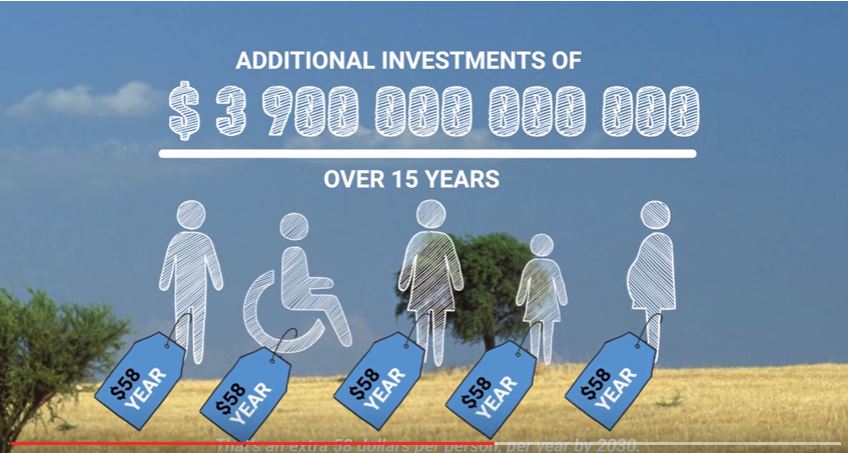
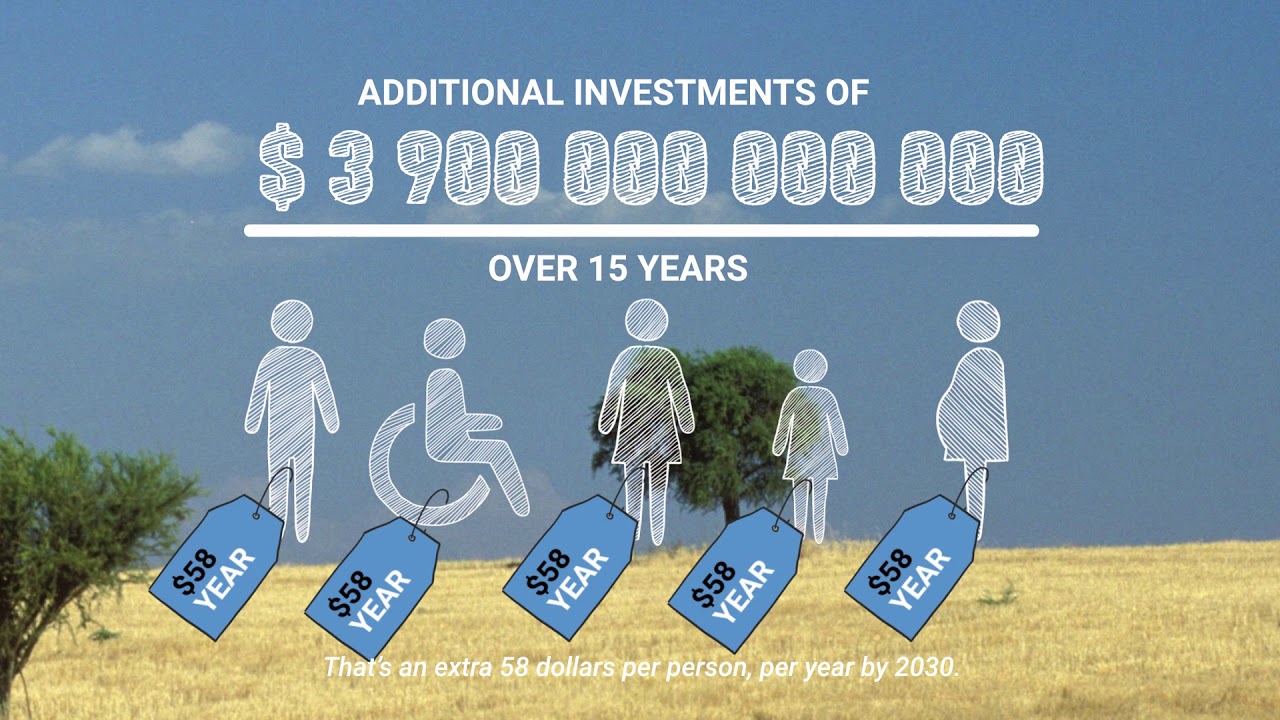
Under the “ambitious” scenario, achieving the SDG health targets would require new investments increasing over time from an initial US$ 134 billion annually to $371 billion, or $58 per person, by 2030.
The analysis shows that 85% of these costs can be met with domestic resources, although as many as 32 of the world’s poorest countries will face an annual gap of up to US$ 54 billion and will continue to need external assistance. High-income countries were not included in the analysis but other estimates show they can all afford to provide universal health coverage with essential health services to their citizens.
The ambitious scenario includes adding more than 23 million health workers, and building more than 415 000 new health facilities, 91% of which would be primary health care centres.
These investments would boost health spending as a proportion of gross domestic product across all 67 countries from an average of 5.6% to 7.5%. The global average for health spending as a proportion of GDP is 9.9%. Although higher spending does not necessarily translate to improved health, making the right investments at the right time can.
The investments could prevent 97 million premature deaths – one every five seconds over 15 years – including more than 50 million infants and children who are either stillborn or die before their fifth birthday, and 20 million deaths from non-communicable diseases such as cardiovascular disease, diabetes and cancer. Life expectancy would increase by between 3.1 and 8.4 years, and 535 million years of healthy living would be added across the 67 countries.
The “progress” scenario would require new investments increasing from an initial US$ 104 billion a year to $274 billion, or $41 per person, by 2030. These investments would prevent about 71 million premature deaths and boost health spending as a proportion of GDP to an average of 6.5%. More than 14 million new health workers would be added, and nearly 378 000 new health facilities built, 93% of which would be primary health care centres.
The analysis includes targets in Sustainable Development Goal 3 (health and well-being) as well as targets from Goal 2 (zero hunger), Goal 6 (clean water and sanitation) and Goal 7 (affordable and clean energy). Some targets and diseases were excluded because of the difficulty of estimating their associated costs and health impact, or a lack of robust data.


The SDG Health Price Tag does not prescribe what countries should spend on health, but is intended as a tool to inform further research. It also highlights that achieving universal health coverage and the other health targets requires not only funding but political will and respect for human rights.

Get it on Google Play


WHO plans to update the estimates every five years and will include other health-related targets and diseases as more evidence becomes available.

ORIGINAL SOURCE OF INFO : WORLD HEALTH ORGANIZATION (MEDIA CENTER)


Get it on Google Play


April 6, 2018 0 comments
0 FacebookTwitterPinterestLinkedinTumblrVKOdnoklassnikiRedditStumbleuponWhatsappTelegramLINEPocketSkypeViberEmail
Newer Posts
Older Posts

Search

Follow Us

Facebook Twitter Instagram Pinterest Linkedin Youtube

Categories

  • Abstracts (25)
  • Activities (91)
  • Adolescent Sexual and Reproductive Health (ASRH) (25)
  • Advice & Tips (3)
  • African Region (5)
  • AI and Health (1)
  • Annual Meeting (6)
  • Antimicrobial Resistance (AMR) (21)
  • Award (19)
  • Awards (16)
  • Books (9)
  • Call for Proposal, EOI & RFP (103)
  • Call for Research Participants (8)
  • Clinical Doctor Jobs (6)
  • Communicable Diseases (107)
  • Competition (20)
  • Conference (128)
  • Consultant (1)
  • Courses (205)
  • Dashboard (2)
  • Digital Health & Health Informatics (10)
  • Drug and Medicine (18)
  • Eastern Mediterranean Region (3)
  • Education (15)
  • Environment (3)
  • Environmental Health & Climate Change (47)
  • European Region (42)
  • Exchange Program (1)
  • Fact Sheet (117)
  • FCHVs (1)
  • Fellowships, Studentship & Scholarships (168)
  • Financial Aid (13)
  • Form Formats (2)
  • Fully funded (22)
  • Global Health News (433)
  • Grants and Funding Opportunities (193)
  • Guest Post (44)
  • Health Assistant Jobs (1)
  • Health Equity (7)
  • Health Financing and Economics (24)
  • Health in Data (115)
  • Health Insurance (5)
  • Health Jobs (52)
  • Health Literacy, Health Education & Promotion (49)
  • Health Organization Profile (42)
  • Health Systems (83)
  • Human Resource for Health (33)
  • Humanitarian Health & Emergency Response (44)
  • Hypertension (5)
  • Implementation Research (48)
  • International Health (3)
  • International Jobs & Opportunities (373)
  • International Plan, Policy & Guidelines (210)
  • Internships (4)
  • Jobs Vacancies (56)
  • Journals (8)
  • Life Style & Public Health Nutrition (39)
  • Live (10)
  • Master's Degree (48)
  • Maternal, Newborn and Child Health (88)
  • Mentorship Program (2)
  • Miscellaneous (16)
  • National Health News (157)
  • National Plan, Policy & Guidelines (468)
  • Neglected Tropical Diseases (NTDs) (51)
  • Non- Communicable Diseases (NCDs) (120)
  • Notice (103)
  • Nursing Jobs (6)
  • Nutritionist Jobs (1)
  • One Health (17)
  • Online & Distance Learning (22)
  • Online Courses (90)
  • Op-Ed Article (3)
  • Opportunities by Region (83)
  • Outbreak News (213)
  • Partially funded (6)
  • PCL Health Science Jobs (3)
  • PH Important Day (533)
  • Pharmacist Jobs (3)
  • PhD (54)
  • Photos (5)
  • Planetary Health (4)
  • PostDoc (14)
  • Presentation Slides (26)
  • Primary Health Care (25)
  • Provincial Plan, Policies and Guidelines (14)
  • Public Health (1,281)
  • Public Health Epidemiology & Biostatistics (13)
  • Public Health Events (306)
  • Public Health Information (20)
  • Public Health Innovation (9)
  • Public Health Jobs (52)
  • Public Health News (552)
  • Public Health Notes (120)
  • Public Health Opportunities (507)
  • Public Health Opportunity (491)
  • Public Health Programs (108)
  • Public Health Seminar (2)
  • Public Health Tools (1)
  • Public Health Update (561)
  • Quality Improvement & Infection Prevention (20)
  • Region of America (8)
  • Reports (184)
  • Research & Project Grants (39)
  • Research & Project Grants (32)
  • Research & Publication (647)
  • Research Articles (10)
  • Road Traffic Accidents (RTA) (9)
  • School of Public Health (60)
  • Self funded (2)
  • South-East Asia Region (26)
  • Success Stories (17)
  • Summer and Winter Courses (40)
  • Summer Courses (28)
  • Sustainable Development Goals (SDGs) (14)
  • Syllabus (61)
  • Symposium (9)
  • Tobacco Control (35)
  • Training (40)
  • Travel Grants (15)
  • Trick, Technique & Skills (8)
  • Uncategorized (3)
  • Undergraduate Degree (7)
  • Universal Health Coverage (36)
  • Universities (29)
  • Universities & School of Public Health (58)
  • Vacancy Announcement (26)
  • Vaccine Preventable Diseases (40)
  • Vector-Borne Diseases(VBDs) (30)
  • Videos (3)
  • View Points (1)
  • Webinar (4)
  • Western Pacific Region (13)
  • Workshop (18)
  • World News (116)
Post New Jobs: Vacancy Announcement Service

Public Health Update (Sagun’s Blog) is a popular public health portal in Nepal. Thousands of health professionals are connected with Public Health Update to get up-to-date public health updates, search for jobs, and explore opportunities.
#1 Public Health Blog for sharing Job opportunities and updates in Nepal

”Public Health Information For All”
– – Sagun Paudel, Founder

  • HOT JOBS
    • Public Health Jobs
    • Medical Doctor Jobs
    • Nursing Jobs
    • Health Assistant Jobs
    • Pharmacist Jobs
    • NGOs Jobs
    • Government Jobs
  • Top Categories
    • National Plan, Policy & Guidelines Top
    • Public Health Calendar
    • Fellowships & Scholarships
    • Health Systems
    • Health Organization Profiles
    • International Jobs & Opportunities
    • Public Health Opportunity

PUBLIC HEALTH INITIATIVE

    • Submit your Vacancies New
    • Partnership Opportunities

Contact: blog.publichealthupdate@gmail.com

https://wa.me/+9779856036932

Public Health Initiative, A Registered Non-profit organization – All Right Reserved. 2011-2024. Contact us. 

Facebook Twitter Instagram Youtube Envelope
Public Health Update
  • Home
  • Public Health
    • Home 1
      • Adolescent Sexual and Reproductive Health (ASRH)
      • Antimicrobial Resistance (AMR)
      • Communicable Diseases
      • Digital Health & Health Informatics
      • Environmental Health & Climate Change
      • Health Financing and Economics
      • Health Equity
    • Home 2
      • Health Literacy, Health Education & Promotion
      • Human Resource for Health
      • Humanitarian Health & Emergency Response
      • Implementation Research
      • International Health
      • Life Style & Public Health Nutrition
      • Maternal, Newborn and Child Health
    • Home 3
      • Neglected Tropical Diseases (NTDs)
      • Non- Communicable Diseases (NCDs)
      • One Health
      • Planetary Health
      • Public Health Epidemiology & Biostatistics
      • Primary Health Care
      • Quality Improvement & Infection Prevention
    • Home 4
      • Road Traffic Accidents (RTA)
      • Sustainable Development Goals (SDGs)
      • Tobacco Control
      • Universal Health Coverage
      • Vaccine Preventable Diseases
      • Vector-Borne Diseases(VBDs)
      • Notices
  • Public Health Update
    • Home 1
      • Public Health News
      • Global Health News
      • Outbreak News
      • National Health News
      • COVID-19
    • Home 2
      • Fact Sheet
      • Health in Data
      • PH Important Day
      • Public Health Events
      • Public Health Programs
    • Home 3
      • Health Systems
      • Health Insurance
      • Health Organization Profile
      • Success Stories
      • Public Health Innovation
  • Public Health Opportunities
    • Fully funded
    • Travel Grants
    • Grants and Funding Opportunities
    • Opportunities by Region
    • International Jobs & Opportunities
    • Research & Project Grants
    • Fellowships, Studentship & Scholarships
    • Conference
  • Jobs
    • Home 1
      • Health Jobs
      • Public Health Jobs
      • Clinical doctor Jobs
      • Health Assistant Jobs
      • Nursing Jobs
      • PCL Health Science Jobs
    • Home 2
      • Dental Jobs
      • Pharmacist Jobs
      • TSLC (Health Jobs)
      • Laboratory Jobs
      • Nutritionist Jobs
  • Downloads
    • International Plan, Policy & Guidelines
    • National Plan, Policy & Guidelines
    • Reports
    • Books
    • Research Articles
  • School of Public Health
    • Home 1
      • Courses
      • Master’s Degree
      • Undergraduate Degree
      • PhD
    • Home 2
      • Universities
      • Syllabus
      • Public Health Notes
      • Mentorship Program
      • Startup Project
    • Home
      • Summer and Winter Courses
      • Summer Courses
      • Online Courses
      • Workshop
      • Training
Public Health Update
  • Home
  • Public Health
    • Home 1
      • Adolescent Sexual and Reproductive Health (ASRH)
      • Antimicrobial Resistance (AMR)
      • Communicable Diseases
      • Digital Health & Health Informatics
      • Environmental Health & Climate Change
      • Health Financing and Economics
      • Health Equity
    • Home 2
      • Health Literacy, Health Education & Promotion
      • Human Resource for Health
      • Humanitarian Health & Emergency Response
      • Implementation Research
      • International Health
      • Life Style & Public Health Nutrition
      • Maternal, Newborn and Child Health
    • Home 3
      • Neglected Tropical Diseases (NTDs)
      • Non- Communicable Diseases (NCDs)
      • One Health
      • Planetary Health
      • Public Health Epidemiology & Biostatistics
      • Primary Health Care
      • Quality Improvement & Infection Prevention
    • Home 4
      • Road Traffic Accidents (RTA)
      • Sustainable Development Goals (SDGs)
      • Tobacco Control
      • Universal Health Coverage
      • Vaccine Preventable Diseases
      • Vector-Borne Diseases(VBDs)
      • Notices
  • Public Health Update
    • Home 1
      • Public Health News
      • Global Health News
      • Outbreak News
      • National Health News
      • COVID-19
    • Home 2
      • Fact Sheet
      • Health in Data
      • PH Important Day
      • Public Health Events
      • Public Health Programs
    • Home 3
      • Health Systems
      • Health Insurance
      • Health Organization Profile
      • Success Stories
      • Public Health Innovation
  • Public Health Opportunities
    • Fully funded
    • Travel Grants
    • Grants and Funding Opportunities
    • Opportunities by Region
    • International Jobs & Opportunities
    • Research & Project Grants
    • Fellowships, Studentship & Scholarships
    • Conference
  • Jobs
    • Home 1
      • Health Jobs
      • Public Health Jobs
      • Clinical doctor Jobs
      • Health Assistant Jobs
      • Nursing Jobs
      • PCL Health Science Jobs
    • Home 2
      • Dental Jobs
      • Pharmacist Jobs
      • TSLC (Health Jobs)
      • Laboratory Jobs
      • Nutritionist Jobs
  • Downloads
    • International Plan, Policy & Guidelines
    • National Plan, Policy & Guidelines
    • Reports
    • Books
    • Research Articles
  • School of Public Health
    • Home 1
      • Courses
      • Master’s Degree
      • Undergraduate Degree
      • PhD
    • Home 2
      • Universities
      • Syllabus
      • Public Health Notes
      • Mentorship Program
      • Startup Project
    • Home
      • Summer and Winter Courses
      • Summer Courses
      • Online Courses
      • Workshop
      • Training
Public Health Initiative, A Registered Non-profit organization – All Right Reserved. 2011-2023