Public Health Initiative, A Registered Non-profit organization – All Right Reserved. 2011-2024. Contact us.

Safe Motherhood and Newborn Health in Nepal
The goal of the National Safe Motherhood Programme is to reduce maternal and neonatal morbidity and mortality and improve maternal and neonatal health through preventive and promotive activities and by addressing avoidable factors that cause death during pregnancy, childbirth and the postpartum period. Evidence suggests that three delays are important factors for maternal and newborn morbidity and mortality in Nepal (delays in seeking care, reaching care and receiving care).
The following strategies have been adopted to reduce risks during pregnancy and childbirth and address factors associated with mortality and morbidity:
- Promoting birth preparedness and complication readiness including awareness raising and improving availability of funds, transport and blood supplies.
- The Safe Motherhood Programme (Aama Suraksha Programme) promotes antenatal checkups and institutional delivery.
- The expansion of 24-hour emergency obstetric care services (basic and comprehensive) at selected public health facilities in all districts.
The Safe Motherhood Programme has made significant progress since it began in 1997. Service coverage has grown along with the development of policies, programmes and protocols. The policy on skilled birth attendants (2006) highlights the importance of skilled birth attendance (SBA) at all births and embodies the government’s commitment to train and deploy doctors, nurses and ANMs with the required skills across the country. The endorsement of the revised National Blood Transfusion Policy (2006) was another significant step for ensuring the availability of safe blood supplies for emergency cases.
The coordinated implementation of strategies and plans envisioned in NHSP-2 and the National Safe Motherhood Plan (2006–2017) have resulted in impressive progress on service expansion and the increasing use of maternal and newborn health (MNH) and reproductive health care services. The Nepal Health Sector Strategy (NHSS) identifies equity and quality of care gaps as areas of concern for achieving the maternal health sustainable development goal (SDG) target.
[quads id=9]
The 2015 earthquakes damaged many health facilities and disrupted MNH and reproductive health services and the ability of communities to access health services. FHD, with support from its partners, has made concerted efforts to restore services and improve the quality of health services in line with the government’s aim to ‘build back better’.
Main strategies of the Safe Motherhood Programme
1. Promoting inter-sectoral coordination and collaboration at central, regional, districts and community levels to ensure commitment and action for promoting safe motherhood with a focus on poor and excluded groups.
2. Strengthening and expanding delivery by skilled birth attendants and providing basic and comprehensive obstetric care services at all levels. Interventions include:
- developing the infrastructure for delivery and emergency obstetric care;
- standardizing basic maternity care and emergency obstetric care at appropriate levels of the health care system;
- strengthening human resource management — diploma in gynaecology (DGO), advanced skilled birth attendant (ASBA), SBA, anaesthesia assistant training and deployment;
- establishing a functional referral system with airlifting for emergency referrals from remote areas, the provision of stretchers in VDC wards and emergency referral funds in remote districts; and
- strengthening community-based awareness on birth preparedness and complication readiness through FCHVs and increasing access to maternal health information and services.
3. Supporting activities that raise the status of women in society.
4. Promoting research on safe motherhood to contribute to improved planning, higher quality services and more cost-effective interventions.
Activities
Birth Preparedness Package and community level maternal and newborn health
FHD continued to expand and maintain MNH activities at community level including the Birth Preparedness Package (jeevan suraksha flipchart and card) and distributed the matri suraksha chakki (misoprostol) to prevent postpartum haemorrhage (PPH) in home deliveries.
The public health system promotes:
- birth preparedness and complication readiness (preparedness of money, health facilities for the
- delivery, transport and blood donors);
- antenatal care (ANC) and postnatal care (PNC) (iron, tetanus toxoid, albendazole);
- self-care (food, rest, no smoking and alcohol) in pregnancy and postpartum periods;
- essential newborn care; and
- the identification of and prompt care seeking for danger signs in the pregnancy, delivery, postpartum and newborn periods.
In 2066/67, the government approved PPH education and the distribution of the matri suraksha chakki through FCHVs to prevent PPH in home deliveries. For home deliveries, three misoprostol tablets (600 mcg) are handed over to pregnant women to take immediately after delivery and before the placenta is expelled. Forty-two districts were implementing the programme in 2072/73.
Rural Ultrasound Programme
The Rural Ultrasound Programme aims for the timely identification of pregnant women with risks of obstetric complication to refer to comprehensive emergency obstetric and neonatal care (CEONC) centres. Trained nurses (SBA) scan clients at rural PHCCs and health posts. Women with detected abnormalities such as abnormal lies and presentation of the foetus are referred to a facility with the needed services. This programme is being implemented in the 11 remote districts of Mugu, Dhading, Darchula, Sindhupalchowk, Solukhumbu, Bajura Bajhang, Achham, Dhankuta, Humla, and Baitadi.
Reproductive health morbidity prevention and management programme
- Management of pelvic organ prolapse: Pelvic organ prolapse (POP) is a common reproductive health morbidity in Nepal and contributes to many disability adjusted life years (DALYs) and social consequences. Multiparity, maternal malnutrition, too frequent pregnancies and heavy work after delivery are the main risk factors. Each year the government allocates funds to manage POP including free screening, providing silicon ring pessaries, Kegell exercise training and free surgical services at designated hospitals. In 2072/73 more than 14,800 women were screened for the condition of which 8.8 percent had first degree POP, 7 percent second degree POP and 8.9 percent third degree POP. More than 1,100 women received surgical treatment and 2,019 women were instructed to manage the condition using ring pessaries.
- Cervical cancer screening and prevention training: Cervical cancer is the most common cancer of women in Nepal, accounting for 21.4 percent of all cancer among 34–64 year old women. The national guidelines on cervical cancer screening and prevention (2010) call for screening at least 50 percent of women aged 30–60 years and for reducing the mortality due to cervical cancer by 10 percent with recommended screening among this group every five years. Cervical cancer screening is done by visual inspection of the cervix by trained nurses or doctors. If any signs of a pre-cancerous lesion are seen, women are referred for cryotherapy to cure the lesion. This approach is costeffective as the early detection of lesions and early management by cryotherapy will usually prevent progression to cervical cancer, and the cost of scaling up this activity is relatively low.
- Obstetric fistula management: Obstetric fistula affects many women from poorer communities and significantly impairs their quality of life due to the social stigma attached to this condition and their physical suffering.
Expansion and quality improvement of service delivery sites: FHD continued to expand 24/7 service delivery sites like birthing centres, BEONC and CEONC sites at PHCCs, health posts and hospitals.
Emergency referral funds
The main objective of this programme is to support emergency referral transport to women from poor, Dalit, Janajati, geographically disadvantaged, and socially and economically disadvantaged communities who need emergency caesarean sections or complication management during pregnancy or child birth. The regional health directorates also have funds to airlift needy women from areas where motorised transport is not available or when immediate transfers are needed. Based on recommendations, free referrals for obstetric complications from birthing centres and BEONC centres to CEONC centres are being implemented in Ramechhap and Dolakha districts.
Safe abortion services
key components of comprehensive abortion care as:
- pre and post counselling on safe abortion methods and post-abortion contraceptive methods;
- termination of pregnancies as per the national protocol;
- diagnosis and treatment of existing reproductive tract infections; and
- provide contraceptive methods as per informed choice and follow-up for post-abortion complication management.
Nyano Jhola Programme
The Nyano Jhola Programme was launched in 2069/70 to protect newborns from hypothermia and infections and to increase the use of peripheral health facilities (birthing centres). Two sets of clothes (bhoto, daura, napkin and cap) for newborns and mothers, and one set of wrapper, mat for baby and gown for mother are provided for women who give birth at birthing centres and district hospitals. The programme was implemented in all 75 districts in 2072/73.
Aama and Newborn Programme
The government has introduced demand-side interventions to improve the quality of maternal care and encourage institutional delivery. The Maternity Incentive Scheme, 2005 provided transport incentives to women to deliver in health facilities. In 2009, user fees were removed from all types of delivery care under the Aama Programme. In 2012, the separate 4ANC incentives programme was merged with the Aama Programme. In 2073/74, the Free Newborn Care Programme (introduced in FY 2072/73) is being merged with the Aama Programme with the provisions listed in HERE
Fact SheetHealth in DataMaternal, Newborn and Child HealthNational Plan, Policy & GuidelinesPublic HealthPublic Health NotesPublic Health ProgramsPublic Health Update
Safe Motherhood Indicators in Nepal
written by Public Health Update
Safe Motherhood Indicators in Nepal
The 2016 Nepal Demographic and Health Survey (2016 NDHS)
Antenatal Care
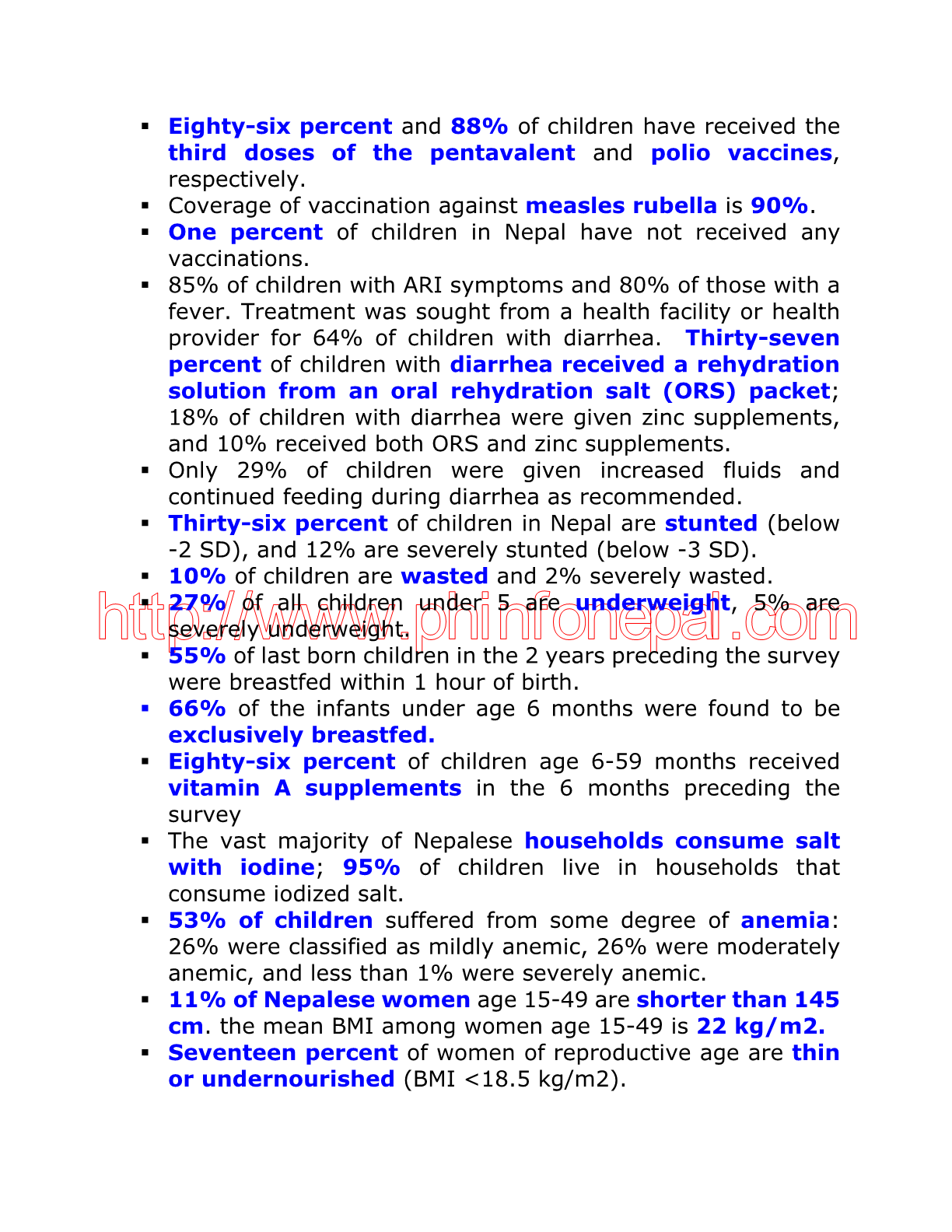
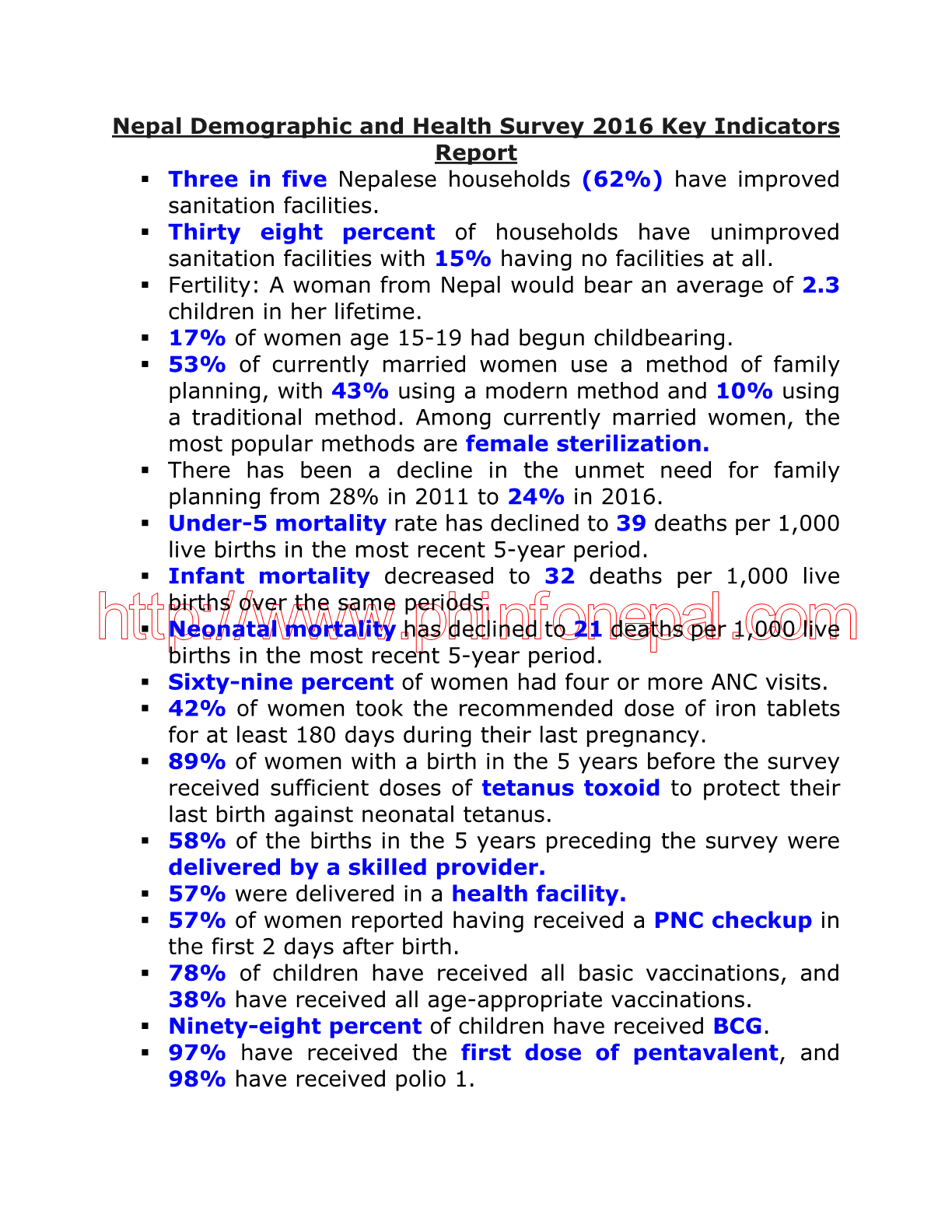
- More than 8 in 10 women (84%) age 15-49 receive antenatal care (ANC) from a skilled provider (doctor, nurse, and auxiliary nurse midwife).
- Two-thirds of women have their first ANC visit in the first trimester, as recommended. Seven in ten women make four or more ANC visits.
- The majority of women (91%) take iron tablets or syrup during pregnancy. Eighty-nine percent of women’s most recent births were protected against neonatal tetanus. Among women who received ANC for their most recent birth, 91% had their blood pressure measured, 76% had a urine sample taken, and 66% had a blood sample taken.
Delivery and Postnatal Care
- More than half of births (57%) are delivered in a health facility, primarily in government sector
facilities. However, 41% of births are delivered at home. Women with SLC and above education (85%) and those in the wealthiest households (90%) are more likely to deliver at a health facility. Only 8% of births in 1996 were delivered in a health facility, compared to 57% in 2016. - Overall, 58% of births are assisted by a skilled provider, the majority by doctors. One in ten births are assisted by no one.
- Skilled assistance during delivery has increased from 9% in 1996 to 58% in 2016. More than half of women (57%) receive a postnatal check within two days of delivery, while 42% did not have a postnatal check within 41 days of delivery.
- 57% of newborns receive a postnatal check within two days of birth, while 40% did not have a postnatal check.
- Among births in the two years before the survey, Chlorhexidine was applied on 39% of newborns, whereas nothing was applied on 37% of newborns.
Maternal Mortality
- The 2016 NDHS asked women about deaths of their sisters to determine maternal mortality. Maternal mortality includes deaths of women during pregnancy, delivery, and 42 days after delivery
excluding deaths that were due to accidents or violence. The maternal mortality ratio (MMR) for
Nepal is 239 deaths per 100,000 live births for the seven-year period before the survey. The confidence interval for the 2016 MMR ranges from 134 to 345 deaths per 100,000 live births.
Ministry of Health, Nepal; New ERA; and ICF. 2017. Nepal Demographic and Health Survey 2016. Kathmandu, Nepal: Ministry of Health, Nepal.
READ MORE: Key Findings (Nepali & English) – The 2016 Nepal Demographic and Health Survey (2016 NDHS)
The 2015 Nepal Health Facility Survey (2015 NHFS)
ANTENATAL CARE SERVICES
- About 98 percent of health facilities in Nepal offer antenatal care (ANC) services.
- One in four health facilities offering ANC had at least one staff member who had received inservice training in ANC within the 24 months before the assessment.
- Twenty-five percent of facilities had ANC guidelines available on the day of the assessment.
- More than half of facilities had soap and running water or alcohol-based hand disinfectant for infection prevention available at the service site on the day of the assessment.
- Ninety percent of health facilities had all essential ANC medicines (combined iron and folic acid tablets, and albendazole tablets) available for ANC clients.
- Almost half of all observed ANC clients were counseled on nutrition during pregnancy. One third of clients were advised on issues relating to the progress of their pregnancy. Two out of ten clients were counseled on importance of at least four ANC visits and on birth/planning/preparedness measures.
- Seven in 10 ANC providers had received personal supervision in the six months preceding the survey.
- Two of every 10 facilities offering ANC provide at least some services for prevention of mother-to-child transmission (PMTCT) of HIV.
- Only 6 percent of facilities offering ANC had insecticide-treated nets available to give to ANC clients for malaria prevention.
READ MORE: The 2015 Nepal Health Facility Survey (2015 NHFS)
DoHS, Annual Report 2072/73 (2015/16)
- % of pregnant women who received Td 2 and 2+= 66
- % of pregnant women attending first ANC visit = 97
- % of pregnant women attending four ANC visits =51
- % of pregnant women receiving IFA tablets or syrup during their last pregnancy= 49
- % of postpartum mothers who received vitamin A supplements = 51
- % of institutional deliveries =55
- % of deliveries conducted by a skilled birth attendant =54
- % of postpartum women received PNC checkup within 24 hours of birth =52
- % of women who had three PNC check-ups as per protocol = 18
REad more: DoHS, Annual Report 2072/73 (2015/16)
Declaration of 4th National Summit of Health and Population Scientists in Nepal
written by Public Health Update
Declaration of 4th National Summit of Health and Population Scientists in Nepal, 11-12 April 2018
‘Advancing Evidence for Changing Health Systems in Nepal’
Health research is one of the cornerstones for shaping health system that is strong, resilient, accessible, affordable, responsive and sustainable. We acknowledge that such health system contributes to achieving Universal Health Coverage. It is a foundation for harnessing demographic dividend, inclusive economic growth, prosperity, equity, social justice and quality of life. We recognize the recent political changes in the country with re-structuring of state and governance systems which provide an opportunity for advancing research and innovations to strengthen health system in the country.
Building on the foundation of health research practices in Nepal, and acknowledging the importance of harnessing evidence to strengthen national health system, Nepal Health Research Council in collaboration with a number of institutions, organized the 4th annual National Summit of Health and Population Scientists in Nepal on 11-12 April 2018. The rich discussions and deliberations at the summit highlighted the ‘need for actions’ under a number of key areas that are aimed to accelerate accomplishment of the summit theme ‘Advancing Evidence for Changing Health Systems in Nepal’.
We, the delegates, representing the Ministry of Health and Population, Nepal Health Research Council, professional councils and associations, academic institutions, bi-lateral and multilateral agencies, civil society, private sector, and individual researchers and scientists, collectively commit to the following declarations;
- Undertake a rigorous appraisal of health research system including available resources, institutional and individual expertise, areas of research priority, with a view to advancing research system in federal context addressing needs of different sections of population;
- Continue quality research for generation, synthetization and application of knowledge towards improving health system performance to contribute to achieve universal health coverage;
- Continue high-level political advocacy for developing Centers for Excellence in health research;
- Advocate for effective implementation of the international and national commitments made by the country for allocating adequate resources in health research;
- Promote and adhere to responsible conduct of research practices,
- Strengthen mechanisms to promote research capabilities of young researchers and scientists by increasing availability of research grants and capacity building opportunities and
- Foster partnership among academia, research institutions, private sectors and researchers to enhance research capabilities and innovations – at national and international levels – that would address federal, provincial and local health research priorities.
NHRC
Road traffic injuries kill approximately 316,000 people each year in WHO’s South-East Asia Region.
That´s more than 865 deaths per day! These deaths account for 25% of the global total of road traffic deaths.
Pedestrians, cyclists and motorcyclists make up almost 50% of road traffic deaths in the region: in some countries this figure rises to over 80%. The safety needs of these groups must be addressed if a decline in the number of regional deaths is to be achieved.
WHO SEARO
Three Tarai districts at high risk of Dengue
BANIYANI, JHAPA: There is a high risk of dengue outbreak in three Tarai districts of the country, including Jhapa.
Jhapa, Rupandehi and Mahottari districts have higher dengue infection rate, according to the statistics of Department of Epidemiology and Disease Prevention Division, Department of Health Services
Last year, Rupandehi witnessed 677 dengue-infected cases, which was the highest. Jhapa stood second with 535 dengue patients while Mahottari saw 438 dengue cases.
According to Dr Bibek Kumar Lal of the Division, at least three persons died in three districts including Jhapa due to dengue last year. He said that dengue epidemic has increased over the years. “In the past 50 years, dengue infection has increased 30 folds,” Dr Lal shared.
He further informed that more than half of the total population of the world are prone to dengue infection.
RSS (THT)
Jhapa, Rupandehi and Mahottari districts have higher dengue infection rate, according to the statistics of Department of Epidemiology and Disease Prevention Division, Department of Health Services
Last year, Rupandehi witnessed 677 dengue-infected cases, which was the highest. Jhapa stood second with 535 dengue patients while Mahottari saw 438 dengue cases.
According to Dr Bibek Kumar Lal of the Division, at least three persons died in three districts including Jhapa due to dengue last year. He said that dengue epidemic has increased over the years. “In the past 50 years, dengue infection has increased 30 folds,” Dr Lal shared.
He further informed that more than half of the total population of the world are prone to dengue infection.
RSS (THT)
Prevention & Control of Dengue Fever