
Public Health Initiative, A Registered Non-profit organization – All Right Reserved. 2011-2024. Contact us.
News From Paper
written by Public Health Update
Original Source: Himalayan News Service Kathmandu, May 25
One month after the first of two major earthquakes hit Nepal, an estimated 70,000 children under five are at risk of malnutrition and require urgent humanitarian support, said United Nation Children’s Fund.
One month after the first of two major earthquakes hit Nepal, an estimated 70,000 children under five are at risk of malnutrition and require urgent humanitarian support, said United Nation Children’s Fund. A press statement issued by UNICEF today said that around 15,000 children in 14 of the worst-hit districts need therapeutic foods — like nutrient-rich peanut paste — for the treatment of severe acute malnutrition.
Additionally, some 55,000 children with moderate acute malnutrition require supplementary feeding and care to bring them back to healthy growth and development.“Before the earthquake, more than 1 in 10 children across Nepal were already suffering from acute malnutrition, while close to 4 in 10 had stunted growth due to chronic under-nutrition,” said Tomoo Hozumi, UNICEF’s Representative in Nepal in the statement. “Now we have serious concerns that the situation could deteriorate in the wake of this disaster and undo the gains in nutrition that this country has achieved in the past few years.”The statement said that UNICEF is working double speed with its partners to provide urgent feeding and care to protect the lives of these children and to build their resistance against diseases, especially water-borne diseases, during the upcoming monsoon season.According to the statement, UNICEF is working with national and international partners and the government of Nepal to deliver a comprehensive nutrition response that includes protecting and promoting breastfeeding for children under two years of age, providing essential micronutrient supplements for more than 120,000 children and counseling mothers and families on how to feed young children with family food.Other activities included supporting community screening to identify children with severe acute malnutrition in affected districts and delivering specialised ready-to-use therapeutic foods to treat over 3,000 such children among others.Across nearly two dozen districts affected by the earthquake, 1.7 million children remain in urgent need of humanitarian aid — with the risk of long-term physical and emotional conditions climbing.“We are already seeing a growth in chronic conditions — such as children with acute respiratory infections provoked by the dust from the debris in the towns and villages,” said Hozumi.According to the statement, over the past month,
UNICEF has mobilised a substantial aid response to help children in urgent need, including supplying clean water to over 305,109 people and adequate sanitation and hand washing facilities to over 45,201 people, giving 10,000 children in displaced communities access to Child Friendly Spaces, providing nearly 9,000 children and more than 2,000 parents with Psychosocial First Aid, vaccination to more than 3,000 children against measles and rubella in the most affected districts. “A lot has been done, but much more needs to be done urgently,” said Hozumi. “The road to recovery for Nepal may be a long and challenging one, but UNICEF will be there, however long it takes to help Nepal’s children bounce back to a better and brighter future.”“We need all the support we can get, as the support we give now will have long-term consequences that will impact generations to come.”
Community Based Orientation of HIV/AIDS- (Nepali Presentation)
You can download from slideshare and you every where if you are going to community people. I request to mention the name of Author if Possible. Thankyou.
The Erasmus Mundus Master Course in Public Health in Disasters (EMMPHID) is a joint university educational programme organized by the Emergency and Disaster Research Unit
of the Universidad de Oviedo (Spain), the Division of Global Health of the Karolinska Institutet (Sweden) and the Centre for Research on Epidemiology of Disasters of the Université catholique de Louvain designed to deliver high quality education and training in the field of Public Health in disaster situations. The Programme is sponsored by the European Union and also involves thirteen associated universities and institutions around the world.
Admission and selection criteria
EMMPHID Master shall make available a maximum of 30 places for highly qualified students. Candidates from any country are welcome to apply to the Erasmus Mundus Master in Public Health in Disasters (EMMPHID). The EMMPHID consortium has adopted a single admission procedure, which is administered and managed online.
Selected applicants (proposed for a scholarship, put on the reserve list, or enrolled on a self paying basis) data may be used for the purposes of evaluating the Erasmus Mundus Programme and will be made available to the Agency, the EM National Structures, the EU Delegations and the Erasmus Mundus Student and Alumni Association, acting as stakeholders of the programme.
Student admission criteria
To be eligible for the EMMPHID master programme the applicant must be holder of a recognized primary degree in areas related to Health, Management and Administration or Social Sciences (a minimum of three years’ study at a university and of a minimum of 180 ECTS, or equivalent according to the regulations in the country of origin and to the European regulations).
The applicant academic record will preferably include studies in the following topics:
- Basic concepts in public health and epidemiological methods
- Introduction and basic principles in health sociology, psychology or economics
- Law and bioethics
- Special topics in public health and population sciences
- General approaches in public health, health promotion and health systems
- Principles of statistics
- General and financial management
- Environmental health
English Proficiency
Applicants must have a good command in English. Applicants must prove a C1 English level (IELTS (minimum score of 6.0 with at least 5.0 point in each section); TOEFL (paper based) at least 575 points with 4.0 in the writing section; TOEFL (IBT) 79 points with at least 17 points in every section). Candidates from English speaking countries must provide an official letter from their University from which they graduated attesting that English is the media of instruction, to be assessed by Academic Committee.
Application procedures
Candidates must fill in the online application that can be accessed at the web-site and upload all supporting documents in digital form, including the relevant certificates and transcripts of previous studies. No original official documents need to be sent at application. Upon admission to the programme, pre-selected candidates must send in certified hard copies of the supporting documents by recommended mail stamped before the registration deadline. Only complete applications will be assessed. Incomplete applications may be rejected without further notification. A complete application consists of:
- Personal information about the applicant – family name, name, date of birth, place of birth, nationality (2), address, sex, recent identity photo;
- Passport copy, as proof of nationality
- Diploma and transcripts (diploma supplement or list of the subjects taken during the study and correspondent marks) of their previous studies fulfilling the EMMPHID admission criteria. The diploma and transcripts must be original, certified documents, scanned and attached to the online application form. Applicants must provide a calculation of the average mark of the university degree that may grant them access to the Master course. Marks must be translated to a 0 to 100 scale using the adequate proportionality.
- Syllabus or description of the courses taken in the fields of Health, Logistics, Sociology and those courses required by Belgian regulations for students of UCL study track
- English language certificate to prove proficiency as stated in the EMMPHID admission criteria, as stated in section 7.1
Other language certificates in foreign languages
Motivation letter – this letter should present the applicant’s motivation to enrol the Master course, preferred study track and mobility, the competencies and skills he / she would like to achieve, future perspectives and aspirations after the Master course, etc.
CV with information about relevant experience and professional training.
The list of past work placements should be well documented. The CV must specify the position held, main responsibilities and how long it lasted. Documentation of relevant courses, workshops, seminars etc can also be included.
Letter of reference – minimum 2 letters, preferably one letter from an academic viewpoint and one from an employer. Reference letters must be written in English and must be signed / stamped.
All application documents should be submitted in English. Applicants must provide official translation of any document in other language. Otherwise documents will not be taken into consideration.
It is the full responsibility of the applicant to provide the necessary documentation. The applications will be exclusively assessed on the information provided by the applicants in the on-line form which are clearly supported by the supporting documentation. In case of any difference between claimed and documented merits, only the documented merits will be taken into consideration.
Admission Open Application procedure information May be in October
S.No. Name of Drug Dosage Form & Its Strength
1 Acetylcystene Powder
2. Activated Charcoal Powder 25G, 50G, Suspension
3. Adrenaline Injection, 1mg/ml
(Epinephrine) 1:1000 solution
4. Acetazolamide Tablet, 250mg
5. Aminophylline Injection, 25mg/ml in 10-ml ampoule
6. Atenolol Injection, 5mg /ml
7. Atropine Sulphate Injection, 0.6mg in 1-ml ampoule
8. Adenosine Injection, 3mg/ml
9. BAL(Dimercaprol) Injection, 50mg/ml
10. Calcium Gluconate Injection, 10%
11. Chlorpromazine Injection, 25mg/ml in 2-ml vial
12. Dexamethasone Injection, 4mg/ml in 2ml ampoule
13. DICA-EDTA (EDTA Clacium Parenteral)
14. Digoxin Injection, 0.25mg/ml in 2ml ampoule
15. Diazepam Injection, 5mg/ml in 2ml vial
16. Dobutamine Injection, 12.5mg/ml in 20 ml ampoule
17. Dopamine Injection, 40mg/ml in 5ml ampoule
18. Frusemide Injection, 10mg/ml in 2ml ampoule
19. Glyceryl Trinitrate Sublingual tablet, 0.5mg,
20. Heparin Injection, 5000 Units/vial
21. Haloperidol Injection, 5mg/ml in 1ml ampoule
22. Hysocine n-butylbromide Injection, 20mg/ml in iml ampoule
23. Hydrocortisone Powder for Injection, 100mg
24. Insulin (Soluble) Injection,40IU/ml in 10ml vial
25. Ipecauanha Syrup
26. Isoprenaline Injection, 20mcg/ml
27. Isosorbide dinitrate Subligual tablet, 5mg
28. Intravenoue Fluids(IV fluids) 5% Dextrose 540ml 10%Dextrose 540ml 5%Dextrose with sodium chloride 540ml Ringer lactate 540ml 0.9% Sodium Chloride 540ml
29. Ipratopium Bromide Aerosol Inhalation
30. Ketamine Injection, 10mg/ml, 50mg/ml in 10 ml vial
31. Lignocaine Injection, 1%, 25 in 30 ml vial, Gel 2%, Topical
32. Lignocaine (Xylocard) Injection, 21.3mg/ml in 50ml vial
33. Mannitol Injection, 20% in 300ml vial
34. Magnesium Sulphate Injection, 50%, 10ml (5gm ampoule)
35. Methyl-ergometrine Injection 0.2mg/ml in 1 ml ampoule
36. Metoclopramide Injection, 5mg/ml in 2ml ampoule
37. Morphine Injection, 10mg/ml in 2-ml ampoule
38. Naloxone Injection, 0.4mg/ml in 1 ml ampoule
39. Noradernaline(norepinephrine) Injection,1mg/ml in 1 ml ampoule
40. Nitroprusside Injection – 50mg
41. Nifedipine Capsule, 5mg
43. Oxytoxin Injection, 5units /ml in 1ml ampoule
44. Paracetamol Injection, 150mg/ml in 2ml ampoule
45. Pethidine Injection, 50mg/ml in 1 and 2 ml ampoule
46. Pheniramine maleate Injection, 22.75 mg/ml in 2ml ampoule
47. Phenobarbitone Injection, 200mg/ml in 1ml ampuole
48. Phenytoin sodium Injection, 50mg/ml in 5 ml ampuole
49. Pilocarpine Eye drop, 2%,4%
50. Polygeline with Electrolytes IV solution, 3.5%
51. Polyvenum Antisnake venum Injection
52. Propanolol Injection, 1 mg / ml
53. Phytomenadione (Vit K) Injection 10mg/ml
54. Potassium Chloride Injection,150mg/ml in 10ml ampoule
55. Pralidoxime (PAM) Injection,25mg/ml in 20ml ampoule
56. Protamine Sulphate Injection, 10mg/ml in 10ml ampoule solution,4%
57. Quinine Sulphate Tablet, 200mg
58. Ranitidine Injection, 25mg/ml in 2ml ampoule
59. Salbutamol Respiratory solution, 5mg/ml in 15ml vial
60. Silver sulphadiazine cream 1%
61. Sodium bi-carbonate Injection, 75mg/ml in 10ml ampoule
62. Sodium Stibogluconate Injection, 100mg/ml
63. Streptokinase Injection,1.5million IU
64. Tetanus Toxoide Injection, 0.5ml
65. Thiopentone Injection,0.5gm 1gm per ampoule
66. Verapamil (Isoptin) Injection, 2.5mg/ml in 2ml ampoule
67. Suxamethonium ( Succinylcholine choloride) Injection 50mg/ml – 2ml ampuole or 10ml
68. Ephidrine Injection 30mg/ml – 1ml ampoule
69. Hydrallazine Injection, 20mg/ml – vial
70. Paraldehyde injection, 5ml
71. 25% Dextrose Injection
72. Amiodarone Injection 50mg/ml, tablet 100mg
73. Ipratopium Bromide (Respiratory Solution) Nebulizer vial
DownloadPDF Document Click Here
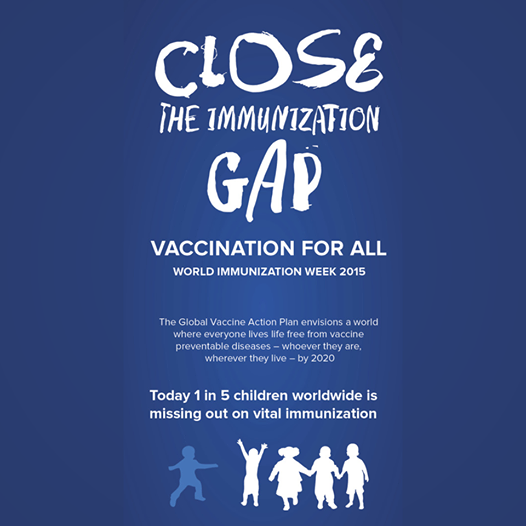
World Immunization Week 24-30 April 2015: Close the immunization Gap
written by Public Health Update
World Immunization Week – celebrated in the last week of April (24-30) aims to promote the use of vaccines to protect people of all ages against disease.
Protection throughout life
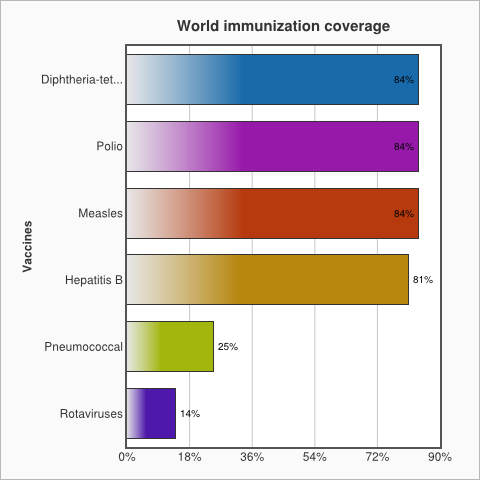
Immunization is widely recognized as one of the most successful and cost-effective health interventions. It prevents between 2 and 3 million deaths every year and now protects children not only against diseases for which vaccines have been available for many years, such as diphtheria, tetanus, polio and measles, but also against diseases such as pneumonia and rotavirus diarrhoea, 2 of the biggest killers of children under 5. Now adolescents and adults can be protected against life-threatening diseases such as influenza, meningitis, and cancers (cervical and liver), thanks to new and sophisticated vaccines.
But 1 in 5 children is still missing out: in 2013, an estimated 21.8 million infants did not receive lifesaving vaccines. Inadequate supply of vaccines, lack of access to health services, a shortage of accurate information about immunization and insufficient political and financial support all play a part.
Close the immunization gap
World Immunization Week 2015 will signal a renewed global, regional, and national effort to accelerate action to increase awareness and demand for immunization by communities, and improve vaccination delivery services.
This year’s campaign focuses on closing the immunization gap and reaching equity in immunization levels as outlined in the Global Vaccine Action Plan (GVAP). The Plan – endorsed by the 194 Member States of the World Health Assembly in May 2012 ― is a framework to prevent millions of deaths by 2020 through universal access to vaccines for people in all communities.
The GVAP aims to:
- strengthen routine immunization to meet vaccination coverage targets;
- accelerate control of vaccine-preventable diseases with polio eradication as the first milestone;
- introduce new and improved vaccines; and
- spur research and development for the next generation of vaccines and technologies.