
Public Health Update
  • Home
  • Public Health Update
  • Nepal Health Jobs
    • Public Health Job Board
    • Organization List
  • Opportunities
    • Fellowships, Studentship & Scholarships
    • Grants and Funding Opportunities
    • Fully funded
    • Conference
  • Downloads
    • International Plan, Policy & Guidelines
    • National Plan, Policy & Guidelines
    • Reports
    • Public Health Notes
    • Syllabus
    • Form Formats
  • School of Public Health
    • PhD
    • Master’s Degree
    • Online Courses
  • Notice
  • Home
  • Public Health Update
  • Nepal Health Jobs
    • Public Health Job Board
    • Organization List
  • Opportunities
    • Fellowships, Studentship & Scholarships
    • Grants and Funding Opportunities
    • Fully funded
    • Conference
  • Downloads
    • International Plan, Policy & Guidelines
    • National Plan, Policy & Guidelines
    • Reports
    • Public Health Notes
    • Syllabus
    • Form Formats
  • School of Public Health
    • PhD
    • Master’s Degree
    • Online Courses
  • Notice
LOGIN / REGISTER
Public Health Update
SUBSCRIBE
Public Health Update
  • Home
  • Public Health Update
  • Nepal Health Jobs
    • Public Health Job Board
    • Organization List
  • Opportunities
    • Fellowships, Studentship & Scholarships
    • Grants and Funding Opportunities
    • Fully funded
    • Conference
  • Downloads
    • International Plan, Policy & Guidelines
    • National Plan, Policy & Guidelines
    • Reports
    • Public Health Notes
    • Syllabus
    • Form Formats
  • School of Public Health
    • PhD
    • Master’s Degree
    • Online Courses
  • Notice

All Right Reserved. Designed and Developed by PenciDesign

National Health NewsPublic HealthPublic Health News

Provincial Health Emergency Operations Centre Handover, Pokhara

by Public Health Update February 17, 2018
written by Public Health Update

Provincial Health Emergency Operations Centre Handover, Pokhara

On 06 February 2018, the Provincial Health Emergency Operations Center (PHEOC) established in Pokhara by WHO/Nepal was handed over formally to the Ministry of Health (MoH), Govt of Nepal. This is the third PHEOC being handed over by WHO to the MoH.
The handover function was jointly inaugurated by Dr Sushil Pyakurel, Chief-Specialist, MoH and Dr. Jos Vandelaer, WHO Representative to Nepal. The importance of HEOCs in different areas of health sector preparedness and response readiness such as hub and satellite hospitals network coordination, prepositioning and replenishment of emergency medical logistics, risk assessment, human reosurces management etc were highlighted by key health authorities during the function. Senior officials from MoH divisions, departments and agencies of the Department of Health Services, all five Regional Health Directors, HEOC focal points from Doti and Surkhet Officials; personnel from all Regional Emergency Operation Centres (EOC) run by the Ministry of Home Affairs; UN and other partners such as the Nepal Red Cross Society, humanity and inclusion providing support to EOCs and disaster preparedness initiative and local authorities partcipated in the function.
27655402 1791604790858192 4519093225203505925 n

WHO/Nepal

February 17, 2018 0 comments
0 FacebookTwitterPinterestLinkedinTumblrVKOdnoklassnikiRedditStumbleuponWhatsappTelegramLINEPocketSkypeViberEmail
Global Health NewsPublic HealthPublic Health News

Individualized, supportive care key to positive childbirth experience, says WHO

by Public Health Update February 17, 2018
written by Public Health Update

Individualized, supportive care key to positive childbirth experience, says WHO

News release (WHO media Centre)

15 FEBRUARY 2018 | GENEVA – WHO has issued new recommendations to establish global care standards for healthy pregnant women and reduce unnecessary medical interventions.
Worldwide, an estimated 140 million births take place every year. Most of these occur without complications for women and their babies. Yet, over the past 20 years, practitioners have increased the use of interventions that were previously only used to avoid risks or treat complications, such as oxytocin infusion to speed up labour or caesarean sections.
“We want women to give birth in a safe environment with skilled birth attendants in well-equipped facilities. However, the increasing medicalization of normal childbirth processes are undermining a woman’s own capability to give birth and negatively impacting her birth experience,” says Dr Princess Nothemba Simelela, WHO Assistant Director-General for Family, Women, Children and Adolescents.
“If labour is progressing normally, and the woman and her baby are in good condition, they do not need to receive additional interventions to accelerate labour,” she says.
Childbirth is a normal physiological process that can be accomplished without complications for the majority of women and babies. However, studies show a substantial proportion of healthy pregnant women undergo at least one clinical intervention during labour and birth. They are also often subjected to needless and potentially harmful routine interventions.
The new WHO guideline includes 56 evidence-based recommendations on what care is needed throughout labour and immediately after for the woman and her baby. These include having a companion of choice during labour and childbirth; ensuring respectful care and good communication between women and health providers; maintaining privacy and confidentiality; and allowing women to make decisions about their pain management, labour and birth positions and natural urge to push, among others.

Every labour is unique and progresses at different rates

The new WHO guideline recognizes that every labour and childbirth is unique and that the duration of the active first stage of labour varies from one woman to another. In a first labour, it usually does not extend beyond 12 hours. In subsequent labours it usually does not extend beyond 10 hours.
To reduce unnecessary medical interventions, the WHO guideline states that the previous benchmark for cervical dilation rate at 1 cm/hr during the active first stage of labour (as assessed by a partograph or chart used to document the course of a normal labour) may be unrealistic for some women and is inaccurate in identifying women at risk of adverse birth outcomes. The guideline emphasizes that a slower cervical dilation rate alone should not be a routine indication for intervention to accelerate labour or expedite birth.
“Many women want a natural birth and prefer to rely on their bodies to give birth to their baby without the aid of medical intervention,” says Ian Askew, WHO Director, Department of Reproductive Health and Research. “Even when a medical intervention is wanted or needed, the inclusion of women in making decisions about the care they receive is important to ensure that they meet their goal of a positive childbirth experience.”

High quality care for all women

Unnecessary labour interventions are widespread in low-, middle- and high-income settings, often putting a strain on already scarce resources in some countries, and further widening of the equity gap.
As more women give birth in health facilities with skilled health professionals and timely referrals, they deserve better quality of care. About 830 women die from pregnancy- or childbirth-related complications around the world every day – the majority could be prevented with high-quality care in pregnancy and during childbirth.
Disrespectful and non-dignified care is prevalent in many health facilities, violating human rights and preventing women from accessing care services during childbirth. In many parts of the world, the health provider controls the birthing process, which further exposes healthy pregnant women to unnecessary medical interventions that interfere with the natural childbirth process.
Achieving the best possible physical, emotional, and psychological outcomes for the woman and her baby requires a model of care in which health systems empower all women to access care that focuses on the mother and child.
Health professionals should advise healthy pregnant women that the duration of labour varies greatly from one woman to another. While most women want a natural labour and birth, they also acknowledge that birth can be an unpredictable and risky event and that close monitoring and sometimes medical interventions may be necessary. Even when interventions are needed or wanted, women usually wish to retain a sense of personal achievement and control by being involved in decision making, and by rooming in with their baby after childbirth.

News release (WHO media Centre)

February 17, 2018 0 comments
0 FacebookTwitterPinterestLinkedinTumblrVKOdnoklassnikiRedditStumbleuponWhatsappTelegramLINEPocketSkypeViberEmail
Global Health NewsPublic HealthPublic Health News

World leaders join new drive to beat noncommunicable diseases

by Public Health Update February 17, 2018
written by Public Health Update

World leaders join new drive to beat noncommunicable diseases

News release (WHO Media Centre)

16 FEBRUARY 2018 | GENEVA – WHO is announcing today a new high-level commission, comprised of heads of state and ministers, leaders in health and development and entrepreneurs. The group will propose bold and innovative solutions to accelerate prevention and control of the leading killers on the planet – noncommunicable diseases (NCDs) like heart and lung disease, cancers, and diabetes.
The WHO Independent Global High-level Commission on NCDs is co-chaired by President Tabaré Vázquez of Uruguay; President Maithripala Sirisena of Sri Lanka; President Sauli Niinistö of Finland; Veronika Skvortsova, Minister of Healthcare of the Russian Federation; and Sania Nishtar, former Federal Minister of Pakistan.
Seven in 10 deaths globally every year are from NCDs, the main contributors to which are tobacco use, harmful use of alcohol, unhealthy diets, and physical inactivity. More than 15 million people between the ages of 30 and 70 years die from NCDs annually. Low- and lower-middle income countries are increasingly affected, with half of premature deaths from NCDs occurring in those countries. Many lives can be saved from NCDs through early diagnosis and improved access to quality and affordable treatment, as well as a whole-of-government approach to reduce the main risk factors.
“NCDs are the world’s leading avoidable killers but the world is not doing enough to prevent and control them,” says Dr Vázquez. “We have to ask ourselves if we want to condemn future generations from dying too young, and living lives of ill health and lost opportunity. The answer clearly is ‘no.’ But there is so much we can do to safeguard and care for people, from protecting everyone from tobacco, harmful use of alcohol, and unhealthy foods and sugary drinks, to giving people the health services they need to stop NCDs in their tracks.”
Mr Michael R. Bloomberg, WHO Global Ambassador for Noncommunicable Diseases and Commission member, said: “For the first time in history, more people are dying of noncommunicable diseases, such as heart disease and diabetes, than infectious diseases. This loss of human life spares no one — rich or poor, young or old – and it imposes heavy economic costs on nations. The more public support we can build for government policies that are proven to save lives – as this Commission will work to do – the more progress we’ll be able to make around the world.”
The new Commission was established by WHO Director-General Dr Tedros Adhanom Ghebreyesus and runs until October 2019. It will provide actionable recommendations to contribute to the Third United Nations General Assembly High-level Meeting on NCDs scheduled for the second half of 2018. This will include the submission of its first report to Dr Tedros in early June.
“Everybody deserves the right to a healthy life,” says Dr Tedros. “We can beat the drivers of the NCD epidemic, which are among the world’s main obstacles to health. I am looking to the Commission to show us new ways to unblock the barriers to good health, and identify innovative, bold and practical actions steps to scale up prevention and treatment of NCDs and provide health for all.”
Co-chair Dr Nishtar says the Commission’s establishment has come at an opportune time, as the world prepares for the UN High-level Meeting on NCDs. “This year, governments will be held to account on progress they have made in protecting their citizens from NCDs,” says Dr Nishtar. “While there have been improvements in some countries and regions, the overall rate of progress has been unacceptably slow. This is resulting in too many people suffering and dying needlessly from NCDs, and leaving families, communities and governments to bear the human and economic costs.”
The World Health Assembly has endorsed the set of WHO “best buys” and other cost-effective interventions proven to prevent or delay most premature NCD deaths. Such measures, which can be readily scaled up in countries, target prevention and treatment of, and raising awareness about, NCDs.

News release (WHO Media Centre)

February 17, 2018 0 comments
0 FacebookTwitterPinterestLinkedinTumblrVKOdnoklassnikiRedditStumbleuponWhatsappTelegramLINEPocketSkypeViberEmail
Nepal Health Infrastructure Development Standards 2074
Research & PublicationNational Plan, Policy & Guidelines

Nepal Health Infrastructure Development Standards 2074

by Public Health Update February 14, 2018
written by Public Health Update

Nepal Health Infrastructure Development Standards 2074

Nepal Health Infrastructure Development Standards 2074

Nepal Health Infrastructure Development Standards 2074

Nepal Health Infrastructure Development Standards 2074 (DOWNLOAD)


Do you have a website? Looking for the best hosting provider? Here’s a discount code.

Latest Public Health Jobs

Latest Posts

  • World Water Day 2026 | Water & Gender Equality
  • Nepal Antimicrobial Resistance (AMR) Bulletin FY 2081/82
  • Call for applications! Short Course on Qualitative Research Methods in Public Health, 2026
  • World Obesity Day 2026 | 8 Billion Reasons to Act on Obesity
  • Salim Yusuf Emerging Leaders Programme 2026

Thanks for visiting us.
Disclaimer: The resources, documents, guidelines, and information on this blog have been collected from various sources and are intended for informational purposes only. Information published on or through this website and affiliated social media channels does not represent the intention, plan, or strategies of an organization that the initiator is associated with in a professional or personal capacity, unless explicitly indicated.
If you have any complaints, information, or suggestions about the content published on Public Health Update, please feel free to contact us at blog.publichealthupdate@gmail.com.
#StayUpdated


  • WordPress
  • Link
  • Facebook
  • Mail
  • Facebook
  • Twitter
  • Twitter
  • LinkedIn
  • Instagram
  • Facebook
February 14, 2018 0 comments
0 FacebookTwitterPinterestLinkedinTumblrVKOdnoklassnikiRedditStumbleuponWhatsappTelegramLINEPocketSkypeViberEmail
PH Important DayPublic Health

February : Iodine Month

by Public Health Update February 14, 2018
written by Public Health Update

February : Iodine Month

February : Iodine Month : The Salt Trading Corporation (STC) is set to celebrate the whole February as ‘iodine month’ beginning Friday. The move aims to promote consumption of iodised salt and control diseases caused by iodine deficiency like goiter, said the STC. 
The STC has been observing February as iodine month since 1998. 
The country is relieved of goiter at present, with the number of people suffering from the disease put at 44 percent in 1985, and the number declined to 0.4 percent in 2007, according to the World Health Organisation (WHO). 
The STC has made iodised salt available all over the country through its branches. According to a 2016 survey, 95 percent of children below 5 year consume iodised salt. 
The government aims to increase the number of people consuming iodised salt to 95 percent by 2018. 
RSS
BgLE2h3CUAIvyYt

Key Message : 2014

  • February: National Iodine Month (Prevention and Control of Iodine Deficiency Disorder)
  • Multi-sector Nutrition Plan II (2018-2022), Nepal
  • National Nutrition Policy, Nepal-2004

CHANGE YOUR PROFILE PICTURE

February 14, 2018 1 comment
0 FacebookTwitterPinterestLinkedinTumblrVKOdnoklassnikiRedditStumbleuponWhatsappTelegramLINEPocketSkypeViberEmail
Syllabus

Master of Public Health (Public Health Service Management & Health Promotion and Education) –Pokhara University

by Public Health Update February 14, 2018
written by Public Health Update

Master of Public Health (Public Health Service Management & Health Promotion and Education) –Pokhara University

Master of Public Health ((Public Health Service Management/ Health Promotion and Education) –Pokhara University (Syllabus) The main goal of the Master of Public Health (MPH) program is to strive for academic excellence, encourage the development of health technology and advance new idea and leadership quality in the field of public health. The result would be the availability of competent public health human resource which could contribute for healthy living in the healthy environment by promoting health, preventing from becoming sick and protecting from diseases. After completion of this course, gradates would contribute for educating people on health promotion and managing public health services as sound as possible. The graduates of this course would be able to carry out research activities independently and in group and contribute in the development of evidence based health policies, plan and programs.

Scholarships !! Master of Public Health – Pokhara University


Program Objectives

Specific objectives of the program are as follows:

  • Provide students a firm grasps of broad-based and integrated advanced concept of public health, including health promotion and education with real-life applications.
  • Develop professional managers who can effectively lead public and private sector public health and related organizations in a highly dynamic and competitive national and global public health service environment.
  • Provide student-centered learning environment where students acquire modern public health service skills, enhance their managerial capabilities, and adopt success-oriented, career-focused attitudes
  • Provide research skills for seeking empirical solution to public health issues.
  • Contribute in the development of evidence based health policy, planning and practice.

Curricular Structure

This curriculum is designed to equip students with knowledge, competencies and attitudes needed for success in public health service positions. This coursework gives students a broad and holistic view of the complexity of issues in today‟s public health service environment. It comprises the following three distinct components:

  • Core Courses: The core courses provide students with advanced analytical concepts and the skills on core areas of public health field, necessary for making program decisions in planning, implementing and evaluating public health and related areas.
  • Specialization Courses: The specialized courses in the concentration level provide students with an opportunity for in-depth study in particular focus on public health field areas listed below:
    i) Health Promotion and Education
    ii) Public Health Service Management
  • Thesis: Students are required to submit a thesis in their specialization area that involves either fieldwork for primary data or national level authorized secondary data. Students are required to prepare a thesis on a prescribed format. This course covers 9 credit hours.

Program Features

The features of the MPH program are competitive learning environment, service demand-driven concentrations, and program flexibility. The MPH is a two-year regular program spread over four semesters each lasting for six months. A student needs to successfully complete 75 credit hours of course work, practical work, seminars and research work to confer the degree.
The program will use a range of critical pedagogy inputs that includes on-campus learning through classroom discussions, presentations, group work, case events and guest lecture series, and off-campus learning through practical for skill development (PSD) work.

The Semester System

The prominent feature of the semester system is the continuous evaluation of performance of student. The credit hour assigned to each course of this program varies depending on theory and practical works. One credit hour theory is equivalent to 16 teaching hours and one credit practical/PSD is equivalent to 48 hours of clinical or laboratory or field activities.

Admission Requirements

Eligibility
To be eligible to apply for admission to the MPH program, an applicant must have;

  • Bachelor of Public Health (BPH) degree or Post Basic Bachelor of Nursing (PBN) degree or Bachelor of Science in Nursing (BSc. N) with community nursing specialization or Post Graduate Diploma in Health Education (after holding a bachelor degree) degree from a recognized university/institution for pursuing MPH with specialization in Health Promotion and Education
  • Bachelor degree in health science field (Public Health, Nursing, Medicine, Laboratory Technology or Pharmacy) for pursuing MPH with specialization in Public Health Service Management.
  • Bachelor degree in health science (Public Health, Nursing, Medicine, Laboratory Technology, Pharmacy, Ayurveda, Radiography, Physiotherapy, Optometry, and Dentistry) for pursuing MPH in Health Policy Research.

Furthermore, the applicant must have obtained a minimum CGPA of 2.0 or 45 percent in bachelor level (required level/degree) and at least one year working experience in after completion of bachelor degree in health related Government Organizations, research organizations NGOs/INGOs, or teaching in CTEVT or university constituent or affiliated colleges in the field of public health, or health promotion/education or nursing or in the field of general health at recognized health service organization or at recognized health science teaching institute.
The final decision on admission is taken on the basis of entrance examination conducted by Faculty of Health Sciences, Pokhara University.

Documents Required for Admission

The applicant is required to submit copies of the following documents with the application form made available by the concerned college/school/university:

  • Completed and signed application form mentioning his/her intended specialization area
  • Transcript/mark-sheet, transfer and character certificates, and citizenship/passport
  • Experience letter

Certificates of all degrees should be photocopied and submitted with proper attestation. Enrollment is conditional upon completion of all admission formalities including payment of fee determined by the school/college. Incomplete application shall not be processed.

Admission Procedures

Admission notice will be announced in Local/National News Paper/s. Application form and information brochure will be provided after the payment of the prescribed fee. The eligible candidates are to be informed to attend the entrance examination.

Academic Schedule and Course Registration

The intake will be taken once a year either in fall or spring session. Selected candidate is required to register assigned courses at the beginning of each semester mandatory.

Scholarships !! Master of Public Health – Pokhara University


Duration of Study

  • Normal duration: 24 months (4 semesters)
  • Maximum duration: 4+1 years from the date of registration.
    (All the courses have to be completed within 4 years, and additional 1 year can be given to Thesis work on special request upon the approval of concerned authority)

Curricular Structure

Pokhara University may offer several career-focused concentrations in the field of public health. These courses allow students to gain specialized knowledge and skills on specific concentration in public health areas. Currently, students are required to select any one of the following concentration areas besides studying core public health courses:

  • Public Health Service Management
  • Health Promotion and Education
  • Health Policy Research

The MPH students are required to complete a total of 18 public health courses (equivalent to 75 credit hours). Students are required to complete public health core courses (40 credits) and specialization area (35 credits).

CURRICULAR STRUCTURE AND COURSE CYCLE

Semester I (Total 20 Credit Hours)

  • PHP 511 Advanced Concept of Public Health 3
  • EPI 512 Advanced Concept of Epidemiology 3
  • PHS 513 Advanced Public Health Statistics 3
  • EOH 514 Environmental and Occupational Health 3
  • DRH 515 Demography, Reproductive Health and Nutrition 3
  • PSD 511 Advanced Concept of Public Health (Practical) 1
  • PSD 512 Advanced Concept of Epidemiology (Practical) 1
  • PSD 513 Advanced Public Health Statistics (Practical) 1
  • PSD 514 Environmental and Occupational Health (Practical) 1
  • PSD 515 Demography, Reproductive Health and Nutrition (Practical) 1

Semester II  (Total 20 Credit Hours)

  • EPI 521 Epidemiology of Diseases and Health Problems 3
  • HPE 522 Public Health and Behavioral Sciences 3
  • HPE 523 Health Promotion and Education 3
  • PHR 524 Advanced Public Health Research 3
  • HSM 525 Public Health Service Management 3
  • PSD 521 Epidemiology of Diseases and Health Problems (Practical) 1
  • PSD 522 Public Health and Behavioral Sciences (Practical) 1
  • PSD 523 Health Promotion and Education (Practical) 1
  • PSD 524 Advanced Public Health Research (Practical) 1
  • PSD 525 Public Health Service Management (Practical) 1

Semester III (Public Health Service Management: Total 20 Credit Hours)

  • HSM 611 Theories of Public Health Service Management 3
  • HSM 612 Health Project Management 3
  • HSM 613 Health Financing and Economics 3
  • HSM 614 Development and Management of Human Resource in Health 3
  • HSM 615 Analysis of Health Service Management in Nepal 3
  • PSD 611 Theories of Public Health Service Management (Practical) 1
  • PSD 612 Health Project Management (Practical) 1
  • PSD 613 Health Financing and Economics (Practical) 1
  • PSD 614 Development and Management of Human Resource in Health (Practical) 1
  • PSD 615 Analysis of Health Service Management in Nepal (Practical) 1

Semester III (Health Promotion and Education: Total 20 Credit Hours)

  • HPE 611 Theories and Principle of Health Behavior, Promotion, Education and Communication 3 
  • HPE 612 Applied Health Promotion 3
  • HPE 613 Applied Health Education 3
  • HPE 614 Applied Health Communication 3
  • HPE 615 Analysis of Health Promotion, Education and Communication Management in Nepal
  • PSD 611 Theories and Principle of Health Behavior, Promotion, Education and Communication (Practical) 1
  • PSD 612 Applied Health Promotion (Practical) 1
  • PSD 613 Applied Health Education (Practical) 1
  • PSD 614 Applied Health Communication (Practical) 1
  • PSD 615 Analysis of Health Promotion, Education and Communication in Nepal (Practical) 1

Semester IV (Public Health Service Management:  (Total 15 Credit Hours)

  • HSM 621 Seminar and Practicum 3(1+2)
  • HSM 622 Health Management Research Methods 3
  • HSM 691 Thesis on Health Service Management 9

Semester IV (Health Promotion and Education: Total 15 Credit Hours)

  • HPE 621 Seminar and Practicum 3(1+2)
  • HPE 622 Health Promotion and Education Research Methods 3
  • HPE 691 Thesis on Health Promotion and Education 9

Excerpt from MPH Curriculum 2017 (Updated :1-11-2017)_Faculty of Health Science, Pokhara University 2017

Scholarships !! Master of Public Health – Pokhara University
February 14, 2018 2 comments
0 FacebookTwitterPinterestLinkedinTumblrVKOdnoklassnikiRedditStumbleuponWhatsappTelegramLINEPocketSkypeViberEmail
National Health NewsPublic Health News

Docs stress condom use to avoid STIs

by Public Health Update February 13, 2018
written by Public Health Update

Docs stress condom use to avoid STIs

 According to Nepal Demographic Health Survey 2016, 72 per cent of women and 92 per cent of men know that use of condom prevents HIV transmission and other sexually transmitted infections. However, the increasing number of HIV infected people in the country suggests that many of them either don’t know how to use condoms correctly or don’t use them consistently.
Data with National Centre for AIDS and STD Control, a total of 30,646 HIV cases have been reported in the country as of July 15, 2017. Among them, 18,989 are males, 11,535 females and 122 are transgender.
Health practitioners in the country, therefore, suggest that people should use condoms consistently and correctly to avoid the infections. As the world is celebrating International Condom Day on February 13 with the aim of making people aware of safe sex practices, health experts have suggested that people use the correct type of condoms to stay safe from sexually transmitted infections.
“Condoms help in prevention of HIV and other STIs and also provide protection from unwanted pregnancy if used consistently and correctly,” said Dr Anup Bastola, HIV clinician at Sukraraj Tropical and Infectious Disease Hospital, Teku.   “However, people in Nepal feel awkward buying condoms and many of them even believe that condom kills sexual pleasure,” added Bastola.
Similarly Dr Bastola also suggested using water based, silicone based lubricants. “Oil based lubricant shouldn’t be used. Similarly use of baby oil, lotions and cooking oil can damage condoms. Such kind of activities should be avoided. Condoms shouldn’t be kept in heat as heat damages them. Instead, it should be kept in cool and dry place. Similarly the same condom should also not be re-used and more than one condom shouldn’t be used at a time as it can damage the condom and also there are chances for slippage. Only latex and polyurethane condoms should only be used,” added Dr Bastola.
A condom acts as a barrier or wall to keep blood, or semen, or vaginal fluids from passing from one person to the other during intercourse. These fluids can harbour germs such as HIV and other sexually transmitted infections. If no condom is used, germs can pass from the infected partner to the uninfected partner.

HIMALAYAN NEWS SERVICE
Kathmandu, February 12

ORIGINAL SOURCE OF INFO

February 13, 2018 0 comments
0 FacebookTwitterPinterestLinkedinTumblrVKOdnoklassnikiRedditStumbleuponWhatsappTelegramLINEPocketSkypeViberEmail
PH Important DayPublic Health

International Condom Day – ‘Condoms are always in fashion’

by Public Health Update February 13, 2018
written by Public Health Update

International Condom Day – ‘Condoms are always in fashion’

2/13/2018: International Condom Day seeks to promote the use of condoms as a means of preventing unwanted pregnancies and sexually transmitted infections (STIs).  Condoms are thin rubber covers that a man wears on his penis during sexual intercourse as a contraceptive or as protection against STIs. Condoms are made from various materials such as latex, non-latex, lambskin and even female condoms. Condoms, latex and polyurethane versions, are the only method available to prevent transmission of STIs and HIV.
International Condom Day is promoted by the AIDS Healthcare Foundation in an effort to reduce the spread of HIV through safe sex practices.  Since its inception in 2009, it has been an informal observance celebrated in conjunction with Valentine’s Day.

Key Message: International Condom Day – ‘Condoms are always in fashion’

ORIGINAL SOURCE OF INFO

February 13, 2018 0 comments
0 FacebookTwitterPinterestLinkedinTumblrVKOdnoklassnikiRedditStumbleuponWhatsappTelegramLINEPocketSkypeViberEmail
Guest PostResearch & Publication

Need of The Ministry of Health in Federal Democratic Republic of Nepal

by Public Health Update February 12, 2018
written by Public Health Update

Need of The Ministry of Health in Federal Democratic Republic of Nepal

Kiran Regmi, Health Secretary, Ministry of Health, Government of Nepal, Kathmandu, Nepal
 Meera Upadhyay, National Professional Officer, WHO Country Office Nepal, Lalitpur, Nepal
 Ehsanullah Tarin, Health Systems Strengthening, Consultant WHO Country Office Nepal, Lalitpur, Nepal
 Padam Bahadur Chand Advisor, Ministry of Health, Government of Nepal, Kathmandu, Nepal
 Senendra Raj Uprety, Ex-Health Secretary, Ministry of Health, Government of Nepal, Kathmandu, Nepal
 Susheel Chandra Lekhak, National Professional Officer, WHO Country Office Nepal, Lalitpur, Nepal

Abstract

The constitution of Nepal provides appointing a council of ministers both at federal and provincial levels without defining portfolios. There is a political agreement that MOH will be retained at the federal level. This article draws evidences around the world to meet health needs of Nepalese, the role of provincial ministry of health and coordinating structure at district/local level.
The constitution emphasises on health and pronounced in 46 articles which provides guidance for the creation of federalized governance levels at federal, provincial and local levels. Retaining ministry of health at federal level without creating devolved structure at province and local levels in health sector will create difficulty in translating the spirit of the constitution and may not be effective in addressing health issues nationally and meeting global achievements like SDGs.
It is suggested to establish an elaborate health system accordingly in Nepal to ensure constitutional mandate of health as a basic human right.

VIEW POINT J Nepal Med Assoc 2017;56(206):281-87
JNMA I VOL 56 I ISSUE 206 I APR-JUN 2017

Download : Journal of Nepal Medical Association

The information contained on https://publichealthupdate.com website is for general information purposes only.

February 12, 2018 0 comments
0 FacebookTwitterPinterestLinkedinTumblrVKOdnoklassnikiRedditStumbleuponWhatsappTelegramLINEPocketSkypeViberEmail
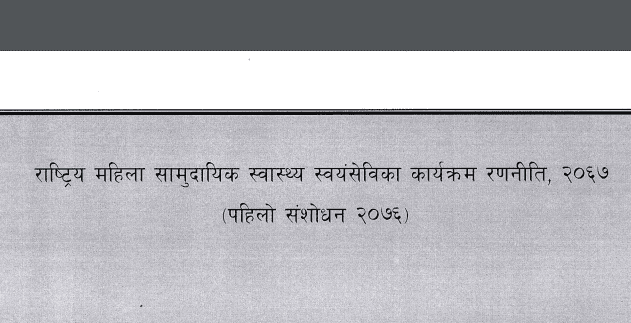
National Female Community Health Volunteer Program Strategy (First Revision 2076)
National Plan, Policy & GuidelinesPublic Health NotesResearch & Publication

National Female Community Health Volunteer Program Strategy (First Revision 2076)

by Public Health Update February 12, 2018
written by Public Health Update

National Female Community Health Volunteer Program Strategy (First Revision 2076)

Goal: The goal of FCHV program is to support the national goal on health through community involvement in public health activities. This includes imparting knowledge and skills for empowerment of women, increasing awareness on health related issues and involvement of local institutions in promoting health care.

DOWNLOAD New version : National Female Community Health Volunteer Program Strategy


Female Community Health Volunteer (FCHV) Programme, Nepal

Objectives:

  • To activate the women for tackling health problems by imparting relevant knowledge and skills
  • To prepare a pool of self-motivated volunteers as a focal person for bridging the health programs with community.
  • To prepare a pool of volunteers to provide services for community-based health programs
  • To increase the participation of community in improving health
  • To develop FCHV as a motivator of health
  • To increase utilization of health care services through demand creation

Role of FCHV

  • The main role of FCHV will be concentrated on the health promoti onal activities of mothers and children in their working area. Besides, they will also help in promoti ng uti lization of available health services and raise awareness on health through MGH
  • FCHV will help in various health programs such as family planning, safer motherhood, newborn care, immunizati on, nutrition, communicable and epidemic diseases, acute respiratory diseases and diarrheal diseases control, environmental sanitation, health education and other national programs
  • FCHV will also provide recommended services like drug distribution and diseases management as directed by Nepal government based on community based approach
  • Other health programs also might involve FCHV through their guidelines. However, the involvement of FCHV in other programs should be mandatorily endorsed by central level FCHV Coordinati on sub-committee.
  • FCHV has to submit an annual report to local health institution and her MGH.
  • FCHV has to submit a monthly report of her activities to local health worker or supervisor every month
  • FCHV can be selected by her respective MGH for a term of 5 years
  • FCHVs are entitled to abide by the code of ethics.

fchvs
Explanation of logo: 
When a small pebble is thrown into a pond, it creates a wave, which gradually spreads all over the surface of pond. Similarly, the activities of FCHV starts at ward level and gradually spreads to VDC level. Subsequently, the district will be covered with such actions and ultimately, whole nation will be developed through FCHV’s action The innermost circle shows that the action starts at community or ward level by individual FCHV, (as community is the center of health activities) Second circle shows the action is spread in the enti re VDC Third circle depicts whole district will be covered by FCHV’s actions The outermost circle shows that the action of FCHV will cover the whole nation. (National Female Community Health Volunteer Program Strategy)
Selection of FCHV
A meeting of MGH will select FCHV on the following basis. The decision of selection of a new FCHV should be communicated formally to local health institution and local government.
Basis of selection of FCHV

  • Permanent resident of the related ward of VDC
  • Interested to work as FCHV for at least 10 years
  • Age between 25-45 years d) Married or single (priority to be given to women having up to 3 children in case of a married woman)
  • Having commitment to serve the community
  • Priority will be given to those, who can read and write
  • Priority will be given to women from Dalit, Janajati and Marginalized groups
  • Those who are interested to be FCHV will have to submit an application to MGH
  • However, those women who are involved in a paid job, will not be allowed to be FCHV.

Retirement

  • FCHV attaining the age of 60 years will be bidden honored farewell on the recommendati on of MGH
  • A letter of honor as well as a designated amount of money may be provided to the retiring FCHV after serving satisfactorily for a period of years.
  • Retiring FCHV will be requested to be a honored member of the MGH
  • Retiring FCHV might continue to get the benefits of an active FCHV like obtaining free essential health care as per the guidelines.

DOWNLOAD : National Female Community Health Volunteer Program Strategy

Female Community Health Volunteer (FCHV) Programme, Nepal

27545632 1645906012161697 2762986854543107454 n

February 12, 2018 2 comments
0 FacebookTwitterPinterestLinkedinTumblrVKOdnoklassnikiRedditStumbleuponWhatsappTelegramLINEPocketSkypeViberEmail
Newer Posts
Older Posts

Search

Follow Us

Facebook Twitter Instagram Pinterest Linkedin Youtube

Categories

  • Abstracts (25)
  • Activities (91)
  • Adolescent Sexual and Reproductive Health (ASRH) (25)
  • Advice & Tips (3)
  • African Region (5)
  • AI and Health (1)
  • Annual Meeting (6)
  • Antimicrobial Resistance (AMR) (21)
  • Award (19)
  • Awards (16)
  • Books (9)
  • Call for Proposal, EOI & RFP (103)
  • Call for Research Participants (8)
  • Clinical Doctor Jobs (6)
  • Communicable Diseases (107)
  • Competition (20)
  • Conference (128)
  • Consultant (1)
  • Courses (205)
  • Dashboard (2)
  • Digital Health & Health Informatics (10)
  • Drug and Medicine (18)
  • Eastern Mediterranean Region (3)
  • Education (15)
  • Environment (3)
  • Environmental Health & Climate Change (47)
  • European Region (42)
  • Exchange Program (1)
  • Fact Sheet (117)
  • FCHVs (1)
  • Fellowships, Studentship & Scholarships (168)
  • Financial Aid (13)
  • Form Formats (2)
  • Fully funded (22)
  • Global Health News (433)
  • Grants and Funding Opportunities (193)
  • Guest Post (44)
  • Health Assistant Jobs (1)
  • Health Equity (7)
  • Health Financing and Economics (24)
  • Health in Data (115)
  • Health Insurance (5)
  • Health Jobs (52)
  • Health Literacy, Health Education & Promotion (49)
  • Health Organization Profile (42)
  • Health Systems (83)
  • Human Resource for Health (33)
  • Humanitarian Health & Emergency Response (44)
  • Hypertension (5)
  • Implementation Research (48)
  • International Health (3)
  • International Jobs & Opportunities (373)
  • International Plan, Policy & Guidelines (210)
  • Internships (4)
  • Jobs Vacancies (56)
  • Journals (8)
  • Life Style & Public Health Nutrition (39)
  • Live (10)
  • Master's Degree (48)
  • Maternal, Newborn and Child Health (88)
  • Mentorship Program (2)
  • Miscellaneous (16)
  • National Health News (157)
  • National Plan, Policy & Guidelines (468)
  • Neglected Tropical Diseases (NTDs) (51)
  • Non- Communicable Diseases (NCDs) (120)
  • Notice (103)
  • Nursing Jobs (6)
  • Nutritionist Jobs (1)
  • One Health (17)
  • Online & Distance Learning (22)
  • Online Courses (90)
  • Op-Ed Article (3)
  • Opportunities by Region (83)
  • Outbreak News (213)
  • Partially funded (6)
  • PCL Health Science Jobs (3)
  • PH Important Day (533)
  • Pharmacist Jobs (3)
  • PhD (54)
  • Photos (5)
  • Planetary Health (4)
  • PostDoc (14)
  • Presentation Slides (26)
  • Primary Health Care (25)
  • Provincial Plan, Policies and Guidelines (14)
  • Public Health (1,281)
  • Public Health Epidemiology & Biostatistics (13)
  • Public Health Events (306)
  • Public Health Information (20)
  • Public Health Innovation (9)
  • Public Health Jobs (52)
  • Public Health News (552)
  • Public Health Notes (120)
  • Public Health Opportunities (507)
  • Public Health Opportunity (491)
  • Public Health Programs (108)
  • Public Health Seminar (2)
  • Public Health Tools (1)
  • Public Health Update (561)
  • Quality Improvement & Infection Prevention (20)
  • Region of America (8)
  • Reports (184)
  • Research & Project Grants (39)
  • Research & Project Grants (32)
  • Research & Publication (647)
  • Research Articles (10)
  • Road Traffic Accidents (RTA) (9)
  • School of Public Health (60)
  • Self funded (2)
  • South-East Asia Region (26)
  • Success Stories (17)
  • Summer and Winter Courses (40)
  • Summer Courses (28)
  • Sustainable Development Goals (SDGs) (14)
  • Syllabus (61)
  • Symposium (9)
  • Tobacco Control (35)
  • Training (40)
  • Travel Grants (15)
  • Trick, Technique & Skills (8)
  • Uncategorized (3)
  • Undergraduate Degree (7)
  • Universal Health Coverage (36)
  • Universities (29)
  • Universities & School of Public Health (58)
  • Vacancy Announcement (26)
  • Vaccine Preventable Diseases (40)
  • Vector-Borne Diseases(VBDs) (30)
  • Videos (3)
  • View Points (1)
  • Webinar (4)
  • Western Pacific Region (13)
  • Workshop (18)
  • World News (116)
Post New Jobs: Vacancy Announcement Service

Public Health Update (Sagun’s Blog) is a popular public health portal in Nepal. Thousands of health professionals are connected with Public Health Update to get up-to-date public health updates, search for jobs, and explore opportunities.
#1 Public Health Blog for sharing Job opportunities and updates in Nepal

”Public Health Information For All”
– – Sagun Paudel, Founder

  • HOT JOBS
    • Public Health Jobs
    • Medical Doctor Jobs
    • Nursing Jobs
    • Health Assistant Jobs
    • Pharmacist Jobs
    • NGOs Jobs
    • Government Jobs
  • Top Categories
    • National Plan, Policy & Guidelines Top
    • Public Health Calendar
    • Fellowships & Scholarships
    • Health Systems
    • Health Organization Profiles
    • International Jobs & Opportunities
    • Public Health Opportunity

PUBLIC HEALTH INITIATIVE

    • Submit your Vacancies New
    • Partnership Opportunities

Contact: blog.publichealthupdate@gmail.com

https://wa.me/+9779856036932

Public Health Initiative, A Registered Non-profit organization – All Right Reserved. 2011-2024. Contact us. 

Facebook Twitter Instagram Youtube Envelope
Public Health Update
  • Home
  • Public Health
    • Home 1
      • Adolescent Sexual and Reproductive Health (ASRH)
      • Antimicrobial Resistance (AMR)
      • Communicable Diseases
      • Digital Health & Health Informatics
      • Environmental Health & Climate Change
      • Health Financing and Economics
      • Health Equity
    • Home 2
      • Health Literacy, Health Education & Promotion
      • Human Resource for Health
      • Humanitarian Health & Emergency Response
      • Implementation Research
      • International Health
      • Life Style & Public Health Nutrition
      • Maternal, Newborn and Child Health
    • Home 3
      • Neglected Tropical Diseases (NTDs)
      • Non- Communicable Diseases (NCDs)
      • One Health
      • Planetary Health
      • Public Health Epidemiology & Biostatistics
      • Primary Health Care
      • Quality Improvement & Infection Prevention
    • Home 4
      • Road Traffic Accidents (RTA)
      • Sustainable Development Goals (SDGs)
      • Tobacco Control
      • Universal Health Coverage
      • Vaccine Preventable Diseases
      • Vector-Borne Diseases(VBDs)
      • Notices
  • Public Health Update
    • Home 1
      • Public Health News
      • Global Health News
      • Outbreak News
      • National Health News
      • COVID-19
    • Home 2
      • Fact Sheet
      • Health in Data
      • PH Important Day
      • Public Health Events
      • Public Health Programs
    • Home 3
      • Health Systems
      • Health Insurance
      • Health Organization Profile
      • Success Stories
      • Public Health Innovation
  • Public Health Opportunities
    • Fully funded
    • Travel Grants
    • Grants and Funding Opportunities
    • Opportunities by Region
    • International Jobs & Opportunities
    • Research & Project Grants
    • Fellowships, Studentship & Scholarships
    • Conference
  • Jobs
    • Home 1
      • Health Jobs
      • Public Health Jobs
      • Clinical doctor Jobs
      • Health Assistant Jobs
      • Nursing Jobs
      • PCL Health Science Jobs
    • Home 2
      • Dental Jobs
      • Pharmacist Jobs
      • TSLC (Health Jobs)
      • Laboratory Jobs
      • Nutritionist Jobs
  • Downloads
    • International Plan, Policy & Guidelines
    • National Plan, Policy & Guidelines
    • Reports
    • Books
    • Research Articles
  • School of Public Health
    • Home 1
      • Courses
      • Master’s Degree
      • Undergraduate Degree
      • PhD
    • Home 2
      • Universities
      • Syllabus
      • Public Health Notes
      • Mentorship Program
      • Startup Project
    • Home
      • Summer and Winter Courses
      • Summer Courses
      • Online Courses
      • Workshop
      • Training
Public Health Update
  • Home
  • Public Health
    • Home 1
      • Adolescent Sexual and Reproductive Health (ASRH)
      • Antimicrobial Resistance (AMR)
      • Communicable Diseases
      • Digital Health & Health Informatics
      • Environmental Health & Climate Change
      • Health Financing and Economics
      • Health Equity
    • Home 2
      • Health Literacy, Health Education & Promotion
      • Human Resource for Health
      • Humanitarian Health & Emergency Response
      • Implementation Research
      • International Health
      • Life Style & Public Health Nutrition
      • Maternal, Newborn and Child Health
    • Home 3
      • Neglected Tropical Diseases (NTDs)
      • Non- Communicable Diseases (NCDs)
      • One Health
      • Planetary Health
      • Public Health Epidemiology & Biostatistics
      • Primary Health Care
      • Quality Improvement & Infection Prevention
    • Home 4
      • Road Traffic Accidents (RTA)
      • Sustainable Development Goals (SDGs)
      • Tobacco Control
      • Universal Health Coverage
      • Vaccine Preventable Diseases
      • Vector-Borne Diseases(VBDs)
      • Notices
  • Public Health Update
    • Home 1
      • Public Health News
      • Global Health News
      • Outbreak News
      • National Health News
      • COVID-19
    • Home 2
      • Fact Sheet
      • Health in Data
      • PH Important Day
      • Public Health Events
      • Public Health Programs
    • Home 3
      • Health Systems
      • Health Insurance
      • Health Organization Profile
      • Success Stories
      • Public Health Innovation
  • Public Health Opportunities
    • Fully funded
    • Travel Grants
    • Grants and Funding Opportunities
    • Opportunities by Region
    • International Jobs & Opportunities
    • Research & Project Grants
    • Fellowships, Studentship & Scholarships
    • Conference
  • Jobs
    • Home 1
      • Health Jobs
      • Public Health Jobs
      • Clinical doctor Jobs
      • Health Assistant Jobs
      • Nursing Jobs
      • PCL Health Science Jobs
    • Home 2
      • Dental Jobs
      • Pharmacist Jobs
      • TSLC (Health Jobs)
      • Laboratory Jobs
      • Nutritionist Jobs
  • Downloads
    • International Plan, Policy & Guidelines
    • National Plan, Policy & Guidelines
    • Reports
    • Books
    • Research Articles
  • School of Public Health
    • Home 1
      • Courses
      • Master’s Degree
      • Undergraduate Degree
      • PhD
    • Home 2
      • Universities
      • Syllabus
      • Public Health Notes
      • Mentorship Program
      • Startup Project
    • Home
      • Summer and Winter Courses
      • Summer Courses
      • Online Courses
      • Workshop
      • Training
Public Health Initiative, A Registered Non-profit organization – All Right Reserved. 2011-2023