Public Health Update
  • Home
  • Public Health Update
  • Nepal Health Jobs
    • Public Health Job Board
    • Organization List
  • Opportunities
    • Fellowships, Studentship & Scholarships
    • Grants and Funding Opportunities
    • Fully funded
    • Conference
  • Downloads
    • International Plan, Policy & Guidelines
    • National Plan, Policy & Guidelines
    • Reports
    • Public Health Notes
    • Syllabus
    • Form Formats
  • School of Public Health
    • PhD
    • Master’s Degree
    • Online Courses
  • Notice
  • Home
  • Public Health Update
  • Nepal Health Jobs
    • Public Health Job Board
    • Organization List
  • Opportunities
    • Fellowships, Studentship & Scholarships
    • Grants and Funding Opportunities
    • Fully funded
    • Conference
  • Downloads
    • International Plan, Policy & Guidelines
    • National Plan, Policy & Guidelines
    • Reports
    • Public Health Notes
    • Syllabus
    • Form Formats
  • School of Public Health
    • PhD
    • Master’s Degree
    • Online Courses
  • Notice
LOGIN / REGISTER
Public Health Update
SUBSCRIBE
Public Health Update
  • Home
  • Public Health Update
  • Nepal Health Jobs
    • Public Health Job Board
    • Organization List
  • Opportunities
    • Fellowships, Studentship & Scholarships
    • Grants and Funding Opportunities
    • Fully funded
    • Conference
  • Downloads
    • International Plan, Policy & Guidelines
    • National Plan, Policy & Guidelines
    • Reports
    • Public Health Notes
    • Syllabus
    • Form Formats
  • School of Public Health
    • PhD
    • Master’s Degree
    • Online Courses
  • Notice

All Right Reserved. Designed and Developed by PenciDesign

Public Health

Young People and Mental Health in a Changing World #WorldMentalHealthDay

by Public Health Update October 10, 2018
written by Public Health Update

Young People and Mental Health in a Changing World #worldmentalhealthday:  World Mental Health Day is observed on 10 October every year, with the overall objective of raising awareness of mental health issues around the world and mobilizing efforts in support of mental health.The Day provides an opportunity for all stakeholders working on mental health issues to talk about their work, and what more needs to be done to make mental health care a reality for people worldwide. this year World Mental Health Day is focused on Young Peoples with the theme. ”Young People and Mental Health in a Changing World”.
Key facts

  • One in six people are aged 10–19 years.
  • Mental health conditions account for 16% of the global burden of disease and injury in people aged 10–19 years.
  • Half of all mental health conditions start by 14 years of age but most cases are undetected and untreated.
  • Globally, depression is one of the leading causes of illness and disability among adolescents.
  • Suicide is the third leading cause of death in 15–19 year olds.
  • The consequences of not addressing adolescent mental health conditions extend to adulthood, impairing both physical and mental health and limiting opportunities to lead fulfilling lives as adults.
  • Mental health promotion and prevention are key to helping adolescents thrive.

World Health Organization  

123 1
12345


Recommendation of International Mental Health Conference Nepal (IMHCN) 2018

One in five people facing mental health problems

Informing the World: How to Change Public Attitudes to Mental Health

Mental health in the workplace – World Mental Health Day 2017

Mental Health Policy, Nepal

Standard Treatment Protocol for mental health services into the Primary Health Care System

World Mental Health Day- 2016 : Psychological First Aid

World Mental Health Day- 2015 (Photos: Pokhara)

World Mental Health Day 2014- “Living with schizophrenia”

Dignity in Mental Health: World Mental Health Day 2015

October 10, 2018 0 comments
0 FacebookTwitterPinterestLinkedinTumblrVKOdnoklassnikiRedditStumbleuponWhatsappTelegramLINEPocketSkypeViberEmail
Global Health NewsPublic Health News

Malaysia eliminates mother-to-child transmission of HIV and syphilis

by Public Health Update October 8, 2018
written by Public Health Update
Malaysia eliminates mother-to-child transmission of HIV and syphilis

8 October 2018, Joint News Release, Manila, Philippines
Malaysia today became the first country in the World Health Organization (WHO) Western Pacific Region to be certified as having eliminated mother-to-child transmission of HIV and syphilis.
“Thanks to Malaysia’s efforts over the past several years, parents can now ensure their babies are born free of HIV and syphilis and have a healthy start to life,” said Dr Shin Young-soo, WHO Regional Director for the Western Pacific. “Elimination could not have been achieved without Malaysia’s strong commitment to ensuring access to quality and affordable health services for all women, children and families.”
WHO Director-General Dr Tedros Adhanom Ghebreyesus and Dr Shin presented Malaysia’s Minister of Health, Dr Dzulkefly Ahmad, with a certificate of elimination during the session of the WHO Regional Committee for the Western Pacific, which opened today in Manila, Philippines.
As treatment for prevention of mother-to-child-transmission is not 100% effective, elimination of transmission is defined as a reduction of transmission to such a low level that it no longer constitutes a public health problem.
Criteria for Elimination WHO’s Global guidance on criteria and processes for validation: Elimination of mother-to-child transmission of HIV and syphilis outlines the process and indicators that countries need to meet for validation:Impact Indicators – must be met for at least 1 year:

  • fewer than 50 new paediatric HIV infections due mother-to-child transmission of HIV per 100 000 live births;
  • HIV mother-to-child transmission rate of less than 5% in breastfeeding populations, less than 2% in non-breastfeeding populations; and
  • fewer than 50 new cases of mother-to-child transmission of syphilis per 100 000 live births.

Process Indicators – must be met for at least 2 years:

  • ≥95% of pregnant women receive at least one antenatal visit;
  • ≥95% of pregnant women are tested for HIV and syphilis; and
  • ≥95% of infected pregnant women receive adequate treatment.

A country that is “validated” has met the internationally set targets at a specific point in time. They are required to maintain ongoing programmes after validation.
Malaysia eliminates mother-to-child transmission of HIV and syphilis

Read more: WHO 8 October 2018, Joint News Release, Manila, Philippines
October 8, 2018 1 comment
0 FacebookTwitterPinterestLinkedinTumblrVKOdnoklassnikiRedditStumbleuponWhatsappTelegramLINEPocketSkypeViberEmail
Public Health

Various Positions- UNDP Nepal

by Public Health Update October 8, 2018
written by Public Health Update

Various Positions- UNDP Nepal : The UNDP Nepal is seeking applications from qualified and result oriented Nepalese citizens for following positions:
kantipur 2018 10 08 page 013

FOR MORE INFORMATION PLEASE VISIT OFFICIAL ANNOUNCEMENT 

October 8, 2018 1 comment
0 FacebookTwitterPinterestLinkedinTumblrVKOdnoklassnikiRedditStumbleuponWhatsappTelegramLINEPocketSkypeViberEmail
National Plan, Policy & GuidelinesPublic HealthPublic Health Programs

Fractional Dose of Inactivated Polio Vaccine-fIPV

by Public Health Update October 4, 2018
written by Public Health Update

Fractional Dose of Inactivated Polio Vaccine-fIPV

Fractional Dose of Inactivated Polio Vaccine-fIPV: The Government of Nepal is preparing to add Fractional-Dose Inactivated Poliovirus Vaccine (fIPV) very soon.  A schedule of fractional intradermal doses administered at 6 and 14 weeks ensures early and appropriately-timed protection. The 2 fractional doses should be separated by a minimum interval of 4 weeks. 2 fractional doses of IPV, given intradermally at 6 and 14 weeks provide higher seroconversion rates than a single full dose (intramuscular) given at 14 weeks.3 FIPV FCHV Leaflet 2018 Final page 001

1 FIPV Brochure 2018 Final page 001
 
2 FIPV Factsheet 2018 nep Final page 0012 FIPV Factsheet 2018 nep Final page 002
fIPV
The National Immunization Programme (NIP) is a priority 1 (P1) programme of the Government of Nepal. Launched as the Expanded Programme on Immunization in 2034 BS (1977/78). Previously Eleven antigens are provided through the national programme to eligible infants, children and mothers through more than 16,000 outreach sessions, including in geographically and economically hard-to-reach and marginalized communities. Now government is planning to add more antigens to control diarrohoea caused by rota virus & FIPV.


National Immunization Schedule, Nepal (Revised)


The National Immunization Programme (National Immunization Schedule), Nepal
27th March 2014 : Historical Day in field of Public Health to end Polio in Nepal
National Immunization Schedule 
Key Strategies for polio eradication 
Nepal Demographic and Health Survey 2016 Key Indicators Report (Short Notes)
Nepal Demographic and Health Survey 2016 Key Indicators Report
World Immunization Week 2017 #VaccinesWork
Sub-National Immunization Day- 2015
Nepal Multiple Indicator Cluster Survey (NMICS) 2014 Key Findings Report
World Polio Day 24 October 2017- Promoting health through the life-course
October 4, 2018 1 comment
0 FacebookTwitterPinterestLinkedinTumblrVKOdnoklassnikiRedditStumbleuponWhatsappTelegramLINEPocketSkypeViberEmail
Notice

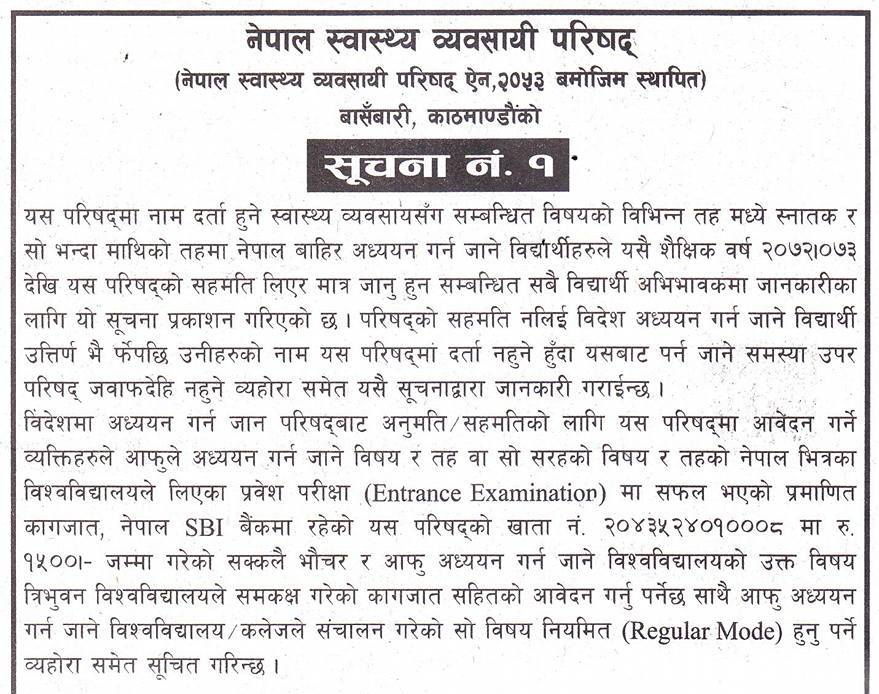
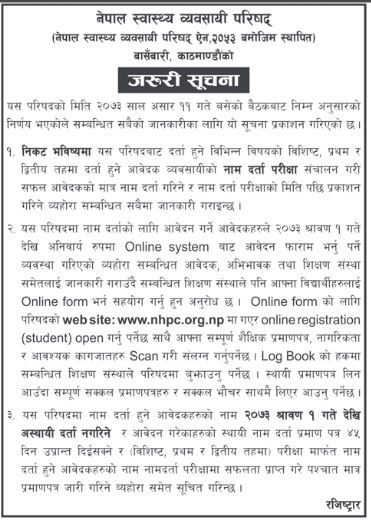
Important Notices – Nepal Health Professional Council (NHPC)

by Public Health Update October 3, 2018
written by Public Health Update
Important Notices – Nepal Health Professional Council (NHPC)


12042657 10153260141884403 5362158495946049507 n
Kantipur(17th Sep 2015)


Important Notices – Nepal Health Professional Council (NHPC)
NHPC
Kantipur (1 July 2016)


October 3, 2018 0 comments
0 FacebookTwitterPinterestLinkedinTumblrVKOdnoklassnikiRedditStumbleuponWhatsappTelegramLINEPocketSkypeViberEmail
ConferenceHealth Literacy, Health Education & PromotionTobacco Control

Resolutions of 12th Asia Pacific Conference on Tobacco or Health (APACT12)

by Public Health Update October 2, 2018
written by Public Health Update

RESOLUTIONS of THE 12th APACT CONFERENCE Bali, Indonesia; 12-15 Sept 2018

Conference theme: “Tobacco Control for Sustainable Development Goals: Ensuring A Healthy Generation”
We, the participants of 12th Asia Pacific Conference on Tobacco or Health (APACT12), representing 28 countries, are deeply concerned that the Asia-Pacific region faces the onslaught of the tobacco epidemic, which claims several million lives every year. The tobacco industry has targeted the region to promote and sell even more tobacco and grow its business, and this is a big threat to public health. The tobacco industry is part of the problem and not the solution. We condemn the tobacco industry’s tactics to undermine, delay, obstruct and dilute public health efforts. Tobacco touches most of the Sustainable Development Goals (SDGs). The Asia Pacific region needs to step-up efforts to accelerate the implementation of the SDGs and the World Health Organization Framework Convention on Tobacco Control (WHO FCTC).
These recommendations follow the numbering of the SDGs:

  1. SDG #1 (No poverty) and FCTC Article 6 (Price measures): To make tobacco less affordable particularly to youth and the poor, and to help tobacco users quit, by increasing tax to a minimum of 75% of retail price on all tobacco products.
  2. SDG #2 (Zero hunger) and FCTC Article 17 (Tobacco farming): To address hunger by growing food in place of tobacco. At least ten countries will put in place definite plans to shift tobacco growers to growing more food crops. Use of child labour in tobacco cultivation must be eliminated by 2025. We call upon the International Labour Organisation (ILO) to end its collaboration with the tobacco industry immediately to align with the decision of the UN Economic and Social Council (ECOSOC).
  3. SDG #3 (Good health and well-being) and FCTC: To protect the health and economic wellbeing of its people and to align with the rest of Asia Pacific region, Indonesia to ratify the WHO FCTC within one year.
  4. SDG #3 (Good health and well-being) and FCTC Article 11 (Packaging and labelling): All countries should adopt prominent graphic pack warnings, and ban pack displays at retail outlets within the next 2 years. A minimum of 8 countries in the region to introduce plain packaging.
  5. SDG #3 (Good health and well-being) and FCTC Article 13 (Tobacco Advertising Promotion and Sponsorship (TAPS) Ban): To ban the use of social media to boost their image and sales.
  6. SDG #4 (Quality Education) and FCTC Article 12 (Education and research): To strengthen and resource public education so that all the public are aware of the harm of tobacco and including information on cessation.
  7. SDG #5 (Gender equality) and FCTC 4.2d (Gender specific measures): To end the targeting of girls by the tobacco industry by TAPS, packaging and product design. All tobacco control measures to incorporate gender specific perspectives.
  8. SDG #11 (Sustainable cities and communities) and FCTC Article 8 (Smoke Free environment): To ensure sustainable and clean cities, and to protect the public from exposure to tobacco smoke, each jurisdiction should adopt 100% smoke-free policies in all workplaces and public places, and to adopt effective enforcement strategies to ensure compliance.
  9. SDG #13 (Climate action) and FCTC Article 18 (Protection of the environment): We recommend the 13th APACT to include debate and discussion on the environmental harms caused by tobacco.
  10. SDG #16 (Peace and justice) and FCTC Article 5.3 (Protecting public policy from tobacco industry interference): To prohibit the tobacco industry from influencing the implementation of SDGs. Consistent with FCTC Articles 5.3 and the implementing guidelines, each state should monitor, expose and ban tobacco industry, their allies and front groups from participating in tobacco control policy development.
  11. SDG #17 (Partnership) and FCTC Article 5.3 3 (Protecting public policy from tobacco industry interference): Partnership with the tobacco industry is detrimental to all SDGs and the FCTC. To ensure good governance, governments, scientists, research entities, and civil society organizations must reject or terminate all partnerships or support from the tobacco industry, including the Philip Morris International-funded Foundation for a Smoke-free World, and other initiatives of the tobacco industry. Governments should not promote tobacco trade and also should divest from tobacco businesses.
  12. SDG #17 (Partnership) and FCTC Article 26 (Sustainable financial mechanism for tobacco control): Government should prioritize sustainable funding for tobacco control.
  13. There is an irreconcilable conflict between the manufacture and marketing of tobacco products and the right to health. We adopt the Cape Town Declaration on Human Rights and a Tobacco-free World.
  14. Towards tobacco free generation: To empower youth involvement and advocacy as a means to achieving a tobacco-free generation.

APACT 12th Youth Vision: Choose Youth Not Tobacco!

APACT 12th Youth Vision: Choose Youth Not Tobacco!


APACT12

APACT12

The 12th Asia Pacific Conference on Tobacco (APACT12th)

October 2, 2018 0 comments
0 FacebookTwitterPinterestLinkedinTumblrVKOdnoklassnikiRedditStumbleuponWhatsappTelegramLINEPocketSkypeViberEmail
National Plan, Policy & GuidelinesNoticePublic Health

सरकारले यि आठ प्रकारका रोगहरुमा दिन्छ सहुलियत,जनहितका लागि सेयर गरौ!

by Public Health Update October 2, 2018
written by Public Health Update

Bipanna Nagarik Kosh

Bipanna Nagarik Kosh was started after the Janandolan of 2062 BS. With the country slowly recovering from the decade long armed conflict, this Kosh was established to provide some financial relief to people from difficult and expensive diseases. Cardiovascular diseases, Cancer, Renal failure, Alzheimer’s disease, Parkinson’s disease, Head and Spinal injury, Sickle Cell Anaemia and Stroke are covered under this program.


new

Required documents

  1. Prescription of patient by any hospital or doctor
  2. Attestation from the local VDC or municipality office (permanent address) that the patient is eligible for the subsidy under the programme
  3. Photocopy of Citizenship & birth registration certificate in case of child. 
  4. Approval from the D(P)HO office granting the subsidy.

If you wish to find out more about the program, contact the nearest District Health Office.

Medical Treatment of Deprived Citizens


October 2, 2018 0 comments
0 FacebookTwitterPinterestLinkedinTumblrVKOdnoklassnikiRedditStumbleuponWhatsappTelegramLINEPocketSkypeViberEmail
List of Documents required for approval of Study & Extra-ordinary Leave
National Plan, Policy & GuidelinesNoticeResearch & Publication

List of Documents required for approval of Study & Extra-ordinary Leave

by Public Health Update October 2, 2018
written by Public Health Update

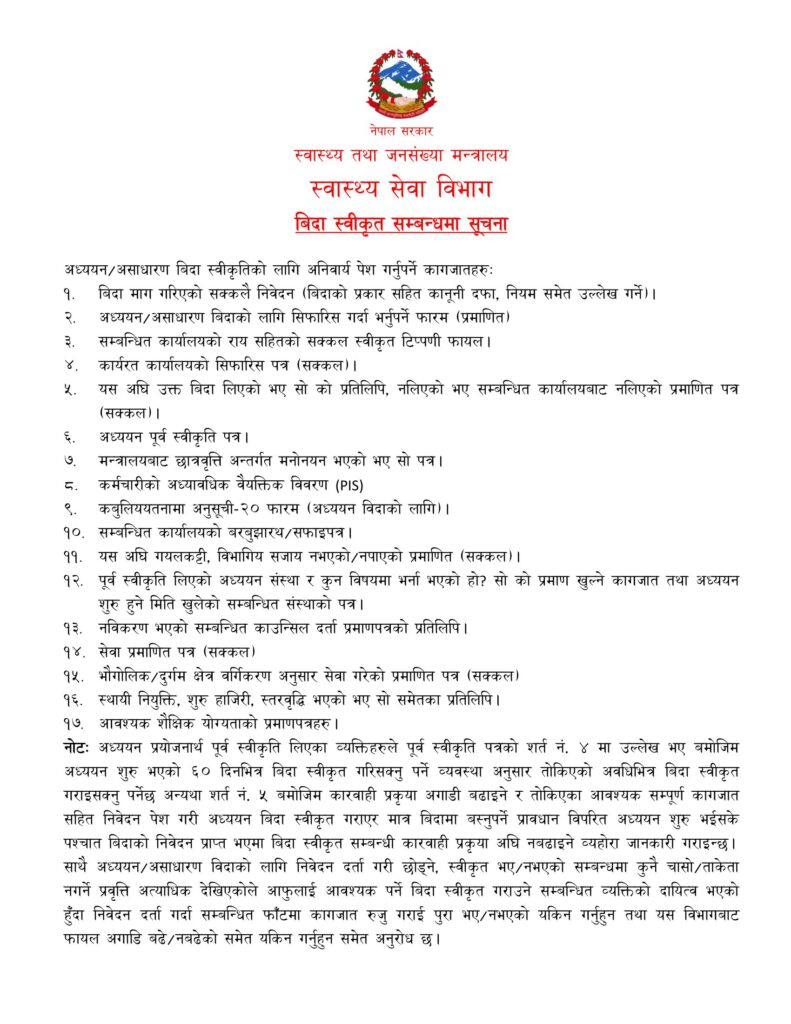
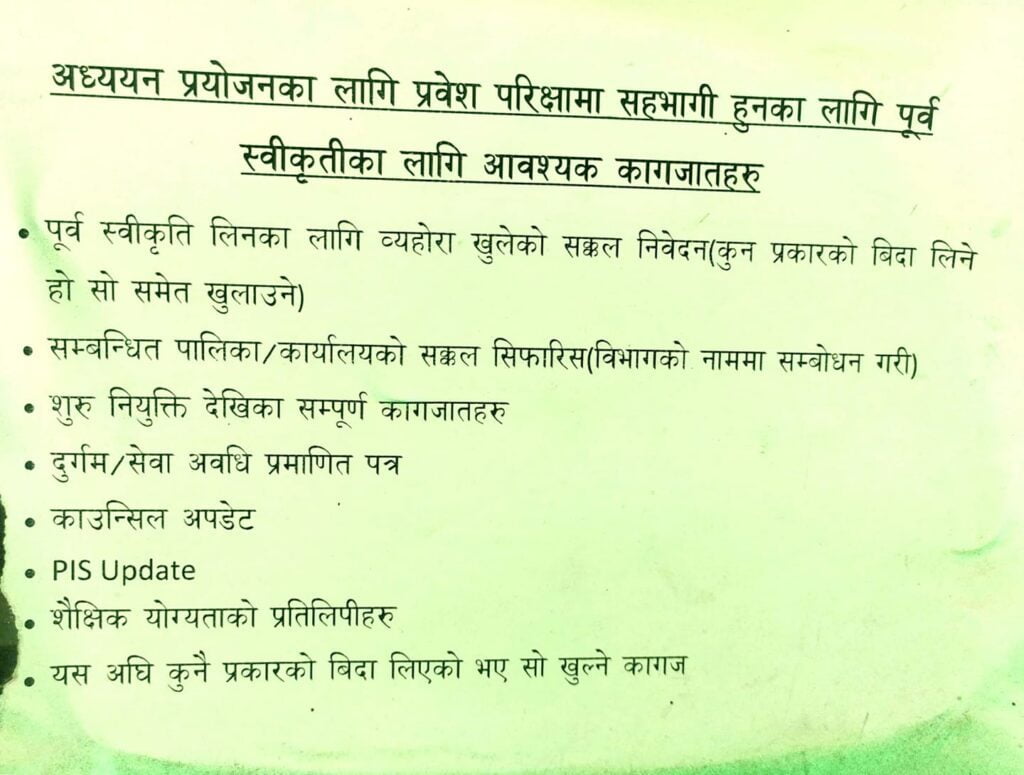
Here is the List of Documents to be submit for approval of Study & Extra-ordinary Leave enlisted by Department of Health Services (DoHS), Ministry of Health and Population.

अध्ययन बिदा सम्बन्धि सूचना

Document required for Study Leave

List of Documents to be submit for approval of Study & Extra-ordinary Leave- DoHS, Ministry of Health and Population.

October 2, 2018 0 comments
0 FacebookTwitterPinterestLinkedinTumblrVKOdnoklassnikiRedditStumbleuponWhatsappTelegramLINEPocketSkypeViberEmail
Syllabus for Public Health Licensing Examination 2073 - Nepal Health Professional Council
NoticeSyllabus

Syllabus for Public Health Licensing Examination 2073 – Nepal Health Professional Council

by Public Health Update October 2, 2018
written by Public Health Update

Syllabus for Public Health Licensing Examination 2073 -Nepal Health Professional Council

1. Background 

The health sector has often been considered an entry point for overall development of the country. Nepal is one of the 189 countries committed to the Millennium Development Goals (MDGs), universal health coverage and more recently Social Development Goal (SDG). In order to fulfill the goals of SDGs, the impetus created by the Nepal Health Sector Strategy 2015-2020. More importantly, constitution of Nepal has enshrined health as fundamental rights of Nepali people and mandated the provision free basic health care services. This has rightly acknowledged the importance of health sector which demands the production and deployment of quality health service providers in the country. Progress in the health sector over the last decade has been impressive with most key health (and nutrition) indicators showing improvements. Life expectancy at birth in Nepal is rising and is now higher than most other neighboring countries at 67 (Asia-Pacific HDR, 2012), infant mortality has declined to 46 infant deaths per 1,000 live births and maternal mortality now stands at 229 maternal deaths per 100,000 live births (MMM Study 2009). This has suggested that more needs to be done to ensure the constitutional mandates. In this context, Nepal health professional Council has realized the importance of providing the public health licensing through the examination. This will help ensure the quality of public health services through the skilled human resources.
 

2. Broader Principles of Public Health Curriculum 

The broader principle of public health curriculum of both bachelor and master of public health is based on the preventive, promotive and rehabilitative health need of the people. The curriculum offers both knowledge and skills required to understand the situation of health status and plan to prevent the disease or condition, promote the healthy lifestyle and community involvement to support the people with disease or conditions. NHPC, recognizes the following core areas that should cover in public health education. In bachelor degree, students learn the basic knowledge and skills. During the master’s degree, students should get the advanced or specialized knowledge in any specific areas of public health educations. 
  • Introduction to public health and health policies,
  • Understand the disease paradigms and their shifts,
  • Analyze the disease or situation,
  • Different dimension of health,
  • Human biology.
  • Approaches, methodologies of development health to public health,
  • History, development and scope of health to public health,
  • Principles, concept, models, dimensions and elements of health to public health,
  • Practice of health to public health management within and beyond the national to international territory,
  • Use of trans-medical models in modern family and community health studies, 
  • Economics of health and health care,
  • Health systems development,
  • Health promotion and communication,
  • Population and development dynamics in modern public health management,
  • Globalization of health to public health service management,
  • Challenges of modern health to public health management in the region or territory,
  • Ethics and politics of family-community health and development,
  • Health research and development, and
  • Growth and development of professionalism. 

 
The curriculum should address the changing sub-national, national, regional and international public health needs. 

3. Need of Examination 

The main intention of conducting examination is to ensure the supply of skilled public health human resources in the market. It also aims to contribute in the production of quality public health graduates. NHPC is a statutory authority formed under the Nepal Health Professional Council Act 2053 Bikram Era sets out condition for the registration of identified health professional including public health graduates. The Act prohibits any public health professional practice without being registered with NHPC. The council maintains register and those who are registered are granted with practicing certificate. The responsibility of quality control of the health professional education in the nation lies in the hands of NHPC. Taking the mandate from this legal provision, the NHPC has decided to conduct the public health licensing examination. 
 

4. Objective of the Syllabus 

The overall of objective of this syllabus is to ensure the availability of basic public health knowledge among the public health practitioners. The specific objective is to define the core subjects and provide the weightage for the purpose of licensing examination of those who completed 4 years bachelor degree in public health from the recognized universities.
 

5. Examination Methodology 

NHPC collects the online applications from of both masters and bachelor degree graduates. The subject committee reviews the certificates and makes the recommendation to the examination committee. The examination committee following this syllabus takes examination in the periodic basis. Those who have complete 4 years bachelor degree in public health from recognized university are eligible to enter into this licensing examination. The questions of respective subject will be collected from the experts and choose the questions randomly during the examination.
 

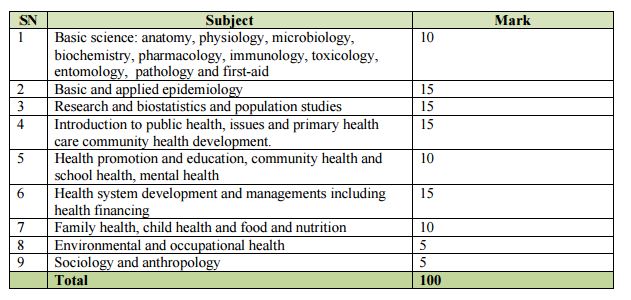
Distribution of Weightage by Subjects 

6.1 Bachelor in public health (total mark 100)
nhpc


6.2 Basic Science:, anatomy, physiology, biochemistry, microbiology, pharmacology, immunology, toxicology and entomology , pathology and first aid – (10)
Anatomy: 
  • Definition of terminologies used in anatomy, different components of animal cell. basic types of tissues with their characteristic features and organ systems.
Physiology: 
  • Introduction to different components of animal’s cell and their function, different tissue of body and their characteristics, body fluids and electrolyte balance their classification and composition and homeostasis. 
Biochemistry: 
  • Introduction and application of biochemistry in public health, Basic concept of acid, base and salt. Definition, classification, physical and chemical properties of carbohydrates, protein, amino acid and fatty acid. Glucose absorption and its homeostasis. Important aspects of essential amino acids and fatty acids. Biomedical importance of cholesterol, bile salt, macro and micronutrients and vitamins. Microbiology: Introduction to microbial world, Classification of microbial diseases, Introduction to community acquired microbial infection. 
Bacteriology: 
  • Classification of bacteria. Normal bacterial flora on or in the body. Concept of opportunistic and pathogenic organisms. Bacterial physiology and its growth factors. Mechanism of infection. Spread of diseases, pandemic, endemic, epidemic and laboratory infection. Physical sterilization, chemical disinfects ion and radiation. Collection and transport of specimen for identification of common bacterial communicable diseases (respiratory, genital and gastrointestinal diseases). Gram staining and AFB staining in identifying bacteria. 
Parasitology: 
  • Classification of human parasite, introduction to parasitic diseases associated with poor personal and public hygiene. Blood parasites (malaria parasite, kala-azar, microfilaria), life cycle and mode of infection. Collection of sample, processing and identification. Treatment, prevention and control. Intestinal protozoa (entamoeba hystolytica, Giardia lamblia and Cryptosporia). Life cycle and mode of infection. Collection of sample, processing and identification. Treatment, prevention and control. Intestinal worms (Roundworm, hookworm, pinworm, whipworm). Tapeworm: T. saginata, T. solium, echinocococus granulosus. H. nana, life cycle and mode of infection. Collection of sample, processing and identification. Treatment, prevention and control. 
Virology: 
  • Introduction, classification of virus, replication of virus introduction to viral disease of community concern, collection and preservation of viral specimen for laboratory study, prevention and control of viral diseases. 

Immunology: 

  • Introduction to immunology, defense mechanism of body, antigen and antibody hypersensitivity reaction and basic concept of immunology in diagnosis of viral diseases. 
Pharmacy and pharmacology: 
  • Meaning of pharmacokinetics, Pharmaco-dynamics and Pharmacokinetics. Classification of drugs, classification, mechanism of action, fate of drugs, side effects indication and contraindication of life saving drugs. Concept of essential drugs and its implementation in Nepal. Essential drugs used in free health services. Use and misuse of antibiotics. Drug policies, drugs acts and standard treatment protocol. Concept of GMP,GLP, and GCP 
Toxicology: 
  • Definition of Toxicology and terminology used in toxicology. 

Occupational and environmental toxicology 

  • Acceptable limits of toxic exposure, prevention and control. 

Entomology: 

  • Definition and classification of important arthropods and rodents, diseases and health hazards associated with arthropods and rodents. Prevention and control of diseases and health hazards. 
Pathology: 
  • General and systemic pathology (in detail of all system). 
First Aid: 
  • Shock, types of shock, identify first aid measures to the patient, First acid measures in case of poisoning (insecticides, rodenticides, drugs, alcohols), Foreign body in ear, nose, throat and eyes and provide first aid, Injury, identify measures to provide first aid appropriately, Hemorrhage, first aid to control external bleeding, Burns, classification, its percentage and first aid measures to thermal and chemical burns, Measure to manage the case of frost bite, Fractured bones and dislocations, its first aid measurement, Heatstroke and its first aid measurement, Rabid animal bites and its first aid measurement, First aid measures in case of drowning, Measures to be taken in case of snake bites, Acute mountain sickness and its first aid measures. 
6.3 Basic and Applied Epidemiology (15) 
Historical development, definition and scope of Epidemiology, Terminology used in epidemiology. Epidemic, Endemic, Pandemic, Sporadic, Zoonotic, Iatrogenic, infection, communicable disease, pollution, contamination, infestation, epidemic, endemic, sporadic, pandemic, epizootic, enzootic, source of infection, reservoir, case, carrier, host, incubation period, communicable period, secondary attack rate, agent, anti-genicity, infectivity, pathogenicity, virulence, infective dose, environment, vector, Parasite Epidemiology methods: distribution of diseases. Frequency measures used in epidemiology-Proportion, Rate and ratio. Frequency measures used in morbidity, mortality, case fatality, incidence, and prevalence. 
Measures of disease frequency
  • Rate, ratio, proportion, population at risk, prevalence (rate), incidence (rate), cumulative incidence proportion, mortality and morbidity rates/ratio.
Measures of association 
  • Absolute risk: risk difference, attributable fraction, population attributable risk relative risk/risk ratio, and odds ratio. 
  • Epidemiological study design: Descriptive, analytical and experimental, case control study, cohort study and experimental study. 
  • Non-Communicable disease epidemiology: CVD, COPD, Cancer, Diabetes, Accidents, Mental health, Suicide, Drug abuse and Snake bites. 
  • Communicable Disease Epidemiology : Viral, Bacterial, Fungal and Protozoal infections, helminthes infestation, zoonotic diseases and others (Trachoma) 
  • Introduction and consequences of conflict and disaster, disaster planning, preparedness and prevention, conflict management and its importance in health service management, and epidemic investigation component of field epidemiology.
6.4 Research and Bio statistics, population studies (Demography) (15) 
Research: 
  • Meaning, definition and purpose of research, importance of research in public health, basic terms used in research concepts, types of research design, research methods, techniques, tools , steps of research process, and process of writing the research report. 

Population studies: 

  • Importance and implication of population study in public health, population structure, characteristics and components and projection. Demographic health survey in Nepal. Population growth and its trend in Nepal with comparison. Three Components of population growth (Fertility, mortality and Migration). Population policy and program in Nepal. Public Health and application of IT 

Biostatistics: 

  • Definition of Common Statistical Terms, difference between Statistics and Biostatistics –some concepts, definition of biostatistics, scope, role, usefulness of different branches of statistics in the investigation of community health and public health research and uses of Biostatistics in public health research. 
  • Descriptive Statistics: Basic concept of variables, types of variables (discrete and continuous variables), scales of measurement. Collection and recording of statistical information on public health and its related fields from primary and secondary sources, Tabulation, processing and presentation of statistical data: frequency distribution and different types of tables (one way, two way and manifold tables). 
  • Measures of Central Tendency: Mean, Median & Mode. Different partition values (quartiles, deciles & percentiles). 
  • Measures of dispersion (variability): Range, standard deviation, variance and coefficient of variation (CV). 
  • Probability Distribution: Concept of set theory, permutations, combinations, factorial, definition of Probability, Multiplicative Law of Probability, addition law of probability, Conditional Probability, and Bayes’ Theorem, Random variable, discrete and continuous probability distribution, definition and properties of Binomial, Poisson and Normal probability distribution, Expected value and variance of Binomial, Poisson and Normal distribution. Sampling theory, sampling distribution, estimation and hypothesis testing. 
6.5 Introduction to public health, issues and primary health care community health development: (15)
  • Introduction to public health
  • Scope of public health
  • Concepts and distinction between public health, community health, social medicine and socialized medicine
  • Ottawa Charter of health promotion
  • Priorities for health promotion (in reference to Jakarta Declaration)
  • Concepts of Health and Diseases, Prevention and levels of Prevention. Application of public health from different models
  • Health Promotion: Concept and scope of health promotion Legal aspect in Public health. 
Health policies and plans
  • Alma-Ata and other International Declarations, Environmental and occupational health laws. Consumer rights, Patient rights
  • Universal health coverage,
  • Public Health Problems in Nepal: Communicable Diseases, Non-communicable Diseases, Mental Health and drug abuse, Vaccine preventable diseases. Food and waterborne diseases
  • Nutrition deficiency diseases.
  • Issues in public health: Issues in epidemiological study in Nepal (TB, Malaria, Polio, Diabetes etc
  • Issues in Reproductive Health in Nepal: holistic model of family health biomedical, bio-psycho- social models and their determinants, Decreasing Antenatal Visits, Low institutional delivery and CPR, Unmet need of Family planning, addressing gender based violence, Reproductive Health problems of the elderly people.
  • Issues in child health in Nepal: CB-IMNCI, EPI program
  • Issues of healthy ageing in Nepal o Issues in environmental and Occupational health in Nepal
  • Uses of pesticides and its effect in health: Waste management
  • Disposal of health care waste and general waste ,Health of the Agriculture, Industries, factories, Transportation and health institution and laboratory workers.
Development of public health in Nepal
  • Ancient and pre unification period
  • Pre Rana Regime period
  • Rana Regime period
  • Public health after 2007 BS
6.6 Health promotion and education, community health and school health, mental health- (10)
  • Health Promotion and Education: History, meaning, concept, principles, scope and philosophy of health education and promotion. Principles of learning
  • Different theories and modalities for behavioral changes, Change process, modules and strategies for change. Methods and Media for health education and health promotion. Selection of appropriate health education method and Medias and its importance. Health promotion and Education in Nepal
  • Policy and strategy programs regarding health promotion and education in Nepal. Introduction of NHEICC, Programs, Goal, policy, strategies and activities of NHEICC. Planning of health education and promotion program. Importance of health education and promotion planning. Steps of Health Education Planning,
  • PRECED and PROCED framework of health education diagnosis
  • Approaches in health promotion and education planning
  • Monitoring and indicator of health education and promotion programs
6.7 Health system development and managements including health financing: (15) 
  • Meaning, concept, principles, scope and application of public health management and administration
  • Planning, elements of planning,, types and method of planning
  • Health and health service management in Nepal 
  • Various approaches of health service delivery in Nepal
  • Health Service Management, Information System (HMIS)/DHIS
  • Organizational structure of health system in Nepal
  • Brief history of development of health services in Nepal Traditional Health Care practices. Ayurveda, Homeopathic and Allopathic medicine in Nepal. Integrated Health services in Nepal National Health policy-2014. Long-term Health plans in Nepal. Current Five year Health Plans in health services 2015-2020, Three years plans, annual plans
  • Organizational structures of health system in Nepal from central level to community level
  • Brief introduction of various health programs in Nepal in term of goals, objectives, strategies and activities, TB control program, Leprosy control program, Malaria control program, EPI/ National Immunization Programme, Nutrition/MCH, Kalaazar, STDs and AIDS control program. Environmental health and health training.
  • District health system : Organizational structure of DPHO/DHO/PHCC/HP. Roles and responsibilities of DPHO/DHO/PHCC and HP. Supervision Monitoring and evaluation of health programs. Referral system in Nepal from different service providing levels. Coordination mechanism from central to health post
  • Sources of Financing in health system of Nepal Budgeting process, Irregularity clearance mechanism in health system 
6.8 Family health, child health, food and nutrition (10)
Family Health: 
  • Concept and historical development of Family Health. Roles of Family Health in prevention, promotion, treatment and rehabilitation of health. Reproductive Health Policies and Adolescent Health. 
  • Health Problems related to Reproductive health and Safe Motherhood program. 
  • Pattern of communicable and non-communicable diseases concerned to reproductive health and safe motherhood 
  • Family planning principles and methods and importance of counseling Challenges in Family planning program specially in FP contraception 
  • Life cycle approach in health 
  • Ageing and disable people’s health Geriatric and disables health problems under family health care setting in Nepal. Policies, strategies and programs for ageing and disable population 
  • Child Health: Child health and national health care system Child health diseases burden in Nepal. Malnutrition and vaccine preventable diseases. Indicators used in child health program 
  • International declarations on health Food and nutrition: Food classification, Sources and daily requirement of calorie. Unhygienic food and effect in health. Food borne diseases
  • Food hygiene and its importance. Nutrition related health problems in Nepal. Food security and nutrition. Food acts and implementation. Inter-sectoral cooperation, coordination for nutrition problem in Nepal and ultispectral nutrition plan. 
6.9 Environmental and Occupational Health (5)
Introduction to Environmental and occupational Health 
  • Meaning, scope and component of environmental and occupational health. Application and importance of environmental and occupational health 

Environmental Health problems of Nepal: 

  • Unsafe drinking water, Indoor Air pollution, Deforestation and desertification, Flooding and soil erosion, Poor sanitation and hygiene, Industrial pollution in urban 

Water resources management:

  • Source and water contamination Water quality and human health. Waterborne diseases. Water purification
  • Solid waste Management: 
  • Types and source of hazardous waste Management of hazardous waste including hospital waste management.
  • Biodiversity and its conservation: 
  • Concept and importance of Biodiversity. Biodiversity and human health. Conservation of Biodiversity and its impact on human health

Occupational Health and Safety development: 

  • Meaning and concept of occupational health. Most common occupational diseases in Nepal. Policies related to occupational Health. Control and treatment of occupational Diseases. Promotion of occupational Health ∑ Basic concept of environmental toxicology, prevention and control.

Environmental problems:

  • Meaning of global warming and climate change. Global environmental warming: Causes of global warming and climate change. Health impact of global warming and climate change
  • Disposal of hospital waste and human excreta 

Occupational health and safety:

  • Meaning and historical development, occupational Health practices applied to specific exposure (Physical, Chemical and biological). Major occupational diseases and their prevention
6.10 Sociology and Anthropology (5)
  • Introduction: definition and meaning of sociology, anthropology scope and classification of sociology 
  • Basic concept: Definition, basic element and characteristics of society, community, groups and social classes. Meaning and characteristics of social norms. Social process, Socialization, Acculturation, Assimilation. 
  • Enculturation. Conflict
  • Social Institution: Marriage, Family and kinship system: Religious, political and economic institutions, Social and cultural change. Meaning and characteristics of socio-cultural change. Factors for socio-cultural change. Uses of sociology and Anthropology in public health
  • Health behavior, illness behavior and sickness role, Models of health behavior. Sociocultural influences in health behavior
  • Culture and Health: Definition of culture, characteristics, elements and types of culture. Self-medication and other prevailing health care practices in Nepal. Meaning, nature and causes of social problems. Consequences of socio-cultural changes. Meaning and agencies of social control, Practices of social control in health field in Nepal ∑ Social psychology: Basic concept and different dimension. 
  • Concepts of health politics and importance in public health intervention. 
DOWNLOAD PDF File : NHPC


Do you have a website? Looking for the best hosting provider? Here’s a discount code.

Latest Public Health Jobs

Latest Posts

  • World Water Day 2026 | Water & Gender Equality
  • Nepal Antimicrobial Resistance (AMR) Bulletin FY 2081/82
  • Call for applications! Short Course on Qualitative Research Methods in Public Health, 2026
  • World Obesity Day 2026 | 8 Billion Reasons to Act on Obesity
  • Salim Yusuf Emerging Leaders Programme 2026

Thanks for visiting us.
Disclaimer: The resources, documents, guidelines, and information on this blog have been collected from various sources and are intended for informational purposes only. Information published on or through this website and affiliated social media channels does not represent the intention, plan, or strategies of an organization that the initiator is associated with in a professional or personal capacity, unless explicitly indicated.
If you have any complaints, information, or suggestions about the content published on Public Health Update, please feel free to contact us at blog.publichealthupdate@gmail.com.
#StayUpdated


  • WordPress
  • Link
  • Facebook
  • Mail
  • Facebook
  • Twitter
  • Twitter
  • LinkedIn
  • Instagram
  • Facebook
October 2, 2018 0 comments
0 FacebookTwitterPinterestLinkedinTumblrVKOdnoklassnikiRedditStumbleuponWhatsappTelegramLINEPocketSkypeViberEmail
National Plan, Policy & GuidelinesResearch & Publication

Social Networking site user manual for Government authorities

by Public Health Update October 1, 2018
written by Public Health Update

The Government of Nepal approved the Social Networking site user manual for Government authorities 2075. 

Social Networking site user manual for Government authorities

Social Networking site user manual for Government authorities Social Networking site user manual for Government authorities Social Networking site user manual for Government authorities


  • Public Health Act 2075
  • Safe Motherhood & Reproductive Health Right Act 2075
  • National Oral Health Policy-2070, NEPAL
  • Handbook for national quality policy and strategy- World Health Organization
October 1, 2018 0 comments
0 FacebookTwitterPinterestLinkedinTumblrVKOdnoklassnikiRedditStumbleuponWhatsappTelegramLINEPocketSkypeViberEmail
Newer Posts
Older Posts

Search

Follow Us

Facebook Twitter Instagram Pinterest Linkedin Youtube

Categories

  • Abstracts (25)
  • Activities (91)
  • Adolescent Sexual and Reproductive Health (ASRH) (25)
  • Advice & Tips (3)
  • African Region (5)
  • AI and Health (1)
  • Annual Meeting (6)
  • Antimicrobial Resistance (AMR) (21)
  • Award (19)
  • Awards (16)
  • Books (9)
  • Call for Proposal, EOI & RFP (103)
  • Call for Research Participants (8)
  • Clinical Doctor Jobs (6)
  • Communicable Diseases (107)
  • Competition (20)
  • Conference (128)
  • Consultant (1)
  • Courses (205)
  • Dashboard (2)
  • Digital Health & Health Informatics (10)
  • Drug and Medicine (18)
  • Eastern Mediterranean Region (3)
  • Education (15)
  • Environment (3)
  • Environmental Health & Climate Change (47)
  • European Region (42)
  • Exchange Program (1)
  • Fact Sheet (117)
  • FCHVs (1)
  • Fellowships, Studentship & Scholarships (168)
  • Financial Aid (13)
  • Form Formats (2)
  • Fully funded (22)
  • Global Health News (433)
  • Grants and Funding Opportunities (193)
  • Guest Post (44)
  • Health Assistant Jobs (1)
  • Health Equity (7)
  • Health Financing and Economics (24)
  • Health in Data (115)
  • Health Insurance (5)
  • Health Jobs (52)
  • Health Literacy, Health Education & Promotion (49)
  • Health Organization Profile (42)
  • Health Systems (83)
  • Human Resource for Health (33)
  • Humanitarian Health & Emergency Response (44)
  • Hypertension (5)
  • Implementation Research (48)
  • International Health (3)
  • International Jobs & Opportunities (373)
  • International Plan, Policy & Guidelines (210)
  • Internships (4)
  • Jobs Vacancies (56)
  • Journals (8)
  • Life Style & Public Health Nutrition (39)
  • Live (10)
  • Master's Degree (48)
  • Maternal, Newborn and Child Health (88)
  • Mentorship Program (2)
  • Miscellaneous (16)
  • National Health News (157)
  • National Plan, Policy & Guidelines (468)
  • Neglected Tropical Diseases (NTDs) (51)
  • Non- Communicable Diseases (NCDs) (120)
  • Notice (103)
  • Nursing Jobs (6)
  • Nutritionist Jobs (1)
  • One Health (17)
  • Online & Distance Learning (22)
  • Online Courses (90)
  • Op-Ed Article (3)
  • Opportunities by Region (83)
  • Outbreak News (213)
  • Partially funded (6)
  • PCL Health Science Jobs (3)
  • PH Important Day (533)
  • Pharmacist Jobs (3)
  • PhD (54)
  • Photos (5)
  • Planetary Health (4)
  • PostDoc (14)
  • Presentation Slides (26)
  • Primary Health Care (25)
  • Provincial Plan, Policies and Guidelines (14)
  • Public Health (1,281)
  • Public Health Epidemiology & Biostatistics (13)
  • Public Health Events (306)
  • Public Health Information (20)
  • Public Health Innovation (9)
  • Public Health Jobs (52)
  • Public Health News (552)
  • Public Health Notes (120)
  • Public Health Opportunities (507)
  • Public Health Opportunity (491)
  • Public Health Programs (108)
  • Public Health Seminar (2)
  • Public Health Tools (1)
  • Public Health Update (561)
  • Quality Improvement & Infection Prevention (20)
  • Region of America (8)
  • Reports (184)
  • Research & Project Grants (39)
  • Research & Project Grants (32)
  • Research & Publication (647)
  • Research Articles (10)
  • Road Traffic Accidents (RTA) (9)
  • School of Public Health (60)
  • Self funded (2)
  • South-East Asia Region (26)
  • Success Stories (17)
  • Summer and Winter Courses (40)
  • Summer Courses (28)
  • Sustainable Development Goals (SDGs) (14)
  • Syllabus (61)
  • Symposium (9)
  • Tobacco Control (35)
  • Training (40)
  • Travel Grants (15)
  • Trick, Technique & Skills (8)
  • Uncategorized (3)
  • Undergraduate Degree (7)
  • Universal Health Coverage (36)
  • Universities (29)
  • Universities & School of Public Health (58)
  • Vacancy Announcement (26)
  • Vaccine Preventable Diseases (40)
  • Vector-Borne Diseases(VBDs) (30)
  • Videos (3)
  • View Points (1)
  • Webinar (4)
  • Western Pacific Region (13)
  • Workshop (18)
  • World News (116)
Post New Jobs: Vacancy Announcement Service

Public Health Update (Sagun’s Blog) is a popular public health portal in Nepal. Thousands of health professionals are connected with Public Health Update to get up-to-date public health updates, search for jobs, and explore opportunities.
#1 Public Health Blog for sharing Job opportunities and updates in Nepal

”Public Health Information For All”
– – Sagun Paudel, Founder

  • HOT JOBS
    • Public Health Jobs
    • Medical Doctor Jobs
    • Nursing Jobs
    • Health Assistant Jobs
    • Pharmacist Jobs
    • NGOs Jobs
    • Government Jobs
  • Top Categories
    • National Plan, Policy & Guidelines Top
    • Public Health Calendar
    • Fellowships & Scholarships
    • Health Systems
    • Health Organization Profiles
    • International Jobs & Opportunities
    • Public Health Opportunity

PUBLIC HEALTH INITIATIVE

    • Submit your Vacancies New
    • Partnership Opportunities

Contact: blog.publichealthupdate@gmail.com

https://wa.me/+9779856036932

Public Health Initiative, A Registered Non-profit organization – All Right Reserved. 2011-2024. Contact us. 

Facebook Twitter Instagram Youtube Envelope
Public Health Update
  • Home
  • Public Health
    • Home 1
      • Adolescent Sexual and Reproductive Health (ASRH)
      • Antimicrobial Resistance (AMR)
      • Communicable Diseases
      • Digital Health & Health Informatics
      • Environmental Health & Climate Change
      • Health Financing and Economics
      • Health Equity
    • Home 2
      • Health Literacy, Health Education & Promotion
      • Human Resource for Health
      • Humanitarian Health & Emergency Response
      • Implementation Research
      • International Health
      • Life Style & Public Health Nutrition
      • Maternal, Newborn and Child Health
    • Home 3
      • Neglected Tropical Diseases (NTDs)
      • Non- Communicable Diseases (NCDs)
      • One Health
      • Planetary Health
      • Public Health Epidemiology & Biostatistics
      • Primary Health Care
      • Quality Improvement & Infection Prevention
    • Home 4
      • Road Traffic Accidents (RTA)
      • Sustainable Development Goals (SDGs)
      • Tobacco Control
      • Universal Health Coverage
      • Vaccine Preventable Diseases
      • Vector-Borne Diseases(VBDs)
      • Notices
  • Public Health Update
    • Home 1
      • Public Health News
      • Global Health News
      • Outbreak News
      • National Health News
      • COVID-19
    • Home 2
      • Fact Sheet
      • Health in Data
      • PH Important Day
      • Public Health Events
      • Public Health Programs
    • Home 3
      • Health Systems
      • Health Insurance
      • Health Organization Profile
      • Success Stories
      • Public Health Innovation
  • Public Health Opportunities
    • Fully funded
    • Travel Grants
    • Grants and Funding Opportunities
    • Opportunities by Region
    • International Jobs & Opportunities
    • Research & Project Grants
    • Fellowships, Studentship & Scholarships
    • Conference
  • Jobs
    • Home 1
      • Health Jobs
      • Public Health Jobs
      • Clinical doctor Jobs
      • Health Assistant Jobs
      • Nursing Jobs
      • PCL Health Science Jobs
    • Home 2
      • Dental Jobs
      • Pharmacist Jobs
      • TSLC (Health Jobs)
      • Laboratory Jobs
      • Nutritionist Jobs
  • Downloads
    • International Plan, Policy & Guidelines
    • National Plan, Policy & Guidelines
    • Reports
    • Books
    • Research Articles
  • School of Public Health
    • Home 1
      • Courses
      • Master’s Degree
      • Undergraduate Degree
      • PhD
    • Home 2
      • Universities
      • Syllabus
      • Public Health Notes
      • Mentorship Program
      • Startup Project
    • Home
      • Summer and Winter Courses
      • Summer Courses
      • Online Courses
      • Workshop
      • Training
Public Health Update
  • Home
  • Public Health
    • Home 1
      • Adolescent Sexual and Reproductive Health (ASRH)
      • Antimicrobial Resistance (AMR)
      • Communicable Diseases
      • Digital Health & Health Informatics
      • Environmental Health & Climate Change
      • Health Financing and Economics
      • Health Equity
    • Home 2
      • Health Literacy, Health Education & Promotion
      • Human Resource for Health
      • Humanitarian Health & Emergency Response
      • Implementation Research
      • International Health
      • Life Style & Public Health Nutrition
      • Maternal, Newborn and Child Health
    • Home 3
      • Neglected Tropical Diseases (NTDs)
      • Non- Communicable Diseases (NCDs)
      • One Health
      • Planetary Health
      • Public Health Epidemiology & Biostatistics
      • Primary Health Care
      • Quality Improvement & Infection Prevention
    • Home 4
      • Road Traffic Accidents (RTA)
      • Sustainable Development Goals (SDGs)
      • Tobacco Control
      • Universal Health Coverage
      • Vaccine Preventable Diseases
      • Vector-Borne Diseases(VBDs)
      • Notices
  • Public Health Update
    • Home 1
      • Public Health News
      • Global Health News
      • Outbreak News
      • National Health News
      • COVID-19
    • Home 2
      • Fact Sheet
      • Health in Data
      • PH Important Day
      • Public Health Events
      • Public Health Programs
    • Home 3
      • Health Systems
      • Health Insurance
      • Health Organization Profile
      • Success Stories
      • Public Health Innovation
  • Public Health Opportunities
    • Fully funded
    • Travel Grants
    • Grants and Funding Opportunities
    • Opportunities by Region
    • International Jobs & Opportunities
    • Research & Project Grants
    • Fellowships, Studentship & Scholarships
    • Conference
  • Jobs
    • Home 1
      • Health Jobs
      • Public Health Jobs
      • Clinical doctor Jobs
      • Health Assistant Jobs
      • Nursing Jobs
      • PCL Health Science Jobs
    • Home 2
      • Dental Jobs
      • Pharmacist Jobs
      • TSLC (Health Jobs)
      • Laboratory Jobs
      • Nutritionist Jobs
  • Downloads
    • International Plan, Policy & Guidelines
    • National Plan, Policy & Guidelines
    • Reports
    • Books
    • Research Articles
  • School of Public Health
    • Home 1
      • Courses
      • Master’s Degree
      • Undergraduate Degree
      • PhD
    • Home 2
      • Universities
      • Syllabus
      • Public Health Notes
      • Mentorship Program
      • Startup Project
    • Home
      • Summer and Winter Courses
      • Summer Courses
      • Online Courses
      • Workshop
      • Training
Public Health Initiative, A Registered Non-profit organization – All Right Reserved. 2011-2023