
Public Health Update
  • Home
  • Public Health Update
  • Nepal Health Jobs
    • Public Health Job Board
    • Organization List
  • Opportunities
    • Fellowships, Studentship & Scholarships
    • Grants and Funding Opportunities
    • Fully funded
    • Conference
  • Downloads
    • International Plan, Policy & Guidelines
    • National Plan, Policy & Guidelines
    • Reports
    • Public Health Notes
    • Syllabus
    • Form Formats
  • School of Public Health
    • PhD
    • Master’s Degree
    • Online Courses
  • Notice
  • Home
  • Public Health Update
  • Nepal Health Jobs
    • Public Health Job Board
    • Organization List
  • Opportunities
    • Fellowships, Studentship & Scholarships
    • Grants and Funding Opportunities
    • Fully funded
    • Conference
  • Downloads
    • International Plan, Policy & Guidelines
    • National Plan, Policy & Guidelines
    • Reports
    • Public Health Notes
    • Syllabus
    • Form Formats
  • School of Public Health
    • PhD
    • Master’s Degree
    • Online Courses
  • Notice
LOGIN / REGISTER
Public Health Update
SUBSCRIBE
Public Health Update
  • Home
  • Public Health Update
  • Nepal Health Jobs
    • Public Health Job Board
    • Organization List
  • Opportunities
    • Fellowships, Studentship & Scholarships
    • Grants and Funding Opportunities
    • Fully funded
    • Conference
  • Downloads
    • International Plan, Policy & Guidelines
    • National Plan, Policy & Guidelines
    • Reports
    • Public Health Notes
    • Syllabus
    • Form Formats
  • School of Public Health
    • PhD
    • Master’s Degree
    • Online Courses
  • Notice

All Right Reserved. Designed and Developed by PenciDesign

PH Important DayPublic Health

World Breastfeeding Week (1–7 August 2012)

by Public Health Update July 29, 2012
written by Public Health Update

It’s Time To Act After 10 Years Global Strategy And 20 Years WBW!
wbwlogo
World Breastfeeding Week is celebrated every year from 1 to 7 August in more than 170 countries to encourage breastfeeding and improve the health of babies around the world. It commemorates the Innocenti Declaration made by WHO and UNICEF policy-makers in August 1990 to protect, promote and support breastfeeding.
Breastfeeding is the best way to provide newborns with the nutrients they need. WHO recommends exclusive breastfeeding until a baby is six months old, and continued breastfeeding with the addition of nutritious complementary foods for up to two years or beyond.
20years ago, theWorld Alliance for Breastfeeding Action (WABA) launched its firstWorld BreastfeedingWeek (WBW) campaign with the theme: “Baby-Friendly Hospital Initiative”. So much has happened in these 20 years, it is time to celebrate but also to look back, understand what has happened and why. Then plan what more can be done to support all women to be able to optimally feed and care for of their infants and young children. 
WBW 2012 Objectives;
1. To recall what has happened in the past 20 years on infant and young child feeding (IYCF).
2. To celebrate successes and achievements nationally, regionally and globally and showcase national work at global level.
3. To assess the status of implementation of the Global Strategy for Infant and Young Child Feeding (GS).
4. To call for action to bridge the remaining gaps in policy and programmes on breastfeeding and IYCF.
5. To draw public attention on the state of policy and programmes on breastfeeding and IYCF.
WHO
July 29, 2012 0 comments
0 FacebookTwitterPinterestLinkedinTumblrVKOdnoklassnikiRedditStumbleuponWhatsappTelegramLINEPocketSkypeViberEmail
Global Health NewsInternational Plan, Policy & GuidelinesPublic HealthResearch & Publication

'Strategic use' of HIV medicines could help end transmission of virus

by Public Health Update July 28, 2012
written by Public Health Update
More strategic use of antiretroviral HIV medications can significantly reduce the transmission of the virus according to WHO proposals that will be presented at the XIX International AIDS Conference in Washington, DC.
Antiretrovirals reduce transmission of HIV
In 2011, a large multi-country study by the HIV Prevention Trials Network showed that antiretrovirals (ARVs) cut transmission of HIV by 96% within couples where one partner is HIV-positive and the other is not infected. A later study in South Africa reinforced these findings.
antiretroviral therapy in tanga1
“When people take antiretrovirals, the amount of HIV in their body is decreased, making them much less likely to pass the virus to others,” says Dr Gottfried Hirnschall, Director of the HIV Department at WHO. “If we can get, and keep, more people on treatment, and reduce their virus levels, we can reduce the number of new people who are infected.”
Strategic use of antiretrovirals
On the basis of this evidence, WHO advice for more strategic use of antiretrovirals includes:
  • new guidelines for treating people with HIV who have uninfected partners (‘serodiscordant’ couples), recommending that antiretroviral therapy be offered to the HIV-positive partner, regardless of the strength of his or her immune system, to reduce the likelihood of HIV transmission to the uninfected partner. Up to 50% of HIV-positive people in on-going relationships are estimated to have HIV-negative partners. Rwanda and Zambia are already implementing this new policy. More than a dozen other countries say they plan to join them.
  • a recommendation to consider modifying current practices to prevent mother-to-child transmission of HIV (PMTCT). Malawi, for example, now offers ARVs to all HIV positive pregnant women, regardless of the strength of their immune system, and has them continue taking the medicines for life. This not only treats HIV infected women and prevents transmission to their infants, it can also protect their partners.
  • WHO currently recommends that people diagnosed with HIV start taking ARVs when the strength of their immune system drops to a CD4+ count of 350 cells/mm3 or lower. There is increasing evidence that HIV infection causes chronic inflammation, increasing the risk of other health problems, including certain types of cancers, heart disease and diabetes. The Organization is now reviewing recent studies that point to the potential health benefits of giving ARVs earlier, before the immune system starts to weaken.
source: WHO
July 28, 2012 0 comments
0 FacebookTwitterPinterestLinkedinTumblrVKOdnoklassnikiRedditStumbleuponWhatsappTelegramLINEPocketSkypeViberEmail
Maternal, Newborn and Child HealthNational Plan, Policy & GuidelinesPublic HealthPublic Health Programs

Female Community Health Volunteers in Nepal

by Public Health Update July 28, 2012
written by Public Health Update
The Female Community Health Volunteer (FCHV) Programme IN Nepal was started in 1988 by the Ministry of Health and Population in order to improve community participation and to enhance the outreach of health services through local women working voluntarily. Initially the strategy proposed one FCHV per ward in rural areas.
Banke Handwashing
In the mid-1990s a “population based” strategy was adopted in 28 districts whereby additional FCHVs were recruited leading to a current total of nearly 50,000 FCHVs in Nepal and 97 % of them are in are in the rural areas.
FCHVs play an important role in contributing to a variety of key public health programs, including family planning, maternal care, child health, vitamin A supplementation/ de-worming and immunization coverage. They are the foundation of Nepal’s community-based primary health care system and are the key referral link between the health services and communities. Additionally FCHVs have made significant contributions to women’s leadership and empowerment at the Village Development Committee (VDC) level, and several active FCHVs are as VDC members.
Given that majority of health problems in Nepal, particularly in the rural communities, are related to the health of women and children coupled with a lack of human resources in the health sector, FCHVs will be a major contributory factor for Nepal to achieve its health related Millennium Goals (4, 5 and 6). Therefore, this paper summarizes the role of FCHVs, the government policy with regards to them and how the programme could be further strengthened to help the health sector utilise their skills to reach its targets. The effective implementation of FCHV program depends largely on support provided by the community, the Health System, and the mass media.
The role of the FCHVs has been outlined as below;
– To act as voluntary health educators and promoters, community mobilizers, referral agents and community based service providers in areas of health as per the trainings received.
– To promote the utilization of available health services and the adoption of preventive health practices among community members. Female Community Health Volunteers
– To play a supportive role in linking the community with available PHC services and to continue to play an important role related to family planning, maternal/neonatal health, child health and select infectious diseases at the community level.
source: WHO
July 28, 2012 0 comments
0 FacebookTwitterPinterestLinkedinTumblrVKOdnoklassnikiRedditStumbleuponWhatsappTelegramLINEPocketSkypeViberEmail
Public Health

LIPSTICK INGREDIENTS

by Public Health Update July 28, 2012
written by Public Health Update
‘Makeup‘ – many of us love it – but most of us have No idea that some of our favorite Beauty products contain Harsh chemicals & Potentially Harmful Ingredients!

red lips
  • METHYLPARABEN: they’ve been linked to Cancer & may disrupt the Endocrine system.

  • PROPYLPARABEN: can Irritate Skin & Eyes or cause reactions in allergic. They hv also been linked to Endocrine disruption,Cancer & other toxic effects.

  • RETINYL PALMITATE: a synthetic form of vit.A,Toxic to pregnant women. Evidences link exposure to a range of health problems, from Cancer to Reproductive effects. Colorants, such as D&C Red 36 & D&C Red 22 Aluminum Lake linked to Nervous System Damage!

  • TOCOPHERYL ACETATE,also known as vitamin E acetate,used in a variety of products like Lipstick, Moisturizer and Foundation,may cause Itching, Burning, Scaling, Hives and Skin Blistering, and may even be Toxic!!!
source: facebook
July 28, 2012 0 comments
0 FacebookTwitterPinterestLinkedinTumblrVKOdnoklassnikiRedditStumbleuponWhatsappTelegramLINEPocketSkypeViberEmail
National Health NewsPublic HealthPublic Health News

HIV cases on rise in Kavre

by Public Health Update July 28, 2012
written by Public Health Update
The number of people living with HIV in the district is on the rise, show recent statistics from the District Public Health Office (DPHO).
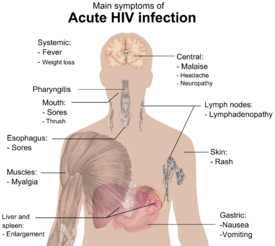
275px Symptoms of acute HIV infection
Acute HIV infection

The number of HIV -infected people reached 213 in the 2011-12 fiscal year from 170 in 2010-11. “The number of people living with HIV increased significantly in the district this year,” said DPHO chief Dr Arjun Prasad Sapkota. He added that most of those infected are sex workers and migrant workers who returned home from foreign jobs. In addition to raising awareness on safe sex through health workers and providing medicines for those with HIV , the DPHO launched an orientation programme on preventing mother-to-child transmission of the disease at Dhulikhel Hospital on Wednesday.

The Health Ministry has been conducting special programmes in all 75 districts of the country to control HIV /AIDS. Sanjaya Dahal, an official at the National Centre for AIDS and STD Control, said an estimated 50,000 people were living with HIV in the country in 2011. “The Health Ministry is working to control the disease,” said Dahal.
The government has been distributing free antiretroviral drugs to the HIV -infected from 36 depots across the country. Available data show 6,483 people with HIV were taking the drug last year.
Posted on: ekantipur  2012-07-21 
July 28, 2012 0 comments
0 FacebookTwitterPinterestLinkedinTumblrVKOdnoklassnikiRedditStumbleuponWhatsappTelegramLINEPocketSkypeViberEmail
Public Health

Bird flu 'could mutate to cause deadly human pandemic'

by Public Health Update June 23, 2012
written by Public Health Update
Bird flu ‘could mutate to cause deadly human pandemic’

Writing in the journal Science, they say it would be theoretically possible for these changes to occur in nature.Researchers have identified five genetic changes that could allow the virus to start a deadly pandemic.

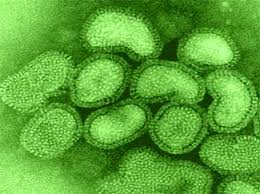
Avian influenza is flu infection in birds. The virus that causes the bird infectin can change (mutate) to infect humans. Such mutation could start a deadly worldwide epidemic.

images
Causes, incidence, and risk factors
The first avian influenza virus to infect humans occurred in Hong Kong in 1997. The epidemic was linked to chickens and classified as avian influenza A (H5N1).
Human cases of avian influenza A (H5N1) have since been reported in Asia, Africa, Europe, Indonesia, Vietnman, the Pacific, and the near East. Hundreds of people have become sick with this virus. Slightly more than 60% of those who became ill have died.
The more the avian flu virus spreads, the greater the chances of a worldwide outbreak in humans. There is a tremendous concern that H5N1 poses an enormous pandemic threat.

The following people have a higher risk for developing the bird flu:

  • Farmers and others who work with poultry
  • Travelers visiting affected countries
  • Those who touch an infected bird
  • Those who eat raw or undercooked poultry meat, eggs, or blood from infected birds

Health care workers and household contacts of patients with avian influenza may also be at an increased risk of the bird flu.
The avian flu virus (H5N1) has been shown to survive in the environment for long periods of time. Infection may be spread simply by touching contaminated surfaces. Birds who were infected with this flu can continue to release the virus in their feces and saliva for as long as 10 days.

Symptoms
Symptoms of avian flu infection in humans depend on the strain of virus.
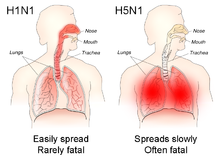
Infection with the H5N1 virus in humans causes typical flu-like symptoms, which might include:

220px H1N1 versus H5N1 pathology
  • Cough (dry or productive)
  • Diarrhea
  • Difficulty breathing
  • Fever greater than 100.4°F (38°C)
  • Headache
  • Malaise
  • Muscle aches
  • Runny nose
  • Sore throat

Signs and tests
If you think you have been exposed to avian influenza, call your health care provider before your visit. This will give the staff a chance to take proper precautions that will protect them and other patients during your office visit.
Tests to identify the avian flu exist but are not widely available. A test for diagnosing strains of bird flu in people suspected of having the virus gives preliminary results within 4 hours. Older tests took 2 to 3 days.

Treatment
Different types of avian flu virus may cause different symptoms. Therefore, treatment may vary.
In general, treatment with the antiviral medication oseltamivir (Tamiflu) or zanamivir (Relenza) may make the disease less severe if you start taking the medicine within 48 hours after your symptoms start.
Oseltamivir may also be prescribed for persons who live in the same house as those diagnosed with avian flu.
The virus that causes human avian flu appears to be resistant to the antiviral medicines amantadine and rimantadine. Therefore these medications should not be used if an H5N1 outbreak occurs.

People with severe infection may need to be placed on a breathing machine. Experts recommend that persons diagnosed with avian flu be put in isolation.
Doctors recommend that people get an influenza (flu) shot to reduce the chance of an avian flu virus mixing with a human flu virus, which would create a new virus that may easily spread.

The U.S. Food and Drug Administration has approved a vaccine to protect humans from the avian flu. Experts say the vaccine could be used if the current H5N1 virus starts spreading between people.
http://www.bbc.co.uk
http://www.ncbi.nlm.nih.gov
June 23, 2012 0 comments
0 FacebookTwitterPinterestLinkedinTumblrVKOdnoklassnikiRedditStumbleuponWhatsappTelegramLINEPocketSkypeViberEmail
PH Important DayPublic HealthTobacco Control

World No Tobacco Day 2012

by Public Health Update May 31, 2012
written by Public Health Update

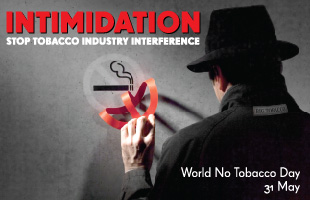
The World Health Organization (WHO) selects “tobacco industry interference” as the theme of the next World No Tobacco Day, which will take place on Thursday, 31 May 2012.

The campaign will focus on the need to expose and counter the tobacco industry’s brazen and increasingly aggressive attempts to undermine the WHO Framework Convention on Tobacco Control (WHO FCTC) because of the serious danger they pose to public health.

wwwwwwwwwwwwwwwww
Tobacco use is one of the leading preventable causes of death. The global tobacco epidemic kills nearly 6 million people each year, of which more than 600,000 are people exposed to second-hand smoke. Unless we act, it will kill up to 8 million people by 2030, of which more than 80% will live in low- and middle-income countries.

As more and more countries move to fully meet their obligations under the WHO FCTC, the tobacco industry’s efforts to undermine the treaty are becoming more and more energetic.

Dhumrapaan

For example, in an attempt to halt the adoption of pictorial health warnings on packages of tobacco, the industry recently adopted the novel tactic of suing countries under bilateral investment treaties, claiming that the warnings impinge the companies’ attempts to use their legally-registered brands.


Meanwhile, the industry’s attempts to undermine the treaty continue on other fronts, particularly with regard to countries’ attempts to ban smoking in enclosed public places and to ban tobacco advertising, promotion and sponsorship.

World No Tobacco Day 2012 will educate policy-makers and the general public about the tobacco industry’s nefarious and harmful tactics.

It will also be in keeping with the letter and the spirit of the WHO FCTC. The preamble of the treaty recognizes “the need to be alert to any efforts by the tobacco industry to undermine or subvert tobacco control efforts and the need to be informed of activities of the tobacco industry that have a negative impact on tobacco control efforts”.

In addition, Article 5.3 of the treaty states that “in setting and implementing their public health policies with respect to tobacco control, Parties shall act to protect these policies from commercial and other vested interests of the tobacco industry in accordance with national law”.

Furthermore, the guidelines to the implementation of Article 5.3 state that Parties are recommended to “raise awareness about…tobacco industry interference with Parties’ tobacco control policies”.

On World No Tobacco Day 2012, and throughout the following year, WHO will urge countries to put the fight against tobacco industry interference at the heart of their efforts to control the global tobacco epidemic.
source:World Health Organization (WHO)
May 31, 2012 0 comments
0 FacebookTwitterPinterestLinkedinTumblrVKOdnoklassnikiRedditStumbleuponWhatsappTelegramLINEPocketSkypeViberEmail
Presentation SlidesPublic Health

Presentation – Prevention of Malnutrition, STIs & Cancer

by Public Health Update May 12, 2012
written by Public Health Update
Prevention & control of malnutrition, st is & cancer……..

View more PowerPoint from SAgun PAudel
May 12, 2012 1 comment
0 FacebookTwitterPinterestLinkedinTumblrVKOdnoklassnikiRedditStumbleuponWhatsappTelegramLINEPocketSkypeViberEmail
Presentation SlidesPublic Health

Presentation – NCDs

by Public Health Update May 12, 2012
written by Public Health Update
Non communicable diseases (final)

View more PowerPoint from SAgun PAudel
May 12, 2012 0 comments
0 FacebookTwitterPinterestLinkedinTumblrVKOdnoklassnikiRedditStumbleuponWhatsappTelegramLINEPocketSkypeViberEmail
Presentation SlidesPublic Health

Presentation – MDGs in Nepal

by Public Health Update May 12, 2012
written by Public Health Update
MDGs in nepal

View more PowerPoint from SAgun PAudel
May 12, 2012 0 comments
0 FacebookTwitterPinterestLinkedinTumblrVKOdnoklassnikiRedditStumbleuponWhatsappTelegramLINEPocketSkypeViberEmail
Newer Posts
Older Posts

Search

Follow Us

Facebook Twitter Instagram Pinterest Linkedin Youtube

Categories

  • Abstracts (25)
  • Activities (91)
  • Adolescent Sexual and Reproductive Health (ASRH) (25)
  • Advice & Tips (3)
  • African Region (5)
  • AI and Health (1)
  • Annual Meeting (6)
  • Antimicrobial Resistance (AMR) (21)
  • Award (19)
  • Awards (16)
  • Books (9)
  • Call for Proposal, EOI & RFP (103)
  • Call for Research Participants (8)
  • Clinical Doctor Jobs (6)
  • Communicable Diseases (107)
  • Competition (20)
  • Conference (128)
  • Consultant (1)
  • Courses (205)
  • Dashboard (2)
  • Digital Health & Health Informatics (10)
  • Drug and Medicine (18)
  • Eastern Mediterranean Region (3)
  • Education (15)
  • Environment (3)
  • Environmental Health & Climate Change (47)
  • European Region (42)
  • Exchange Program (1)
  • Fact Sheet (117)
  • FCHVs (1)
  • Fellowships, Studentship & Scholarships (168)
  • Financial Aid (13)
  • Form Formats (2)
  • Fully funded (22)
  • Global Health News (434)
  • Grants and Funding Opportunities (193)
  • Guest Post (44)
  • Health Assistant Jobs (1)
  • Health Equity (7)
  • Health Financing and Economics (24)
  • Health in Data (115)
  • Health Insurance (5)
  • Health Jobs (52)
  • Health Literacy, Health Education & Promotion (49)
  • Health Organization Profile (42)
  • Health Systems (83)
  • Human Resource for Health (33)
  • Humanitarian Health & Emergency Response (44)
  • Hypertension (5)
  • Implementation Research (48)
  • International Health (3)
  • International Jobs & Opportunities (373)
  • International Plan, Policy & Guidelines (210)
  • Internships (4)
  • Jobs Vacancies (56)
  • Journals (8)
  • Life Style & Public Health Nutrition (39)
  • Live (10)
  • Master's Degree (48)
  • Maternal, Newborn and Child Health (88)
  • Mentorship Program (2)
  • Miscellaneous (16)
  • National Health News (157)
  • National Plan, Policy & Guidelines (468)
  • Neglected Tropical Diseases (NTDs) (51)
  • Non- Communicable Diseases (NCDs) (120)
  • Notice (103)
  • Nursing Jobs (6)
  • Nutritionist Jobs (1)
  • One Health (18)
  • Online & Distance Learning (22)
  • Online Courses (90)
  • Op-Ed Article (3)
  • Opportunities by Region (83)
  • Outbreak News (213)
  • Partially funded (6)
  • PCL Health Science Jobs (3)
  • PH Important Day (533)
  • Pharmacist Jobs (3)
  • PhD (54)
  • Photos (5)
  • Planetary Health (4)
  • PostDoc (14)
  • Presentation Slides (26)
  • Primary Health Care (25)
  • Provincial Plan, Policies and Guidelines (14)
  • Public Health (1,282)
  • Public Health Epidemiology & Biostatistics (13)
  • Public Health Events (306)
  • Public Health Information (20)
  • Public Health Innovation (9)
  • Public Health Jobs (52)
  • Public Health News (553)
  • Public Health Notes (120)
  • Public Health Opportunities (507)
  • Public Health Opportunity (491)
  • Public Health Programs (108)
  • Public Health Seminar (2)
  • Public Health Tools (1)
  • Public Health Update (562)
  • Quality Improvement & Infection Prevention (20)
  • Region of America (8)
  • Reports (184)
  • Research & Project Grants (39)
  • Research & Project Grants (32)
  • Research & Publication (647)
  • Research Articles (10)
  • Road Traffic Accidents (RTA) (9)
  • School of Public Health (60)
  • Self funded (2)
  • South-East Asia Region (26)
  • Success Stories (17)
  • Summer and Winter Courses (40)
  • Summer Courses (28)
  • Sustainable Development Goals (SDGs) (14)
  • Syllabus (61)
  • Symposium (9)
  • Tobacco Control (35)
  • Training (40)
  • Travel Grants (15)
  • Trick, Technique & Skills (8)
  • Uncategorized (3)
  • Undergraduate Degree (7)
  • Universal Health Coverage (36)
  • Universities (29)
  • Universities & School of Public Health (58)
  • Vacancy Announcement (26)
  • Vaccine Preventable Diseases (40)
  • Vector-Borne Diseases(VBDs) (30)
  • Videos (3)
  • View Points (1)
  • Webinar (4)
  • Western Pacific Region (13)
  • Workshop (18)
  • World News (117)
Post New Jobs: Vacancy Announcement Service

Public Health Update (Sagun’s Blog) is a popular public health portal in Nepal. Thousands of health professionals are connected with Public Health Update to get up-to-date public health updates, search for jobs, and explore opportunities.
#1 Public Health Blog for sharing Job opportunities and updates in Nepal

”Public Health Information For All”
– – Sagun Paudel, Founder

  • HOT JOBS
    • Public Health Jobs
    • Medical Doctor Jobs
    • Nursing Jobs
    • Health Assistant Jobs
    • Pharmacist Jobs
    • NGOs Jobs
    • Government Jobs
  • Top Categories
    • National Plan, Policy & Guidelines Top
    • Public Health Calendar
    • Fellowships & Scholarships
    • Health Systems
    • Health Organization Profiles
    • International Jobs & Opportunities
    • Public Health Opportunity

PUBLIC HEALTH INITIATIVE

    • Submit your Vacancies New
    • Partnership Opportunities

Contact: blog.publichealthupdate@gmail.com

https://wa.me/+9779856036932

Public Health Initiative, A Registered Non-profit organization – All Right Reserved. 2011-2024. Contact us. 

Facebook Twitter Instagram Youtube Envelope
Public Health Update
  • Home
  • Public Health
    • Home 1
      • Adolescent Sexual and Reproductive Health (ASRH)
      • Antimicrobial Resistance (AMR)
      • Communicable Diseases
      • Digital Health & Health Informatics
      • Environmental Health & Climate Change
      • Health Financing and Economics
      • Health Equity
    • Home 2
      • Health Literacy, Health Education & Promotion
      • Human Resource for Health
      • Humanitarian Health & Emergency Response
      • Implementation Research
      • International Health
      • Life Style & Public Health Nutrition
      • Maternal, Newborn and Child Health
    • Home 3
      • Neglected Tropical Diseases (NTDs)
      • Non- Communicable Diseases (NCDs)
      • One Health
      • Planetary Health
      • Public Health Epidemiology & Biostatistics
      • Primary Health Care
      • Quality Improvement & Infection Prevention
    • Home 4
      • Road Traffic Accidents (RTA)
      • Sustainable Development Goals (SDGs)
      • Tobacco Control
      • Universal Health Coverage
      • Vaccine Preventable Diseases
      • Vector-Borne Diseases(VBDs)
      • Notices
  • Public Health Update
    • Home 1
      • Public Health News
      • Global Health News
      • Outbreak News
      • National Health News
      • COVID-19
    • Home 2
      • Fact Sheet
      • Health in Data
      • PH Important Day
      • Public Health Events
      • Public Health Programs
    • Home 3
      • Health Systems
      • Health Insurance
      • Health Organization Profile
      • Success Stories
      • Public Health Innovation
  • Public Health Opportunities
    • Fully funded
    • Travel Grants
    • Grants and Funding Opportunities
    • Opportunities by Region
    • International Jobs & Opportunities
    • Research & Project Grants
    • Fellowships, Studentship & Scholarships
    • Conference
  • Jobs
    • Home 1
      • Health Jobs
      • Public Health Jobs
      • Clinical doctor Jobs
      • Health Assistant Jobs
      • Nursing Jobs
      • PCL Health Science Jobs
    • Home 2
      • Dental Jobs
      • Pharmacist Jobs
      • TSLC (Health Jobs)
      • Laboratory Jobs
      • Nutritionist Jobs
  • Downloads
    • International Plan, Policy & Guidelines
    • National Plan, Policy & Guidelines
    • Reports
    • Books
    • Research Articles
  • School of Public Health
    • Home 1
      • Courses
      • Master’s Degree
      • Undergraduate Degree
      • PhD
    • Home 2
      • Universities
      • Syllabus
      • Public Health Notes
      • Mentorship Program
      • Startup Project
    • Home
      • Summer and Winter Courses
      • Summer Courses
      • Online Courses
      • Workshop
      • Training
Public Health Update
  • Home
  • Public Health
    • Home 1
      • Adolescent Sexual and Reproductive Health (ASRH)
      • Antimicrobial Resistance (AMR)
      • Communicable Diseases
      • Digital Health & Health Informatics
      • Environmental Health & Climate Change
      • Health Financing and Economics
      • Health Equity
    • Home 2
      • Health Literacy, Health Education & Promotion
      • Human Resource for Health
      • Humanitarian Health & Emergency Response
      • Implementation Research
      • International Health
      • Life Style & Public Health Nutrition
      • Maternal, Newborn and Child Health
    • Home 3
      • Neglected Tropical Diseases (NTDs)
      • Non- Communicable Diseases (NCDs)
      • One Health
      • Planetary Health
      • Public Health Epidemiology & Biostatistics
      • Primary Health Care
      • Quality Improvement & Infection Prevention
    • Home 4
      • Road Traffic Accidents (RTA)
      • Sustainable Development Goals (SDGs)
      • Tobacco Control
      • Universal Health Coverage
      • Vaccine Preventable Diseases
      • Vector-Borne Diseases(VBDs)
      • Notices
  • Public Health Update
    • Home 1
      • Public Health News
      • Global Health News
      • Outbreak News
      • National Health News
      • COVID-19
    • Home 2
      • Fact Sheet
      • Health in Data
      • PH Important Day
      • Public Health Events
      • Public Health Programs
    • Home 3
      • Health Systems
      • Health Insurance
      • Health Organization Profile
      • Success Stories
      • Public Health Innovation
  • Public Health Opportunities
    • Fully funded
    • Travel Grants
    • Grants and Funding Opportunities
    • Opportunities by Region
    • International Jobs & Opportunities
    • Research & Project Grants
    • Fellowships, Studentship & Scholarships
    • Conference
  • Jobs
    • Home 1
      • Health Jobs
      • Public Health Jobs
      • Clinical doctor Jobs
      • Health Assistant Jobs
      • Nursing Jobs
      • PCL Health Science Jobs
    • Home 2
      • Dental Jobs
      • Pharmacist Jobs
      • TSLC (Health Jobs)
      • Laboratory Jobs
      • Nutritionist Jobs
  • Downloads
    • International Plan, Policy & Guidelines
    • National Plan, Policy & Guidelines
    • Reports
    • Books
    • Research Articles
  • School of Public Health
    • Home 1
      • Courses
      • Master’s Degree
      • Undergraduate Degree
      • PhD
    • Home 2
      • Universities
      • Syllabus
      • Public Health Notes
      • Mentorship Program
      • Startup Project
    • Home
      • Summer and Winter Courses
      • Summer Courses
      • Online Courses
      • Workshop
      • Training
Public Health Initiative, A Registered Non-profit organization – All Right Reserved. 2011-2023