

Public Health Update
  • Home
  • Public Health Update
  • Nepal Health Jobs
    • Public Health Job Board
    • Organization List
  • Opportunities
    • Fellowships, Studentship & Scholarships
    • Grants and Funding Opportunities
    • Fully funded
    • Conference
  • Downloads
    • International Plan, Policy & Guidelines
    • National Plan, Policy & Guidelines
    • Reports
    • Public Health Notes
    • Syllabus
    • Form Formats
  • School of Public Health
    • PhD
    • Master’s Degree
    • Online Courses
  • Notice
LOGIN / REGISTER
Public Health Update
SUBSCRIBE
Public Health Update
  • Home
  • Public Health Update
  • Nepal Health Jobs
    • Public Health Job Board
    • Organization List
  • Opportunities
    • Fellowships, Studentship & Scholarships
    • Grants and Funding Opportunities
    • Fully funded
    • Conference
  • Downloads
    • International Plan, Policy & Guidelines
    • National Plan, Policy & Guidelines
    • Reports
    • Public Health Notes
    • Syllabus
    • Form Formats
  • School of Public Health
    • PhD
    • Master’s Degree
    • Online Courses
  • Notice

All Right Reserved. Designed and Developed by PenciDesign

Public Health

Swine flu Updates…

by Public Health Update February 26, 2015
written by Public Health Update

13416731

Kantipur National Daily Newspaper
�


�

134614757 2
Kantipur National Daily Newspaper
February 26, 2015 0 comments
0 FacebookTwitterPinterestLinkedinTumblrVKOdnoklassnikiRedditStumbleuponWhatsappTelegramLINEPocketSkypeViberEmail
Public Health

Swine Flu

by Public Health Update February 24, 2015
written by Public Health Update

Finaaaaaaaaaa
thehimalayantimes
Capture
Adharsha samaj

d29132052
Thehimalayantimes
February 24, 2015 0 comments
0 FacebookTwitterPinterestLinkedinTumblrVKOdnoklassnikiRedditStumbleuponWhatsappTelegramLINEPocketSkypeViberEmail
Public Health

Swine Flu

by Public Health Update February 22, 2015
written by Public Health Update


143333216Kantipur
February 22, 2015 0 comments
0 FacebookTwitterPinterestLinkedinTumblrVKOdnoklassnikiRedditStumbleuponWhatsappTelegramLINEPocketSkypeViberEmail
Public Health

Set up isolation wards‚ MoHP tells all hospitals:FIGHTING SWINE FLU

by Public Health Update February 21, 2015
written by Public Health Update
Original Source :HIMALAYAN NEWS SERVICE

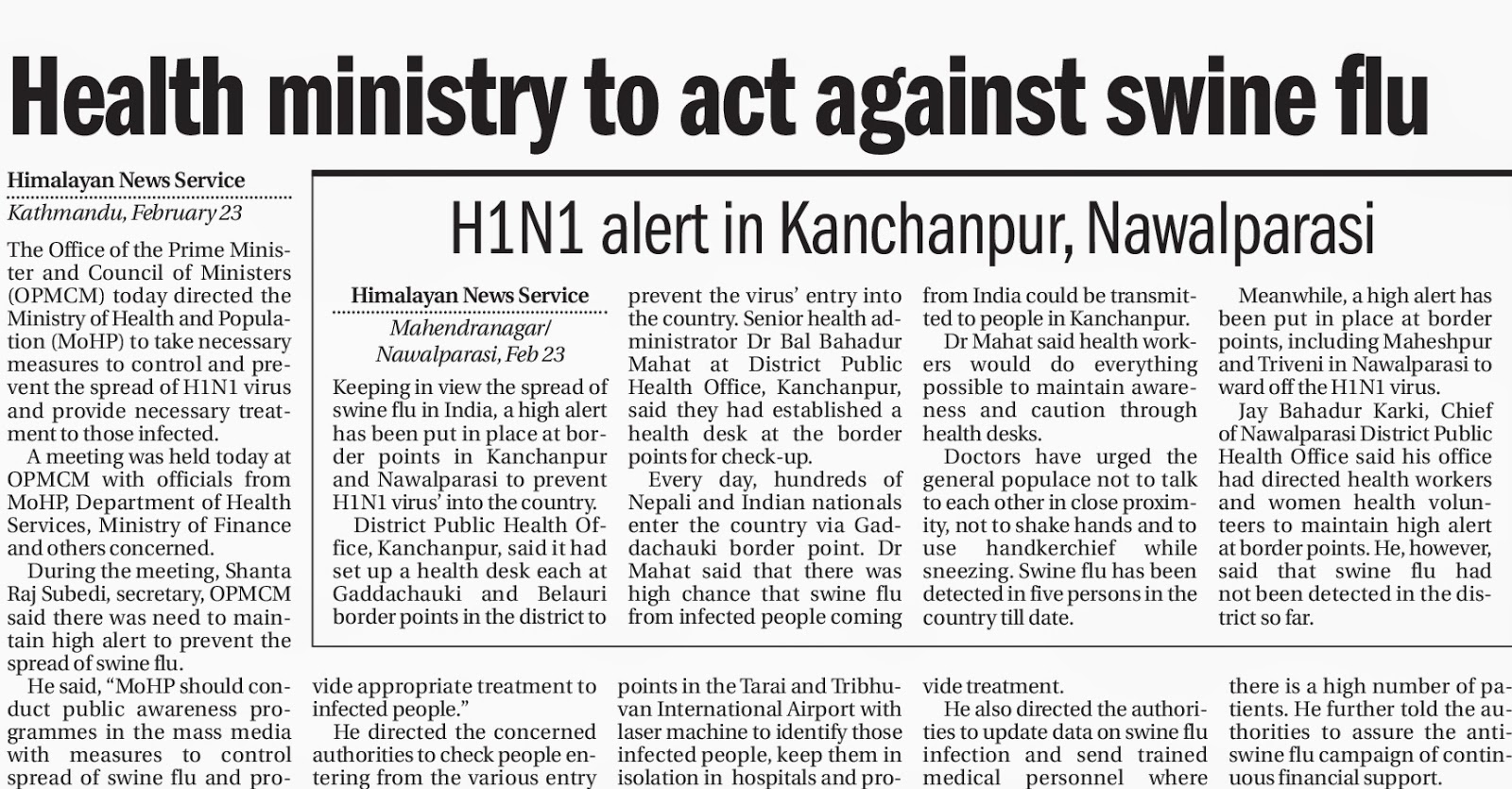
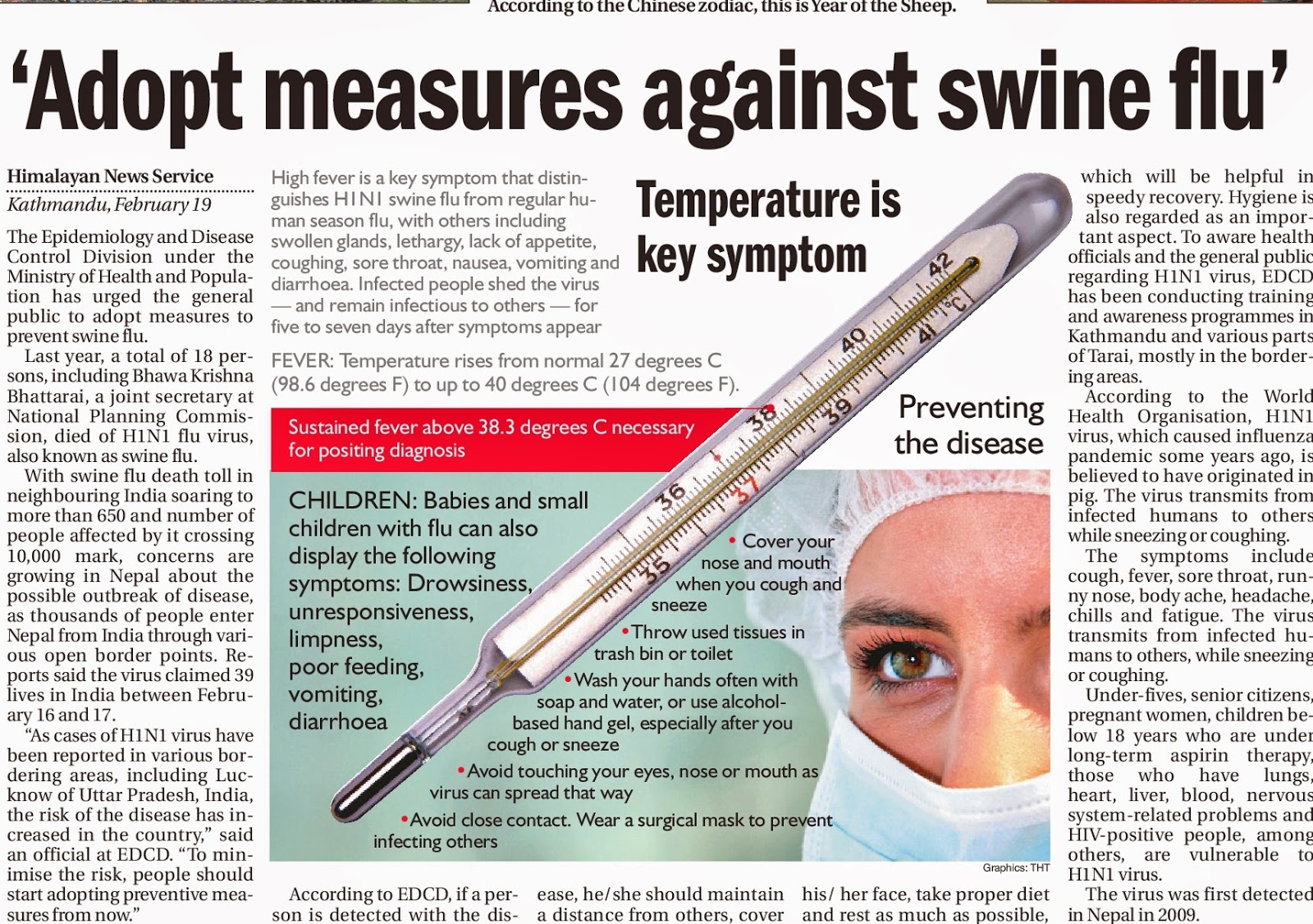
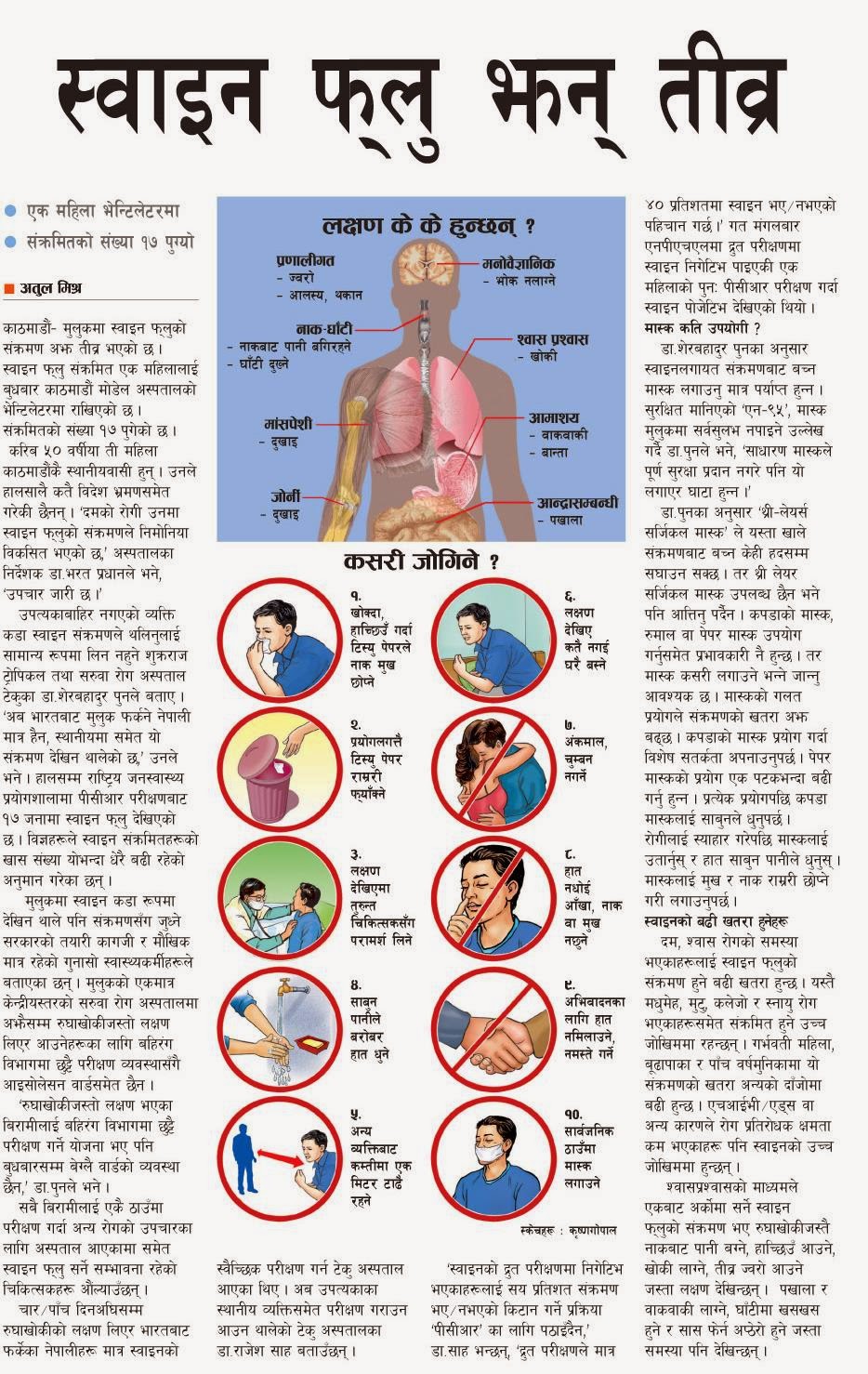
The Ministry of Health and Population has asked all the hospitals to set up isolation wards to tackle H1N1 virus in case of any epidemic. 
With the increasing number of people being affected by H1N1 virus, which is also known as swine flu, in India, the risk of the disease is increasing in Nepal as well, it said. Issuing a press statement, MoHP informed that it was all prepared to tackle the disease. MoHP said it has sufficient stock of anti-viral medicines, antibiotics and personal protective equipment to fight against the virus if an epidemic occurs. It has also prepared a guideline for prevention and treatment of the virus.
d50832836
thehimalayantimes(21st feb 2015)
“We have asked all government and private hospitals to set up isolation wards to deal with the virus. Lab services and antiviral medicines will be provided under the supervision of medical officials at the National Public Health Laboratory and Epidemiology and Disease Control Division,” said MoHP, appealing to the general public to adopt preventive measures against the virus. 

“To stay safe, one should cover his/her face while sneezing, maintain proper hygiene and maintain a distance from those who are suffering from swine flu,” MoHA advised. 
The symptoms of swine flu include cough, fever, sore throat, runny nose, body ache, headache, chills and fatigue. 
The virus transmits from infected humans to others while sneezing or coughing. Under-fives, senior citizens, pregnant women, children below 18 years who are under long-term aspirin therapy, those who have lungs, heart, liver, blood, nervous system-related problems and HIV-positive people, among others, are vulnerable to H1N1 virus. The virus was first detected in Nepal in 2009.
February 21, 2015 0 comments
0 FacebookTwitterPinterestLinkedinTumblrVKOdnoklassnikiRedditStumbleuponWhatsappTelegramLINEPocketSkypeViberEmail
National Plan, Policy & GuidelinesReportsResearch & Publication

Nepali Youths in Figures(Author:MoYS, UNFPA and Restless Development)

by Public Health Update February 17, 2015
written by Public Health Update

The Ministry of Youth and Sports has launched a book comprising comprehensive statistics and details about the youths of the country. 
This report, highlighting data specific to youth in Nepal, is based on the Population and Housing Census 2011 provided by the Central Bureau of Statistics of the Government of Nepal.


Population of the 16-40 years age group is considered as the youth population in Nepal. According to the 2011 Census, the total youth population in Nepal is 10,689,842 (40.3% of the total population). Among them, 45.8% are males and 54.5% are females.

Capture
DOWNLOAD FULL REPORT

Kathmandu district has the highest proportion of the youth population i.e. 52.9% whereas Pyuthan district has the lowest proportion of youth population i.e. 32.7% to its total population. Nearly 1400 thousand youth were found to have been abroad for employment, which is nearly 72% of the total absentee population (1,921,494) of Nepal in 2011. Out of the youth population going abroad for employment, 93.2% are males and 61% are from the age group of 16-25 years.

Read more; 
DOWNLOAD FULL REPORT: CLICK HERE
February 17, 2015 0 comments
0 FacebookTwitterPinterestLinkedinTumblrVKOdnoklassnikiRedditStumbleuponWhatsappTelegramLINEPocketSkypeViberEmail
Public Health

NPHL meets the International Health Regulations, 2005 (WHO certified lab for BSL-3)

by Public Health Update February 14, 2015
written by Public Health Update

HIMALAYAN NEWS SERVICE
KATHMANDU: The World Health Organisation has certified that the Biosafety Level-3 (BSL)-3 Laboratory established at the National Public Health Laboratory in Teku meets the International Health Regulations, 2005 for its operations.The BSL-3 Laboratory was certified after an international team of WHO experts found its facilities at par with the international standards. The WHO team inspected the government-owned lab in January.

IMG 0789 7687 4191


Speaking at a programme ‘Dissemination of Functioning of Bio-Safety Level-3 Laboratory in NPHL’, Minister for Health and Population Khagaraj Adhikari said that the BSL-3 Laboratory should be able to come up with new inventions, discoveries and solutions against various new viral diseases to contribute to the health sector in Nepal as well in other parts of the world. 
He advised officials at the BSL-3 Laboratory to also initiate production of vaccines to control the epidemic diseases in collaboration with national and international experts. “Research, testing and health counselling services must be part of the lab to find out new solutions of contagious diseases,” he said, adding that anti-snake venom and anti-rabies vaccines should be given high priority.
Geeta Shakya, Director, NPHL, said the BSL-3 Laboratory will be operated to detect viral epidemic such as H5N1 (bird flu), avian influenza A (H7N9), MERS (Middle East Respiratory Syndrome) virus, CCHF (Crimean-Congo Hemorrhagic Fever), KFD (Kasunur Forest Disease), Nipah and Westline virus that may hit Nepal. 


“The main objective of the BSL-3 Laboratory is to detect the epidemic within a short period of time and to control the pandemics and reduce health hazards and threats to lifespan,” she said.The BSL-3 Laboratory tests the sample of pandemics that occur due to intentional, natural and catastrophic germs. The laboratory is able to manage the Natural-Errorism, Bio-Terrorism and Biological Warfare which is not possible by the BSL-2 Laboratory.


According to Shakya, the BSL-3 Laboratory is equipped with CCTV cameras, alarm system and telephone system. The third level digital control entry doors have been installed for the internal security of the lab. 

Likewise, bio-safety cabinets and High-Efficiency Particulate Arrestance filter air-handling unit have been controlled by digital building management system for the protection against harmful germs. 
The personal protection equipment and respirator have also been managed for the protection of the lab experts and assistants. In addition, the laboratory has been established according to the international principles for the construction, identification, certification, safety and use.


Dr Ling Aung, WHO Country Representative to Nepal, said, “WHO’s technical support for international trainings in human resources capacity development, procurement and supply of equipment, reagents and chemicals and bringing international experts for on-the-job training at NPHL has played vital role in the development of the BSL-3 Laboratory.”
He urged the government to meet the specially trained human resources in microbiology, bio-safety and round-the-clock power supply.

February 14, 2015 0 comments
0 FacebookTwitterPinterestLinkedinTumblrVKOdnoklassnikiRedditStumbleuponWhatsappTelegramLINEPocketSkypeViberEmail
PH Important DayPublic Health

World Cancer Day: February 4th- ''Not beyond us''

by Public Health Update February 4, 2015
written by Public Health Update
World Cancer Day, organized by the Union for International Cancer Control, is an opportunity to highlight the wide range of actions needed to effectively prevent, treat and control the many forms of cancer.
The day, the theme of which in 2015 is “Not beyond us”, offers WHO an opportunity to demonstrate the Organization’s policies and programmes for countries to reduce their cancer burden. The Global action plan for the prevention and control of NCDs 2013-2020 offers the overall framework for country action.


The Global action plan calls for national, international and multisectoral action across multiple areas to reduce cancer risks in populations, and to strengthen health care delivery systems for people with cancer. Environmental and infectious causes are important for cancer prevention so that WHO’s guidance in those areas is part of the comprehensive approach.
Campaign Key Messages
Choosing Healthy Lives
Reducing the social and environmental risk factors for cancer and empowering people to make healthy choices, are key components to achieving the global overarching goal of reducing premature deaths from NCDs by 25% by 2025 and reaching the aspirational targets of the World Cancer Declaration.
Delivering Early Detection
Ensuring the availability of, and access to, early detection programmes for cancer can significantly reduce the cancer burden in all countries.


Achieving Treatment For All
All people have the right to access quality, effective cancer treatment and services on equal terms, regardless of geography and without suffering economic hardship as a consequence.
Maximising Quality Of Life
Understanding and responding to the full impact of cancer on emotional, mental and physical wellbeing will maximise the quality of life for patients, their families and carers.

download
Cancer is a generic term for a large group of diseases that can affect any part of the body. Other terms used are malignant tumours and neoplasms. One defining feature of cancer is the rapid creation of abnormal cells that grow beyond their usual boundaries, and which can then invade adjoining parts of the body and spread to other organs. Cancer is one of the leading causes of death in the world, particularly in developing countries. In the WHO Western Pacific Region, it is estimated that close to 4.07 million new cases occurred in 2008 (2.31 million in men and 1.75 million in women). Almost 2.6 million people in the Region died from cancer that same year.
Source of Information: WHO 

Read also : Global Action Plan for the Prevention and Control of NCDs 2013-2020

Get involved in Global Event of World Cancer Day-2015

February 4, 2015 0 comments
0 FacebookTwitterPinterestLinkedinTumblrVKOdnoklassnikiRedditStumbleuponWhatsappTelegramLINEPocketSkypeViberEmail
National Plan, Policy & GuidelinesReportsResearch & Publication

Nepal Multiple Indicator Cluster Survey (NMICS) 2014 Key Findings Report

by Public Health Update January 15, 2015
written by Public Health Update
The Nepal Multiple Indicator Cluster Survey (NMICS) was carried out in 2014 by Central Bureau of Statistics, Government of Nepal, as part of the global MICS program. Technical support was provided by the United Nations Children’s Fund (UNICEF). UNICEF and the Government of Nepal provided financial support.


proxy?url=http%3A%2F%2F4.bp.blogspot.com%2F WQTI F7tx9c%2FVLe1Bkf7TWI%2FAAAAAAAAAGI%2FUJ1dZpxs8nk%2Fs1600%2F395660047408806153 nmics key.fullAccording to the key findings, the current under-five mortality rate is 38 per 1,000 live births while the neonatal mortality rate is 23 per 1,000 live births, which accounts for 61 percent of under-five deaths. Full immunization coverage against key childhood diseases of children under one is 85 percent. Two thirds of women attended at least one antenatal care visit (68 percent) and over half of the women had a skilled birth attendant during delivery (56 percent). Nearly half (49 percent) of women of reproductive age are marrying before the age of 18. Of them 16 percent were married before the age of 15. The adolescent fertility rate is 71 per 1,000 women. Stunting of children under five is 37 percent, underweight prevalence is 30 percent and wasting prevalence 11 percent.
Nearly all households have access to improved sources of drinking water (93 percent). The proportion of households without improved drinking water using appropriate treatment methods is 14 percent. Though access to improved water has increased, about 71% of the water sources are contaminated with fecal coliform. In addition, 82 percent of households having access to water sources are exposed to water contaminated with fecal coliform which indicates further contamination of water in households. Sixty percent of households have access to improved sanitation facilities that are not shared. 


Among children of school going age, 86 percent attend primary or secondary school. Almost all children attending primary school reach the fifth grade (99 percent) and complete it (99.5 percent). Nearly all children transition to secondary school (97 percent) from primary, but only two thirds of secondary school age children actually attend secondary or a higher form of education (66 percent). Gender parity index in attendance in primary and secondary schools stand at 0.99 and 1.02 respectively.

DOWNLOAD FULL REPORT FROM HERE

Original Source Click here

January 15, 2015 0 comments
0 FacebookTwitterPinterestLinkedinTumblrVKOdnoklassnikiRedditStumbleuponWhatsappTelegramLINEPocketSkypeViberEmail
International Plan, Policy & GuidelinesReports

World Health Organization: New study highlights need to scale up violence prevention efforts globally

by Public Health Update December 12, 2014
written by Public Health Update
News from who 

10 Dec 2014,Geneva
The “Global status report on violence prevention 2014” reveals that 475 000 people were murdered in 2012, and homicide is the third leading cause of death globally for males aged 15–44 years, highlighting the urgent need for more decisive action to prevent violence.
Despite indications that homicide rates decreased by 16% globally between 2000 and 2012, violence remains widespread. Non-fatal acts of violence take a particular toll on women and children. One in four children has been physically abused; one in five girls has been sexually abused; and one in three women has been a victim of physical and/or sexual intimate partner violence at some point in her lifetime.


10801520 856437641068287 7175393752429024739 n

The Global status report on violence prevention 2014, which reflects data from 133 countries, is the first report of its kind to assess national efforts to address interpersonal violence, namely child maltreatment, youth violence, intimate partner and sexual violence, and elder abuse.
Jointly published by WHO, the United Nations Development Programme, and the United Nations Office on Drugs and Crime, the report reviews the current status of violence prevention efforts in countries, and calls for a scaling up of violence prevention programmes; stronger legislation and enforcement of laws relevant for violence prevention; and enhanced services for victims of violence.
DOWNLOAD REPORT
VISIT ORIGINAL SOURCE OF INFORMATION

December 12, 2014 0 comments
0 FacebookTwitterPinterestLinkedinTumblrVKOdnoklassnikiRedditStumbleuponWhatsappTelegramLINEPocketSkypeViberEmail
International Plan, Policy & GuidelinesResearch & Publication

Prevention and Control of Cervical Cancer (New WHO guide)

by Public Health Update December 3, 2014
written by Public Health Update
News from WHO
3,DECEMBER 2014 MELBOURNE: New guidance from WHO aims to help countries better prevent and control cervical cancer. The disease is one of the world’s deadliest – but most easily preventable – forms of cancer for women, responsible for more than 270 000 deaths annually, 85% of which occur in developing countries.


The new “Comprehensive cervical cancer control: a guide to essential practice” will be launched at the World Cancer Leaders’ Summit in Melbourne, Australia on 3 December 2014.
Picture1

The main elements in the new guidance are:

  • Vaccinate 9 to 13-year-old girls with two doses of HPV vaccine 
  • Use HPV tests to screen women for cervical cancer prevention.
  • Communicate more widely.
  • Addressing inequities
DOWNLOAD THIS GUIDE CLICK HERE

Original Source:  http://who.int/reproductivehealth/publications/cancers/cervical-cancer-guide/en/

December 3, 2014 0 comments
0 FacebookTwitterPinterestLinkedinTumblrVKOdnoklassnikiRedditStumbleuponWhatsappTelegramLINEPocketSkypeViberEmail
Newer Posts
Older Posts

Search

Follow Us

Facebook Twitter Instagram Pinterest Linkedin Youtube

Categories

  • Abstracts (26)
  • Activities (91)
  • Adolescent Sexual and Reproductive Health (ASRH) (25)
  • Advice & Tips (4)
  • African Region (5)
  • AI and Health (1)
  • Annual Meeting (6)
  • Antimicrobial Resistance (AMR) (21)
  • Award (20)
  • Awards (17)
  • Books (9)
  • Call for Proposal, EOI & RFP (103)
  • Call for Research Participants (9)
  • Clinical Doctor Jobs (6)
  • Communicable Diseases (107)
  • Competition (20)
  • Conference (130)
  • Consultant (1)
  • Courses (206)
  • Dashboard (2)
  • Digital Health & Health Informatics (10)
  • Drug and Medicine (18)
  • Eastern Mediterranean Region (3)
  • Education (16)
  • Environment (3)
  • Environmental Health & Climate Change (47)
  • European Region (42)
  • Exchange Program (1)
  • Fact Sheet (118)
  • FCHVs (1)
  • Fellowships, Studentship & Scholarships (168)
  • Financial Aid (13)
  • Form Formats (2)
  • Fully funded (22)
  • Global Health News (440)
  • Grants and Funding Opportunities (193)
  • Guest Post (44)
  • Health Assistant Jobs (1)
  • Health Equity (7)
  • Health Financing and Economics (24)
  • Health in Data (118)
  • Health Insurance (5)
  • Health Jobs (52)
  • Health Literacy, Health Education & Promotion (51)
  • Health Organization Profile (42)
  • Health Systems (85)
  • Human Resource for Health (33)
  • Humanitarian Health & Emergency Response (45)
  • Hypertension (5)
  • Implementation Research (49)
  • International Health (3)
  • International Jobs & Opportunities (374)
  • International Plan, Policy & Guidelines (212)
  • Internships (5)
  • Jobs Vacancies (57)
  • Journals (8)
  • Life Style & Public Health Nutrition (39)
  • Live (10)
  • Master's Degree (48)
  • Maternal, Newborn and Child Health (88)
  • Mentorship Program (2)
  • Miscellaneous (16)
  • National Health News (160)
  • National Plan, Policy & Guidelines (473)
  • Neglected Tropical Diseases (NTDs) (51)
  • Non- Communicable Diseases (NCDs) (123)
  • Notice (103)
  • Nursing Jobs (6)
  • Nutritionist Jobs (1)
  • One Health (18)
  • Online & Distance Learning (22)
  • Online Courses (91)
  • Op-Ed Article (3)
  • Opportunities by Region (83)
  • Outbreak News (213)
  • Partially funded (6)
  • PCL Health Science Jobs (3)
  • PH Important Day (538)
  • Pharmacist Jobs (3)
  • PhD (54)
  • Photos (5)
  • Planetary Health (4)
  • PostDoc (14)
  • Presentation Slides (26)
  • Primary Health Care (25)
  • Provincial Plan, Policies and Guidelines (17)
  • Public Health (1,288)
  • Public Health Epidemiology & Biostatistics (14)
  • Public Health Events (307)
  • Public Health Information (21)
  • Public Health Innovation (9)
  • Public Health Jobs (52)
  • Public Health News (558)
  • Public Health Notes (120)
  • Public Health Opportunities (510)
  • Public Health Opportunity (493)
  • Public Health Programs (108)
  • Public Health Seminar (2)
  • Public Health Tools (2)
  • Public Health Update (574)
  • Quality Improvement & Infection Prevention (20)
  • Region of America (8)
  • Reports (187)
  • Research & Project Grants (39)
  • Research & Project Grants (33)
  • Research & Publication (651)
  • Research Articles (10)
  • Road Traffic Accidents (RTA) (9)
  • School of Public Health (60)
  • Self funded (2)
  • South-East Asia Region (26)
  • Success Stories (17)
  • Summer and Winter Courses (40)
  • Summer Courses (28)
  • Sustainable Development Goals (SDGs) (14)
  • Syllabus (61)
  • Symposium (9)
  • Tobacco Control (35)
  • Training (40)
  • Travel Grants (15)
  • Trick, Technique & Skills (8)
  • Uncategorized (3)
  • Undergraduate Degree (7)
  • Universal Health Coverage (36)
  • Universities (29)
  • Universities & School of Public Health (58)
  • Vacancy Announcement (26)
  • Vaccine Preventable Diseases (40)
  • Vector-Borne Diseases(VBDs) (31)
  • Videos (3)
  • View Points (1)
  • Webinar (4)
  • Western Pacific Region (13)
  • Workshop (18)
  • World News (120)
Post New Jobs: Vacancy Announcement Service

Search Box

Public Health Update (Sagun’s Blog) is a popular public health portal in Nepal. Thousands of health professionals are connected with Public Health Update to get up-to-date public health updates, search for jobs, and explore opportunities.
#1 Public Health Blog for sharing Job opportunities and updates in Nepal

”Public Health Information For All”
– – Sagun Paudel, Founder

  • HOT JOBS
    • Public Health Jobs
    • Medical Doctor Jobs
    • Nursing Jobs
    • Health Assistant Jobs
    • Pharmacist Jobs
    • NGOs Jobs
    • Government Jobs
  • Top Categories
    • National Plan, Policy & Guidelines Top
    • Public Health Calendar
    • Fellowships & Scholarships
    • Health Systems
    • Health Organization Profiles
    • International Jobs & Opportunities
    • Public Health Opportunity

PUBLIC HEALTH INITIATIVE

    • Submit your Vacancies New
    • Partnership Opportunities

Contact: blog.publichealthupdate@gmail.com

https://wa.me/+9779856036932

All Right Reserved. 2011-2026. Contact us. 

Facebook Twitter Instagram Youtube Envelope
Public Health Update
  • Home
  • Public Health
    • Home 1
      • Adolescent Sexual and Reproductive Health (ASRH)
      • Antimicrobial Resistance (AMR)
      • Communicable Diseases
      • Digital Health & Health Informatics
      • Environmental Health & Climate Change
      • Health Financing and Economics
      • Health Equity
    • Home 2
      • Health Literacy, Health Education & Promotion
      • Human Resource for Health
      • Humanitarian Health & Emergency Response
      • Implementation Research
      • International Health
      • Life Style & Public Health Nutrition
      • Maternal, Newborn and Child Health
    • Home 3
      • Neglected Tropical Diseases (NTDs)
      • Non- Communicable Diseases (NCDs)
      • One Health
      • Planetary Health
      • Public Health Epidemiology & Biostatistics
      • Primary Health Care
      • Quality Improvement & Infection Prevention
    • Home 4
      • Road Traffic Accidents (RTA)
      • Sustainable Development Goals (SDGs)
      • Tobacco Control
      • Universal Health Coverage
      • Vaccine Preventable Diseases
      • Vector-Borne Diseases(VBDs)
      • Notices
  • Public Health Update
    • Home 1
      • Public Health News
      • Global Health News
      • Outbreak News
      • National Health News
      • COVID-19
    • Home 2
      • Fact Sheet
      • Health in Data
      • PH Important Day
      • Public Health Events
      • Public Health Programs
    • Home 3
      • Health Systems
      • Health Insurance
      • Health Organization Profile
      • Success Stories
      • Public Health Innovation
  • Public Health Opportunities
    • Fully funded
    • Travel Grants
    • Grants and Funding Opportunities
    • Opportunities by Region
    • International Jobs & Opportunities
    • Research & Project Grants
    • Fellowships, Studentship & Scholarships
    • Conference
  • Jobs
    • Home 1
      • Health Jobs
      • Public Health Jobs
      • Clinical doctor Jobs
      • Health Assistant Jobs
      • Nursing Jobs
      • PCL Health Science Jobs
    • Home 2
      • Dental Jobs
      • Pharmacist Jobs
      • TSLC (Health Jobs)
      • Laboratory Jobs
      • Nutritionist Jobs
  • Downloads
    • International Plan, Policy & Guidelines
    • National Plan, Policy & Guidelines
    • Reports
    • Books
    • Research Articles
  • School of Public Health
    • Home 1
      • Courses
      • Master’s Degree
      • Undergraduate Degree
      • PhD
    • Home 2
      • Universities
      • Syllabus
      • Public Health Notes
      • Mentorship Program
      • Startup Project
    • Home
      • Summer and Winter Courses
      • Summer Courses
      • Online Courses
      • Workshop
      • Training
Public Health Initiative, A Registered Non-profit organization – All Right Reserved. 2011-2023